

ASTM E2206-21
(Test Method)Standard Test Method for Force Calibration of Thermomechanical Analyzers
General Information
- Abstract
SIGNIFICANCE AND USE
5.1 Most thermomechanical analysis experiments are carried out with some force applied to the test specimen. This force is often created electronically. It may be constant or changed during the experiment.
5.2 This method demonstrates conformance or calibrates the electronically applied force signal.
5.3 This method may be used for research and development, quality control, manufacturing or regulatory applications.
5.4 Other thermomechanical analyzer calibration functions include temperature by Test Method E1363 and length change by Test Method E2113.
SCOPE
1.1 This test method describes the calibration or performance confirmation of the electronically applied force signal for thermomechanical analyzers over the range of 0 N to 1 N.
1.2 The values stated in SI units are to be regarded as standard. No other units of measurement are included in this standard.
1.3 This standard does not purport to address all of the safety concerns, if any, associated with its use. It is the responsibility of the user of this standard to establish appropriate safety, health, and environmental practices and determine the applicability of regulatory limitations prior to use.
1.4 This international standard was developed in accordance with internationally recognized principles on standardization established in the Decision on Principles for the Development of International Standards, Guides and Recommendations issued by the World Trade Organization Technical Barriers to Trade (TBT) Committee.
- Status
- Published
- Publication Date
- 28-Feb-2021
- Technical Committee
- E37 - Thermal Measurements
- Drafting Committee
- E37.10 - Fundamental, Statistical and Mechanical Properties


Overview
ASTM E2206-21, titled Standard Test Method for Force Calibration of Thermomechanical Analyzers, establishes procedures for calibrating or confirming the performance of electronically applied force signals in thermomechanical analyzers (TMAs) over the range of 0 N to 1 N. This calibration process is essential for ensuring accuracy and repeatability in thermomechanical analysis, which is widely used to investigate material properties such as thermal expansion, stress response, and dimensional changes under controlled temperatures and loads.
This method is applicable in laboratory, manufacturing, quality control, and regulatory settings, supporting precise force application in diverse thermomechanical experiments. The use of SI units is mandated, and adherence to appropriate safety, health, and environmental protocols is required.
Key Topics
- Force Calibration in Thermomechanical Analyzers:
The standard describes how to verify or calibrate the force generated by TMAs through comparison to the gravitational force exerted by a traceable, known mass. - Calibration Range:
Focused on electronically applied forces from 0 Newtons up to 1 Newton, ensuring accuracy within this measurement range. - Conformance Assessment:
The method includes criteria for determining if the instrument falls within an acceptable conformity range, typically 1% or better, based on calibration results. - Repeatability and Reproducibility:
Guidance on quantifying repeatability (within the same lab) and reproducibility (across different labs) is provided, supporting both laboratory and interlaboratory consistency. - Instrumentation and Environment:
Requirements for apparatus such as rigid specimen holders, force transducers, precision mass standards, programmable furnaces, and environmental controls (such as inert purge gas) ensure calibration integrity. - Documentation and Reporting:
Specifies the information to be documented, such as instrument identification, calibration constants, conformity results, and method version, to maintain traceability and compliance.
Applications
The force calibration procedures described in ASTM E2206-21 are vital in a range of scientific and industrial applications where accurate mechanical force measurements are required during thermal analysis. Key application areas include:
- Research & Development:
Ensures reliable data for the development of new materials by precisely measuring dimensional changes under controlled forces and temperatures. - Quality Control:
Supports routine instrument checks to maintain consistent performance and product compliance in manufacturing environments. - Regulatory Compliance:
Satisfies requirements for documented calibration and traceability in industries subject to regulatory oversight. - Manufacturing Process Optimization:
Improves process control by ensuring that force measurements during thermomechanical analysis are accurate and repeatable. - Material Characterization:
Provides confidence in data for critical studies on the mechanical and thermal properties of polymers, composites, metals, and ceramics.
Related Standards
ASTM E2206-21 references and complements several other ASTM standards to provide a comprehensive framework for thermomechanical analyzer calibration:
- ASTM E4: Practices for Force Verification of Testing Machines
- ASTM E473: Terminology Relating to Thermal Analysis and Rheology
- ASTM E617: Specification for Laboratory Weights and Precision Mass Standards
- ASTM E831: Test Method for Linear Thermal Expansion of Solid Materials by Thermomechanical Analysis
- ASTM E1142: Terminology Relating to Thermophysical Properties
- ASTM E1363: Test Method for Temperature Calibration of Thermomechanical Analyzers
- ASTM E2113: Test Method for Length Change Calibration of Thermomechanical Analyzers
- ASTM E2161: Terminology Relating to Performance Validation in Thermal Analysis and Rheology
By incorporating ASTM E2206-21 into laboratory and quality management systems, organizations can ensure the traceability, accuracy, and reliability of force measurements in thermal analysis, supporting both scientific advancement and regulatory compliance.
Relations
- Effective Date
- 01-Oct-2023
- Effective Date
- 01-Oct-2023
- Effective Date
- 15-Aug-2023
- Effective Date
- 01-Apr-2019
- Effective Date
- 01-Oct-2018
- Refers
ASTM E1363-16 - Standard Test Method for Temperature Calibration of Thermomechanical Analyzers - Effective Date
- 01-Dec-2016
- Effective Date
- 01-Sep-2015
- Effective Date
- 01-May-2015
- Effective Date
- 15-Aug-2014
- Effective Date
- 15-Aug-2014
- Effective Date
- 01-Aug-2014
- Effective Date
- 01-Jun-2014
- Effective Date
- 01-Apr-2014
- Effective Date
- 15-Feb-2014
- Effective Date
- 01-Nov-2013
Get Certified
Connect with accredited certification bodies for this standard

ECOCERT
Organic and sustainability certification.

Eurofins Food Testing Global
Global leader in food, environment, and pharmaceutical product testing.

Intertek Bangladesh
Intertek certification and testing services in Bangladesh.
Sponsored listings
Frequently Asked Questions
ASTM E2206-21 is a standard published by ASTM International. Its full title is "Standard Test Method for Force Calibration of Thermomechanical Analyzers". This standard covers: SIGNIFICANCE AND USE 5.1 Most thermomechanical analysis experiments are carried out with some force applied to the test specimen. This force is often created electronically. It may be constant or changed during the experiment. 5.2 This method demonstrates conformance or calibrates the electronically applied force signal. 5.3 This method may be used for research and development, quality control, manufacturing or regulatory applications. 5.4 Other thermomechanical analyzer calibration functions include temperature by Test Method E1363 and length change by Test Method E2113. SCOPE 1.1 This test method describes the calibration or performance confirmation of the electronically applied force signal for thermomechanical analyzers over the range of 0 N to 1 N. 1.2 The values stated in SI units are to be regarded as standard. No other units of measurement are included in this standard. 1.3 This standard does not purport to address all of the safety concerns, if any, associated with its use. It is the responsibility of the user of this standard to establish appropriate safety, health, and environmental practices and determine the applicability of regulatory limitations prior to use. 1.4 This international standard was developed in accordance with internationally recognized principles on standardization established in the Decision on Principles for the Development of International Standards, Guides and Recommendations issued by the World Trade Organization Technical Barriers to Trade (TBT) Committee.
SIGNIFICANCE AND USE 5.1 Most thermomechanical analysis experiments are carried out with some force applied to the test specimen. This force is often created electronically. It may be constant or changed during the experiment. 5.2 This method demonstrates conformance or calibrates the electronically applied force signal. 5.3 This method may be used for research and development, quality control, manufacturing or regulatory applications. 5.4 Other thermomechanical analyzer calibration functions include temperature by Test Method E1363 and length change by Test Method E2113. SCOPE 1.1 This test method describes the calibration or performance confirmation of the electronically applied force signal for thermomechanical analyzers over the range of 0 N to 1 N. 1.2 The values stated in SI units are to be regarded as standard. No other units of measurement are included in this standard. 1.3 This standard does not purport to address all of the safety concerns, if any, associated with its use. It is the responsibility of the user of this standard to establish appropriate safety, health, and environmental practices and determine the applicability of regulatory limitations prior to use. 1.4 This international standard was developed in accordance with internationally recognized principles on standardization established in the Decision on Principles for the Development of International Standards, Guides and Recommendations issued by the World Trade Organization Technical Barriers to Trade (TBT) Committee.
ASTM E2206-21 is classified under the following ICS (International Classification for Standards) categories: 71.040.50 - Physicochemical methods of analysis. The ICS classification helps identify the subject area and facilitates finding related standards.
ASTM E2206-21 has the following relationships with other standards: It is inter standard links to ASTM E1142-23b, ASTM E473-23b, ASTM E617-23, ASTM E831-19, ASTM E617-18, ASTM E1363-16, ASTM E2161-15, ASTM E1142-15, ASTM E1142-14b, ASTM E473-14, ASTM E831-14, ASTM E4-14, ASTM E1142-14a, ASTM E1142-14, ASTM E831-13. Understanding these relationships helps ensure you are using the most current and applicable version of the standard.
ASTM E2206-21 is available in PDF format for immediate download after purchase. The document can be added to your cart and obtained through the secure checkout process. Digital delivery ensures instant access to the complete standard document.
Standards Content (Sample)
This international standard was developed in accordance with internationally recognized principles on standardization established in the Decision on Principles for the
Development of International Standards, Guides and Recommendations issued by the World Trade Organization Technical Barriers to Trade (TBT) Committee.
Designation: E2206 − 21
Standard Test Method for
Force Calibration of Thermomechanical Analyzers
This standard is issued under the fixed designation E2206; the number immediately following the designation indicates the year of
original adoption or, in the case of revision, the year of last revision.Anumber in parentheses indicates the year of last reapproval.A
superscript epsilon (´) indicates an editorial change since the last revision or reapproval.
1. Scope E2161Terminology Relating to Performance Validation in
Thermal Analysis and Rheology
1.1 This test method describes the calibration or perfor-
mance confirmation of the electronically applied force signal
3. Terminology
for thermomechanical analyzers over the range of0Nto1N.
3.1 The technical terms used in this standard are defined in
1.2 The values stated in SI units are to be regarded as
Terminologies E473, E1142, and E2161 including calibration,
standard. No other units of measurement are included in this
conformance, precision, relative standard deviation,
standard.
repeatability, reproducibility, and thermomechanical analyzer.
1.3 This standard does not purport to address all of the
4. Summary of Test Method
safety concerns, if any, associated with its use. It is the
4.1 The electronic force signal generated by a thermome-
responsibility of the user of this standard to establish appro-
chanical analyzer is compared to that exerted by gravity on a
priate safety, health, and environmental practices and deter-
known mass. The thermomechanical analyzer may be said to
mine the applicability of regulatory limitations prior to use.
be in conformance if the performance is within established
1.4 This international standard was developed in accor-
limits, typically 1%. Alternatively, the force signal may be
dance with internationally recognized principles on standard-
calibrated using a two-point calibration method.
ization established in the Decision on Principles for the
Development of International Standards, Guides and Recom-
5. Significance and Use
mendations issued by the World Trade Organization Technical
5.1 Most thermomechanical analysis experiments are car-
Barriers to Trade (TBT) Committee.
ried out with some force applied to the test specimen. This
force is often created electronically. It may be constant or
2. Referenced Documents
changed during the experiment.
2.1 ASTM Standards:
5.2 Thismethoddemonstratesconformanceorcalibratesthe
E4Practices for Force Verification of Testing Machines
electronically applied force signal.
E473Terminology Relating to Thermal Analysis and Rhe-
5.3 Thismethodmaybeusedforresearchanddevelopment,
ology
quality control, manufacturing or regulatory applications.
E617Specification for Laboratory Weights and Precision
Mass Standards
5.4 Other thermomechanical analyzer calibration functions
E831Test Method for Linear Thermal Expansion of Solid
include temperature by Test Method E1363 and length change
Materials by Thermomechanical Analysis
by Test Method E2113.
E1142Terminology Relating to Thermophysical Properties
6. Apparatus
E1363Test Method forTemperature Calibration ofThermo-
6.1 Thermomechanical Analyzer—The essential instrumen-
mechanical Analyzers
tationrequiredtoprovideaminimumthermomechanicalanaly-
E2113Test Method for Length Change Calibration of Ther-
sis or thermodilatometric capability for this method includes:
momechanical Analyzers
6.1.1 Rigid Specimen Holder, inert, low expansivity mate-
rial [typically <0.6µm⁄(m·K)] to center the specimen in the
furnace and to fix the specimen to mechanical ground.
ThistestmethodisunderthejurisdictionofASTMCommitteeE37onThermal
Measurements and is the direct responsibility of Subcommittee E37.10 on
NOTE 1—Amorphous silica (quartz) is a commonly used material of
Fundamental, Statistical and Mechanical Properties.
construction. Materials of construction with greater expansivity may be
Current edition approved March 1, 2021. Published April 2021. Originally
used but shall be reported.
approved in 2002. Last previous edition approved in 2015 as E2206–11 (2015).
DOI: 10.1520/E2206-21.
6.1.2 Rigid (Expansion or Compression) Probe, inert, low
For referenced ASTM standards, visit the ASTM website, www.astm.org, or
expansivity material [typically <0.6µm⁄(m·K)] which con-
contact ASTM Customer Service at service@astm.org. For Annual Book of ASTM
tactsthespecimenwithanappliedcompressiveforce(seeNote
Standards volume information, refer to the standard’s Document Summary page on
the ASTM website. 1).
Copyright © ASTM International, 100 Barr Harbor Drive, PO Box C700, West Conshohocken, PA 19428-2959. United States
E2206 − 21
6.1.3 Sensing Element, linear over a minimum range of 7.2 Other calibration procedures which may be used, but
2mm to measure the displacement of the rigid probe readable which are not required in this standard include Test Methods
to 61µm resulting from changes in length of the specimen. E1363, E831, and E2113.
6.1.4 Programmable Force Transducer, to generate a con-
8. Procedure
stant force (61.0%) of up to 1.0N that is applied through the
rigid probe to the specimen. 8.1 With no specimen present, lower the probe so that it
contacts the specimen holder. Zero the device so that no force
NOTE 2—Other force ranges may be used but shall be reported.
(load) is applied by the probe to the specimen holder.
6.1.5 Furnace, capable of providing uniform controlled
NOTE 6—The means for determining “no load” condition is specific to
heating (cooling) of the specimen to a constant temperature or
the instrument used. The user of this method should check the Instrument
Operations Manual for this information.)
at a constant rate within the temperature range of −100 °C to
600 °C.
8.2 Apply a Class4 or better (that is, Class1, 2, 3, or4)
mass standard of 50 g to 100g to the probe. Record the
NOTE 3—Other temperature ranges may be used but shall be reported.
(traceable)massofthestandardasM ing.Applyacountering
6.1.6 Temperature Controller, capable of executing a spe-
force to the force transducer so that no force is applied by the
cific temperature program by operating the furnace between
probe to the specimen holder. Record this force as F in mN.
selected temperature limits at a rate of change of up to
NOTE 7—Other masses may be used but shall be reported.
10°C⁄min constant to 0.1°C⁄min or at an isothermal tempera-
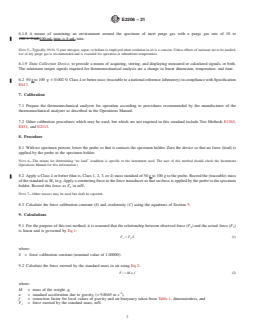
8.3 Calculate the force calibration constant (S) and confor-
ture constant to 60.5°C.
mity (C) using the equations of Section 9.
NOTE 4—Other heating rates may be used but shall be reported.
9. Calculations
6.1.7 TemperatureSensor,thatcanbeattachedto,incontact
with, or reproducibly positioned in close proximity to the 9.1 Forthepurposeofthistestmethod,itisassumedthatthe
specimentop
...
This document is not an ASTM standard and is intended only to provide the user of an ASTM standard an indication of what changes have been made to the previous version. Because
it may not be technically possible to adequately depict all changes accurately, ASTM recommends that users consult prior editions as appropriate. In all cases only the current version
of the standard as published by ASTM is to be considered the official document.
Designation: E2206 − 11 (Reapproved 2015) E2206 − 21
Standard Test Method for
Force Calibration of Thermomechanical Analyzers
This standard is issued under the fixed designation E2206; the number immediately following the designation indicates the year of
original adoption or, in the case of revision, the year of last revision. A number in parentheses indicates the year of last reapproval. A
superscript epsilon (´) indicates an editorial change since the last revision or reapproval.
1. Scope
1.1 This test method describes the calibration or performance confirmation of the electronically applied force signal for
thermomechanical analyzers over the range of 0 N to 1 N.
1.2 The values stated in SI units are to be regarded as standard. No other units of measurement are included in this standard.
1.3 There is no ISO method equivalent to this standard.
1.3 This standard does not purport to address all of the safety concerns, if any, associated with its use. It is the responsibility
of the user of this standard to establish appropriate safety safety, health, and healthenvironmental practices and determine the
applicability of regulatory limitations prior to use.
1.4 This international standard was developed in accordance with internationally recognized principles on standardization
established in the Decision on Principles for the Development of International Standards, Guides and Recommendations issued
by the World Trade Organization Technical Barriers to Trade (TBT) Committee.
2. Referenced Documents
2.1 ASTM Standards:
E4 Practices for Force Verification of Testing Machines
E473 Terminology Relating to Thermal Analysis and Rheology
E617 Specification for Laboratory Weights and Precision Mass Standards
E831 Test Method for Linear Thermal Expansion of Solid Materials by Thermomechanical Analysis
E1142 Terminology Relating to Thermophysical Properties
E1363 Test Method for Temperature Calibration of Thermomechanical Analyzers
E2113 Test Method for Length Change Calibration of Thermomechanical Analyzers
E2161 Terminology Relating to Performance Validation in Thermal Analysis and Rheology
3. Terminology
3.1 The technical terms used in this standard are defined in Terminologies E473, E1142, and E2161 including calibration,
conformance, precision, relative standard deviation, repeatability, reproducibility, and thermomechanical analyzer.
This test method is under the jurisdiction of ASTM Committee E37 on Thermal Measurements and is the direct responsibility of Subcommittee E37.10 on Fundamental,
Statistical and Mechanical Properties.
Current edition approved Oct. 1, 2015March 1, 2021. Published October 2015April 2021. Originally approved in 2002. Last previous edition approved in 20112015 as
E2206 – 11.E2206 – 11 (2015). DOI: 10.1520/E2206-11R15.10.1520/E2206-21.
For referenced ASTM standards, visit the ASTM website, www.astm.org, or contact ASTM Customer Service at service@astm.org. For Annual Book of ASTM Standards
volume information, refer to the standard’s Document Summary page on the ASTM website.
Copyright © ASTM International, 100 Barr Harbor Drive, PO Box C700, West Conshohocken, PA 19428-2959. United States
E2206 − 21
4. Summary of Test Method
4.1 The electronic force signal generated by a thermomechanical analyzer is compared to that exerted by gravity on a known mass.
The thermomechanical analyzer may be said to be in conformance if the performance is within established limits, typically 1 %.
Alternatively, the force signal may be calibrated using a two-point calibration method.
5. Significance and Use
5.1 Most thermomechanical analysis experiments are carried out with some force applied to the test specimen. This force is often
created electronically. It may be constant or changed during the experiment.
5.2 This method demonstrates conformance or calibrates the electronically applied force signal.
5.3 This method may be used for research and development, quality control, manufacturing or regulatory applications.
5.4 Other thermomechanical analyzer calibration functions include temperature by Test Method E1363 and length change by Test
Method E2113.
6. Apparatus
6.1 Thermomechanical Analyzer—The essential instrumentation required to provide a minimum thermomechanical analysis or
thermodilatometric capability for this method includes:
6.1.1 Rigid Specimen Holder, inert, low expansivity material [typically <0.6 μm ⁄(m · K)] to center the specimen in the furnace and
to fix the specimen to mechanical ground.
NOTE 1—Amorphous silica (quartz) is a commonly used material of construction. Materials of construction with greater expansivity may be used but shall
be reported.
6.1.2 Rigid (Expansion or Compression) Probe, inert, low expansivity material [typically <0.6 μm ⁄(m · K)] which contacts the
specimen with an applied compressive force (see Note 1).
6.1.3 Sensing Element, linear over a minimum range of 2 mm to measure the displacement of the rigid probe readable to 61 μm
resulting from changes in length of the specimen.
6.1.4 Programmable Force Transducer, to generate a constant force (61.0 %) of up to 1.0 N that is applied through the rigid probe
to the specimen.
NOTE 2—Other force ranges may be used but shall be reported.
6.1.5 Furnace, capable of providing uniform controlled heating (cooling) of the specimen to a constant temperature or at a
constant rate within the temperature range of −100 °C to 600°C.600 °C.
NOTE 3—Other temperature ranges may be used but shall be reported.
6.1.6 Temperature Controller, capable of executing a specific temperature program by operating the furnace between selected
temperature limits at a rate of change of up to 10°C/min10 °C ⁄min constant to 0.1°C/min0.1 °C ⁄min or at an isothermal
temperature constant to 60.5°C.60.5 °C.
NOTE 4—Other heating rates may be used but shall be reported.
6.1.7 Temperature Sensor, that can be attached to, in contact with, or reproducibly positioned in close proximity to the specimen
to provide an indication of the specimen temperature to 60.1°C.60.1 °C.
E2206 − 21
6.1.8 A means of sustaining an environment around the specimen of inert purge gas with a purge gas rate of 10 to
100 6 5 mL100 mL ⁄min 6 5 mL ⁄min.
NOTE 5—Typically, 99.9+ % pure nitrogen, argon, or helium is employed when oxidation in air is a concern. Unless effects of moisture are to be studied,
use of dry purge gas is recommended and is essential for operation at subambient temperatures.
6.1.9 Data Collection Device, to provide a means of acquiring, storing, and displaying measured or calculated signals, or both.
The minimum output signals required for thermomechanical analysis are a change in linear dimension, temperature, and time.
6.2 50 g to 100 g 6 0.002 % Class 4 or better mass (traceable to a national reference laboratory) in compliance with Specification
E617.
7. Calibration
7.1 Prepare the thermomechanical analyzer for operation according to procedures recommen
...