

ASTM E3249-21
(Guide)Standard Guide for Remedial Action Resiliency to Climate Impacts
General Information
- Abstract
SIGNIFICANCE AND USE
4.1 This guide outlines various techniques for evaluating and mitigating the impacts of climate change and weather extremes on remediation systems, activity and use limitations, stewardship and remediation activities.
4.2 Users include: local, state, federal, tribal, and international agencies; the military; environmental consultants; developers; financial institutions; non-governmental organizations; environmental advocacy groups; commercial businesses, industries, and the interested public.
4.3 A 2018 ITRC survey of 45 state environmental agencies found key Best Management Practices (BMPs) and adaptation strategies for resilient cleanup. These include remedy infrastructure and disaster planning for chemical releases as an important part of the state’s clean-up program. In some cases, such considerations are now required by state regulations and included in policy and guidance (ITRC, 2018 (3)).
4.4 Adaptation is important because it is about considering and addressing the changing frequency and intensity of extreme events. Adaptation differs from resiliency by anticipating, planning and preparing for impacts under both current and future climate conditions.
4.5 There are many models and different strategies on adapting to climate and weather extremes, including those in the European Union (European Union, 2013 (4), IPPC, 2001 (5)).
4.6 The USGAO has reported benefits from evaluating climate risks for large projects. (USGAO, 2019 (6)) GAO found most Superfund sites have not factored the increasing frequency and severity of extreme weather events and climate impacts into the design of remedies. This has resulted in unplanned releases of chemicals into the environment at some sites.
4.7 Companies and organizations operating in accordance with ISO 14001-2015 may find this guide useful for meeting the long-term compliance obligation requirements of Clause 5.2 (ISO 14001-2015)
4.8 This guide should be integrated into the fundamentals of an organizati...
SCOPE
1.1 The potential for increasing climate and extreme weather impacts requires more attention be given to their effect on sites where chemicals have been released. All stages of remediation planning and implementation should consider and address potential climate and extreme weather impacts, such as flooding and wildfires, that may affect remedy sustainability, continued protection of human and ecological receptors, the surrounding community, and the environment. Both resiliency to current extreme weather impacts as well as adaptation to longer-term impacts due to the changing climate should be considered. Consideration of climate and extreme weather impacts during stabilization, remedial investigation, feasibility studies, remedial design, remedial action implementation, long-term operations and management, and site stewardship may lead to the use of innovative technologies and more robust remediation strategies.
1.2 The conceptual site model is designed to inform all aspects of site decision making, inclusive of the investigation, feasibility study, design and implementation. It may be the most important mechanism to integrate consideration of climate impacts. The conceptual site model should be continuously developed and refined, while considering new knowledge about climate factors and potential impacts to the site.
1.3 This ASTM resiliency guide identifies the best management practices for incorporating resiliency and vulnerability assessment into all stages of the site cleanup process. Historically, resiliency was primarily considered or contemplated in the final stages of the cleanup process, such as in the operation and maintenance stage, after a remedy was completely in place at a site. Gradually, resiliency has extended to earlier stages of the cleanup process. This may include initial vulnerability assessment for site stabilization and extending into the remedial investigation and feasibility stage. This ...
- Status
- Published
- Publication Date
- 14-Apr-2021
- Technical Committee
- E50 - Environmental Assessment, Risk Management and Corrective Action
- Drafting Committee
- E50.07 - Climate and Community
Overview
ASTM E3249-21: Standard Guide for Remedial Action Resiliency to Climate Impacts provides a structured approach for evaluating and mitigating the effects of climate change and extreme weather events on remediation systems. Developed by ASTM International, this guide is designed to help environmental professionals, government agencies, and industries ensure that cleanup sites and remediation activities remain effective under changing climate conditions.
With increasing risks from flooding, wildfires, hurricanes, and other climate-driven events, the need for resilient and adaptive remediation strategies is more critical than ever. This standard supports comprehensive decision-making throughout all phases of site assessment, remediation planning, implementation, and long-term management.
Key Topics
Climate and Weather Impact Integration: The guide emphasizes consideration of both current and anticipated climate and extreme weather impacts-such as flooding and heatwaves-in all stages of remediation, from site investigation to remedy review.
Adaptive Planning: Addressing the difference between adaptation (anticipating and preparing for future changes) and resiliency (the ability to recover from extreme events), the standard advocates ongoing assessment and incorporation of new climate data.
Vulnerability & Risk Assessments: Users are instructed to evaluate site susceptibility to climate hazards-like high floodwater, wildfires, and storm surges-using updated models, FEMA flood maps, and local climate data.
Resilient Design & Best Practices: Implementing best management practices (BMPs), such as incorporating redundancy, automation, and contingency planning into remediation systems, is encouraged to enhance operational integrity and site protection.
Conceptual Site Model Refinement: Continuous development of the conceptual site model ensures emerging climate risks are integrated into decision-making, from initial assessment through feasibility studies and long-term site stewardship.
Stakeholder Guidance: The guide is relevant to a broad user base, including federal, state, tribal, and local agencies; military; environmental consultants; developers; NGOs; and commercial entities, as well as the general public.
Applications
ASTM E3249-21 serves as a practical tool for:
Environmental Remediation Projects: Integrating climate risk into the remediation of contaminated sites, such as Superfund, brownfields, and industrial facilities, safeguarding remedies against current and future disasters.
Regulatory Compliance: Supporting organizations striving to meet compliance obligations under frameworks like ISO 14001:2015 by strengthening environmental management systems through climate-focused risk assessment.
Disaster Planning: Guiding developers and businesses in disaster planning, remedy infrastructure design, and emergency preparedness to mitigate chemical release risks exacerbated by extreme weather.
Sustainable Site Stewardship: Ensuring ongoing protection of human health and the environment by promoting robust operations and maintenance strategies responsive to evolving climate threats.
Policy & Best Practice Development: Informing government policy, state guidance, and industry standards for resilient site management, making climate adaptation an integral part of remediation strategies.
Related Standards
- ASTM E1689: Guide for Developing Conceptual Site Models for Contaminated Sites – supports robust characterization and risk communication.
- ASTM E3136: Guide for Climate Resiliency in Water Resources – complements efforts to integrate climate resiliency in broader environmental projects.
- ISO 14001:2015: Environmental Management Systems – provides an overarching framework for integrating climate adaptation into environmental compliance.
- NOAA and USACE Climate Tools: For flood and sea-level rise risk assessment.
- USEPA and FEMA Guidance: For integrating updated weather hazard information into site management and remedy design.
Adopting ASTM E3249-21 ensures remediation systems and stewardship activities are designed to withstand both existing and future climate-related risks, protecting public health, ecosystems, and investments in environmental cleanup.
Relations
- Refers
ASTM E1689-95(2008) - Standard Guide for Developing Conceptual Site Models for Contaminated Sites - Effective Date
- 01-Feb-2008
Get Certified
Connect with accredited certification bodies for this standard

BSI Group
BSI (British Standards Institution) is the business standards company that helps organizations make excellence a habit.

Bureau Veritas
Bureau Veritas is a world leader in laboratory testing, inspection and certification services.

DNV
DNV is an independent assurance and risk management provider.
Sponsored listings
Frequently Asked Questions
ASTM E3249-21 is a guide published by ASTM International. Its full title is "Standard Guide for Remedial Action Resiliency to Climate Impacts". This standard covers: SIGNIFICANCE AND USE 4.1 This guide outlines various techniques for evaluating and mitigating the impacts of climate change and weather extremes on remediation systems, activity and use limitations, stewardship and remediation activities. 4.2 Users include: local, state, federal, tribal, and international agencies; the military; environmental consultants; developers; financial institutions; non-governmental organizations; environmental advocacy groups; commercial businesses, industries, and the interested public. 4.3 A 2018 ITRC survey of 45 state environmental agencies found key Best Management Practices (BMPs) and adaptation strategies for resilient cleanup. These include remedy infrastructure and disaster planning for chemical releases as an important part of the state’s clean-up program. In some cases, such considerations are now required by state regulations and included in policy and guidance (ITRC, 2018 (3)). 4.4 Adaptation is important because it is about considering and addressing the changing frequency and intensity of extreme events. Adaptation differs from resiliency by anticipating, planning and preparing for impacts under both current and future climate conditions. 4.5 There are many models and different strategies on adapting to climate and weather extremes, including those in the European Union (European Union, 2013 (4), IPPC, 2001 (5)). 4.6 The USGAO has reported benefits from evaluating climate risks for large projects. (USGAO, 2019 (6)) GAO found most Superfund sites have not factored the increasing frequency and severity of extreme weather events and climate impacts into the design of remedies. This has resulted in unplanned releases of chemicals into the environment at some sites. 4.7 Companies and organizations operating in accordance with ISO 14001-2015 may find this guide useful for meeting the long-term compliance obligation requirements of Clause 5.2 (ISO 14001-2015) 4.8 This guide should be integrated into the fundamentals of an organizati... SCOPE 1.1 The potential for increasing climate and extreme weather impacts requires more attention be given to their effect on sites where chemicals have been released. All stages of remediation planning and implementation should consider and address potential climate and extreme weather impacts, such as flooding and wildfires, that may affect remedy sustainability, continued protection of human and ecological receptors, the surrounding community, and the environment. Both resiliency to current extreme weather impacts as well as adaptation to longer-term impacts due to the changing climate should be considered. Consideration of climate and extreme weather impacts during stabilization, remedial investigation, feasibility studies, remedial design, remedial action implementation, long-term operations and management, and site stewardship may lead to the use of innovative technologies and more robust remediation strategies. 1.2 The conceptual site model is designed to inform all aspects of site decision making, inclusive of the investigation, feasibility study, design and implementation. It may be the most important mechanism to integrate consideration of climate impacts. The conceptual site model should be continuously developed and refined, while considering new knowledge about climate factors and potential impacts to the site. 1.3 This ASTM resiliency guide identifies the best management practices for incorporating resiliency and vulnerability assessment into all stages of the site cleanup process. Historically, resiliency was primarily considered or contemplated in the final stages of the cleanup process, such as in the operation and maintenance stage, after a remedy was completely in place at a site. Gradually, resiliency has extended to earlier stages of the cleanup process. This may include initial vulnerability assessment for site stabilization and extending into the remedial investigation and feasibility stage. This ...
SIGNIFICANCE AND USE 4.1 This guide outlines various techniques for evaluating and mitigating the impacts of climate change and weather extremes on remediation systems, activity and use limitations, stewardship and remediation activities. 4.2 Users include: local, state, federal, tribal, and international agencies; the military; environmental consultants; developers; financial institutions; non-governmental organizations; environmental advocacy groups; commercial businesses, industries, and the interested public. 4.3 A 2018 ITRC survey of 45 state environmental agencies found key Best Management Practices (BMPs) and adaptation strategies for resilient cleanup. These include remedy infrastructure and disaster planning for chemical releases as an important part of the state’s clean-up program. In some cases, such considerations are now required by state regulations and included in policy and guidance (ITRC, 2018 (3)). 4.4 Adaptation is important because it is about considering and addressing the changing frequency and intensity of extreme events. Adaptation differs from resiliency by anticipating, planning and preparing for impacts under both current and future climate conditions. 4.5 There are many models and different strategies on adapting to climate and weather extremes, including those in the European Union (European Union, 2013 (4), IPPC, 2001 (5)). 4.6 The USGAO has reported benefits from evaluating climate risks for large projects. (USGAO, 2019 (6)) GAO found most Superfund sites have not factored the increasing frequency and severity of extreme weather events and climate impacts into the design of remedies. This has resulted in unplanned releases of chemicals into the environment at some sites. 4.7 Companies and organizations operating in accordance with ISO 14001-2015 may find this guide useful for meeting the long-term compliance obligation requirements of Clause 5.2 (ISO 14001-2015) 4.8 This guide should be integrated into the fundamentals of an organizati... SCOPE 1.1 The potential for increasing climate and extreme weather impacts requires more attention be given to their effect on sites where chemicals have been released. All stages of remediation planning and implementation should consider and address potential climate and extreme weather impacts, such as flooding and wildfires, that may affect remedy sustainability, continued protection of human and ecological receptors, the surrounding community, and the environment. Both resiliency to current extreme weather impacts as well as adaptation to longer-term impacts due to the changing climate should be considered. Consideration of climate and extreme weather impacts during stabilization, remedial investigation, feasibility studies, remedial design, remedial action implementation, long-term operations and management, and site stewardship may lead to the use of innovative technologies and more robust remediation strategies. 1.2 The conceptual site model is designed to inform all aspects of site decision making, inclusive of the investigation, feasibility study, design and implementation. It may be the most important mechanism to integrate consideration of climate impacts. The conceptual site model should be continuously developed and refined, while considering new knowledge about climate factors and potential impacts to the site. 1.3 This ASTM resiliency guide identifies the best management practices for incorporating resiliency and vulnerability assessment into all stages of the site cleanup process. Historically, resiliency was primarily considered or contemplated in the final stages of the cleanup process, such as in the operation and maintenance stage, after a remedy was completely in place at a site. Gradually, resiliency has extended to earlier stages of the cleanup process. This may include initial vulnerability assessment for site stabilization and extending into the remedial investigation and feasibility stage. This ...
ASTM E3249-21 is classified under the following ICS (International Classification for Standards) categories: 13.020.99 - Other standards related to environmental protection. The ICS classification helps identify the subject area and facilitates finding related standards.
ASTM E3249-21 has the following relationships with other standards: It is inter standard links to ASTM E1689-95(2008). Understanding these relationships helps ensure you are using the most current and applicable version of the standard.
ASTM E3249-21 is available in PDF format for immediate download after purchase. The document can be added to your cart and obtained through the secure checkout process. Digital delivery ensures instant access to the complete standard document.
Standards Content (Sample)
This international standard was developed in accordance with internationally recognized principles on standardization established in the Decision on Principles for the
Development of International Standards, Guides and Recommendations issued by the World Trade Organization Technical Barriers to Trade (TBT) Committee.
Designation: E3249 − 21
Standard Guide for
Remedial Action Resiliency to Climate Impacts
This standard is issued under the fixed designation E3249; the number immediately following the designation indicates the year of
original adoption or, in the case of revision, the year of last revision. A number in parentheses indicates the year of last reapproval. A
superscript epsilon (´) indicates an editorial change since the last revision or reapproval.
1. Scope to current potential impacts as well as prepare for anticipated
future impacts due to the changing climate.
1.1 The potential for increasing climate and extreme
weatherimpactsrequiresmoreattentionbegiventotheireffect 1.4 The scope of this guide is generally based upon
on sites where chemicals have been released. All stages of experience in site management in the US, however it may also
remediation planning and implementation should consider and apply to sites in other countries, regions and continents.
addresspotentialclimateandextremeweatherimpacts,suchas
1.5 This international standard was developed in accor-
flooding and wildfires, that may affect remedy sustainability,
dance with internationally recognized principles on standard-
continued protection of human and ecological receptors, the
ization established in the Decision on Principles for the
surrounding community, and the environment. Both resiliency
Development of International Standards, Guides and Recom-
to current extreme weather impacts as well as adaptation to
mendations issued by the World Trade Organization Technical
longer-term impacts due to the changing climate should be
Barriers to Trade (TBT) Committee.
considered. Consideration of climate and extreme weather
2. Referenced Documents
impacts during stabilization, remedial investigation, feasibility
studies, remedial design, remedial action implementation, 2
2.1 ASTM Standards:
long-term operations and management, and site stewardship
E1689 Guide for Developing Conceptual Site Models for
mayleadtotheuseofinnovativetechnologiesandmorerobust
Contaminated Sites
remediation strategies.
E3136 Guide for Climate Resiliency in Water Resources
1.2 The conceptual site model is designed to inform all 2.2 ISO Standards:
ISO 14001:2015 Environmental Management Systems Ver-
aspects of site decision making, inclusive of the investigation,
feasibility study, design and implementation. It may be the sion Dec. 2016 SC1 website
most important mechanism to integrate consideration of cli-
3. Terminology
mate impacts. The conceptual site model should be continu-
ously developed and refined, while considering new knowl-
3.1 Definitions:
edge about climate factors and potential impacts to the site. 3.1.1 adaptive capacity—thepotentialorabilityofasystem,
region, or community to adapt to the effects or impacts of
1.3 ThisASTM resiliency guide identifies the best manage-
climate change.
ment practices for incorporating resiliency and vulnerability
3.1.1.1 Discussion—Enhancement of adaptive capacity rep-
assessment into all stages of the site cleanup process.
resents a practical means of coping with changes and uncer-
Historically, resiliency was primarily considered or contem-
tainties in climate, including variability and extremes.
plated in the final stages of the cleanup process, such as in the
3.1.2 barrier assessment—an evaluation of fences, walls,
operation and maintenance stage, after a remedy was com-
pletely in place at a site. Gradually, resiliency has extended to caps and other physical structures, natural obstacles, or other
measures and impediments to restrict activity and use and
earlier stages of the cleanup process. This may include initial
vulnerability assessment for site stabilization and extending eliminate or reduce exposure pathways.
into the remedial investigation and feasibility stage.This guide
3.1.3 best management practices (BMPs)—activities that, if
will enable site project managers and others involved in site
applicable to the situation, typically will reduce the environ-
clean up to incorporate resiliency more robustly into the early
mental footprint of a cleanup activity.
stages of the cleanup process, and thereby improve resilience
For referenced ASTM standards, visit the ASTM website, www.astm.org, or
contact ASTM Customer Service at service@astm.org. For Annual Book of ASTM
ThisguideisunderthejurisdictionofASTMCommitteeE50onEnvironmental Standards volume information, refer to the standard’s Document Summary page on
Assessment, Risk Management and CorrectiveAction and is the direct responsibil- the ASTM website.
ity of Subcommittee E50.07 on Climate and Community. Available from International Organization for Standardization (ISO), ISO
Current edition approved April 15, 2021. Published May 2021. DOI: 10.1520/ Central Secretariat, Chemin de Blandonnet 8, CP 401, 1214 Vernier, Geneva,
E3249–21. Switzerland, https://www.iso.org.
Copyright © ASTM International, 100 Barr Harbor Drive, PO Box C700, West Conshohocken, PA 19428-2959. United States
E3249 − 21
3.1.3.1 Discussion—Methods that have been determined to 3.2.1 DTSC—Department of Toxic Substances Control,
be the most effective and practical means of improving or California
increasing the resiliency of a particular cleanup.
3.2.2 FEMA—Federal Emergency Management Agency
3.1.4 chemicals of concern—any spill or leak to, or detec-
3.2.3 IPCC—Inter Governmental Panel on Climate Change
tion of hazardous materials in, environmental media other than
3.2.4 ITRC—Interstate Technology and Regulatory Council
permitted discharges. E1689
3.2.5 NOAA—National Oceanic and Atmospheric Agency
3.1.5 ecosystem services—a way to characterize the natural
system in a context of direct relevance to the benefits people
3.2.6 SSFL—Santa Susana Field Laboratory, California.
derive from nature (Summers (1)).
3.2.7 SURF—Sustainable Remediation Forum
3.1.6 environmental justice—the fair treatment and mean-
3.2.8 USACE—United States Army Corps of Engineers
ingful involvement of all people regardless of race, color,
national origin, or income, with respect to the development,
3.2.9 USEPA—United States Environmental Protection
implementation, and enforcement of environmental laws,
Agency
regulations, and policies (USEPA, 2020 (2)).
3.2.10 USGAO—United State Government Accountability
3.1.7 extreme events—Climate change impacts that increase
Office
the potential for and frequency of weather and natural
3.2.11 USGS—United States Geological Survey
occurrences, outside of historical norms.
3.1.8 resilience—adaptive capacity of an organization in a
4. Significance and Use
complex and changing environment.
4.1 This guide outlines various techniques for evaluating
3.1.8.1 Discussion—A capability to anticipate, prepare for,
and mitigating the impacts of climate change and weather
respond to, and recover from significant multi-hazard threats
extremes on remediation systems, activity and use limitations,
with minimum damage to social well-being, the economy, and
stewardship and remediation activities.
the environment. This refers to risks under both current and
future, anticipated climate conditions. Some experts describe
4.2 Users include: local, state, federal, tribal, and interna-
vulnerability as the opposite of resiliency. E3136
tional agencies; the military; environmental consultants; devel-
3.1.9 site assessment—thecleanupphaseinwhichthesiteis opers; financial institutions; non-governmental organizations;
characterized to determine if the concentrations and distribu- environmental advocacy groups; commercial businesses,
tionofchemicalsreleasedposeapotentialrisktohumanhealth industries, and the interested public.
or the environment.
4.3 A2018 ITRC survey of 45 state environmental agencies
3.1.9.1 Discussion—More specifically, this cleanup phase
found key Best Management Practices (BMPs) and adaptation
involves collecting data on: soil, soil vapor, groundwater, air,
strategies for resilient cleanup. These include remedy infra-
surface water, and/or sediment quality; site characteristics (for
structure and disaster planning for chemical releases as an
example,subsurfacegeology,geochemistry,soilpropertiesand
important part of the state’s clean-up program. In some cases,
structures, hydrology, and surface characteristics); land and
such considerations are now required by state regulations and
resource use; and potential human and ecological receptors.
included in policy and guidance (ITRC, 2018 (3)).
The site assessment generates data to develop a conceptual site
4.4 Adaptation is important because it is about considering
modelandinformdecisionsregardingthecleanup,ifnecessary
and addressing the changing frequency and intensity of ex-
(which may include a risk assessment). Regulatory require-
treme events. Adaptation differs from resiliency by
ments for site assessment may vary by program. In the
anticipating, planning and preparing for impacts under both
environmental remediation industry, site assessment is also
current and future climate conditions.
referred to as remedial investigation, site investigation, or site
characterization.
4.5 There are many models and different strategies on
3.1.10 Superfund—The Federal Comprehensive Environ-
adapting to climate and weather extremes, including those in
mental Response, Compensation and LiabilityAct (CERCLA)
the European Union (European Union, 2013 (4), IPPC, 2001
42 U.S.C. Section 9601 et seq.
(5)).
3.1.11 vulnerability assessment—the process for evaluating
4.6 The USGAO has reported benefits from evaluating
all stages of the remedial site cleanup process’ exposure to
climate risks for large projects. (USGAO, 2019 (6)) GAO
climate or weather hazards of concern, such as high floodwater
found most Superfund sites have not factored the increasing
or soil subsidence.
frequency and severity of extreme weather events and climate
3.1.11.1 Discussion—An evaluation of the remedial site’s
impacts into the design of remedies. This has resulted in
sensitivity to the hazards of concern and likelihood for the
unplanned releases of chemicals into the environment at some
hazards to reduce remedy effectiveness.
sites.
3.2 Acronyms:
4.7 Companies and organizations operating in accordance
with ISO 14001-2015 may find this guide useful for meeting
the long-term compliance obligation requirements of Clause
The boldface numbers in parentheses refer to a list of references at the end of
this standard. 5.2 (ISO 14001-2015)
E3249 − 21
4.8 Thisguideshouldbeintegratedintothefundamentalsof for contaminant migration, assuming expected extreme events
an organization’s management system in order to support an related to climate locally.
organization’s strategies, plans, and operations. For example,
5.1.1 Once site discovery determines the need for a prelimi-
ISO,Risk,orConformityAssessmentreferencesmayinfluence
nary assessment, the assessment should consider the proximity
integrating risk management into significant activities and
of previously flooded areas or of the frequency and nature of
functions. ((ISO 14001-2015))
other extreme weather events, as the potential trigger for
migration of any contaminants from the site. The assessment
4.9 Users also include: owners of Superfund sites; oil, gas
should also consider the likelihood of floods or other extreme
and chemical companies; owners of land upon which oil, gas
and chemical companies operate; design/build consultants and weather events anticipated as the climate changes.
other industrial users who can include principles of this
5.1.2 If the preliminary assessment determines the need for
standard into their design and operation procedures and risk
a site inspection, sampling and evaluation should consider
evaluation protocols. These are well -recognized management
areas of impact and migration of contaminants from past and
control programs within the chemical industry, and as such are
anticipated future flooding and other extreme weather events,
highly relevant to how companies manage the resilience of
such as hurricane force winds or excessive local groundwater
physical systems. (ACC, 2014 (7))
extraction due to droughts.Additional factors may include, but
notlimitedto,erosionduetodroughtsandhighwindevents,as
4.10 Climate factors discussed in this standard guide can
well as impacts to on-site engineered systems and infrastruc-
result in the unplanned or unexpected release of chemicals of
concern into the environment. These releases may adversely ture.
affect human and ecological receptors and impact cultural
5.1.3 If a hazard ranking system score and documentation
resources and infrastructure.
are prepared, in anticipation of a proposed listing on the
National Priority List, or a state’s confirmed chemical release
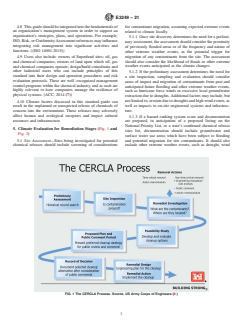
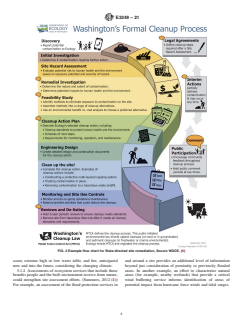
5. Climate Evaluation for Remediation Stages (Fig. 1 and
sites list, documentation should include groundwater and
Fig. 2)
surface water use areas which have been subject to flooding
5.1 Site Assessment—Sites being investigated for potential and potential migration for site contaminants. It should also
chemical releases should include screening of considerations include other extreme weather events, such as drought, wind
FIG. 1 The CERCLA Process. Source, US Army Corps of Engineers (8 )
E3249 − 21
FIG. 2 Example flow chart for State-directed site remediation, Source WDOE. (9)
scour, extreme high or low water table, and fire, anticipated and around a site provides an additional level of information
now and into the future, considering the changing climate. beyond just consideration of proximity to previously flooded
5.1.4 Assessments of ecosystem services that include those areas. In another example, an effort to characterize natural
benefits people and the built environment receive from nature, areas (for example, nearby wetlands) that provide a critical
could strengthen site assessment efforts. (Summers, 2012 (1)) wind buffering service informs identification of areas of
For example, an assessment of the flood protection services in potential impact from hurricane force winds and tidal surges.
E3249 − 21
5.2 Remedial Investigation and Feasibility Study—As remedy vulnerability assessment examines the expected rem-
shown in Fig. 1 and Fig. 2 these stages of remedial action are edy protection level, given the physical and environmental
important parts of site cleanup. Portions of the RI/FS that vulnerabilities. An initial step of a vulnerability assessment is
should be evaluated for climate resiliency include: to understand risk by conducting a hazard and climate assess-
ment. The process involves identifying which hazards could
5.2.1 Identification of viable, potential, responsible parties.
impact the area of study, identifying the intensity of each
(PRPs),
hazard,thefrequencyandprobabilityofoccurrence,theareaof
5.2.2 PreparationoftheRI/FSStatementofWork(SOW)by
impact, and the duration of impact. The extent to which this
USEPA staff,
planning activity should be documented will depend upon
5.2.3 PRP or USEPA develops RI/FS work plan based on
anticipated impacts on any remedy. If there are multiple and
the SOW,
serious extreme events anticipated, a separate, resiliency or
5.2.4 RI Start—sampling of various media to learn the
adaptation plan document may be required. Otherwise these
nature and extent of contamination and exposure pathways,
impacts can be included as a discretely identifiable section in
5.2.5 FS Start—Development of various cleanup alterna-
response planning documents
tives and evaluating their resiliency,
5.3.4 Using vulnerability assessment tools, users should
5.2.6 Draft RI/FS report is written,
evaluate the risk (likelihood of occurrence and intensity of the
5.2.7 Review/comment on draft RI/FS report,
hazard) to human health and the environment from chemical
5.2.8 Develop Final RI/FS Report, and
releases at the remediation site. Users should evaluate pro-
5.2.9 Site project manager writes a proposed plan which
posed remedy options, considering current and future climate
includes the selected remedy.
expectations, including those that involve activity and use
5.3 Remedial Investigation evaluates the risks and resil-
limitations against the worst-case scenario, whether it is
iency of the site as it currently exists, prior to stabilization, flooding,tornadoes,hurricanes,fireorotherwise.Thedesignof
unless emergency action is immediately required. It should
the remediation and stewardship should be based on those risk
evaluate all relevant, current and future potential climate or factors.
extreme weather impacts for the local area to determine risks
NOTE 2—The vulnerability assessment should include the secondary
and resiliency following any initial site stabilization as plan-
effects of climate change and weather extremes. For example, loss of
ning moves forward. This evaluation should use the most
utility services to the remediation site due to extreme heat or cold.
updated FEMA flood maps, regional climate data (local if
5.3.5 The risk to human and ecological receptors posed by
available), climate event forecast model(s), and coastal flood-
a site will evolve over time due to changing climate conditions
ing models (if applicable). Long-term historic average climate
and anticipated extreme events. The current parameters of a 1,
data may misrepresent the present climate dynamics at the site.
5, 10, 100 and 500- year event are evolving rapidly. Instead of
More recently, rainfall patterns have changed, with events
a one-hundred-year event (a 1 % chance of an event happening
beingofshorterdurationbutstrongerrainfall.Thisinformation
in a given year) as currently defined, it may be necessary to
should be used for remedy decision-making, and include
plan for a five-hundred-year event (a 0.2 % chance of an event
records of local and regional flooding, evaluated for potential
happening in a given year), multiple times, during the lifetime
site implications.
of the remedy. Determining the level of acceptable risk is
5.3.1 FEMA flood maps may be multi-years old and reflect
critical to designing the appropriate level of protectiveness of
data that doesn’t represent extreme events. These maps should
the desired remedy.
be used with caution, and verified with local information if at
5.3.6 There are interactive resources to help local govern-
all possible.
ments anticipate, plan, and prepare while continuing to deliver
NOTE1—Theuserisadvisedtoevaluatethepotentialimpactofderecho services effectively to their communities, even as the climate
storms on the site.
changes. and respond to extreme events. (NOAAand USACE,
2018 (11))Decisionmakerscancreateanintegratedpackageof
5.3.2 At site cleanups, users should evaluate the current and
information tailored specifically to their needs. Climate pro-
future risk, likelihood of occurrence and intensity of the
jection tools and maps like these are critical to understanding
hazard, to human health and the environment from site
the changing environmental conditions at a site, including any
contamination. This includes the evaluation of proposed rem-
structures that may be exposed during the service life of the
edy options against the worst-case scenario, whether it be
remedy.
flooding, tornadoes, hurricanes, subsidence, drought, loss of
5.3.7 Users should evaluate the fate of past site cleanup
permafrost, or fire. The design of the cleanup will be based on
those risk factors. Users should also assess potential secondary remedies that have experienced a natural disaster and apply the
lessons learned for resiliency and mitigation techniques. (Ap-
effectsofincreasedrainfallandrainintensityatareassubjectto
period fires. These secondary effects include landslides and pendix X1)
mudslides which can bury remediation equipment or expose 5.3.8 Early in the process, users should evaluate process
previouslyundisturbedareasthatcontainreleasedchemicalsof options and select remedies that will incorporate resiliency and
concern. adaptation so that they are carried forward into the planning
process.
5.3.3 Many projects, including the design and implementa-
tion of a site cleanup remedy, benefit from a vulnerability 5.3.9 Users should consider the role of natural ecosystems
assessment. (Adaptation Community, 2018. (10)) A cleanup for community resiliency. Ecosystem services have the ability
E3249 − 21
to influence many of community’s vulnerability and recover- 5.4.5.2 Forecast the amount of waste at any given time that
ability characteristics (Summers et al. (1)). will be on-site.
5.4.5.3 Identify the region where the site is located (that is,
5.4 Feasibility Studies (FS)—The FS is the stage where
Northwest, Southwest, Alaska, Great Plains, Midwest,
different cleanup alternatives for a site are considered using
Northeast, Southeast, Caribbean, Hawaii and Pacific Islands,
established, standard evaluation criteria. Resiliency to a future
Fig. 3.) In many cases the resolution of available climate
natural disaster or change in climate should be considered
models may allow the user to fine tune the site location using
during this stage. The earlier resiliency is considered in the
latitude and longitude, and calibrate the assessment of climate
cleanup process, the stronger and more resilient the remedy.
impacts to the site.
5.4.1 Remedy selection criteria should include the concept
5.4.5.4 Identify the kind of natural disasters common for
of a resilient remedy that is resistant to extreme events or new
that area and identify how climate might change the frequency,
normal, such as sea level rise.
severity, or types of natural disasters.
5.4.2 As a best management practice, users should avail
5.4.5.5 Identify how climate is likely to affect the protec-
themselves of a variety of tools to assess potential, worst-case,
tiveness of the remedy, and proposed actions.
climate impacts to a site cleanup remedy (Guide E3136).
5.4.5.6 Estimate the projected lifespan of the remedy.
5.4.3 FEMA’s online database can provide a history of
5.4.5.7 Identify the remedy’s critical functional require-
disastersfortheareainquestion,whileclimateprojectiontools
ments before, during, and after a possible hazard strike.
such as NOAA’s Sea Level Rise Viewer and the U.S Climate
5.4.5.8 List the possible risk mitigation measures if there is
Resilience Toolkit’s Climate Explorer (NOAA and USACE,
a compromise of the remedy.
2018 (11)) provide maps that anticipate future environmental
5.4.5.9 Identify an area for temporary storage in case of a
changes that may increase hazard risk. USEPAalso provides a
disaster and a removal and response strategy when a disaster
climate adaptation tool, ARC-X (USEPA, 2019 (12))
does occur.
5.4.4 To address climate adaptation, users should: screen
5.4.5.10 Review the reduction of toxicity, mobility and
site remedies for climate related vulnerabilities; conduct sen-
sitivity analysis to screen out low probability/low impact volume evaluation and identify the residual mass that could be
left in place, either permanently or during the alternative
vulnerabilities; evaluate adaptation measures available and
applicable to address vulnerabilities; and increase remedy lifespan. Predict how this mass might be affected by an
extreme event and how the toxicity or mobility assumptions
resilience by implementing adaptation measures. This includes
activities such as those listed in section may be compromised.
5.4.5 Primary Considerations: 5.4.5.11 List the conditions where off-site resources may be
5.4.5.1 Identify the type of chemical releases present and required if the site were to be impacted, and their likely
the hazards that could be left in place, as may be impacted by availability, depending on whether the site, surrounding area,
climate events. or region is impacted. These resources may include off-site
FIG. 3 Example from USEPA’s ARC-X program
E3249 − 21
storage capabilities, or the ability to mobilize heavy equipment during five-year or other periodic reviews of remedies that
and personnel to the site if transportation access is compro- assess the continued protectiveness of remedial actions. It
mised. should include the evaluation of any activity and use
limitations, in relation to anticipated extreme events, as influ-
5.5 RemedialDesign,ActionandImplementation—Evaluate
enced by climate.
process options and anticipate remedies to maximize resil-
iency.
NOTE 3—This includes effects on sites where chemicals are stored.
5.5.1 Incorporate redundancy and flexibility into designs.
5.6.2 Operational Integrity Considerations:
5.5.2 Site design assumptions should be reviewed for ex-
5.6.2.1 Build contingencies into decision documents, in-
pected extreme events, especially the 100-year flood plain
cluding options identified for critical system components and
designation (the 1 % chance of flooding in a given year) in
operational dependencies.
vulnerable areas. The emphasis should be prevention of in-
5.6.2.2 Review and affirm remediation system
creased risks from remedy degradation due to extreme events
dependencies, such as the integrity of power, key support
related to climate. Lessons learned from past damages to
systems and availability of supplies.
similar remedial action sites should guide future designs.
5.6.2.3 Put fail-safe processes and procedures in place.
(Appendix X1)
5.6.3 Optimization—Optimization should be geared toward
5.5.3 Design documents and assumptions for sites near the
automation, self-reliance and reduced reliance on physical
coast should use the most recent Sea Level Change Curve
prevention and mitigation barriers to contain wastes. For
Calculator (NOAA and USACE, 2018 (11)).
example, reducing reliance on above ground berms, piping,
5.5.4 Implementation of New Remedies—All stages of
and generators can minimize threats to critical system compo-
investigation, feasibility study, implementation, and remedy
nents from tornados, fire, flood debris, hail storms and inci-
review should account for expected extreme events, as influ-
dental contact.
enced by current trends in the local and regional climate.
5.6.3.1 Where possible, automate systems for monitoring,
5.5.5 Remedy evaluation—Ecosystem services might be
operations, and contingent measures. Provide for auxiliary
relevant in the evaluation of process options and design of
power generation, and back up plans for manual checks on
remedies to maximize resiliency. Checking a remedy or suite
systems. Users should emphasize remote monitoring
of remedies against current ecological services in the area of a
capabilities, their redundancy for critical systems, and their
site might help identify if there are changes as a result of that
survivability during an extreme event.
remedy. A negative change could infer a potential decrease in
5.6.3.2 Where possible, build in power independence such
overall resilience.
as green energy, and site sourced energy for redundancy to
5.5.6 For existing remedies, users should evaluate all exist-
remotely supplied energy.
ing remedial clean up actions underway or recently complete
for risk and vulnerability issues, given recent and anticipated
5.7 Remedy Review—Parties responsible for sites where
regional, extreme events related to climate. This will include
chemical releases remain should evaluate remedy effectiveness
factors such as how long ago the remedy was completed, the
and any new, climate-related guidance from regulatory agen-
location of the remedy relative to various extreme event risks
cies. This will include any changes in land use regulation.
and the nature of the remedy.
5.7.1 The NCP (13) states that alternatives shall be assessed
5.6 Operation and Maintenance (O&M), Operational for the long-term effectiveness and permanence they afford,
alongwiththedegreeofcertaintythatthealternativewillprove
Integrity, and Optimization:
5.6.1 Operation and Maintenance—During operation and successful. USEPA suggests the application of an adaptation
approach that considers climate as part of ongoing site man-
maintenance activities, ongoing barrier assessments should be
conducted to determine potential impacts to public health and agement. See Fig. 4.
the environment from systems failures, resulting in chemical 5.7.2 In2016USEPAprovidedadditionalclarificationtothe
releases. Remedial activities may also impact environmental CERCLA 5-year review process. The protectiveness of a
quality outside the boundaries of the site. Users should remedy should specifically consider vulnerabilities that may be
evaluate the potential for a site, its physical barriers, and related to climate impacts that were not apparent during
relatedoff-siteactivitiestoresultinenvironmentalimpactsand remedy selection, remedy implementation or O&M. This may
damage during an extreme event. This is especially important include sea level rise, changes in precipitation, increasing risk
FIG. 4 USEPA Climate Adaptation Management
E3249 − 21
of floods, changes in temperature, increasing intensity of 6.2.5 Currently FEMA flood hazard area determinations do
hurricanes,increasingwildfires,meltingpermafrostinnorthern not consider sea level rise. In coastal areas, remedies with an
regions or extreme cold and winter storms. extended period of implementation should consider the impact
5.7.3 There are a number of climate related tools available of sea-level rise on future flood risk. Users should consider
that can assist in preparing for a remedy review, such as the current data, tools and methods for evaluating risk from
NOAA Sea Level Rise Viewer (NOAA and USACE, 2018 combined flood and sea-level rise. Dependent on conditions,
(11)) or US Forest Service Wildfire Hazard Potential (WHP) these methodologies might vary from simple “bathtub” models
mapping tool (14). These tools provide the means to consider to site-specific hydrologic assessments.
the design criteria of a remedy against the current and future
6.2.6 In flood prone areas, users should consider any up-
predicted impacts from climate events. dates of the Federal Emergency ManagementAgency maps. In
some areas design may require consideration of the 500-year
NOTE 4—In addition to NOAA, agencies such as the USGS, and within
(0.2 % chance in a year) or 1000-year (0.1% chance in a year)
the European Union may also provide useful tools.
storm event and associated flood plain. Local authorities may
5.7.4 Regardless of the regulatory jurisdiction, the remedy
update FEMA maps based on local development activities.
review process for resilience to climate impacts should con-
6.2.7 Given the variability in climate conditions, it may be
sider the robustness of prevention and mitigation barriers.
difficult to predict the levels of flooding and sea-level rise
Together, these actions allow a remedy to maintain its func-
expected from an extreme event. Users should consult recent
tionality in the face of severe weather, or a longer-term climate
regulatory, industry and academic models to assist with pre-
event such as drought. In addition, review of operational
dictions in relation to the location of the site. (NOAA and
dependencies like power and supplies should also be consid-
USACE, 2018 (11))
ered during the remedy review process.
6.2.8 There is a potential for flooding caused by the new
6. Potential Climate Impacts on Remedies and normalinprecipitationpatterns.Insomeareas,averagerainfall
may not have changed significantly, but it may be seen in
Adaptation
shorter rain events, rather than long drizzly days. Long-term
6.1 Users should employ a regional approach in selecting
historic climate data may provide an incorrect picture of the
adaptation alternatives for remedies. Fig. 3 provides an ex-
types of routine storms presently occurring, and their impacts.
ample from USEPA’s ARC-X program. (USEPA, 2019 (12))
Designs based on 500 or 1000-year storms (0.2 % or 0.1 %
6.2 Flooding and sea-level rise:
chancesinayear)maybeanoverdesign,andoverdependency
6.2.1 Current remedy selection and management criteria
on long term rainfall data may result in an under-design.
should take into account flooding and sea level rise for
6.2.9 Some sites are highly resilient to ever being flooded
planning,engineering,land-use,design,anddevelopmentprac-
and this type of site can receive an enormous deluge of rain
tices.
without flooding. Other sites, that have waste in place, can
6.2.2 The prevailing practices, even for most critical
become extremely flooded with damaging impacts without
infrastructure, are designs and building plans for the climate
even a significant storm.
patternsofthepast,ratherthanthoseobservedinthepresentor
6.2.10 Anextremeeventmaymakeasiteinaccessiblewhile
anticipated imminently. Because this has significant implica-
notnegativelyimpactingthesite.Duringthisperiod,automatic
tions for public health and safety, for the integrity of commu-
site controls may fail due to a lack of maintenance, resulting in
nities at risk, and the resilience of the local economy, current
further releases to the
...