

ASTM D6982-22
(Practice)Standard Practice for Detecting Hot Spots Using Point-Net (Grid) Search Patterns
General Information
- Abstract
SIGNIFICANCE AND USE
4.1 Search sampling strategies have found wide utility in geologic exploration where drilling is required to detect subsurface mineral deposits, such as when drilling for oil and gas. Using such strategies to search for buried wastes and subsurface contaminants, including volatile organic compounds, is a logical extension of these strategies.
4.2 Systematic sampling strategies are often the most cost-effective method for searching for hot spots.
4.3 This practice may be used to determine the risk of missing a hot spot of specified size and shape given a specified sampling pattern and sampling density.
4.4 This practice may be used to determine the smallest hot spot that can be detected with a specified probability and given sampling density.
4.5 This practice may be used to select the optimum grid sampling strategy (that is, sampling pattern and density) for a specified risk of not detecting a hot spot.
4.6 By using the algorithms given in this practice, one can balance the cost of sampling versus the risk of missing a hot spot.
4.7 Search sampling patterns may also be used to optimize the locations of additional groundwater monitoring wells or vadose zone monitoring devices.
SCOPE
1.1 This practice provides equations and nomographs, and a reference to a computer program, for calculating probabilities of detecting hot spots (that is, localized areas of soil or groundwater contamination) using point-net (that is, grid) search patterns. Hot spots, more generally referred to as targets, are presumed to be invisible on the ground surface. Hot spots may include former surface impoundments and waste disposal pits, as well as contaminant plumes in groundwater or the vadose zone.
1.2 For purposes of calculating detection probabilities, hot spots or buried contaminants are presumed to be elliptically shaped when projected vertically to the ground surface, and search patterns are square, rectangular, or rhombic. Assumptions about the size and shape of suspected hot spots are the primary limitations of this practice, and must be judged by historical information. A further limitation is that hot spot boundaries are usually not clear and distinct.
1.3 In general, this practice should not be used in lieu of surface geophysical methods for detecting buried objects, including underground utilities, where such buried objects can be detected by these methods (see Guide D6429).
1.4 Search sampling would normally be conducted during preliminary investigations of hazardous waste sites or hazardous waste management facilities (see Guide D5730). Sampling may be conducted by drilling or by direct-push methods. In contrast, guidance on sampling for the purpose of making statistical inferences about population characteristics (for example, contaminant concentrations) can be found in Guide D6311.
1.5 This standard does not purport to address all of the safety concerns, if any, associated with its use. It is the responsibility of the user of this standard to establish appropriate safety, health, and environmental practices and determine the applicability of regulatory limitations prior to use.
1.6 This international standard was developed in accordance with internationally recognized principles on standardization established in the Decision on Principles for the Development of International Standards, Guides and Recommendations issued by the World Trade Organization Technical Barriers to Trade (TBT) Committee.
- Status
- Published
- Publication Date
- 30-Apr-2022
- Technical Committee
- D34 - Waste Management
- Drafting Committee
- D34.01.01 - Planning for Sampling
Buy Documents
ASTM D6982-22 - Standard Practice for Detecting Hot Spots Using Point-Net (Grid) Search Patterns
REDLINE ASTM D6982-22 - Standard Practice for Detecting Hot Spots Using Point-Net (Grid) Search Patterns
Overview
ASTM D6982-22: Standard Practice for Detecting Hot Spots Using Point-Net (Grid) Search Patterns establishes systematic approaches for locating subsurface contamination, such as buried waste or chemical plumes, by applying grid-based sampling techniques. Emphasizing methods validated through geological and environmental site investigations, this standard enables practitioners to assess and optimize the probability of detecting “hot spots”-localized areas where contaminants, such as volatile organic compounds or hazardous wastes, exceed specified thresholds.
This practice provides practical tools, including equations and nomographs, for calculating detection probabilities and selecting optimal grid patterns and densities to meet both regulatory and economic requirements. It aims to inform initial investigations at hazardous waste sites, support site characterization, and facilitate risk management in environmental sampling.
Key Topics
- Point-Net (Grid) Sampling: The standard defines the use of square, rectangular, or triangular (rhombic) grids for systematic sampling when searching for invisible, subsurface contamination.
- Detection Probability Calculations: Offers guidance on calculating the likelihood of detecting a hot spot based on grid type, spacing, and the assumed size and shape of subsurface targets.
- Sampling Strategy Optimization: Advises on balancing sample costs with detection risks, and supports selection of grid geometry and density required to meet specified detection probabilities.
- Practical Limitations: Recognizes that assumptions regarding hot spot shapes (typically elliptical) and boundaries-often unclear-must be based on historical and site-specific information.
- Sampling Techniques: Addresses application by drilling or direct-push methods and provides considerations for composite sampling, where samples from multiple points are combined for cost efficiency.
- Risk Assessment: Enables determination of the minimum hot spot size detectable with a set probability, and supports estimation of the risk of not detecting significant subsurface contamination.
- Supplemental Monitoring: Guides on using point-net patterns to optimize locations for groundwater monitoring wells or vadose zone monitoring devices.
Applications
- Environmental Site Investigations: Widely applied in the preliminary evaluation and characterization of hazardous waste sites, remediation projects, and environmental impact assessments.
- Subsurface Contamination Detection: Useful for locating concealed contaminant plumes, legacy disposal pits, and former impoundments at industrial or waste management sites.
- Regulatory Compliance: Supports compliance with environmental regulations by offering a statistically robust framework for sampling soil and groundwater and documenting detection probabilities.
- Monitoring and Risk Management: Enhances ongoing site monitoring by enabling data-driven expansion or adjustment of well networks or sampling nodes to optimize detection efficiency.
- Geologic Exploration: Adaptable from mineral exploration techniques-such as for oil and gas-to environmental applications, providing a versatile approach to systematic subsurface investigation.
Note: ASTM D6982-22 is not intended as a substitute for geophysical methods where buried objects (e.g., utilities) are to be located by surface techniques.
Related Standards
- ASTM D5730: Guide for Site Characterization for Environmental Purposes, focusing on soil, rock, vadose zone, and groundwater evaluation.
- ASTM D6051: Guide for Composite Sampling and Field Subsampling for Environmental Waste Management Activities-advises on cost-effective compositing strategies.
- ASTM D6311: Guide for the Generation of Environmental Data Related to Waste Management Activities-covers selection and optimization of sampling design for statistical inferences.
- ASTM D6429: Guide for Selecting Surface Geophysical Methods-references alternative or complementary methodologies for buried object detection.
Summary
ASTM D6982-22 serves as an essential resource for environmental professionals focused on detecting subsurface contamination efficiently and reliably. By employing systematic, grid-based sampling patterns and informed risk analysis, this standard aids in designing cost-effective strategies that maximize detection probability, assist in regulatory compliance, and ensure robust site characterization across a range of environmental and waste management applications.
Relations
- Refers
ASTM D6429-99(2011)e1 - Standard Guide for Selecting Surface Geophysical Methods (Withdrawn 2020) - Effective Date
- 01-Jul-2011
- Effective Date
- 01-Sep-2009
- Effective Date
- 01-Oct-2006
- Effective Date
- 15-Mar-2006
- Effective Date
- 01-Jan-2004
- Effective Date
- 10-Jul-2002
- Effective Date
- 01-Jan-2001
- Effective Date
- 01-Jan-2001
- Effective Date
- 10-Jun-1999
- Effective Date
- 10-Sep-1998
- Effective Date
- 10-Sep-1998
- Effective Date
- 10-Mar-1998
Buy Documents
ASTM D6982-22 - Standard Practice for Detecting Hot Spots Using Point-Net (Grid) Search Patterns
REDLINE ASTM D6982-22 - Standard Practice for Detecting Hot Spots Using Point-Net (Grid) Search Patterns
Get Certified
Connect with accredited certification bodies for this standard

BSI Group
BSI (British Standards Institution) is the business standards company that helps organizations make excellence a habit.

Bureau Veritas
Bureau Veritas is a world leader in laboratory testing, inspection and certification services.

DNV
DNV is an independent assurance and risk management provider.
Sponsored listings
Frequently Asked Questions
ASTM D6982-22 is a standard published by ASTM International. Its full title is "Standard Practice for Detecting Hot Spots Using Point-Net (Grid) Search Patterns". This standard covers: SIGNIFICANCE AND USE 4.1 Search sampling strategies have found wide utility in geologic exploration where drilling is required to detect subsurface mineral deposits, such as when drilling for oil and gas. Using such strategies to search for buried wastes and subsurface contaminants, including volatile organic compounds, is a logical extension of these strategies. 4.2 Systematic sampling strategies are often the most cost-effective method for searching for hot spots. 4.3 This practice may be used to determine the risk of missing a hot spot of specified size and shape given a specified sampling pattern and sampling density. 4.4 This practice may be used to determine the smallest hot spot that can be detected with a specified probability and given sampling density. 4.5 This practice may be used to select the optimum grid sampling strategy (that is, sampling pattern and density) for a specified risk of not detecting a hot spot. 4.6 By using the algorithms given in this practice, one can balance the cost of sampling versus the risk of missing a hot spot. 4.7 Search sampling patterns may also be used to optimize the locations of additional groundwater monitoring wells or vadose zone monitoring devices. SCOPE 1.1 This practice provides equations and nomographs, and a reference to a computer program, for calculating probabilities of detecting hot spots (that is, localized areas of soil or groundwater contamination) using point-net (that is, grid) search patterns. Hot spots, more generally referred to as targets, are presumed to be invisible on the ground surface. Hot spots may include former surface impoundments and waste disposal pits, as well as contaminant plumes in groundwater or the vadose zone. 1.2 For purposes of calculating detection probabilities, hot spots or buried contaminants are presumed to be elliptically shaped when projected vertically to the ground surface, and search patterns are square, rectangular, or rhombic. Assumptions about the size and shape of suspected hot spots are the primary limitations of this practice, and must be judged by historical information. A further limitation is that hot spot boundaries are usually not clear and distinct. 1.3 In general, this practice should not be used in lieu of surface geophysical methods for detecting buried objects, including underground utilities, where such buried objects can be detected by these methods (see Guide D6429). 1.4 Search sampling would normally be conducted during preliminary investigations of hazardous waste sites or hazardous waste management facilities (see Guide D5730). Sampling may be conducted by drilling or by direct-push methods. In contrast, guidance on sampling for the purpose of making statistical inferences about population characteristics (for example, contaminant concentrations) can be found in Guide D6311. 1.5 This standard does not purport to address all of the safety concerns, if any, associated with its use. It is the responsibility of the user of this standard to establish appropriate safety, health, and environmental practices and determine the applicability of regulatory limitations prior to use. 1.6 This international standard was developed in accordance with internationally recognized principles on standardization established in the Decision on Principles for the Development of International Standards, Guides and Recommendations issued by the World Trade Organization Technical Barriers to Trade (TBT) Committee.
SIGNIFICANCE AND USE 4.1 Search sampling strategies have found wide utility in geologic exploration where drilling is required to detect subsurface mineral deposits, such as when drilling for oil and gas. Using such strategies to search for buried wastes and subsurface contaminants, including volatile organic compounds, is a logical extension of these strategies. 4.2 Systematic sampling strategies are often the most cost-effective method for searching for hot spots. 4.3 This practice may be used to determine the risk of missing a hot spot of specified size and shape given a specified sampling pattern and sampling density. 4.4 This practice may be used to determine the smallest hot spot that can be detected with a specified probability and given sampling density. 4.5 This practice may be used to select the optimum grid sampling strategy (that is, sampling pattern and density) for a specified risk of not detecting a hot spot. 4.6 By using the algorithms given in this practice, one can balance the cost of sampling versus the risk of missing a hot spot. 4.7 Search sampling patterns may also be used to optimize the locations of additional groundwater monitoring wells or vadose zone monitoring devices. SCOPE 1.1 This practice provides equations and nomographs, and a reference to a computer program, for calculating probabilities of detecting hot spots (that is, localized areas of soil or groundwater contamination) using point-net (that is, grid) search patterns. Hot spots, more generally referred to as targets, are presumed to be invisible on the ground surface. Hot spots may include former surface impoundments and waste disposal pits, as well as contaminant plumes in groundwater or the vadose zone. 1.2 For purposes of calculating detection probabilities, hot spots or buried contaminants are presumed to be elliptically shaped when projected vertically to the ground surface, and search patterns are square, rectangular, or rhombic. Assumptions about the size and shape of suspected hot spots are the primary limitations of this practice, and must be judged by historical information. A further limitation is that hot spot boundaries are usually not clear and distinct. 1.3 In general, this practice should not be used in lieu of surface geophysical methods for detecting buried objects, including underground utilities, where such buried objects can be detected by these methods (see Guide D6429). 1.4 Search sampling would normally be conducted during preliminary investigations of hazardous waste sites or hazardous waste management facilities (see Guide D5730). Sampling may be conducted by drilling or by direct-push methods. In contrast, guidance on sampling for the purpose of making statistical inferences about population characteristics (for example, contaminant concentrations) can be found in Guide D6311. 1.5 This standard does not purport to address all of the safety concerns, if any, associated with its use. It is the responsibility of the user of this standard to establish appropriate safety, health, and environmental practices and determine the applicability of regulatory limitations prior to use. 1.6 This international standard was developed in accordance with internationally recognized principles on standardization established in the Decision on Principles for the Development of International Standards, Guides and Recommendations issued by the World Trade Organization Technical Barriers to Trade (TBT) Committee.
ASTM D6982-22 is classified under the following ICS (International Classification for Standards) categories: 13.020.99 - Other standards related to environmental protection. The ICS classification helps identify the subject area and facilitates finding related standards.
ASTM D6982-22 has the following relationships with other standards: It is inter standard links to ASTM D6429-99(2011)e1, ASTM D6311-98(2009), ASTM D6051-96(2006), ASTM D6429-99(2006), ASTM D5730-04, ASTM D5730-02, ASTM D6051-96(2001), ASTM D6051-96, ASTM D6429-99, ASTM D6311-98, ASTM D6311-98(2003), ASTM D5730-98. Understanding these relationships helps ensure you are using the most current and applicable version of the standard.
ASTM D6982-22 is available in PDF format for immediate download after purchase. The document can be added to your cart and obtained through the secure checkout process. Digital delivery ensures instant access to the complete standard document.
Standards Content (Sample)
This international standard was developed in accordance with internationally recognized principles on standardization established in the Decision on Principles for the
Development of International Standards, Guides and Recommendations issued by the World Trade Organization Technical Barriers to Trade (TBT) Committee.
Designation: D6982 − 22
Standard Practice for
Detecting Hot Spots Using Point-Net (Grid) Search Patterns
This standard is issued under the fixed designation D6982; the number immediately following the designation indicates the year of
original adoption or, in the case of revision, the year of last revision.Anumber in parentheses indicates the year of last reapproval.A
superscript epsilon (´) indicates an editorial change since the last revision or reapproval.
1. Scope 1.6 This international standard was developed in accor-
dance with internationally recognized principles on standard-
1.1 Thispracticeprovidesequationsandnomographs,anda
ization established in the Decision on Principles for the
reference to a computer program, for calculating probabilities
Development of International Standards, Guides and Recom-
of detecting hot spots (that is, localized areas of soil or
mendations issued by the World Trade Organization Technical
groundwater contamination) using point-net (that is, grid)
Barriers to Trade (TBT) Committee.
searchpatterns.Hotspots,moregenerallyreferredtoastargets,
are presumed to be invisible on the ground surface. Hot spots
2. Referenced Documents
may include former surface impoundments and waste disposal
2.1 ASTM Standards:
pits, as well as contaminant plumes in groundwater or the
D5730Guide for Site Characterization for Environmental
vadose zone.
Purposes With Emphasis on Soil, Rock, the Vadose Zone
1.2 For purposes of calculating detection probabilities, hot
and Groundwater (Withdrawn 2013)
spots or buried contaminants are presumed to be elliptically
D6051Guide for Composite Sampling and Field Subsam-
shaped when projected vertically to the ground surface, and
pling for Environmental Waste Management Activities
search patterns are square, rectangular, or rhombic. Assump-
D6311Guide for Generation of Environmental Data Related
tions about the size and shape of suspected hot spots are the
toWaste ManagementActivities: Selection and Optimiza-
primary limitations of this practice, and must be judged by
tion of Sampling Design
historical information. A further limitation is that hot spot
D6429Guide for Selecting Surface Geophysical Methods
boundaries are usually not clear and distinct.
3. Terminology
1.3 In general, this practice should not be used in lieu of
3.1 Definitions:
surface geophysical methods for detecting buried objects,
3.1.1 hot spot—a localized area of soil or groundwater
including underground utilities, where such buried objects can
contamination.
be detected by these methods (see Guide D6429).
3.1.1.1 Discussion—A hot spot may be considered as a
1.4 Search sampling would normally be conducted during
discretevolumeofburiedwasteorcontaminatedsoilwherethe
preliminary investigations of hazardous waste sites or hazard-
concentration of a contaminant of interest exceeds some
ous waste management facilities (see Guide D5730). Sampling
prespecified threshold value. Although hot spots are more
may be conducted by drilling or by direct-push methods. In
likely to have variable sizes and shapes and not have clear and
contrast, guidance on sampling for the purpose of making
distinct boundaries, ellipitically shaped hot spots or targets
statistical inferences about population characteristics (for
with well-defined edges are assumed for the purposes of
example, contaminant concentrations) can be found in Guide
calculating detection probabilities. The assumption that hot
D6311.
spots have elliptical shapes is not inconsistent with known
historical patterns of contaminant distribution.
1.5 This standard does not purport to address all of the
safety concerns, if any, associated with its use. It is the
3.1.2 sampling density—the number of soil borings (that is,
responsibility of the user of this standard to establish appro-
sampling points) per unit area.
priate safety, health, and environmental practices and deter-
3.1.3 semi-major axis, a—one half the length of the long
mine the applicability of regulatory limitations prior to use.
axis of an ellipse. For a circle, this distance is simply the
radius.
1 2
This practice is under the jurisdiction of ASTM Committee D34 on Waste For referenced ASTM standards, visit the ASTM website, www.astm.org, or
Management and is the direct responsibility of Subcommittee D34.01.01 on contactASTM Customer Service at service@astm.org. ForAnnual Book ofASTM
Planning for Sampling. Standards volume information, refer to the standard’s Document Summary page on
Current edition approved May 1, 2022. Published May 2022. Originally theASTM website.
approved in 2003. Last previous edition approved in 2016 as D6982–09 (2016). The last approved version of this historical standard is referenced on
DOI: 10.1520/D6982-22. www.astm.org.
Copyright © ASTM International, 100 Barr Harbor Drive, PO Box C700, West Conshohocken, PA 19428-2959. United States
D6982 − 22
3.1.4 semi-minor axis, b—one half the length of the short 5. Assumptions
axis of an ellipse.
5.1 One or more targets or hot spots exist and are equally
3.1.5 target—the object or “hot spot” that is being searched
likely to occur in any part of the search area.
for.
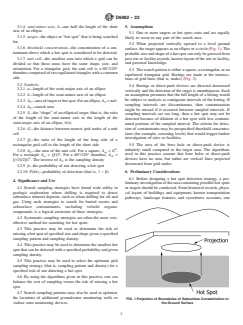
5.2 When projected vertically upward to a level ground
3.1.6 threshold concentration—the concentration of a con-
surface, the target appears as an ellipse or a circle (Fig. 1).The
taminant above which a hot spot is considered to be detected.
probablesizeandshapeofahotspotcanonlybeguessedfrom
past site or facility records, known layout of the site or facility,
3.1.7 unit cell—the smallest area into which a grid can be
and personal knowledge.
divided so that these areas have the same shape, size, and
orientation. For a triangular grid, the unit cell is a 60°/120°
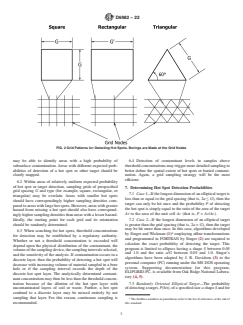
5.3 Thesearchpatterniseitherasquare,arectangular,oran
rhombuscomprisedoftwoequilateraltriangleswithacommon
equilateral triangular grid. Borings are made at the intersec-
side.
tions of grid lines (that is, nodes) (Fig. 2).
3.2 Symbols:
5.4 Borings or direct-push devices are directed downward
3.2.1 a—length of the semi-major axis of an ellipse
vertically and the detection of the target is unambiguous. Such
3.2.2 b—length of the semi-minor axis of an ellipse an assumption presumes that the full length of a boring would
be subject to analysis as contiguous intervals of the boring. If
3.2.3 A —areaoftargetorhotspot.Foranellipse, A =πab.
T T
sampling intervals are discontinuous, then contamination
3.2.4 A —search area
S
might be missed if it occurred between sampled intervals. If
3.2.5 S—the “shape” of an elliptical target (that is, the ratio
sampling intervals are too long, then a hot spot may not be
of the length of the semi-minor axis to the length of the
detected because of dilution of a hot spot with less contami-
semi-major axis of an ellipse, b/a)
nated portions of the sampled interval. The criteria for detec-
3.2.6 G—the distance between nearest grid nodes of a unit tion of contaminants may be prespecified threshold concentra-
tions (for example, screening levels) that would trigger further
cell
investigation of sites or facilities.
3.2.7 Q—the ratio of the length of the long side of a
rectangular grid cell to the length of the short side 5.5 The area of the bore hole or direct-push device is
infinitely small compared to the target area. The algorithms
3.2.8 A —the area of the unit cell. For a square, A = G .
C sq
used in this practice assume that bore holes or direct-push
For a rectangle A = Q·G . For a 60°/120° rhombus, A =
re rh
devices have no area, but rather are vertical lines projected
[(√3)/2]G . The inverse of A is the sampling density
C
downward from grid nodes.
3.2.9 β—the probability of not detecting a hot spot
3.2.10 P(hit)—probability of detection (that is, 1 − β) 6. Preliminary Considerations
6.1 Before designing a hot spot detection strategy, a pre-
4. Significance and Use
liminary investigation of the area containing possible hot spots
4.1 Search sampling strategies have found wide utility in or targets should be conducted. From historical records, physi-
geologic exploration where drilling is required to detect
cal layout of buildings and equipment, known transportation
subsurface mineral deposits, such as when drilling for oil and pathways, landscape features, and eyewitness accounts, one
gas. Using such strategies to search for buried wastes and
subsurface contaminants, including volatile organic
compounds, is a logical extension of these strategies.
4.2 Systematic sampling strategies are often the most cost-
effective method for searching for hot spots.
4.3 This practice may be used to determine the risk of
missing a hot spot of specified size and shape given a specified
sampling pattern and sampling density.
4.4 This practice may be used to determine the smallest hot
spot that can be detected with a specified probability and given
sampling density.
4.5 This practice may be used to select the optimum grid
sampling strategy (that is, sampling pattern and density) for a
specified risk of not detecting a hot spot.
4.6 By using the algorithms given in this practice, one can
balance the cost of sampling versus the risk of missing a hot
spot.
4.7 Search sampling patterns may also be used to optimize
the locations of additional groundwater monitoring wells or
FIG. 1 Projection of Boundaries of Subsurface Contamination to
vadose zone monitoring devices. the Ground Surface
D6982 − 22
FIG. 2 Grid Patterns for Detecting Hot Spots. Borings are Made at the Grid Nodes
may be able to identify areas with a high probability of 6.4 Detection of contaminant levels in samples above
subsurface contamination.Areas with different expected prob- thresholdconcentrationsmaytriggermoredetailedsamplingto
abilities of detection of a hot spot or other target should be better define the spatial extent of hot spots or buried contami-
clearly mapped. nation. Again, a grid sampling strategy will be the most
efficient.
6.2 Within areas of relatively uniform expected probability
of hot spot or target detection, sampling grids of prespecified
7. Determining Hot Spot Detection Probabilities
grid spacing G and type (for example, square, rectangular, or
7.1 Case I—Ifthelongestdimensionofanellipticaltargetis
triangular) may be overlain. Areas with smaller hot spots
less than or equal to the grid spacing (that is, 2a ≤ G), then the
should have correspondingly higher sampling densities com-
target can only be hit once and the probability P of detecting
paredtoareaswithlargehotspots.However,areaswithgreater
the hot spot is simply equal to the ratio of the area of the target
hazard from missing a hot spot should also have correspond-
A to the area of the unit cell A (that is, P = A /A ).
T C T C
inglyhighersamplingdensitiesthanareaswithalesserhazard.
Ideally, the starting point for each grid and its orientation 7.2 Case 2—If the longest dimension of an elliptical target
should be randomly determined. is greater than the grid spacing (that is, 2a > G), then the target
may be hit more than once. In this case, algorithms developed
6.3 When searching for hot spots, threshold concentrations
by Singer and Wickman (1) employing affine transformations
for detection may be established by a regulatory authority.
and programmed in FORTRAN by Singer (2) are required to
Whether or not a threshold concentration is exceeded will
calculate the exact probability of detecting the target. This
depend upon the physical distribution of the contaminant, the
program is limited to ellipses having a shape S between 0.05
volumeofthesamplingdevice,thesamplingintervalsselected,
and 1.0 and the ratio a/G between 0.05 and 1.0. Singer’s
and the sensitivity of the analysis. If contamination occurs in a
algorithms have been adapted by J. R. Davidson (3) to the
discrete layer, then the probability of detecting a hot spot will
personal computer (PC) running under the MS DOS operating
decrease with increasing volume of material sampled in a bore
system. Supporting documentation for this program,
hole or if the sampling interval exceeds the depth of the
ELIPGRID-PC, is available from Oak Ridge National Labora-
discrete hot spot layer. The analytically determined contami-
tory (4, 5).
nant concentration may then be less than the threshold concen-
tration because of the dilution of the hot spot layer with 7.3 Randomly Oriented Elliptical Target—The probability
uncontaminated layers of soil or waste. Further, a hot spot ofdetectingatarget,P(hit),ofaspecifiedsizeashapeSandfor
confined to a discrete layer may be missed entirely by not
sampling that layer. For this reason, continuous sampling is
The boldface numbers in parentheses refer to the list of references at the end of
recommended. this standard.
D6982 − 22
a specified grid G spacing can be obtained from nomographs 8. Comparing the Relative Efficiencies of Search Patterns
showninFigs.3and4forsquareandequilateraltriangulargrid
8.1 The efficiency of a search pattern is measured as the
sampling patterns, respectively. Data for these nomographs
probability that a target (for example, hot spot) will be hit at
weregeneratedusingtheELIPGRID-PCprogram.Tousethese
least once. Given the same sampling density, a sampling
graphs, first calculate the ratio a/G. Then draw a vertical line
patternwithahigherprobabilityofhittingatargetwillbemore
from the point represented by the ratio a/G on the x-axis of the
efficient than a sampling pattern with a lower probability of
graph to the curve representing the prespecified shape of the
hitting the same target. The relative efficiency, RE,ofone
ellipse. Then draw a horizontal line to the y-axis. For shapes
sampling pattern over another when searching for a target is
other than those shown on the graphs, one must interpolate
measured as the percent difference in the efficiency of two
between curves with closest values of S. The value on the
equivalent density sampling patterns. For example, RE =
y-axisrepresentstheprobabilityofatleastonehitofthetarget.
100% (P − P )/P where P and P are the
TRI SQR SQR TRI SQR
Using these same graphs, one can also determine the required
probabilities of detecting a target with an equilateral triangular
grid spacing to detect an elliptical target of shape at a
gridandasquaregrid,respectively.Byextension,forthesame
prespecified probability of detection. In this case, draw a
probability of detecting a target, a more efficient sampling
horizontal line from the prespecified probability of a hit to the
pattern will require fewer borings, and will thus be more
curve representing the prespecified shape of the ellipse. Then
economical. In this section, the relative efficiencies of hitting
draw a vertical line down to the x-axis. From the ratio a/G at
randomly oriented (that is, orientation unknown) and oriented
the point of intersection with the x-axis, one can determine the
elliptical targets of prespecified size and shape are compared
mini
...
This document is not an ASTM standard and is intended only to provide the user of an ASTM standard an indication of what changes have been made to the previous version. Because
it may not be technically possible to adequately depict all changes accurately, ASTM recommends that users consult prior editions as appropriate. In all cases only the current version
of the standard as published by ASTM is to be considered the official document.
Designation: D6982 − 09 (Reapproved 2016) D6982 − 22
Standard Practice for
Detecting Hot Spots Using Point-Net (Grid) Search Patterns
This standard is issued under the fixed designation D6982; the number immediately following the designation indicates the year of
original adoption or, in the case of revision, the year of last revision. A number in parentheses indicates the year of last reapproval. A
superscript epsilon (´) indicates an editorial change since the last revision or reapproval.
1. Scope
1.1 This practice provides equations and nomographs, and a reference to a computer program, for calculating probabilities of
detecting hot spots (that is, localized areas of soil or groundwater contamination) using point-net (that is, grid) search patterns. Hot
spots, more generally referred to as targets, are presumed to be invisible on the ground surface. Hot spots may include former
surface impoundments and waste disposal pits, as well as contaminant plumes in ground water groundwater or the vadose zone.
1.2 For purposes of calculating detection probabilities, hot spots or buried contaminants are presumed to be elliptically shaped
when projected vertically to the ground surface, and search patterns are square, rectangular, or rhombic. Assumptions about the
size and shape of suspected hot spots are the primary limitations of this practice, and must be judged by historical information.
A further limitation is that hot spot boundaries are usually not clear and distinct.
1.3 In general, this practice should not be used in lieu of surface geophysical methods for detecting buried objects, including
underground utilities, where such buried objects can be detected by these methods (see Guide D6429).
1.4 Search sampling would normally be conducted during preliminary investigations of hazardous waste sites or hazardous waste
management facilities (see Guide D5730). Sampling may be conducted by drilling or by direct-push methods. In contrast, guidance
on sampling for the purpose of making statistical inferences about population characteristics (for example, contaminant
concentrations) can be found in Guide D6311.
1.5 This standard does not purport to address all of the safety concerns, if any, associated with its use. It is the responsibility
of the user of this standard to establish appropriate safety safety, health, and healthenvironmental practices and determine the
applicability of regulatory limitations prior to use.
1.6 This international standard was developed in accordance with internationally recognized principles on standardization
established in the Decision on Principles for the Development of International Standards, Guides and Recommendations issued
by the World Trade Organization Technical Barriers to Trade (TBT) Committee.
2. Referenced Documents
2.1 ASTM Standards:
D5730 Guide for Site Characterization for Environmental Purposes With Emphasis on Soil, Rock, the Vadose Zone and
Groundwater (Withdrawn 2013)
This practice is under the jurisdiction of ASTM Committee D34 on Waste Management and is the direct responsibility of Subcommittee D34.01.01 on Planning for
Sampling.
Current edition approved May 1, 2016May 1, 2022. Published May 2016May 2022. Originally approved in 2003. Last previous edition approved in 20092016 as
D6982 – 09.D6982 – 09 (2016). DOI: 10.1520/D6982-16.10.1520/D6982-22.
For referenced ASTM standards, visit the ASTM website, www.astm.org, or contact ASTM Customer Service at service@astm.org. For Annual Book of ASTM Standards
volume information, refer to the standard’s Document Summary page on the ASTM website.
The last approved version of this historical standard is referenced on www.astm.org.
Copyright © ASTM International, 100 Barr Harbor Drive, PO Box C700, West Conshohocken, PA 19428-2959. United States
D6982 − 22
D6051 Guide for Composite Sampling and Field Subsampling for Environmental Waste Management Activities
D6311 Guide for Generation of Environmental Data Related to Waste Management Activities: Selection and Optimization of
Sampling Design
D6429 Guide for Selecting Surface Geophysical Methods
3. Terminology
3.1 Definitions:
3.1.1 hot spot—a localized area of soil or groundwater contamination.
3.1.1.1 Discussion—
A hot spot may be considered as a discrete volume of buried waste or contaminated soil where the concentration of a contaminant
of interest exceeds some prespecified threshold value. Although hot spots are more likely to have variable sizes and shapes and
not have clear and distinct boundaries, ellipitically shaped hot spots or targets with well defined well-defined edges are assumed
for the purposes of calculating detection probabilities. The assumption that hot spots have elliptical shapes is not inconsistent with
known historical patterns of contaminant distribution.
3.1.2 sampling density—the number of soil borings (that is, sampling points) per unit area.
3.1.3 semi-major axis, a—one-half one half the length of the long axis of an ellipse. For a circle, this distance is simply the radius.
3.1.4 semi-minor axis, b—one-half one half the length of the short axis of an ellipse.
3.1.5 target—the object or “hot spot” that is being searched for.
3.1.6 threshold concentration—the concentration of a contaminant above which a hot spot is considered to be detected.
3.1.7 unit cell—the smallest area into which a grid can be divided so that these areas have the same shape, size, and orientation.
For a triangular grid, the unit cell is a 60°/120° rhombus comprised of two equilateral triangles with a common side.
3.2 Symbols: a = length of the semi-major axis of an ellipse
b = length of the semi-minor axis of an ellipse
A = area of target or hot spot. For an ellipse, A = πab.
T T
A = search area
S
S = the “shape” of an elliptical target (that is, the ratio of the length of the semi-minor axis to the length of the semi-major axis
of an ellipse, b/a)
G = the distance between nearest grid nodes of a unit cell
Q = the ratio of the length of the long side of a rectangular grid cell to the length of the short side
2 2 2
A = the area of the unit cell. For a square, A = G . For a rectangle A = Q·G . For a 60°/120° rhombus, A = [(√3)/2]G .
C sq re rh
The inverse of A is the sampling density
C
β = the probability of not detecting a hot spot
P(hit) = probability of detection (that is, 1 − β)
3.2 Symbols:
3.2.1 a—length of the semi-major axis of an ellipse
3.2.2 b—length of the semi-minor axis of an ellipse
3.2.3 A —area of target or hot spot. For an ellipse, A = πab.
T T
3.2.4 A —search area
S
3.2.5 S—the “shape” of an elliptical target (that is, the ratio of the length of the semi-minor axis to the length of the semi-major
axis of an ellipse, b/a)
3.2.6 G—the distance between nearest grid nodes of a unit cell
D6982 − 22
3.2.7 Q—the ratio of the length of the long side of a rectangular grid cell to the length of the short side
2 2 2
3.2.8 A —the area of the unit cell. For a square, A = G . For a rectangle A = Q·G . For a 60°/120° rhombus, A = [(√3)/2]G .
C sq re rh
The inverse of A is the sampling density
C
3.2.9 β—the probability of not detecting a hot spot
3.2.10 P(hit)—probability of detection (that is, 1 − β)
4. Significance and Use
4.1 Search sampling strategies have found wide utility in geologic exploration where drilling is required to detect subsurface
mineral deposit,deposits, such as when drilling for oil and gas. Using such strategies to search for buried wastes and subsurface
contaminants, including volatile organic compounds, is a logical extension of these strategies.
4.2 Systematic sampling strategies are often the most cost-effective method for searching for hot spots.
4.3 This practice may be used to determine the risk of missing a hot spot of specified size and shape given a specified sampling
pattern and sampling density.
4.4 This practice may be used to determine the smallest hot spot that can be detected with a specified probability and given
sampling density.
4.5 This practice may be used to select the optimum grid sampling strategy (that is, sampling pattern and density) for a specified
risk of not detecting a hot spot.
4.6 By using the algorithms given in this practice, one can balance the cost of sampling versus the risk of missing a hot spot.
4.7 Search sampling patterns may also be used to optimize the locations of additional ground water groundwater monitoring wells
or vadose zone monitoring devices.
5. Assumptions
5.1 One or more targets or hot spots exist and are equally likely to occur in any part of the search area.
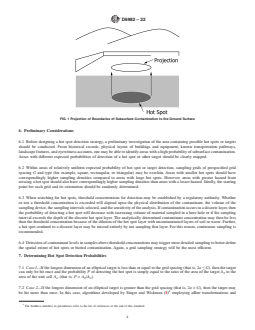
5.2 When projected vertically upward to a level ground surface, the target appears as an ellipse or a circle (Fig. 1). The probable
size and shape of a hot spot can only be guessed from past site or facility records, known layout of the site or facility, and personal
knowledge.
5.3 The search pattern is either a square, a rectangular, or an equilateral triangular grid. Borings are made at the intersections of
grid lines (that is, nodes) (Fig. 2).
5.4 Borings or direct-push devices are directed downward vertically and the detection of the target is unambiguous. Such an
assumption presumes that the full length of a boring would be subject to analysis as contiguous intervals of the boring. If sampling
intervals are discontinuous, then contamination might be missed if it occurred between sampled intervals. If sampling intervals are
too long, then a hot spot may not be detected because of dilution of a hot spot with less contaminated portions of the sampled
interval. The criteria for detection of contaminants may be prespecified threshold concentrations (for example, screening levels)
that would trigger further investigation of sites or facilities.
5.5 The area of the borehole bore hole or direct-push device is infinitely small compared to the target area. The algorithms used
in this practice assume that boreholes bore holes or direct-push devices have no area, but rather are vertical lines projected
downward from grid nodes.
D6982 − 22
FIG. 1 Projection of Boundaries of Subsurface Contamination to the Ground Surface
6. Preliminary Considerations
6.1 Before designing a hot spot detection strategy, a preliminary investigation of the area containing possible hot spots or targets
should be conducted. From historical records, physical layout of buildings and equipment, known transportation pathways,
landscape features, and eyewitness accounts, one may be able to identify areas with a high probability of subsurface contamination.
Areas with different expected probabilities of detection of a hot spot or other target should be clearly mapped.
6.2 Within areas of relatively uniform expected probability of hot spot or target detection, sampling grids of prespecified grid
spacing G and type (for example, square, rectangular, or triangular) may be overlain. Areas with smaller hot spots should have
correspondingly higher sampling densities compared to areas with large hot spots. However, areas with greater hazard from
missing a hot spot should also have correspondingly higher sampling densities than areas with a lesser hazard. Ideally, the starting
point for each grid and its orientation should be randomly determined.
6.3 When searching for hot spots, threshold concentrations for detection may be established by a regulatory authority. Whether
or not a threshold concentration is exceeded will depend upon the physical distribution of the contaminant, the volume of the
sampling device, the sampling intervals selected, and the sensitivity of the analysis. If contamination occurs in a discrete layer, then
the probability of detecting a hot spot will decrease with increasing volume of material sampled in a bore hole or if the sampling
interval exceeds the depth of the discrete hot spot layer. The analytically determined contaminant concentration may then be less
than the threshold concentration because of the dilution of the hot spot layer with uncontaminated layers of soil or waste. Further,
a hot spot confined to a discrete layer may be missed entirely by not sampling that layer. For this reason, continuous sampling is
recommended.
6.4 Detection of contaminant levels in samples above threshold concentrations may trigger more detailed sampling to better define
the spatial extent of hot spots or buried contamination. Again, a grid sampling strategy will be the most efficient.
7. Determining Hot Spot Detection Probabilities
7.1 Case I—If the longest dimension of an elliptical target is less than or equal to the grid spacing (that is, 2a ≤ G), then the target
can only be hit once and the probability P of detecting the hot spot is simply equal to the ratio of the area of the target A to the
T
area of the unit cell A (that is, P = A /A ).
C T C
7.2 Case 2—If the longest dimension of an elliptical target is greater than the grid spacing (that is, 2a > G), then the target may
be hit more than once. In this case, algorithms developed by Singer and Wickman (1) employing affine transformations and
The boldface numbers in parentheses refer to the list of references at the end of this standard.
D6982 − 22
FIG. 2 Grid Patterns for Detecting Hot Spots. Borings are Made at the Grid Nodes
programmed in FORTRAN by Singer (2) are required to calculate the exact probability of detecting the target. This program is
limited to ellipses having a shape S between 0.05 and 1.0 and the ratio a/G between 0.05 and 1.0. Singer’s algorithms have been
adapted by J. R. Davidson (3) to the personal computer (PC) running under the MS DOS operating system. Supporting
documentation for this program, ELIPGRID-PC, is available from Oak Ridge National Laboratory (4, 5).
7.3 Randomly Oriented Elliptical Target—The probability of detecting a target, P(hit), of a specified size a shape S and for a
specified grid G spacing can be obtained from nomographs shown in Figs. 3 and 4 for square and equilateral triangular grid
sampling patterns, respectively. Data for these nomographs were generated using the ELIPGRID-PC program. To use these graphs,
first calculate the ratio a/G. Then draw a vertical line from the point represented by the ratio a/G on the x-axis of the graph to the
curve representing the prespecified shape of the ellipse. Then draw a horizontal line to the y-axis. For shapes other than those
shown on the graphs, one must interpolate between curves with closest values of S. The value on the y-axis represents the
probability of at least one hit of the target. Using these same graphs, one can also determine the required grid spacing to detect
an elliptical target of shape at a prespecified probability of detection. In this case, draw a horizontal line from the prespecified
probability of a hit to the curve representing the prespecified shape of the ellipse. Then draw a vertical line down to the x-axis.
From the ratio a/G at the point of intersection with the x-axis, one can determine the minimum required grid spacing. Similarly,
one can also determine the smallest sized hot spot of a given shape that can be detected for a given grid spacing and probability
of detection by calculating a from the ratio a/G and grid spacing G. Alternatively, one can use the computer program
ELIPGRID-PC.
7.4 Oriented Elliptical Target—If the orientation of the elliptical target with respect to the grid lines is specified, then the
probability of detecting the target must be determined using the computer program ELIPGRID-PC.
8. Comparing the Relative Efficiencies of Search Patterns
8.1 The efficiency of a search pattern is measured as the probability that a target (for example, hot spot) will be hit at least once.
Given the same sampling density, a sampling pattern with a higher probability of hitting a target will be more efficient than a
sampling pattern with a lower probability of hitting the same target. The relative efficiency, RE, of one sampling pattern over
another when s
...