

ASTM D5146-10(2019)
(Guide)Standard Guide to Testing Solvent-Borne Architectural Coatings
General Information
- Abstract
ABSTRACT
This guide covers the selection and use of procedures for testing solvent-borne architectural coatings to be used on exterior, interior, or both types of surfaces. The properties that can be examined by the test methods listed herein are as follows: liquid paint properties (skinning, condition in container, coarse particles and foreign matter, density or weight per gallon, fineness of dispersion, flash point, odor, absorption, colorant acceptance, dilution stability, package stability, heat stability, and settling); coating application and film formation characteristics (brush application properties, brush drag, roller application properties, roller spatter, spray application properties, touch-up uniformity, consistency (low-shear viscosity), rheological properties of non-Newtonian liquids, sag resistance, levelling properties, and drying properties); appearance of dry film (color appearance, color differences by visual comparison, color differences using instrumental measurements, directional reflectance, gloss, sheen, hiding power, and yellowness index); properties of dry film (abrasion resistance, adhesion, flexibility, resistance to household chemicals, color change of white enamels, washability and cleansability, blister resistance, exposure resistance, chalking, checking, cracking, erosion, flaking, mildew resistance, and fume resistance); and Coating Analysis (chemical analysis, volatile content, nonvolatile volume content, water content, pigment content, pigment analysis, nonvolatile vehicle content, vehicle separation, and nonvolatile vehicle identification).
SCOPE
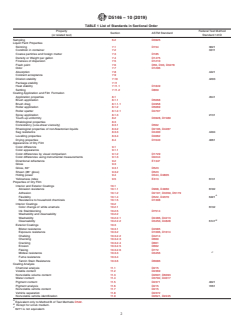
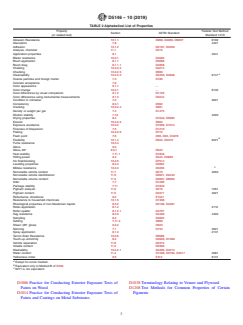
1.1 This guide covers the selection and use of procedures for testing solvent-borne coatings to be used on exterior, interior or both types of surfaces (see Note 1). The properties that can be examined or, in some cases, the relevant test procedures are listed in Table 1 and Table 2.
Note 1: The term “architectural coating” as used here combines the definition in Terminology D16 with that in the FSCT Paint/Coatings Dictionary, as follows: “Organic coatings intended for on-site application to interior or exterior surfaces of residential, commercial, institutional, or industrial buildings, in contrast to industrial coatings. They are protective and decorative finishes applied at ambient temperatures. Often called Trade Sales Coatings.”
Note 2: Architectural coatings that are designed to give better performance than most conventional coatings because they are tougher and more stain- and abrasion-resistant are covered by Guide D3730.
1.2 The types of organic coatings covered by this guide are as follows:
(1) Type 1 Interior Low-Gloss Wall Finish,
(2) Type 2 Interior Gloss and Semigloss Wall and Trim Enamels,
(3) Type 3 Exterior House and Trim Coatings, and
(4) Type 4 Floor Enamel, Exterior and/or Interior.
1.2.1 Each is intended for application by brushing, rolling, spraying, or other means to the materials appropriate for its type, which may include wood, plaster, wallboard, masonry, steel, previously painted surfaces, and other architectural substrates.
1.3 The values stated in SI units are to be regarded as the standard. The values given in parentheses are for information only.
1.4 This standard does not purport to address all of the safety concerns, if any, associated with its use. It is the responsibility of the user of this standard to establish appropriate safety, health, and environmental practices and determine the applicability of regulatory limitations prior to use.
1.5 This international standard was developed in accordance with internationally recognized principles on standardization established in the Decision on Principles for the Development of International Standards, Guides and Recommendations issued by the World Trade Organization Technical Barriers to Trade (TBT) Committee.
- Status
- Published
- Publication Date
- 31-Dec-2018
- Technical Committee
- D01 - Paint and Related Coatings, Materials, and Applications
- Drafting Committee
- D01.42 - Architectural Coatings
Overview
ASTM D5146-10(2019) - Standard Guide to Testing Solvent-Borne Architectural Coatings provides guidance on the selection and use of test methods and procedures for evaluating solvent-borne coatings in architectural applications. Applicable to coatings used on both interior and exterior surfaces, this standard is crucial for manufacturers, specifiers, and users who require reliable assessment of coating properties, consistency, and performance.
This guide addresses the testing of architectural coatings intended for on-site application to residential, commercial, institutional, or industrial buildings. Properties evaluated cover liquid paint characteristics, application and film formation, appearance, and performance of dry films, as well as comprehensive chemical analysis. ASTM D5146 supports quality control, product development, and regulatory compliance for solvent-borne paints, helping to ensure coatings are fit for purpose in diverse building environments.
Key Topics
ASTM D5146 covers a wide range of topics critical to the evaluation of solvent-borne architectural coatings, including:
- Liquid paint properties: Includes tests for skinning, condition in container, foreign matter, density, fineness of dispersion, flash point, odor, absorption, and stability (package, heat, settling).
- Application and film formation: Assesses brush, roller, and spray application performance, touch-up uniformity, consistency (low-shear viscosity), rheological properties, sag resistance, levelling, and drying characteristics.
- Dry film appearance: Evaluates color (visual and instrumental), directional reflectance, gloss (60° and 85°), sheen, hiding power, and yellowness index.
- Dry film properties: Measures abrasion resistance, adhesion, flexibility, resistance to household chemicals, color change, washability, blister, exposure, chalking, checking, cracking, erosion, flaking, mildew, and fume resistance.
- Coating analysis: Chemical analysis, volatile and nonvolatile content, water content, pigment content and analysis, vehicle content and separation, and identification of nonvolatile vehicle components.
Applications
ASTM D5146 is particularly valuable to:
- Paint and coatings manufacturers: For research and development, benchmarking, and quality assurance in the production of solvent-borne architectural coatings.
- Specifiers and architects: To specify coatings with proven performance on designated substrates (wood, plaster, masonry, steel, wallboard, and previously painted surfaces) in both interior and exterior environments.
- Contractors and applicators: To select coatings tested for application properties suitable for brushing, rolling, or spraying.
- Testing laboratories: As a reference for standardized test procedures essential for generating reliable, comparable, and regulatory-compliant data.
- Regulatory and quality assurance professionals: For establishing safety, health, and environmental best practices, and for verifying compliance with local, national, or international standards regarding volatile content, storage, and usage.
The standard is designed to be flexible, allowing users to select only those tests relevant to their requirements. By defining performance characteristics and test methods, ASTM D5146 helps ensure consistent results and supports communications between buyers and sellers.
Related Standards
ASTM D5146 references and aligns with a broad range of related ASTM and Federal test methods, facilitating comprehensive evaluation and harmonization with other industry requirements, including:
- ASTM D16: Terminology for Paint, Related Coatings, Materials, and Applications
- ASTM D523: Test Method for Specular Gloss
- ASTM D1475: Test Method for Density of Liquid Coatings
- ASTM D562: Test Method for Consistency of Paints (KU Viscosity)
- ASTM D2805/D344: Hiding Power of Paints
- ASTM D4060/D968: Abrasion Resistance of Organic Coatings
- ASTM D3359: Adhesion by Tape Test
- Federal Test Method Standard No. 141D: Federal standards for sampling, application, stability, and various physical and chemical property tests.
Other referenced standards address film flexibility, washability, settling, rheological properties, drying, and resistance performance, ensuring that ASTM D5146-based testing is robust and widely accepted.
Keywords: ASTM D5146, solvent-borne coatings, architectural coatings, paint testing, coating performance, gloss, adhesion, durability, standard test methods, building coatings, ASTM standards.
Relations
- Effective Date
- 01-Jan-2019
- Effective Date
- 01-Feb-2024
- Effective Date
- 01-Feb-2024
- Effective Date
- 01-Feb-2024
- Effective Date
- 01-Jan-2024
- Refers
ASTM D4287-00(2023) - Standard Test Method for High-Shear Viscosity Using a Cone/Plate Viscometer - Effective Date
- 01-Oct-2023
- Refers
ASTM D4214-23 - Standard Test Methods for Evaluating the Degree of Chalking of Exterior Paint Films - Effective Date
- 01-Oct-2023
- Effective Date
- 01-Aug-2020
- Effective Date
- 01-Jun-2020
- Effective Date
- 01-May-2020
- Effective Date
- 15-Dec-2019
- Effective Date
- 01-Oct-2019
- Effective Date
- 01-Oct-2019
- Refers
ASTM D661-93(2019) - Standard Test Method for Evaluating Degree of Cracking of Exterior Paints - Effective Date
- 01-Oct-2019
- Refers
ASTM D660-93(2019) - Standard Test Method for Evaluating Degree of Checking of Exterior Paints - Effective Date
- 01-Oct-2019
Frequently Asked Questions
ASTM D5146-10(2019) is a guide published by ASTM International. Its full title is "Standard Guide to Testing Solvent-Borne Architectural Coatings". This standard covers: ABSTRACT This guide covers the selection and use of procedures for testing solvent-borne architectural coatings to be used on exterior, interior, or both types of surfaces. The properties that can be examined by the test methods listed herein are as follows: liquid paint properties (skinning, condition in container, coarse particles and foreign matter, density or weight per gallon, fineness of dispersion, flash point, odor, absorption, colorant acceptance, dilution stability, package stability, heat stability, and settling); coating application and film formation characteristics (brush application properties, brush drag, roller application properties, roller spatter, spray application properties, touch-up uniformity, consistency (low-shear viscosity), rheological properties of non-Newtonian liquids, sag resistance, levelling properties, and drying properties); appearance of dry film (color appearance, color differences by visual comparison, color differences using instrumental measurements, directional reflectance, gloss, sheen, hiding power, and yellowness index); properties of dry film (abrasion resistance, adhesion, flexibility, resistance to household chemicals, color change of white enamels, washability and cleansability, blister resistance, exposure resistance, chalking, checking, cracking, erosion, flaking, mildew resistance, and fume resistance); and Coating Analysis (chemical analysis, volatile content, nonvolatile volume content, water content, pigment content, pigment analysis, nonvolatile vehicle content, vehicle separation, and nonvolatile vehicle identification). SCOPE 1.1 This guide covers the selection and use of procedures for testing solvent-borne coatings to be used on exterior, interior or both types of surfaces (see Note 1). The properties that can be examined or, in some cases, the relevant test procedures are listed in Table 1 and Table 2. Note 1: The term “architectural coating” as used here combines the definition in Terminology D16 with that in the FSCT Paint/Coatings Dictionary, as follows: “Organic coatings intended for on-site application to interior or exterior surfaces of residential, commercial, institutional, or industrial buildings, in contrast to industrial coatings. They are protective and decorative finishes applied at ambient temperatures. Often called Trade Sales Coatings.” Note 2: Architectural coatings that are designed to give better performance than most conventional coatings because they are tougher and more stain- and abrasion-resistant are covered by Guide D3730. 1.2 The types of organic coatings covered by this guide are as follows: (1) Type 1 Interior Low-Gloss Wall Finish, (2) Type 2 Interior Gloss and Semigloss Wall and Trim Enamels, (3) Type 3 Exterior House and Trim Coatings, and (4) Type 4 Floor Enamel, Exterior and/or Interior. 1.2.1 Each is intended for application by brushing, rolling, spraying, or other means to the materials appropriate for its type, which may include wood, plaster, wallboard, masonry, steel, previously painted surfaces, and other architectural substrates. 1.3 The values stated in SI units are to be regarded as the standard. The values given in parentheses are for information only. 1.4 This standard does not purport to address all of the safety concerns, if any, associated with its use. It is the responsibility of the user of this standard to establish appropriate safety, health, and environmental practices and determine the applicability of regulatory limitations prior to use. 1.5 This international standard was developed in accordance with internationally recognized principles on standardization established in the Decision on Principles for the Development of International Standards, Guides and Recommendations issued by the World Trade Organization Technical Barriers to Trade (TBT) Committee.
ABSTRACT This guide covers the selection and use of procedures for testing solvent-borne architectural coatings to be used on exterior, interior, or both types of surfaces. The properties that can be examined by the test methods listed herein are as follows: liquid paint properties (skinning, condition in container, coarse particles and foreign matter, density or weight per gallon, fineness of dispersion, flash point, odor, absorption, colorant acceptance, dilution stability, package stability, heat stability, and settling); coating application and film formation characteristics (brush application properties, brush drag, roller application properties, roller spatter, spray application properties, touch-up uniformity, consistency (low-shear viscosity), rheological properties of non-Newtonian liquids, sag resistance, levelling properties, and drying properties); appearance of dry film (color appearance, color differences by visual comparison, color differences using instrumental measurements, directional reflectance, gloss, sheen, hiding power, and yellowness index); properties of dry film (abrasion resistance, adhesion, flexibility, resistance to household chemicals, color change of white enamels, washability and cleansability, blister resistance, exposure resistance, chalking, checking, cracking, erosion, flaking, mildew resistance, and fume resistance); and Coating Analysis (chemical analysis, volatile content, nonvolatile volume content, water content, pigment content, pigment analysis, nonvolatile vehicle content, vehicle separation, and nonvolatile vehicle identification). SCOPE 1.1 This guide covers the selection and use of procedures for testing solvent-borne coatings to be used on exterior, interior or both types of surfaces (see Note 1). The properties that can be examined or, in some cases, the relevant test procedures are listed in Table 1 and Table 2. Note 1: The term “architectural coating” as used here combines the definition in Terminology D16 with that in the FSCT Paint/Coatings Dictionary, as follows: “Organic coatings intended for on-site application to interior or exterior surfaces of residential, commercial, institutional, or industrial buildings, in contrast to industrial coatings. They are protective and decorative finishes applied at ambient temperatures. Often called Trade Sales Coatings.” Note 2: Architectural coatings that are designed to give better performance than most conventional coatings because they are tougher and more stain- and abrasion-resistant are covered by Guide D3730. 1.2 The types of organic coatings covered by this guide are as follows: (1) Type 1 Interior Low-Gloss Wall Finish, (2) Type 2 Interior Gloss and Semigloss Wall and Trim Enamels, (3) Type 3 Exterior House and Trim Coatings, and (4) Type 4 Floor Enamel, Exterior and/or Interior. 1.2.1 Each is intended for application by brushing, rolling, spraying, or other means to the materials appropriate for its type, which may include wood, plaster, wallboard, masonry, steel, previously painted surfaces, and other architectural substrates. 1.3 The values stated in SI units are to be regarded as the standard. The values given in parentheses are for information only. 1.4 This standard does not purport to address all of the safety concerns, if any, associated with its use. It is the responsibility of the user of this standard to establish appropriate safety, health, and environmental practices and determine the applicability of regulatory limitations prior to use. 1.5 This international standard was developed in accordance with internationally recognized principles on standardization established in the Decision on Principles for the Development of International Standards, Guides and Recommendations issued by the World Trade Organization Technical Barriers to Trade (TBT) Committee.
ASTM D5146-10(2019) is classified under the following ICS (International Classification for Standards) categories: 87.040 - Paints and varnishes. The ICS classification helps identify the subject area and facilitates finding related standards.
ASTM D5146-10(2019) has the following relationships with other standards: It is inter standard links to ASTM D5146-10, ASTM D2369-24, ASTM D4958-24, ASTM D4213-24, ASTM D16-24, ASTM D4287-00(2023), ASTM D4214-23, ASTM D93-20, ASTM D5895-20, ASTM E1347-06(2020), ASTM D2371-19, ASTM D662-93(2019), ASTM D5068-04(2019), ASTM D661-93(2019), ASTM D660-93(2019). Understanding these relationships helps ensure you are using the most current and applicable version of the standard.
ASTM D5146-10(2019) is available in PDF format for immediate download after purchase. The document can be added to your cart and obtained through the secure checkout process. Digital delivery ensures instant access to the complete standard document.
Standards Content (Sample)
This international standard was developed in accordance with internationally recognized principles on standardization established in the Decision on Principles for the
Development of International Standards, Guides and Recommendations issued by the World Trade Organization Technical Barriers to Trade (TBT) Committee.
Designation: D5146 − 10 (Reapproved 2019)
Standard Guide to
Testing Solvent-Borne Architectural Coatings
This standard is issued under the fixed designation D5146; the number immediately following the designation indicates the year of
original adoption or, in the case of revision, the year of last revision. A number in parentheses indicates the year of last reapproval. A
superscript epsilon (´) indicates an editorial change since the last revision or reapproval.
1. Scope ization established in the Decision on Principles for the
Development of International Standards, Guides and Recom-
1.1 This guide covers the selection and use of procedures
mendations issued by the World Trade Organization Technical
for testing solvent-borne coatings to be used on exterior,
Barriers to Trade (TBT) Committee.
interior or both types of surfaces (see Note 1). The properties
that can be examined or, in some cases, the relevant test
2. Referenced Documents
procedures are listed in Table 1 and Table 2.
2.1 ASTM Standards:
NOTE 1—The term “architectural coating” as used here combines the
D16 TerminologyforPaint,RelatedCoatings,Materials,and
definition in Terminology D16 with that in the FSCT Paint/Coatings
Applications
Dictionary, as follows: “Organic coatings intended for on-site application
to interior or exterior surfaces of residential, commercial, institutional, or
D56 Test Method for Flash Point by Tag Closed Cup Tester
industrial buildings, in contrast to industrial coatings. They are protective
D93 Test Methods for Flash Point by Pensky-Martens
and decorative finishes applied at ambient temperatures. Often called
Closed Cup Tester
Trade Sales Coatings.”
D154 Guide for Testing of Varnishes (Withdrawn 2018)
NOTE 2—Architectural coatings that are designed to give better perfor-
D185 Test Methods for Coarse Particles in Pigments
mancethanmostconventionalcoatingsbecausetheyaretougherandmore
stain- and abrasion-resistant are covered by Guide D3730.
D215 Practice for the Chemical Analysis of White Linseed
Oil Paints (Withdrawn 2005)
1.2 The types of organic coatings covered by this guide are
D344 Test Method for Relative Hiding Power of Paints by
as follows:
the Visual Evaluation of Brushouts (Withdrawn 2018)
(1) Type 1 Interior Low-Gloss Wall Finish,
D358 Specification for Wood to Be Used as Panels in
(2) Type 2 Interior Gloss and Semigloss Wall and Trim
Weathering Tests of Coatings (Withdrawn 2014)
Enamels,
D522 Test Methods for Mandrel Bend Test of Attached
(3) Type 3 Exterior House and Trim Coatings, and
Organic Coatings
(4) Type 4 Floor Enamel, Exterior and/or Interior.
D523 Test Method for Specular Gloss
1.2.1 Each is intended for application by brushing, rolling,
D562 Test Method for Consistency of Paints Measuring
spraying, or other means to the materials appropriate for its
KrebsUnit(KU)ViscosityUsingaStormer-TypeViscom-
type, which may include wood, plaster, wallboard, masonry,
eter
steel, previously painted surfaces, and other architectural
D660 Test Method for Evaluating Degree of Checking of
substrates.
Exterior Paints
1.3 The values stated in SI units are to be regarded as the
D661 Test Method for Evaluating Degree of Cracking of
standard. The values given in parentheses are for information
Exterior Paints
only.
D662 Test Method for Evaluating Degree of Erosion of
1.4 This standard does not purport to address all of the
Exterior Paints
safety concerns, if any, associated with its use. It is the
D772 Test Method for Evaluating Degree of Flaking (Scal-
responsibility of the user of this standard to establish appro-
ing) of Exterior Paints
priate safety, health, and environmental practices and deter-
D869 TestMethodforEvaluatingDegreeofSettlingofPaint
mine the applicability of regulatory limitations prior to use.
D968 Test Methods for Abrasion Resistance of Organic
1.5 This international standard was developed in accor-
Coatings by Falling Abrasive
dance with internationally recognized principles on standard-
1 2
This guide is under the jurisdiction of ASTM Committee D01 on Paint and For referenced ASTM standards, visit the ASTM website, www.astm.org, or
Related Coatings, Materials, and Applications and is the direct responsibility of contact ASTM Customer Service at service@astm.org. For Annual Book of ASTM
Subcommittee D01.42 on Architectural Coatings. Standards volume information, refer to the standard’s Document Summary page on
Current edition approved Jan. 1, 2019. Published January 2019. Originally the ASTM website.
approved in 1990. Last previous edition approved in 2010 as D5146 – 10. DOI: The last approved version of this historical standard is referenced on
10.1520/D5146-10R19. www.astm.org.
Copyright © ASTM International, 100 Barr Harbor Drive, PO Box C700, West Conshohocken, PA 19428-2959. United States
D5146 − 10 (2019)
TABLE 1 List of Standards in Sectional Order
Property Federal Test Method
Section ASTM Standard
(or related test) Standard 141D
Sampling 6.2 D3925
Liquid Paint Properties
Skinning 7.1 D154 3021
Condition in container 7.2 3011
Coarse particles and foreign matter 7.3 D185
Density or Weight per gallon 7.4 D1475
Fineness of dispersion 7.5 D1210
Flash point 7.6 D56, D93, D3278
Odor 7.7 D1296
Absorption 7.8 4421
Colorant acceptance 7.9
Dilution stability 7.10 4203
Package stability 7.11
Heat stability 7.11.1 D1849
Settling 7.11.2 D869
Coating Application and Film Formation
Application properties 8.1 4541
Brush application 8.1.1 D5068
Brush drag 8.1.1.1 D4958
Roller application 8.1.2 D5069
Roller spatter 8.1.2.1 D4707
Spray application 8.1.3 2131
Touch-up uniformity 8.2 D3928, D7489
Rhelological properties 8.3
Consistency (Low-shear viscosity) 8.3.1 D562
Rheological properties of non-Newtonian liquids 8.3.2 D2196, D4287
Sag resistance 8.3.3 D4400 4494
Levelling properties 8.3.4 D4062
Drying properties 8.4 D1640 4061
Appearance of Dry Film
Color difference 9.1
Color appearance 9.1.1
Color differences by visual comparison 9.1.2 D1729
Color differences using instrumental measurements 9.1.3 D2244
Directional reflectance 9.2 E1347
Gloss 9.3
Gloss, 60° 9.3.1 D523
Sheen (85° gloss) 9.3.2 D523
Hiding power 9.4 D344, D2805
Yellowness index 9.5 E313 6131
Properties of Dry Film
Interior and Exterior Coatings 10.1
Abrasion resistance 10.1.1 D968, D4060 6192
Adhesion 10.1.2 D2197, D3359, D5179
A
Flexibility 10.1.4 D522, D2370 6221
Resistance to household chemicals 10.1.5 D1308
Interior Coatings 10.2
Color change of white enamels 10.2.1 6132
Ink Stainblocking 10.2.5 D7514
Washability and cleansability 10.2.2
Washability 10.2.2.1 D2486, D4213
B
Cleansability 10.2.2.2 D3450, D4828 6141
Exterior Coatings 10.3
Blister resistance 10.3.1 D4585
Exposure resistance 10.3.2 D1006, D1014
Chalking 10.3.2.2 D4214
Checking 10.3.2.3 D660
Cracking 10.3.2.4 D661
Erosion 10.3.2.5 D662
Flaking 10.3.2.6 D772
C
Mildew resistance 10.3.3 D3456
Fume resistance 10.3.4
Tannin Stain Resistance 10.3.6 D6686
Coating Analysis
Chemical analysis 11.1 D215
Volatile content 11.2 D2369
Nonvolatile volume content 11.3 D2697, D6093
Water content 11.4 D3792, D4017
Pigment content 11.5 D2371 4021
Pigment analysis 11.6 D215 7261
Nonvolatile vehicle content 11.7 D215
Vehicle separation 11.8 D2372
Nonvolatile vehicle identification 11.9 D2621, D2245
A
Equivalent only to Method B of Test Methods D522.
B
Except for scrub medium.
C
6271 is not equivalent.
D5146 − 10 (2019)
TABLE 2 Alphabetical List of Properties
Property Federal Test Method
Section ASTM Standard
(or related test) Standard 141D
Abrasion Resistance 10.1.1 D968, D4060, D6037 6192
Absorption 7.8 4421
Adhesion 10.1.2 D2197, D3359
Analysis, chemical 11.1 D215
Application properties 8.1 4541
Blister resistance 10.3.1 D4585
Brush application 8.1.1 D5068
Brush drag 8.1.1.1 D4958
Chalking 10.3.2.2 D4214
Checking 10.3.2.3 D660
A
Cleansability 10.2.2.2 D3450, D4828 6141
Coarse particles and foreign matter 7.3 D185
Colorant acceptance 7.9
Color appearance 9.1.1 .
Color change 10.2.1 . 6132
Color differences by visual comparison 9.1.2 D1729
Color differences using instrumental measurements 9.1.3 D2244
Condition in container 7.2 3021
Consistency 8.3.1 D562
Cracking 10.3.2.4 D661
Density or weight per gal 7.4 D1475
Dilution stability 7.10 4203
Drying properties 8.4 D1640, D5895
Erosion 10.3.2.5 D662
Exposure resistance 10.3.2 D1006, D1014
Fineness of Dispersion 7.5 D1210
Flaking 10.3.2.6 D772
Flash point 7.6 D56, D93, D3278
B
Flexibility 10.1.4 D522, D2370 6221
Fume resistance 10.3.4
Gloss 9.3
Gloss, 60° 9.3.1 D523
Heat stability 7.11.1 D1849
Hiding power 9.4 D344, D2805
Ink Stainblocking 10.2.5 D7514
Levelling properties 8.3.4 D4062
C
Mildew resistance 10.3.3 D3456
Nonvolatile vehicle content 11.7 D215 4053
Nonvolatile vehicle identification 11.9 D2621, D2245
Nonvolatile volume content 11.3 D2697, D6093
Odor 7.7 D1296
Package stability 7.11 D1849
Pigment analysis 11.6 D215 7261
Pigment content 11.5 D2371 4021
Reflectance, directional 9.2 E1347
Resistance to household chemicals 10.1.5 D1308
Rheological properties of non-Newtonian liquids 8.3.2 D2196, D4287
Roller application 8.1.2 2112
Roller spatter 8.1.2.1 D4707
Sag resistance 8.3.3 D4400 4494
Sampling 6.2 D3925
Settling 7.11.2 D869
Sheen (85° gloss) 9.3.2 D523
Skinning 7.1 D154 3021
Spray application 8.1.3 2131
Tannin Stain Resistance 10.3.6 D6686
Touch-up uniformity 8.2 D3928, D7489
Vehicle separation 11.8 D2372
Volatile content 11.2 D2369
Washability 10.2.2.1 D2486, D4213
Water content 11.4 D1208, D3792, D4017 4081
Yellowness index 9.5 E313 6131
A
Except for scrub medium.
B
Equivalent only to Method B of D522.
C
6271 is not equivalent.
D1006 Practice for Conducting Exterior Exposure Tests of D1038 Terminology Relating to Veneer and Plywood
Paints on Wood
D1208 Test Methods for Common Properties of Certain
D1014 Practice for Conducting Exterior Exposure Tests of
Pigments
Paints and Coatings on Metal Substrates
D5146 − 10 (2019)
D1210 Test Method for Fineness of Dispersion of Pigment- D4017 Test Method for Water in Paints and Paint Materials
Vehicle Systems by Hegman-Type Gage by Karl Fischer Method
D4060 Test Method for Abrasion Resistance of Organic
D1296 Test Method for Odor of Volatile Solvents and
Diluents Coatings by the Taber Abraser
D4062 Test Method for Leveling of Paints by Draw-Down
D1308 Test Method for Effect of Household Chemicals on
Method
Clear and Pigmented Organic Finishes
D4213 Test Method for Scrub Resistance of Paints by
D1475 Test Method for Density of Liquid Coatings, Inks,
Abrasion Weight Loss
and Related Products
D4214 Test Methods for Evaluating the Degree of Chalking
D1554 Terminology Relating to Wood-Base Fiber and Par-
of Exterior Paint Films
ticle Panel Materials
D4287 Test Method for High-Shear Viscosity Using a Cone/
D1640 Test Methods for Drying, Curing, or Film Formation
Plate Viscometer
of Organic Coatings
D4400 Test Method for Sag Resistance of Paints Using a
D1729 Practice for Visual Appraisal of Colors and Color
Multinotch Applicator
Differences of Diffusely-Illuminated Opaque Materials
D4585 Practice for Testing Water Resistance of Coatings
D1849 Test Method for Package Stability of Paint
Using Controlled Condensation
D2196 Test Methods for Rheological Properties of Non-
D4707 Test Method for Measuring Paint Spatter Resistance
Newtonian Materials by Rotational Viscometer
During Roller Application
D2197 Test Method for Adhesion of Organic Coatings by
D4828 Test Methods for Practical Washability of Organic
Scrape Adhesion
Coatings
D2244 Practice for Calculation of Color Tolerances and
D4946 TestMethodforBlockingResistanceofArchitectural
Color Differences from Instrumentally Measured Color
Paints
Coordinates
D4958 Test Method for Comparison of the Brush Drag of
D2245 Test Method for Identification of Oils and Oil Acids
Latex Paints
in Solvent-Reducible Paints (Withdrawn 2016)
D5068 Practice for Preparation of Paint Brushes for Evalu-
D2369 Test Method for Volatile Content of Coatings
ation
D2370 Test Method for Tensile Properties of Organic Coat-
D5069 Practice for Preparation of Paint-Roller Covers for
ings
Evaluation of Architectural Coatings
D2371 Test Method for Pigment Content of Solvent-
D5179 Test Method for Measuring Adhesion of Organic
Reducible Paints
Coatings in the Laboratory by Direct Tensile Method
D2372 Practice for Separation of Vehicle From Solvent-
D5895 Test Methods for Evaluating Drying or Curing Dur-
Reducible Paints
ing Film Formation of Organic Coatings Using Mechani-
D2486 Test Methods for Scrub Resistance of Wall Paints
cal Recorders
D2621 Test Method for Infrared Identification of Vehicle
D6037 Test Methods for Dry Abrasion Mar Resistance of
Solids From Solvent-Reducible Paints
High Gloss Coatings
D2697 Test Method for Volume Nonvolatile Matter in Clear
D6093 Test Method for Percent Volume Nonvolatile Matter
or Pigmented Coatings
in Clear or Pigmented Coatings Using a Helium Gas
D2805 Test Method for Hiding Power of Paints by Reflec-
Pycnometer
tometry
D6686 Test Method for Evaluation of Tannin Stain Resis-
D3273 TestMethodforResistancetoGrowthofMoldonthe
tance of Coatings
Surface of Interior Coatings in an Environmental Cham-
D7489 Practice for Evaluating Touch-Up Properties of Ar-
ber
chitectural Coatings under Various Environmental Condi-
D3278 Test Methods for Flash Point of Liquids by Small
tions
Scale Closed-Cup Apparatus
D7514 Test Method for Evaluating Ink Stainblocking of
D3359 Test Methods for Rating Adhesion by Tape Test
Architectural Paint Systems by Visual Assessment
D3450 Test Method for Washability Properties of Interior
E105 Practice for Probability Sampling of Materials
Architectural Coatings
E313 Practice for Calculating Yellowness and Whiteness
D3456 Practice for Determining by Exterior Exposure Tests
Indices from Instrumentally Measured Color Coordinates
theSusceptibilityofPaintFilmstoMicrobiologicalAttack
E1347 Test Method for Color and Color-Difference Mea-
D3730 Guide for Testing High-Performance Interior Archi-
surement by Tristimulus Colorimetry
tectural Wall Coatings
2.2 U.S. Federal Standard:
D3792 Test Method forWater Content of Coatings by Direct 4
Federal Test Method Standard No. 141D
Injection Into a Gas Chromatograph
2131 Application of Sprayed Films
D3925 Practice for Sampling Liquid Paints and Related
3011 Condition in Container
Pigmented Coatings
4203 Reducibility and Dilution Stability
D3928 Test Method for Evaluation of Gloss or Sheen
Uniformity
D3960 PracticeforDeterminingVolatileOrganicCompound
Available from DLA Document Services, Building 4/D, 700 Robbins Ave.,
(VOC) Content of Paints and Related Coatings Philadelphia, PA 19111-5094, http://quicksearch.dla.mil.
D5146 − 10 (2019)
4421 Absorption Test service environment: exterior or interior, specialized types of
4541 Working Properties and Appearance of Dried Film solvent-borne coatings have been developed for the different
6132 Accelerated Yellowness locations.The recommended test methods presented in Table 1
2.3 Other Document: and Table 2 cover practically all the properties of solvent-
Paint/Coatings Dictionary of the Federation of Societies for reducible coatings but all of them are not required with each
Coatings Technology type. Coatings intended for exterior use only or both exterior
and interior use require certain properties not relevant to those
3. Terminology
for interior use only. Selection of the methods to be followed
3.1 For definitions of terms in this guide refer to Terminol-
must be governed by experience and the requirements in each
ogy D16, D1038, and D1554 and to the FSCT Paint/Coatings
individual case, together with agreement between the pur-
Dictionary.
chaser and the seller.
4. Conditions Affecting Solvent-Reducible Coatings 5.2 The purchaser should first determine the properties a
coating should have and then select only those test methods
4.1 Interior and Exterior Coatings:
that measure or evaluate those properties. After selecting the
4.1.1 Substrate Type—The substrate to be painted can affect
desired tests, the purchaser should then decide which proper-
not only the application properties of a coating, such as gloss
ties are the most important and establish the requirements or
and uniformity, but is also a factor in determining the type of
specifications accordingly. Since coating properties frequently
coating to use. For instance, low-gloss wall finishes do not
tend to oppose each other, such as low sheen versus good
have the abrasion resistance required on floors, whereas
cleansability, some properties may need to be less emphasized
finishes intended only for interior service probably do not have
if others are to be accentuated. This balance of properties must
adequate resistance to weather factors. Other factors are the
be considered when selecting the tests and establishing the
type and quality of metal, wood or wood composite (plywood,
requirements. The significance of the tests and the normal
particle board or hardboard), the type, quality and alkalinity of
range of values are presented in the different sections, in most
concrete, plaster and joint cement systems, and the type and
cases.
condition of any previous coatings.
4.1.2 Substrate Conditions—Conditions such as porosity,
5.3 This guide does not indicate relative importance of the
hardness or, in the case of unpainted concrete, alkalinity
various tests nor does it recommend specific test values
determine the kind of coating that can be applied. The
becausepropertiesveryimportanttoonepurchasermaybeless
condition of previously painted substrates, such as degree of
so to another.
chalk, presence of grease, dirt, and mold, film adhesion and
porosity,allinfluencetheperformanceofcoatings.Smoothness
6. Sampling
of the substrate affects the spreading rate, final appearance, and
6.1 Prior to sampling, the condition of the container should
texture.
be checked since damage to it may cause evaporation,
4.1.3 Preparation of previously painted substrates including
skinning, or other undesirable effects on the coating.
detergent cleaning, solvent cleaning, and sanding.
4.1.4 Type and quality of primer or undercoat and time of
6.2 Sample in accordance with Practice D3925. Determine
drying before topcoating.
thedensityinpoundsperkilograms/litre(gallon)inaccordance
4.1.5 Environmental conditions such as temperature and
with Test Method D1475. Continue sampling and determining
humidity at the time of coating application and during drying.
density until successive results agree within 45 g (0.1 lb) or as
agreed upon between the purchaser and seller. Then take
4.2 Exterior Finishes:
samples for testing.
4.2.1 Substrate Weathering—Weathering of wood before
painting will probably adversely affect the performance of
6.3 Specifytheamountrequiredforarepresentativesample,
exterior coatings. Some weathering of masonry surfaces may
the package sizes, and an identification code.A4-L (or 1-U.S.
have beneficial effects on the performance.
gal) sample is usually sufficient for the recommended tests, but
4.2.2 Substrate Aspects of the Building—If construction
for guidance in selecting a sampling plan consult Practice
defects or defects due to age are such that excessive moisture
E105.
from the inside or the outside makes its way through the
substrate or if the substrate is in direct contact with damp
7. Liquid Coating Properties
ground, blistering, flaking or peeling may result.
7.1 Skinning—Coatings that contain a binder that dries by
4.2.3 Environmental conditions after application, both gen-
oxidation may be subject to skin formation in a partially-filled
eral for the area and specific, such as under eaves, behind
can. Since skins are insoluble in the material, they must be
shrubbery, northside and southside exposure.
removed before use. The referenced test in a partially-filled
5. Selection of Tests
container indicates the tendency of the material to skin. A
typical minimum time for skinning in accordance with this
5.1 Because the conditions to which a coating is subjected
method is 48 h. Examine the original sample for skins, both on
vary with (a) the surface type: wall, floor, ceiling, and (b) the
and below the surface. Using a well-mixed skin-free portion of
the sample, perform a skinning test in accordance with Guide
Available from Federation of Societies for Coatings Technology (FSCT), 492
Norristown Rd., Blue Bell, PA 19422-2350, http://www.coatingstech.org. D154.
D5146 − 10 (2019)
7.2 Condition in Container—Thickening, pigment settling, acceptable. Although not specifically designed for liquid coat-
and separation are undesirable and objectionable if material ings Test Method D1296 may be used with the solvent-
that has been stored cannot be readily reconditioned and made reducible type.
suitable for application with a reasonable amount of stirring.
7.8 Absorption—On porous surfaces, binder penetration can
The referenced method covers procedures for determining
result in pigment volume concentration changes as the film
changes in properties after storage and lists characteristics that
dries. This may cause appearance to vary. The referenced
are undesirable and objectionable in a stored paint. Determine
method provides a rough measure of the wetting and penetrat-
condition in the container in accordance with Method 3011 of
ing properties of the binder on a porous surface. Determine the
Federal Test Method Standard No. 141D. (See also 7.11,
absorption in accordance with Method 4421 of Federal Test
Package Stability.)
Method Standard No.141D.
7.3 Coarse Particles and Foreign Matter—Liquid coatings
7.9 Colorant Acceptance—Tintability of white bases with
must be free of coarse particles and foreign matter to be able to
colorants of standardized tinting strength is a trade require-
form uniform films of good appearance, a typical maximum
ment. If tinting colors are not adequately compatible with tint
being 0.5 weight % of the total material. The referenced
bases, lighter, darker, or nonuniform shades of colors are
method with a 325-mesh (45-µm) screen gives the percent of
produced. There is no accepted ASTM test method at present.
these particles. Determine content of coarse particles and
Test methods may be agreed upon between the purchaser and
foreign matter in accordance with Test Methods D185.
seller.
7.4 Density or Weight per Gallon—The density measured in
7.10 Dilution Stability—Dilution with a specified thinner
pounds per kilograms per litre = g⁄mL (gallon) is used to shows whether the materials are compatible and whether the
ensure product uniformity from batch to batch, provides a
reduced coating is stable. Consequently the suggested diluent
check against the theoretical weight calculated from the should be readily incorporated into the coating without exces-
formula, and is useful for determining the similarity of two
sive stirring or shaking. The referenced method evaluates the
samples. The referenced method gives a procedure for mea- stability of the material that has been reduced by a given
suring the density of the coating at a specified temperature.
amount or to a specified viscosity. Determine dilution stability
Most interior paints have densities of about 1.2 to 1.4 kg/L(10 in accordance with Method 4203 of Federal Test Method
to 12 lb/gal). Determine density in accordance with Test Standard No. 141D.
Method D1475, using a calibrated weight per gallon cup.
7.11 Package Stability—Since coatings are normally not
used immediately after manufacture, they must remain stable
7.5 Fineness of Dispersion—Generally, the more finely a
in the can for some time. At normal temperatures most
pigment is dispersed, the more efficiently it is being utilized.
solvent-borne coatings can be stored for over a year with little
Onemethodformeasuringthedegreeofdispersion(commonly
change in properties. However, exposure in uninsulated
referred to as “fineness of grind.”) is to draw the liquid coating
warehouses, or during shipping to high temperatures in the
down a calibrated tapered groove varying in depth from 100 to
summer, may cause unacceptable changes in these products.
0 µm (0–8 Hegman units) (4 to 0 mils) . The depth at which
Anotherunsatisfactoryconditionthatmayoccurduringstorage
continuous groupings of particles or agglomerates, or both,
is excessive settling.
protrude through the surface of the wet film is taken as the
7.11.1 Heat Stability—Exposure to high temperatures can
fineness of dispersion value. Higher readings in Hegman units
or lower readings in mils or micrometres indicate finer disper- be used to test for the stability of a packaged coating that
frequently encounters such conditions in service, or as an
sion. Low sheen finishes may have a dispersion value of 50 µm
or 4 Hegman (2 mils) while gloss enamels might be near zero accelerated test to predict stability at normal temperatures.
Althoughindicationsoflongtermpackagestabilitycanusually
(8 Hegman) indicating that the pigment agglomerates are too
small to be detected by the referenced method. Determine beobtainedinseveraldaysorweeksatanelevatedtemperature
such as 50°C (125°F) or 60°C (140°F), occasionally the results
fineness of dispersion in accordance with Test Method D1210.
of the accelerated test do not agree with those at prolonged
7.6 Flash Point—Organic solvents used in these coatings
normal storage conditions. In the referenced method the
have characteristic temperatures at which they support com-
changes in consistency and certain other properties of the
bustion. This temperature is known as the flash point and is
accelerated aged material are compared to those occurring in a
often used for danger classification in shipping by common
control kept at normal temperatures for a longer period. When
carrier. It is also used to determine conditions of storage to
testing for heat stability, as such, changes in viscosity, flow,
meet fire regulations and the safety requirements of the U.S.
gloss, foam resistance, color uniformity, and wet adhesion are
Occupational Safety and Health Act (OSHA). Determine flash
usually checked. Determine heat stability in accordance with
point in accordance with Test Methods D56, D93, Part B, or
Test Method D1849.
D3278.
7.11.2 Settling—Modern coatings are generally resistant to
7.7 Odor—Some solvent combinations produce obnoxious hard settling, but do at times show separation and soft settling.
odors, particularly when painting indoors with inadequate The referenced method covers the degree of pigment suspen-
ventilation and at elevated temperatures. Interior solvent-borne sion in and ease of remixing of a shelf-aged specimen to a
coatings usually contain low-odor or odorless mineral spirits. homogeneous condition suitable for the intended use. Deter-
Nevertheless, they should be evaluated to ensure that they are mine settling in accordance with Test Method D869.
D5146 − 10 (2019)
8. Coating Application and Film Formation ofapplicationorlocalizeddamageinservice.Withacoatingof
suitable touch-up properties, additional material of the same
8.1 Application Properties—Application or working prop-
batch or lot can be applied only to those localized areas to
erties of a paint are generally compared to a standard or
provide uniformity of color, gloss, and levelling over the entire
described by requirements in the product specification. Deter-
surface.Determinetouch-uppropertiesinaccordancewithTest
mine working properties in accordance with Method 4541 of
Method D3928. Variations in drying condit
...