

ASTM D661-93(2019)
(Test Method)Standard Test Method for Evaluating Degree of Cracking of Exterior Paints
General Information
- Abstract
SIGNIFICANCE AND USE
4.1 Cracking failure of paint films can occur in use. This test method provides a means of evaluating the degree of the failure by comparing the pictorial standards.
SCOPE
1.1 This test method covers the evaluation of the degree of cracking of exterior paints by comparison with photographic standards.
1.2 This international standard was developed in accordance with internationally recognized principles on standardization established in the Decision on Principles for the Development of International Standards, Guides and Recommendations issued by the World Trade Organization Technical Barriers to Trade (TBT) Committee.
- Status
- Published
- Publication Date
- 30-Sep-2019
- Technical Committee
- D01 - Paint and Related Coatings, Materials, and Applications
- Drafting Committee
- D01.25 - Evaluation of Weathering Effects


Overview
ASTM D661-93(2019), Standard Test Method for Evaluating Degree of Cracking of Exterior Paints, provides a consistent and practical approach to assess cracking failures in exterior paint films. Developed by ASTM International, this standard enables users to evaluate paint durability by comparing observed cracking with established photographic reference standards. Complying with globally recognized methodologies, ASTM D661 ensures reliable and internationally accepted paint inspection practices.
Key Topics
- Cracking Evaluation: The method covers the assessment of exterior paint cracking by direct visual comparison to standardized photographs found in the Pictorial Standards of Coating Defects Handbook.
- Types of Cracking: Recognizes three primary crack types in paint films:
- Irregular Pattern: No defined geometric arrangement.
- Line Type: Parallel, linear cracks, often horizontal or vertical, sometimes following brush marks.
- Sigmoid Type: Curved, interconnected crack patterns occurring in a large-scale configuration.
- Reference Standards: Emphasizes the use of approved photographic standards for objective evaluation. Actual reference photographs should be used instead of reproductions for accurate results.
- Inspection Guidelines:
- Use 10x magnification to differentiate between cracks and less severe checking.
- Select average or multiple locations on large surfaces for reliable ratings.
- Remove dirt or debris gently before inspection, as these can obscure the true nature or extent of cracking.
Applications
This ASTM standard is widely adopted by professionals involved in:
- Quality Assurance in Coatings: Manufacturers, contractors, and inspectors utilize the test method to determine the integrity and longevity of exterior paint systems by documenting and rating crack development.
- Specification Compliance: Ensures paint products and application methods meet performance criteria in construction, infrastructure, and architectural projects.
- Damage Assessment and Maintenance: Facility managers and building owners utilize the standard for routine inspections, helping to identify and address premature paint failures before escalating maintenance costs.
- Research and Development: Coatings scientists apply this method to evaluate new formulations or application methods for resistance to environmental stress and cracking.
The standard is especially useful in environments where exposure to weathering is a concern, such as buildings, bridges, marine structures, and exterior industrial assets.
Related Standards
Understanding and evaluating paint failures often requires reference to additional standards, including:
- ASTM D660: Standard Test Method for Evaluating Degree of Checking of Exterior Paints-used to distinguish between cracking and checking, which are related but distinct types of film breakdown.
- Pictorial Standards of Coating Defects Handbook: Contains the primary photographic reference standards essential for consistent ratings under ASTM D661.
- ASTM D01 Standards: Comprehensive standards for paint and related coatings, materials, and applications, supporting the evaluation of performance and durability.
Practical Value
Adopting ASTM D661-93(2019) provides several benefits:
- Consistent Evaluation: Ensures all stakeholders assess paint cracking in an objective, repeatable manner, minimizing subjective interpretation.
- Enhanced Durability Insights: Helps users compare products and select the best-performing paint systems for demanding exterior applications.
- International Acceptance: Facilitates regulatory compliance and acceptance in national and global projects adhering to recognized trade and quality requirements.
Organizations seeking robust and standardized methods for coating inspection and quality monitoring will find ASTM D661 invaluable for maintaining the performance and appearance of painted exterior surfaces.
Relations
- Replaces
ASTM D661-93(2011) - Standard Test Method for Evaluating Degree of Cracking of Exterior Paints - Effective Date
- 01-Oct-2019
- Refers
ASTM D660-93(2019) - Standard Test Method for Evaluating Degree of Checking of Exterior Paints - Effective Date
- 01-Oct-2019
- Refers
ASTM D660-93(2011) - Standard Test Method for Evaluating Degree of Checking of Exterior Paints - Effective Date
- 01-Nov-2011
- Refers
ASTM D660-93(2005) - Standard Test Method for Evaluating Degree of Checking of Exterior Paints - Effective Date
- 01-Sep-2005
- Refers
ASTM D660-93(2000) - Standard Test Method for Evaluating Degree of Checking of Exterior Paints - Effective Date
- 01-Jan-2000
- Effective Date
- 01-Jan-2000
- Effective Date
- 01-Oct-2019
- Effective Date
- 01-Oct-2019
- Effective Date
- 01-Oct-2019
- Effective Date
- 01-Oct-2019
- Effective Date
- 01-Oct-2019
- Effective Date
- 01-Oct-2019
- Referred By
ASTM D3322-23 - Standard Practice for Testing Primers and Primer Surfacers Over Preformed Metal - Effective Date
- 01-Oct-2019
- Effective Date
- 01-Oct-2019
- Effective Date
- 01-Oct-2019
Frequently Asked Questions
ASTM D661-93(2019) is a standard published by ASTM International. Its full title is "Standard Test Method for Evaluating Degree of Cracking of Exterior Paints". This standard covers: SIGNIFICANCE AND USE 4.1 Cracking failure of paint films can occur in use. This test method provides a means of evaluating the degree of the failure by comparing the pictorial standards. SCOPE 1.1 This test method covers the evaluation of the degree of cracking of exterior paints by comparison with photographic standards. 1.2 This international standard was developed in accordance with internationally recognized principles on standardization established in the Decision on Principles for the Development of International Standards, Guides and Recommendations issued by the World Trade Organization Technical Barriers to Trade (TBT) Committee.
SIGNIFICANCE AND USE 4.1 Cracking failure of paint films can occur in use. This test method provides a means of evaluating the degree of the failure by comparing the pictorial standards. SCOPE 1.1 This test method covers the evaluation of the degree of cracking of exterior paints by comparison with photographic standards. 1.2 This international standard was developed in accordance with internationally recognized principles on standardization established in the Decision on Principles for the Development of International Standards, Guides and Recommendations issued by the World Trade Organization Technical Barriers to Trade (TBT) Committee.
ASTM D661-93(2019) is classified under the following ICS (International Classification for Standards) categories: 87.040 - Paints and varnishes. The ICS classification helps identify the subject area and facilitates finding related standards.
ASTM D661-93(2019) has the following relationships with other standards: It is inter standard links to ASTM D661-93(2011), ASTM D660-93(2019), ASTM D660-93(2011), ASTM D660-93(2005), ASTM D660-93(2000), ASTM D660-93, ASTM D6577-15(2019), ASTM D3451-06(2017), ASTM D1006/D1006M-21, ASTM D6944-15(2020), ASTM D4082-10(2023), ASTM G210-13(2023), ASTM D3322-23, ASTM D5499-94(2021), ASTM E1605-22. Understanding these relationships helps ensure you are using the most current and applicable version of the standard.
ASTM D661-93(2019) is available in PDF format for immediate download after purchase. The document can be added to your cart and obtained through the secure checkout process. Digital delivery ensures instant access to the complete standard document.
Standards Content (Sample)
This international standard was developed in accordance with internationally recognized principles on standardization established in the Decision on Principles for the
Development of International Standards, Guides and Recommendations issued by the World Trade Organization Technical Barriers to Trade (TBT) Committee.
Designation: D661 − 93 (Reapproved 2019)
Standard Test Method for
Evaluating Degree of Cracking of Exterior Paints
This standard is issued under the fixed designation D661; the number immediately following the designation indicates the year of
original adoption or, in the case of revision, the year of last revision. A number in parentheses indicates the year of last reapproval. A
superscript epsilon (´) indicates an editorial change since the last revision or reapproval.
This standard has been approved for use by agencies of the U.S. Department of Defense.
1. Scope 4. Significance and Use
1.1 This test method covers the evaluation of the degree of 4.1 Cracking failure of paint films can occur in use.This test
cracking of exterior paints by comparison with photographic methodprovidesameansofevaluatingthedegreeofthefailure
standards. by comparing the pictorial standards.
1.2 This international standard was developed in accor-
5. Types of Cracking
dance with internationally recognized principles on standard-
5.1 Three types of cracking are recognized:
ization established in the Decision on Principles for the
5.1.1 Irregular Pattern Type—Cracking in which the breaks
Development of International Standards, Guides and Recom-
in the film are in no definite pattern.
mendations issued by the World Trade Organization Technical
5.1.2 Line Type—Cracking in which the breaks in the film
Barriers to Trade (TBT) Committee.
are generally arranged in parallel lines, usually either horizon-
2. Referenced Documents tally or vertically, over the surface of the film. These breaks
2 often follow the line of brush marks.
2.1 ASTM Standards:
5.1.3 Sigmoid Type—Cracking in which the breaks in the
D660 Test Method for Evaluating Degree of Checking of
film form a pattern consisting of curves meeting and
Exterior Paints
intersecting, usually on a relatively large scale.
2.2 Other Standards:
Pictorial Standards of Coating Defects Handbook
6. Use of Photographic Reference Standards
6.1 The photographic reference standards that are part of
3. Terminology
this test method and are provided in the Pictorial Standards of
3.1 Definitions of Terms Specific to This Standard:
Coating Defects Handbook are representative of the degree of
3.1.1 cracking, n—that phenomenon manifested in paint
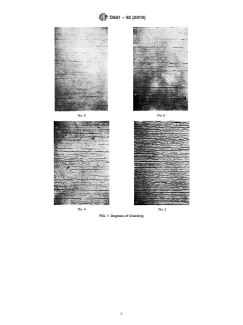
cracking of exterior paint films. Fig. 1 is for illustration
films by a break extending through to the surface painted.
purposes only and should not be used for evaluation.
3.1.1.1 Discussion—Where this is difficult to determine, the
6.2 The use of the photographic reference standards illus-
break should be called a crack only if the underlying surface is
trated in Fig. 1 requires the following precautions:
visible. The use of a magnification of 10 diameters is recom-
6.2.1 The accompanying photographic reference standards
mended in cases where it is difficult to differentiate between
show line-type cracking only. Irregular and sigmoid-type
cracking and checking (see Test Method D660).
cracking may also be interpreted from these photographs.
6.2.2 Care must be taken not to confuse various types of
failure that may be present on the same surface. This is
This test method is under the jurisdiction of ASTM Committee D01 on Paint
and Related Coatings, Materials, andApplications and is the direct responsibility of particularly true in observing cracking and checking. Cracking
Subcommittee D01.25 on Evaluation of Weathering Effects.
may very often be an advanced stage of checking and is very
Current edition approved Oct. 1, 2019. Published October
...