

ASTM D3451-06(2017)
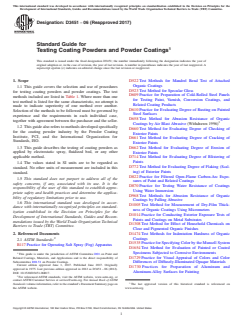
(Guide)Standard Guide for Testing Coating Powders and Powder Coatings
General Information
- Abstract
SIGNIFICANCE AND USE
4.1 This guide provides a useful summary to the selection and use of procedures for testing coating powders and powder coatings. It is applicable to both thermoplastic and thermoset coatings, unless indicated otherwise. By design this guide does not purport to address test methods or procedures developed specifically for the functional powder coating market, those coating powders for application to pipe or reinforced steel bars (rebar). Information on current test procedures for pipe and reinforced steel bar coating powders and powder coatings can be obtained through their respective ASTM Subcommittees, A01.05 and D01.48.
4.2 Selection of the methods to be followed and the interpretation of results must be governed by experience and the requirements in each individual case, together with agreement between the purchaser and seller. It should be noted that many of the methods used for characterizing a coating powder, such as gel time (Section 16) and inclined flow (Section 17), are primarily meant for the relative comparison of two coating powders, rather than to give a test value that can be interpreted as good or bad. Interpretation of the test results will depend on the specific application in question and will also often depend on the chemistry of the coating powder used.
SCOPE
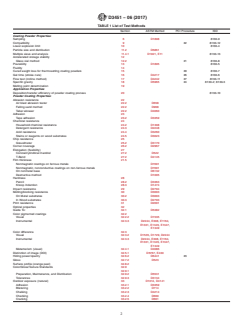
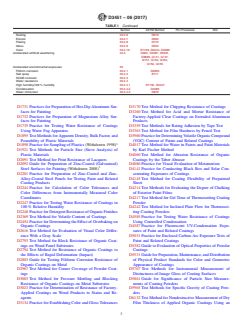
1.1 This guide covers the selection and use of procedures for testing coating powders and powder coatings. The test methods included are listed in Table 1. Where more than one test method is listed for the same characteristic, no attempt is made to indicate superiority of one method over another. Selection of the methods to be followed must be governed by experience and the requirements in each individual case, together with agreement between the purchaser and the seller.
1.2 This guide also refers to methods developed specifically for the coating powder industry by the Powder Coating Institute, PCI, and the International Organization for Standards, ISO.
1.3 This guide describes the testing of coating powders as applied by electrostatic spray, fluidized bed, or any other applicable method.
1.4 The values stated in SI units are to be regarded as standard. No other units of measurement are included in this standard.
1.5 This standard does not purport to address all of the safety concerns, if any, associated with its use. It is the responsibility of the user of this standard to establish appropriate safety and health practices and determine the applicability of regulatory limitations prior to use.
1.6 This international standard was developed in accordance with internationally recognized principles on standardization established in the Decision on Principles for the Development of International Standards, Guides and Recommendations issued by the World Trade Organization Technical Barriers to Trade (TBT) Committee.
- Status
- Published
- Publication Date
- 31-May-2017
- Technical Committee
- D01 - Paint and Related Coatings, Materials, and Applications
- Drafting Committee
- D01.51 - Powder Coatings
Overview
ASTM D3451-06(2017): Standard Guide for Testing Coating Powders and Powder Coatings provides a comprehensive summary for selecting and using procedures to test both thermoplastic and thermoset coating powders and powder coatings. Developed by ASTM International, this guide assists users, manufacturers, and laboratories in evaluating critical properties and performance of powder coatings, supporting quality assurance, product development, and procurement.
Applicable to powder coatings applied by electrostatic spray, fluidized bed, or other methods, the standard draws on test methods from ASTM, the Powder Coating Institute (PCI), and ISO, ensuring relevance to a wide range of industrial, architectural, automotive, and appliance applications. While it does not address specialized methods for functional powder coatings on pipes or rebar, users are guided to relevant subcommittees for those needs.
Key Topics
The standard focuses on essential aspects of powder coatings testing, including:
- Sampling and Preparation: Guidelines for representative sampling (e.g., ASTM D1898, ISO 8130-9) and test specimen preparation.
- Physical and Chemical Properties: Includes compatibility, lower explosion limit, particle size/distribution, specific gravity, fluidity, pourability, and storage stability.
- Application Methods: Covers deposition/transfer efficiency and applicability to various coating processes.
- Performance Testing: Procedures for evaluating abrasion resistance, adhesion (e.g., ASTM D3359), chemical resistance (e.g., ASTM D1308, D2248), hardness, impact resistance, and environmental durability (salt spray, humidity, weathering).
- Optical & Film Properties: Tests for gloss (ASTM D523), color (ASTM D1535, D2244), hiding power, metamerism, and distinctness of image (DOI).
- Panel Conditioning and Curing: Recommendations for substrate preparation, undercoat systems, curing cycles, and film thickness measurements.
- Interpretation of Results: Emphasizes the need for expert judgment and buyer-seller agreement, as many methods provide comparative rather than absolute values.
Applications
ASTM D3451-06(2017) is vital for multiple stakeholders:
- Manufacturers: Develop and benchmark powder coating products by assessing properties such as flow, storage stability, and cured film performance.
- Quality Control Labs: Ensure batch-to-batch consistency and compliance with customer requirements using standardized test procedures.
- Procurement & Specification: Allow buyers and end-users to evaluate products consistently and negotiate quality criteria.
- Research & Development: Facilitate innovation in powder coating formulations and application methods.
- End-Use Industries: Achieve optimal performance in markets like automotive, appliance, architectural, and general industrial finishing.
By using these standardized testing methods, organizations can improve product reliability, reduce recalls, and meet both regulatory and customer quality requirements.
Related Standards
The guide references and aligns with numerous standards to provide a robust testing framework, including but not limited to:
- ASTM Test Methods: D3359 (Adhesion), D523 (Gloss), D2244 (Color), D2794 (Impact), D4060 (Abrasion - Taber), D5861 (Particle Size).
- ISO Standards: ISO 8130 series for powder coating properties and methods.
- PCI Procedures: PCI #1 (Stability), #2 (Compatibility), #4 (Density), #6 (Gel Time), #7 (Inclined Plate Flow), and #9 (Cured Weight Loss).
- Additional Guidance: ASTM D609, D1730, D1731 for substrate preparation, and practices for environmental and exposure testing.
For specialized needs, such as coatings for pipe or rebar, users are advised to consult ASTM subcommittees A01.05 and D01.48.
Keywords: ASTM D3451, powder coatings, coating powder testing, thermoplastic, thermoset, abrasion resistance, adhesion, gloss measurement, color evaluation, ISO 8130, PCI procedures, quality control, industrial coatings, standard test methods.
Relations
- Effective Date
- 01-Jun-2017
- Effective Date
- 01-Feb-2024
- Effective Date
- 01-Feb-2024
- Effective Date
- 01-Feb-2024
- Effective Date
- 01-Feb-2024
- Effective Date
- 01-Feb-2024
- Effective Date
- 15-Jan-2024
- Effective Date
- 01-Dec-2023
- Effective Date
- 01-Dec-2023
- Refers
ASTM E1164-23 - Standard Practice for Obtaining Spectrometric Data for Object-Color Evaluation - Effective Date
- 01-Nov-2023
- Effective Date
- 01-Nov-2023
- Effective Date
- 01-Nov-2023
- Refers
ASTM D1732-03(2023) - Standard Practices for Preparation of Magnesium Alloy Surfaces for Painting - Effective Date
- 01-Nov-2023
- Effective Date
- 01-Nov-2023
- Refers
ASTM D4214-23 - Standard Test Methods for Evaluating the Degree of Chalking of Exterior Paint Films - Effective Date
- 01-Oct-2023
Get Certified
Connect with accredited certification bodies for this standard

CIS Institut d.o.o.
Personal Protective Equipment (PPE) certification body. Notified Body NB-2890 for EU Regulation 2016/425 PPE.

Kiwa BDA Testing
Building and construction product certification.
Kmetijski inštitut Slovenije
Agricultural Institute of Slovenia. Soil testing, plant health, agricultural product analysis.
Sponsored listings
Frequently Asked Questions
ASTM D3451-06(2017) is a guide published by ASTM International. Its full title is "Standard Guide for Testing Coating Powders and Powder Coatings". This standard covers: SIGNIFICANCE AND USE 4.1 This guide provides a useful summary to the selection and use of procedures for testing coating powders and powder coatings. It is applicable to both thermoplastic and thermoset coatings, unless indicated otherwise. By design this guide does not purport to address test methods or procedures developed specifically for the functional powder coating market, those coating powders for application to pipe or reinforced steel bars (rebar). Information on current test procedures for pipe and reinforced steel bar coating powders and powder coatings can be obtained through their respective ASTM Subcommittees, A01.05 and D01.48. 4.2 Selection of the methods to be followed and the interpretation of results must be governed by experience and the requirements in each individual case, together with agreement between the purchaser and seller. It should be noted that many of the methods used for characterizing a coating powder, such as gel time (Section 16) and inclined flow (Section 17), are primarily meant for the relative comparison of two coating powders, rather than to give a test value that can be interpreted as good or bad. Interpretation of the test results will depend on the specific application in question and will also often depend on the chemistry of the coating powder used. SCOPE 1.1 This guide covers the selection and use of procedures for testing coating powders and powder coatings. The test methods included are listed in Table 1. Where more than one test method is listed for the same characteristic, no attempt is made to indicate superiority of one method over another. Selection of the methods to be followed must be governed by experience and the requirements in each individual case, together with agreement between the purchaser and the seller. 1.2 This guide also refers to methods developed specifically for the coating powder industry by the Powder Coating Institute, PCI, and the International Organization for Standards, ISO. 1.3 This guide describes the testing of coating powders as applied by electrostatic spray, fluidized bed, or any other applicable method. 1.4 The values stated in SI units are to be regarded as standard. No other units of measurement are included in this standard. 1.5 This standard does not purport to address all of the safety concerns, if any, associated with its use. It is the responsibility of the user of this standard to establish appropriate safety and health practices and determine the applicability of regulatory limitations prior to use. 1.6 This international standard was developed in accordance with internationally recognized principles on standardization established in the Decision on Principles for the Development of International Standards, Guides and Recommendations issued by the World Trade Organization Technical Barriers to Trade (TBT) Committee.
SIGNIFICANCE AND USE 4.1 This guide provides a useful summary to the selection and use of procedures for testing coating powders and powder coatings. It is applicable to both thermoplastic and thermoset coatings, unless indicated otherwise. By design this guide does not purport to address test methods or procedures developed specifically for the functional powder coating market, those coating powders for application to pipe or reinforced steel bars (rebar). Information on current test procedures for pipe and reinforced steel bar coating powders and powder coatings can be obtained through their respective ASTM Subcommittees, A01.05 and D01.48. 4.2 Selection of the methods to be followed and the interpretation of results must be governed by experience and the requirements in each individual case, together with agreement between the purchaser and seller. It should be noted that many of the methods used for characterizing a coating powder, such as gel time (Section 16) and inclined flow (Section 17), are primarily meant for the relative comparison of two coating powders, rather than to give a test value that can be interpreted as good or bad. Interpretation of the test results will depend on the specific application in question and will also often depend on the chemistry of the coating powder used. SCOPE 1.1 This guide covers the selection and use of procedures for testing coating powders and powder coatings. The test methods included are listed in Table 1. Where more than one test method is listed for the same characteristic, no attempt is made to indicate superiority of one method over another. Selection of the methods to be followed must be governed by experience and the requirements in each individual case, together with agreement between the purchaser and the seller. 1.2 This guide also refers to methods developed specifically for the coating powder industry by the Powder Coating Institute, PCI, and the International Organization for Standards, ISO. 1.3 This guide describes the testing of coating powders as applied by electrostatic spray, fluidized bed, or any other applicable method. 1.4 The values stated in SI units are to be regarded as standard. No other units of measurement are included in this standard. 1.5 This standard does not purport to address all of the safety concerns, if any, associated with its use. It is the responsibility of the user of this standard to establish appropriate safety and health practices and determine the applicability of regulatory limitations prior to use. 1.6 This international standard was developed in accordance with internationally recognized principles on standardization established in the Decision on Principles for the Development of International Standards, Guides and Recommendations issued by the World Trade Organization Technical Barriers to Trade (TBT) Committee.
ASTM D3451-06(2017) is classified under the following ICS (International Classification for Standards) categories: 13.300 - Protection against dangerous goods. The ICS classification helps identify the subject area and facilitates finding related standards.
ASTM D3451-06(2017) has the following relationships with other standards: It is inter standard links to ASTM D3451-06(2012), ASTM D2091-96(2024), ASTM D6441-05(2024), ASTM D2793-99(2024), ASTM D2369-24, ASTM D3023-98(2024), ASTM D2794-93(2024), ASTM D822-23, ASTM D5031-23, ASTM E1164-23, ASTM D4086-18(2023), ASTM E1331-15(2023), ASTM D1732-03(2023), ASTM D5767-18(2023), ASTM D4214-23. Understanding these relationships helps ensure you are using the most current and applicable version of the standard.
ASTM D3451-06(2017) is available in PDF format for immediate download after purchase. The document can be added to your cart and obtained through the secure checkout process. Digital delivery ensures instant access to the complete standard document.
Standards Content (Sample)
This international standard was developed in accordance with internationally recognized principles on standardization established in the Decision on Principles for the
Development of International Standards, Guides and Recommendations issued by the World Trade Organization Technical Barriers to Trade (TBT) Committee.
Designation: D3451 − 06 (Reapproved 2017)
Standard Guide for
Testing Coating Powders and Powder Coatings
This standard is issued under the fixed designation D3451; the number immediately following the designation indicates the year of
original adoption or, in the case of revision, the year of last revision. A number in parentheses indicates the year of last reapproval. A
superscript epsilon (´) indicates an editorial change since the last revision or reapproval.
1. Scope D522 Test Methods for Mandrel Bend Test of Attached
Organic Coatings
1.1 This guide covers the selection and use of procedures
D523 Test Method for Specular Gloss
for testing coating powders and powder coatings. The test
D609 Practice for Preparation of Cold-Rolled Steel Panels
methods included are listed in Table 1. Where more than one
for Testing Paint, Varnish, Conversion Coatings, and
test method is listed for the same characteristic, no attempt is
Related Coating Products
made to indicate superiority of one method over another.
D610 Practice for Evaluating Degree of Rusting on Painted
Selection of the methods to be followed must be governed by
Steel Surfaces
experience and the requirements in each individual case,
D658 Test Method for Abrasion Resistance of Organic
together with agreement between the purchaser and the seller.
Coatings by Air Blast Abrasive (Withdrawn 1996)
1.2 This guide also refers to methods developed specifically
D660 Test Method for Evaluating Degree of Checking of
for the coating powder industry by the Powder Coating
Exterior Paints
Institute, PCI, and the International Organization for
D661 Test Method for Evaluating Degree of Cracking of
Standards, ISO.
Exterior Paints
1.3 This guide describes the testing of coating powders as
D662 Test Method for Evaluating Degree of Erosion of
applied by electrostatic spray, fluidized bed, or any other
Exterior Paints
applicable method.
D714 Test Method for Evaluating Degree of Blistering of
Paints
1.4 The values stated in SI units are to be regarded as
D772 Test Method for Evaluating Degree of Flaking (Scal-
standard. No other units of measurement are included in this
ing) of Exterior Paints
standard.
D822 Practice for Filtered Open-Flame Carbon-Arc Expo-
1.5 This standard does not purport to address all of the
sures of Paint and Related Coatings
safety concerns, if any, associated with its use. It is the
D870 Practice for Testing Water Resistance of Coatings
responsibility of the user of this standard to establish appro-
Using Water Immersion
priate safety and health practices and determine the applica-
D968 Test Methods for Abrasion Resistance of Organic
bility of regulatory limitations prior to use.
Coatings by Falling Abrasive
1.6 This international standard was developed in accor-
D1005 Test Method for Measurement of Dry-Film Thick-
dance with internationally recognized principles on standard-
ness of Organic Coatings Using Micrometers
ization established in the Decision on Principles for the
D1014 Practice for Conducting Exterior Exposure Tests of
Development of International Standards, Guides and Recom-
Paints and Coatings on Metal Substrates
mendations issued by the World Trade Organization Technical
D1308 Test Method for Effect of Household Chemicals on
Barriers to Trade (TBT) Committee.
Clear and Pigmented Organic Finishes
2. Referenced Documents D1474 Test Methods for Indentation Hardness of Organic
Coatings
2.1 ASTM Standards:
D1535 Practice for Specifying Color by the Munsell System
B117 Practice for Operating Salt Spray (Fog) Apparatus
D1654 Test Method for Evaluation of Painted or Coated
Specimens Subjected to Corrosive Environments
This guide is under the jurisdiction of ASTM Committee D01 on Paint and
Related Coatings, Materials, and Applications and is the direct responsibility of D1729 Practice for Visual Appraisal of Colors and Color
Subcommittee D01.51 on Powder Coatings.
Differences of Diffusely-Illuminated Opaque Materials
Current edition approved June 1, 2017. Published June 2017. Originally
D1730 Practices for Preparation of Aluminum and
approved in 1975. Last previous edition approved in 2012 as D3451 – 06 (2012).
Aluminum-Alloy Surfaces for Painting
DOI: 10.1520/D3451-06R17.
For referenced ASTM standards, visit the ASTM website, www.astm.org, or
contact ASTM Customer Service at service@astm.org. For Annual Book of ASTM
Standards volume information, refer to the standard’s Document Summary page on The last approved version of this historical standard is referenced on
the ASTM website. www.astm.org.
Copyright © ASTM International, 100 Barr Harbor Drive, PO Box C700, West Conshohocken, PA 19428-2959. United States
D3451 − 06 (2017)
TABLE 1 List of Test Methods
Section ASTM Method PCI Procedure ISO
Coating Powder Properties:
Sampling 6 D1898 8130-9
Compatibility 9 #2 8130-12
Lower explosion limit 10 8130-4
Particle size and distribution 11.2 D5861
Multiple sieve and analysis 11.4.1 D1921, E11 8130-13
Accelerated storage stability 12
Glass vial method 12.2 #1 8130-8
Pourability 13 D1895 8130-5
Fluidity 14
Cured weight loss for thermosetting coating powders 15 #9 8130-7
Gel time (stroke cure) 16 D4217 #6 8130-6
Flow test (incline method) 17 D4242 #7 8130-11
Specific gravity 18 D5965 #4 8130-2; 8130-3
Melting point determination 19
Application Properties:
Deposition/transfer efficiency of powder coating process 20 8130-10
Powder Coating Properties:
Abrasion resistance 22
Air blast abrasion tester 22.2 D658
Falling sand method 22.2 D968
Taber abraser 22.2 D4060
Adhesion 23
Tape adhesion 23.2 D3359
Chemical resistance 24
Household chemical resistance 24.2 D1308
Detergent resistance 24.3 D2248
Acid resistance 24.4 D3260
Stains or reagents on wood substrates 24.5 D3023
Chip resistance 25
Gravelmeter 25.2 D3170
Corner coverage 26.2 D2967
Elongation (flexibility) 27
Conical/cylindrical mandrel 27.2 D522
T-Bend 27.2 D4145
Film thickness 21.5
Nonmagnetic coatings on ferrous metals D7091
Nonmagnetic, nonconductive coatings on non-ferrous metals D7091
On nonmetal base D6132
Destructive method D1005
Hardness 28
Pencil 28.2 D3363
Knoop Indention 28.3 D1474
Impact resistance 29 D2794
Molting/blocking resistance 30 D3003
On Metal substrates 30.2 D3003
In Wood substrates 30.3 D2793
Print resistance 31 D2091
Optical properties 32
Guide To: 32.1 D5382
Color pigmented coatings 32.2
Visual 32.2.2 D1535
Instrumental 32.3.3 D2244, E308, E1164,
E1331, E1345, E1347,
E1349
Color difference 32.3
Visual 32.3.2 D1535, D1729, D2244
Instrumental 32.3.3 D2244, E308, E1164,
E1331, E1345, E1347,
E1349
Metamerism (visual) 32.4.1 D4086
Distinction of image (DOI) 32.5.1 D5767, E430
Hiding power/opacity 32.6.2 D6441 #3
Gloss 32.7.2 D523
Surface profile (orange peel) 32.8.2
Color/Gloss/Texture Standards 32.9
32.9.1
Preparation, Maintenance, and Distribution 32.9.2 D5531
Tolerances 32.9.3 D3134
Outdoor exposure (natural) 33 D1014, D4141
Adhesion 33.2.1 D3359
Blistering 33.2.2 D714
Chalking 33.2.3 D4214
Checking 33.2.4 D660
Cracking 33.2.5 D661
D3451 − 06 (2017)
TABLE 1 Continued
Section ASTM Method PCI Procedure ISO
Rusting 33.2.6 D610
Erosion 33.2.7 D662
Flaking 33.2.8 D772
Gloss 33.2.9 D523
Color 33.2.10 D1729, D2244, D4086
Accelerated artificial weathering 34.3 D822, D4587, D5031,
D6695, G141, G147,
G151, G152, G153,
G154, G155
Accelerated environmental exposures 35
Filiform corrosion 35.2.1 D2803
Salt spray 35.2.2 B117
SCAB corrosion 35.2.3
Water resistance 35.2.4
High humidity/100 % humidity 35.2.4.1 D1735, D2247
Condensation 35.2.4.2 D4585
Water immersion 35.2.4.3 D870
D1731 Practices for Preparation of Hot-DipAluminum Sur- D3170 Test Method for Chipping Resistance of Coatings
faces for Painting D3260 Test Method for Acid and Mortar Resistance of
D1732 Practices for Preparation of Magnesium Alloy Sur- Factory-Applied Clear Coatings on Extruded Aluminum
faces for Painting Products
D1735 Practice for Testing Water Resistance of Coatings D3359 Test Methods for Rating Adhesion by Tape Test
Using Water Fog Apparatus D3363 Test Method for Film Hardness by Pencil Test
D1895 Test Methods forApparent Density, Bulk Factor, and D3960 PracticeforDeterminingVolatileOrganicCompound
Pourability of Plastic Materials (VOC) Content of Paints and Related Coatings
D1898 Practice for Sampling of Plastics (Withdrawn 1998) D4017 Test Method for Water in Paints and Paint Materials
D1921 Test Methods for Particle Size (Sieve Analysis) of by Karl Fischer Method
Plastic Materials D4060 Test Method for Abrasion Resistance of Organic
D2091 Test Method for Print Resistance of Lacquers Coatings by the Taber Abraser
D2092 Guide for Preparation of Zinc-Coated (Galvanized) D4086 Practice for Visual Evaluation of Metamerism
Steel Surfaces for Painting (Withdrawn 2008) D4141 Practice for Conducting Black Box and Solar Con-
D2201 Practice for Preparation of Zinc-Coated and Zinc- centrating Exposures of Coatings
Alloy-Coated Steel Panels for Testing Paint and Related D4145 Test Method for Coating Flexibility of Prepainted
Coating Products Sheet
D2244 Practice for Calculation of Color Tolerances and D4214 Test Methods for Evaluating the Degree of Chalking
Color Differences from Instrumentally Measured Color of Exterior Paint Films
Coordinates D4217 Test Method for Gel Time of Thermosetting Coating
D2247 Practice for Testing Water Resistance of Coatings in Powder
100 % Relative Humidity D4242 Test Method for Inclined Plate Flow for Thermoset-
D2248 PracticeforDetergentResistanceofOrganicFinishes ting Coating Powders
D2369 Test Method for Volatile Content of Coatings D4585 Practice for Testing Water Resistance of Coatings
D2454 PracticeforDeterminingtheEffectofOverbakingon Using Controlled Condensation
Organic Coatings D4587 Practice for Fluorescent UV-Condensation Expo-
D2616 Test Method for Evaluation of Visual Color Differ- sures of Paint and Related Coatings
ence With a Gray Scale D5031 Practice for Enclosed Carbon-Arc Exposure Tests of
D2793 Test Method for Block Resistance of Organic Coat- Paint and Related Coatings
ings on Wood Panel Substrates D5382 Guide to Evaluation of Optical Properties of Powder
D2794 Test Method for Resistance of Organic Coatings to Coatings
the Effects of Rapid Deformation (Impact) D5531 GuideforPreparation,Maintenance,andDistribution
D2803 Guide for Testing Filiform Corrosion Resistance of of Physical Product Standards for Color and Geometric
Organic Coatings on Metal Appearance of Coatings
D2967 Test Method for Corner Coverage of Powder Coat- D5767 Test Methods for Instrumental Measurement of
ings Distinctness-of-Image Gloss of Coating Surfaces
D3003 Test Method for Pressure Mottling and Blocking D5861 Guide for Significance of Particle Size Measure-
Resistance of Organic Coatings on Metal Substrates ments of Coating Powders
D3023 Practice for Determination of Resistance of Factory- D5965 Test Methods for Specific Gravity of Coating Pow-
Applied Coatings on Wood Products to Stains and Re- ders
agents D6132 TestMethodforNondestructiveMeasurementofDry
D3134 Practice for Establishing Color and Gloss Tolerances Film Thickness of Applied Organic Coatings Using an
D3451 − 06 (2017)
Ultrasonic Coating Thickness Gage ISO 8130-9 Sampling
D6441 Test Methods for Measuring the Hiding Power of ISO 8130-10 Deposition efficiency of coating powders
Powder Coatings ISO 8130-11 Inclined-plane flow test
D6695 Practice for Xenon-Arc Exposures of Paint and ISO 8130-12 Determination of compatibility
Related Coatings ISO 8130-13 Coating Powder – Part B; Particle size analysis
D7091 Practice for Nondestructive Measurement of Dry by laser diffraction
Film Thickness of Nonmagnetic Coatings Applied to ISO 8130-14 Powder Coating Terminology
Ferrous Metals and Nonmagnetic, Nonconductive Coat- 2.3 PCI Recommended Procedures:
ings Applied to Non-Ferrous Metals
PCI #1 Accelerated Stability Test – Powder Coatings
E11 Specification for Woven Wire Test Sieve Cloth and Test PCI #2 Compatibility of Powder Coatings
Sieves
PCI #3 Contrast Ratio – Powder Coatings
E284 Terminology of Appearance PCI #4 Density of Powder Coating Materials
E308 PracticeforComputingtheColorsofObjectsbyUsing
PCI #6 Gel Time Reactivity
the CIE System PCI #7 Inclined Plate Flow
E430 TestMethodsforMeasurementofGlossofHigh-Gloss PCI #9 Cured Weight Loss for Thermosetting Coating Pow-
Surfaces by Abridged Goniophotometry
ders
E1164 PracticeforObtainingSpectrometricDataforObject-
3. Terminology
Color Evaluation
E1331 Test Method for Reflectance Factor and Color by
3.1 Definitions:
Spectrophotometry Using Hemispherical Geometry
3.1.1 contrast ratio, n—a value related to the hiding powder
E1345 Practice for Reducing the Effect of Variability of
of a coating.
Color Measurement by Use of Multiple Measurements
3.1.1.1 Discussion—The ratio of the reflectance of the
E1347 Test Method for Color and Color-Difference Mea-
coating over black and white backgrounds at equal film
surement by Tristimulus Colorimetry
thickness. In the coatings industry 98 % contrast ratio is by
E1349 Test Method for Reflectance Factor and Color by
convention characterized as being visually opaque, for hiding
Spectrophotometry Using Bidirectional (45°:0° or 0°:45°)
power measurement purposes, although it is recognized that
Geometry
visually (just as photometrically) the opacity is actually some-
G141 Guide for Addressing Variability in Exposure Testing
what less than complete. For the reported hiding power to be
of Nonmetallic Materials
significant, the contrast ratio value must be reported at a
G147 Practice for Conditioning and Handling of Nonmetal-
specific film thickness.
lic Materials for Natural and Artificial Weathering Tests
3.1.2 hiding power, n—the spreading rate of a coating at a
G151 Practice for Exposing Nonmetallic Materials inAccel-
specified level of hiding, which is conventionally 0.98 contrast
erated Test Devices that Use Laboratory Light Sources
ratio representing photometric “complete hiding.”
G152 Practice for Operating Open Flame Carbon Arc Light
3.1.2.1 Discussion—Practically speaking, hiding power is
Apparatus for Exposure of Nonmetallic Materials
the extent to which a powder coating masks the color and
G153 Practice for Operating Enclosed Carbon Arc Light
pattern of the substrate at a given film thickness.
Apparatus for Exposure of Nonmetallic Materials
3.1.3 minimum explosive concentration (MEC), n—the
G154 Practice for Operating Fluorescent Ultraviolet (UV)
lower point for a range of concentrations of organic particles
Lamp Apparatus for Exposure of Nonmetallic Materials
suspended in air that can be ignited by a sufficient energy
G155 Practice for Operating XenonArc LightApparatus for
source.
Exposure of Non-Metallic Materials
4 3.1.3.1 Discussion—Also referred to as LEL or Lower
2.2 ISO Standards:
Explosive Level.
ISO 8130-1 Determination of particle size distribution by
3.1.4 orange peel, n—the appearance of irregularity of a
sieving
surface resembling the skin of an orange.
ISO 8130-2 Determination of density by gas comparison
pykometer (referee method)
3.1.5 pourability, n—the ability of a dry coating to flow
ISO8130-3 Determinationofdensitybyliquiddisplacement
uniformly or to be continuously poured from a container at a
pykometer
steady rate.
ISO 8130-4 Calculation of lower explosion limit
3.1.6 specific gravity, n—an expression of ratio of the
ISO8130-5 Determinationofflowpropertiesofapowder/air
densityofamaterialtothatofwateratagiventemperatureand
mixture
pressure.
ISO 8130-6 Determination of gel time of thermosetting
3.2 Definitions of Terms Specific to This Standard:
coating powders at a given temperature
3.2.1 Many of the following definitions specific to this
ISO 8130-7 Determination of loss of mass on stoving
guide were taken from the Powder Coating Institute’s
ISO 8130-8 Assessment of the storage stability of thermo-
setting powders
The PCI Recommended Procedures are available from the Powder Coating
ISO standards are available from American National Standards Institute Institute (PCI), 2121 Eisenhower Avenue, Suite 401, Alexandria, VA 22314,
(ANSI), 25 W. 43rd St., 4th Floor, New York, NY 10036, http://www.ansi.org. http://powdercoating.org.
D3451 − 06 (2017)
Publication, “Powder Coating Terms & Definitions,” and are 3.2.11 nonelectrostatic deposition, n—technique of moving
indicatedassuchbytheinitials,PCI. Anotherusefulsourceof coating powder onto a substrate, which may be heated above
terminology for coating powders and powder coatings is ISO the melt point of the coating powder material. (PCI)
8130-14. 3.2.11.1 Discussion—The actual application could be the
spray or fluidized bed technique as with electrostatic deposi-
3.2.2 bulk density, n—mass per unit volume in powder form
including the air trapped between particles. (PCI) tion.
3.2.12 particle size, n—averagediameterofparticleshaving
3.2.3 coating powder, n—finely divided particles of organic
irregular boundaries that can be determined by various test
polymer, either thermoplastic or thermosetting, which gener-
methods. (PCI)
ally contain pigments, fillers, and additives and which remain
finely divided during storage under suitable conditions. (PCI)
3.2.13 particle-size distribution, n—arrangement of particle
size measurements on a coating powder in groups of specified
3.2.4 coverage rate, n—theareacoveredperunitquantityof
diameters. (PCI)
coating at a specified film thickness, typically expressed in
ft /lb./mil.
3.2.14 powder coatings, n—coatings that are protective,
3.2.4.1 Discussion—The term coverage rate is similar to
decorative, or both, formed by the application of a coating
“spreading rate” as often used in liquid technologies.
powder (3.1.1) to a substrate and fused into a film by the
application of heat or radiant energy. (PCI)
3.2.5 electrostatic deposition, n—technique of moving and
chargingcoatingpowdersothatitisdepositedontoagrounded
3.2.15 storage stability, n—the ability of coating powders to
substrate by one of the following methods: (PCI)
maintain physical and chemical properties during specific
storage conditions. (PCI)
3.2.5.1 cloud chamber technique, n—method of moving a
charged or uncharged object through a charged or uncharged 3.2.16 tribocharging, n—the process of creating a static
cloud of coating powder in an enclosed chamber.
electric charge on powder particles by friction against a
nonconductive material. (PCI)
3.2.5.2 fluidized bed technique, n—method of moving a
ground objective over or through a charged fluidized coating 3.2.17 volatile content, n—the weight percent of the coating
powder which is lost under specified conditions of temperature
powder.
and time. (PCI)
3.2.5.3 spray technique, n—method of spraying and charg-
ing coating powder so that it is deposited onto a grounded
4. Significance and Use
charged substrate.
4.1 This guide provides a useful summary to the selection
3.2.6 film formation of a coating powder, n—the forming of
and use of procedures for testing coating powders and powder
a continuous film by melting coating powder particles and
coatings. It is applicable to both thermoplastic and thermoset
coalescing them by the application of energy. (PCI)
coatings, unless indicated otherwise. By design this guide does
3.2.6.1 Discussion—For thermosetting materials, a chemi-
not purport to address test methods or procedures developed
cal reaction, either condensation or addition, also takes place.
specifically for the functional powder coating market, those
For thermoplastic materials, no chemical reaction takes place.
coating powders for application to pipe or reinforced steel bars
Thermoplasticmaterialsflowwhenheatisappliedanddevelop
(rebar). Information on current test procedures for pipe and
performance properties when cooled. Flow will re-occur if
reinforced steel bar coating powders and powder coatings can
re-heated. Both thermoset and thermoplastic films have unifor-
be obtained through their respective ASTM Subcommittees,
mity of color, toughness, and other properties associated with
A01.05 and D01.48.
protective and decorative coatings.
4.2 Selection of the methods to be followed and the inter-
3.2.7 fluidity, n—the ability of a powder to move freely,
pretation of results must be governed by experience and the
uniformly, and continuously (somewhat like a liquid) when
requirements in each individual case, together with agreement
subjected to certain conditions of pressure, temperature, and
between the purchaser and seller. It should be noted that many
velocity of a carrier gas.
of the methods used for characterizing a coating powder, such
3.2.8 gel time, n—the time interval (measured in seconds)
as gel time (Section 16) and inclined flow (Section 17), are
required for a coating powder to be transformed from a dry
primarily meant for the relative comparison of two coating
solid to a gel-like state at a given temperature. (PCI)
powders, rather than to give a test value that can be interpreted
3.2.9 glass plate flow, (GPF), n—the measurement (in
as good or bad. Interpretation of the test results will depend on
millimetres) of flow-out on an inclined smooth glass surface
the specific application in question and will also often depend
when powder is in a molten state at a given temperature. (PCI)
on the chemistry of the coating powder used.
3.2.10 impact fusion, n—the tendency of finely divided
5. General Requirements
powders to fuse with other particles in the application equip-
ment during the application process. (PCI)
5.1 Ideally, all tests shall be conducted under the same
conditions as to light source, sample age, temperature, and
humidity. These conditions may be indicated by the individual
test procedure used or agreed upon between the purchaser and
The PCI publication, “Powder Coating Terms & Definitions” is available from
the Powder Coating Institute (PCI). seller.Intheabsenceofotherguidance,testconditionsof23 6
D3451 − 06 (2017)
2°C, 50 6 5 % relative humidity, and a relatively consistent appearance of the cured powder coating. There is
sample (panel) conditioning time, (sample to sample), are unfortunately, no one optimum P.S.D. or median particle size.
recommended. The optimum P.S.D. and median particle size for each appli-
cation will be influenced by the part configuration being
6. Sampling
coated, the desired film thickness range, the desired film
appearance, the powder chemistry, and the application equip-
6.1 Sample the coating powder in accordance with Practice
ment.
D1898 or ISO 8130-9.
11.2 Guide D5861 references a number of commonly used
6.2 Prepare specimens as required for the specific tests on
methods for the measurement of particle size.
the coating.
11.3 Particle Size by Laser Defraction.
7. Equipment
11.3.1 Run particle size analysis by laser diffraction using
7.1 Use the equipment as specified in each test method.
ISO 8130-13.
11.4 Multiple Sieve Analysis:
8. Conditions Affecting Coating Powder or Powder
11.4.1 Run multiple sieve analysis in accordance with Test
Coatings, or Both
Method D1921 or ISO 8130-1.
8.1 Theperformanceofacoatingpowdercanbeaffectedby
11.4.2 Specification E11 can be used in specifying the
damage to container, size of container, storage time, excessive
required sieves.
temperature, excessive humidity and temperature fluctuations,
which may cause settling, caking, or chemical change.
12. Accelerated Storage Stability
8.2 The performance of powder coatings may be affected
12.1 For the recommended useful life of a coating powder,
by:
thecoatingpowdermustbeeasilyfluidizedandfree-flowingin
8.2.1 Substrate type, substrate age, substrate condition, and
order to be properly applied. In addition, the coating powder
the type, quality, and suitability of the metal treatment or
has to melt, flow out, and cure (thermoset coating powders), to
primer used under the powder coating.
form a powder coating possessing the aesthetic and protective
8.2.2 Application conditions such as temperature, humidity,
properties desired. In the case of a thermoset coating powder,
voltage, part grounding, and gun to part distance.
an accelerated storage stability test can allow a powder user to
predict the physical and chemical stability of a coating powder
COATING POWDER PROPERTIES
in order to determine its long term usability as a function of
time and temperature. The physical stability of a thermoplastic
9. Compatibility
coating powder can also be predicted.
9.1 The need for compatibility arises when working with
12.2 Run accelerated storage stability in accordance with
coating powders of varying color or chemical composition.
PCI Procedure #1 or ISO 8130-8.
Problems such as changes in gloss, surface appearance, physi-
cal properties, and color contamination may occur if incom-
13. Pourability
patible powders are mixed. Rather than discover these prob-
lems on the production coating line, it is recommended that the
13.1 Test for pourability in accordance with Test Method
compatibility of powders be checked prior to their use. D1895.
9.2 Test compatibility of coating powders in accordance
14. Fluidity
with PCI Procedure #2 or ISO 8130-12.
14.1 A coating powder’s transport and spraying character-
10. Minimum Explosive Concentration (Lower Explosive
isticsare,amongotherthings,highlydependentonit’sfluidity,
Level (LEL))
defined as the ability to move freely, uniformly, and continu-
ously (somewhat like a liquid), when subjected to certain
10.1 The minimum explosive concentration (MEC) as de-
conditions of pressure, temperature, and velocity of a carrier
fined in 3.1.3 is a value that is critical in the proper design of
gas (air).
coating powder application and collection systems. To obtain
preciseandreliableLELresults,itisbesttoemploytheservice
14.2 Test fluidity in accordance with ISO 8130-5.
of an independent laboratory, which has the special apparatus
needed. However, a quick calculation method, as listed below,
15. Cured Weight Loss for Thermosetting Coating
has been proved in practice to be satisfactory when applied to
Powders
coating application plants.
15.1 In comparison to liquid coatings, coating powders will
10.2 Calculate the MEL (or LEL) of a coating powder in
have a relatively small cured weight loss as a result of the cure
accordance with ISO 8130-4.
cycle. Typically, the cured weight loss from a coating powder
will consist of water and low molecular weight organic
11. Particle Size and Distribution
compounds or blocking agents, or both. The cured weight loss
11.1 A coating powder’s particle size distribution (P.S.D.) may be requested in order to properly determine the exhaust
and the resulting median particle size can have a significant requirements of a bake oven or to comply with state or federal
affect on the coating powder’s application properties and the reporting guidelines. At this time, there is not a recognized
D3451 − 06 (2017)
ASTM standard test method for determining the cured weight
B = weight of coating powder sample and dish, g,
loss for a coating powder; however, the following procedure
C = weight of dish and contents after heating 20 min at
has proven satisfactory in the field (refer also to PCI Procedure
193°C (or other time/temperature), g.
#9 or ISO 8130-7). Please note that this procedure may or may
15.4.2 Calculate the average percent cured weight loss for
not determine the cured weight percent VOC (Volatile Organic
the three trials.
Compounds).Theexactidentityofthematerialslostduringthe
15.5 Report:
cure cycle would have to be determined by other means to
15.5.1 Report the sample name, cure cycle, (time/
identify what weight percent is organic and inorganic (that is,
temperature) used, and the average percent cured weight loss.
water—see Note 1). Also, it would depend on the identity of
any organic compounds as to whether they are exempt or
16. Gel Time or Stroke Cure (for Thermosetting Powder
nonexempt VOC under Federal EPA Guidelines. (Refer to
Only)
Practice D3960 and local air quality regulations.)
16.1 For a powder coating film to exhibit optimum perfor-
NOTE1—TestMethodD4017isonemethodfordeterminingthepercent
mance properties, the coating powder must be cured properly.
water in an uncured coating powder. In some cases, the cured weight
A coating powder’s gel time, along with knowledge of the
percent VOC may be estimated by subtracting the weight percent water
coating powder chemistry being used, can be used to predict
(see Test Method D4017) from the total percent cured weight loss.
whether it will achieve adequate cure under a given set of
15.2 Apparatus:
baking conditions, time or temperature, or both. This test is
15.2.1 Analytical Balance, sensitive to 0.1 mg.
most useful to the coating powder formulator.
15.2.2 Small Aluminum Weighing Dishes. Approximate
16.2 Test gel time in accordance with Test Method D4217,
size: 50 mm (bottom diameter) by 15 mm (height).
PCI Procedure #6, or ISO 8130-6.
15.2.3 Laboratory Circulating Bake Oven, capable of hold-
ing temperatures from 100°C to 250°C at 6 2°C.
17. Flow Test (Incline Method)
15.2.4 Desiccator.
17.1 In the uncured state, the required flow or leveling
15.3 Procedure:
properties of a coating powder depend on the intended cured
15.3.1 Weigh three aluminum dishes to 0.1 mg. Record this
powder coating application. For a very smooth cured film
weight as “A.”
surface, a coating powder with relatively high flow may be
15.3.2 To each aluminum dish add 0.5 6 0.01 g of coating
required. On the other hand, if one needs to coat a part with
powder. By gentle tilting, spread the coating powder uniformly
sharp edges, a coating powder with relatively short flow may
overthebottomofthedishes,thenweighto0.1mg.Recordthe
be required. The inclined flow test provides one means to
weight of the dish and powder as “B.”
compare the uncured flow characteristics of two powders. The
chemistry of the coating powder can also influence cured film
NOTE 2—The recommended sample size of 0.5 g was chosen, in part,
smoothness. This test is most useful to the coating powder
based on sample size guidelines in Test Method D2369, but also on past
experience that showed a 0.5-g sample to yield both realistic results and formulator.
afairlevelofrepeatabilityinagivenlaboratory.A0.5-gsampleofcoating
17.2 Run the inclined flow test in accordance with Test
powder should give a cured film thickness of about 6 mils.
Method D4242, PCI Procedure #7, or ISO 8130-11.
15.3.3 Heat the dishes and contents in an oven for 20 min at
193°C 6 2°C (see Note 3). It is recommended that the samples 18. Specific Gravity (Density) of Coating Powders
beplacedon/inapreconditionedheatsinkintheoventoinsure
18.1 A coating powder’s specific gravity (see 3.1.6 for
goodheattransferandrelativelyconstanttemperatureexposure
definition) is directly proportional to its coverage (spreading)
during the heat cycle.
rate, but independent of particle size and other properties. A
coating powder is applied by volume (mils thick by square
NOTE 3—The standard bake temperature for this procedure is 20 min at
193°C. There may however, be specific situations where a different bake feet), but often is purchased by weight (pounds). Knowing the
schedule might be more representative, such as with low cure powders
spe
...