

ASTM D4214-23
(Test Method)Standard Test Methods for Evaluating the Degree of Chalking of Exterior Paint Films
General Information
- Abstract
SIGNIFICANCE AND USE
4.1 The procedures provide a broad range of techniques and photographic references to evaluate chalking of exterior paints.
SCOPE
1.1 These test methods cover the evaluation of the degree of chalking on white or tinted exterior paint films. These test methods describe the procedures recommended for transferring the chalk to a fabric or fingertip, which is then compared to photographic reference standards, or in the case of adhesive tapes, compared to a reflectance table or photographic reference standards, to determine the degree of chalking.
1.2 The values stated in SI units are to be regarded as the standard. The values given in parentheses are for information only.
1.3 This standard does not purport to address all of the safety concerns, if any, associated with its use. It is the responsibility of the user of this standard to establish appropriate safety, health, and environmental practices and determine the applicability of regulatory limitations prior to use.
1.4 This international standard was developed in accordance with internationally recognized principles on standardization established in the Decision on Principles for the Development of International Standards, Guides and Recommendations issued by the World Trade Organization Technical Barriers to Trade (TBT) Committee.
- Status
- Published
- Publication Date
- 30-Sep-2023
- Technical Committee
- D01 - Paint and Related Coatings, Materials, and Applications
- Drafting Committee
- D01.25 - Evaluation of Weathering Effects
Buy Documents
ASTM D4214-23 - Standard Test Methods for Evaluating the Degree of Chalking of Exterior Paint Films
REDLINE ASTM D4214-23 - Standard Test Methods for Evaluating the Degree of Chalking of Exterior Paint Films
Overview
ASTM D4214-23, titled Standard Test Methods for Evaluating the Degree of Chalking of Exterior Paint Films, is a widely referenced international standard developed by ASTM International. This document provides a set of methodologies for the consistent and reliable evaluation of chalking on exterior paint films-an important property impacting both aesthetic appeal and protective performance. The standard outlines procedures for assessing the degree of chalking on white or tinted exterior paints using transfer and comparison methods anchored to photographic reference standards and reflectance measurement tables. These robust methods serve industries such as construction, coatings manufacturing, and building maintenance by enabling objective, comparable evaluations of weathering effects on paint and coatings.
Key Topics
- Chalking Definition: Chalking refers to the formation of a friable, powdery substance on the surface of a pigmented coating, resulting from the breakdown of the paint film.
- Test Methods: ASTM D4214-23 covers several distinct methods:
- Cloth Tape Method: Uses a fabric (such as wool felt or velvet) to collect chalk, with the residue compared to photographic reference material.
- Wet Finger Method: Involves rubbing a moistened fingertip on the surface and rating the amount of chalk adhering.
- Transparent Tape Method: Employs clear adhesive tape to pick up chalk, followed by reflectance measurement or visual comparison to photographic standards.
- TNO Type Method: Leverages photographic reference standards for semi-quantitative assessment of tape-applied chalk.
- Use of Photographic Reference Standards: Visual comparison to standardized images ensures consistency across different operators, locations, and products.
- Reporting and Repeatability: The standard specifies detailed documentation, including date, location, method, and observations, to support reproducible evaluations and data comparison.
Applications
ASTM D4214-23 offers practical value across various sectors where durability and appearance of exterior coatings are critical:
- Product Development and Quality Assurance: Paint manufacturers and formulators utilize these test methods to evaluate chalking resistance of exterior coatings, informing product improvement and formulation adjustments.
- Construction and Building Maintenance: Facilities managers, specifiers, and contractors use this standard to assess performance of existing coatings and schedule maintenance or repainting operations.
- Compliance and Performance Testing: Regulatory and industry bodies refer to ASTM D4214-23 in product specification documents to ensure paints meet required performance standards in terms of weathering resistance.
- Research and Weathering Studies: Laboratories and research institutions depend on its objective, repeatable methods for long-term exposure studies and benchmarking new materials.
Related Standards
ASTM D4214-23 references and complements several other key standards:
- ASTM D662: Test Method for Evaluating Degree of Erosion of Exterior Paints
- ASTM D3330: Test Method for Peel Adhesion of Pressure-Sensitive Tape
- ASTM E177: Practice for Use of Terms Precision and Bias in ASTM Test Methods
- ASTM E691: Practice for Conducting an Interlaboratory Study to Determine the Precision of a Test Method
- ASTM E1347: Test Method for Color and Color-Difference Measurement by Tristimulus Colorimetry
- Pictorial Standards of Coating Defects: Used for photographic reference in chalking evaluation
Practical Value
By standardizing procedures for evaluating chalking on exterior paint films, ASTM D4214-23 helps:
- Ensure consistent assessment across the paint and construction industries
- Support evidence-based product claims and warranty decisions
- Facilitate international trade and regulatory compliance through harmonized testing
- Foster ongoing improvements in paint durability and weathering resistance for the built environment
Keywords: ASTM D4214-23, chalking, evaluation, exterior paint films, paint testing standard, coatings, weathering, photographic reference, reflectance measurement.
Relations
- Effective Date
- 01-Oct-2023
- Effective Date
- 01-Oct-2023
- Effective Date
- 01-Oct-2023
- Effective Date
- 01-Oct-2023
- Effective Date
- 01-Oct-2023
- Effective Date
- 01-Oct-2023
- Effective Date
- 01-Oct-2023
- Effective Date
- 01-Oct-2023
- Effective Date
- 01-Oct-2023
- Effective Date
- 01-Oct-2023
- Effective Date
- 01-Oct-2023
- Effective Date
- 01-Oct-2023
- Referred By
ASTM D6763-16(2022) - Standard Guide for Testing Exterior Wood Stains and Clear Water Repellents - Effective Date
- 01-Oct-2023
- Referred By
ASTM D5065-17(2021) - Standard Guide for Assessing the Condition of Aged Coatings on Steel Surfaces - Effective Date
- 01-Oct-2023
- Effective Date
- 01-Oct-2023
Buy Documents
ASTM D4214-23 - Standard Test Methods for Evaluating the Degree of Chalking of Exterior Paint Films
REDLINE ASTM D4214-23 - Standard Test Methods for Evaluating the Degree of Chalking of Exterior Paint Films
Frequently Asked Questions
ASTM D4214-23 is a standard published by ASTM International. Its full title is "Standard Test Methods for Evaluating the Degree of Chalking of Exterior Paint Films". This standard covers: SIGNIFICANCE AND USE 4.1 The procedures provide a broad range of techniques and photographic references to evaluate chalking of exterior paints. SCOPE 1.1 These test methods cover the evaluation of the degree of chalking on white or tinted exterior paint films. These test methods describe the procedures recommended for transferring the chalk to a fabric or fingertip, which is then compared to photographic reference standards, or in the case of adhesive tapes, compared to a reflectance table or photographic reference standards, to determine the degree of chalking. 1.2 The values stated in SI units are to be regarded as the standard. The values given in parentheses are for information only. 1.3 This standard does not purport to address all of the safety concerns, if any, associated with its use. It is the responsibility of the user of this standard to establish appropriate safety, health, and environmental practices and determine the applicability of regulatory limitations prior to use. 1.4 This international standard was developed in accordance with internationally recognized principles on standardization established in the Decision on Principles for the Development of International Standards, Guides and Recommendations issued by the World Trade Organization Technical Barriers to Trade (TBT) Committee.
SIGNIFICANCE AND USE 4.1 The procedures provide a broad range of techniques and photographic references to evaluate chalking of exterior paints. SCOPE 1.1 These test methods cover the evaluation of the degree of chalking on white or tinted exterior paint films. These test methods describe the procedures recommended for transferring the chalk to a fabric or fingertip, which is then compared to photographic reference standards, or in the case of adhesive tapes, compared to a reflectance table or photographic reference standards, to determine the degree of chalking. 1.2 The values stated in SI units are to be regarded as the standard. The values given in parentheses are for information only. 1.3 This standard does not purport to address all of the safety concerns, if any, associated with its use. It is the responsibility of the user of this standard to establish appropriate safety, health, and environmental practices and determine the applicability of regulatory limitations prior to use. 1.4 This international standard was developed in accordance with internationally recognized principles on standardization established in the Decision on Principles for the Development of International Standards, Guides and Recommendations issued by the World Trade Organization Technical Barriers to Trade (TBT) Committee.
ASTM D4214-23 is classified under the following ICS (International Classification for Standards) categories: 87.040 - Paints and varnishes. The ICS classification helps identify the subject area and facilitates finding related standards.
ASTM D4214-23 has the following relationships with other standards: It is inter standard links to ASTM D4214-07(2015), ASTM D7856-21, ASTM D5722-20, ASTM D6577-15(2019), ASTM D6695-16, ASTM D3794-22, ASTM D4141/D4141M-22, ASTM D1014-18, ASTM E1796-20, ASTM D4587-23, ASTM D5146-10(2019), ASTM D822/D822M-13(2018), ASTM D6763-16(2022), ASTM D5065-17(2021), ASTM D3361/D3361M-22. Understanding these relationships helps ensure you are using the most current and applicable version of the standard.
ASTM D4214-23 is available in PDF format for immediate download after purchase. The document can be added to your cart and obtained through the secure checkout process. Digital delivery ensures instant access to the complete standard document.
Standards Content (Sample)
This international standard was developed in accordance with internationally recognized principles on standardization established in the Decision on Principles for the
Development of International Standards, Guides and Recommendations issued by the World Trade Organization Technical Barriers to Trade (TBT) Committee.
Designation: D4214 − 23
Standard Test Methods for
Evaluating the Degree of Chalking of Exterior Paint Films
This standard is issued under the fixed designation D4214; the number immediately following the designation indicates the year of
original adoption or, in the case of revision, the year of last revision. A number in parentheses indicates the year of last reapproval. A
superscript epsilon (´) indicates an editorial change since the last revision or reapproval.
This standard has been approved for use by agencies of the U.S. Department of Defense.
1. Scope Determine the Precision of a Test Method
E1347 Test Method for Color and Color-Difference Mea-
1.1 These test methods cover the evaluation of the degree of
surement by Tristimulus Colorimetry
chalking on white or tinted exterior paint films. These test
methods describe the procedures recommended for transferring
3. Terminology
the chalk to a fabric or fingertip, which is then compared to
3.1 Definitions:
photographic reference standards, or in the case of adhesive
3.1.1 chalking, n—the formation on a pigmented coating of
tapes, compared to a reflectance table or photographic refer-
a friable powder evolved from the film itself at or just beneath
ence standards, to determine the degree of chalking.
the surface.
1.2 The values stated in SI units are to be regarded as the
standard. The values given in parentheses are for information
4. Significance and Use
only.
4.1 The procedures provide a broad range of techniques and
1.3 This standard does not purport to address all of the
photographic references to evaluate chalking of exterior paints.
safety concerns, if any, associated with its use. It is the
5. Type of Chalking
responsibility of the user of this standard to establish appro-
priate safety, health, and environmental practices and deter-
5.1 Only one type of chalking is recognized, as defined in
mine the applicability of regulatory limitations prior to use.
Section 3.
1.4 This international standard was developed in accor-
6. Use of Photographic Reference Standards
dance with internationally recognized principles on standard-
ization established in the Decision on Principles for the
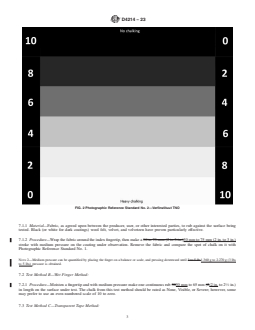
6.1 The following two photographic reference standards are
Development of International Standards, Guides and Recom-
part of these test methods. Each represents the degree of
mendations issued by the World Trade Organization Technical
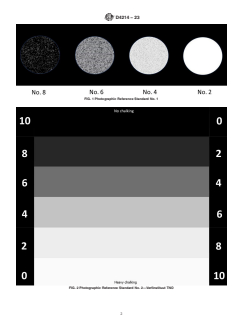
chalking on a paint film. The photographs shown in Fig. 1 and
Barriers to Trade (TBT) Committee.
Fig. 2 are to be used for the evaluation of degree of chalking.
6.2 The use of photographic reference standards Fig. 1 and
2. Referenced Documents
Fig. 2 requires the following precautions:
2.1 ASTM Standards:
6.2.1 The degree of chalking may vary over any given area.
D662 Test Method for Evaluating Degree of Erosion of
It is important, therefore, to select a representative portion of
Exterior Paints
the coated material to evaluate. On large surfaces, it is
D3330 Test Method for Peel Adhesion of Pressure-Sensitive
recommended that the rating be made at several locations and
Tape
the mean and range reported.
E177 Practice for Use of the Terms Precision and Bias in
6.2.2 It is difficult to make readings outdoors on a windy
ASTM Test Methods
day, and making readings at such time should be avoided. It
E691 Practice for Conducting an Interlaboratory Study to
should also be noted that rain, snow, or moisture in any form
will remove chalk, so readings should be made after a period of
clear weather and when the surface is dry.
These test methods are under the jurisdiction of ASTM Committee D01 on
6.2.3 Chalking and erosion (Note 1) are closely related.
Paint and Related Coatings, Materials, and Applications and are the direct
responsibility of Subcommittee D01.25 on Evaluation of Weathering Effects.
However, the rate of chalking as measured by these test
Current edition approved Oct. 1, 2023. Published October 2023. Originally
methods, and the rate of erosion may not be comparable
approved in 1982. Last previous edition approved in 2015 as D4214 – 07 (2015).
because some pigment combinations tend to retain chalk on the
DOI: 10.1520/D4214-23.
surface while other pigment combinations exert a self-cleaning
For referenced ASTM standards, visit the ASTM website, www.astm.org, or
contact ASTM Customer Service at service@astm.org. For Annual Book of ASTM
action by natural means.
Standards volume information, refer to the standard’s Document Summary page on
the ASTM website. NOTE 1—For the evaluation of erosion, see Test Method D662.
Copyright © ASTM International, 100 Barr Harbor Drive, PO Box C700, West Conshohocken, PA 19428-2959. United States
D4214 − 23
FIG. 1 Photographic Reference Standard No. 1
FIG. 2 Photographic Reference Standard No. 2—Verfinstituut TNO
D4214 − 23
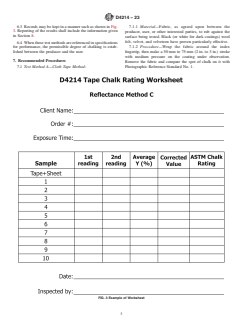
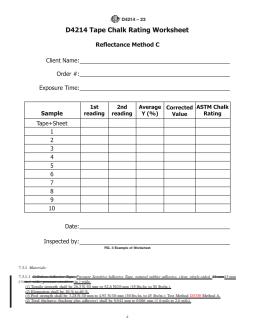
6.3 Records may be kept in a manner such as shown in Fig. 7.1.1 Material—Fabric, as agreed upon between the
3. Reporting of the results shall include the information given producer, user, or other interested parties, to rub against the
in Section 8.
surface being tested. Black (or white for dark coatings) wool
felt, velvet, and velveteen have proven particularly effective.
6.4 When these test methods are referenced in specifications
for performance, the permissible degree of chalking is estab- 7.1.2 Procedure—Wrap the fabric around the index
lished between the producer and the user. fingertip, then make a 50 mm to 75 mm (2 in. to 3 in.) stroke
with medium pressure on the coating under observation.
7. Recommended Procedures
Remove the fabric and compare the spot of chalk on it with
7.1 Test Method A—Cloth Tape Method: Photographic Reference Standard No. 1.
FIG. 3 Example of Worksheet
D4214 − 23
NOTE 2—Medium pressure can be quantified by placing the finger on a
of the clear plastic sheet cover, leaving about 32 mm (1 ⁄4 in.)
balance or scale, and pressing downward until 1.360 g to 2.270 g (3 lbs to
of space between the pieces (see Fig. 4).
5 lbs) pressure is obtained.
7.2 Test Method B—Wet Finger Method:
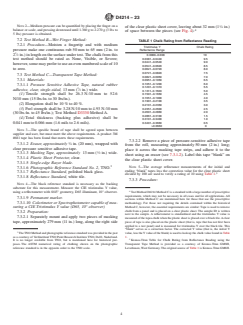
TABLE 1 Chalk Rating from Reflectance Reading
7.2.1 Procedure—Moisten a fingertip and with medium
Tristimulus Y Chalk Rating
pressure make one continuous rub 50 mm to 65 mm (2 in. to
Reflectance Range
2 ⁄2 in.) in length on the surface under test. The chalk from this
0.0000–0.038 10
0.0381–0.0440 9.5
test method should be rated as None, Visible, or Severe;
0.0441–0.0540 9.0
however, some may prefer to use an even numbered scale of 10
0.0541–0.0620 8.5
to zero.
0.0621–0.0720 8.0
0.0721–0.0820 7.5
7.3 Test Method C—Transparent Tape Method:
0.0821–0.0950 7.0
7.3.1 Materials: 0.0951–0.1050 6.5
0.1051–0.1200 6.0
7.3.1.1 Pressure Sensitive Adhesive Tape, natural rubber
0.1201–0.1310 5.5
adhesive, clear, single-sided, 13 mm ( ⁄2 in.) wide.
0.1311–0.1500 5.0
(1) Tensile strength shall be 26.3 N ⁄10 mm to 52.6 0.1501–0.1650 4.5
0.1651–0.1900 4.0
N/10 mm (15 lbs ⁄in. to 30 lbs/in.).
0.1901–0.2100 3.5
(2) Elongation shall be 10 % to 40 %.
0.2101–0.2350 3.0
(3) Peel strength shall be 3.28 N ⁄10 mm to 4.93 N ⁄10 mm 0.2351–0.2600 2.5
0.2601–0.2860 2.0
(30 lbs ⁄in. to 45 lbs/in.); Test Method D3330 Method A.
0.2861–0.3100 1.5
(4) Total thickness (backing plus adhesive) shall be
0.3101–0.3400 1.0
0.3401–0.3660 0.5
0.041 mm to 0.066 mm (1.6 mils to 2.6 mils).
>0.3660 0
NOTE 3—The specific brand of tape shall be agreed upon between
supplier and user, but must meet the above requirements. A product 3M
#681 tape has been found that meets these requirements.
7.3.2.2 Remove a piece of pressure-sensitive adhesive tape
7.3.1.2 Eraser, approximately ⁄4 in. (20 mm), wrapped with
from the roll, measuring approximately 50 mm (2 in.) long;
clear pressure sensitive adhesive tape.
place it across the masking tape strips, and adhere it to the
7.3.1.3 Masking Tape, approximately 13 mm ( ⁄2 in.) wide.
sheet using an eraser (see 7.3.1.2). Label this tape “blank” on
7.3.1.4 Plastic Sheet Protector, clear.
the clear plastic sheet cover.
7.3.1.5 Single-edge Razor blade.
NOTE 5—The average reflectance measurements of the initial and
7.3.1.6 Photographic Reference Standard No. 2, TNO.
ending “blank” tapes less the correction value for the clear plastic sheet
7.3.1.7 Reflectance Standard, polished black glass.
divided by 100 are used to verify a rating of 10 using Table 1.
7.3.1.8 Reflectance Standard, white tile.
7.3.3 Procedure:
NOTE 4—The black reference standard is necessary as the backing
substrate for this measurement. Measure the CIE tristimulus Y value,
using a reflectometer with 0/45° geometry, D65 illuminant, 10° observer. Test Method D4214 Method C is a standard with a large number of prescriptive
requirements, which may not be necessary in all cases and for all applications. All
7.3.1.9 Permanent marker.
sections within Method C are maintained here for those that use the prescriptive
7.3.1.10 Colorimeter or Spectrophotometer capable of mea-
methodology. For those not requiring the details contained within the historical
Method C, however, the essential requirements are similar: Tape is used to remove
suring a CIE Tristimulus Y value (D65, 10° observer)
chalk from a panel and is placed on a clear plastic sheet. The sample ID is written
7.3.2 Preparation:
next to the sample. A reflectometer is standardized and the tristimulus Y value is
7.3.2.1 Separately mount and apply two pieces of masking
measured of the tape+chalk when the plastic sheet is placed over a black tile. A clear
tape, approximately 279 mm (11 in.) long, along the right side piece of tape is also placed on the plastic sheet (that is, tape that has not first been
applied to a test panel) and is measured for tristimulus Y over the black tile. This
"blank" serves as a correction factor. The corrected Y value (that is, the initial Y
The TNO Method and photographic reference standard was provided in the past value, less the Y value of the blank) is used to
...
This document is not an ASTM standard and is intended only to provide the user of an ASTM standard an indication of what changes have been made to the previous version. Because
it may not be technically possible to adequately depict all changes accurately, ASTM recommends that users consult prior editions as appropriate. In all cases only the current version
of the standard as published by ASTM is to be considered the official document.
Designation: D4214 − 07 (Reapproved 2015) D4214 − 23
Standard Test Methods for
Evaluating the Degree of Chalking of Exterior Paint Films
This standard is issued under the fixed designation D4214; the number immediately following the designation indicates the year of
original adoption or, in the case of revision, the year of last revision. A number in parentheses indicates the year of last reapproval. A
superscript epsilon (´) indicates an editorial change since the last revision or reapproval.
This standard has been approved for use by agencies of the U.S. Department of Defense.
1. Scope
1.1 These test methods cover the evaluation of the degree of chalking on white or tinted exterior paint films. These test methods
describe the procedures recommended for transferring the chalk to a fabric or fingertip, which is then compared to photographic
reference standards, or in the case of adhesive tapes, compared to a reflectance table or photographic reference standards, to
determine the degree of chalking.
1.2 The values stated in SI units are to be regarded as the standard. The values given in parentheses are for information only.
1.3 This standard does not purport to address all of the safety concerns, if any, associated with its use. It is the responsibility
of the user of this standard to establish appropriate safety and healthsafety, health, and environmental practices and determine
the applicability of regulatory limitations prior to use.
1.4 This international standard was developed in accordance with internationally recognized principles on standardization
established in the Decision on Principles for the Development of International Standards, Guides and Recommendations issued
by the World Trade Organization Technical Barriers to Trade (TBT) Committee.
2. Referenced Documents
2.1 ASTM Standards:
D662 Test Method for Evaluating Degree of Erosion of Exterior Paints
D3330 Test Method for Peel Adhesion of Pressure-Sensitive Tape
E177 Practice for Use of the Terms Precision and Bias in ASTM Test Methods
E691 Practice for Conducting an Interlaboratory Study to Determine the Precision of a Test Method
E1347 Test Method for Color and Color-Difference Measurement by Tristimulus Colorimetry
2.2 Other Document:
Pictorial Standards of Coating Defects
3. Terminology
3.1 Definitions:
3.1.1 chalking, n—the formation on a pigmented coating of a friable powder evolved from the film itself at or just beneath the
surface.
These test methods are under the jurisdiction of ASTM Committee D01 on Paint and Related Coatings, Materials, and Applications and are the direct responsibility of
Subcommittee D01.25 on Evaluation of Weathering Effects.
Current edition approved June 1, 2015Oct. 1, 2023. Published June 2015October 2023. Originally approved in 1982. Last previous edition approved in 20072015 as
D4214 – 07.D4214 – 07 (2015). DOI: 10.1520/D4214-07R15.10.1520/D4214-23.
For referenced ASTM standards, visit the ASTM website, www.astm.org, or contact ASTM Customer Service at service@astm.org. For Annual Book of ASTM Standards
volume information, refer to the standard’s Document Summary page on the ASTM website.
Copyright © ASTM International, 100 Barr Harbor Drive, PO Box C700, West Conshohocken, PA 19428-2959. United States
D4214 − 23
4. Significance and Use
4.1 The procedures provide a broad range of techniques and photographic references to evaluate chalking of exterior paints.
5. Type of Chalking
5.1 Only one type of chalking is recognized, as defined in Section 3.
6. Use of Photographic Reference Standards
6.1 The photographic following two photographic reference standards that are part of these test methods are representative of the
degreesmethods. Each represents the degree of chalking on a paint film. The photographs shown in Fig. 1 and Fig. 2 are for
illustration purposes only and should not be used for evaluation.to be used for the evaluation of degree of chalking.
6.2 The use of photographic reference standards illustrated in Fig. 1 and Fig. 2 requires the following precautions:
6.2.1 The degree of chalking willmay vary over any given area. Therefore, an average It is important, therefore, to select a
representative portion of the coating should be evaluated.coated material to evaluate. On large surfaces, it is recommended that
the rating be made at several locations and the mean and range reported.
6.2.2 It is difficult to make readingsreadings outdoors on a windy day and day, and making readings at such time should be
avoided. It should also be noted that rain, snow, or moisture in any form will remove chalk, so that readings should be made after
a period of clear weather and when the surface is dry.
6.2.3 Chalking and erosion (Note 1) are closely related. However, the rate of chalking as measured by these test methods, and the
rate of erosion may not be comparable because some pigment combinations tend to retain chalk on the surface while other pigment
combinations exert a self-cleaning action by natural means.
NOTE 1—For the evaluation of erosion, see Test Method D662.
6.3 Records may be kept on formsin a manner such as shown in Fig. 3. Reporting of the results shall include the information given
in Section 8.
6.4 When these test methods isare referenced in specifications for performance, the permissible degree of chalking is established
between the producer and the user.
7. Recommended Procedures
7.1 Test Method A—Cloth Tape Method:
FIG. 1 Photographic Reference Standard No. 1—Test Method 1D659
D4214 − 23
FIG. 2 Photographic Reference Standard No. 2—Verfinstituut TNO
7.1.1 Material—Fabric, as agreed upon between the producer, user, or other interested parties, to rub against the surface being
tested. Black (or white for dark coatings) wool felt, velvet, and velveteen have proven particularly effective.
7.1.2 Procedure—Wrap the fabric around the index fingertip, then make a 50 to 75-mm (2 to 3-in.)50 mm to 75 mm (2 in. to 3 in.)
stroke with medium pressure on the coating under observation. Remove the fabric and compare the spot of chalk on it with
Photographic Reference Standard No. 1.
NOTE 2—Medium pressure can be quantified by placing the finger on a balance or scale, and pressing downward until 3 to 5-lb 1.360 g to 2.270 g (3 lbs
to 5 lbs) pressure is obtained.
7.2 Test Method B—Wet Finger Method:
7.2.1 Procedure—Moisten a fingertip and with medium pressure make one continuous rub 5050 mm to 65 mm (2(2 in. to 2 ⁄2 in.)
in length on the surface under test. The chalk from this test method should be rated as None, Visible, or Severe; however, some
may prefer to use an even numbered scale of 10 to zero.
7.3 Test Method C—Transparent Tape Method:
D4214 − 23
FIG. 3 Example of Worksheet
7.3.1 Materials:
7.3.1.1 Cellulose Adhesive Tape, Pressure Sensitive Adhesive Tape, natural rubber adhesive, clear, single-sided, 13-mm13 mm
( ⁄2-in.) wide, pressure-sensitive. in.) wide.
(1) Tensile strength shall be 26.3 N ⁄10 mm to 52.6 N/10 mm (15 lbs ⁄in. to 30 lbs/in.).
(2) Elongation shall be 10 % to 40 %.
(3) Peel strength shall be 3.28 N ⁄10 mm to 4.93 N ⁄10 mm (30 lbs ⁄in. to 45 lbs/in.); Test Method D3330 Method A.
(4) Total thickness (backing plus adhesive) shall be 0.041 mm to 0.066 mm (1.6 mils to 2.6 mils).
D4214 − 23
NOTE 3—The specific brand of tape shall be agreed upon between supplier and user, but must meet the above requirements. A product 3M #681 tape has
been found that meets these requirements.
7.3.1.2 Eraser, approximately ⁄4 in. (20 mm), wrapped with cellophane tape.clear pressure sensitive adhesive tape.
7.3.1.3 Masking Tape, 13-mmapproximately 13 mm ( ⁄2-in.) in.) wide.
7.3.1.4 Plastic Sheet Protector, clear.
7.3.1.5 Single-edge Razor blade.
7.3.1.6 Photographic Reference Standard No. 2, TNO.
7.3.1.7 Reflectance Standard, polished black glass.
7.3.1.8 Reflectance Standard, white tile.
NOTE 4—The black reference standard is necessary as the background backing substrate for this measurement, since the reflectance of black paper is too
high. Reflectometers (tristimulus colorimeters), with 0 to 45° geometry, use themeasurement. Measure the CIE tristimulus Y value, using a reflectometer
with 0/45° geometry, D65 illuminant, Y10°value. observer.
7.3.1.9 Permanent marker.
7.3.1.10 Colorimeter or Spectrophotometer capable of measuring a CIE Tristimulus Y value (D65, 10° observer)
7.3.2 Optional Materials:
7.3.2.1 China Marker, black.
7.3.2.2 Razor Blade.
7.3.2 Preparation:
7.3.2.1 Separately mount and apply two 279-mm (11-in.) pieces of masking tape along tape, approximately 279 mm (11 in.)
long, along the right side of the clear plastic sheet cover leaving 32cover, leaving about 32 mm (1 ⁄4 in.) of space between the
pieces (see Fig. 4).
7.3.2.2 Remove a 50-mm (2-in.) long piece of 13-mm ( ⁄2-in.) cellulose, pressure-sensitive adhesive tape from the roll; roll,
measuring approximately 50 mm (2 in.) long; place it across the masking tape strips, and adhere it to the sheet using a 20-mm (an
eraser (see ⁄4-in.) 7.3.1.2eraser, wrapped with cellophane tape. ). Label this tape “blank” on the clear plastic sheet cover. A black
china marker has been found useful for this purpose.
NOTE 5—The average reflectance measurements of the initial and ending “blank” tapes less the correction value for the clear plastic sheet divided by 100
are used to verify a rating of 10 using Table 1.
7.3.3 Procedure:
The TNO Method and photographic reference standard are provided was provided in the past as a courtesy of Verfinstituut TNO Paint Research Institute TNO,
Schoemakerstraat 97, Delft, Nederland. The original source of the photographic reference standard illustrated in Delft, Nederland. It is no longer available from TNO, but
Fig. 2is the Paint Research Institute, TNO. The mentioned here for historical purposes. The ASTM numerical rating of chalking shown on the photographic reference standard
is in the opposite order to the original TNO scale.
Test Method D4214 Method C is a standard with a large number of prescriptive requirements, which may not be necessary in all cases and for all applications. All sections
within Method C are maintained here for those that use the prescriptive methodology. For those not requiring the details contained within the historical Method C, however,
the essential requirements are similar: Tape is used to remove chalk from a panel and is placed on a clear plastic sheet. The sample ID is written next to the sample. A
reflectometer is standardized and the tristimulus Y value is measured of the tape+chalk when the plastic sheet is placed over a black tile. A clear piece of tape is also placed
on the plastic sheet (that is, tape that has not first been applied to a test panel) and is measured for tristimulus Y over the black tile. This "blank" serves as a correction factor.
The corrected Y value (that is, the initial Y value, less the Y value of the blank) is used to look up the chalk value found in Table 1.
Kronos-Titan Table for Chalk Rating from Reflectance Reading using the Transparent Tape Method is provided as a courtesy of Kronos-Titan GMbH, Leverkusen, West
Germany. The original source of Table 1 is Kronos-Titan GMbH.
D4214 − 23
FIG. 4 Completed Worksheet
7.3.3.1 Apply clear adhesive tape, approximately 50 mm (2 in.) long, to the surface being tested. Rub the tape ten times with
moderate pressure using the covered eraser to remove all bubbles and prevent scratching. Remove the tape from the surface and
adhere it to the sheet by rubbing with the eraser. Label the specimen.
7.3.3.2 Apply a 50-mm (2-in.) long piece of 13-mm ( ⁄2-in.) wide tape to the surface being rated. Rub ten times with moderate
pressure using the covered eraser, to remove all bub
...