

ASTM D4213-24
(Test Method)Standard Test Method for Scrub Resistance of Paints by Abrasion Weight Loss
General Information
- Abstract
SIGNIFICANCE AND USE
4.1 Interior paint films often become soiled, especially near doorways, windows, and play areas, and frequently need to be cleaned by scrubbing. This test method covers the determination of the relative resistance of paints to erosion when scrubbed.
4.2 The precision of scrub resistance measurements in absolute physical values, such as Test Methods D2486 (cycles-to-failure or this test method, microlitres per 100 cycles), is poor due to the relatively large effect of subtle and difficult-to-control variables in test conditions. The test method described herein minimizes this problem by using a standard calibration panel as an integral part of each scrubbing operation and relating its weight loss to that of the paint film under test to establish the latter's scrub resistance.
Note 1: The numerical scrub resistance values obtained by this test method are of significance only in relation to the specific calibration panel types with which the value is obtained. Thus, for example, a scrub resistance value of 83 with a Type X calibration panel would be reported as 83X.
4.3 Results obtained by this test method do not necessarily represent the scrub resistance that might be determined if the test film is allowed to dry before testing appreciably longer than the seven-day period specified herein.
4.4 Results obtained by this test method do not necessarily relate to ease of soil or stain removal (also referred to as “cleanability” or “cleansability”). To test for those characteristics use Test Methods D3450 and D4828.
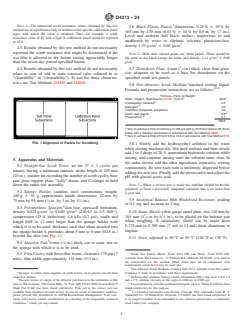
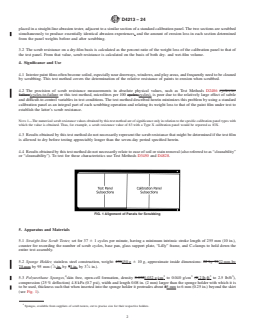
FIG. 1 Alignment of Panels for Scrubbing
SCOPE
1.1 This test method covers an accelerated procedure for determining the resistance of paints to erosion caused by scrubbing. (Note: The term wet abrasion is sometimes used for scrubbing, and wet abrasion resistance or scrubbability for scrub resistance.) Although scrub resistance tests are intended primarily for interior coatings, they are sometimes used with exterior coatings as an additional measure of film performance.
1.2 The values stated in SI units are to be regarded as the standard. The values given in parentheses are for information only.
1.3 This standard does not purport to address all of the safety concerns, if any, associated with its use. It is the responsibility of the user of this standard to establish appropriate safety, health, and environmental practices and determine the applicability of regulatory limitations prior to use.
1.4 This international standard was developed in accordance with internationally recognized principles on standardization established in the Decision on Principles for the Development of International Standards, Guides and Recommendations issued by the World Trade Organization Technical Barriers to Trade (TBT) Committee.
- Status
- Published
- Publication Date
- 31-Jan-2024
- Technical Committee
- D01 - Paint and Related Coatings, Materials, and Applications
- Drafting Committee
- D01.42 - Architectural Coatings
Overview
ASTM D4213-24 is an international standard test method developed by ASTM International, specifying an accelerated procedure for determining the scrub resistance of paints by measuring abrasion weight loss. Scrub resistance, also referred to as wet abrasion resistance or scrubbability, is a critical performance indicator for interior paints, especially in high-traffic areas where surfaces are often subjected to cleaning or scrubbing. This standard primarily applies to interior paint coatings but may also be used for evaluating certain exterior coatings as an additional measure of film performance.
The method involves subjecting a painted panel and a standard calibration panel to simultaneous scrubbing under controlled conditions, then comparing the relative weight loss. The scrub resistance values are significant mainly in relation to the calibration panel type used in the test.
Key Topics
- Scrub Resistance Assessment: Measures how well a paint film withstands erosion due to repeated scrubbing, reflecting durability and longevity under cleaning stress.
- Standardized Procedure: Utilizes a straight-line scrub tester and standard calibration panels, ensuring consistency and comparability of results.
- Relative Measurement: The method minimizes the influence of subtle test variables by directly comparing the test panel’s performance with that of a calibration standard.
- Result Interpretation: Values should always be reported with reference to the calibration panel type (e.g., 83X), as results are specific to the panel used.
- Limitations:
- Does not directly assess cleanability or soil/stain removal properties (other ASTM methods are recommended for those characteristics).
- Results are based on a fixed drying time for test films and may vary if drying time differs.
- Safety, health, and environmental considerations must be taken into account by the user.
Applications
ASTM D4213-24 is widely used in:
- Paint Formulation and Quality Control: Enables manufacturers and formulators to evaluate and improve paint durability for regions prone to frequent cleaning, such as around doorways, windows, and children’s play areas.
- Product Comparison: Offers paint producers, specifiers, and end users a standardized measure to compare scrub resistance across different products or batches.
- Regulatory Testing: Supports compliance with national and international requirements for architectural coatings, especially regarding durability claims.
- R&D and Performance Benchmarking: Industrial laboratories and research institutions utilize this test method to benchmark innovations in paint technologies or raw material compositions.
Related Standards
Several ASTM standards complement or are referenced by ASTM D4213-24:
- ASTM D2486: Test Methods for Scrub Resistance of Wall Paints - provides alternative methods for evaluating cycles to failure.
- ASTM D3450, ASTM D4828: Methods for evaluating the cleanability and washability of organic paint coatings.
- ASTM D562: Method for measuring the viscosity of paints.
- ASTM D1193: Specification for reagent water used in testing.
- ASTM D1475: Method for determining density of liquid coatings.
- ASTM E70: Method for measuring pH of aqueous solutions.
- ASTM E691: Practice for conducting interlaboratory precision studies.
- Practice D3980, Practice E180: Guidelines for interlaboratory studies and precision determination.
Practical Value
Adopting ASTM D4213-24 ensures that paint products meet customer expectations for durability in demanding environments. By offering a reproducible and standardized assessment of scrub resistance, this standard helps manufacturers maintain consistency in quality, supports marketing claims, and enables specifiers and end-users to make informed decisions when selecting architectural coatings.
Keywords: abrasion resistance, scrub resistance, wet abrasion, scrubbability, paint durability, abrasion weight loss, interior coatings, ASTM standards, washability, paint testing
Relations
- Replaces
ASTM D4213-08(2016) - Standard Test Method for Scrub Resistance of Paints by Abrasion Weight Loss - Effective Date
- 01-Feb-2024
- Effective Date
- 01-Feb-2024
- Effective Date
- 01-Feb-2024
- Effective Date
- 01-Feb-2024
- Effective Date
- 01-Feb-2024
Frequently Asked Questions
ASTM D4213-24 is a standard published by ASTM International. Its full title is "Standard Test Method for Scrub Resistance of Paints by Abrasion Weight Loss". This standard covers: SIGNIFICANCE AND USE 4.1 Interior paint films often become soiled, especially near doorways, windows, and play areas, and frequently need to be cleaned by scrubbing. This test method covers the determination of the relative resistance of paints to erosion when scrubbed. 4.2 The precision of scrub resistance measurements in absolute physical values, such as Test Methods D2486 (cycles-to-failure or this test method, microlitres per 100 cycles), is poor due to the relatively large effect of subtle and difficult-to-control variables in test conditions. The test method described herein minimizes this problem by using a standard calibration panel as an integral part of each scrubbing operation and relating its weight loss to that of the paint film under test to establish the latter's scrub resistance. Note 1: The numerical scrub resistance values obtained by this test method are of significance only in relation to the specific calibration panel types with which the value is obtained. Thus, for example, a scrub resistance value of 83 with a Type X calibration panel would be reported as 83X. 4.3 Results obtained by this test method do not necessarily represent the scrub resistance that might be determined if the test film is allowed to dry before testing appreciably longer than the seven-day period specified herein. 4.4 Results obtained by this test method do not necessarily relate to ease of soil or stain removal (also referred to as “cleanability” or “cleansability”). To test for those characteristics use Test Methods D3450 and D4828. FIG. 1 Alignment of Panels for Scrubbing SCOPE 1.1 This test method covers an accelerated procedure for determining the resistance of paints to erosion caused by scrubbing. (Note: The term wet abrasion is sometimes used for scrubbing, and wet abrasion resistance or scrubbability for scrub resistance.) Although scrub resistance tests are intended primarily for interior coatings, they are sometimes used with exterior coatings as an additional measure of film performance. 1.2 The values stated in SI units are to be regarded as the standard. The values given in parentheses are for information only. 1.3 This standard does not purport to address all of the safety concerns, if any, associated with its use. It is the responsibility of the user of this standard to establish appropriate safety, health, and environmental practices and determine the applicability of regulatory limitations prior to use. 1.4 This international standard was developed in accordance with internationally recognized principles on standardization established in the Decision on Principles for the Development of International Standards, Guides and Recommendations issued by the World Trade Organization Technical Barriers to Trade (TBT) Committee.
SIGNIFICANCE AND USE 4.1 Interior paint films often become soiled, especially near doorways, windows, and play areas, and frequently need to be cleaned by scrubbing. This test method covers the determination of the relative resistance of paints to erosion when scrubbed. 4.2 The precision of scrub resistance measurements in absolute physical values, such as Test Methods D2486 (cycles-to-failure or this test method, microlitres per 100 cycles), is poor due to the relatively large effect of subtle and difficult-to-control variables in test conditions. The test method described herein minimizes this problem by using a standard calibration panel as an integral part of each scrubbing operation and relating its weight loss to that of the paint film under test to establish the latter's scrub resistance. Note 1: The numerical scrub resistance values obtained by this test method are of significance only in relation to the specific calibration panel types with which the value is obtained. Thus, for example, a scrub resistance value of 83 with a Type X calibration panel would be reported as 83X. 4.3 Results obtained by this test method do not necessarily represent the scrub resistance that might be determined if the test film is allowed to dry before testing appreciably longer than the seven-day period specified herein. 4.4 Results obtained by this test method do not necessarily relate to ease of soil or stain removal (also referred to as “cleanability” or “cleansability”). To test for those characteristics use Test Methods D3450 and D4828. FIG. 1 Alignment of Panels for Scrubbing SCOPE 1.1 This test method covers an accelerated procedure for determining the resistance of paints to erosion caused by scrubbing. (Note: The term wet abrasion is sometimes used for scrubbing, and wet abrasion resistance or scrubbability for scrub resistance.) Although scrub resistance tests are intended primarily for interior coatings, they are sometimes used with exterior coatings as an additional measure of film performance. 1.2 The values stated in SI units are to be regarded as the standard. The values given in parentheses are for information only. 1.3 This standard does not purport to address all of the safety concerns, if any, associated with its use. It is the responsibility of the user of this standard to establish appropriate safety, health, and environmental practices and determine the applicability of regulatory limitations prior to use. 1.4 This international standard was developed in accordance with internationally recognized principles on standardization established in the Decision on Principles for the Development of International Standards, Guides and Recommendations issued by the World Trade Organization Technical Barriers to Trade (TBT) Committee.
ASTM D4213-24 is classified under the following ICS (International Classification for Standards) categories: 87.040 - Paints and varnishes. The ICS classification helps identify the subject area and facilitates finding related standards.
ASTM D4213-24 has the following relationships with other standards: It is inter standard links to ASTM D4213-08(2016), ASTM D3730-17(2022), ASTM D2486-17, ASTM D5324-16(2022), ASTM D5146-10(2019). Understanding these relationships helps ensure you are using the most current and applicable version of the standard.
ASTM D4213-24 is available in PDF format for immediate download after purchase. The document can be added to your cart and obtained through the secure checkout process. Digital delivery ensures instant access to the complete standard document.
Standards Content (Sample)
This international standard was developed in accordance with internationally recognized principles on standardization established in the Decision on Principles for the
Development of International Standards, Guides and Recommendations issued by the World Trade Organization Technical Barriers to Trade (TBT) Committee.
Designation: D4213 − 24
Standard Test Method for
Scrub Resistance of Paints by Abrasion Weight Loss
This standard is issued under the fixed designation D4213; the number immediately following the designation indicates the year of
original adoption or, in the case of revision, the year of last revision. A number in parentheses indicates the year of last reapproval. A
superscript epsilon (´) indicates an editorial change since the last revision or reapproval.
1. Scope Architectural Coatings
D3980 Practice for Interlaboratory Testing of Paint and
1.1 This test method covers an accelerated procedure for
Related Materials (Withdrawn 1998)
determining the resistance of paints to erosion caused by
D4828 Test Methods for Practical Washability of Organic
scrubbing. (Note: The term wet abrasion is sometimes used for
Coatings
scrubbing, and wet abrasion resistance or scrubbability for
E70 Test Method for pH of Aqueous Solutions With the
scrub resistance.) Although scrub resistance tests are intended
Glass Electrode
primarily for interior coatings, they are sometimes used with
E691 Practice for Conducting an Interlaboratory Study to
exterior coatings as an additional measure of film performance.
Determine the Precision of a Test Method
1.2 The values stated in SI units are to be regarded as the
standard. The values given in parentheses are for information
3. Summary of Test Method
only.
3.1 The material under test is applied to a black plastic scrub
1.3 This standard does not purport to address all of the
test panel, and after drying one week, a section of the test panel
safety concerns, if any, associated with its use. It is the
is placed in a straight-line abrasion tester, adjacent to a similar
responsibility of the user of this standard to establish appro-
section of a standard calibration panel. The two sections are
priate safety, health, and environmental practices and deter-
scrubbed simultaneously to produce essentially identical abra-
mine the applicability of regulatory limitations prior to use.
sion experiences, and the amount of erosion loss in each
1.4 This international standard was developed in accor-
section determined from the panel weights before and after
dance with internationally recognized principles on standard-
scrubbing.
ization established in the Decision on Principles for the
3.2 The scrub resistance on a dry-film basis is calculated as
Development of International Standards, Guides and Recom-
the percent ratio of the weight loss of the calibration panel to
mendations issued by the World Trade Organization Technical
that of the test panel. From that value, scrub resistance is
Barriers to Trade (TBT) Committee.
calculated on the basis of both dry- and wet-film volume.
2. Referenced Documents
4. Significance and Use
2.1 ASTM Standards:
4.1 Interior paint films often become soiled, especially near
D562 Test Method for Consistency of Paints Measuring
doorways, windows, and play areas, and frequently need to be
Krebs Unit (KU) Viscosity Using a Stormer-Type Viscom-
cleaned by scrubbing. This test method covers the determina-
eter
tion of the relative resistance of paints to erosion when
D1193 Specification for Reagent Water
scrubbed.
D1475 Test Method for Density of Liquid Coatings, Inks,
and Related Products
4.2 The precision of scrub resistance measurements in
D2486 Test Methods for Scrub Resistance of Wall Paints
absolute physical values, such as Test Methods D2486 (cycles-
D3450 Test Method for Washability Properties of Interior
to-failure or this test method, microlitres per 100 cycles), is
poor due to the relatively large effect of subtle and difficult-
to-control variables in test conditions. The test method de-
This test method is under the jurisdiction of ASTM Committee D01 on Paint
scribed herein minimizes this problem by using a standard
and Related Coatings, Materials, and Applications and is the direct responsibility of
calibration panel as an integral part of each scrubbing operation
Subcommittee D01.42 on Architectural Coatings.
and relating its weight loss to that of the paint film under test
Current edition approved Feb. 1, 2024. Published February 2024. Originally
to establish the latter’s scrub resistance.
approved in 1983. Last previous edition approved in 2016 as D4213 – 08 (2016).
DOI: 10.1520/D4213-24.
For referenced ASTM standards, visit the ASTM website, www.astm.org, or
contact ASTM Customer Service at service@astm.org. For Annual Book of ASTM
Standards volume information, refer to the standard’s Document Summary page on The last approved version of this historical standard is referenced on
the ASTM website. www.astm.org.
Copyright © ASTM International, 100 Barr Harbor Drive, PO Box C700, West Conshohocken, PA 19428-2959. United States
D4213 − 24
NOTE 1—The numerical scrub resistance values obtained by this test
5.6 Black Plastic Panels, dimensions: 0.25 % 6 10 % by
method are of significance only in relation to the specific calibration panel
165 mm by 430 mm (0.01 % 6 10 % by 6.5 in. by 17 in.).
types with which the value is obtained. Thus, for example, a scrub
Level and uniform dull black surface, impervious to and
resistance value of 83 with a Type X calibration panel would be reported
unaffected by water or aliphatic solvents, plasticizer-free,
as 83X.
3 3
density 1.33 g ⁄cm 6 0.05 g/cm .
4.3 Results obtained by this test method do not necessarily
represent the scrub resistance that might be determined if the
NOTE 2—With dark colored paints use white panels. These should be
test film is allowed to dry before testing appreciably longer the same as the black except for color, and density: 1.41 g ⁄cm 6 0.05
g/cm .
than the seven-day period specified herein.
5.7 Drawdown Plate, 6 mm ( ⁄4 in.) thick, clear float glass,
4.4 Results obtained by this test method do not necessarily
size adequate to be used as a base for drawdowns on the
relate to ease of soil or stain removal (also referred to as
specified scrub test panels.
“cleanability” or “cleansability”). To test for those character-
istics use Test Methods D3450 and D4828.
5.8 Non-Abrasive Scrub Medium, standard wetting liquid.
8-10
Formula and preparation instructions are as follows:
Formula—Parts by Weight
A
Water, reagent, Specification D1193, Type IV 89.6
Hydroxyethyl cellulose 2.0
Detergent 4.0
Trisodium phosphate, anhydrous 4.0
B
Acetic acid glacial 0.3
Preservative 0.1
100.0
A
Vary to achieve a final consistency of 165 g to 220 g (75 Krebs Units to 85 Krebs
Units) with a Stormer viscometer in accordance with Test Method D562.
B
Vary to achieve a final pH from 9.5 to 10.0 in accordance with Test Method E70.
FIG. 1 Alignment of Panels for Scrubbing
5.8.1 Slowly add the hydroxyethyl cellulose to the water
while stirring mechanically. Stir until uniform and then slowly
add 2 to 3 drops of 28 % ammonium hydroxide solution while
mixing, and continue mixing until the solution turns clear. In
5. Apparatus and Materials
the order shown, add the other ingredients separately, stirring
5.1 Straight-line Scrub Tester, set for 37 6 1 cycles per
continuously. Be sure each item is uniformly dispersed before
minute, having a minimum intrinsic stroke length of 255 mm
adding the next one. Finally, add the preservative and adjust the
(10 in.), counter for recording the number of scrub cycles, base
pH with glacial acetic acid.
pan, glass support plate, “Lilly” frame, and C-clamps to hold
NOTE 3—When a referee test is made the medium should be freshly
down the entire test assembly.
prepared, or from a previously unopened container that is no more than
5.2 Sponge Holder, stainless steel construction, weight:
1-year old.
450 g 6 10 g, approximate inside dimensions: 22 mm by
5.9 Analytical Balance With Windshield Enclosure, reading
7 3
75 mm by 95 mm ( ⁄8 in. by 3 in. by 3 ⁄4 in.).
to 0.1 mg and accurate to 1 mg.
5.3 Polyurethane Sponges, skin free, open-cell formation,
3 3 3 3
5.10 Static Shield, a thin gauge metal plate, size 110 mm by
density 0.032 g ⁄cm to 0.040 g/cm (2 lb ⁄ft to 2.5 lb/ft ),
1 1
165 mm (4 ⁄4 in. by 6 ⁄2 in.), to be placed on the balance pan
compression (25 % deflection) 4.8 kPa (0.7 psi), width and
when weighing. A satisfactory shield can be made from
length 0.08 in. (2 mm) larger than the sponge holder with
0.175 mm to 0.300 mm (7 mil to 12 mil) thick aluminum or
which it is to be used, thickness such that when inserted into
tinplate.
the sponge holder it protrudes about 5 mm to 6 mm (0.25 in.)
beyond the skirt (see Fig. 1).
5.11 Oven, adjusted to 50 °C to 55 °C (120 °F to 130 °F).
5.4 Abrasive Pad, 6 mm ( ⁄4 in.) thick, cut to same size as
the sponge with which it is to be used.
5.5 Film Caster, with horseshoe frame, clearance 175 μm (7 Scrub Test Panels—Black: Form P121-10N and White: Form P122-10N,
1 available from The Leneta Co., 15 Whitney Rd., Mahwah, NJ 07430, were used in
mils), film width approximately 135 mm (5 ⁄4 in.).
the round-robin for this method. Other charts that are in compliance with
requirements stated in 5.6 may be used also.
Non-Abrasive Scrub Medium—Catalog Item SC-1 available from The Leneta
Sponges, available from suppliers of scrub testers, cut to precise size for their Company is made in accordance with these requirements.
respective holders. Hydroxyethyl cellulose having a molar substitution (MS) value from 1.8 to 2.5
The sole source of supply of the abrasive pad known to the committee at this and a 2 % solution viscosity in the range of 4400 cps to 6500 cps.
time is 3M Company, 3M Center Bldg., St. Paul, MN 55144-1000. Scotch-Brite™ Iso-octylphenoxy polyethoxyethanol detergent, such as Triton X-100 has been
Hand Pad #7448 has been found satisfactory. Pads cut to the correct size are found satisfactory for this purpose.
available from suppliers of scrub testers. If you are aware of alternative suppliers, 1,3,5-triethyl hexahydro-sym-triazine (Vancide TH), obtainable from R. T.
please provide this information to ASTM International Headquarters. Your com- Vanderbilt Co., 30 Winfield St., Norwalk, CT 06855, has been found satisfactory. It
ments will receive careful consideration at a meeting of the responsible technical is no longer available. It recommended to use whatever preservative is commonly
committee, which you may attend. used within your company.
D4213 − 24
NOTE 6—Use a calibration panel type similar in scrub resistance to that
5.12 Calibration Panels, prepared in advance using paints
of the test paint, unless a single standard is required for a widely varying
of suitable scrub resistance.
group of paints. In the latter case use calibration panels that can be
NOTE 4—The procedure for preparing calibration panels is the same as characterized as having “good” or intermediate scrub resistance.
described in 6.1 and 6.2 for regular test panels, except that the panels shall
6.7 Place the Lilly frame (see 5.1) on the panel assembly
be aged sufficiently before use to ensure that the effect of additional ageing
and clamp it down firmly to prevent any shift in the test
on their scrub resistance is negligible. A period of 6 months has been
assembly while scrubbing.
found adequate. Earlier use requires that in a given test series all
calibration panels be the same age.
6.8 Soak the sponge in tapwater and squeeze to a weight of
5.13 Pycnometer, for example, “weight-per-gallon” cup.
about 20 g, then place it in the sponge holder making sure the
sponge protrudes approximately 5 mm to 6 mm ( ⁄4 in.) (see
6. Procedure
Fig. 2).
6.1 Stir the test paint well by hand. (Do not shake). Strain if
6.9 Dampen the abrasive pad with tap water. Fill the
...
This document is not an ASTM standard and is intended only to provide the user of an ASTM standard an indication of what changes have been made to the previous version. Because
it may not be technically possible to adequately depict all changes accurately, ASTM recommends that users consult prior editions as appropriate. In all cases only the current version
of the standard as published by ASTM is to be considered the official document.
Designation: D4213 − 08 (Reapproved 2016) D4213 − 24
Standard Test Method for
Scrub Resistance of Paints by Abrasion Weight Loss
This standard is issued under the fixed designation D4213; the number immediately following the designation indicates the year of
original adoption or, in the case of revision, the year of last revision. A number in parentheses indicates the year of last reapproval. A
superscript epsilon (´) indicates an editorial change since the last revision or reapproval.
1. Scope
1.1 This test method covers an accelerated procedure for determining the resistance of paints to erosion caused by scrubbing.
(Note: The term wet abrasion is sometimes used for scrubbing, and wet abrasion resistance or scrubbability for scrub resistance.)
Although scrub resistance tests are intended primarily for interior coatings, they are sometimes used with exterior coatings as an
additional measure of film performance.
1.2 The values stated in SI units are to be regarded as the standard. The values given in parentheses are for information only.
1.3 This standard does not purport to address all of the safety concerns, if any, associated with its use. It is the responsibility
of the user of this standard to establish appropriate safety and healthsafety, health, and environmental practices and determine
the applicability of regulatory limitations prior to use.
1.4 This international standard was developed in accordance with internationally recognized principles on standardization
established in the Decision on Principles for the Development of International Standards, Guides and Recommendations issued
by the World Trade Organization Technical Barriers to Trade (TBT) Committee.
2. Referenced Documents
2.1 ASTM Standards:
D562 Test Method for Consistency of Paints Measuring Krebs Unit (KU) Viscosity Using a Stormer-Type Viscometer
D1193 Specification for Reagent Water
D1475 Test Method for Density of Liquid Coatings, Inks, and Related Products
D2486 Test Methods for Scrub Resistance of Wall Paints
D3450 Test Method for Washability Properties of Interior Architectural Coatings
D3980 Practice for Interlaboratory Testing of Paint and Related Materials (Withdrawn 1998)
D4828 Test Methods for Practical Washability of Organic Coatings
E70 Test Method for pH of Aqueous Solutions With the Glass Electrode
E180 Practice for Determining the Precision of ASTM Methods for Analysis and Testing of Industrial and Specialty Chemicals
(Withdrawn 2009)
E691 Practice for Conducting an Interlaboratory Study to Determine the Precision of a Test Method
3. Summary of Test Method
3.1 The material under test is applied to a black plastic scrub test panel, and after drying one week, a section of the test panel is
This test method is under the jurisdiction of ASTM Committee D01 on Paint and Related Coatings, Materials, and Applications and is the direct responsibility of
Subcommittee D01.42 on Architectural Coatings.
Current edition approved Dec. 1, 2016Feb. 1, 2024. Published December 2016February 2024. Originally approved in 1983. Last previous edition approved in 20122016
as D4213 – 08 (2012).(2016). DOI: 10.1520/D4213-08R16.10.1520/D4213-24.
For referenced ASTM standards, visit the ASTM website, www.astm.org, or contact ASTM Customer Service at service@astm.org. For Annual Book of ASTM Standards
volume information, refer to the standard’s Document Summary page on the ASTM website.
The last approved version of this historical standard is referenced on www.astm.org.
Copyright © ASTM International, 100 Barr Harbor Drive, PO Box C700, West Conshohocken, PA 19428-2959. United States
D4213 − 24
placed in a straight-line abrasion tester, adjacent to a similar section of a standard calibration panel. The two sections are scrubbed
simultaneously to produce essentially identical abrasion experiences, and the amount of erosion loss in each section determined
from the panel weights before and after scrubbing.
3.2 The scrub resistance on a dry-film basis is calculated as the percent ratio of the weight loss of the calibration panel to that of
the test panel. From that value, scrub resistance is calculated on the basis of both dry- and wet-film volume.
4. Significance and Use
4.1 Interior paint films often become soiled, especially near doorways, windows, and play areas, and frequently need to be cleaned
by scrubbing. This test method covers the determination of the relative resistance of paints to erosion when scrubbed.
4.2 The precision of scrub resistance measurements in absolute physical values, such as Test Methods D2486 cycles-to-
failure(cycles-to-failure or this test method, microlitres per 100 cycles,cycles), is poor due to the relatively large effect of subtle
and difficult-to-control variables in test conditions. The test method described herein minimizes this problem by using a standard
calibration panel as an integral part of each scrubbing operation and relating its weight loss to that of the paint film under test to
establish the latter’s scrub resistance.
NOTE 1—The numerical scrub resistance values obtained by this test method are of significance only in relation to the specific calibration panel types with
which the value is obtained. Thus, for example, a scrub resistance value of 83 with a Type X calibration panel would be reported as 83X.
4.3 Results obtained by this test method do not necessarily represent the scrub resistance that might be determined if the test film
is allowed to dry before testing appreciably longer than the seven-day period specified herein.
4.4 Results obtained by this test method do not necessarily relate to ease of soil or stain removal (also referred to as “cleanability”
or “cleansability”). To test for those characteristics use Test Methods D3450 and D4828.
FIG. 1 Alignment of Panels for Scrubbing
5. Apparatus and Materials
5.1 Straight-line Scrub Tester, set for 37 6 1 cycles per minute, having a minimum intrinsic stroke length of 255 mm (10 in.),
counter for recording the number of scrub cycles, base pan, glass support plate, “Lilly” frame, and C-clamps to hold down the
entire test assembly.
5.2 Sponge Holder, stainless steel construction, weight: 450450 g 6 10 g, approximate inside dimensions: 22 by 7522 mm by
7 3
75 mm by 95 mm ( ⁄8 in. by 33 in. by 3 ⁄4 in.).
4 3 3 3 3
5.3 Polyurethane Sponges, skin free, open-cell formation, density 0.0320.032 g ⁄cm to 0.040 g/cm (2(2 lb ⁄ft to 2.5 lb/ft ),
compression (25 % deflection) 4.8 kPa (0.7 psi), width and length 0.08 in. (2 mm) larger than the sponge holder with which it is
to be used, thickness such that when inserted into the sponge holder it protrudes about 55 mm to 6 mm (0.25 in.) beyond the skirt
(see Fig. 1).
Sponges, available from suppliers of scrub testers, cut to precise size for their respective holders.
D4213 − 24
5.4 Abrasive Pad, 6-mm6 mm ( ⁄4-in.) in.) thick, cut to same size as the sponge with which it is to be used.
5.5 Film Caster, with horseshoe frame, clearance 175 μm (7 mils), film width approximately 135 mm (5 ⁄4 in.).
5.6 Black Plastic Panels, dimensions: 0.250.25 % 6 10 % by 165165 mm by 430 mm (0.01(0.01 % 6 10 % by 6.56.5 in. by 17
in.). Level and uniform dull black surface, impervious to and unaffected by water or aliphatic solvents, plasticizer-free, density
3 3
1.331.33 g ⁄cm 6 0.05 g/cm .
3 3
NOTE 2—With dark colored paints use white panels. These should be the same as the black except for color, and density: 1.411.41 g ⁄cm 6 0.05 g/cm .
5.7 Drawdown Plate, 6-mm6 mm ( ⁄4-in.) in.) thick, clear float glass, size adequate to be used as a base for drawdowns on the
specified scrub test panels.
7 8-10
5.8 Non-Abrasive Scrub Medium, standard wetting liquid. Formula and preparation instructions are as follows:
Formula—Parts by Weight
A
Water, reagent, Specification D1193, Type IV 89.6
Hydroxyethyl cellulose 2.0
Detergent 4.0
Trisodium phosphate, anhydrous 4.0
B
Acetic acid glacial 0.3
Preservative 0.1
100.0
A
Vary to achieve a final consistency of 165165 g to 220 g (75 (75 Krebs Units to 85 Krebs Units) with a Stormer viscometer in accordance with Test Method D562.
B
Vary to achieve a final pH from 9.5 to 10.0 in accordance with Test Method E70.
5.8.1 Slowly add the hydroxyethyl cellulose to the water while stirring mechanically. Stir until uniform and then slowly add 2 to
3 drops of 28 % ammonium hydroxide solution while mixing, and continue mixing until the solution turns clear. In the order
shown, add the other ingredients separately, stirring continuously. Be sure each item is uniformly dispersed before adding the next
one. Finally, add the preservative and adjust the pH with glacial acetic acid.
NOTE 3—When a referee test is made the medium should be freshly prepared, or from a previously unopened container that is no more than 1-year old.
5.9 Analytical Balance With Windshield Enclosure, reading to 0.1 mg and accurate to 1 mg.
1 1
5.10 Static Shield, a thin gagegauge metal plate, size 110110 mm by 165 mm (4 ⁄4 by in. by 6 ⁄2 in.), to be placed on the balance
pan when weighing. A satisfactory shield can be made from 0.1750.175 mm to 0.300 mm (7(7 mil to 12 mil) thick aluminum or
tinplate.
5.11 Oven, adjusted to 50 to 55°C (120 to 130°F).50 °C to 55 °C (120 °F to 130 °F).
5.12 Calibration Panels, prepared in advance using paints of suitable scrub resistance.
Abrasive pad—Scotch-Brite #7448 manufactured by The sole source of supply of the abrasive pad known to the committee at this time is 3M Company, 3M Center Bldg.,
St. Paul, MN 55144-1000 55144-1000. Scotch-Brite™ Hand Pad #7448 has been found satisfactory. Pads cut to the correct size are available from suppliers of scrub testers.
If you are aware of alternative suppliers, please provide this information to ASTM International Headquarters. Your comments will receive careful consideration at a meeting
of the responsible technical committee, which you may attend.
Scrub Test Panels—Black: Form P121-10N and White: Form P122-10N, available from The Leneta Co., 15 Whitney Rd., Mahwah, NJ 07430, were used in the
round-robin for this method. Other charts that are in compliance with requirements stated in 5.6 may be used also.
Non-Abrasive Scrub Medium—Catalog Item SC-1 available from The Leneta Company is made in accordance with these requirements.
Hydroxyethyl cellulose having a molar substitution (MS) value from 1.8 to 2.5 and a 2 % solution viscosity in the range of 44004400 cps to 6500 cps.
Iso-octylphenoxy polyethoxyethanol detergent, such as Triton X-100 has been found satisfactory for this purpose.
1,3,5-triethyl hexahydro-sym-triazine (Vancide TH), obtainable from R. T. Vanderbilt Co., 30 Winfield St., Norwalk, CT 06855, has been found satisfactory. It is no
longer available. It recommended to use whatever preservative is commonly used within your company.
Calibration panels may be prepared by individual laboratories for internal use and for relating their results to those of associated laboratories. Suitably aged and
standardized calibration panels, having “poor,” “good,” and “very good” scrub resistance are available commercially from the Leneta Company. These are identified as Type
A, C, and D respectively. The scrub resistance of Type A has been found to be approximately 35 % of Type C, and Type C approximately 50 % of Type D.
D4213 − 24
NOTE 4—The procedure for preparing calibration panels is the same as described in 6.1 and 6.2 for regular test panels, except that the panels shall be
aged sufficiently before use to ensure that the effect of additional ageing on their scrub resistance is negligible. A period of 6 months has been found
adequate. Earlier use requires that in a given test series all calibration panels be the same age.
5.13 Pycnometer, for example, “weight-per-gallon” cup.
6. Procedure
6.1 Stir the test paint well by hand. (Do not shake)
...