

ASTM D2486-17
(Test Method)Standard Test Methods for Scrub Resistance of Wall Paints
General Information
- Abstract
SIGNIFICANCE AND USE
4.1 Paints often become soiled, especially near doorways, windows, and in work and play areas. These test methods cover the determination of the relative resistance of different paints to erosion when repeatedly scrubbed during the life of the paint.
4.2 Test Method D4213 is a similar scrub resistance test using a weight-loss technique and reporting volumetric film erosion rates.
4.3 Test Method A measures scrub resistance by the traditional cycles-to-failure concept. Poor correlation in scrub testing can be attributable to among other things variations in the stiffness of the brush bristles, condition of washability tester, application and drying conditions. In an attempt to improve reproducibility, Test Method B has been developed.
SCOPE
1.1 These test methods cover a procedure for determining the resistance of wall paints to erosion caused by scrubbing, referred to herein after as “scrub resistance.”
1.2 Two test methods are covered as follows:
1.2.1 Test Method A—Cycles-to-failure obtained on test paint.
1.2.2 Test Method B—Ratio expressed as a percentage of cycles-to-failure obtained on the test paint to that obtained on a concurrent run with a known reference paint.
1.3 The values stated in SI units are to be regarded as the standard. The values given in parentheses are for information only.
1.4 This standard does not purport to address all of the safety concerns, if any, associated with its use. It is the responsibility of the user of this standard to establish appropriate safety and health practices and determine the applicability of regulatory limitations prior to use.
1.5 This international standard was developed in accordance with internationally recognized principles on standardization established in the Decision on Principles for the Development of International Standards, Guides and Recommendations issued by the World Trade Organization Technical Barriers to Trade (TBT) Committee.
- Status
- Published
- Publication Date
- 31-May-2017
- Technical Committee
- D01 - Paint and Related Coatings, Materials, and Applications
- Drafting Committee
- D01.42 - Architectural Coatings

Overview
ASTM D2486-17: Standard Test Methods for Scrub Resistance of Wall Paints is a key international standard developed by ASTM International for evaluating the durability and washability of wall paints. Scrub resistance measures a paint coating’s ability to withstand erosion caused by repeated cleaning or scrubbing, an important characteristic for paints used in high-traffic or easily soiled areas such as doorways, kitchens, workspaces, and children’s playrooms. This standard outlines two test methods to determine the scrub resistance of wall paints, helping manufacturers, specifiers, and end users ensure product quality and performance.
Key Topics
ASTM D2486-17 covers the following core elements:
- Test Method A – Cycles-to-Failure:
- Measures the number of scrub cycles required to remove the paint film from a test panel.
- Test Method B – Comparative Ratio:
- Compares the cycles-to-failure of a test paint to a reference paint, expressing the result as a percentage.
- Sample Preparation:
- Detailed guidance on panel preparation, film application, and conditioning for consistent and reliable results.
- Scrubbing Apparatus:
- Utilizes a straight line washability machine, specified brushes, and abrasive scrub media to simulate cleaning.
- Precision and Reproducibility:
- Includes best practices to enhance inter-laboratory reproducibility and reduce variability, highlighting factors such as brush condition, application technique, and drying conditions.
- Reporting Requirements:
- Specifies how to document test method used, cycles-to-failure or comparative ratios, and any deviations from the standard.
Keywords: scrub resistance, wet abrasion resistance, wall paint durability, ASTM D2486
Applications
ASTM D2486-17 is widely used across the paint and coatings industry to:
- Assess and Compare Product Quality:
- Enables manufacturers to benchmark scrub resistance of new formulations against established products or reference paints.
- Support Product Claims:
- Provides a scientific basis for labeling paints as “washable” or “scrub resistant,” an important attribute for paints used in homes, schools, and commercial facilities.
- Quality Control in Production:
- Ensures consistency and reliability in production batches, avoiding premature paint failure or customer complaints.
- Specification Development:
- Used by architects, builders, and specifiers to set minimum performance criteria in project specifications for interior wall paints.
- Regulatory and Sustainability Compliance:
- Supports technical documentation for procurement, regulatory approval, and sustainability certifications where paint durability and lifecycle are considered.
Related Standards
Several related ASTM standards and methods integrate with or provide complementary guidance to ASTM D2486-17:
- ASTM D4213: Test Method for Scrub Resistance of Paints by Abrasion Weight Loss – offers an alternative approach based on mass loss and volumetric film erosion rates.
- ASTM D3924: Specification for Environment for Conditioning and Testing Paint, Varnish, Lacquer, and Related Materials (Withdrawn) – previously specified standard laboratory conditions for testing.
- Other Coating Durability Standards: Additional ASTM standards may address other aspects of paint durability, such as adhesion, flexibility, and chemical resistance.
ASTM D2486-17 remains the primary method for evaluating the scrub resistance of wall paints, ensuring robust product performance and supporting innovation in paint technology. Adherence to this standard enhances confidence in paint products and supports the delivery of long-lasting, easy-to-clean coated surfaces in diverse environments.
Relations
- Effective Date
- 01-Jun-2017
- Effective Date
- 01-Feb-2024
- Refers
ASTM D4213-08(2016) - Standard Test Method for Scrub Resistance of Paints by Abrasion Weight Loss - Effective Date
- 01-Dec-2016
- Effective Date
- 01-Apr-2016
- Refers
ASTM D4213-08(2012) - Standard Test Method for Scrub Resistance of Paints by Abrasion Weight Loss - Effective Date
- 01-Jul-2012
- Effective Date
- 01-Jun-2011
- Effective Date
- 15-Feb-2008
- Effective Date
- 01-Feb-2005
- Refers
ASTM D4213-96(2003) - Standard Test Method for Scrub Resistance of Paints by Abrasion Weight Loss - Effective Date
- 01-Dec-2003
- Effective Date
- 06-Nov-1996
- Effective Date
- 01-Jan-1996
- Effective Date
- 01-Jun-2017
- Effective Date
- 01-Jun-2017
- Effective Date
- 01-Jun-2017
- Effective Date
- 01-Jun-2017
Frequently Asked Questions
ASTM D2486-17 is a standard published by ASTM International. Its full title is "Standard Test Methods for Scrub Resistance of Wall Paints". This standard covers: SIGNIFICANCE AND USE 4.1 Paints often become soiled, especially near doorways, windows, and in work and play areas. These test methods cover the determination of the relative resistance of different paints to erosion when repeatedly scrubbed during the life of the paint. 4.2 Test Method D4213 is a similar scrub resistance test using a weight-loss technique and reporting volumetric film erosion rates. 4.3 Test Method A measures scrub resistance by the traditional cycles-to-failure concept. Poor correlation in scrub testing can be attributable to among other things variations in the stiffness of the brush bristles, condition of washability tester, application and drying conditions. In an attempt to improve reproducibility, Test Method B has been developed. SCOPE 1.1 These test methods cover a procedure for determining the resistance of wall paints to erosion caused by scrubbing, referred to herein after as “scrub resistance.” 1.2 Two test methods are covered as follows: 1.2.1 Test Method A—Cycles-to-failure obtained on test paint. 1.2.2 Test Method B—Ratio expressed as a percentage of cycles-to-failure obtained on the test paint to that obtained on a concurrent run with a known reference paint. 1.3 The values stated in SI units are to be regarded as the standard. The values given in parentheses are for information only. 1.4 This standard does not purport to address all of the safety concerns, if any, associated with its use. It is the responsibility of the user of this standard to establish appropriate safety and health practices and determine the applicability of regulatory limitations prior to use. 1.5 This international standard was developed in accordance with internationally recognized principles on standardization established in the Decision on Principles for the Development of International Standards, Guides and Recommendations issued by the World Trade Organization Technical Barriers to Trade (TBT) Committee.
SIGNIFICANCE AND USE 4.1 Paints often become soiled, especially near doorways, windows, and in work and play areas. These test methods cover the determination of the relative resistance of different paints to erosion when repeatedly scrubbed during the life of the paint. 4.2 Test Method D4213 is a similar scrub resistance test using a weight-loss technique and reporting volumetric film erosion rates. 4.3 Test Method A measures scrub resistance by the traditional cycles-to-failure concept. Poor correlation in scrub testing can be attributable to among other things variations in the stiffness of the brush bristles, condition of washability tester, application and drying conditions. In an attempt to improve reproducibility, Test Method B has been developed. SCOPE 1.1 These test methods cover a procedure for determining the resistance of wall paints to erosion caused by scrubbing, referred to herein after as “scrub resistance.” 1.2 Two test methods are covered as follows: 1.2.1 Test Method A—Cycles-to-failure obtained on test paint. 1.2.2 Test Method B—Ratio expressed as a percentage of cycles-to-failure obtained on the test paint to that obtained on a concurrent run with a known reference paint. 1.3 The values stated in SI units are to be regarded as the standard. The values given in parentheses are for information only. 1.4 This standard does not purport to address all of the safety concerns, if any, associated with its use. It is the responsibility of the user of this standard to establish appropriate safety and health practices and determine the applicability of regulatory limitations prior to use. 1.5 This international standard was developed in accordance with internationally recognized principles on standardization established in the Decision on Principles for the Development of International Standards, Guides and Recommendations issued by the World Trade Organization Technical Barriers to Trade (TBT) Committee.
ASTM D2486-17 is classified under the following ICS (International Classification for Standards) categories: 87.040 - Paints and varnishes. The ICS classification helps identify the subject area and facilitates finding related standards.
ASTM D2486-17 has the following relationships with other standards: It is inter standard links to ASTM D2486-06(2016), ASTM D4213-24, ASTM D4213-08(2016), ASTM D3924-16, ASTM D4213-08(2012), ASTM D3924-80(2011), ASTM D4213-08, ASTM D3924-80(2005), ASTM D4213-96(2003), ASTM D4213-96e1, ASTM D3924-80(1996), ASTM E1795-20a, ASTM E1797-12(2017)e1, ASTM D5324-16(2022), ASTM D6736-08(2019). Understanding these relationships helps ensure you are using the most current and applicable version of the standard.
ASTM D2486-17 is available in PDF format for immediate download after purchase. The document can be added to your cart and obtained through the secure checkout process. Digital delivery ensures instant access to the complete standard document.
Standards Content (Sample)
This international standard was developed in accordance with internationally recognized principles on standardization established in the Decision on Principles for the
Development of International Standards, Guides and Recommendations issued by the World Trade Organization Technical Barriers to Trade (TBT) Committee.
Designation: D2486 − 17
Standard Test Methods for
Scrub Resistance of Wall Paints
This standard is issued under the fixed designation D2486; the number immediately following the designation indicates the year of
original adoption or, in the case of revision, the year of last revision. A number in parentheses indicates the year of last reapproval. A
superscript epsilon (´) indicates an editorial change since the last revision or reapproval.
This standard has been approved for use by agencies of the U.S. Department of Defense.
1. Scope D4213 Test Method for Scrub Resistance of Paints by
Abrasion Weight Loss
1.1 These test methods cover a procedure for determining
the resistance of wall paints to erosion caused by scrubbing,
3. Summary of Test Method
referred to herein after as “scrub resistance.”
3.1 In Test Method A, the test paint is applied to a black
1.2 Two test methods are covered as follows:
plastic panel. After curing, the coated panel is placed over a
1.2.1 Test Method A—Cycles-to-failure obtained on test
12.7 wide by 0.25-mm thick ( ⁄2-in. by 10-mil) shim and held
paint.
in place on a drawdown plate in a washability machine by
1.2.2 Test Method B—Ratio expressed as a percentage of
means of a gasketed frame. The coated panel is then scrubbed
cycles-to-failure obtained on the test paint to that obtained on
with a bristle brush and an abrasive scrub medium until the
a concurrent run with a known reference paint.
paint film is removed in one continuous thin line across the
1.3 The values stated in SI units are to be regarded as the
shim.
standard. The values given in parentheses are for information
3.2 InTestMethodB,thetestpaintandareferencepaintare
only.
applied simultaneously perpendicular to the length of the black
1.4 This standard does not purport to address all of the
plastic panel.After curing, the coated panel is placed over two
safety concerns, if any, associated with its use. It is the
12.7 by 0.25-mm ( ⁄2-in. by 10-ml) shims that are positioned
responsibility of the user of this standard to establish appro-
under each coating. The coatings are then scrubbed with a
priate safety and health practices and determine the applica-
bristle brush and an abrasive scrub medium until each paint
bility of regulatory limitations prior to use.
film is removed in one continuous thin line across its own
1.5 This international standard was developed in accor-
shim.
dance with internationally recognized principles on standard-
ization established in the Decision on Principles for the
4. Significance and Use
Development of International Standards, Guides and Recom-
4.1 Paints often become soiled, especially near doorways,
mendations issued by the World Trade Organization Technical
windows,andinworkandplayareas.Thesetestmethodscover
Barriers to Trade (TBT) Committee.
thedeterminationoftherelativeresistanceofdifferentpaintsto
erosion when repeatedly scrubbed during the life of the paint.
2. Referenced Documents
4.2 Test Method D4213 is a similar scrub resistance test
2.1 ASTM Standards:
using a weight-loss technique and reporting volumetric film
D3924 Specification for Environment for Conditioning and
erosion rates.
Testing Paint, Varnish, Lacquer, and Related Materials
(Withdrawn 2016)
4.3 Test Method A measures scrub resistance by the tradi-
tional cycles-to-failure concept. Poor correlation in scrub
testing can be attributable to among other things variations in
These test methods are under the jurisdiction of ASTM Committee D01 on
the stiffness of the brush bristles, condition of washability
Paint and Related Coatings, Materials, and Applications and are the direct
tester, application and drying conditions. In an attempt to
responsibility of Subcommittee D01.42 on Architectural Coatings.
CurrenteditionapprovedJune1,2017.PublishedJuly2017.Originallyapproved improve reproducibility, Test Method B has been developed.
in 1966. Last previous edition approved in 2016 as D2486 – 06 (2016). DOI:
10.1520/D2486-17.
5. Apparatus
For referenced ASTM standards, visit the ASTM website, www.astm.org, or
contact ASTM Customer Service at service@astm.org. For Annual Book of ASTM
5.1 Straight Line Washability Machine.
Standards volume information, refer to the standard’s Document Summary page on
5.1.1 Accessory Apparatus: (see Figs. 1 and 2).
the ASTM website.
5.1.1.1 Nylon Bristle Brush and Accessories, (total weight
The last approved version of this historical standard is referenced on
www.astm.org. 454 6 10 g).
Copyright © ASTM International, 100 Barr Harbor Drive, PO Box C700, West Conshohocken, PA 19428-2959. United States
D2486 − 17
FIG. 2 Accessory Apparatus for Scrub Test
FIG. 1 Accessory Apparatus for Scrub Test grams
A
Water, distilled or deionized 49.4
5,7
Hydroxyethyl cellulose 0.8
Ammonium hydroxide, 28 % 0.1
7 5,8
Detergent 2.0
5.1.1.2 Drawdown Plate, 454 by 165 by 6.3 mm (17 ⁄8 by
Trisodium phosphate, anhydrous 2.0
1 1
6 ⁄2 by ⁄4 in.).
5,9
Silica 45.0
B
5.1.1.3 Brass Shims, 12.7- by 0.25-mm ( ⁄2-in. by 10-mils).
Acetic acid (glacial) 0.7
5,10
Its length can be fitted to the width of the drawdown plate. Preservative 0.03g
5.2 Film Applicator, having 0.18-mm (7-mil) clearance and
A
Adjust to achieve viscosity of 110 to 120 Krebs units before use.
1 1
B
6.25-mm ( ⁄4-in.) edge and width of 135 mm (5 ⁄4-in.).
Vary to achieve a pH of 9.5 to 10.
6.4 Reference paint when using Test Method B.
6. Reagents and Materials
6.1 Purity of Reagents—Reagent grade chemicals shall be 7. Preparation of Apparatus
used in all tests.
7.1 WashabilityMachine—The straight line washability ma-
4,5
6.2 Black Plastic Panels. chine should be leveled before use and operated at 37 6 1
5,6
cycles per minute.
6.3 Abrasive Scrub Medium.
6.3.1 Laboratory standardized abrasive scrub medium con-
sisting of the following:
Cellosize QP-4400H, The Dow Chemical Company, Midland, Michigan, was
used in developing the Precision and Bias statement. Other equivalent molecular
weight cellulosic thickeners can be used such as Natrosol 250 MR, Ashland
4 1
Dull black plastic panels, P-121-10N, 165 by 432 by 0.25 mm (6 ⁄2 by 17 in. Aqualon, Wilmington, Delaware.
by 10 mils) manufactured by The Leneta Co., 15 Whitney Rd., Mahwah, NJ 07430 The sole source of supply of the Triton X-100 detergent known to the
were used in the original development of this standard in order to get the results in committee at this time is The Dow Chemical Company, Midland, Michigan.
these test methods. The following silica is recommended by this Subcommittee and is used in
If you are aware of alternative suppliers, please provide this information to commercially available abrasive scrub media. It is also known to be used by
ASTM International Headquarters. Your comments will receive careful consider- companies who blend their own abrasive scrub media: Imsil 1240, manufactured by
ation at a meeting of the responsible technical committee, which you may attend. Unimin Specialty Minerals Inc., 258 Elm St., New Canaan, CT 06840.
6 10
The sole source of supply of the abrasive scrub medium known to the The preservative package recommended is BIT, 1,2–Benzisothiazol-3(2H)-
committee at this time is The Leneta Company. one. There are several suppliers who offer BIT-based agents.
D2486 − 17
7.2 Brush—Replace the brush when the bristles have be- 8.4 Start the test. After each 400 cycles before failure,
come worn to a point that the bristles extend less than 15 mm remove the brush (do not rinse), add 10 g of stirred abrasive
scrub medium and place 5 mLof water on the path of the brush
( ⁄8 in.) from the block. Mark the ends of the brush to ensure it
before continuing.
is oriented in the same direction for each use.
7.2.1 Brushes(thatareinfrequentuse)—Brushes that are in
8.5 Record the number of cycles to remove one continuous
frequent use shall be stored in water. Each time before starting
thin line of paint film across the 12.7-mm ( ⁄2-in.) width of the
the first
...
This document is not an ASTM standard and is intended only to provide the user of an ASTM standard an indication of what changes have been made to the previous version. Because
it may not be technically possible to adequately depict all changes accurately, ASTM recommends that users consult prior editions as appropriate. In all cases only the current version
of the standard as published by ASTM is to be considered the official document.
Designation: D2486 − 06 (Reapproved 2016) D2486 − 17
Standard Test Methods for
Scrub Resistance of Wall Paints
This standard is issued under the fixed designation D2486; the number immediately following the designation indicates the year of
original adoption or, in the case of revision, the year of last revision. A number in parentheses indicates the year of last reapproval. A
superscript epsilon (´) indicates an editorial change since the last revision or reapproval.
This standard has been approved for use by agencies of the U.S. Department of Defense.
1. Scope
1.1 These test methods cover a procedure for determining the resistance of wall paints to erosion caused by scrubbing, referred
to herein after as “scrub resistance.”
1.2 Two test methods are covered as follows:
1.2.1 Test Method A—Cycles-to-failure obtained on test paint.
1.2.2 Test Method B—Ratio expressed as a percentage of cycles-to-failure obtained on the test paint to that obtained on a
concurrent run with a known reference paint.
1.3 The values stated in SI units are to be regarded as the standard. The values given in parentheses are for information only.
1.4 This standard does not purport to address all of the safety concerns, if any, associated with its use. It is the responsibility
of the user of this standard to establish appropriate safety and health practices and determine the applicability of regulatory
limitations prior to use.
1.5 This international standard was developed in accordance with internationally recognized principles on standardization
established in the Decision on Principles for the Development of International Standards, Guides and Recommendations issued
by the World Trade Organization Technical Barriers to Trade (TBT) Committee.
2. Referenced Documents
2.1 ASTM Standards:
D3924 Specification for Environment for Conditioning and Testing Paint, Varnish, Lacquer, and Related Materials (Withdrawn
2016)
D4213 Test Method for Scrub Resistance of Paints by Abrasion Weight Loss
3. Summary of Test Method
3.1 In Test Method A, the test paint is applied to a black plastic panel. After curing, the coated panel is placed over a 12.7 wide
by 0.25-mm thick ( ⁄2-in. by 10-mil) shim and held in place on a drawdown plate in a washability machine by means of a gasketed
frame. The coated panel is then scrubbed with a bristle brush and an abrasive scrub medium until the paint film is removed in one
continuous thin line across the shim.
3.2 In Test Method B, the test paint and a reference paint are applied simultaneously perpendicular to the length of the black
plastic panel. After curing, the coated panel is placed over two 12.7 by 0.25-mm ( ⁄2-in. by 10-ml) shims that are positioned under
each coating. The coatings are then scrubbed with a bristle brush and an abrasive scrub medium until each paint film is removed
in one continuous thin line across its own shim.
4. Significance and Use
4.1 Paints often become soiled, especially near doorways, windows, and in work and play areas. These test methods cover the
determination of the relative resistance of different paints to erosion when repeatedly scrubbed during the life of the paint.
These test methods are under the jurisdiction of ASTM Committee D01 on Paint and Related Coatings, Materials, and Applications and are the direct responsibility of
Subcommittee D01.42 on Architectural Coatings.
Current edition approved Dec. 1, 2016June 1, 2017. Published December 2016July 2017. Originally approved in 1966. Last previous edition approved in 20122016 as
ɛ1
D2486 – 06 (2012)(2016). . DOI: 10.1520/D2486-06R16.10.1520/D2486-17.
For referenced ASTM standards, visit the ASTM website, www.astm.org, or contact ASTM Customer Service at service@astm.org. For Annual Book of ASTM Standards
volume information, refer to the standard’s Document Summary page on the ASTM website.
The last approved version of this historical standard is referenced on www.astm.org.
Copyright © ASTM International, 100 Barr Harbor Drive, PO Box C700, West Conshohocken, PA 19428-2959. United States
D2486 − 17
4.2 Test Method D4213 is a similar scrub resistance test using a weight-loss technique and reporting volumetric film erosion
rates.
4.3 Test Method A measures scrub resistance by the traditional cycles-to-failure concept. Poor correlation in scrub testing can
be attributable to among other things variations in the stiffness of the brush bristles, condition of washability tester, application and
drying conditions. In an attempt to improve reproducibility, Test Method B has been developed.
5. Apparatus
5.1 Straight Line Washability Machine.
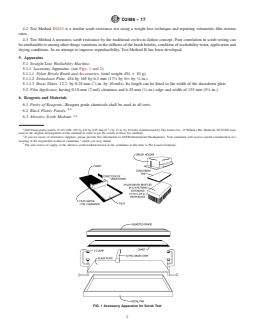
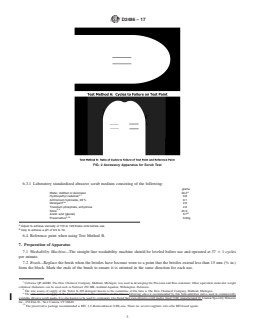
5.1.1 Accessory Apparatus: (see Figs. 1 and 2).
5.1.1.1 Nylon Bristle Brush and Accessories, (total weight 454 6 10 g).
7 1 1
5.1.1.2 Drawdown Plate, 454 by 165 by 6.3 mm (17 ⁄8 by 6 ⁄2 by ⁄4 in.).
5.1.1.3 Brass Shims, 12.7- by 0.25-mm ( ⁄2-in. by 10-mils). Its length can be fitted to the width of the drawdown plate.
1 1
5.2 Film Applicator, having 0.18-mm (7-mil) clearance and 6.25-mm ( ⁄4-in.) edge and width of 135 mm (5 ⁄4-in.).
6. Reagents and Materials
6.1 Purity of Reagents—Reagent grade chemicals shall be used in all tests.
4,5
6.2 Black Plastic Panels.
5,6
6.3 Abrasive Scrub Medium.
Dull black plastic panels, P-121-10N, 165 by 432 by 0.25 mm (6 ⁄2 by 17 in. by 10 mils) manufactured by The Leneta Co., 15 Whitney Rd., Mahwah, NJ 07430 were
used in the original development of this standard in order to get the results in these test methods.
If you are aware of alternative suppliers, please provide this information to ASTM International Headquarters. Your comments will receive careful consideration at a
meeting of the responsible technical committee, which you may attend.
The sole source of supply of the abrasive scrub medium known to the committee at this time is The Leneta Company.
FIG. 1 Accessory Apparatus for Scrub Test
D2486 − 17
FIG. 2 Accessory Apparatus for Scrub Test
6.3.1 Laboratory standardized abrasive scrub medium consisting of the following:
grams
A
Water, distilled or deionized 49.4
5,7
Hydroxyethyl cellulose 0.8
Ammonium hydroxide, 28 % 0.1
5,8
Detergent 2.0
Trisodium phosphate, anhydrous 2.0
5,9
Silica 45.0
B
Acetic acid (glacial) 0.7
5,10
Preservative 0.03g
A
Adjust to achieve viscosity of 110 to 120 Krebs units before use.
B
Vary to achieve a pH of 9.5 to 10.
6.4 Reference paint when using Test Method B.
7. Preparation of Apparatus
7.1 Washability Machine—The straight line washability machine should be leveled before use and operated at 37 6 1 cycles
per minute.
7.2 Brush—Replace the brush when the bristles have become worn to a point that the bristles extend less than 15 mm ( ⁄8 in.)
from the block. Mark the ends of the brush to ensure it is oriented in the same direction for each use.
Cellosize QP-4400H, The Dow Chemical Company, Midland, Michigan, was used in developing the Precision and Bias statement. Other equivalent molecular weight
cellulosic thickeners can be used such as Natrosol 250 MR, Ashland Aqualon, Wilmington, Delaware.
The sole source of supply of the Triton X-100 detergent known to the committee at this time is The Dow Chemical Company, Midland, Michigan.
The sole source of supply of the Imsil 45 known to the committee at this time is following silica is recommended by this Subcommittee and is used in commercially
available abrasive scrub media. It is also known to be used by companies who blend their own abrasive scrub media: Imsil 1240, manufactured by Unimin Specialty Minerals
Inc., 258 Elm St., New Canaan, CT 06840.
The preservative package recommended is BIT, 1,2–Benzisothiazol-3(2H)-one. There are several suppliers who offer BIT-based agents.
D2486 − 17
7.2.1 Brushes (that are in frequent use)—Brushes that are in frequent use shall be stored in water. Each time before starting the
first test of the day, remove the brush and rinse in water, then precondition the brush, by running it for 400 cycles on a scrub panel,
after which it is ready for test work.
7.2.2 Brushes (that
...