

ASTM E1795-20a
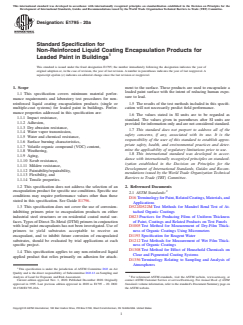
(Specification)Standard Specification for Non-Reinforced Liquid Coating Encapsulation Products for Leaded Paint in Buildings
General Information
- Abstract
ABSTRACT
This specification covers minimum material performance requirements and laboratory test procedures for nonreinforced liquid coating encapsulation products (single or multiple-coat systems) for leaded paint in buildings. Three types of nonreinforced liquid coating encapsulation products are presented: type I - encapsulation products intended for interior use, type II - encapsulation products intended for exterior use, and type III - encapsulation products intended for either interior or exterior use. The impact resistance, adhesion, dry abrasion resistance, water vapour transmission, water and chemical resistance, surface burning characteristics, and volatile organic compound content shall be tested to meet the requirements prescribed. Weathering, aging, scrub resistance, mildew resistance, paintability/repairability, flexibility, and tensile properties shall be tested to meet the requirements prescribed.
SCOPE
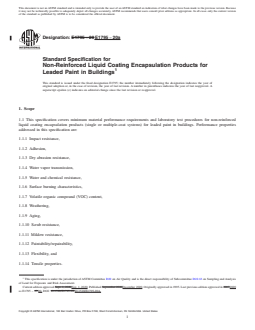
1.1 This specification covers minimum material performance requirements and laboratory test procedures for non-reinforced liquid coating encapsulation products (single or multiple-coat systems) for leaded paint in buildings. Performance properties addressed in this specification are:
1.1.1 Impact resistance,
1.1.2 Adhesion,
1.1.3 Dry abrasion resistance,
1.1.4 Water vapor transmission,
1.1.5 Water and chemical resistance,
1.1.6 Surface burning characteristics,
1.1.7 Volatile organic compound (VOC) content,
1.1.8 Weathering,
1.1.9 Aging,
1.1.10 Scrub resistance,
1.1.11 Mildew resistance,
1.1.12 Paintability/repairability,
1.1.13 Flexibility, and
1.1.14 Tensile properties.
1.2 This specification does not address the selection of an encapsulation product for specific use conditions. Specific use conditions may require performance values other than those stated in this specification. See Guide E1796.
1.3 This specification does not cover the use of corrosion-inhibiting primers prior to encapsulation products on either industrial steel structures or on residential coated metal surfaces. Types of Direct-To-Metal (DTM) primers in conjunction with lead paint encapsulants has not been investigated. Use of primers to yield substrates acceptable to receive an encapsulant, and to inhibit future corrosion of encapsulated substrates, should be evaluated by trial applications at each specific project.
1.4 This specification applies to any non-reinforced liquid applied product that relies primarily on adhesion for attachment to the surface. These products are used to encapsulate a leaded paint surface with the intent of reducing human exposure to lead.
1.5 The results of the test methods included in this specification will not necessarily predict field performance.
1.6 The values stated in SI units are to be regarded as standard. The values given in parentheses after SI units are provided for information only and are not considered standard.
1.7 This standard does not purport to address all of the safety concerns, if any, associated with its use. It is the responsibility of the user of this standard to establish appropriate safety, health, and environmental practices and determine the applicability of regulatory limitations prior to use.
1.8 This international standard was developed in accordance with internationally recognized principles on standardization established in the Decision on Principles for the Development of International Standards, Guides and Recommendations issued by the World Trade Organization Technical Barriers to Trade (TBT) Committee.
- Status
- Published
- Publication Date
- 31-Oct-2020
- Technical Committee
- D22 - Air Quality
- Drafting Committee
- D22.12 - Sampling and Analysis of Lead for Exposure and Risk Assessment
Buy Documents
ASTM E1795-20a - Standard Specification for Non-Reinforced Liquid Coating Encapsulation Products for Leaded Paint in Buildings
REDLINE ASTM E1795-20a - Standard Specification for Non-Reinforced Liquid Coating Encapsulation Products for Leaded Paint in Buildings
Overview
ASTM E1795-20a is the Standard Specification for Non-Reinforced Liquid Coating Encapsulation Products for Leaded Paint in Buildings, published by ASTM International. This specification defines the minimum performance requirements and laboratory test procedures for non-reinforced liquid coating encapsulation products, which are designed to encapsulate lead-based paint and reduce human exposure in both residential and commercial building environments. The products covered include single and multiple-coat systems, classified into three types based on intended use: interior only, exterior only, and both interior and exterior applications.
Encapsulation is a key strategy in lead paint abatement, offering a cost-effective and less invasive alternative to full paint removal, especially in older buildings with historic or sensitive architectural features.
Key Topics
Product Classification
- Type I: Intended for interior use only
- Type II: Intended for exterior use only
- Type III: Suitable for both interior and exterior use
Performance Requirements
- Impact resistance
- Adhesion to leaded surfaces
- Dry abrasion resistance
- Water vapor transmission
- Water and chemical resistance
- Surface burning characteristics
- Volatile organic compound (VOC) content
- Weathering and aging resistance
- Scrub resistance
- Mildew resistance
- Paintability and repairability
- Flexibility and tensile properties
Test Methods
- Laboratory testing of non-reinforced liquid coating encapsulation systems follows standard ASTM test methods for each performance criterion.
- Selection of specific encapsulation products must account for site-specific conditions and local regulation compliance.
Limitations
- The specification does not guide the selection of encapsulation products for unique site conditions. For guidance, refer to ASTM E1796.
- It does not cover the use of corrosion-inhibiting primers or direct-to-metal (DTM) primers before encapsulation.
Applications
ASTM E1795-20a is widely used by paint manufacturers, building owners, remediation specialists, contractors, and safety inspectors concerned with lead hazard reduction. Practical applications include:
- Paint Stabilization: Encapsulation products create a new surface over leaded paint, stabilizing deteriorating coatings without removal.
- Lead Hazard Control: Used in child-occupied facilities, schools, and homes to minimize lead dust and chip exposure.
- Building Maintenance: Suitable for preservation of historic structures where paint removal is not feasible.
- Regulatory Compliance: Assists property managers and contractors in meeting federal, state, and municipal requirements for lead abatement.
Related Standards
For proper implementation and compliance, the following related ASTM standards and guides are commonly referenced alongside ASTM E1795-20a:
- ASTM E1796 – Guide for Selection and Use of Liquid Coating Encapsulation Products for Leaded Paint in Buildings
- ASTM D3359 – Standard Test Methods for Rating Adhesion by Tape Test
- ASTM D4060 – Test Method for Abrasion Resistance of Organic Coatings
- ASTM E84 – Test Method for Surface Burning Characteristics of Building Materials
- ASTM D3960 – Practice for Determining Volatile Organic Compound (VOC) Content of Paints and Related Coatings
Practical Value
Implementing ASTM E1795-20a ensures encapsulation products meet rigorous performance requirements critical for effective lead hazard reduction. It standardizes testing and performance benchmarks, supporting improved occupant health, regulatory compliance, and building durability. By adhering to this standard, stakeholders can confidently specify, use, and inspect lead paint encapsulation products in sensitive environments, contributing to safer indoor air quality and sustainable building management.
Keywords: encapsulation products, lead paint, ASTM E1795-20a, building safety, lead abatement, liquid coating, performance requirements, VOC content, hazard reduction, leaded paint encapsulant.
Relations
- Effective Date
- 01-Mar-2024
- Effective Date
- 01-Mar-2024
- Effective Date
- 15-Jan-2024
- Effective Date
- 15-Jan-2024
- Effective Date
- 01-Jan-2024
- Effective Date
- 01-Dec-2023
- Refers
ASTM D4214-23 - Standard Test Methods for Evaluating the Degree of Chalking of Exterior Paint Films - Effective Date
- 01-Oct-2023
- Effective Date
- 01-Sep-2023
- Effective Date
- 01-Sep-2020
- Effective Date
- 01-Jun-2020
- Effective Date
- 01-Jun-2020
- Effective Date
- 01-Jun-2020
- Effective Date
- 15-Mar-2020
- Effective Date
- 01-Jul-2019
- Effective Date
- 15-Apr-2019
Buy Documents
ASTM E1795-20a - Standard Specification for Non-Reinforced Liquid Coating Encapsulation Products for Leaded Paint in Buildings
REDLINE ASTM E1795-20a - Standard Specification for Non-Reinforced Liquid Coating Encapsulation Products for Leaded Paint in Buildings
Frequently Asked Questions
ASTM E1795-20a is a technical specification published by ASTM International. Its full title is "Standard Specification for Non-Reinforced Liquid Coating Encapsulation Products for Leaded Paint in Buildings". This standard covers: ABSTRACT This specification covers minimum material performance requirements and laboratory test procedures for nonreinforced liquid coating encapsulation products (single or multiple-coat systems) for leaded paint in buildings. Three types of nonreinforced liquid coating encapsulation products are presented: type I - encapsulation products intended for interior use, type II - encapsulation products intended for exterior use, and type III - encapsulation products intended for either interior or exterior use. The impact resistance, adhesion, dry abrasion resistance, water vapour transmission, water and chemical resistance, surface burning characteristics, and volatile organic compound content shall be tested to meet the requirements prescribed. Weathering, aging, scrub resistance, mildew resistance, paintability/repairability, flexibility, and tensile properties shall be tested to meet the requirements prescribed. SCOPE 1.1 This specification covers minimum material performance requirements and laboratory test procedures for non-reinforced liquid coating encapsulation products (single or multiple-coat systems) for leaded paint in buildings. Performance properties addressed in this specification are: 1.1.1 Impact resistance, 1.1.2 Adhesion, 1.1.3 Dry abrasion resistance, 1.1.4 Water vapor transmission, 1.1.5 Water and chemical resistance, 1.1.6 Surface burning characteristics, 1.1.7 Volatile organic compound (VOC) content, 1.1.8 Weathering, 1.1.9 Aging, 1.1.10 Scrub resistance, 1.1.11 Mildew resistance, 1.1.12 Paintability/repairability, 1.1.13 Flexibility, and 1.1.14 Tensile properties. 1.2 This specification does not address the selection of an encapsulation product for specific use conditions. Specific use conditions may require performance values other than those stated in this specification. See Guide E1796. 1.3 This specification does not cover the use of corrosion-inhibiting primers prior to encapsulation products on either industrial steel structures or on residential coated metal surfaces. Types of Direct-To-Metal (DTM) primers in conjunction with lead paint encapsulants has not been investigated. Use of primers to yield substrates acceptable to receive an encapsulant, and to inhibit future corrosion of encapsulated substrates, should be evaluated by trial applications at each specific project. 1.4 This specification applies to any non-reinforced liquid applied product that relies primarily on adhesion for attachment to the surface. These products are used to encapsulate a leaded paint surface with the intent of reducing human exposure to lead. 1.5 The results of the test methods included in this specification will not necessarily predict field performance. 1.6 The values stated in SI units are to be regarded as standard. The values given in parentheses after SI units are provided for information only and are not considered standard. 1.7 This standard does not purport to address all of the safety concerns, if any, associated with its use. It is the responsibility of the user of this standard to establish appropriate safety, health, and environmental practices and determine the applicability of regulatory limitations prior to use. 1.8 This international standard was developed in accordance with internationally recognized principles on standardization established in the Decision on Principles for the Development of International Standards, Guides and Recommendations issued by the World Trade Organization Technical Barriers to Trade (TBT) Committee.
ABSTRACT This specification covers minimum material performance requirements and laboratory test procedures for nonreinforced liquid coating encapsulation products (single or multiple-coat systems) for leaded paint in buildings. Three types of nonreinforced liquid coating encapsulation products are presented: type I - encapsulation products intended for interior use, type II - encapsulation products intended for exterior use, and type III - encapsulation products intended for either interior or exterior use. The impact resistance, adhesion, dry abrasion resistance, water vapour transmission, water and chemical resistance, surface burning characteristics, and volatile organic compound content shall be tested to meet the requirements prescribed. Weathering, aging, scrub resistance, mildew resistance, paintability/repairability, flexibility, and tensile properties shall be tested to meet the requirements prescribed. SCOPE 1.1 This specification covers minimum material performance requirements and laboratory test procedures for non-reinforced liquid coating encapsulation products (single or multiple-coat systems) for leaded paint in buildings. Performance properties addressed in this specification are: 1.1.1 Impact resistance, 1.1.2 Adhesion, 1.1.3 Dry abrasion resistance, 1.1.4 Water vapor transmission, 1.1.5 Water and chemical resistance, 1.1.6 Surface burning characteristics, 1.1.7 Volatile organic compound (VOC) content, 1.1.8 Weathering, 1.1.9 Aging, 1.1.10 Scrub resistance, 1.1.11 Mildew resistance, 1.1.12 Paintability/repairability, 1.1.13 Flexibility, and 1.1.14 Tensile properties. 1.2 This specification does not address the selection of an encapsulation product for specific use conditions. Specific use conditions may require performance values other than those stated in this specification. See Guide E1796. 1.3 This specification does not cover the use of corrosion-inhibiting primers prior to encapsulation products on either industrial steel structures or on residential coated metal surfaces. Types of Direct-To-Metal (DTM) primers in conjunction with lead paint encapsulants has not been investigated. Use of primers to yield substrates acceptable to receive an encapsulant, and to inhibit future corrosion of encapsulated substrates, should be evaluated by trial applications at each specific project. 1.4 This specification applies to any non-reinforced liquid applied product that relies primarily on adhesion for attachment to the surface. These products are used to encapsulate a leaded paint surface with the intent of reducing human exposure to lead. 1.5 The results of the test methods included in this specification will not necessarily predict field performance. 1.6 The values stated in SI units are to be regarded as standard. The values given in parentheses after SI units are provided for information only and are not considered standard. 1.7 This standard does not purport to address all of the safety concerns, if any, associated with its use. It is the responsibility of the user of this standard to establish appropriate safety, health, and environmental practices and determine the applicability of regulatory limitations prior to use. 1.8 This international standard was developed in accordance with internationally recognized principles on standardization established in the Decision on Principles for the Development of International Standards, Guides and Recommendations issued by the World Trade Organization Technical Barriers to Trade (TBT) Committee.
ASTM E1795-20a is classified under the following ICS (International Classification for Standards) categories: 87.040 - Paints and varnishes. The ICS classification helps identify the subject area and facilitates finding related standards.
ASTM E1795-20a has the following relationships with other standards: It is inter standard links to ASTM E2239-24, ASTM E1796-24, ASTM D4708-24, ASTM D2794-93(2024), ASTM D16-24, ASTM E84-23d, ASTM D4214-23, ASTM E84-23c, ASTM D1356-20a, ASTM D1212-91(2020), ASTM D1005-95(2020), ASTM D4414-95(2020), ASTM D1356-20, ASTM E84-19b, ASTM E84-19a. Understanding these relationships helps ensure you are using the most current and applicable version of the standard.
ASTM E1795-20a is available in PDF format for immediate download after purchase. The document can be added to your cart and obtained through the secure checkout process. Digital delivery ensures instant access to the complete standard document.
Standards Content (Sample)
This international standard was developed in accordance with internationally recognized principles on standardization established in the Decision on Principles for the
Development of International Standards, Guides and Recommendations issued by the World Trade Organization Technical Barriers to Trade (TBT) Committee.
Designation:E1795 −20a
Standard Specification for
Non-Reinforced Liquid Coating Encapsulation Products for
Leaded Paint in Buildings
This standard is issued under the fixed designation E1795; the number immediately following the designation indicates the year of
original adoption or, in the case of revision, the year of last revision.Anumber in parentheses indicates the year of last reapproval.A
superscript epsilon (´) indicates an editorial change since the last revision or reapproval.
1. Scope ment to the surface. These products are used to encapsulate a
leaded paint surface with the intent of reducing human expo-
1.1 This specification covers minimum material perfor-
sure to lead.
mance requirements and laboratory test procedures for non-
reinforced liquid coating encapsulation products (single or 1.5 The results of the test methods included in this specifi-
multiple-coat systems) for leaded paint in buildings. Perfor- cation will not necessarily predict field performance.
mance properties addressed in this specification are:
1.6 The values stated in SI units are to be regarded as
1.1.1 Impact resistance,
standard. The values given in parentheses after SI units are
1.1.2 Adhesion,
providedforinformationonlyandarenotconsideredstandard.
1.1.3 Dry abrasion resistance,
1.7 This standard does not purport to address all of the
1.1.4 Water vapor transmission,
safety concerns, if any, associated with its use. It is the
1.1.5 Water and chemical resistance,
responsibility of the user of this standard to establish appro-
1.1.6 Surface burning characteristics,
priate safety, health, and environmental practices and deter-
1.1.7 Volatile organic compound (VOC) content,
mine the applicability of regulatory limitations prior to use.
1.1.8 Weathering,
1.8 This international standard was developed in accor-
1.1.9 Aging,
dance with internationally recognized principles on standard-
1.1.10 Scrub resistance,
ization established in the Decision on Principles for the
1.1.11 Mildew resistance,
Development of International Standards, Guides and Recom-
1.1.12 Paintability/repairability,
mendations issued by the World Trade Organization Technical
1.1.13 Flexibility, and
Barriers to Trade (TBT) Committee.
1.1.14 Tensile properties.
1.2 This specification does not address the selection of an
2. Referenced Documents
encapsulation product for specific use conditions. Specific use 2
2.1 ASTM Standards:
conditions may require performance values other than those
D16TerminologyforPaint,RelatedCoatings,Materials,and
stated in this specification. See Guide E1796.
Applications
1.3 This specification does not cover the use of corrosion- D522/D522MTest Methods for Mandrel Bend Test of At-
inhibiting primers prior to encapsulation products on either tached Organic Coatings
industrial steel structures or on residential coated metal sur- D823Practices for Producing Films of Uniform Thickness
faces.TypesofDirect-To-Metal(DTM)primersinconjunction of Paint, Coatings and Related Products on Test Panels
with lead paint encapsulants has not been investigated. Use of D1005Test Method for Measurement of Dry-Film Thick-
primers to yield substrates acceptable to receive an ness of Organic Coatings Using Micrometers
encapsulant, and to inhibit future corrosion of encapsulated D1193Specification for Reagent Water
substrates, should be evaluated by trial applications at each D1212Test Methods for Measurement of Wet Film Thick-
specific project. ness of Organic Coatings
D1308Test Method for Effect of Household Chemicals on
1.4 This specification applies to any non-reinforced liquid
Clear and Pigmented Coating Systems
applied product that relies primarily on adhesion for attach-
D1356Terminology Relating to Sampling and Analysis of
Atmospheres
This specification is under the jurisdiction of ASTM Committee D22 on Air
Quality and is the direct responsibility of Subcommittee D22.12 on Sampling and
Analysis of Lead for Exposure and Risk Assessment. For referenced ASTM standards, visit the ASTM website, www.astm.org, or
Current edition approved Nov. 1, 2020. Published December 2020. Originally contact ASTM Customer Service at service@astm.org. For Annual Book of ASTM
approved in 1995. Last previous edition approved in 2020 as E1795 – 20. DOI: Standards volume information, refer to the standard’s Document Summary page on
10.1520/E1795-20A. the ASTM website.
Copyright © ASTM International, 100 Barr Harbor Drive, PO Box C700, West Conshohocken, PA 19428-2959. United States
E1795−20a
D1475Test Method for Density of Liquid Coatings, Inks, 3.2 Definitions of Terms Specific to This Standard:
and Related Products 3.2.1 lead inaccessibility, n—the ability of an encapsulation
D1653Test Methods for Water Vapor Transmission of Or- product to resist or inhibit the transport of lead to its surface.
ganic Coating Films
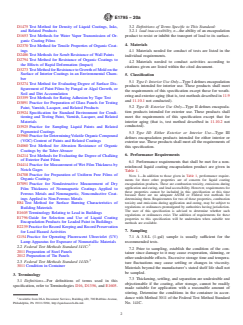
4. Materials
D2370Test Method for Tensile Properties of Organic Coat-
ings
4.1 Materials needed for conduct of tests are listed in the
D2486Test Methods for Scrub Resistance of Wall Paints
individual requirements.
D2794Test Method for Resistance of Organic Coatings to
4.2 Materials needed to conduct activities according to
the Effects of Rapid Deformation (Impact)
citations given are listed within the cited document.
D3273TestMethodforResistancetoGrowthofMoldonthe
Surface of Interior Coatings in an Environmental Cham-
5. Classification
ber
5.1 Type I: Interior Use Only—TypeIdefinesencapsulation
D3274Test Method for Evaluating Degree of Surface Dis-
products intended for interior use. These products shall meet
figurement of Paint Films by Fungal or Algal Growth, or
the requirements of this specification except those for weath-
Soil and Dirt Accumulation
eringandexterioraging(thatis,testmethodsdescribedin11.9
D3359Test Methods for Rating Adhesion by Tape Test
and 11.10.1 not conducted).
D3891Practice for Preparation of Glass Panels for Testing
5.2 Type II: Exterior Use Only—Type II defines encapsula-
Paint, Varnish, Lacquer, and Related Products
tion products intended for exterior use. These products shall
D3924Specification for Standard Environment for Condi-
meet the requirements of this specification except that for
tioning and Testing Paint, Varnish, Lacquer, and Related
interior aging (that is, test method described in 11.10.2 not
Materials
conducted).
D3925Practice for Sampling Liquid Paints and Related
Pigmented Coatings
5.3 Type III: Either Exterior or Interior Use—Type III
D3960PracticeforDeterminingVolatileOrganicCompound
defines encapsulation products intended for either interior or
(VOC) Content of Paints and Related Coatings
exterior use. These products shall meet all the requirements of
D4060Test Method for Abrasion Resistance of Organic
this specification.
Coatings by the Taber Abraser
D4214Test Methods for Evaluating the Degree of Chalking 6. Performance Requirements
of Exterior Paint Films
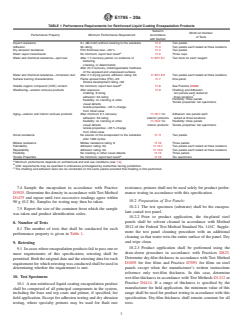
6.1 Performance requirements that shall be met for a non-
D4414Practice for Measurement of Wet Film Thickness by
reinforced liquid coating encapsulation product are given in
Notch Gages
Table 1.
D4708Practice for Preparation of Uniform Free Films of
NOTE 1—In addition to those given in Table 1, performance require-
Organic Coatings ments for three other properties are of concern for liquid coating
encapsulation products. These are combustion toxicity, emissions during
D7091Practice for Nondestructive Measurement of Dry
application and curing, and lead accessibility. However, requirements for
Film Thickness of Nonmagnetic Coatings Applied to
these properties cannot be included in this specification at this time
Ferrous Metals and Nonmagnetic, Nonconductive Coat-
because there are no adequate ASTM or Federal test methods for
ings Applied to Non-Ferrous Metals
determining them. Requirements for two of these properties, combustion
E84Test Method for Surface Burning Characteristics of toxicity and emissions during application and curing, may be subject to
regulations or ordinances promulgated by authorities having jurisdiction.
Building Materials
The user of this specification is advised to determine whether such
E1605Terminology Relating to Lead in Buildings
regulations or ordinances exist. The addition of requirements for these
E1796Guide for Selection and Use of Liquid Coating
properties to this specification will be undertaken when suitable test
Encapsulation Products for Leaded Paint in Buildings
methods are available.
E2239PracticeforRecordKeepingandRecordPreservation
7. Sampling
for Lead Hazard Activities
G154Practice for Operating Fluorescent Ultraviolet (UV)
7.1 A 3.8-L (1-gal) sample is usually sufficient for the
Lamp Apparatus for Exposure of Nonmetallic Materials
recommended tests.
2.2 Federal Test Methods Standard 141C:
7.2 Prior to sampling, establish the condition of the con-
2011Preparation of Steel Panels
tainer since damage to it may cause evaporation, skinning, or
2012Preparation of Tin Panels
other undesirable effects. Excessive storage time and tempera-
2.3 Federal Test Methods Standard 141D:
ture fluctuations may cause settling or changes in viscosity.
3011Condition in Container
Materials beyond the manufacturer’s stated shelf life shall not
be sampled.
3. Terminology
7.3 Thickening, settling, and separation are undesirable and
3.1 Definitions—For definitions of terms used in this
objectionable if the coating, after storage, cannot be readily
specification, refer to Terminologies D16, D1356, and E1605.
made suitable for application with a reasonable amount of
stirring. Determine the conditions in the container in accor-
dance with Method 3011 of the Federal Test Method Standard
Available from DLADocument Services, Building 4/D, 700 RobbinsAvenue,
Philadelphia, PA 19111-5094, http://quicksearch.dla.mil. No. 141C.
E1795−20a
TABLE 1 Performance Requirements for Reinforced Liquid Coating Encapsulation Products
Tested in
Minimum Number
Performance Property Minimum Performance Requirement Accordance
of Tests
with Section
Impact resistance 9 J (80 in·lbf) without cracking to the substrate 11.2 Two panels
Adhesion 5A rating 11.3 Two panels each tested at three locations
Dry abrasion resistance Film thickness loss: <20 % 11.4 Two panels
A
Water vapor transmission No minimum; report test result 11.5 Three cups
Water and chemical resistance—spot test After 1 h recovery period, no evidence of 11.6/11.6.1 Two tests for each reagent
blistering,
cracking, or delamination
After 24 h recovery, indistinguishable hardness
of the exposed and unexposed surfaces
Water and chemical resistance—immersion test After 2 h drying period, adhesion rating: 5A 11.6/11.6.2 Two panels each tested at three locations
Surface burning characteristics Flame spread index (FSI) <25 11.7 One panel
Smoke development rating <50
B
Volatile organic compound (VOC) content No minimum; report test result 11.8 See Practice D3960
Weathering—exterior end-use products After exposure: 11.9 Chalking and Adhesion:
chalking: 8 rating two panels each tested at
C
adhesion: 5A rating three locations
Flexibility: three panels
flexibility: no cracking or other
Tensile properties: ten specimens
visual defects
tensile properties: <35 % change
from initial value
Aging—exterior and interior end-use products After minimum6hrecovery: 11.10.1:for Adhesion: two panels each
adhesion: 5A rating exterior products tested at three locations
flexibility: no cracking or other 11.10.2:for Flexibility: three panels
visual defects interior products Tensile properties: ten specimens
tensile properties: <35 % change
from initial value
Scrub resistance No erosion of the encapsulant to the substrate 11.11 Two panels
after 1200 cycles
Mildew resistance Mildew resistance rating: 8 11.12 Three panels
Paintability Adhesion rating: 5A 11.13.1 Two panels each tested at three locations
Repairability Adhesion rating: 5A 11.13.2 Two panels each tested at three locations
Flexibility No cracking or other visual defects 11.14 Three panels
A
Tensile Properties No minimum; report test result 11.15 Ten specimens
A
Minimum performance depends on architectural and end use conditions (see 1.2).
B
VOC requirements may be specified in ordinances promulgated by authorities having jurisdiction.
C
The chalking and adhesion tests can be conducted on the same panels provided that chalking is first performed.
7.4 Sample the encapsulant in accordance with Practice resistance, primers shall not be used solely for product perfor-
D3925.DeterminethedensityinaccordancewithTestMethod
mance testing in accordance with this specification.
D1475 and repeat until two successive readings agree within
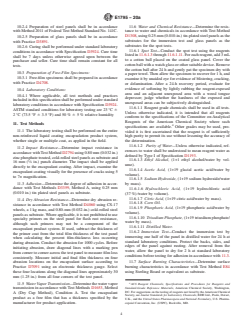
10.2 Preparation of Test Panels:
90 g (0.2 lb). Samples for testing may then be taken.
10.2.1 The test specimen (substrate) shall be the encapsu-
7.5 Report the size of the container from which the sample
lant coated test panel.
was taken and product identification codes.
10.2.2 Prior to product application, the tin-plated steel
8. Number of Tests panels shall be solvent cleaned in accordance with Method
2012 of the Federal Test Method Standard No. 141C. Supple-
8.1 The number of tests that shall be conducted for each
ment the test panel cleaning procedure with an additional
performance property is given in Table 1.
cleaning so that water wets the entire surface of the panel. Dry
and wipe clean.
9. Retesting
10.2.3 Product application shall be performed using the
9.1 Incaseswhereencapsulationproductsfailtopassoneor
draw-down procedure in accordance with Practices D823.
more requirements of this specification, retesting shall be
Determine dry-film thickness in accordance with Test Method
permitted.Boththeoriginaldataandtheretestingdataforeach
D1005 for free films and Practice D7091 for films on steel
requirementforwhichretestingwasconductedshallbeusedin
panels except when the manufacturer’s written instructions
determining whether the requirement is met.
reference only wet-film thickness. In this case, determine
10. Test Specimens
wet-film thickness in accordance with Test Methods D1212 or
Practice D4414. If a range of thickness is specified by the
10.1 Anon-reinforced liquid coating encapsulation product
manufacturer for field application, the minimum value of this
shall be comprised of all principal components in the system,
range shall be used for product testing in accordance with this
including the base and top coats
...
This document is not an ASTM standard and is intended only to provide the user of an ASTM standard an indication of what changes have been made to the previous version. Because
it may not be technically possible to adequately depict all changes accurately, ASTM recommends that users consult prior editions as appropriate. In all cases only the current version
of the standard as published by ASTM is to be considered the official document.
Designation: E1795 − 20 E1795 − 20a
Standard Specification for
Non-Reinforced Liquid Coating Encapsulation Products for
Leaded Paint in Buildings
This standard is issued under the fixed designation E1795; the number immediately following the designation indicates the year of
original adoption or, in the case of revision, the year of last revision. A number in parentheses indicates the year of last reapproval. A
superscript epsilon (´) indicates an editorial change since the last revision or reapproval.
1. Scope
1.1 This specification covers minimum material performance requirements and laboratory test procedures for non-reinforced
liquid coating encapsulation products (single or multiple-coat systems) for leaded paint in buildings. Performance properties
addressed in this specification are:
1.1.1 Impact resistance,
1.1.2 Adhesion,
1.1.3 Dry abrasion resistance,
1.1.4 Water vapor transmission,
1.1.5 Water and chemical resistance,
1.1.6 Surface burning characteristics,
1.1.7 Volatile organic compound (VOC) content,
1.1.8 Weathering,
1.1.9 Aging,
1.1.10 Scrub resistance,
1.1.11 Mildew resistance,
1.1.12 Paintability/repairability,
1.1.13 Flexibility, and
1.1.14 Tensile properties.
This specification is under the jurisdiction of ASTM Committee D22 on Air Quality and is the direct responsibility of Subcommittee D22.12 on Sampling and Analysis
of Lead for Exposure and Risk Assessment.
Current edition approved Sept. 1, 2020Nov. 1, 2020. Published September 2020December 2020. Originally approved in 1995. Last previous edition approved in 20172020
as E1795 – 17.20. DOI: 10.1520/E1795-20.10.1520/E1795-20A.
Copyright © ASTM International, 100 Barr Harbor Drive, PO Box C700, West Conshohocken, PA 19428-2959. United States
E1795 − 20a
1.2 This specification does not address the selection of an encapsulation product for specific use conditions. Specific use
conditions may require performance values other than those stated in this specification. See Guide E1796.
1.3 This specification does not cover the use of corrosion-inhibiting primers prior to encapsulation products on either industrial
steel structures or on residential coated metal surfaces. Types of Direct-To-Metal (DTM) primers in conjunction with lead paint
encapsulants has not been investigated. Use of primers to yield substrates acceptable to receive an encapsulant, and to inhibit future
corrosion of encapsulated substrates, should be evaluated by trial applications at each specific project.
1.4 This specification applies to any non-reinforced liquid applied product that relies primarily on adhesion for attachment to the
surface. These products are used to encapsulate a leaded paint surface with the intent of reducing human exposure to lead.
1.5 The results of the test methods included in this specification will not necessarily predict field performance.
1.6 The values stated in SI units are to be regarded as standard. The values given in parentheses after SI units are provided for
information only and are not considered standard.
1.7 This standard does not purport to address all of the safety concerns, if any, associated with its use. It is the responsibility
of the user of this standard to establish appropriate safety, health, and environmental practices and determine the applicability of
regulatory limitations prior to use.
1.8 This international standard was developed in accordance with internationally recognized principles on standardization
established in the Decision on Principles for the Development of International Standards, Guides and Recommendations issued
by the World Trade Organization Technical Barriers to Trade (TBT) Committee.
2. Referenced Documents
2.1 ASTM Standards:
D16 Terminology for Paint, Related Coatings, Materials, and Applications
D522/D522M Test Methods for Mandrel Bend Test of Attached Organic Coatings
D823 Practices for Producing Films of Uniform Thickness of Paint, Coatings and Related Products on Test Panels
D1005 Test Method for Measurement of Dry-Film Thickness of Organic Coatings Using Micrometers
D1193 Specification for Reagent Water
D1212 Test Methods for Measurement of Wet Film Thickness of Organic Coatings
D1308 Test Method for Effect of Household Chemicals on Clear and Pigmented Coating Systems
D1356 Terminology Relating to Sampling and Analysis of Atmospheres
D1475 Test Method for Density of Liquid Coatings, Inks, and Related Products
D1653 Test Methods for Water Vapor Transmission of Organic Coating Films
D2370 Test Method for Tensile Properties of Organic Coatings
D2486 Test Methods for Scrub Resistance of Wall Paints
D2794 Test Method for Resistance of Organic Coatings to the Effects of Rapid Deformation (Impact)
D3273 Test Method for Resistance to Growth of Mold on the Surface of Interior Coatings in an Environmental Chamber
D3274 Test Method for Evaluating Degree of Surface Disfigurement of Paint Films by Fungal or Algal Growth, or Soil and Dirt
Accumulation
D3359 Test Methods for Rating Adhesion by Tape Test
D3891 Practice for Preparation of Glass Panels for Testing Paint, Varnish, Lacquer, and Related Products
D3924 Specification for Standard Environment for Conditioning and Testing Paint, Varnish, Lacquer, and Related Materials
D3925 Practice for Sampling Liquid Paints and Related Pigmented Coatings
D3960 Practice for Determining Volatile Organic Compound (VOC) Content of Paints and Related Coatings
D4060 Test Method for Abrasion Resistance of Organic Coatings by the Taber Abraser
D4214 Test Methods for Evaluating the Degree of Chalking of Exterior Paint Films
D4414 Practice for Measurement of Wet Film Thickness by Notch Gages
D4708 Practice for Preparation of Uniform Free Films of Organic Coatings
D7091 Practice for Nondestructive Measurement of Dry Film Thickness of Nonmagnetic Coatings Applied to Ferrous Metals
and Nonmagnetic, Nonconductive Coatings Applied to Non-Ferrous Metals
For referenced ASTM standards, visit the ASTM website, www.astm.org, or contact ASTM Customer Service at service@astm.org. For Annual Book of ASTM Standards
volume information, refer to the standard’s Document Summary page on the ASTM website.
E1795 − 20a
E84 Test Method for Surface Burning Characteristics of Building Materials
E1605 Terminology Relating to Lead in Buildings
E1796 Guide for Selection and Use of Liquid Coating Encapsulation Products for Leaded Paint in Buildings
E2239 Practice for Record Keeping and Record Preservation for Lead Hazard Activities
G154 Practice for Operating Fluorescent Ultraviolet (UV) Lamp Apparatus for Exposure of Nonmetallic Materials
2.2 Federal Test Methods Standard 141C:
2011 Preparation of Steel Panels
2012 Preparation of Tin Panels
2.3 Federal Test Methods Standard 141D:
3011 Condition in Container
3. Terminology
3.1 Definitions—For definitions of terms used in this specification, refer to Terminologies D16, D1356, and E1605.
3.2 Definitions of Terms Specific to This Standard:
3.2.1 lead inaccessibility, n—the ability of an encapsulation product to resist or inhibit the transport of lead to its surface.
4. Materials
4.1 Materials needed for conduct of tests are listed in the individual requirements.
4.2 Materials needed to conduct activities according to citations given are listed within the cited document.
5. Classification
5.1 Type I: Interior Use Only—Type I defines encapsulation products intended for interior use. These products shall meet the
requirements of this specification except those for weathering and exterior aging (that is, test methods described in 10.911.9 and
10.10.111.10.1 not conducted).
5.2 Type II: Exterior Use Only—Type II defines encapsulation products intended for exterior use. These products shall meet the
requirements of this specification except that for interior aging (that is, test method described in 10.10.211.10.2 not conducted).
5.3 Type III: Either Exterior or Interior Use—Type III defines encapsulation products intended for either interior or exterior use.
These products shall meet all the requirements of this specification.
6. Performance Requirements
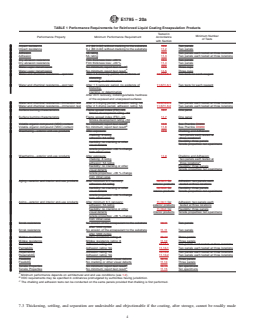
6.1 Performance requirements that shall be met for a non-reinforced liquid coating encapsulation product are given in Table 1.
NOTE 1—In addition to those given in Table 1, performance requirements for three other properties are of concern for liquid coating encapsulation
products. These are combustion toxicity, emissions during application and curing, and lead accessibility. However, requirements for these properties
cannot be included in this specification at this time because there are no adequate ASTM or Federal test methods for determining them. Requirements
for two of these properties, combustion toxicity and emissions during application and curing, may be subject to regulations or ordinances promulgated
by authorities having jurisdiction. The user of this specification is advised to determine whether such regulations or ordinances exist. The addition of
requirements for these properties to this specification will be undertaken when suitable test methods are available.
7. Sampling
7.1 A 3.8-L (1-gal) sample is usually sufficient for the recommended tests.
7.2 Prior to sampling, establish the condition of the container since damage to it may cause evaporation, skinning, or other
undesirable effects. Excessive storage time and temperature fluctuations may cause settling or changes in viscosity. Materials
beyond the manufacturer’s stated shelf life shall not be sampled.
Available from DLA Document Services, Building 4/D, 700 Robbins Avenue, Philadelphia, PA 19111-5094, http://quicksearch.dla.mil.
E1795 − 20a
TABLE 1 Performance Requirements for Reinforced Liquid Coating Encapsulation Products
Tested in
Minimum Number
Performance Property Minimum Performance Requirement Accordance
of Tests
with Section
Impact resistance 9 J (80 in·lbf) without cracking to the substrate 10.2 Two panels
Impact resistance 9 J (80 in·lbf) without cracking to the substrate 11.2 Two panels
Adhesion 5A rating 10.3 Two panels each tested at three locations
Adhesion 5A rating 11.3 Two panels each tested at three locations
Dry abrasion resistance Film thickness loss: <20 % 10.4 Two panels
Dry abrasion resistance Film thickness loss: <20 % 11.4 Two panels
A
Water vapor transmission No minimum; report test result 10.5 Three cups
A
Water vapor transmission No minimum; report test result 11.5 Three cups
Water and chemical resistance—spot test After 1 h recovery period, no evidence of 10.6/10.6.1 Two tests for each reagent
blistering,
cracking, or delamination
Water and chemical resistance—spot test After 1 h recovery period, no evidence of 11.6/11.6.1 Two tests for each reagent
blistering,
cracking, or delamination
After 24 h recovery, indistinguishable hardness
of the exposed and unexposed surfaces
Water and chemical resistance—immersion test After 2 h drying period, adhesion rating: 5A 10.6/10.6.2 Two panels each tested at three locations
Water and chemical resistance—immersion test After 2 h drying period, adhesion rating: 5A 11.6/11.6.2 Two panels each tested at three locations
Surface burning characteristics Flame spread index (FSI) <25 10.7 One panel
Smoke development rating <50
Surface burning characteristics Flame spread index (FSI) <25 11.7 One panel
Smoke development rating <50
B
Volatile organic compound (VOC) content No minimum; report test result 10.8 See Practice D3960
B
Volatile organic compound (VOC) content No minimum; report test result 11.8 See Practice D3960
Weathering—exterior end-use products After exposure: 10.9 Chalking and Adhesion:
chalking: 8 rating two panels each tested at
C
adhesion: 5A rating three locations
Flexibility: three panels
flexibility: no cracking or other
Tensile properties: ten specimens
visual defects
tensile properties: <35 % change
from initial value
Weathering—exterior end-use products After exposure: 11.9 Chalking and Adhesion:
chalking: 8 rating two panels each tested at
C
adhesion: 5A rating three locations
Flexibility: three panels
flexibility: no cracking or other
Tensile properties: ten specimens
visual defects
tensile properties: <35 % change
from initial value
Aging—exterior and interior end-use products After minimum 6 h recovery: 10.10.1: for Adhesion: two panels each
adhesion: 5A rating exterior products tested at three locations
flexibility: no cracking or other 10.10.2: for Flexibility: three panels
visual defects interior products Tensile properties: ten specimens
tensile properties: <35 % change
from initial value
Aging—exterior and interior end-use products After minimum 6 h recovery: 11.10.1: for Adhesion: two panels each
adhesion: 5A rating exterior products tested at three locations
flexibility: no cracking or other 11.10.2: for Flexibility: three panels
visual defects interior products Tensile properties: ten specimens
tensile properties: <35 % change
from initial value
Scrub resistance No erosion of the encapsulant to the substrate 10.11 Two panels
after 1200 cycles
Scrub resistance No erosion of the encapsulant to the substrate 11.11 Two panels
after 1200 cycles
Mildew resistance Mildew resistance rating: 8 10.12 Three panels
Mildew resistance Mildew resistance rating: 8 11.12 Three panels
Paintability Adhesion rating: 5A 10.13.1 Two panels each tested at three locations
Paintability Adhesion rating: 5A 11.13.1 Two panels each tested at three locations
Repairability Adhesion rating: 5A 10.13.2 Two panels each tested at three locations
Repairability Adhesion rating: 5A 11.13.2 Two panels each tested at three locations
Flexibility No cracking or other visual defects 10.14 Three panels
Flexibility No cracking or other visual defects 11.14 Three panels
A
Tensile Properties No minimum; report test result 10.15 Ten specimens
A
Tensile Properties No minimum; report test result 11.15 Ten specimens
A
Minimum performance depends on architectural and end use conditions (see 1.2).
B
VOC requirements may be specified in ordinances promulgated by authorities having jurisdiction.
C
The chalking and adhesion tests can be conducted on the same panels provided that chalking is first performed.
7.3 Thickening, settling, and separation are undesirable and objectionable if the coating, after storage, cannot be readily made
E1795 − 20a
suitable for application with a reasonable amount of stirring. Determine the conditions in the container in accordance with Method
3011 of the Federal Test Method Standard No. 141C.
7.4 Sample the encapsulant in accordance with Practice D3925. Determine the density in accordance with Test Method D1475 and
repeat until two successive readings agree within 90 g (0.2 lb). Samples for testing may then be taken.
7.5 Report the size of the container from which the sample was taken and product identification codes.
8. Number of Tests
8.1 The number of tests that shall be conducted for each performance property is given in Table 1.
9. Retesting
9.1 In cases where encapsulation products fail to pass one or more requirements of this specification, retesting shall be permitted.
Both the original data and the retesting data for each requirement for which retesting was conducted shall be used in determining
whether the requirement is met.
10. Test Specimens
10.1 A non-reinforced liquid coating encapsulation product shall be comprised of all principal components in the system,
including the base and top coats and primer, if specified, for field application. Except for adhesion testing and dry abrasion testing,
where specialty primers may be used for flash rust resistance, primers shall not be used solely for product performance testing in
accordance with this specification.
10.2 Preparation of Test Panels:
10.2.1 The test specimen (substrate) shall be the encapsulant coated test panel.
10.2.2 Prior to product application, the tin-plated steel panels shall be solvent cleaned in accordance with Method 2012 of the
Federal Test Method Standard No. 141C. Supplement the test panel cleaning procedure with an additional cleaning so tha
...