

ASTM D4587-23
(Practice)Standard Practice for Fluorescent UV-Condensation Exposures of Paint and Related Coatings
General Information
- Abstract
SIGNIFICANCE AND USE
4.1 The ability of a paint or coating to resist degradation of its physical and optical properties caused by exposure to light, heat, and water can be important for many applications. This practice describes artificial accelerated weathering methods designed to reproduce property changes associated with exposure to sunlight, moisture, and heat in end-use conditions. The weathering methods referenced in this practice do not simulate the deterioration caused by localized weather phenomena such as atmospheric pollution, biological attack, and saltwater exposure.
4.2 Cautions—Variation in results may be expected when different operating conditions are used. Therefore, no reference to the use of this practice shall be made unless accompanied by a report prepared according to Section 10 that describes the specific operating conditions used. Refer to Practice G151 for detailed information on the caveats applicable to use of results obtained according to this practice.
Note 2: Additional information on sources of variability and on strategies for addressing variability in the design, execution and data analysis of laboratory accelerated exposure tests is found in Guide G141.
4.2.1 The spectral irradiance of light from fluorescent UV lamps is significantly different from that produced in light and water exposure devices using other light sources. The type and rate of degradation and the performance rankings produced in exposures to fluorescent UV lamps can be much different from those produced by exposures to other types of laboratory light sources.
4.2.2 Interlaboratory comparisons are valid only when all laboratories use the same design of apparatus, lamp, and exposure conditions.
4.3 Reproducibility of test results between laboratories has been shown to be good when the stability of materials is evaluated in terms of performance ranking compared to other materials or to a control material.6,7 Therefore, exposure of a similar material of known performance (a ...
SCOPE
1.1 This practice describes artificial accelerated weathering methods for testing the durability of coatings and related products using fluorescent UV lamps and water apparatus operated in accordance with Practices G151 and G154.
1.2 This practice also makes recommendations for preparation of test specimens, exposure duration, and the evaluation of test results.
Note 1: ISO 16474-3 also describes fluorescent UV lamp and water apparatus for artificial accelerated weathering of paints and coatings.
1.3 The values stated in SI units are to be regarded as the standard. The values given in parentheses are for information only.
1.4 This standard does not purport to address all of the safety concerns, if any, associated with its use. It is the responsibility of the user of this standard to establish appropriate safety, health, and environmental practices and determine the applicability of regulatory limitations prior to use.
1.5 This international standard was developed in accordance with internationally recognized principles on standardization established in the Decision on Principles for the Development of International Standards, Guides and Recommendations issued by the World Trade Organization Technical Barriers to Trade (TBT) Committee.
- Status
- Published
- Publication Date
- 31-May-2023
- Technical Committee
- D01 - Paint and Related Coatings, Materials, and Applications
- Drafting Committee
- D01.27 - Accelerated Testing
Buy Documents
ASTM D4587-23 - Standard Practice for Fluorescent UV-Condensation Exposures of Paint and Related Coatings
REDLINE ASTM D4587-23 - Standard Practice for Fluorescent UV-Condensation Exposures of Paint and Related Coatings
Overview
ASTM D4587-23 is a key ASTM International standard that establishes the practice for conducting artificial accelerated weathering tests on paint and related coatings using fluorescent UV lamp and condensation exposures. The standard provides procedures for evaluating the resistance of coatings to physical and optical property degradation due to simulated sunlight, moisture, and heat. This is essential for manufacturers, quality assurance professionals, and researchers seeking to predict the long-term durability of paints and coatings in various end-use environments.
Using the methodologies outlined in ASTM D4587-23 helps organizations assess material performance, compare product formulations, and validate quality claims by simulating critical environmental stress factors. The standard is widely recognized in paint, coatings, automotive, industrial, and architectural industries, facilitating consistent and reproducible testing required for product development and regulatory compliance.
Key Topics
- Artificial Accelerated Weathering: Describes how fluorescent UV lamps and water apparatus are used to reproduce property changes associated with sunlight, heat, and moisture exposure.
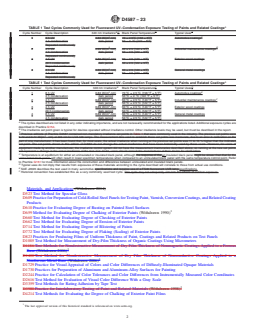
- Test Conditions and Apparatus: Details the use of equipment conforming to ASTM G151 and ASTM G154, including typical UV exposure/condensation cycles for various coatings (e.g., automotive, industrial, wood, general metal).
- Preparation and Handling of Specimens:
- Recommendations for specimen coating, conditioning, and mounting procedures
- Guidance on replicates and control materials for robust statistical evaluation
- Evaluation of Results:
- Procedures for periodic property assessment
- Methodologies for ranking and comparing material performance
- Importance of detailed reporting on exposure conditions and results
- Variability and Reproducibility: Addresses sources of variability and emphasizes the need for consistent apparatus, lamps, and exposure settings across laboratories.
Applications
ASTM D4587-23 is applied across industries where long-term outdoor performance of paints and coatings must be anticipated:
- Automotive Coatings: Assessment of color retention, gloss, and physical durability under accelerated UV and condensation cycles.
- Architectural and Industrial Maintenance Coatings: Evaluation of paint systems for buildings, infrastructure, and equipment that require weathering resistance.
- Exterior Wood and Metal Coatings: Testing finishes on wood siding, outdoor furniture, and structural metals to ensure extended service life.
- Product Development and Quality Control: Comparison of new formulations with known standards or control materials to verify enhancements in weathering resistance.
- Specification and Regulatory Testing: Verification of coatings’ compliance with industry or customer specifications, including documentation for procurement and regulatory submission.
By simulating real-world exposure conditions in a controlled laboratory environment, ASTM D4587-23 enables manufacturers to predict coating degradation, improve material robustness, and reduce the need for extended field testing.
Related Standards
ASTM D4587-23 is used in conjunction with several other standards for a comprehensive approach to weathering and performance testing:
- ASTM G151: Practice for exposing nonmetallic materials in accelerated test devices using laboratory light sources.
- ASTM G154: Operating fluorescent UV lamp apparatus for exposure of nonmetallic materials.
- ISO 16474-3: International guidance for exposure of coatings to fluorescent UV lamps and water.
- ASTM D609, D1730, D823: Practices and test methods for panel preparation and coating application.
- ASTM D523, D610, D2244: Test methods for evaluating gloss, rusting, and color changes.
- SAE J2020: Accelerated exposure of automotive exterior materials using fluorescent UV condensation apparatus.
These related documents provide additional requirements and recommendations on specimen preparation, apparatus construction, exposure conditions, and data analysis for reliable and meaningful accelerated weathering tests.
Keywords: artificial weathering, UV exposure, condensation, paint durability, coatings testing, accelerated aging, fluorescent UV lamps, ASTM D4587, weather resistance, test protocols.
Relations
- Effective Date
- 01-Jan-2024
- Effective Date
- 01-Dec-2023
- Refers
ASTM D4214-23 - Standard Test Methods for Evaluating the Degree of Chalking of Exterior Paint Films - Effective Date
- 01-Oct-2023
- Effective Date
- 01-Jun-2020
- Effective Date
- 01-May-2020
- Effective Date
- 01-May-2020
- Refers
ASTM D2616-19 - Standard Test Method for Evaluation of Visual Color Difference With a Gray Scale - Effective Date
- 01-Nov-2019
- Effective Date
- 01-Oct-2019
- Refers
ASTM D660-93(2019) - Standard Test Method for Evaluating Degree of Checking of Exterior Paints - Effective Date
- 01-Oct-2019
- Effective Date
- 01-Jun-2019
- Refers
ASTM D610-08(2019) - Standard Practice for Evaluating Degree of Rusting on Painted Steel Surfaces - Effective Date
- 01-Jan-2019
- Refers
ASTM D772-18 - Standard Test Method for Evaluating Degree of Flaking (Scaling) of Exterior Paints - Effective Date
- 01-Sep-2018
- Effective Date
- 01-Dec-2017
- Effective Date
- 01-Jun-2017
- Effective Date
- 01-Jul-2016
Buy Documents
ASTM D4587-23 - Standard Practice for Fluorescent UV-Condensation Exposures of Paint and Related Coatings
REDLINE ASTM D4587-23 - Standard Practice for Fluorescent UV-Condensation Exposures of Paint and Related Coatings
Frequently Asked Questions
ASTM D4587-23 is a standard published by ASTM International. Its full title is "Standard Practice for Fluorescent UV-Condensation Exposures of Paint and Related Coatings". This standard covers: SIGNIFICANCE AND USE 4.1 The ability of a paint or coating to resist degradation of its physical and optical properties caused by exposure to light, heat, and water can be important for many applications. This practice describes artificial accelerated weathering methods designed to reproduce property changes associated with exposure to sunlight, moisture, and heat in end-use conditions. The weathering methods referenced in this practice do not simulate the deterioration caused by localized weather phenomena such as atmospheric pollution, biological attack, and saltwater exposure. 4.2 Cautions—Variation in results may be expected when different operating conditions are used. Therefore, no reference to the use of this practice shall be made unless accompanied by a report prepared according to Section 10 that describes the specific operating conditions used. Refer to Practice G151 for detailed information on the caveats applicable to use of results obtained according to this practice. Note 2: Additional information on sources of variability and on strategies for addressing variability in the design, execution and data analysis of laboratory accelerated exposure tests is found in Guide G141. 4.2.1 The spectral irradiance of light from fluorescent UV lamps is significantly different from that produced in light and water exposure devices using other light sources. The type and rate of degradation and the performance rankings produced in exposures to fluorescent UV lamps can be much different from those produced by exposures to other types of laboratory light sources. 4.2.2 Interlaboratory comparisons are valid only when all laboratories use the same design of apparatus, lamp, and exposure conditions. 4.3 Reproducibility of test results between laboratories has been shown to be good when the stability of materials is evaluated in terms of performance ranking compared to other materials or to a control material.6,7 Therefore, exposure of a similar material of known performance (a ... SCOPE 1.1 This practice describes artificial accelerated weathering methods for testing the durability of coatings and related products using fluorescent UV lamps and water apparatus operated in accordance with Practices G151 and G154. 1.2 This practice also makes recommendations for preparation of test specimens, exposure duration, and the evaluation of test results. Note 1: ISO 16474-3 also describes fluorescent UV lamp and water apparatus for artificial accelerated weathering of paints and coatings. 1.3 The values stated in SI units are to be regarded as the standard. The values given in parentheses are for information only. 1.4 This standard does not purport to address all of the safety concerns, if any, associated with its use. It is the responsibility of the user of this standard to establish appropriate safety, health, and environmental practices and determine the applicability of regulatory limitations prior to use. 1.5 This international standard was developed in accordance with internationally recognized principles on standardization established in the Decision on Principles for the Development of International Standards, Guides and Recommendations issued by the World Trade Organization Technical Barriers to Trade (TBT) Committee.
SIGNIFICANCE AND USE 4.1 The ability of a paint or coating to resist degradation of its physical and optical properties caused by exposure to light, heat, and water can be important for many applications. This practice describes artificial accelerated weathering methods designed to reproduce property changes associated with exposure to sunlight, moisture, and heat in end-use conditions. The weathering methods referenced in this practice do not simulate the deterioration caused by localized weather phenomena such as atmospheric pollution, biological attack, and saltwater exposure. 4.2 Cautions—Variation in results may be expected when different operating conditions are used. Therefore, no reference to the use of this practice shall be made unless accompanied by a report prepared according to Section 10 that describes the specific operating conditions used. Refer to Practice G151 for detailed information on the caveats applicable to use of results obtained according to this practice. Note 2: Additional information on sources of variability and on strategies for addressing variability in the design, execution and data analysis of laboratory accelerated exposure tests is found in Guide G141. 4.2.1 The spectral irradiance of light from fluorescent UV lamps is significantly different from that produced in light and water exposure devices using other light sources. The type and rate of degradation and the performance rankings produced in exposures to fluorescent UV lamps can be much different from those produced by exposures to other types of laboratory light sources. 4.2.2 Interlaboratory comparisons are valid only when all laboratories use the same design of apparatus, lamp, and exposure conditions. 4.3 Reproducibility of test results between laboratories has been shown to be good when the stability of materials is evaluated in terms of performance ranking compared to other materials or to a control material.6,7 Therefore, exposure of a similar material of known performance (a ... SCOPE 1.1 This practice describes artificial accelerated weathering methods for testing the durability of coatings and related products using fluorescent UV lamps and water apparatus operated in accordance with Practices G151 and G154. 1.2 This practice also makes recommendations for preparation of test specimens, exposure duration, and the evaluation of test results. Note 1: ISO 16474-3 also describes fluorescent UV lamp and water apparatus for artificial accelerated weathering of paints and coatings. 1.3 The values stated in SI units are to be regarded as the standard. The values given in parentheses are for information only. 1.4 This standard does not purport to address all of the safety concerns, if any, associated with its use. It is the responsibility of the user of this standard to establish appropriate safety, health, and environmental practices and determine the applicability of regulatory limitations prior to use. 1.5 This international standard was developed in accordance with internationally recognized principles on standardization established in the Decision on Principles for the Development of International Standards, Guides and Recommendations issued by the World Trade Organization Technical Barriers to Trade (TBT) Committee.
ASTM D4587-23 is classified under the following ICS (International Classification for Standards) categories: 87.040 - Paints and varnishes. The ICS classification helps identify the subject area and facilitates finding related standards.
ASTM D4587-23 has the following relationships with other standards: It is inter standard links to ASTM D16-24, ASTM D6631-05(2023), ASTM D4214-23, ASTM D1005-95(2020), ASTM D1730-09(2020), ASTM E1347-06(2020), ASTM D2616-19, ASTM D662-93(2019), ASTM D660-93(2019), ASTM D6631-05(2019), ASTM D610-08(2019), ASTM D772-18, ASTM D823-17, ASTM G147-17, ASTM D16-16. Understanding these relationships helps ensure you are using the most current and applicable version of the standard.
ASTM D4587-23 is available in PDF format for immediate download after purchase. The document can be added to your cart and obtained through the secure checkout process. Digital delivery ensures instant access to the complete standard document.
Standards Content (Sample)
This international standard was developed in accordance with internationally recognized principles on standardization established in the Decision on Principles for the
Development of International Standards, Guides and Recommendations issued by the World Trade Organization Technical Barriers to Trade (TBT) Committee.
Designation: D4587 − 23
Standard Practice for
Fluorescent UV-Condensation Exposures of Paint and
Related Coatings
This standard is issued under the fixed designation D4587; the number immediately following the designation indicates the year of
original adoption or, in the case of revision, the year of last revision. A number in parentheses indicates the year of last reapproval. A
superscript epsilon (´) indicates an editorial change since the last revision or reapproval.
1. Scope* Related Coating Products
D610 Practice for Evaluating Degree of Rusting on Painted
1.1 This practice describes artificial accelerated weathering
Steel Surfaces
methods for testing the durability of coatings and related
D659 Method for Evaluating Degree of Chalking of Exterior
products using fluorescent UV lamps and water apparatus
Paints (Withdrawn 1990)
operated in accordance with Practices G151 and G154.
D660 Test Method for Evaluating Degree of Checking of
1.2 This practice also makes recommendations for prepara-
Exterior Paints
tion of test specimens, exposure duration, and the evaluation of
D662 Test Method for Evaluating Degree of Erosion of
test results.
Exterior Paints
NOTE 1—ISO 16474-3 also describes fluorescent UV lamp and water
D714 Test Method for Evaluating Degree of Blistering of
apparatus for artificial accelerated weathering of paints and coatings.
Paints
1.3 The values stated in SI units are to be regarded as the
D772 Test Method for Evaluating Degree of Flaking (Scal-
standard. The values given in parentheses are for information
ing) of Exterior Paints
only.
D823 Practices for Producing Films of Uniform Thickness
1.4 This standard does not purport to address all of the
of Paint, Coatings and Related Products on Test Panels
safety concerns, if any, associated with its use. It is the D1005 Test Method for Measurement of Dry-Film Thick-
responsibility of the user of this standard to establish appro-
ness of Organic Coatings Using Micrometers
priate safety, health, and environmental practices and deter- D1729 Practice for Visual Appraisal of Colors and Color
mine the applicability of regulatory limitations prior to use.
Differences of Diffusely-Illuminated Opaque Materials
1.5 This international standard was developed in accor- D1730 Practices for Preparation of Aluminum and
dance with internationally recognized principles on standard-
Aluminum-Alloy Surfaces for Painting
ization established in the Decision on Principles for the
D2244 Practice for Calculation of Color Tolerances and
Development of International Standards, Guides and Recom- Color Differences from Instrumentally Measured Color
mendations issued by the World Trade Organization Technical
Coordinates
Barriers to Trade (TBT) Committee. D2616 Test Method for Evaluation of Visual Color Differ-
ence With a Gray Scale
2. Referenced Documents
D3359 Test Methods for Rating Adhesion by Tape Test
D4214 Test Methods for Evaluating the Degree of Chalking
2.1 ASTM Standards:
of Exterior Paint Films
D16 Terminology for Paint, Related Coatings, Materials, and
D5870 Practice for Calculating Property Retention Index of
Applications
Plastics
D523 Test Method for Specular Gloss
D6631 Guide for Committee D01 for Conducting an Inter-
D609 Practice for Preparation of Cold-Rolled Steel Panels
laboratory Study for the Purpose of Determining the
for Testing Paint, Varnish, Conversion Coatings, and
Precision of a Test Method
D7091 Practice for Nondestructive Measurement of Dry
This practice is under the jurisdiction of ASTM Committee D01 on Paint and
Film Thickness of Nonmagnetic Coatings Applied to
Related Coatings, Materials, and Applications and is the direct responsibility of
Ferrous Metals and Nonmagnetic, Nonconductive Coat-
Subcommittee D01.27 on Accelerated Testing.
ings Applied to Non-Ferrous Metals
Current edition approved June 1, 2023. Published June 2023. Originally
ɛ1
approved in 1986. Last previous edition approved in 2019 as D4587 – 11 (2019) . D7787 Practice for Selecting Wood Substrates for Weather-
DOI: 10.1520/D4587-23.
ing Evaluations of Architectural Coatings
For referenced ASTM standards, visit the ASTM website, www.astm.org, or
contact ASTM Customer Service at service@astm.org. For Annual Book of ASTM
Standards volume information, refer to the standard’s Document Summary page on The last approved version of this historical standard is referenced on
the ASTM website. www.astm.org.
*A Summary of Changes section appears at the end of this standard
Copyright © ASTM International, 100 Barr Harbor Drive, PO Box C700, West Conshohocken, PA 19428-2959. United States
D4587 − 23
E691 Practice for Conducting an Interlaboratory Study to detailed information on the caveats applicable to use of results
Determine the Precision of a Test Method obtained according to this practice.
E1347 Test Method for Color and Color-Difference Mea-
NOTE 2—Additional information on sources of variability and on
surement by Tristimulus Colorimetry
strategies for addressing variability in the design, execution and data
E1348 Test Method for Transmittance and Color by Spec-
analysis of laboratory accelerated exposure tests is found in Guide G141.
trophotometry Using Hemispherical Geometry
4.2.1 The spectral irradiance of light from fluorescent UV
E1349 Test Method for Reflectance Factor and Color by
lamps is significantly different from that produced in light and
Spectrophotometry Using Bidirectional (45°:0° or 0°:45°)
water exposure devices using other light sources. The type and
Geometry
rate of degradation and the performance rankings produced in
G113 Terminology Relating to Natural and Artificial Weath-
exposures to fluorescent UV lamps can be much different from
ering Tests of Nonmetallic Materials
those produced by exposures to other types of laboratory light
G141 Guide for Addressing Variability in Exposure Testing
sources.
of Nonmetallic Materials
4.2.2 Interlaboratory comparisons are valid only when all
G147 Practice for Conditioning and Handling of Nonmetal-
laboratories use the same design of apparatus, lamp, and
lic Materials for Natural and Artificial Weathering Tests
exposure conditions.
G151 Practice for Exposing Nonmetallic Materials in Accel-
4.3 Reproducibility of test results between laboratories has
erated Test Devices that Use Laboratory Light Sources
been shown to be good when the stability of materials is
G154 Practice for Operating Fluorescent Ultraviolet (UV)
evaluated in terms of performance ranking compared to other
Lamp Apparatus for Exposure of Materials
6,7
materials or to a control material. Therefore, exposure of a
G169 Guide for Application of Basic Statistical Methods to
similar material of known performance (a control) at the same
Weathering Tests
time as the test materials is strongly recommended. It is
2.2 ISO Standard:
recommended that at least three replicates of each material be
ISO 16474-3 Paints and Varnishes—Methods of exposure to
exposed to allow for statistical evaluation of results.
laboratory light sources – Part 3: Fluorescent UV Lamps
4.4 Repeatability and reproducibility of test results will
2.3 SAE Standard:
depend upon the care that is taken to operate the equipment
SAE J2020 Accelerated Exposure of Automotive Exterior
according to Practice G154. Significant factors include regu-
Materials Using a Fluorescent UV Condensation Appara-
lation of line voltage, temperature of the room in which the
tus
device operates, temperature control, and condition and age of
the lamps.
3. Terminology
4.5 All references to artificial accelerated weathering in
3.1 The definitions given in Terminology D16 are appli-
accordance with this practice shall include a complete descrip-
cable to this practice.
tion of the test cycle and equipment used.
3.2 The definitions given in Terminology G113 are appli-
cable to this practice.
5. Apparatus
5.1 The fluorescent UV lamp and water apparatus shall
4. Significance and Use
conform to the requirements defined in Practices G151 and
4.1 The ability of a paint or coating to resist degradation of
G154.
its physical and optical properties caused by exposure to light,
5.2 Unless otherwise specified, the spectral irradiance of the
heat, and water can be important for many applications. This
fluorescent UV lamp shall conform to the requirements in
practice describes artificial accelerated weathering methods
Practice G154 for a UVA 340 lamp.
designed to reproduce property changes associated with expo-
sure to sunlight, moisture, and heat in end-use conditions. The
NOTE 3—Fluorescent UV exposures described in SAE J2020 for
automotive applications call for use of fluorescent UVA or UVB lamps.
weathering methods referenced in this practice do not simulate
the deterioration caused by localized weather phenomena such
5.3 Laboratory Conditions:
as atmospheric pollution, biological attack, and saltwater
5.3.1 Locate the apparatus in an area maintained between
exposure.
18 °C and 27 °C (65 °F and 80 °F). Measure ambient tempera-
ture at a maximum distance of 150 mm (6 in.) from the plane
4.2 Cautions—Variation in results may be expected when
door of the apparatus. Control of ambient temperature is
different operating conditions are used. Therefore, no reference
particularly critical when one apparatus is stacked above
to the use of this practice shall be made unless accompanied by
another, because the heat generated from the lower unit can
a report prepared according to Section 10 that describes the
affect the ambient conditions of the units above.
specific operating conditions used. Refer to Practice G151 for
4 6
Available from International Organization for Standardization (ISO), ISO Fischer, R., “Results of Round Robin Studies of Light- and Water-Exposure
Central Secretariat, BIBC II, Chemin de Blandonnet 8, CP 401, 1214 Vernier, Standard Practices,” Accelerated and Outdoor Durability Testing of Organic
Geneva, Switzerland, http://www.iso.org. Materials, ASTM STP 1202, ASTM, 1993.
5 7
Available from SAE International (SAE), 400 Commonwealth Dr., Warrendale, Ketola, W., and Fischer, R., “Characterization and Use of Reference Materials
PA 15096, http://www.sae.org. in Accelerated Durability Tests,” VAMAS Technical Report No. 30, NIST, June 1997.
D4587 − 23
5.3.2 Place the apparatus at least 300 mm (12 in.) from 7.7 Identify, condition, and handle all test specimens,
walls or other apparatus. Do not place the apparatus near a heat controls, and reference materials in accordance with proce-
source such as an oven. dures described in Practice G147 prior to, during, and after
exposure.
5.3.3 Ventilate the room in which the apparatus is located to
remove heat and moisture.
7.8 Do not mask the face of a specimen for the purpose of
showing on one panel the effects of various exposure times.
6. Hazards
Misleading results may be obtained by this method, since the
masked portion of the specimen is still exposed to temperature
6.1 Warning—In addition to other precautions, never look
and humidity cycles that in many cases will affect results.
directly at the fluorescent UV lamp because UV radiation can
damage the eye. Turn the device off before removing panels for
7.9 Retain a supply of unexposed file specimens of all
inspection.
materials evaluated.
7.9.1 When destructive property tests are run, it is recom-
7. Test Specimens
mended that a sufficient number of file specimens be retained
so that the property of interest can be determined on unexposed
7.1 Apply the test coating to flat (planar) panels with the
file specimens each time exposed materials are evaluated.
substrate, method of preparation, method of application, coat-
ing system, film thickness, and method of drying consistent
NOTE 5—Since the stability of the file specimen may also be time
dependent, users are cautioned that over prolonged exposure periods, or
with the anticipated end use, or as mutually agreed upon
where small differences in the order of acceptable limits of property
between the producer and user.
changes are anticipated, comparison of exposed specimens with the file
7.2 Panel specifications and methods of preparation com- specimen may not be valid. Nondestructive instrumental measurements
are recommended whenever possible.
monly used include but are not limited to Practices D609,
D1730, or Specification D7787. Select panel sizes suitable for
7.10 Specimens should not ordinarily be removed from the
use with the apparatus.
weathering apparatus for more than 24 h, then returned for
additional tests, since this may not produce the same results on
7.2.1 For specimens coated on insulating materials, such as
plastics, polymeric foams, or composites, check the specimens all materials as tests run without this type of interruption. When
specimens are removed from the exposure apparatus for 24 h or
during the condensation period to verify that visible conden-
sation is occurring on the surface of the specimens. Perform more, then returned for additional exposure, report the elapsed
time as noted under Section 10.
this visual check once per week at least one hour after the start
of condensation.
8. Procedure
NOTE 4—If condensation is not occurring, the most likely cause
involves inadequate convective and/or conductive heat transfer between 8.1 Table 1 lists several artificial weathering cycles have
the specimen and the laboratory room-air cooling; Common causes
been developed for fluorescent UV lamp and water apparatus
include: (1) the laboratory temperature room-air is too high; (2) conden-
exposure of paints and coatings. Obtain agreement between all
sation temperature is set too low, or too close to room temperature; (3)
concerned parties for the specific exposure cycle used. Addi-
thick specimens of insulating material may be preventing the room-air
tional intervals and periods of condensation may be substituted
cooling necessary for condensation; or (4) improper specimen mounting is
allowing vapor to escape from the chamber.
upon agreement among the concerned parties.
7.3 Coat test panels in accordance with Practices D823, then
NOTE 6—Each setpoint and its tolerances found in Table 1 represent an
operational control point for equilibrium conditions at a single location in
measure the film thickness in accordance with an appropriate
the cabinet, which may not necessarily represent the uniformity of those
procedure such as Test Method D1005 or D7091. Nondestruc-
conditions throughout the
...
This document is not an ASTM standard and is intended only to provide the user of an ASTM standard an indication of what changes have been made to the previous version. Because
it may not be technically possible to adequately depict all changes accurately, ASTM recommends that users consult prior editions as appropriate. In all cases only the current version
of the standard as published by ASTM is to be considered the official document.
´1
Designation: D4587 − 11 (Reapproved 2019) D4587 − 23
Standard Practice for
Fluorescent UV-Condensation Exposures of Paint and
Related Coatings
This standard is issued under the fixed designation D4587; the number immediately following the designation indicates the year of
original adoption or, in the case of revision, the year of last revision. A number in parentheses indicates the year of last reapproval. A
superscript epsilon (´) indicates an editorial change since the last revision or reapproval.
ε NOTE—Section 4.2 was updated editorially in December 2019.
1. Scope Scope*
1.1 This practice covers the selection of test conditions for accelerated exposure testingdescribes artificial accelerated weathering
methods for testing the durability of coatings and related products inusing fluorescent UV and condensation devices conducted
according to lamps and water apparatus operated in accordance with Practices G151 and G154. This practice also covers the
preparation of test specimens, and the evaluation of test results. Table 1 describes commonly used test conditions.
NOTE 1—Previous versions of this practice referenced fluorescent UV devices described by Practice G53, which described very specific equipment
designs. Practice G53 has been withdrawn and replaced by Practice G151, which describes performance criteria for all exposure devices that use
laboratory light sources, and by Practice G154, which gives requirements for exposing nonmetallic materials in fluorescent UV devices.
NOTE 2—ISO 11507:1997 also describes fluorescent UV-condensation exposures of paints and coatings.
1.2 This practice also makes recommendations for preparation of test specimens, exposure duration, and the evaluation of test
results.
NOTE 1—ISO 16474-3 also describes fluorescent UV lamp and water apparatus for artificial accelerated weathering of paints and coatings.
1.3 The values stated in SI units are to be regarded as the standard. The values given in parentheses are for information only.
1.4 This standard does not purport to address all of the safety concerns, if any, associated with its use. It is the responsibility
of the user of this standard to establish appropriate safety, health, and environmental practices and determine the applicability of
regulatory limitations prior to use.
1.5 This international standard was developed in accordance with internationally recognized principles on standardization
established in the Decision on Principles for the Development of International Standards, Guides and Recommendations issued
by the World Trade Organization Technical Barriers to Trade (TBT) Committee.
2. Referenced Documents
2.1 ASTM Standards:
D358D16 Specification for Wood to Be Used as Panels in Weathering Tests of CoatingsTerminology for Paint, Related Coatings,
This practice is under the jurisdiction of ASTM Committee D01 on Paint and Related Coatings, Materials, and Applications and is the direct responsibility of
Subcommittee D01.27 on Accelerated Testing.
Current edition approved Dec. 1, 2019June 1, 2023. Published December 2019June 2023. Originally approved in 1986. Last previous edition approved in 20112019 as
ɛ1
D4587 – 11.D4587 – 11 (2019) . DOI: 10.1520/D4587-11R19E01.10.1520/D4587-23.
For referenced ASTM standards, visit the ASTM website, www.astm.org, or contact ASTM Customer Service at service@astm.org. For Annual Book of ASTM Standards
volume information, refer to the standard’s Document Summary page on the ASTM website.
*A Summary of Changes section appears at the end of this standard
Copyright © ASTM International, 100 Barr Harbor Drive, PO Box C700, West Conshohocken, PA 19428-2959. United States
D4587 − 23
A
TABLE 1 Test Cycles Commonly Used for Fluorescent UV–Condensation Exposure Testing of Paints and Related Coatings
B,C D E
Cycle Number Cycle Description 340 nm Irradiance Black Panel Temperature Typical Uses
2 F
1 8 h UV 0.83 W/(m ·nm) 70 ± 2.5ºC (158 ± 5ºF) Automotive coatings
4 h condensation dark period 50 ± 2. ºC (122 ± 5ºF)
Repeated continuously
2 G
2 4 h UV 0.89 W/(m ·nm) 60 ± 2.5 (140 ± 5ºF) Industrial maintenance coatings
4 h condensation dark period 50 ± 2.5 (122 ± 5ºF)
Repeated continuously
3 4 h UV 0.89 W/(m ·nm) 60 ± 2.5 (140 ± 5ºF) Exterior wood coatings
20 h condensation dark period 50 ± 2.5 (122 ± 5ºF)
Repeated continuously
4 8 h UV 0.89 W/(m ·nm) 60 ± 2.5 (140 ± 5ºF) General metal coatings
4 h condensation dark period 50 ± 2.5 (122 ± 5ºF)
Repeated continuously
A
TABLE 1 Test Cycles Commonly Used for Fluorescent UV–Condensation Exposure Testing of Paints and Related Coatings
B C D
Cycle Number Cycle Description 340 nm Irradiance Black Panel Temperature Typical Uses
2 E
1 8 h UV 0.83 W/(m ·nm) 70 ºC ± 2.5 ºC (158 ºF ± 5 ºF) Automotive coatings
4 h condensation dark period 50 ºC ± 2. ºC (122 ºF ± 5 ºF)
2 F
2 4 h UV 0.89 W/(m ·nm) 60 ºC ± 2.5 ºC (140 ºF ± 5 ºF) Industrial maintenance coatings
4 h condensation dark period 50 ºC ± 2.5 ºC (122 ºF ± 5 ºF)
3 4 h UV 0.89 W/(m ·nm) 60 ºC ± 2.5 ºC (140 ºF ± 5 ºF) Exterior wood coatings
20 h condensation dark period 50 ºC ± 2.5 ºC (122 ºF ± 5 ºF)
4 8 h UV 0.89 W/(m ·nm) 60 ºC ± 2.5 ºC (140 ºF ± 5 ºF) General metal coatings
4 h condensation dark period 50 ºC ± 2.5 ºC (122 ºF ± 5 ºF)
A
The cycles described are not listed in any order indicating importance, and are not necessarily recommended for the applications listed. Additional exposure cycles are
described in Practice G154.
B
The irradiance set point given is typical for devices operated without irradiance control. Other irradiance levels may be used, but must be described in the report.
C
Previous editions of Practice D4587 contained non-mandatory irradiance set points in Table 1 that were commonly used in the industry. The previous set points were
0.72 and 0.77 W/(m · nm) at 340 nm for UVA 340 lamps. The measurement data used to establish these set points was inaccurate, due to an error in calibration on the
part of one manufacturer. It has been found that, for most users, the actual irradiance when running at the previous set points was 11 to 15 % higher than the indicated
set point. The set points shown in this edition of D4587 do not change the actual irradiances that have been historically used by these users. However, for users of
equipment made by another manufacturer, the irradiance control system did not have the measurement inaccuracies described above, so running at the new set points
will represent a change in the actual irradiance of the test. If in doubt, users should consult the manufacturer of their device for clarification.
C
Temperature is at equilibrium for either an uninsulated or insulated black panel, although the response of the an insulated black panel might be slower than that for the
uninsulated black panel. will often result in lower specimen temperatures when compared to an uninsulated black panel with the same temperature control point. Refer
to Practice G151 for more information about the construction and differences between uninsulated and insulated black panels.
D
Typical uses do not imply that results from exposures of these materials according to the cycle described will correlate to those from actual use conditions.
E
SAE J2020 describes the test used in many automotive specifications and requires use of a FS40 fluorescent UVB lamp.specifications.
F
Historical convention has established this as a very commonly used test cycle. This cycle may not adequately simulate the effects of outdoor exposure.
Materials, and Applications (Withdrawn 2014)
D523 Test Method for Specular Gloss
D609 Practice for Preparation of Cold-Rolled Steel Panels for Testing Paint, Varnish, Conversion Coatings, and Related Coating
Products
D610 Practice for Evaluating Degree of Rusting on Painted Steel Surfaces
D659 Method for Evaluating Degree of Chalking of Exterior Paints (Withdrawn 1990)
D660 Test Method for Evaluating Degree of Checking of Exterior Paints
D662 Test Method for Evaluating Degree of Erosion of Exterior Paints
D714 Test Method for Evaluating Degree of Blistering of Paints
D772 Test Method for Evaluating Degree of Flaking (Scaling) of Exterior Paints
D823 Practices for Producing Films of Uniform Thickness of Paint, Coatings and Related Products on Test Panels
D1005 Test Method for Measurement of Dry-Film Thickness of Organic Coatings Using Micrometers
D1186 Test Methods for Nondestructive Measurement of Dry Film Thickness of Nonmagnetic Coatings Applied to a Ferrous
Base (Withdrawn 2006)
D1400 Test Method for Nondestructive Measurement of Dry Film Thickness of Nonconductive Coatings Applied to a
Nonferrous Metal Base (Withdrawn 2006)
D1729 Practice for Visual Appraisal of Colors and Color Differences of Diffusely-Illuminated Opaque Materials
D1730 Practices for Preparation of Aluminum and Aluminum-Alloy Surfaces for Painting
D2244 Practice for Calculation of Color Tolerances and Color Differences from Instrumentally Measured Color Coordinates
D2616 Test Method for Evaluation of Visual Color Difference With a Gray Scale
D3359 Test Methods for Rating Adhesion by Tape Test
D3980 Practice for Interlaboratory Testing of Paint and Related Materials (Withdrawn 1998)
D4214 Test Methods for Evaluating the Degree of Chalking of Exterior Paint Films
The last approved version of this historical standard is referenced on www.astm.org.
D4587 − 23
D5870 Practice for Calculating Property Retention Index of Plastics
D6631 Guide for Committee D01 for Conducting an Interlaboratory Study for the Purpose of Determining the Precision of a Test
Method
D7091 Practice for Nondestructive Measurement of Dry Film Thickness of Nonmagnetic Coatings Applied to Ferrous Metals
and Nonmagnetic, Nonconductive Coatings Applied to Non-Ferrous Metals
D7787 Practice for Selecting Wood Substrates for Weathering Evaluations of Architectural Coatings
E691 Practice for Conducting an Interlaboratory Study to Determine the Precision of a Test Method
E1347 Test Method for Color and Color-Difference Measurement by Tristimulus Colorimetry
G53E1348 Practice for Operating Light-and Water-Exposure Apparatus (Fluorescent UV-Condensation Type) for Exposure of
Nonmetallic MaterialsTest Method for Transmittance and Color by Spectrophotometry Using Hemispherical Geometry
(Withdrawn 2000)
E1349 Test Method for Reflectance Factor and Color by Spectrophotometry Using Bidirectional (45°:0° or 0°:45°) Geometry
G113 Terminology Relating to Natural and Artificial Weathering Tests of Nonmetallic Materials
G141 Guide for Addressing Variability in Exposure Testing of Nonmetallic Materials
G147 Practice for Conditioning and Handling of Nonmetallic Materials for Natural and Artificial Weathering Tests
G151 Practice for Exposing Nonmetallic Materials in Accelerated Test Devices that Use Laboratory Light Sources
G154 Practice for Operating Fluorescent Ultraviolet (UV) Lamp Apparatus for Exposure of Materials
G169 Guide for Application of Basic Statistical Methods to Weathering Tests
2.2 ISO Standard:
ISO 11507:199716474-3 Paints and Varnishes—Exposure of Coatings to Artificial Weathering—Exposure to Fluorescent UV
and WaterVarnishes—Methods of exposure to laboratory light sources – Part 3: Fluorescent UV Lamps
2.3 SAE Standard:
SAE J2020 Accelerated Exposure of Automotive Exterior Materials Using a Fluorescent UV Condensation Apparatus
3. Terminology
3.1 The definitions given in Terminology D16 are applicable to this practice.
3.2 The definitions given in Terminology G113 are applicable to this practice.
4. Significance and Use
4.1 The ability of a paint or coating to resist deteriorationdegradation of its physical and optical properties caused by exposure
to light, heat, and water can be very significant important for many applications. This practice is intended to inducedescribes
artificial accelerated weathering methods designed to reproduce property changes associated with end-use conditions, including the
effects of exposure to sunlight, moisture, and heat. The exposure used heat in end-use conditions. The weathering methods
referenced in this practice is not intended to do not simulate the deterioration caused by localized weather phenomena such as
atmospheric pollution, biological attack, and saltwater exposure.
4.2 Cautions—Warning—Variation in results may be expected when different operating conditions are used. Therefore, no
reference to the use of this practice shall be made unless accompanied by a report prepared according to Section 10 that describes
the specific operating conditions used. Refer to Practice G151 for detailed information on the caveats applicable to use of results
obtained according to this practice.Variation in results may be expected when different operating conditions are used. Therefore,
no reference to the use of this practice shall be made unless accompanied by a report prepared according to Section 10 that
describes the specific operating conditions used. Refer to Practice G151 for detailed information on the caveats applicable to use
of results obtained according to this practice.
NOTE 2—Additional information on sources of variability and on strategies for addressing variability in the design, execution and data analysis of
laboratory accelerated exposure tests is found in Guide G141.
4.2.1 The spectral power distribution irradiance of light from fluorescent UV lamps is significantly different from that produced
in light and water exposure devices using other light sources. The type and rate of degradation and the performance rankings
produced in exposures to fluorescent UV lamps can be much different from those produced by exposures to other types of
laboratory light sources.
Available from International Organization for Standardization (ISO), ISO Central Secretariat, BIBC II, Chemin de Blandonnet 8, CP 401, 1214 Vernier, Geneva,
Switzerland, http://www.iso.org.
Available from SAE International (SAE), 400 Commonwealth Dr., Warrendale, PA 15096, http://www.sae.org.
D4587 − 23
4.2.2 Interlaboratory comparisons are valid only when all laboratories use the same design of fluorescent UV device, apparatus,
lamp, and exposure conditions.
4.3 Reproducibility of test results between laboratories has been shown to be good when the stability of materials is evaluated in
6,7
terms of performance ranking compared to other materials or to a control.control material. Therefore, exposure of a similar
material of known performance (a control) at the same time as the test materials is strongly recommended. It is recommended that
at least three replicates of each material be exposed to allow for statistical evaluation of results.
4.4 Test Repeatability and reproducibility of test results will depend upon the care that is taken to operate the equipment according
to Practice G154. Significant factors include regulation of line voltage, temperature of the room in which the device operates,
temperature control, and condition and age of the lamps.
4.5 All references to exposures artificial accelerated weathering in accordance with this practice mustshall include a complete
description of the test cycle used.and equipment used.
5. Apparatus
5.1 Use of The fluorescent UV apparatus thatlamp and water apparatus shall conform to the requirements defined in Practices
G151 and G154 is required to conform to this practice.
NOTE 4—A fluorescent UV apparatus that complied with Practice G53 also complies with Practice G154.
5.2 Unless otherwise specified, the spectral power distribution irradiance of the fluorescent UV lamp shall conform to the
requirements in Practice G154 for a UVA 340 lamp.
NOTE 3—Fluorescent UV exposures described in SAE J2020 for automotive applications call for use of fluorescent UVA or UVB lamps.
5.3 Test Chamber Location: Laboratory Conditions:
5.3.1 Locate the apparatus in an area maintained between 18 and 27°C (65 and 80°F).18 °C and 27 °C (65 °F and 80 °F). Measure
ambient temperature at a maximum distance of 150 mm (6 in.) from the plane door of the apparatus. Control of ambient
temperature is particularly critical when one apparatus is stacked above another, because the heat generated from the lower unit
can interfere with the operation affect the ambient conditions of the units above.
5.3.2 Place the apparatus at least 300 mm (12 in.) from walls or other apparatus. Do not place the apparatus near a heat source
such as an oven.
5.3.3 Ventilate the room in which the apparatus is located to remove heat and moisture.
6. Hazards
6.1 Warning—In addition to other precautions, never look directly at the fluorescent UV lamp because UV radiation can damage
the eye. Turn the device off before removing panels for inspection.
7. Test Specimens
7.1 Apply the test coating to flat (plane)(planar) panels with the substrate, method of preparation, method of application, coating
system, film thickness, and method of drying consistent with the anticipated end use, or as mutually agreed upon between the
producer and user.
7.2 Panel specifications and methods of preparation commonly used include but are not limited to Practices D609, D1730, or
Specification D358D7787. Select panel sizes suitable for use with the exposure apparatus.
Fischer, R., “Results of Round Robin Studies of Light- and Water-Exposure Standard Practices,” Accelerated and Outdoor Durability Testing of Organic Materials, ASTM
STP 1202, ASTM, 1993.
Ketola, W., and Fischer, R., “Characterization and Use of Reference Materials in Accelerated Durabi
...