

ASTM D822-23
(Practice)Standard Practice for Filtered Open-Flame Carbon-Arc Exposures of Paint and Related Coatings
General Information
- Abstract
SIGNIFICANCE AND USE
4.1 The ability of a paint or coating to resist deterioration of its physical and optical properties caused by exposure to light, heat, and water can be very significant for many applications. This practice is intended to induce property changes associated with end-use conditions, including the effects of sunlight, moisture, and heat. The exposure used in this practice is not intended to simulate the deterioration caused by localized weather phenomena such as atmospheric pollution, biological attack, and saltwater exposure.
4.2 Cautions—Variation in results may be expected when different operating conditions are used. Therefore, no reference to the use of this practice shall be made unless accompanied by a report prepared according to Section 10 that describes the specific operating conditions used. Refer to Practice G151 for detailed information on the caveats applicable to use of results obtained according to this practice.
Note 1: Additional information on sources of variability and on strategies for addressing variability in the design, execution, and data analysis of laboratory accelerated exposure tests is found in Guide G141.
4.2.1 The spectral power distribution of light from an open-flame carbon-arc is significantly different from that produced in light and water exposure devices using other carbon-arc configurations or other light sources. The type and rate of degradation and the performance rankings produced by exposures to filtered open-flame carbon-arcs can be much different from those produced by exposures to other types of laboratory light sources.
4.2.2 Interlaboratory comparisons are valid only when all laboratories use the same type of carbon-arc, filters, and exposure conditions.
4.3 Reproducibility of test results between laboratories has been shown to be good when the stability of materials is evaluated in terms of performance ranking compared to other materials or to a control.4,5 Therefore, exposure of a similar material of known...
SCOPE
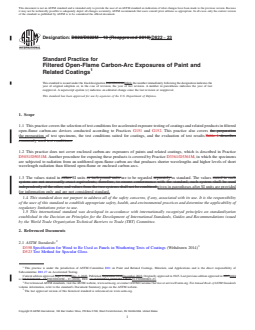
1.1 This practice covers the selection of test conditions for accelerated exposure testing of coatings and related products in filtered open-flame carbon-arc devices conducted according to Practices G151 and G152. This practice also covers the preparation of test specimens, the test conditions suited for coatings, and the evaluation of test results.
1.2 This practice does not cover enclosed carbon-arc exposures of paints and related coatings, which is described in Practice D5031/D5031M. Another procedure for exposing these products is covered by Practice D3361/D3361M, in which the specimens are subjected to radiation from an unfiltered open-flame carbon arc that produces shorter wavelengths and higher levels of short wavelength radiation than filtered open-flame or enclosed carbon arcs.
1.3 The values stated in SI units are to be regarded as standard. The values given in parentheses after SI units are provided for information only and are not considered standard.
1.4 This standard does not purport to address all of the safety concerns, if any, associated with its use. It is the responsibility of the user of this standard to establish appropriate safety, health, and environmental practices and determine the applicability of regulatory limitations prior to use.
1.5 This international standard was developed in accordance with internationally recognized principles on standardization established in the Decision on Principles for the Development of International Standards, Guides and Recommendations issued by the World Trade Organization Technical Barriers to Trade (TBT) Committee.
- Status
- Published
- Publication Date
- 30-Nov-2023
- Technical Committee
- D01 - Paint and Related Coatings, Materials, and Applications
- Drafting Committee
- D01.27 - Accelerated Testing
Buy Documents
ASTM D822-23 - Standard Practice for Filtered Open-Flame Carbon-Arc Exposures of Paint and Related Coatings
REDLINE ASTM D822-23 - Standard Practice for Filtered Open-Flame Carbon-Arc Exposures of Paint and Related Coatings
Overview
ASTM D822-23 is the standard practice for conducting filtered open-flame carbon-arc exposure tests on paints and related coatings. Developed by ASTM International, this standard outlines the procedures for exposing coatings to simulated sunlight, moisture, and heat in a controlled laboratory environment. The main goal is to evaluate the ability of coatings to resist deterioration in their physical and optical properties due to environmental stressors such as UV radiation and humidity, which closely mimic outdoor end-use conditions. ASTM D822-23 does not address other weathering factors like atmospheric pollution, biological attack, or saltwater exposure.
This test method ensures consistent and reproducible testing conditions, providing reliable data for product development, quality control, and specification compliance. It is widely respected for benchmarking material performance and is recognized by industry and regulatory bodies, including the U.S. Department of Defense.
Key Topics
- Accelerated Weathering: Uses filtered open-flame carbon-arc devices to simulate the long-term effects of sunlight, heat, and moisture on coating systems over a short period.
- Selection and Preparation of Test Specimens: Details on preparing and conditioning panels or substrates to ensure they represent end-use environments.
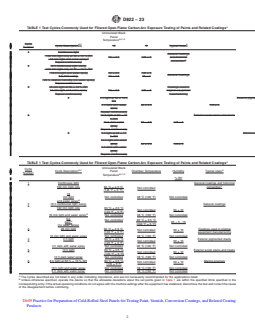
- Test Conditions: Specifies humidity, temperature, and exposure cycles commonly used for paints and coatings, along with precise documentation of the operating environment.
- Evaluation of Results: Recommends methods for periodic evaluation of changes in test specimens, including gloss, color, chalking, rusting, blistering, and other physical or optical properties.
- Reproducibility and Reporting: Stresses the importance of using the same apparatus, filters, and test cycles to ensure the validity of interlaboratory comparisons. Requires comprehensive reporting of test conditions for accurate interpretation of results.
- Limitations: Not intended for simulating damage caused by pollution, biological attack, or salt solutions; does not replace outdoor exposure data for final service-life predictions.
Applications
ASTM D822-23 is applied throughout the paints, coatings, and materials industries to:
- Product Development: Assesses durability and compares candidate materials under harsh environmental conditions before market launch.
- Quality Assurance: Verifies batch consistency in manufacturing through standardized tests.
- Specification Compliance: Demonstrates conformity to performance requirements in industry, government, or customer specifications.
- Research and Comparative Testing: Enables objective comparison between new formulations, control samples, or competitive products.
- Predictive Maintenance and Warranty Support: Supports claims of product longevity through accelerated exposure data.
Typical sectors utilizing this standard include architectural coatings, automotive finishes, protective industrial coatings, marine paints, and other applications where environmental durability is critical.
Related Standards
ASTM D822-23 references and complements several other ASTM standards to ensure comprehensive evaluation and consistency across tests:
- ASTM G151 & G152: Baseline standards for exposing nonmetallic materials using laboratory light sources, and for operating carbon arc light apparatus.
- ASTM D3361/D3361M & D5031/D5031M: Procedures for unfiltered and enclosed carbon-arc exposures, respectively.
- ASTM D1005 & D7091: Methods for dry film thickness measurement on coated panels.
- ASTM D523, D610, D772, D2244, D4214: Test methods for evaluating gloss, rusting, flaking, color difference, and degree of chalking.
- ASTM E691, G141 & G169: Statistical guides for interlaboratory testing and addressing variability in weathering results.
Using ASTM D822-23 in conjunction with these referenced standards ensures rigorous, reproducible accelerated weathering testing for paints and coatings, supporting the development of high-performance, long-lasting products in demanding environments.
Relations
- Effective Date
- 01-Dec-2023
- Effective Date
- 01-Sep-2018
- Referred By
ASTM F2589-16(2021) - Standard Specification for Ornamental Fences Employing Steel Tubular Pickets - Effective Date
- 01-Dec-2023
- Effective Date
- 01-Dec-2023
- Effective Date
- 01-Dec-2023
- Effective Date
- 01-Dec-2023
- Effective Date
- 01-Dec-2023
- Effective Date
- 01-Dec-2023
- Effective Date
- 01-Dec-2023
- Effective Date
- 01-Dec-2023
- Effective Date
- 01-Dec-2023
- Effective Date
- 01-Dec-2023
- Effective Date
- 01-Dec-2023
Buy Documents
ASTM D822-23 - Standard Practice for Filtered Open-Flame Carbon-Arc Exposures of Paint and Related Coatings
REDLINE ASTM D822-23 - Standard Practice for Filtered Open-Flame Carbon-Arc Exposures of Paint and Related Coatings
Frequently Asked Questions
ASTM D822-23 is a standard published by ASTM International. Its full title is "Standard Practice for Filtered Open-Flame Carbon-Arc Exposures of Paint and Related Coatings". This standard covers: SIGNIFICANCE AND USE 4.1 The ability of a paint or coating to resist deterioration of its physical and optical properties caused by exposure to light, heat, and water can be very significant for many applications. This practice is intended to induce property changes associated with end-use conditions, including the effects of sunlight, moisture, and heat. The exposure used in this practice is not intended to simulate the deterioration caused by localized weather phenomena such as atmospheric pollution, biological attack, and saltwater exposure. 4.2 Cautions—Variation in results may be expected when different operating conditions are used. Therefore, no reference to the use of this practice shall be made unless accompanied by a report prepared according to Section 10 that describes the specific operating conditions used. Refer to Practice G151 for detailed information on the caveats applicable to use of results obtained according to this practice. Note 1: Additional information on sources of variability and on strategies for addressing variability in the design, execution, and data analysis of laboratory accelerated exposure tests is found in Guide G141. 4.2.1 The spectral power distribution of light from an open-flame carbon-arc is significantly different from that produced in light and water exposure devices using other carbon-arc configurations or other light sources. The type and rate of degradation and the performance rankings produced by exposures to filtered open-flame carbon-arcs can be much different from those produced by exposures to other types of laboratory light sources. 4.2.2 Interlaboratory comparisons are valid only when all laboratories use the same type of carbon-arc, filters, and exposure conditions. 4.3 Reproducibility of test results between laboratories has been shown to be good when the stability of materials is evaluated in terms of performance ranking compared to other materials or to a control.4,5 Therefore, exposure of a similar material of known... SCOPE 1.1 This practice covers the selection of test conditions for accelerated exposure testing of coatings and related products in filtered open-flame carbon-arc devices conducted according to Practices G151 and G152. This practice also covers the preparation of test specimens, the test conditions suited for coatings, and the evaluation of test results. 1.2 This practice does not cover enclosed carbon-arc exposures of paints and related coatings, which is described in Practice D5031/D5031M. Another procedure for exposing these products is covered by Practice D3361/D3361M, in which the specimens are subjected to radiation from an unfiltered open-flame carbon arc that produces shorter wavelengths and higher levels of short wavelength radiation than filtered open-flame or enclosed carbon arcs. 1.3 The values stated in SI units are to be regarded as standard. The values given in parentheses after SI units are provided for information only and are not considered standard. 1.4 This standard does not purport to address all of the safety concerns, if any, associated with its use. It is the responsibility of the user of this standard to establish appropriate safety, health, and environmental practices and determine the applicability of regulatory limitations prior to use. 1.5 This international standard was developed in accordance with internationally recognized principles on standardization established in the Decision on Principles for the Development of International Standards, Guides and Recommendations issued by the World Trade Organization Technical Barriers to Trade (TBT) Committee.
SIGNIFICANCE AND USE 4.1 The ability of a paint or coating to resist deterioration of its physical and optical properties caused by exposure to light, heat, and water can be very significant for many applications. This practice is intended to induce property changes associated with end-use conditions, including the effects of sunlight, moisture, and heat. The exposure used in this practice is not intended to simulate the deterioration caused by localized weather phenomena such as atmospheric pollution, biological attack, and saltwater exposure. 4.2 Cautions—Variation in results may be expected when different operating conditions are used. Therefore, no reference to the use of this practice shall be made unless accompanied by a report prepared according to Section 10 that describes the specific operating conditions used. Refer to Practice G151 for detailed information on the caveats applicable to use of results obtained according to this practice. Note 1: Additional information on sources of variability and on strategies for addressing variability in the design, execution, and data analysis of laboratory accelerated exposure tests is found in Guide G141. 4.2.1 The spectral power distribution of light from an open-flame carbon-arc is significantly different from that produced in light and water exposure devices using other carbon-arc configurations or other light sources. The type and rate of degradation and the performance rankings produced by exposures to filtered open-flame carbon-arcs can be much different from those produced by exposures to other types of laboratory light sources. 4.2.2 Interlaboratory comparisons are valid only when all laboratories use the same type of carbon-arc, filters, and exposure conditions. 4.3 Reproducibility of test results between laboratories has been shown to be good when the stability of materials is evaluated in terms of performance ranking compared to other materials or to a control.4,5 Therefore, exposure of a similar material of known... SCOPE 1.1 This practice covers the selection of test conditions for accelerated exposure testing of coatings and related products in filtered open-flame carbon-arc devices conducted according to Practices G151 and G152. This practice also covers the preparation of test specimens, the test conditions suited for coatings, and the evaluation of test results. 1.2 This practice does not cover enclosed carbon-arc exposures of paints and related coatings, which is described in Practice D5031/D5031M. Another procedure for exposing these products is covered by Practice D3361/D3361M, in which the specimens are subjected to radiation from an unfiltered open-flame carbon arc that produces shorter wavelengths and higher levels of short wavelength radiation than filtered open-flame or enclosed carbon arcs. 1.3 The values stated in SI units are to be regarded as standard. The values given in parentheses after SI units are provided for information only and are not considered standard. 1.4 This standard does not purport to address all of the safety concerns, if any, associated with its use. It is the responsibility of the user of this standard to establish appropriate safety, health, and environmental practices and determine the applicability of regulatory limitations prior to use. 1.5 This international standard was developed in accordance with internationally recognized principles on standardization established in the Decision on Principles for the Development of International Standards, Guides and Recommendations issued by the World Trade Organization Technical Barriers to Trade (TBT) Committee.
ASTM D822-23 is classified under the following ICS (International Classification for Standards) categories: 87.040 - Paints and varnishes. The ICS classification helps identify the subject area and facilitates finding related standards.
ASTM D822-23 has the following relationships with other standards: It is inter standard links to ASTM D822/D822M-13(2018), ASTM D5031/D5031M-13(2018), ASTM F2589-16(2021), ASTM D6577-15(2019), ASTM D3451-06(2017), ASTM D2218-67(2019), ASTM E1529-22, ASTM D1654-08(2016)e1, ASTM D5589-19, ASTM G178-16(2023), ASTM D211-67(2023), ASTM F2408-16(2023), ASTM D3794-22. Understanding these relationships helps ensure you are using the most current and applicable version of the standard.
ASTM D822-23 is available in PDF format for immediate download after purchase. The document can be added to your cart and obtained through the secure checkout process. Digital delivery ensures instant access to the complete standard document.
Standards Content (Sample)
This international standard was developed in accordance with internationally recognized principles on standardization established in the Decision on Principles for the
Development of International Standards, Guides and Recommendations issued by the World Trade Organization Technical Barriers to Trade (TBT) Committee.
Designation: D822 − 23
Standard Practice for
Filtered Open-Flame Carbon-Arc Exposures of Paint and
Related Coatings
This standard is issued under the fixed designation D822; the number immediately following the designation indicates the year of
original adoption or, in the case of revision, the year of last revision. A number in parentheses indicates the year of last reapproval. A
superscript epsilon (´) indicates an editorial change since the last revision or reapproval.
This standard has been approved for use by agencies of the U.S. Department of Defense.
1. Scope 2. Referenced Documents
1.1 This practice covers the selection of test conditions for 2.1 ASTM Standards:
accelerated exposure testing of coatings and related products in D358 Specification for Wood to Be Used as Panels in
filtered open-flame carbon-arc devices conducted according to Weathering Tests of Coatings (Withdrawn 2014)
Practices G151 and G152. This practice also covers the prepa- D523 Test Method for Specular Gloss
ration of test specimens, the test conditions suited for coatings, D609 Practice for Preparation of Cold-Rolled Steel Panels
and the evaluation of test results. for Testing Paint, Varnish, Conversion Coatings, and
Related Coating Products
1.2 This practice does not cover enclosed carbon-arc expo-
D610 Practice for Evaluating Degree of Rusting on Painted
sures of paints and related coatings, which is described in
Steel Surfaces
Practice D5031/D5031M. Another procedure for exposing
D659 Method for Evaluating Degree of Chalking of Exterior
these products is covered by Practice D3361/D3361M, in
Paints (Withdrawn 1990)
which the specimens are subjected to radiation from an
D660 Test Method for Evaluating Degree of Checking of
unfiltered open-flame carbon arc that produces shorter wave-
Exterior Paints
lengths and higher levels of short wavelength radiation than
D662 Test Method for Evaluating Degree of Erosion of
filtered open-flame or enclosed carbon arcs.
Exterior Paints
1.3 The values stated in SI units are to be regarded as
D714 Test Method for Evaluating Degree of Blistering of
standard. The values given in parentheses after SI units are
Paints
provided for information only and are not considered standard.
D772 Test Method for Evaluating Degree of Flaking (Scal-
1.4 This standard does not purport to address all of the
ing) of Exterior Paints
safety concerns, if any, associated with its use. It is the D823 Practices for Producing Films of Uniform Thickness
responsibility of the user of this standard to establish appro-
of Paint, Coatings and Related Products on Test Panels
priate safety, health, and environmental practices and deter- D1005 Test Method for Measurement of Dry-Film Thick-
mine the applicability of regulatory limitations prior to use.
ness of Organic Coatings Using Micrometers
1.5 This international standard was developed in accor- D1729 Practice for Visual Appraisal of Colors and Color
dance with internationally recognized principles on standard-
Differences of Diffusely-Illuminated Opaque Materials
ization established in the Decision on Principles for the D1730 Practices for Preparation of Aluminum and
Development of International Standards, Guides and Recom-
Aluminum-Alloy Surfaces for Painting
mendations issued by the World Trade Organization Technical D2244 Practice for Calculation of Color Tolerances and
Barriers to Trade (TBT) Committee.
Color Differences from Instrumentally Measured Color
Coordinates
1 2
This practice is under the jurisdiction of ASTM Committee D01 on Paint and For referenced ASTM standards, visit the ASTM website, www.astm.org, or
Related Coatings, Materials, and Applications and is the direct responsibility of contact ASTM Customer Service at service@astm.org. For Annual Book of ASTM
Subcommittee D01.27 on Accelerated Testing. Standards volume information, refer to the standard’s Document Summary page on
Current edition approved Dec. 1, 2023. Published December 2023. Originally the ASTM website.
approved in 1945. Last previous edition approved in 2018 as D822/ The last approved version of this historical standard is referenced on
D822M – 13 (2018). DOI: 10.1520/D0822-23. www.astm.org.
Copyright © ASTM International, 100 Barr Harbor Drive, PO Box C700, West Conshohocken, PA 19428-2959. United States
D822 − 23
D2616 Test Method for Evaluation of Visual Color Differ- carbon-arc configurations or other light sources. The type and
ence With a Gray Scale rate of degradation and the performance rankings produced by
D3361/D3361M Practice for Unfiltered Open-Flame exposures to filtered open-flame carbon-arcs can be much
Carbon-Arc Exposures of Paint and Related Coatings different from those produced by exposures to other types of
D4214 Test Methods for Evaluating the Degree of Chalking laboratory light sources.
of Exterior Paint Films 4.2.2 Interlaboratory comparisons are valid only when all
D5031/D5031M Practice for Enclosed Carbon-Arc Expo-
laboratories use the same type of carbon-arc, filters, and
sure Tests of Paint and Related Coatings exposure conditions.
D5870 Practice for Calculating Property Retention Index of
4.3 Reproducibility of test results between laboratories has
Plastics
been shown to be good when the stability of materials is
D7091 Practice for Nondestructive Measurement of Dry
evaluated in terms of performance ranking compared to other
Film Thickness of Nonmagnetic Coatings Applied to 4,5
materials or to a control. Therefore, exposure of a similar
Ferrous Metals and Nonmagnetic, Nonconductive Coat-
material of known performance (a control) at the same time as
ings Applied to Non-Ferrous Metals
the test materials is strongly recommended. It is recommended
E691 Practice for Conducting an Interlaboratory Study to
that at least three replicates of each material be exposed to
Determine the Precision of a Test Method
allow for statistical evaluation of results.
E1347 Test Method for Color and Color-Difference Mea-
4.4 Test results will depend upon the care that is taken to
surement by Tristimulus Colorimetry
operate the equipment according to Practice G152. Significant
G113 Terminology Relating to Natural and Artificial Weath-
factors include regulation of line voltage, freedom from salt or
ering Tests of Nonmetallic Materials
other deposits from water, temperature and humidity control,
G141 Guide for Addressing Variability in Exposure Testing
and conditions of the electrodes.
of Nonmetallic Materials
G147 Practice for Conditioning and Handling of Nonmetal-
4.5 All references to exposures in accordance with this
lic Materials for Natural and Artificial Weathering Tests
practice must include a complete description of the test cycle
G151 Practice for Exposing Nonmetallic Materials in Accel-
used.
erated Test Devices that Use Laboratory Light Sources
G152 Practice for Operating Open Flame Carbon Arc Light
5. Apparatus
Apparatus for Exposure of Nonmetallic Materials
5.1 Use filtered open-flame carbon-arc apparatus that con-
G169 Guide for Application of Basic Statistical Methods to
forms to the requirements defined in Practices G151 and G152.
Weathering Tests
5.2 Unless otherwise specified, the spectral power distribu-
3. Terminology
tion of the filtered open-flame carbon-arc shall conform to the
3.1 The definitions given in Terminology G113 are appli- requirements in Practice G152 for carbon arc with daylight
cable to this practice. filters.
4. Significance and Use
6. Hazards
4.1 The ability of a paint or coating to resist deterioration of
6.1 Warning—In addition to other precautions, never look
its physical and optical properties caused by exposure to light,
directly at the carbon arc because UV radiation can damage the
heat, and water can be very significant for many applications.
eye. Most carbon-arc machines are equipped with door safety
This practice is intended to induce property changes associated
switches, but users of old equipment must be certain to turn off
with end-use conditions, including the effects of sunlight,
the power to the carbon arc before opening the test-chamber
moisture, and heat. The exposure used in this practice is not
door.
intended to simulate the deterioration caused by localized
6.2 The burning carbon rods used in these devices become
weather phenomena such as atmospheric pollution, biological
very hot during use. Make sure to allow at least 15 min for the
attack, and saltwater exposure.
arcs to cool after the device is turned off before attempting to
4.2 Cautions—Variation in results may be expected when
change the carbon rods.
different operating conditions are used. Therefore, no reference
6.3 Carbon residue and ash are known respiratory irritants.
to the use of this practice shall be made unless accompanied by
Wear an appropriate high-efficiency dust respirator, gloves, and
a report prepared according to Section 10 that describes the
safety glasses when handling or changing carbon rods. Make
specific operating conditions used. Refer to Practice G151 for
sure to wash any carbon residue from hands or arms prior to
detailed information on the caveats applicable to use of results
eating or drinking.
obtained according to this practice.
NOTE 1—Additional information on sources of variability and on
strategies for addressing variability in the design, execution, and data
analysis of laboratory accelerated exposure tests is found in Guide G141.
Fischer, R., “Results of Round-Robin Studies of Light- and Water-Exposure
Standard Practices,” Accelerated and Outdoor Durability Testing of Organic
4.2.1 The spectral power distribution of light from an
Materials, ASTM STP 1202, ASTM, 1993.
open-flame carbon-arc is significantly different from that
Ketola, W., and Fischer, R., “Characterization and Use of Reference Materials
produced in light and water exposure devices using other in Accelerated Durability Tests,” VAMAS Technical Report No. 30, NIST, June 1997.
D822 − 23
7. Test Specimens property of interest can be determined on unexposed file
specimens each time exposed materials are evaluated.
7.1 Apply the coating to flat (plane) panels with the
substrate, method of preparation, method of application, coat-
NOTE 3—Since the stability of the file specimen may also be time-
dependent, users are cautioned that over prolonged exposure periods, or
ing system, film thickness, and method of drying consistent
where small differences in the order of acceptable limits are anticipated,
with the anticipated end use, or as mutually agreed upon
comparison of exposed specimens with the file specimen may not be valid.
between the producer and user.
Nondestructive instrumental measurements are recommended whenever
possible.
7.2 Panel specifications and methods of preparation include
but are not limited to Practices D609 or D1730, or Specifica-
7.10 Specimens should not ordinarily be removed from the
tion D358. Select panel sizes suitable for use with the exposure
exposure apparatus for more than 24 h, then returned for
apparatus.
additional tests, since this does not produce the same results on
all materials as tests run without this type of interruption. When
7.3 Coat test panels in accordance with Test Methods D823,
specimens are removed from the exposure apparatus for 24 h or
then measure the film thickness in accordance with an appro-
more, then returned for additional exposure, report the elapsed
priate procedure selected from Test Method D1005 and Prac-
time as noted under Section 10.
tice D7091. Nondestructive methods are preferred because
panels so measured need not be repaired.
8. Procedure
7.4 Prior to exposing coated panels in the apparatus, condi-
8.1 Table 1 lists several exposure cycles that are used for
tion them at 23 °C 6 2 °C [73 °F 6 3 °F] and 50 % 6 10 %
filtered open-flame carbon-arc exposures of nonmetallic mate-
relative humidity for one of the following periods in accor-
rials. Obtain mutual agreement between all concerned parties
dance with the type of coating:
for the specific exposure cycle used. Additional intervals and
Baked coatings 24 h
methods of wetting, by spray, condensation, or both, may be
Radiation-cured coatings 24 h
All other coatings 7 days
substituted upon agreement among the concerned parties.
7.4.1 Other procedures for preparation of test specimens
NOTE 4—Each set point and the corresponding operational fluctuations
may be used if agreed upon between all interested parties.
found in Table 1 represent an operational control point for equilibrium
conditions at a single location in the cabinet, which may not necessarily
7.5 Mount specimens in holders so that only the minimum
represent the uniformity of those conditions throughout the cabinet.
specimen area required for support by the holder is covered.
ASTM Committee G03 is working to refine these operational fluctuations
This unexposed surface must not be used as part of the test
and address the uniformity issue.
area. In cases where it is necessary to support flexible speci-
8.1.1 Unless otherwise specified, maintain relative humidity
mens during exposure, attach the flexible specimens to a thin
at 50 % 6 10 % equilibrium during the light-only interval.
supporting panel.
8.2 Unless otherwise specified, operate the device so that
NOTE 2—For supporting flexible specimens, aluminum panels that are
the allowable deviations about the set points given in Table 1
0.025 inches (0.64 mm) thick have been found to be acceptable for many
are within the specified limits specified in the corresponding
applications. Alternatively, stainless steel panels that are at least 0.025
entry. If the actual operating conditions do not agree with the
inches (0.64 mm) thick can also be used, to avoid potential corrosion from
aluminum panels. machine settings after the equipment has stabilized, discon-
tinue the test and correct the cause of the disagreement before
7.6 Unless otherwise specified, expose at least three repli-
continuing.
cate specimens of each test and control material.
7.6.1 If performance comparisons are not being made be-
8.3 If no other cycle is specified, use Cycle No. 1.
tween the test materials themselves, it is recommended that a
8.4 Mount test specimens in the device following the
control material be exposed simultaneously with experimental
placement and specimen repositioning procedures described in
materials for determination of relative performance. All con-
Practice G152. It is recommended that all unused spaces in the
cerned parties must agree on the control material, if any is
specimen exposure area be filled with blank metal panels.
used.
8.5 If the irradiance uniformity within the exposure area
7.7 Follow the procedures described in Practice G147 for
does not meet the requirements of Practice G151 for exposure
identification and conditioning and handling of specimens of
without repositioning, use one of the procedures described in
test, control, and reference materials prior to, during, and after
Practice G152 to ensure that specimens receive as uniform a
exposure.
radiant exposure as possible.
7.8 Do not mask the face of a specimen for the purpose of
8.5.1 If specimen repositioning is used, and no repositioning
s
...
This document is not an ASTM standard and is intended only to provide the user of an ASTM standard an indication of what changes have been made to the previous version. Because
it may not be technically possible to adequately depict all changes accurately, ASTM recommends that users consult prior editions as appropriate. In all cases only the current version
of the standard as published by ASTM is to be considered the official document.
Designation: D822/D822M − 13 (Reapproved 2018) D822 − 23
Standard Practice for
Filtered Open-Flame Carbon-Arc Exposures of Paint and
Related Coatings
This standard is issued under the fixed designation D822/D822M;D822; the number immediately following the designation indicates the
year of original adoption or, in the case of revision, the year of last revision. A number in parentheses indicates the year of last
reapproval. A superscript epsilon (´) indicates an editorial change since the last revision or reapproval.
This standard has been approved for use by agencies of the U.S. Department of Defense.
1. Scope
1.1 This practice covers the selection of test conditions for accelerated exposure testing of coatings and related products in filtered
open-flame carbon-arc devices conducted according to Practices G151 and G152. This practice also covers the preparation
the preparation of test specimens, the test conditions suited for coatings, and the evaluation of test results.Table 1 describes
commonly used test conditions.
1.2 This practice does not cover enclosed carbon-arc exposures of paints and related coatings, which is described in Practice
D5031/D5031M. Another procedure for exposing these products is covered by Practice D3361/D3361M, in which the specimens
are subjected to radiation from an unfiltered open-flame carbon arc that produces shorter wavelengths and higher levels of short
wavelength radiation than filtered open-flame or enclosed carbon arcs.
1.3 The values stated in either SI units or inch-pound units are to be regarded separately as standard. The values stated in each
system are not necessarily exact equivalents; therefore, to ensure conformance with the standard, each system shall be used
independently of the other, and values from the two systems shall not be combined.given in parentheses after SI units are provided
for information only and are not considered standard.
1.4 This standard does not purport to address all of the safety concerns, if any, associated with its use. It is the responsibility
of the user of this standard to establish appropriate safety, health, and environmental practices and determine the applicability of
regulatory limitations prior to use.
1.5 This international standard was developed in accordance with internationally recognized principles on standardization
established in the Decision on Principles for the Development of International Standards, Guides and Recommendations issued
by the World Trade Organization Technical Barriers to Trade (TBT) Committee.
2. Referenced Documents
2.1 ASTM Standards:
D358 Specification for Wood to Be Used as Panels in Weathering Tests of Coatings (Withdrawn 2014)
D523 Test Method for Specular Gloss
This practice is under the jurisdiction of ASTM Committee D01 on Paint and Related Coatings, Materials, and Applications and is the direct responsibility of
Subcommittee D01.27 on Accelerated Testing.
Current edition approved Sept. 1, 2018Dec. 1, 2023. Published September 2018December 2023. Originally approved in 1945. Last previous edition approved in 20132018
as D822/D822M – 13.D822/D822M – 13 (2018). DOI: 10.1520/D0822_D0822M-13R18.10.1520/D0822-23.
For referenced ASTM standards, visit the ASTM website, www.astm.org, or contact ASTM Customer Service at service@astm.org. For Annual Book of ASTM Standards
volume information, refer to the standard’s Document Summary page on the ASTM website.
The last approved version of this historical standard is referenced on www.astm.org.
Copyright © ASTM International, 100 Barr Harbor Drive, PO Box C700, West Conshohocken, PA 19428-2959. United States
D822 − 23
A
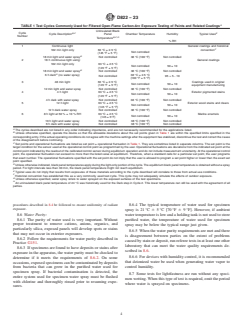
TABLE 1 Test Cycles Commonly Used for Filtered Open-Flame Carbon-Arc Exposure Testing of Paints and Related Coatings
Uninsulated Black
Panel
B,C,D
Temperature
Cycle
B,C E
Cycle Description °C °F Typical Uses
Number
1 Continuous light
General coatings
102 min light only at 50 ± 10 % RH
63 ± 2.5 145 ± 5 and historical
G
18 min light and water spray
F
convention
Repeat continuously
2 18 h continuous light using:
102 min light only at 50 ± 10 % RH
18 min light and water spray 63 ± 2.5 145 ± 5
General coatings
6 h dark using: 24 ± 1.5 75 ± 3
95 % relative humidity (no water spray)
Repeat continuously
3 48 min light at 50 ± 10 % RH Coatings used in
12 min light and water spray 63 ± 2.5 145 ± 5 original equipment
Repeat continuously manufacturing
4 4 h light at 50 ± 10% Exterior pigmented
RH
4 h dark with water 63 ± 2.5 145 ± 5
spray
Repeat continuously
5 12 h light at 50 ± 10 Exterior wood stains and clears
% RH
12 h dark water 63 ± 2.5 145 ± 5
spray
Repeat continuously
6 8 h light at 50 ± 10 Marine enamels
% RH
10 h light and water
spray 63 ± 2.5 145 ± 5
6 h dark with water
spray
Repeat continuously
A
TABLE 1 Test Cycles Commonly Used for Filtered Open-Flame Carbon-Arc Exposure Testing of Paints and Related Coatings
Uninsulated Black
Cycle
B,C E
Cycle Description Panel Chamber Temperature Humidity Typical Uses
Number
B,C,D
Temperature
% RH
1 Continuous light General coatings and historical
F
102 min light only 63 °C ± 2.5 °C convention
Not controlled
(145 °F ± 5 °F)
min light Not controlled 38 °C (100 °F) Not controlled
G
and water spray
2 18 h continuous light using: General coatings
102 min light only 63 °C ± 2.5 °C
Not controlled 50 ± 10
(145 °F ± 5 °F)
G
18 min light and water spray Not controlled 38 °C (100 °F) Not controlled
6 h
Not controlled 38 °C ± 2.5 °C
H
95 + 5 - 10
dark
(100 °F ± 5 °F)
(no water spray)
3 48 min light 63 °C ± 2.5 °C Coatings used in original
Not controlled 50 ± 10
(145 °F ± 5 °F) equipment manufacturing
12 min light and water spray Not controlled 38 °C (100 °F) Not controlled
4 4 h light 63 °C ± 2.5 °C Exterior pigmented stains
Not controlled 50 ± 10
(145 °F ± 5 °F)
4 h dark with water spray Not controlled 38 °C (100 °F) Not controlled
5 12 h light 63 °C ± 2.5 °C Exterior wood stains and clears
Not controlled 50 ± 10
(145 °F ± 5 °F)
12 h dark water spray Not controlled 38 °C (100 °F) Not controlled
6 8 h light at 50 % ± 10 % RH 63 °C ± 2.5 °C Marine enamels
Not controlled 50 ± 10
(145 ± 5°F)
10 h light and water spray Not controlled 38 °C (100 °F) Not controlled
6 h dark with water spray Not controlled 38 °C (100 °F) Not controlled
A
The cycles described are not listed in any order indicating importance, and are not necessarily recommended for the applications listed.
B
Unless otherwise specified, operate the device so that the allowable deviations about the set points given in Table 1 are within the specified limits specified in the
corresponding entry. If the actual operating conditions do not agree with the machine settings after the equipment has stabilized, discontinue the test and correct the cause
of the disagreement before continuing.
D609 Practice for Preparation of Cold-Rolled Steel Panels for Testing Paint, Varnish, Conversion Coatings, and Related Coating
Products
D822 − 23
C
Set points and operational fluctuations are listed as set point ± operational fluctuation in Table 1. They are sometimes listed in separate columns. The set point is the
target condition for the sensor used at the operational control point as programmed by the user. Operational fluctuations are deviations from the indicated set point at the
control point indicated by the readout of the calibrated control sensor during equilibrium operation and do not include measurement uncertainty. At the operational control
point, the operational fluctuation can exceed no more than the listed value at equilibrium. Therefore, when a standard calls for a particular set point, the user programs
that exact number. The operational fluctuations specified with the set point do not imply that the user is allowed to program a set point higher or lower than the exact set
point specified.
D
Unless otherwise indicated, black panel temperatures apply during the light-only portion of the cycle. The equilibrium black panel temperature is obtained without a spray
period. For light intervals less than 30 min, the black panel temperature might not reach equilibrium.
E
Typical uses do not imply that results from exposures of these materials according to the cycle described will correlate to those from actual use conditions.
F
Historical convention has established this as a very commonly used test cycle. This cycle may not adequately simulate the effects of outdoor exposure.
G
Unless otherwise specified, water spray refers to water sprayed on the exposed surfaces of the test specimens.
H
An uninsulated black panel temperature of 24 °C was historically used for the Dark step in Cycle 2. This lower temperature can still be used with the agreement of all
parties.
D610 Practice for Evaluating Degree of Rusting on Painted Steel Surfaces
D659 Method for Evaluating Degree of Chalking of Exterior Paints (Withdrawn 1990)
D660 Test Method for Evaluating Degree of Checking of Exterior Paints
D662 Test Method for Evaluating Degree of Erosion of Exterior Paints
D714 Test Method for Evaluating Degree of Blistering of Paints
D772 Test Method for Evaluating Degree of Flaking (Scaling) of Exterior Paints
D823 Practices for Producing Films of Uniform Thickness of Paint, Coatings and Related Products on Test Panels
D1005 Test Method for Measurement of Dry-Film Thickness of Organic Coatings Using Micrometers
D1186 Test Methods for Nondestructive Measurement of Dry Film Thickness of Nonmagnetic Coatings Applied to a Ferrous
Base (Withdrawn 2006)
D1400 Test Method for Nondestructive Measurement of Dry Film Thickness of Nonconductive Coatings Applied to a
Nonferrous Metal Base (Withdrawn 2006)
D1729 Practice for Visual Appraisal of Colors and Color Differences of Diffusely-Illuminated Opaque Materials
D1730 Practices for Preparation of Aluminum and Aluminum-Alloy Surfaces for Painting
D2244 Practice for Calculation of Color Tolerances and Color Differences from Instrumentally Measured Color Coordinates
D2616 Test Method for Evaluation of Visual Color Difference With a Gray Scale
D3361/D3361M Practice for Unfiltered Open-Flame Carbon-Arc Exposures of Paint and Related Coatings
D4214 Test Methods for Evaluating the Degree of Chalking of Exterior Paint Films
D5031/D5031M Practice for Enclosed Carbon-Arc Exposure Tests of Paint and Related Coatings
D5870 Practice for Calculating Property Retention Index of Plastics
D7091 Practice for Nondestructive Measurement of Dry Film Thickness of Nonmagnetic Coatings Applied to Ferrous Metals
and Nonmagnetic, Nonconductive Coatings Applied to Non-Ferrous Metals
E691 Practice for Conducting an Interlaboratory Study to Determine the Precision of a Test Method
E1347 Test Method for Color and Color-Difference Measurement by Tristimulus Colorimetry
G113 Terminology Relating to Natural and Artificial Weathering Tests of Nonmetallic Materials
G141 Guide for Addressing Variability in Exposure Testing of Nonmetallic Materials
G147 Practice for Conditioning and Handling of Nonmetallic Materials for Natural and Artificial Weathering Tests
G151 Practice for Exposing Nonmetallic Materials in Accelerated Test Devices that Use Laboratory Light Sources
G152 Practice for Operating Open Flame Carbon Arc Light Apparatus for Exposure of Nonmetallic Materials
G169 Guide for Application of Basic Statistical Methods to Weathering Tests
3. Terminology
3.1 The definitions given in Terminology G113 are applicable to this practice.
4. Significance and Use
4.1 The ability of a paint or coating to resist deterioration of its physical and optical properties caused by exposure to light, heat,
and water can be very significant for many applications. This practice is intended to induce property changes associated with
end-use conditions, including the effects of sunlight, moisture, and heat. The exposure used in this practice is not intended to
simulate the deterioration caused by localized weather phenomena such as atmospheric pollution, biological attack, and saltwater
exposure.
4.2 Cautions—Variation in results may be expected when different operating conditions are used. Therefore, no reference to the
use of this practice shall be made unless accompanied by a report prepared according to Section 10 that describes the specific
operating conditions used. Refer to Practice G151 for detailed information on the caveats applicable to use of results obtained
according to this practice.
D822 − 23
NOTE 1—Additional information on sources of variability and on strategies for addressing variability in the design, execution, and data analysis of
laboratory accelerated exposure tests is found in Guide G141.
4.2.1 The spectral power distribution of light from an open-flame carbon-arc is significantly different from that produced in light
and water exposure devices using other carbon-arc configurations or other light sources. The type and rate of degradation and the
performance rankings produced by exposures to filtered open-flame carbon-arcs can be much different from those produced by
exposures to other types of laboratory light sources.
4.2.2 Interlaboratory comparisons are valid only when all laboratories use the same type of carbon-arc, filters, and exposure
conditions.
4.3 Reproducibility of test results between laboratories has been shown to be good when the stability of materials is evaluated in
4,5
terms of performance ranking compared to other materials or to a control. Therefore, exposure of a similar material of known
performance (a control) at the same time as the test materials is strongly recommended. It is recommended that at least three
replicates of each material be exposed to allow for statistical evaluation of results.
4.4 Test results will depend upon the care that is taken to operate the equipment according to Practice G152. Significant factors
include regulation of line voltage, freedom from salt or other deposits from water, temperature and humidity control, and
conditions of the electrodes.
4.5 All references to exposures in accordance with this practice must include a complete description of the test cycle used.
5. Apparatus
5.1 Use filtered open-flame carbon-arc apparatus that conforms to the requirements defined in Practices G151 and G152.
5.2 Unless otherwise specified, the spectral power distribution of the filtered open-flame carbon-arc shall conform to the
requirements in Practice G152 for carbon arc with daylight filters.
6. Hazards
6.1 Warning—In addition to other precautions, never look directly at the carbon arc because UV radiation can damage the eye.
Most carbon-arc machines are equipped with door safety switches, but users of old equipment must be certain to turn off the power
to the carbon arc before opening the test-chamber door.
6.2 The burning carbon rods used in these devices become very hot during use. Make sure to allow at least 15 min for the arcs
to cool after the device is turned off before attempting to change the carbon rods.
6.3 Carbon residue and ash are known respiratory irritants. Wear an appropriate high-efficiency dust respirator, gloves, and safety
glasses when handling or changing carbon rods. Make sure to wash any carbon residue from hands or arms prior to eating or
drinking.
7. Test Specimens
7.1 Apply the coating to flat (plane) panels with the substrate, method of preparation, method of application, coating system, film
thickness, and method of drying consistent with the anticipated end use, or as mutually agreed upon between the producer and user.
7.2 Panel specifications and methods of preparation include but are not limited to Practices D609 or D1730, or Specification D358.
Select panel sizes suitable for use with the exposure apparatus.
Fischer, R., “Results of Round-Robin Studies of Light- and Water-Exposure Standard Practices,” Accelerated and Outdoor Durability Testing of Organic Materials,
ASTM STP 1202, ASTM, 1993.
Ketola, W., and Fischer, R., “Characterization and Use of Reference Materials in Accelerated Durability Tests,” VAMAS Technical Report No. 30, NIST, June 1997.
D822 − 23
7.3 Coat test panels in a
...