

ASTM D2218-67(2019)
(Specification)Standard Specification for Molybdate Orange Pigments
General Information
- Abstract
ABSTRACT
This specification covers molybdate orange dry pigments made by chemical coprecipitation of lead chromate and lead molybdate, with or without admixtures of other insoluble lead compounds or other materials. Mixing the pigments with a white pigment should produce tints with required mass colors and characters. The dry pigments should be subjected to chemical analysis, The dry pigments should conform to the specified requirements for chromium content, molybdenum content, moisture and other volatile matter content, coarse particle content, water-soluble matter content, mass color and tinting strength, and resistance to loss of gloss, chalking, and color change.
SCOPE
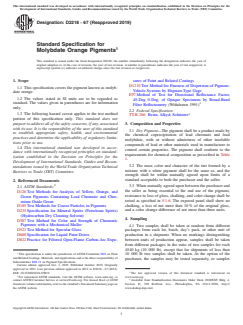
1.1 This specification covers the pigment known as molybdate orange.
1.2 The values stated in SI units are to be regarded as standard. The values given in parentheses are for information only.
1.3 The following hazard caveat applies to the test method portion of this specification only. This standard does not purport to address all of the safety concerns, if any, associated with its use. It is the responsibility of the user of this standard to establish appropriate safety, health, and environmental practices and determine the applicability of regulatory limitations prior to use.
1.4 This international standard was developed in accordance with internationally recognized principles on standardization established in the Decision on Principles for the Development of International Standards, Guides and Recommendations issued by the World Trade Organization Technical Barriers to Trade (TBT) Committee.
- Status
- Published
- Publication Date
- 30-Sep-2019
- Technical Committee
- D01 - Paint and Related Coatings, Materials, and Applications
- Drafting Committee
- D01.31 - Pigment Specifications


Overview
ASTM D2218-67(2019): Standard Specification for Molybdate Orange Pigments is a key international standard published by ASTM International. It specifies requirements for molybdate orange pigments, which are produced by chemical coprecipitation of lead chromate and lead molybdate. These pigments may include additional insoluble lead compounds or other materials intended to modify certain properties. The standard details the necessary chemical composition, physical properties, and performance characteristics required for molybdate orange pigments used primarily in paints, coatings, and related applications.
Key Topics
Composition and Production
- Molybdate orange pigments are made by coprecipitating lead chromate and lead molybdate.
- Formulations may include additional insoluble lead compounds or other materials to adjust performance.
Quality and Purity Requirements
Pigments must meet strict criteria, including:- Chromium and molybdenum content within specified ranges.
- Limits on moisture, volatile matter, coarse particles, and water-soluble matter.
- Adherence to requirements for mass color, tinting strength, and resistance to gloss loss, chalking, and color change.
Testing and Analysis
- Procedures for sampling during production batches.
- Standardized ASTM test methods for:
- Chemical composition
- Fineness of dispersion
- Coarse particle content
- Gloss and reflectance
- Moisture and volatile matter
- Mass color and tinting strength
- Emphasizes the use of SI units as the measurement standard.
Performance Evaluation
- Provides recommended methods for testing the pigment’s resistance to weathering, gloss loss, color change, and chalking, especially for coatings applications.
Health, Safety, and Regulatory Compliance
- Includes cautionary guidance to ensure users establish appropriate safety, health, and environmental practices.
- Compliance with local and international regulations is stressed.
Applications
Molybdate orange pigments specified by ASTM D2218-67(2019) are widely used in several industries due to their vibrant color, tinting strength, and durability. Typical applications include:
Paints and Coatings
- Used in architectural, industrial, automotive, and protective coatings for their outstanding color stability, gloss retention, and resistance to weathering.
Plastics and Polymers
- Incorporated into plastic manufacturing where high-performance color is required.
Printing Inks and Colorants
- Suitable for formulating high-strength, fade-resistant printing inks.
Benefits of using standardized molybdate orange pigments:
- Improved quality control during pigment selection and manufacturing.
- Compatibility and reproducibility in product formulation.
- Assurance of consistent performance across different batches and suppliers.
Related Standards
For comprehensive pigment and coating quality assurance, the following standards are referenced or used in conjunction with ASTM D2218-67(2019):
- ASTM D126 - Test Methods for Analysis of Yellow, Orange, and Green Pigments Containing Lead Chromate
- ASTM D185 - Test Methods for Coarse Particles in Pigments
- ASTM D235 - Specification for Mineral Spirits (Petroleum Spirits) (Hydrocarbon Dry Cleaning Solvent)
- ASTM D387 - Test Method for Color and Strength of Chromatic Pigments with a Mechanical Muller
- ASTM D523 - Test Method for Specular Gloss
- ASTM D1210 - Test Method for Fineness of Dispersion of Pigment-Vehicle Systems by Hegman-Type Gage
- ASTM D600 - Specification for Liquid Paint Driers
- ASTM D822 - Practice for Filtered Open-Flame Carbon-Arc Exposure of Paint and Related Coatings
Keywords: molybdate orange, ASTM D2218, pigment standard, lead chromate, lead molybdate, paint pigments, coatings, tinting strength, gloss retention, color stability, chemical analysis.
Relations
- Effective Date
- 01-Oct-2019
- Effective Date
- 01-Dec-2023
- Effective Date
- 01-Jan-2014
- Effective Date
- 01-Jun-2012
- Effective Date
- 01-Feb-2010
- Effective Date
- 01-Jun-2008
- Effective Date
- 01-Feb-2008
- Effective Date
- 01-Feb-2008
- Effective Date
- 01-Jul-2007
- Effective Date
- 01-Jun-2007
- Effective Date
- 01-Jun-2007
- Effective Date
- 01-Nov-2006
- Effective Date
- 01-Nov-2006
- Effective Date
- 01-Mar-2005
- Effective Date
- 01-Jul-2004
Frequently Asked Questions
ASTM D2218-67(2019) is a technical specification published by ASTM International. Its full title is "Standard Specification for Molybdate Orange Pigments". This standard covers: ABSTRACT This specification covers molybdate orange dry pigments made by chemical coprecipitation of lead chromate and lead molybdate, with or without admixtures of other insoluble lead compounds or other materials. Mixing the pigments with a white pigment should produce tints with required mass colors and characters. The dry pigments should be subjected to chemical analysis, The dry pigments should conform to the specified requirements for chromium content, molybdenum content, moisture and other volatile matter content, coarse particle content, water-soluble matter content, mass color and tinting strength, and resistance to loss of gloss, chalking, and color change. SCOPE 1.1 This specification covers the pigment known as molybdate orange. 1.2 The values stated in SI units are to be regarded as standard. The values given in parentheses are for information only. 1.3 The following hazard caveat applies to the test method portion of this specification only. This standard does not purport to address all of the safety concerns, if any, associated with its use. It is the responsibility of the user of this standard to establish appropriate safety, health, and environmental practices and determine the applicability of regulatory limitations prior to use. 1.4 This international standard was developed in accordance with internationally recognized principles on standardization established in the Decision on Principles for the Development of International Standards, Guides and Recommendations issued by the World Trade Organization Technical Barriers to Trade (TBT) Committee.
ABSTRACT This specification covers molybdate orange dry pigments made by chemical coprecipitation of lead chromate and lead molybdate, with or without admixtures of other insoluble lead compounds or other materials. Mixing the pigments with a white pigment should produce tints with required mass colors and characters. The dry pigments should be subjected to chemical analysis, The dry pigments should conform to the specified requirements for chromium content, molybdenum content, moisture and other volatile matter content, coarse particle content, water-soluble matter content, mass color and tinting strength, and resistance to loss of gloss, chalking, and color change. SCOPE 1.1 This specification covers the pigment known as molybdate orange. 1.2 The values stated in SI units are to be regarded as standard. The values given in parentheses are for information only. 1.3 The following hazard caveat applies to the test method portion of this specification only. This standard does not purport to address all of the safety concerns, if any, associated with its use. It is the responsibility of the user of this standard to establish appropriate safety, health, and environmental practices and determine the applicability of regulatory limitations prior to use. 1.4 This international standard was developed in accordance with internationally recognized principles on standardization established in the Decision on Principles for the Development of International Standards, Guides and Recommendations issued by the World Trade Organization Technical Barriers to Trade (TBT) Committee.
ASTM D2218-67(2019) is classified under the following ICS (International Classification for Standards) categories: 87.060.10 - Pigments and extenders. The ICS classification helps identify the subject area and facilitates finding related standards.
ASTM D2218-67(2019) has the following relationships with other standards: It is inter standard links to ASTM D2218-67(2012), ASTM D822-23, ASTM D523-14, ASTM D126-87(2012), ASTM D1210-05(2010), ASTM D523-08, ASTM D523-89(2008), ASTM D387-00(2008), ASTM D185-07, ASTM D235-02(2007), ASTM D600-07, ASTM D126-87(2006), ASTM D822-01(2006), ASTM D1210-05, ASTM D1210-96(2004). Understanding these relationships helps ensure you are using the most current and applicable version of the standard.
ASTM D2218-67(2019) is available in PDF format for immediate download after purchase. The document can be added to your cart and obtained through the secure checkout process. Digital delivery ensures instant access to the complete standard document.
Standards Content (Sample)
This international standard was developed in accordance with internationally recognized principles on standardization established in the Decision on Principles for the
Development of International Standards, Guides and Recommendations issued by the World Trade Organization Technical Barriers to Trade (TBT) Committee.
Designation:D2218 −67 (Reapproved 2019)
Standard Specification for
Molybdate Orange Pigments
This standard is issued under the fixed designation D2218; the number immediately following the designation indicates the year of
original adoption or, in the case of revision, the year of last revision. A number in parentheses indicates the year of last reapproval. A
superscript epsilon (´) indicates an editorial change since the last revision or reapproval.
1. Scope sures of Paint and Related Coatings
D1210 Test Method for Fineness of Dispersion of Pigment-
1.1 This specification covers the pigment known as molyb-
Vehicle Systems by Hegman-Type Gage
date orange.
E97 Method of Test for Directional Reflectance Factor,
1.2 The values stated in SI units are to be regarded as
45-Deg 0-Deg, of Opaque Specimens by Broad-Band
standard. The values given in parentheses are for information
Filter Reflectometry (Withdrawn 1991)
only.
2.2 Federal Specification:
1.3 The following hazard caveat applies to the test method
TT-R-266 Resin, Alkyd; Solutions
portion of this specification only. This standard does not
purport to address all of the safety concerns, if any, associated
3. Composition and Properties
with its use. It is the responsibility of the user of this standard
3.1 Dry Pigment—The pigment shall be a product made by
to establish appropriate safety, health, and environmental
the chemical coprecipitation of lead chromate and lead
practices and determine the applicability of regulatory limita-
molybdate, with or without admixtures of other insoluble
tions prior to use.
compounds of lead or other materials used in manufacture to
1.4 This international standard was developed in accor-
control certain properties. The pigment shall conform to the
dance with internationally recognized principles on standard-
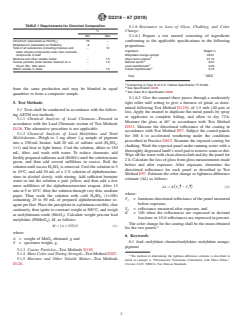
requirements for chemical composition as prescribed in Table
ization established in the Decision on Principles for the
1.
Development of International Standards, Guides and Recom-
3.2 The mass color and character of the tint formed by a
mendations issued by the World Trade Organization Technical
mixture with a white pigment shall be the same as, and the
Barriers to Trade (TBT) Committee.
strength shall be within mutually agreed upon limits of a
standard acceptable to both the purchaser and the seller.
2. Referenced Documents
3.3 When mutually agreed upon between the purchaser and
2.1 ASTM Standards:
the seller as being essential to the end use of the pigment,
D126 Test Methods for Analysis of Yellow, Orange, and
resistance to loss of gloss, chalking, and color change shall be
Green Pigments Containing Lead Chromate and Chro-
tested as specified in 5.1.6. The exposed panel shall show no
mium Oxide Green
chalking, a loss of not more than 10 % of the original gloss,
D185 Test Methods for Coarse Particles in Pigments
and a color change difference of not more than three units.
D235 Specification for Mineral Spirits (Petroleum Spirits)
(Hydrocarbon Dry Cleaning Solvent)
4. Sampling
D387 Test Method for Color and Strength of Chromatic
Pigments with a Mechanical Muller
4.1 Two samples shall be taken at random from different
D523 Test Method for Specular Gloss
packages from each lot, batch, day’s pack, or other unit of
D600 Specification for Liquid Paint Driers
production in a shipment. When no markings distinguishing
D822 Practice for Filtered Open-Flame Carbon-Arc Expo-
between units of production appear, samples shall be taken
from different packages in the ratio of two samples for each
4540 kg (10 000 lb), except that for shipments of less than
This specification is under the jurisdiction of ASTM Committee D01 on Paint
10 000 lb two samples shall be taken. At the option of the
and Related Coatings, Materials, andApplications and is the direct responsibility of
purchaser, the samples may be tested separately, or samples
Subcommittee D01.31 on Pigment Specifications.
Current edition approved Oct. 1, 2019. Published October 2019. Originally
approved in 1963. Last previous edition approved in 2012 as D2218 – 67 (2012).
DOI: 10.1520/D2218-67R19. The last approved version of this historical standard is referenced on
For referenced ASTM standards, visit the ASTM website, www.astm.org, or www.astm.org.
contact ASTM Customer Service at service@astm.org. For Annual Book of ASTM Available from Standardization Documents Order Desk, DODSSP, Bldg. 4,
Standards volume information, refer to the standard’s Document Summary page on Section D, 700 Robbins Ave., Philadelphia, PA 19111-5098, http://
the ASTM website. www.dodssp.daps.mil.
Copyright © ASTM International, 100 Barr Harbor Drive, PO Box C700, West Conshohocken, PA 19428-2959. United States
D2218−67 (2019)
TABLE 1 Requirements for Chemical Composition
5.1.6 Resistance to Loss of Gloss, Chalking, and Color
% Change:
Min Max 5.1.6.1 Prepare a test enamel consisting of ingredients
Chromium (calculated as PbCrO ) 70 . conforming to the applicable specifications in the following
Molybdenum (calculated as PbMoO ) 8 .
proportions:
Total of all substances (including moisture and . 12
Ingredient Weight %
w
...