

ASTM F2408-16(2023)
(Specification)Standard Specification for Ornamental Fences Employing Galvanized Steel Tubular Pickets
General Information
- Abstract
ABSTRACT
This specification establishes the minimum requirements for coated tubular picket ornamental fence systems fabricated from galvanized steel components. Steel material for tubular picket ornamental fence system structural components shall be galvanized by the hot-dip process, either after forming, or prior to forming. Powder coatings applied to the exterior surface of fence components shall be polymer material: polyester or epoxy and polyester combinations. Wet coating applied to the exterior surface of fence components shall be a two-coat paint application system (one coat of epoxy, polyester or polyurethane primer; one coat of polyester, polyurethane, or acrylic liquid). Fittings, fasteners, and decorative accessories for ornamental steel fence systems shall be manufactured with a material and finish coating that meets the same protective coating performance requirements as required for panels and posts. Four structural test methods shall be conducted: Method A which is application of horizontal concentrated load, Method B which is application of vertical concentrated load, Method C which is application of horizontal thrust load to infill areas, and Method D which is application of horizontal cone penetration load. Different tests shall also be performed in order to determine the following properties of the fence system coatings: adhesion, corrosion resistance, impact resistance, and weathering resistance.
SCOPE
1.1 This specification establishes the minimum requirements for coated tubular picket ornamental fence systems fabricated from galvanized steel components.
1.2 The requirements of this specification do not apply to vertical bar fence systems utilizing solid bar or wrought iron materials.
1.3 The values stated in inch-pound units are to be regarded as standard. The values given in parentheses are mathematical conversions to SI units that are provided for information only and are not considered standard.
1.4 This international standard was developed in accordance with internationally recognized principles on standardization established in the Decision on Principles for the Development of International Standards, Guides and Recommendations issued by the World Trade Organization Technical Barriers to Trade (TBT) Committee.
- Status
- Published
- Publication Date
- 31-Jan-2023
- Technical Committee
- F14 - Fences
- Drafting Committee
- F14.35 - Architectural Metal Fence Systems
Overview
ASTM F2408-16(2023) is the Standard Specification for Ornamental Fences Employing Galvanized Steel Tubular Pickets, developed and published by ASTM International. This specification sets out the minimum performance requirements and material standards for ornamental fence systems that utilize galvanized steel tubular pickets, including their fabrication, coating, structural integrity, and component compatibility. The standard is intended to ensure durability, corrosion and weather resistance, and adequate physical security for residential, commercial, and industrial applications.
Key Topics
Material Requirements
- Fence components (tubular pickets, rails, posts) must be fabricated from galvanized steel, using the hot-dip process either before or after forming, as appropriate for the chosen application.
- Powder coatings (e.g., polyester, epoxy-polyester) or wet coatings (multi-layer paint systems) are required for exterior surface protection.
- All fittings, fasteners, and ornamental accessories must meet the same coating and performance requirements as the main panels and posts.
Structural Performance
- The standard describes four key structural test methods:
- Horizontal concentrated load
- Vertical concentrated load
- Horizontal thrust load on infill areas
- Horizontal cone penetration load
- These tests ensure fences meet minimum strength and impact resistance to withstand reasonable loads, abuse, or penetration attempts.
- The standard describes four key structural test methods:
Coating Performance
- Coatings are evaluated for:
- Adhesion: Must retain >90% adherence after test
- Corrosion resistance: Withstand 1000 hours of salt spray without significant degradation
- Impact resistance: Must resist cracking or loss of adhesion under impact at specified temperature and force levels
- Weathering resistance: Maintain gloss and color stability after accelerated weathering exposure
- Coatings are evaluated for:
Dimensional and Safety Criteria
- Prescribes typical cross-section, wall thicknesses, and picket spacing to meet standard practices for residential, commercial, and industrial fences.
- Contains guidelines to avoid sharp picket tops for fences under a specified height to address public safety requirements.
Applications
The ASTM F2408-16(2023) standard is widely used in the architectural, commercial, and security sectors to ensure ornamental steel fencing products offer reliable performance and longevity. Typical applications include:
- Residential: Property boundaries, pool enclosures, decorative fencing that demands both security and aesthetics.
- Commercial: Perimeter fencing for businesses, schools, and recreational facilities where durability and appearance are critical.
- Industrial: Security fencing for factories, warehouses, and utility installations requiring robust protection against intrusion or accidental impact.
- Public and Safety Uses: Childcare facilities, public parks, and pool fencing are often required to meet stricter spacing and height standards for safety.
Users of this standard include manufacturers, contractors, specifiers, city planners, and inspectors who require fencing systems that are compliant with both local regulations and international quality benchmarks.
Related Standards
The following ASTM and international standards are referenced within ASTM F2408-16(2023) or used in conjunction with it for material and coating evaluation:
- ASTM A1008/A1008M: Steel Sheet, Cold-Rolled
- ASTM A1011/A1011M: Steel, Sheet and Strip, Hot-Rolled
- ASTM A653/A653M: Steel Sheet, Zinc-Coated (Galvanized)
- ASTM B117: Salt Spray (Fog) Testing for Corrosion Resistance
- ASTM D3359: Adhesion by Tape Test
- ASTM D2794: Organic Coatings Impact Resistance
- ASTM D822: Weathering Resistance of Paints and Related Coatings
- ASTM F2814: Guide for Design and Construction of Ornamental Steel Picket Fence Systems for Security Purposes
Keywords: ornamental fence, galvanized steel, tubular pickets, ASTM F2408, powder coating, corrosion resistance, architectural fencing, steel security fencing, fence standards, fence coatings, public safety fencing.
Relations
- Effective Date
- 15-Jan-2024
- Effective Date
- 01-Dec-2023
- Effective Date
- 01-Nov-2023
- Effective Date
- 01-Nov-2023
- Effective Date
- 01-Sep-2023
- Effective Date
- 01-Sep-2018
- Effective Date
- 01-Jun-2018
- Effective Date
- 01-Dec-2016
- Effective Date
- 01-Sep-2016
- Effective Date
- 01-Aug-2015
- Effective Date
- 01-Jul-2015
- Effective Date
- 01-May-2015
- Effective Date
- 01-Jan-2015
- Effective Date
- 01-Jan-2015
- Effective Date
- 01-Jun-2014
Get Certified
Connect with accredited certification bodies for this standard

DIBt (Deutsches Institut für Bautechnik)
German Institute for Building Technology.
DIN CERTCO
DIN Group product certification.

Aboma Certification B.V.
Specialized in construction, metal, and transport sectors.
Sponsored listings
Frequently Asked Questions
ASTM F2408-16(2023) is a technical specification published by ASTM International. Its full title is "Standard Specification for Ornamental Fences Employing Galvanized Steel Tubular Pickets". This standard covers: ABSTRACT This specification establishes the minimum requirements for coated tubular picket ornamental fence systems fabricated from galvanized steel components. Steel material for tubular picket ornamental fence system structural components shall be galvanized by the hot-dip process, either after forming, or prior to forming. Powder coatings applied to the exterior surface of fence components shall be polymer material: polyester or epoxy and polyester combinations. Wet coating applied to the exterior surface of fence components shall be a two-coat paint application system (one coat of epoxy, polyester or polyurethane primer; one coat of polyester, polyurethane, or acrylic liquid). Fittings, fasteners, and decorative accessories for ornamental steel fence systems shall be manufactured with a material and finish coating that meets the same protective coating performance requirements as required for panels and posts. Four structural test methods shall be conducted: Method A which is application of horizontal concentrated load, Method B which is application of vertical concentrated load, Method C which is application of horizontal thrust load to infill areas, and Method D which is application of horizontal cone penetration load. Different tests shall also be performed in order to determine the following properties of the fence system coatings: adhesion, corrosion resistance, impact resistance, and weathering resistance. SCOPE 1.1 This specification establishes the minimum requirements for coated tubular picket ornamental fence systems fabricated from galvanized steel components. 1.2 The requirements of this specification do not apply to vertical bar fence systems utilizing solid bar or wrought iron materials. 1.3 The values stated in inch-pound units are to be regarded as standard. The values given in parentheses are mathematical conversions to SI units that are provided for information only and are not considered standard. 1.4 This international standard was developed in accordance with internationally recognized principles on standardization established in the Decision on Principles for the Development of International Standards, Guides and Recommendations issued by the World Trade Organization Technical Barriers to Trade (TBT) Committee.
ABSTRACT This specification establishes the minimum requirements for coated tubular picket ornamental fence systems fabricated from galvanized steel components. Steel material for tubular picket ornamental fence system structural components shall be galvanized by the hot-dip process, either after forming, or prior to forming. Powder coatings applied to the exterior surface of fence components shall be polymer material: polyester or epoxy and polyester combinations. Wet coating applied to the exterior surface of fence components shall be a two-coat paint application system (one coat of epoxy, polyester or polyurethane primer; one coat of polyester, polyurethane, or acrylic liquid). Fittings, fasteners, and decorative accessories for ornamental steel fence systems shall be manufactured with a material and finish coating that meets the same protective coating performance requirements as required for panels and posts. Four structural test methods shall be conducted: Method A which is application of horizontal concentrated load, Method B which is application of vertical concentrated load, Method C which is application of horizontal thrust load to infill areas, and Method D which is application of horizontal cone penetration load. Different tests shall also be performed in order to determine the following properties of the fence system coatings: adhesion, corrosion resistance, impact resistance, and weathering resistance. SCOPE 1.1 This specification establishes the minimum requirements for coated tubular picket ornamental fence systems fabricated from galvanized steel components. 1.2 The requirements of this specification do not apply to vertical bar fence systems utilizing solid bar or wrought iron materials. 1.3 The values stated in inch-pound units are to be regarded as standard. The values given in parentheses are mathematical conversions to SI units that are provided for information only and are not considered standard. 1.4 This international standard was developed in accordance with internationally recognized principles on standardization established in the Decision on Principles for the Development of International Standards, Guides and Recommendations issued by the World Trade Organization Technical Barriers to Trade (TBT) Committee.
ASTM F2408-16(2023) is classified under the following ICS (International Classification for Standards) categories: 91.090 - External structures. The ICS classification helps identify the subject area and facilitates finding related standards.
ASTM F2408-16(2023) has the following relationships with other standards: It is inter standard links to ASTM D2794-93(2024), ASTM D822-23, ASTM A1008/A1008M-23, ASTM A1008/A1008M-23e1, ASTM F2814-23, ASTM A1008/A1008M-18, ASTM A1011/A1011M-18, ASTM D1654-08(2016), ASTM A1008/A1008M-16, ASTM D2244-15a, ASTM F2814-09(2015), ASTM A1008/A1008M-15, ASTM D2244-15, ASTM D2244-15e1, ASTM E4-14. Understanding these relationships helps ensure you are using the most current and applicable version of the standard.
ASTM F2408-16(2023) is available in PDF format for immediate download after purchase. The document can be added to your cart and obtained through the secure checkout process. Digital delivery ensures instant access to the complete standard document.
Standards Content (Sample)
This international standard was developed in accordance with internationally recognized principles on standardization established in the Decision on Principles for the
Development of International Standards, Guides and Recommendations issued by the World Trade Organization Technical Barriers to Trade (TBT) Committee.
Designation: F2408 − 16 (Reapproved 2023)
Standard Specification for
Ornamental Fences Employing Galvanized Steel Tubular
Pickets
This standard is issued under the fixed designation F2408; the number immediately following the designation indicates the year of
original adoption or, in the case of revision, the year of last revision. A number in parentheses indicates the year of last reapproval. A
superscript epsilon (´) indicates an editorial change since the last revision or reapproval.
1. Scope Alloy, High-Strength Low-Alloy with Improved
Formability, and Ultra-High Strength
1.1 This specification establishes the minimum require-
B117 Practice for Operating Salt Spray (Fog) Apparatus
ments for coated tubular picket ornamental fence systems
D523 Test Method for Specular Gloss
fabricated from galvanized steel components.
D714 Test Method for Evaluating Degree of Blistering of
1.2 The requirements of this specification do not apply to
Paints
vertical bar fence systems utilizing solid bar or wrought iron
D822 Practice for Filtered Open-Flame Carbon-Arc Expo-
materials.
sures of Paint and Related Coatings
1.3 The values stated in inch-pound units are to be regarded
D1654 Test Method for Evaluation of Painted or Coated
as standard. The values given in parentheses are mathematical Specimens Subjected to Corrosive Environments
conversions to SI units that are provided for information only
D2244 Practice for Calculation of Color Tolerances and
and are not considered standard. Color Differences from Instrumentally Measured Color
Coordinates
1.4 This international standard was developed in accor-
D2794 Test Method for Resistance of Organic Coatings to
dance with internationally recognized principles on standard-
the Effects of Rapid Deformation (Impact)
ization established in the Decision on Principles for the
D3359 Test Methods for Rating Adhesion by Tape Test
Development of International Standards, Guides and Recom-
E4 Practices for Force Calibration and Verification of Test-
mendations issued by the World Trade Organization Technical
ing Machines
Barriers to Trade (TBT) Committee.
F2814 Guide for Design and Construction of Ornamental
Steel Picket Fence Systems for Security Purposes
2. Referenced Documents
2.1 ASTM Standards:
3. Terminology
A239 Practice for Locating the Thinnest Spot in a Zinc
3.1 Definitions of Terms Specific to This Standard:
(Galvanized) Coating on Iron or Steel Articles
A653/A653M Specification for Steel Sheet, Zinc-Coated
3.1.1 adhesion, n—the bonding integrity of an organic
(Galvanized) or Zinc-Iron Alloy-Coated (Galvannealed)
coating to the base metal substrate.
by the Hot-Dip Process
3.1.2 corrosion resistance, n—the ability of an organically
A1008/A1008M Specification for Steel, Sheet, Cold-Rolled,
coated metal product to resist attack due to the base metal
Carbon, Structural, High-Strength Low-Alloy, High-
attempting to return to a more passive oxidized state.
Strength Low-Alloy with Improved Formability, Required
Hardness, Solution Hardened, and Bake Hardenable 3.1.3 fence panel, n—fabricated unit consisting of rails and
pickets. Also referred to as a fence section.
A1011/A1011M Specification for Steel, Sheet and Strip,
Hot-Rolled, Carbon, Structural, High-Strength Low-
3.1.4 impact resistance, n—the measure of an organically
coated metal product to resist indention; the ability of a coating
to resist cracking or loss of adhesion due to reforming the metal
This specification is under the jurisdiction of ASTM Committee F14 on Fences
during bending or a shape change from abuse.
and is the direct responsibility of Subcommittee F14.35 on Architectural Metal
Fence Systems.
3.1.5 ornamental accessory, n—any fitting that adds further
Current edition approved Feb. 1, 2023. Published February 2023. Originally
decoration to an ornamental metal fence system including
approved in 2004. Last previous edition approved in 2016 as F2408 – 16. DOI:
items such as finials, caps, picket collars, rings, scrolls, or other
10.1520/F2408-16R23.
ornamental panel inserts.
For referenced ASTM standards, visit the ASTM website, www.astm.org, or
contact ASTM Customer Service at service@astm.org. For Annual Book of ASTM
3.1.6 post, n—vertical fence structural component that sup-
Standards volume information, refer to the standard’s Document Summary page on
the ASTM website. ports the panel in the ornamental metal fence system.
Copyright © ASTM International, 100 Barr Harbor Drive, PO Box C700, West Conshohocken, PA 19428-2959. United States
F2408 − 16 (2023)
3.1.7 rail, n—horizontal structural component of a fence 5.1.2 Steel material for fence structural components (that is,
panel. tubular pickets, rails, and posts), when galvanized prior to
forming, shall conform to the requirements of Specification
3.1.8 tubular picket, n—hollow vertical ornamental compo-
A653/A653M, with a minimum yield strength of 45 000 psi
nent of a fence panel.
(310 MPa). For Industrial applications (see Table 1), the steel
3.1.9 tubular picket ornamental metal fence system, n—an
shall be hot-dip galvanized to meet Specification A653/A653M
architectural metal fence system that combines ornamental
2 2
with a minimum zinc coating weight of 0.9 oz/ft (276 g/m ),
fence structural components (that is, tubular pickets, rails, and
Coating Designation G-90. For Commercial and Residential
posts) with ornamental accessories and fasteners, assembled
applications (see Table 1), the steel shall be hot-dip galvanized
and evaluated as a complete installed structure.
to meet Specification A653/A653M with a minimum zinc
2 2
3.1.10 weathering resistance, n—the ability of an organi-
coating weight of 0.6 oz/ft (184 g/m ), Coating Designation
cally coated metal product to resist loss of coating gloss or
G-60.
color change due to excessive humidity or ultra-violet (UV)
5.2 Organic Coating Materials:
sunlight exposure.
5.2.1 Powder coatings applied to the exterior surface of
fence components shall be polymer material: polyester or
4. Significance and Use
epoxy and polyester combinations having a minimum thick-
4.1 The purpose of this specification is to define minimum
ness of 3 mils; polyolefin elastomer having a minimum
selection criteria and test procedures to ensure product users
thickness of 7 mils; or PVC having a minimum thickness of 10
that a tubular picket ornamental metal fence system has the
mils.
strength necessary to withstand reasonable loads and penetra-
5.2.2 Wet coating applied to the exterior surface of fence
tion forces, and has the appropriate combination of material
components shall be a two-coat paint application system (one
and surface protection to withstand the harmful effects of
coat of epoxy, polyester or polyurethane primer; one coat of
corrosion and weathering for an extended period of time.
polyester, polyurethane, or acrylic liquid) with the total com-
bined coating having a minimum thickness of 2 mils.
4.2 For security applications, more definitive requirements
are listed in Guide F2814.
5.3 Fittings, fasteners, and decorative accessories for orna-
mental steel fence systems shall be manufactured with a
5. Materials and Manufacture
material and finish coating that meets the same protective
coating performance requirements as required for panels and
5.1 Steel material for tubular picket ornamental fence sys-
posts.
tem structural components shall be galvanized by the hot-dip
process, either after forming (in accordance with 5.1.1), or
6. Physical Dimensions
prior to forming (in accordance with 5.1.2).
6.1 Cross-section and thickness dimensional requirements
5.1.1 Steel material for fence structural components (that is,
for ornamental metal fence structural components shall be as
tubular pickets, rails, and posts), when galvanized after
specified by the manufacturer, provided that the performance
forming, shall conform to the requirements of Specification
criteria of Section 8 are met. Table 1 is provided as a guideline
A1008/A1008M or Specification A1011/A1011M, with a mini-
to show nominal values typically used for residential,
mum yield strength of 45 000 psi (310 MPa). The exterior shall
2 2
commercial, and industrial applications.
be hot-dip galvanized with a 0.3 oz/ft (92 g/m ) minimum
zinc weight. The exterior galvanized surface shall be chemical 6.2 Fence height and space between rails may vary in
treated or conversion coated to adhere a polymeric coating. A accordance with manufacturer’s standards, provided local or-
polymeric coating shall be applied and provide a minimum of dinances and building codes do not limit these dimensions for
95 % surface coverage as disclosed by Practice A239, Proce- a specific application, such as might be the case for pool safety,
dure 7.1. The interior surface shall be coated with a thermo- gate safety, or structural wind load bearing capacity. No
setting coating containing zinc or other rust inhibitors and have sharply pointed picket tops shall be used on fences less than
0.3 mils (0.0076 mm) minimum thickness. four ft (1.22 m) in height.
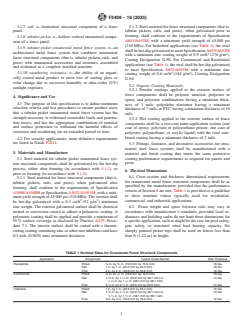
TABLE 1 Nominal Sizes for Ornamental Fence Structural Components
Application Component Typical Cross-Section Wall Thickness
5 5
Residential Picket ⁄8 in. by ⁄8 in. (15.9 mm by 15.9 mm) 18 Ga.
Rail 1 in. by 1 in. (25.4 mm by 25.4 mm) 18 Ga.
Post 2 in. by 2 in. (50.8 mm by 50.8 mm) 16 Ga.
3 3
Commercial Picket ⁄4 in. by ⁄4 in. (19.0 mm by 19.0 mm) 16 Ga.
3 1
Rail 1- ⁄8 in. by 1- ⁄2 in. (34.9 mm by 38.1 mm) or 14 Ga.
1 1
1- ⁄2 in. by 1- ⁄2 in. (38.1 mm by 38.1 mm)
1 1
Post 2- ⁄2 in. by 2- ⁄2 in. (63.5 mm by 63.5 mm) 14 Ga.
Industrial Picket 1 in. by 1 in. (25.4 mm by 25.4 mm) 16 Ga.
3 1
Rail 1- ⁄8 in. by 1- ⁄2 in. (34.9 mm by 38.1 mm) or 14 Ga.
1 1
1- ⁄2 in. by 1- ⁄2 in. (38.1 mm by 38.1 mm)
Post 3 in. by 3 in. (76.2 mm by 76.2 mm) 12 Ga.
F2408 − 16 (2023)
NOTE 1—Fence height is a nominal value and is typically the distance
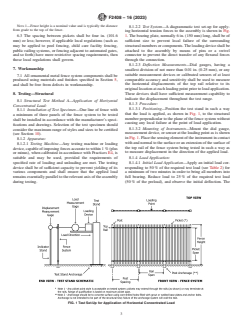
8.1.2.2 Test System—A diagrammatic test set-up for apply-
from grade to the top of the fence.
ing horizontal tension forces to the assembly is shown in Fig.
6.3 The spacing between pickets shall be four in. (101.6 1. The bearing plate, normally 6 in. (150 mm) long, shall be of
mm) or less; however, if applicable local regulations (such as sufficient size to prevent local failure of the surrounding
may be applied to pool fencing, child care facility fencing, structural members or components. The loading device shall be
public railing systems, or fencing adjacent to automated gates, attached to the assembly by means of pins or a swivel
and so forth) have more restrictive spacing requirements, then connector to prevent the direct transfer of any flexural forces
those local regulations shall govern. through the connection.
8.1.2.3 Deflection Measurements—Dial gauges, having a
7. Workmanship
smallest division of not more than 0.01 in. (0.25 mm), or any
suitable measurement devices or calibrated sensors of at least
7.1 All ornamental metal fence system components shall be
comparable accuracy and sensitivity shall be used to measure
produced using materials and finishes specified in Section 5,
the horizontal displacements of the top rail relative to its
and shall be free from defects in workmanship.
original location at each loading point prior to load application.
These devices shall have sufficient measurement capability to
8. Testing—Structural
indicate the displacement throughout the test range.
8.1 Structural Test Method A—Application of Horizontal
8.1.3 Procedure:
Concentrated Load:
8.1.3.1 Positioning—Position the test stand in such a way
8.1.1 Installation of Test Specimen—One line of fence with
that the load is applied, as shown in Fig. 1, to the structural
a minimum of three panels of the fence system to be tested
member perpendicular to the plane of the fence system without
shall be installed in accordance with the manufacturer’s speci-
causing any local failure at the point of load application.
fications and drawings. Selection of the test specimen should
8.1.3.2 Mounting of Instruments—Mount the dial gauge,
consider the maximum range of styles and sizes to be certified
measurement device, or sensor at the loading point as is shown
(see Section 10).
in Fig. 1. Place the sensing element of the instrument in contact
8.1.2 Apparatus:
with and normal to the surface or an extension of the surface of
8.1.2.1 Testing Machine—Any testing machine or loading
the top rail of the fence system being tested in such a way as
device, capable of imposing forces accurate to within 1 % (plus
to measure displacement in the direction of the applied load.
or minus), when calibrated in accordance with Practices E4, is
8.1.4 Load Application:
suitable and may be used, provided the requirements of
specified rate of loading and unloading are met. The testing 8.1.4.1 Initial Load Application—Apply an initial load cor-
device shall be of sufficient capacity to prevent yielding of its responding to 50 % of the required test load (see Table 2) for
various components and shall ensure that the applied load a minimum of two minutes in order to bring all members into
remains essentially parallel to the relevant axis of the assembly full bearing. Reduce load to 25 % of the required test load
during testing. (50 % of the preload), and observe the initial deflection. The
FIG. 1 Test Set-Up for Application of Horizontal Concentrated Load
F2408 − 16 (2023)
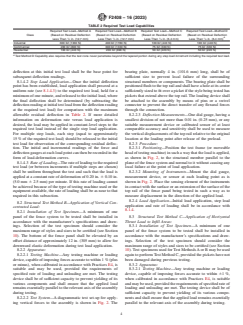
TABLE 2 Required Test Load Capabilities
Required Test Load—Method A Required Test Load—Method B Required Test Load—Method C Required Test Load—Method D
Class (Based on Residual Deflection (Based on Residual Deflection (Based on Residual Deflection (Based on Residual Deflection
A
1 1 1 1
Less Than ⁄2 in. (12.7 mm) Less Than ⁄2 in. (12.7 mm) Less Than ⁄4 in. (6.4 mm) Less Than ⁄4 in. (6.4 mm)
Industrial 300 lbf (1330 N) 400 lbf (1780 N) 100 lbf (440 N) 100 lbf (440 N)
Commercial 200 lbf (890 N) 300 lbf (1330 N) 75 lbf (330 N) 75 lbf (330 N)
Residential 100 lbf (440 N) 200 lbf (890 N) 50 lbf (220 N) 50 lbf (220 N)
A
Test Method D Capability also requires that the test cone never penetrates beyond the tapered portion during any step load increment including the required test load.
deflection at this initial test load shall be the base point for bearing plate, normally 4 in. (101.6 mm) long, shall be of
subsequent deflection readings. sufficient size to prevent local failure of the surrounding
8.1.4.2 Step Load Application—Once the initial deflection structural members or components. The bearing plate shall be
point has been established, load application shall proceed at a positioned flush to the top rail and shall have a hole at its center
uniform rate (see 8.1.4.3) to the required test load, held for a sufficie
...