

ASTM D1006/D1006M-21
(Practice)Standard Practice for Conducting Exterior Exposure Tests of Hand and Factory Applied Paints on Wood and Wood Composite Materials
General Information
- Abstract
SIGNIFICANCE AND USE
4.1 The procedure described in this practice is intended to aid in evaluating the performance of house and trim paints to new, previously unpainted wood.
4.2 The relative durability of paints in outdoor exposures can be very different depending on the location of the exposure because of differences in solar radiation, time of wetness, temperature, pollutants, and other factors. Therefore, it cannot be assumed that results from one exposure in a single location will be useful for determining relative durability in a different location. Exposures in several locations with different climates which represent a broad range of anticipated service conditions are recommended.
4.2.1 Because of year-to-year climatological variations, results from a single exposure test cannot be used to predict the absolute rate at which a material degrades. Several years of repeat exposures are needed to get an “average” test result for a given location.
4.2.2 Solar radiation varies considerably as function of time of year. This can cause large differences in the apparent rate of degradation in many paints. Comparing results for materials exposed for short periods (less than one year) is not recommended unless materials are exposed at the same time in the same location.
4.2.3 It is recommended that at least three replicates of each material be tested. A statistical estimate of the number of replicates needed based on parameters known about the material can be found in Practice E122.
4.3 The Significance and Use section in Practice G7 addresses many variables to be considered in exterior exposure tests.
SCOPE
1.1 This practice covers procedures to be followed for direct exposure of house and trim paints on new, previously unpainted wood and wood composite materials to the environment. When originators of a weathering test have the actual exposure conducted by a separate agency, the specific conditions for the exposure of test and control specimens should be clearly defined and mutually agreed upon between all parties.
1.2 This standard covers specimen preparation including the application of the test paint to the wood substrate.
1.3 The values stated in either SI units or inch-pound units are to be regarded separately as standard. The values stated in each system are not necessarily exact equivalents; therefore, to ensure conformance with the standard, each system shall be used independently of the other, and values from the two systems shall not be combined.
1.4 This standard does not purport to address all of the safety concerns, if any, associated with its use. It is the responsibility of the user of this standard to establish appropriate safety, health, and environmental practices and determine the applicability of regulatory limitations prior to use.
1.5 This international standard was developed in accordance with internationally recognized principles on standardization established in the Decision on Principles for the Development of International Standards, Guides and Recommendations issued by the World Trade Organization Technical Barriers to Trade (TBT) Committee.
- Status
- Published
- Publication Date
- 31-May-2021
- Technical Committee
- D01 - Paint and Related Coatings, Materials, and Applications
- Drafting Committee
- D01.27 - Accelerated Testing
Buy Documents
ASTM D1006/D1006M-21 - Standard Practice for Conducting Exterior Exposure Tests of Hand and Factory Applied Paints on Wood and Wood Composite Materials
REDLINE ASTM D1006/D1006M-21 - Standard Practice for Conducting Exterior Exposure Tests of Hand and Factory Applied Paints on Wood and Wood Composite Materials
Overview
ASTM D1006/D1006M-21 is the Standard Practice for Conducting Exterior Exposure Tests of Hand and Factory Applied Paints on Wood and Wood Composite Materials. This international standard, published by ASTM International, provides procedures to evaluate the performance and durability of house and trim paints exposed to outdoor environments. It covers both hand- and factory-applied coatings, enabling manufacturers, paint formulators, and quality assurance professionals to assess paint performance on new, previously unpainted wood and wood composite surfaces.
The standard outlines best practices for the preparation of specimens, exposure conditions, inspection, and reporting. It is widely adopted in the coatings, construction, and wood products industries to verify compliance, support product development, and demonstrate paint longevity under varying outdoor conditions.
Key Topics
Test Site and Climate Variability
- Paint durability can differ greatly by exposure location due to variations in solar radiation, time of wetness, temperature, and pollutants.
- Multiple geographically diverse sites are recommended for a broad evaluation of service conditions.
- Year-to-year climate fluctuations require several years of repeat exposures for reliable average results.
Specimen Preparation and Application
- Detailed guidelines provided for the preparation of test panels, including recommended wood substrate types and specimen dimensions.
- Paint must be applied according to manufacturer’s instructions, covering spread rate, number of coats, and dry film thickness.
- It is essential to record and control preparation variables, such as moisture content of wood and drying times between coats.
Exposure and Inspection Procedures
- Panels are exposed on durable test racks, typically oriented vertically facing either north or south, depending on test objectives.
- Optional exposure setups (e.g., under eaves, rainscreen assemblies) are described to simulate real-world conditions.
- Inspections occur at regular intervals (initial, three months, then every three/six months), evaluating properties such as gloss, chalking, cracking, flaking, and color change according to referenced ASTM test methods.
Control Specimens and Data Reporting
- Use of control paints is recommended for comparative evaluations.
- Comprehensive reporting procedures ensure consistency and traceability, including details on material properties, exposure conditions, and performance outcomes.
Applications
Product Development and Quality Assurance
- Manufacturers utilize ASTM D1006/D1006M-21 to verify exterior paint formulations for wood and wood composite materials, ensuring durability and weather-resistance before market release.
Comparative Performance Testing
- The practice supports side-by-side evaluation of multiple coatings, helping specifiers and quality control teams identify superior products for various climates and end-use scenarios.
Regulatory and Certification Support
- Compliance with this practice can be cited in documentation for product warranties, regulatory submissions, or certification programs that require evidence of field performance under realistic outdoor exposure.
Third-Party Testing
- Paint producers or specifiers may engage independent laboratories to conduct exterior exposure tests, ensuring objective data and reproducibility according to standardized methods.
Related Standards
The following ASTM standards are commonly used in conjunction with ASTM D1006/D1006M-21 for paint performance evaluation:
- ASTM D523 – Test Method for Specular Gloss
- ASTM D660, D661, D714, D772 – Methods for Evaluating Checking, Cracking, Blistering, and Flaking of Paints
- ASTM D2244 – Practice for Calculation of Color Tolerances and Differences
- ASTM D4214 – Methods for Evaluating Chalking of Paint Films
- ASTM D6132 – Nondestructive Measurement of Dry Film Thickness
- ASTM G7, G113, G147 – Practices and Terminology for Environmental Exposure Testing and Handling
These standards provide essential methodologies for comprehensive paint weathering and performance assessments.
Keywords: ASTM D1006, exterior exposure test, paint durability, wood coatings, weathering, quality assurance, specimen preparation, outdoor exposure standard
Relations
- Effective Date
- 01-Jan-2024
- Refers
ASTM D4214-23 - Standard Test Methods for Evaluating the Degree of Chalking of Exterior Paint Films - Effective Date
- 01-Oct-2023
- Refers
ASTM D661-93(2019) - Standard Test Method for Evaluating Degree of Cracking of Exterior Paints - Effective Date
- 01-Oct-2019
- Refers
ASTM D660-93(2019) - Standard Test Method for Evaluating Degree of Checking of Exterior Paints - Effective Date
- 01-Oct-2019
- Effective Date
- 01-Jan-2019
- Refers
ASTM D772-18 - Standard Test Method for Evaluating Degree of Flaking (Scaling) of Exterior Paints - Effective Date
- 01-Sep-2018
- Effective Date
- 01-Jun-2017
- Effective Date
- 01-Aug-2015
- Effective Date
- 01-Jun-2015
- Effective Date
- 01-Jan-2015
- Effective Date
- 01-Jan-2015
- Effective Date
- 01-Nov-2014
- Effective Date
- 01-May-2014
- Effective Date
- 01-Mar-2014
- Effective Date
- 01-Jan-2014
Buy Documents
ASTM D1006/D1006M-21 - Standard Practice for Conducting Exterior Exposure Tests of Hand and Factory Applied Paints on Wood and Wood Composite Materials
REDLINE ASTM D1006/D1006M-21 - Standard Practice for Conducting Exterior Exposure Tests of Hand and Factory Applied Paints on Wood and Wood Composite Materials
Frequently Asked Questions
ASTM D1006/D1006M-21 is a standard published by ASTM International. Its full title is "Standard Practice for Conducting Exterior Exposure Tests of Hand and Factory Applied Paints on Wood and Wood Composite Materials". This standard covers: SIGNIFICANCE AND USE 4.1 The procedure described in this practice is intended to aid in evaluating the performance of house and trim paints to new, previously unpainted wood. 4.2 The relative durability of paints in outdoor exposures can be very different depending on the location of the exposure because of differences in solar radiation, time of wetness, temperature, pollutants, and other factors. Therefore, it cannot be assumed that results from one exposure in a single location will be useful for determining relative durability in a different location. Exposures in several locations with different climates which represent a broad range of anticipated service conditions are recommended. 4.2.1 Because of year-to-year climatological variations, results from a single exposure test cannot be used to predict the absolute rate at which a material degrades. Several years of repeat exposures are needed to get an “average” test result for a given location. 4.2.2 Solar radiation varies considerably as function of time of year. This can cause large differences in the apparent rate of degradation in many paints. Comparing results for materials exposed for short periods (less than one year) is not recommended unless materials are exposed at the same time in the same location. 4.2.3 It is recommended that at least three replicates of each material be tested. A statistical estimate of the number of replicates needed based on parameters known about the material can be found in Practice E122. 4.3 The Significance and Use section in Practice G7 addresses many variables to be considered in exterior exposure tests. SCOPE 1.1 This practice covers procedures to be followed for direct exposure of house and trim paints on new, previously unpainted wood and wood composite materials to the environment. When originators of a weathering test have the actual exposure conducted by a separate agency, the specific conditions for the exposure of test and control specimens should be clearly defined and mutually agreed upon between all parties. 1.2 This standard covers specimen preparation including the application of the test paint to the wood substrate. 1.3 The values stated in either SI units or inch-pound units are to be regarded separately as standard. The values stated in each system are not necessarily exact equivalents; therefore, to ensure conformance with the standard, each system shall be used independently of the other, and values from the two systems shall not be combined. 1.4 This standard does not purport to address all of the safety concerns, if any, associated with its use. It is the responsibility of the user of this standard to establish appropriate safety, health, and environmental practices and determine the applicability of regulatory limitations prior to use. 1.5 This international standard was developed in accordance with internationally recognized principles on standardization established in the Decision on Principles for the Development of International Standards, Guides and Recommendations issued by the World Trade Organization Technical Barriers to Trade (TBT) Committee.
SIGNIFICANCE AND USE 4.1 The procedure described in this practice is intended to aid in evaluating the performance of house and trim paints to new, previously unpainted wood. 4.2 The relative durability of paints in outdoor exposures can be very different depending on the location of the exposure because of differences in solar radiation, time of wetness, temperature, pollutants, and other factors. Therefore, it cannot be assumed that results from one exposure in a single location will be useful for determining relative durability in a different location. Exposures in several locations with different climates which represent a broad range of anticipated service conditions are recommended. 4.2.1 Because of year-to-year climatological variations, results from a single exposure test cannot be used to predict the absolute rate at which a material degrades. Several years of repeat exposures are needed to get an “average” test result for a given location. 4.2.2 Solar radiation varies considerably as function of time of year. This can cause large differences in the apparent rate of degradation in many paints. Comparing results for materials exposed for short periods (less than one year) is not recommended unless materials are exposed at the same time in the same location. 4.2.3 It is recommended that at least three replicates of each material be tested. A statistical estimate of the number of replicates needed based on parameters known about the material can be found in Practice E122. 4.3 The Significance and Use section in Practice G7 addresses many variables to be considered in exterior exposure tests. SCOPE 1.1 This practice covers procedures to be followed for direct exposure of house and trim paints on new, previously unpainted wood and wood composite materials to the environment. When originators of a weathering test have the actual exposure conducted by a separate agency, the specific conditions for the exposure of test and control specimens should be clearly defined and mutually agreed upon between all parties. 1.2 This standard covers specimen preparation including the application of the test paint to the wood substrate. 1.3 The values stated in either SI units or inch-pound units are to be regarded separately as standard. The values stated in each system are not necessarily exact equivalents; therefore, to ensure conformance with the standard, each system shall be used independently of the other, and values from the two systems shall not be combined. 1.4 This standard does not purport to address all of the safety concerns, if any, associated with its use. It is the responsibility of the user of this standard to establish appropriate safety, health, and environmental practices and determine the applicability of regulatory limitations prior to use. 1.5 This international standard was developed in accordance with internationally recognized principles on standardization established in the Decision on Principles for the Development of International Standards, Guides and Recommendations issued by the World Trade Organization Technical Barriers to Trade (TBT) Committee.
ASTM D1006/D1006M-21 is classified under the following ICS (International Classification for Standards) categories: 87.040 - Paints and varnishes. The ICS classification helps identify the subject area and facilitates finding related standards.
ASTM D1006/D1006M-21 has the following relationships with other standards: It is inter standard links to ASTM D5237-14(2024), ASTM D4214-23, ASTM D661-93(2019), ASTM D660-93(2019), ASTM D5237-14(2019), ASTM D772-18, ASTM G147-17, ASTM D2244-15a, ASTM D4214-07(2015), ASTM D2244-15e1, ASTM D2244-15, ASTM D5237-14, ASTM D2244-14, ASTM G113-14, ASTM D523-14. Understanding these relationships helps ensure you are using the most current and applicable version of the standard.
ASTM D1006/D1006M-21 is available in PDF format for immediate download after purchase. The document can be added to your cart and obtained through the secure checkout process. Digital delivery ensures instant access to the complete standard document.
Standards Content (Sample)
This international standard was developed in accordance with internationally recognized principles on standardization established in the Decision on Principles for the
Development of International Standards, Guides and Recommendations issued by the World Trade Organization Technical Barriers to Trade (TBT) Committee.
Designation: D1006/D1006M − 21
Standard Practice for
Conducting Exterior Exposure Tests of Hand and Factory
Applied Paints on Wood and Wood Composite Materials
This standard is issued under the fixed designation D1006/D1006M; the number immediately following the designation indicates the
year of original adoption or, in the case of revision, the year of last revision. A number in parentheses indicates the year of last
reapproval. A superscript epsilon (´) indicates an editorial change since the last revision or reapproval.
This standard has been approved for use by agencies of the U.S. Department of Defense.
1. Scope* D660 Test Method for Evaluating Degree of Checking of
Exterior Paints
1.1 Thispracticecoversprocedurestobefollowedfordirect
D661 Test Method for Evaluating Degree of Cracking of
exposure of house and trim paints on new, previously un-
Exterior Paints
painted wood and wood composite materials to the environ-
D714 Test Method for Evaluating Degree of Blistering of
ment. When originators of a weathering test have the actual
Paints
exposure conducted by a separate agency, the specific condi-
D772 Test Method for Evaluating Degree of Flaking (Scal-
tions for the exposure of test and control specimens should be
clearly defined and mutually agreed upon between all parties. ing) of Exterior Paints
D2244 Practice for Calculation of Color Tolerances and
1.2 Thisstandardcoversspecimenpreparationincludingthe
Color Differences from Instrumentally Measured Color
application of the test paint to the wood substrate.
Coordinates
1.3 The values stated in either SI units or inch-pound units
D4214 Test Methods for Evaluating the Degree of Chalking
are to be regarded separately as standard. The values stated in
of Exterior Paint Films
each system are not necessarily exact equivalents; therefore, to
D5237 Guide for Evaluating Fabric Softeners
ensure conformance with the standard, each system shall be
D6132 TestMethodforNondestructiveMeasurementofDry
used independently of the other, and values from the two
Film Thickness of Applied Organic Coatings Using an
systems shall not be combined.
Ultrasonic Coating Thickness Gage
1.4 This standard does not purport to address all of the
D7787 Practice for Selecting Wood Substrates for Weather-
safety concerns, if any, associated with its use. It is the
ing Evaluations of Architectural Coatings
responsibility of the user of this standard to establish appro-
E122 Practice for Calculating Sample Size to Estimate,With
priate safety, health, and environmental practices and deter-
Specified Precision, the Average for a Characteristic of a
mine the applicability of regulatory limitations prior to use.
Lot or Process
1.5 This international standard was developed in accor-
E1677 SpecificationforAirBarrier(AB)MaterialorAssem-
dance with internationally recognized principles on standard-
blies for Low-Rise Framed Building Walls
ization established in the Decision on Principles for the
G7 Practice for Atmospheric Environmental Exposure Test-
Development of International Standards, Guides and Recom-
ing of Nonmetallic Materials
mendations issued by the World Trade Organization Technical
G113 Terminology Relating to Natural andArtificial Weath-
Barriers to Trade (TBT) Committee.
ering Tests of Nonmetallic Materials
2. Referenced Documents
G147 Practice for Conditioning and Handling of Nonmetal-
lic Materials for Natural and Artificial Weathering Tests
2.1 ASTM Standards:
D523 Test Method for Specular Gloss
3. Terminology
This practice is under the jurisdiction of ASTM Committee D01 on Paint and
3.1 Definitions—ThedefinitionsgiveninTerminologyG113
Related Coatings, Materials, and Applications and is the direct responsibility of
are applicable to this practice.
Subcommittee D01.27 on Accelerated Testing.
Current edition approved June 1, 2021. Published June 2021. Originally
3.2 Definitions of Terms Specific to This Standard:
approved in 1951. Last previous edition approved in 2013 as D1006/D1006M – 13.
DOI: 10.1520/D1006_D1006M-21. 3.2.1 rainscreen, n—a system of construction where the
For referenced ASTM standards, visit the ASTM website, www.astm.org, or
siding stands off from the moisture-resistant surface of a
contact ASTM Customer Service at service@astm.org. For Annual Book of ASTM
building wall, creating an air gap to allow drainage and
Standards volume information, refer to the standard’s Document Summary page on
the ASTM website. ventilation.
*A Summary of Changes section appears at the end of this standard
Copyright © ASTM International, 100 Barr Harbor Drive, PO Box C700, West Conshohocken, PA 19428-2959. United States
D1006/D1006M − 21
4. Significance and Use 5.2.1 Vertical North (Northern Hemisphere)—Exposure
rackispositionedsothattheexposedsurfacesofspecimensare
4.1 The procedure described in this practice is intended to
vertical (90°) facing north, away from the equator. This
aid in evaluating the performance of house and trim paints to
orientation encourages the growth of biological organisms
new, previously unpainted wood.
since the amount of direct sunlight reaching the specimens is
4.2 The relative durability of paints in outdoor exposures
reduced or completely eliminated depending on latitude.
can be very different depending on the location of the exposure 5.2.2 Vertical South (Northern Hemisphere)—Exposure
because of differences in solar radiation, time of wetness,
rackispositionedsothattheexposedsurfacesofthespecimens
temperature, pollutants, and other factors. Therefore, it cannot are vertical (90°) facing south, toward the equator. This
be assumed that results from one exposure in a single location
orientation allows direct sunlight to reach the specimens and
will be useful for determining relative durability in a different results in degradation commonly associated with ultraviolet
location. Exposures in several locations with different climates
exposure.
which represent a broad range of anticipated service conditions 5.2.3 Other Exposure Orientations—If desired, exposures
are recommended.
may also be conducted at other angles or facing directions to
provide faster results. See Practice G7 for more information on
4.2.1 Because of year-to-year climatological variations, re-
other exposure options.
sults from a single exposure test cannot be used to predict the
absolute rate at which a material degrades. Several years of
NOTE 1—A 45 degree exposure facing the equator may speed up the
repeat exposures are needed to get an “average” test result for
deteriorationcomparedtoaverticalexposure,butthechangeinanglemay
a given location. also change the type of failure mode.
4.2.2 Solar radiation varies considerably as function of time
5.3 In the case where it is desirable to expose coated panels
of year. This can cause large differences in the apparent rate of
in a sheltered area, such as under eaves, a suitable test rack
degradation in many paints. Comparing results for materials
with a sheltered or eave arrangement can be used.
exposed for short periods (less than one year) is not recom-
6. Construction of Test Fixtures (Exposed Racks)
mended unless materials are exposed at the same time in the
same location.
6.1 Test fixtures should be durable and rigid enough to
withstand the effects of weather. All materials used for test
4.2.3 It is recommended that at least three replicates of each
fixtures shall be either treated wood or noncorrodible metal
material be tested. A statistical estimate of the number of
without surface treatment. Aluminum Alloys 6061T6 or
replicates needed based on parameters known about the mate-
6063T6 have been found suitable for use in most locations.
rial can be found in Practice E122.
Properly primed and coated steel is suitable for use in desert
4.3 The Significance and Use section in Practice G7 ad-
areas.
dresses many variables to be considered in exterior exposure
6.2 Test Fixture Design—Test racks of several different
tests.
designs are currently used for the exposure testing of paints on
wood.Test racks for the exposure of paints and trims that more
5. Location of Test Sites and Exposure Orientation
closely simulate end-use applications, including under eave
5.1 Test Sites—The climatic conditions of the test sites
and rainscreen exposures, are presented fully in Appendix X1.
shouldberepresentativeofthoseoftheareainwhichthepaints
Test racks that are commonly used for the exposure of wood
are to be used. The type and rate of failure of a paint film will
siding boards, primarily for the evaluation of mildew growth,
vary when exposed to different combinations of climatic and
dirt accumulation, and color change are shown in Fig. 1.These
atmospheric conditions. For reliable results, exposure sites
racks can be configured to hold specimens or specimen holders
should be selected that are representative geographically,
of any convenient width and length. Adjustable racks can be
climatically, and in atmospheric contaminations with those of
used to accommodate specimens of different lengths.An offset
the locality in which the paint will be used. To obtain
design (notched cutouts) in the mounting hardware shall be
conclusions that are valid for paints with national distribution
used in order to avoid contamination from specimens mounted
requires exposure at several sites, selected to cover a wide
above other specimens. Offsets shall be of the proper size to
range in climatic conditions. Suggested sites include South
accommodatethewidthofthesidingboard.Typically,152-mm
Florida, the Great Lakes region, the hot desert southwest, the
[6-in.] or 230-mm [9-in.] sized offsets are used. Other sizes are
northeast, and extreme southern Louisiana.
available. An example of an offset mounting hardware is
shown in Fig. 2.
5.2 Exposure Orientation—Unless otherwise specified,
specimensfortestinghousepaintshouldbeexposedonvertical
6.3 To create a sheltered eave type exposure, place a 90
test fixtures facing either north or south, or both. In compari-
degreecapalongthetopoftheexposurerackwhichprojects25
sons where dirt collection and mildew resistance are not
mm [1 in.] beyond the face of the mounted panels.
pertinent, north vertical exposures may be omitted. Test fix-
7. Construction of Test Specimens
tures shall be placed in a location so that there is no shadow on
any specimen when the sun’s angle of elevation is greater than 7.1 Choose a wood substrate in accordance with Practice
20°.Specimenscanbeexposedatnorthorsouthorientationsor D7787. Prior to use, test lumber and panels shall be stored
other “ exposure angles” in order to focus on the degradation under such conditions that the moisture content of the wood
mode desired. Typical exposure angles are as follows: will be maintained within the normal range for exterior
D1006/D1006M − 21
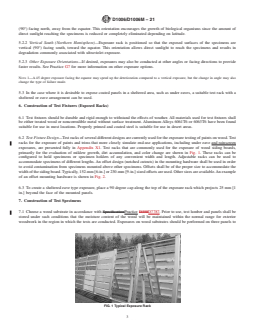
FIG. 1 Typical Exposure Rack
FIG. 2 Offset Mounting Hardware
woodwork in the region in which the tests are conducted. 152-mm [6-in.] siding substrate unless otherwise agreed upon.
Exposures on wood substrates should be performed on three Each area shall be a minimum of 152 mm in length. Each test
panels to allow for variations in wood. In selecting wood test area can be painted with a different paint thus providing a
boards, care should be taken to consider features of cladding side-by-side comparison for performance.
that may be present in usage environments such as variations
NOTE 2—It is important to remember that up to 75 mm [3 in.] of each
and orientation of grain patterns, age, and presence of knots.
end of the test panel will be masked by the exposure rack.
7.2 For house paints, unless the pattern of siding requires 7.5 When it will not interfere with the property to be tested,
some other choice, test panels should be made of one or the
all panels should be coated on the back to protect against
other of two patterns of siding, namely 127-mm [0.5-in.] or
warping.
190-mm [0.75-in.] bevel siding or 25-mm [1-in.] by 152-mm
8. Use of Control or Reference Materials
[6-in.] drop siding.Atest panel may be subdivided into two or
8.1 When several paints are being compared, one paint
more test areas. A subdivided panel is one complete panel in
should be selected as a “control.” The control paint should be
which multiple paint specimens are applied to sections of the
applied to one area of each test panel. Variations caused by
panel. If the panels in the house paint test are not subdivided,
wooddifferencesarerevealedintheperformanceofthecontrol
one 914-mm [3-ft] length of 152-mm siding will be acceptable.
paint, and can be used to adjust the ratings of other paints to a
If the panels are subdivided, each test area shall be a minimum
common basis. For best results there should be two controls,
of 152-mm in length.
one known to perform well and one known to perform poorly.
7.3 For trim paints, the test panel may have 25-mm [1-in.]
by 102-mm [4-in.] pieces of lumber at each end.
9. Specimen Preparation
7.4 For exposures of paints on test fixtures described in 6.2 9.1 All materials being compared in a single study shall be
and Fig. 1, a test panel should be a 914-mm [36-in.] length of prepared within a thirty-day period. All specimens in a single
D1006/D1006M − 21
study shall start testing on the same day. Any deviation from 11. Inspection and Records
this mounting procedure shall be documented in the test report.
11.1 After the panels have been exposed to the weather,
9.2 It is best in theory and practice to do the painting inspections should be made after not more than one month, at
outdoors in proper weather for painting; however, indoor three months, and at intervals of three months during the first
painting is permissible provided no more than one week (72 h two years, and every six months thereafter. Characteristics to
isthepreferredmaximumtime)elapsesbetweenthesuccessive be evaluated may include checking Test Method D660, crack-
coats. Furthermore, all painting must be performed under
ing Test Method D661, flaking Test Method D772, blistering
essentially the same drying conditions. It is necessary to allow Test Method D714, chalking Test Methods D4214, color
each coat to cure sufficiently before top coating. Ensure the top
change Practice D2244, gloss change Test Method D523,
coating is sufficiently cured before sending out the panels for microbiological fouling, local discoloration over knots, paint
outdoor exposure. See Practice G147 for more instructions.
failure on resin pockets, tannin bleeding, etc. Midwinter
Facto
...
This document is not an ASTM standard and is intended only to provide the user of an ASTM standard an indication of what changes have been made to the previous version. Because
it may not be technically possible to adequately depict all changes accurately, ASTM recommends that users consult prior editions as appropriate. In all cases only the current version
of the standard as published by ASTM is to be considered the official document.
Designation: D1006/D1006M − 13 D1006/D1006M − 21
Standard Practice for
Conducting Exterior Exposure Tests of Hand and Factory
Applied Paints on Wood and Wood Composite Materials
This standard is issued under the fixed designation D1006/D1006M; the number immediately following the designation indicates the
year of original adoption or, in the case of revision, the year of last revision. A number in parentheses indicates the year of last
reapproval. A superscript epsilon (´) indicates an editorial change since the last revision or reapproval.
This standard has been approved for use by agencies of the U.S. Department of Defense.
1. Scope*
1.1 This practice covers procedures to be followed for direct exposure of house and trim paints on new, previously unpainted wood
and wood composite materials to the environment. When originators of a weathering test have the actual exposure conducted by
a separate agency, the specific conditions for the exposure of test and control specimens should be clearly defined and mutually
agreed upon between all parties.
1.2 This standard covers specimen preparation including the application of the test paint to the wood substrate.
1.3 The values stated in either SI units or inch-pound units are to be regarded separately as standard. The values stated in each
system are not necessarily exact equivalents; therefore, to ensure conformance with the standard, each system shall be used
independently of the other, and values from the two systems shall not be combined.
1.4 This standard does not purport to address all of the safety concerns, if any, associated with its use. It is the responsibility
of the user of this standard to establish appropriate safety safety, health, and healthenvironmental practices and determine the
applicability of regulatory limitations prior to use.
1.5 This international standard was developed in accordance with internationally recognized principles on standardization
established in the Decision on Principles for the Development of International Standards, Guides and Recommendations issued
by the World Trade Organization Technical Barriers to Trade (TBT) Committee.
2. Referenced Documents
2.1 ASTM Standards:
D523 Test Method for Specular Gloss
D660 Test Method for Evaluating Degree of Checking of Exterior Paints
D661 Test Method for Evaluating Degree of Cracking of Exterior Paints
D714 Test Method for Evaluating Degree of Blistering of Paints
D772 Test Method for Evaluating Degree of Flaking (Scaling) of Exterior Paints
D2244 Practice for Calculation of Color Tolerances and Color Differences from Instrumentally Measured Color Coordinates
D4214 Test Methods for Evaluating the Degree of Chalking of Exterior Paint Films
D5237 Guide for Evaluating Fabric Softeners
This practice is under the jurisdiction of ASTM Committee D01 on Paint and Related Coatings, Materials, and Applications and is the direct responsibility of
Subcommittee D01.27 on Accelerated Testing.
Current edition approved June 1, 2013June 1, 2021. Published August 2013June 2021. Originally approved in 1951. Last previous edition approved in 20062013 as
D1006 – 01 (2006).D1006/D1006M – 13. DOI: 10.1520/D1006_D1006M-13.10.1520/D1006_D1006M-21.
For referenced ASTM standards, visit the ASTM website, www.astm.org, or contact ASTM Customer Service at service@astm.org. For Annual Book of ASTM Standards
volume information, refer to the standard’s Document Summary page on the ASTM website.
*A Summary of Changes section appears at the end of this standard
Copyright © ASTM International, 100 Barr Harbor Drive, PO Box C700, West Conshohocken, PA 19428-2959. United States
D1006/D1006M − 21
D6132 Test Method for Nondestructive Measurement of Dry Film Thickness of Applied Organic Coatings Using an Ultrasonic
Coating Thickness Gage
D358D7787 SpecificationPractice for Wood to Be Used as Panels in Weathering Tests of Selecting Wood Substrates for
Weathering Evaluations of Architectural Coatings (Withdrawn 2014)
E41E122 Terminology Relating to ConditioningPractice for Calculating Sample Size to Estimate, With Specified Precision, the
Average for a Characteristic of a Lot or Process (Withdrawn 2019)
E1677 Specification for Air Barrier (AB) Material or Assemblies for Low-Rise Framed Building Walls
G7 Practice for Atmospheric Environmental Exposure Testing of Nonmetallic Materials
G113 Terminology Relating to Natural and Artificial Weathering Tests of Nonmetallic Materials
G147 Practice for Conditioning and Handling of Nonmetallic Materials for Natural and Artificial Weathering Tests
3. Terminology
3.1 Definitions—The definitions given in TerminologiesTerminology E41 and G113 are applicable to this practice.
3.2 Definitions of Terms Specific to This Standard:
3.2.1 rainscreen, n—a system of construction where the siding stands off from the moisture-resistant surface of a building wall,
creating an air gap to allow drainage and ventilation.
4. Significance and Use
4.1 The procedure described in this practice is intended to aid in evaluating the performance of house and trim paints to new,
previously unpainted wood.
4.2 The relative durability of paints in outdoor exposures can be very different depending on the location of the exposure because
of differences in solar radiation, time of wetness, temperature, pollutants, and other factors. Therefore, it cannot be assumed that
results from one exposure in a single location will be useful for determining relative durability in a different location. Exposures
in several locations with different climates which represent a broad range of anticipated service conditions are recommended.
4.2.1 Because of year-to-year climatological variations, results from a single exposure test cannot be used to predict the absolute
rate at which a material degrades. Several years of repeat exposures are needed to get an “average” test result for a given location.
4.2.2 Solar radiation varies considerably as function of time of year. This can cause large differences in the apparent rate of
degradation in many paints. Comparing results for materials exposed for short periods (less than one year) is not recommended
unless materials are exposed at the same time in the same location.
4.2.3 It is recommended that at least three replicates of each material be tested. A statistical estimate of the number of replicates
needed based on parameters known about the material can be found in Practice E122.
4.3 The Significance and Use section in Practice G7 addresses many variables to be considered in exterior exposure tests.
5. Location of Test Sites and Exposure Orientation
5.1 Test Sites—The climatic conditions of the test sites should be representative of those of the area in which the paints are to be
used. The type and rate of failure of a paint film will vary when exposed to different combinations of climatic and atmospheric
conditions. For reliable results, exposure sites should be selected that are representative geographically, climatically, and in
atmospheric contaminations with those of the locality in which the paint will be used. To obtain conclusions that are valid for paints
with national distribution requires exposure at several sites, selected to cover a wide range in climatic conditions. Suggested sites
include South Florida, the Great Lakes region, the hot desert southwest, the northeast, and extreme southern Louisiana.
5.2 Exposure Orientation—Unless otherwise specified, specimens for testing house paint should be exposed on vertical test
fixtures facing either north or south, or both. In comparisons where dirt collection and mildew resistance are not pertinent, north
vertical exposures may be omitted. Test fixtures shall be placed in a location so that there is no shadow on any specimen when
the sun’s angle of elevation is greater than 20°. Specimens can be exposed at north or south orientations or other “ exposure angles”
in order to focus on the degradation mode desired. Typical exposure angles are as follows:
5.2.1 Vertical North (Northern Hemisphere)—Exposure rack is positioned so that the exposed surfaces of specimens are vertical
D1006/D1006M − 21
(90°) facing north, away from the equator. This orientation encourages the growth of biological organisms since the amount of
direct sunlight reaching the specimens is reduced or completely eliminated depending on latitude.
5.2.2 Vertical South (Northern Hemisphere)—Exposure rack is positioned so that the exposed surfaces of the specimens are
vertical (90°) facing south, toward the equator. This orientation allows direct sunlight to reach the specimens and results in
degradation commonly associated with ultraviolet exposure.
5.2.3 Other Exposure Orientations—If desired, exposures may also be conducted at other angles or facing directions to provide
faster results. See Practice G7 for more information on other exposure options.
NOTE 1—A 45 degree exposure facing the equator may speed up the deterioration compared to a vertical exposure, but the change in angle may also
change the type of failure mode.
5.3 In the case where it is desirable to expose coated panels in a sheltered area, such as under eaves, a suitable test rack with a
sheltered or eave arrangement can be used.
6. Construction of Test Fixtures (Exposed Racks)
6.1 Test fixtures should be durable and rigid enough to withstand the effects of weather. All materials used for test fixtures shall
be either treated wood or noncorrodible metal without surface treatment. Aluminum Alloys 6061T6 or 6063T6 have been found
suitable for use in most locations. Properly primed and coated steel is suitable for use in desert areas.
6.2 Test Fixture Design—Test racks of several different designs are currently used for the exposure testing of paints on wood. Test
racks for the exposure of paints and trims that more closely simulate end-use applications, including under eave and rainscreen
exposures, are presented fully in Appendix X1. Test racks that are commonly used for the exposure of wood siding boards,
primarily for the evaluation of mildew growth, dirt accumulation, and color change are shown in Fig. 1. These racks can be
configured to hold specimens or specimen holders of any convenient width and length. Adjustable racks can be used to
accommodate specimens of different lengths. An offset design (notched cutouts) in the mounting hardware shall be used in order
to avoid contamination from specimens mounted above other specimens. Offsets shall be of the proper size to accommodate the
width of the siding board. Typically, 152-mm [6-in.] or 230-mm [9-in.] sized offsets are used. Other sizes are available. An example
of an offset mounting hardware is shown in Fig. 2.
6.3 To create a sheltered eave type exposure, place a 90 degree cap along the top of the exposure rack which projects 25 mm [1
in.] beyond the face of the mounted panels.
7. Construction of Test Specimens
7.1 Choose a wood substrate in accordance with SpecificationPractice D358D7787. Prior to use, test lumber and panels shall be
stored under such conditions that the moisture content of the wood will be maintained within the normal range for exterior
woodwork in the region in which the tests are conducted. Exposures on wood substrates should be performed on three panels to
FIG. 1 Typical Exposure Rack
D1006/D1006M − 21
FIG. 2 Offset Mounting Hardware
allow for variations in wood. In selecting wood test boards, care should be taken to consider features of cladding that may be
present in usage environments such as variations and orientation of grain patterns, age, and presence of knots.
7.2 For house paints, unless the pattern of siding requires some other choice, test panels should be made of one or the other of
two patterns of siding, namely 127-mm [0.5-in.] or 190-mm [0.75-in.] bevel siding or 25-mm [1-in.] by 152-mm [6-in.] drop
siding. A test panel may be subdivided into two or more test areas. A subdivided panel is one complete panel in which multiple
paint specimens are applied to sections of the panel. If the panels in the house paint test are not subdivided, one 914-mm [3-ft]
length of 152-mm siding will be acceptable. If the panels are subdivided, each test area shall be a minimum of 152-mm in length.
7.3 For trim paints, the test panel may have 25-mm [1-in.] by 102-mm [4-in.] pieces of lumber at each end.
7.4 For exposures of paints on test fixtures described in 6.2 and Fig. 1, a test panel should be a 914-mm [36-in.] length of 152-mm
[6-in.] siding substrate unless otherwise agreed upon. Each area shall be a minimum of 152 mm in length. Each test area can be
painted with a different paint thus providing a side-by-side comparison for performance.
NOTE 2—It is important to remember that up to 75 mm [3 in.] of each end of the test panel will be masked by the exposure rack.
7.5 When it will not interfere with the property to be tested, all panels should be coated on the back to protect against warping.
8. Use of Control or Reference Materials
8.1 When several paints are being compared, one paint should be selected as a “control.” The control paint should be applied to
one area of each test panel. Variations caused by wood differences are revealed in the performance of the control paint, and can
be used to adjust the ratings of other paints to a common basis. For best results there should be two controls, one known to perform
well and one known to perform poorly.
9. Specimen Preparation
9.1 All materials being compared in a single study shall be prepared and exposed within a thirty-day period. For very large studies
where all specimens cannot be prepared and exposed within the thirty-day period, prepare duplicate coatings of at least 30 % of
the materials or prepare and expose specimens of a control paint at the beginning and at the end of the period needed for
completion.All specimens in a single study shall start testing on the same day. Any deviation from this mounting procedure shall
be documented in the test report.
9.2 It is best in theory and practice to do the painting outdoors in proper weather for painting; however, indoor painting is
permissible provided no more than one week (72 h is the preferred maximum time) elapses between the successive coats.
D1006/D1006M − 21
Furthermore, all painting must be performed under essentially the same drying conditions. It is necessary to allow each coat to cure
sufficiently before top coating. Ensure the top coating is sufficiently cured before sending out the panels for outdoor exposure. See
Practice G147 for more instructions. Factory finish wood products shall be prepared using the exact factory finish system (not hand
painted).
NOTE 3—If coated panels are shipped to the exposure location before the coating is fully cured, the surfaces of the panels may stick to each other and
may not be able to be separated without damaging the surface.
NOTE 3—If coated panels are shipped to the exposure location before the coating is fully cured, the surfaces of the panels may stick to each other and
may not be able to be separated with
...