

ASTM D4287-00(2023)
(Test Method)Standard Test Method for High-Shear Viscosity Using a Cone/Plate Viscometer
General Information
- Abstract
SIGNIFICANCE AND USE
4.1 The viscosity value obtained by this test method gives information about the flow properties of the material under high-shear conditions similar to those encountered during application: brushing (see Test Method D4958), spraying, electrostatic disk, or roll coating.
4.2 This test method is suitable for all paints and varnishes whether they are Newtonian in behavior or not. However, due to the narrow gap between the stationary and rotary parts of high-shear viscometers, this test method is more reproducible for paints having finer pigment dispersions as determined by Test Method D1210.
SCOPE
1.1 This test method covers the determination of the viscosity of paints, varnishes, and related products at a rate of shear of 12 000 s−1.
1.2 Paints and varnishes that dry very rapidly may not give reproducible results with this test method. Measurements made at elevated temperatures may also give poor precision due to loss of volatiles and to drying.
1.3 The values stated in SI units are to be regarded as standard. No other units of measurement are included in this standard.
1.4 This standard does not purport to address all of the safety concerns, if any, associated with its use. It is the responsibility of the user of this standard to establish appropriate safety, health, and environmental practices and determine the applicability of regulatory limitations prior to use.
1.5 This international standard was developed in accordance with internationally recognized principles on standardization established in the Decision on Principles for the Development of International Standards, Guides and Recommendations issued by the World Trade Organization Technical Barriers to Trade (TBT) Committee.
- Status
- Published
- Publication Date
- 30-Sep-2023
- Technical Committee
- D01 - Paint and Related Coatings, Materials, and Applications
- Drafting Committee
- D01.24 - Physical Properties of Liquid Paints & Paint Materials
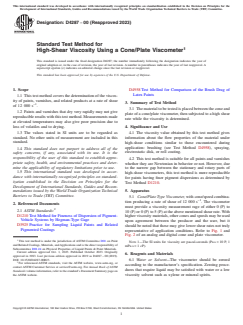

Overview
ASTM D4287-00(2023): Standard Test Method for High-Shear Viscosity Using a Cone/Plate Viscometer specifies a procedure to determine the high-shear viscosity of paints, varnishes, and related products. This method provides crucial insight into the flow properties of these materials under application conditions that generate high shear rates, such as brushing, spraying, electrostatic disk, or roll coating.
The test employs a cone/plate viscometer to measure viscosity at a defined shear rate of 12,000 s⁻¹. By simulating practical application environments, this standardized method helps manufacturers, formulators, and quality control technicians ensure that coatings perform consistently and meet industry requirements.
Key Topics
- High-Shear Viscosity Measurement: The standard focuses on evaluating the viscosity of paints and varnishes under high-shear conditions, mimicking real-world application processes.
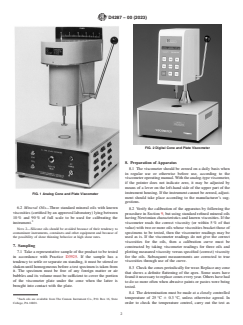
- Cone/Plate Viscometer Usage: Outlines the apparatus requirements, calibration procedures, and use of either analog or digital viscometers for repeatable results.
- Test Method Scope: Suitable for both Newtonian and non-Newtonian coatings, though finer pigment dispersions yield more reproducible results due to the narrow gap in viscometers.
- Precision and Repeatability: Provides guidelines for sample preparation, apparatus calibration, and measurement procedures to ensure accuracy and comparability of results.
- Reporting and Documentation: Specifies essential details to include when documenting test outcomes, promoting transparency and enabling product comparability.
Applications
Implementing ASTM D4287-00(2023) delivers critical benefits for:
- Paint and Coatings Manufacturers: By regularly measuring high-shear viscosity, manufacturers can optimize formulations for specific application methods and ensure consistent application properties.
- Quality Control: Routine use of this test ensures batch-to-batch uniformity, helping to verify that paint and varnish products meet expected performance during brushing, spraying, or roller application.
- Product Development: Formulators can assess how changes in raw materials or manufacturing processes impact high-shear viscosity, informing design adjustments to achieve targeted application characteristics.
- Compliance and Specification: Meeting this ASTM standard may be required by customers or regulatory bodies, demonstrating adherence to industry best practices.
- Troubleshooting: Identifies coating issues relating to flow and application, enabling corrective actions to be implemented promptly within production or application environments.
Related Standards
To maximize the effectiveness of high-shear viscosity testing and ensure comprehensive quality assurance, consider referencing the following related standards:
- ASTM D1210: Test Method for Fineness of Dispersion of Pigment-Vehicle Systems by Hegman-Type Gage - Essential for determining optimal pigment dispersion prior to viscosity measurement.
- ASTM D3925: Practice for Sampling Liquid Paints and Related Pigmented Coatings - Ensures representative sampling to support reliable viscosity testing.
- ASTM D4958: Test Method for Comparison of the Brush Drag of Latex Paints - Provides context on brush application performance complementing high-shear viscosity data.
Summary
ASTM D4287-00(2023) delivers a proven method for measuring the high-shear viscosity of paints, varnishes, and related materials using a cone/plate viscometer. By following this standard, companies in the coatings industry support greater product quality, performance predictability, and compliance with recognized international standards. Apply this method to achieve consistent results in demanding real-world application conditions, foster regulatory compliance, and drive continuous improvement in paint and varnish manufacturing.
Keywords: high-shear viscosity, cone/plate viscometer, ASTM D4287, paint testing, varnish quality control, coatings application, viscosity measurement standard.
Relations
- Replaces
ASTM D4287-00(2019) - Standard Test Method for High-Shear Viscosity Using a Cone/Plate Viscometer - Effective Date
- 01-Oct-2023
- Effective Date
- 01-Feb-2024
- Effective Date
- 01-Oct-2023
- Effective Date
- 01-Oct-2023
- Effective Date
- 01-Oct-2023
- Effective Date
- 01-Oct-2023
- Effective Date
- 01-Oct-2023
- Referred By
ASTM D6763-16(2022) - Standard Guide for Testing Exterior Wood Stains and Clear Water Repellents - Effective Date
- 01-Oct-2023
- Effective Date
- 01-Oct-2023
- Effective Date
- 01-Oct-2023
- Effective Date
- 01-Oct-2023
- Referred By
ASTM D4958-10(2016) - Standard Test Method for Comparison of the Brush Drag of Latex Paints - Effective Date
- 01-Oct-2023
- Effective Date
- 01-Oct-2023
Frequently Asked Questions
ASTM D4287-00(2023) is a standard published by ASTM International. Its full title is "Standard Test Method for High-Shear Viscosity Using a Cone/Plate Viscometer". This standard covers: SIGNIFICANCE AND USE 4.1 The viscosity value obtained by this test method gives information about the flow properties of the material under high-shear conditions similar to those encountered during application: brushing (see Test Method D4958), spraying, electrostatic disk, or roll coating. 4.2 This test method is suitable for all paints and varnishes whether they are Newtonian in behavior or not. However, due to the narrow gap between the stationary and rotary parts of high-shear viscometers, this test method is more reproducible for paints having finer pigment dispersions as determined by Test Method D1210. SCOPE 1.1 This test method covers the determination of the viscosity of paints, varnishes, and related products at a rate of shear of 12 000 s−1. 1.2 Paints and varnishes that dry very rapidly may not give reproducible results with this test method. Measurements made at elevated temperatures may also give poor precision due to loss of volatiles and to drying. 1.3 The values stated in SI units are to be regarded as standard. No other units of measurement are included in this standard. 1.4 This standard does not purport to address all of the safety concerns, if any, associated with its use. It is the responsibility of the user of this standard to establish appropriate safety, health, and environmental practices and determine the applicability of regulatory limitations prior to use. 1.5 This international standard was developed in accordance with internationally recognized principles on standardization established in the Decision on Principles for the Development of International Standards, Guides and Recommendations issued by the World Trade Organization Technical Barriers to Trade (TBT) Committee.
SIGNIFICANCE AND USE 4.1 The viscosity value obtained by this test method gives information about the flow properties of the material under high-shear conditions similar to those encountered during application: brushing (see Test Method D4958), spraying, electrostatic disk, or roll coating. 4.2 This test method is suitable for all paints and varnishes whether they are Newtonian in behavior or not. However, due to the narrow gap between the stationary and rotary parts of high-shear viscometers, this test method is more reproducible for paints having finer pigment dispersions as determined by Test Method D1210. SCOPE 1.1 This test method covers the determination of the viscosity of paints, varnishes, and related products at a rate of shear of 12 000 s−1. 1.2 Paints and varnishes that dry very rapidly may not give reproducible results with this test method. Measurements made at elevated temperatures may also give poor precision due to loss of volatiles and to drying. 1.3 The values stated in SI units are to be regarded as standard. No other units of measurement are included in this standard. 1.4 This standard does not purport to address all of the safety concerns, if any, associated with its use. It is the responsibility of the user of this standard to establish appropriate safety, health, and environmental practices and determine the applicability of regulatory limitations prior to use. 1.5 This international standard was developed in accordance with internationally recognized principles on standardization established in the Decision on Principles for the Development of International Standards, Guides and Recommendations issued by the World Trade Organization Technical Barriers to Trade (TBT) Committee.
ASTM D4287-00(2023) is classified under the following ICS (International Classification for Standards) categories: 87.040 - Paints and varnishes. The ICS classification helps identify the subject area and facilitates finding related standards.
ASTM D4287-00(2023) has the following relationships with other standards: It is inter standard links to ASTM D4287-00(2019), ASTM D4958-24, ASTM D6577-15(2019), ASTM D7395-18(2023), ASTM D3794-22, ASTM D5146-10(2019), ASTM F3208-20, ASTM D6763-16(2022), ASTM D7394-18(2023), ASTM D5324-16(2022), ASTM D3730-17(2022), ASTM D4958-10(2016), ASTM D4212-16(2023). Understanding these relationships helps ensure you are using the most current and applicable version of the standard.
ASTM D4287-00(2023) is available in PDF format for immediate download after purchase. The document can be added to your cart and obtained through the secure checkout process. Digital delivery ensures instant access to the complete standard document.
Standards Content (Sample)
This international standard was developed in accordance with internationally recognized principles on standardization established in the Decision on Principles for the
Development of International Standards, Guides and Recommendations issued by the World Trade Organization Technical Barriers to Trade (TBT) Committee.
Designation: D4287 − 00 (Reapproved 2023)
Standard Test Method for
High-Shear Viscosity Using a Cone/Plate Viscometer
This standard is issued under the fixed designation D4287; the number immediately following the designation indicates the year of
original adoption or, in the case of revision, the year of last revision. A number in parentheses indicates the year of last reapproval. A
superscript epsilon (´) indicates an editorial change since the last revision or reapproval.
This standard has been approved for use by agencies of the U.S. Department of Defense.
1. Scope D4958 Test Method for Comparison of the Brush Drag of
Latex Paints
1.1 This test method covers the determination of the viscos-
ity of paints, varnishes, and related products at a rate of shear
3. Summary of Test Method
−1
of 12 000 s .
3.1 The material to be tested is placed between the cone and
1.2 Paints and varnishes that dry very rapidly may not give
plate of a cone/plate viscometer, then subjected to a high shear
reproducible results with this test method. Measurements made
rate while the viscosity is determined.
at elevated temperatures may also give poor precision due to
loss of volatiles and to drying.
4. Significance and Use
1.3 The values stated in SI units are to be regarded as 4.1 The viscosity value obtained by this test method gives
standard. No other units of measurement are included in this
information about the flow properties of the material under
standard. high-shear conditions similar to those encountered during
application: brushing (see Test Method D4958), spraying,
1.4 This standard does not purport to address all of the
electrostatic disk, or roll coating.
safety concerns, if any, associated with its use. It is the
responsibility of the user of this standard to establish appro-
4.2 This test method is suitable for all paints and varnishes
priate safety, health, and environmental practices and deter-
whether they are Newtonian in behavior or not. However, due
mine the applicability of regulatory limitations prior to use.
to the narrow gap between the stationary and rotary parts of
1.5 This international standard was developed in accor-
high-shear viscometers, this test method is more reproducible
dance with internationally recognized principles on standard-
for paints having finer pigment dispersions as determined by
ization established in the Decision on Principles for the
Test Method D1210.
Development of International Standards, Guides and Recom-
5. Apparatus
mendations issued by the World Trade Organization Technical
Barriers to Trade (TBT) Committee.
5.1 Cone/Plate Type Viscometer, with cone/speed combina-
−1
tion producing a rate of shear of 12 000 s . The viscometer
2. Referenced Documents
must provide a viscosity measurement rage of either 0 (P) to
2.1 ASTM Standards:
10 (P) or 0 (P) to 5 (P) at the above mentioned shear rate. With
D1210 Test Method for Fineness of Dispersion of Pigment-
higher viscosity materials, other cones and speeds may be used
Vehicle Systems by Hegman-Type Gage
upon agreement between the producer and the user, but it
D3925 Practice for Sampling Liquid Paints and Related
should be noted that these may give lower shear rates not truly
Pigmented Coatings
representative of application conditions. Refer to Fig. 1 and
Fig. 2 of an analog and digital cone and plate viscometer.
This test method is under the jurisdiction of ASTM Committee D01 on Paint
NOTE 1—The SI units for viscosity are pascal-seconds (Pa·s = 10 P, 1
and Related Coatings, Materials, and Applications and is the direct responsibility of
mPa·s = 1 cP).
Subcommittee D01.24 on Physical Properties of Liquid Paints & Paint Materials.
Current edition approved Oct. 1, 2023. Published October 2023. Originally
6. Reagents and Materials
approved in 1983. Last previous edition approved in 2019 as D4287 – 00 (2019).
DOI: 10.1520/D4287-00R23.
6.1 Water or Solvent—The viscometer should be zeroed
For referenced ASTM standards, visit the ASTM website, www.astm.org, or
according to the manufacturer’s specification. Zeroing proce-
contact ASTM Customer Service at service@astm.org. For Annual Book of ASTM
dures that require liquid may be satisfied with water or a low
Standards volume information, refer to the standard’s Document Summary page on
the ASTM website. viscosity solvent such as xylene or mineral spirits.
Copyright © ASTM International, 100 Barr Harbor Drive, PO Box C700, West Conshohocken, PA 19428-2959. United States
D4287 − 00 (2023)
FIG. 2 Digital Cone and Plate Viscometer
8. Preparation of Apparatus
8.1 The viscometer should be zeroed on a daily basis when
in regular use or otherwise before use, according to the
viscometer operating manual. With the analog-type viscometer,
if the pointer does not indicate zero, it may be adjusted by
means of a lever on the left-hand side of the upper part of the
instrument housing. If the instrument cannot be zeroed, adjust-
FIG. 1 Analog Cone and Plate Viscometer
ment should take place according to the manufacturer’s sug-
gestions.
6.2 Mineral Oils—Three standard mineral oils with known
8.2 Verify the calibration of the apparatus by following the
viscosities (certified by an approved laboratory) lying between
procedure in Section 9, but using standard refined mineral oils
10 % and 90 % of full scale to be used for calibrating the
having Newtonian characteristics and known viscosities. If the
instrument.
viscometer reads the correct viscosity (or within 5 % of that
value) with two or more oils whose viscosities bracket those of
NOTE 2—Silicone oils should be avoided because of their tendency to
specimens to be tested, then the viscometer readings may be
contaminate instruments, containers and other equipment and because of
the possibility of shear thinning behavior at high shear rates. used as is. If the viscometer readings do not give the correct
viscosities for the oils, then a calibration curve must be
7. Sampling
constructed by taking viscometer readings for three oils and
plotting measured viscosity versus specified (correct) viscosity
7.1 Take a representative sample of the product to be tested
for the oils. Subsequent measurements are corrected to true
in accordance with Practice D3925. If the sample has a
viscosities through use of the curve.
tendency to settle or separate on standing, it must be stirred or
shaken until homogeneous before a test specimen is taken from
8.3 Check the cones periodically for wear. Replace any cone
it. The specimen must be free of any foreign matter or air
that shows a definite flattening of the apex. Some users have
bubbles and its volume must be sufficient to cover the portion
found it necessary to replace cones every year. Others have had
of the visc
...