

ASTM D2864-21a
(Terminology)Standard Terminology Relating to Electrical Insulating Liquids and Gases
General Information
- Abstract
- Status
- Published
- Publication Date
- 31-Oct-2021
- Technical Committee
- D27 - Electrical Insulating Liquids and Gases
- Drafting Committee
- D27.15 - Planning Resource and Development
Overview
ASTM D2864-21a: Standard Terminology Relating to Electrical Insulating Liquids and Gases is a comprehensive terminology document developed by ASTM International. It aids users of ASTM standards and professionals in the electrical, utilities, testing, and manufacturing industries by offering clear and authoritative definitions associated with all forms of electrical insulating fluids and gases. These terms are critical for describing materials, properties, methods, and processes commonly used in the testing, performance evaluation, and manufacturing of electrical insulating systems, such as transformer oils, synthetic insulating fluids, and gaseous dielectrics.
Key Topics
Definitions of Insulating Materials
Includes terms and explanations for mineral insulating oils, ester-based liquids, silicone fluids, and synthetic insulating fluids used in electrical systems to ensure safety, reliability, and efficiency.Electrical and Dielectric Properties
Covers essential concepts such as dielectric breakdown voltage, dissipation factor, relative permittivity, conductivity, resistivity, and loss angle. Understanding these properties is fundamental in evaluating product specifications and performance.Test Methods and Processing Terms
Defines various standard test methods like aniline point (ASTM D611), cloud point (ASTM D2500), and gassing tendency (ASTM D2300) for insulating liquids. Also explains refining processes such as acid treating, hydrogen treating, solvent extraction, and reclaiming used for maintaining and improving insulating oils.Condition Monitoring and Contaminants
Terminology includes definitions for common contaminants-such as dissolved water, free water, emulsified water, corrosive sulfur, and furanic compounds-that impact insulation reliability. Terms like oxidation inhibitor, scavenger, and reconditioning are also included.General Physical Characteristics
Clarifies measurements and terminology around viscosity, pour point, color, wax content, and interfacial tension, all vital for selecting and maintaining insulating materials.
Applications
The ASTM D2864-21a terminology is widely applied in:
Electrical Power Equipment Manufacturing:
Ensures clear communication during the design and specification of transformers, capacitors, cables, and switchgear, where fluid and gas insulation is required.Testing Laboratories:
Facilitates correct and consistent reporting of properties like dielectric strength, loss tangent, and water content according to standardized definitions.Maintenance and Asset Management:
Supports transformer oil analysis and maintenance tasks by providing agreed terminology for issues like gassing tendency, reconditioning, and contamination.R&D and Quality Control:
Offers a reference language for product development, comparison of new insulating fluids, and validation of analytical methods.Technical Documentation and Compliance:
Assists in drafting precise and internationally recognizable documentation, ensuring compliance with international best practices and harmonization across organizations.
Related Standards
Several ASTM standards are referenced in ASTM D2864-21a and commonly used alongside it, including:
- ASTM D611: Test Methods for Aniline Point and Mixed Aniline Point of Petroleum Products and Hydrocarbon Solvents
- ASTM D2007: Test Method for Characteristic Groups in Rubber Extender and Processing Oils
- ASTM D2140: Practice for Calculating Carbon-Type Composition of Insulating Oils
- ASTM D2300: Test Method for Gassing of Electrical Insulating Liquids
- ASTM D2500: Test Method for Cloud Point of Petroleum Products and Liquid Fuels
- ASTM E355: Practice for Gas Chromatography Terms and Relationships
Practical Value
Adhering to the definitions set forth in ASTM D2864-21a helps ensure:
- Consistent understanding across stakeholders in the electrical and energy sectors
- Accurate test result interpretation and product comparison
- Reliable communication in technical documentation, procurement, and regulatory compliance
For more details and access to official terminology, consult the ASTM standard or related publications.
Relations
- Effective Date
- 01-Mar-2024
- Effective Date
- 01-Dec-2023
- Effective Date
- 01-Dec-2023
- Effective Date
- 15-Dec-2019
- Effective Date
- 01-Jan-2017
- Effective Date
- 01-Oct-2016
- Effective Date
- 01-Jan-2016
- Effective Date
- 01-May-2011
- Effective Date
- 15-Apr-2009
- Effective Date
- 01-Dec-2008
- Effective Date
- 01-Jun-2008
- Effective Date
- 01-Nov-2007
- Effective Date
- 01-Mar-2007
- Effective Date
- 01-Jul-2005
- Effective Date
- 01-May-2004
Get Certified
Connect with accredited certification bodies for this standard

IMQ S.p.A. (Certification)
Italian electrical product certification.

SLG Prüf- und Zertifizierungs GmbH
German testing and certification body.

UL Solutions
Global safety science company with testing, inspection and certification.
Sponsored listings
Frequently Asked Questions
ASTM D2864-21a is a standard published by ASTM International. Its full title is "Standard Terminology Relating to Electrical Insulating Liquids and Gases". This standard covers: Standard Terminology Relating to Electrical Insulating Liquids and Gases
Standard Terminology Relating to Electrical Insulating Liquids and Gases
ASTM D2864-21a is classified under the following ICS (International Classification for Standards) categories: 01.040.29 - Electrical engineering (Vocabularies); 29.040.01 - Insulating fluids in general. The ICS classification helps identify the subject area and facilitates finding related standards.
ASTM D2864-21a has the following relationships with other standards: It is inter standard links to ASTM D2007-19(2024)e1, ASTM D2140-23e1, ASTM D2140-23, ASTM D2007-19, ASTM D2300-08(2017), ASTM D2007-11(2016), ASTM D2500-16, ASTM D2007-11, ASTM D2500-09, ASTM D2007-03(2008), ASTM D2300-08, ASTM D611-07, ASTM E355-96(2007), ASTM D2500-05, ASTM D611-04. Understanding these relationships helps ensure you are using the most current and applicable version of the standard.
ASTM D2864-21a is available in PDF format for immediate download after purchase. The document can be added to your cart and obtained through the secure checkout process. Digital delivery ensures instant access to the complete standard document.
Standards Content (Sample)
This international standard was developed in accordance with internationally recognized principles on standardization established in the Decision on Principles for the
Development of International Standards, Guides and Recommendations issued by the World Trade Organization Technical Barriers to Trade (TBT) Committee.
Designation: D2864 − 21a
Standard Terminology Relating to
Electrical Insulating Liquids and Gases
This standard is issued under the fixed designation D2864; the number immediately following the designation indicates the year of
original adoption or, in the case of revision, the year of last revision.Anumber in parentheses indicates the year of last reapproval.A
superscript epsilon (´) indicates an editorial change since the last revision or reapproval.
INTRODUCTION
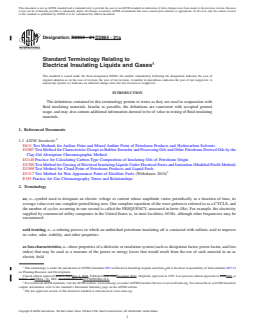
The definitions contained in this terminology pertain to terms as they are used in conjunction with
fluid insulating materials. Insofar as possible, the definitions are consistent with accepted general
usage,andmayalsocontainadditionalinformationdeemedtobeofvalueintestingoffluidinsulating
materials.
1. Referenced Documents CYCLE, and the number of cycles occurring in one second
2 is called the FREQUENCY, measured in hertz (Hz). For
1.1 ASTM Standards:
example, the electricity supplied by commercial utility
D611Test Methods for Aniline Point and Mixed Aniline
companies in the United States is, in most localities, 60 Hz,
Point of Petroleum Products and Hydrocarbon Solvents
although other frequencies may be encountered.
D2007Test Method for Characteristic Groups in Rubber
Extender and Processing Oils and Other Petroleum-
acid treating, n—a refining process in which an unfinished
Derived Oils by the Clay-Gel Absorption Chromato-
petroleum insulating oil is contacted with sulfuric acid to
graphic Method
improve its color, odor, stability, and other properties.
D2140Practice for Calculating Carbon-Type Composition
ac loss characteristics, n—those properties of a dielectric or
of Insulating Oils of Petroleum Origin
insulation system (such as dissipation factor, power factor,
D2300Test Method for Gassing of Electrical Insulating
and loss index) that may be used as a measure of the power
Liquids Under Electrical Stress and Ionization (Modified
or energy losses that would result from the use of such
Pirelli Method)
material in an ac electric field.
D2500Test Method for Cloud Point of Petroleum Products
and Liquid Fuels additive, n—a chemical compound or compounds added to an
D3117Test Method for Wax Appearance Point of Distillate insulating fluid for the purpose of imparting new properties
Fuels (Withdrawn 2010) or altering those properties which the fluid already has.
E355PracticeforGasChromatographyTermsandRelation-
ambient temperature, n—the temperature of the surrounding
ships
atmosphere as determined by an instrument shielded from
direct or reflected rays of the sun.
2. Terminology
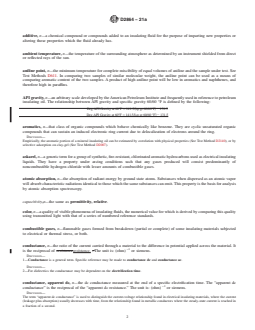
aniline point, n—the minimum temperature for complete
ac, n—symbol used to designate an electric voltage or current
miscibilityofequalvolumesofanilineandthesampleunder
whoseamplitudevariesperiodicallyasafunctionoftime,its
test. See Test Methods D611. In comparing two samples of
average value over one complete period being zero. One
similar molecular weight, the aniline point can be used as a
complete repetition of the wave pattern is referred to as a
means of comparing aromatic content of the two samples.A
product of high aniline point will be low in aromatics and
naphthenes, and therefore high in paraffins.
This terminology is under the jurisdiction of ASTM Committee D27 on
Electrical Insulating Liquids and Gases and is the direct responsibility of Subcom-
API gravity, n—an arbitrary scale developed by theAmerican
mittee D27.15 on Planning Resource and Development.
Petroleum Institute and frequently used in reference to
Current edition approved Nov. 1, 2021. Published December 2021. Originally
petroleum insulating oil. The relationship between API
approved in 1970. Last previous edition approved in 2021 as D2864–21. DOI:
10.1520/D2864-21A. gravity and specific gravity 60/60 °F is defined by the
For referenced ASTM standards, visit the ASTM website, www.astm.org, or
following:
contact ASTM Customer Service at service@astm.org. For Annual Book of ASTM
Standards volume information, refer to the standard’s Document Summary page on DegAPIGravityat60°F 5 141.5/~spgr60/60 °F! 2 131.5
the ASTM website.
aromatics, n—that class of organic compounds which behave
The last approved version of this historical standard is referenced on
www.astm.org. chemicallylikebenzene.Theyarecyclicunsaturatedorganic
Copyright © ASTM International, 100 Barr Harbor Drive, PO Box C700, West Conshohocken, PA 19428-2959. United States
D2864 − 21a
DISCUSSION—2—For dielectrics the conductivity may be dependent
compounds that can sustain an induced electronic ring
on the electrification time. (See also conductivity, apparent dc
current due to delocalization of electrons around the ring.
volume and conductivity, dc volume.)
DISCUSSION—Empirically, the aromatic portion of a mineral insulat-
ing oil can be estimated by correlation with physical properties (See
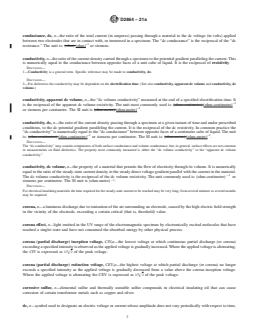
conductivity, apparent dc volume, n—the “dc volume con-
Test Method D2140), or by selective adsorption on clay-gel (See Test
ductivity” measured at the end of a specified electrification
Method D2007).
time. It is the reciprocal of the apparent dc volume resistiv-
−1
ity. The unit most commonly used is: (ohm-centimetre) or
askarel, n—a generic term for a group of synthetic, fire-
−1
siemens per centimetre. The SI unit is (ohm-metre) .
resistant, chlorinated aromatic hydrocarbons used as electri-
cal insulating liquids. They have a property under arcing
conductivity, dc, n—the ratio of the current density passing
conditions such that any gases produced will consist pre-
through a specimen at a given instant of time and under
dominantlyofnoncombustiblehydrogenchloridewithlesser
prescribedconditions,tothedcpotentialgradientparalleling
amounts of combustible gases.
the current. It is the reciprocal of the dc resistivity. In
common practice the “dc conductivity” is numerically equal
atomic absorption, n—the absorption of radiant energy by
to the “dc conductance” between opposite faces of a centi-
groundstateatoms.Substanceswhendispersedasanatomic
−1
metre cube of liquid. The unit is: (ohm-centimetre) or
vapor will absorb characteristic radiations identical to those
−1
siemens per centimetre. The SI unit is: (ohm-metre) .
which the same substances can emit. This property is the
DISCUSSION—The“dcconductivity”maycontaincomponentsofboth
basis for analysis by atomic absorption spectroscopy.
surface conductance and volume conductance, but, in general, surface
effects are not common in measurements on fluid dielectrics. The
capacitivity, n—the same as permittivity, relative.
property most commonly measured is either the “dc volume conduc-
color, n—a quality of visible phenomena of insulating fluids,
tivity” or the “apparent dc volume conductivity.”
the numerical value for which is derived by comparing this
conductivity, dc volume, n—the property of a material that
quality using transmitted light with that of a series of
permits the flow of electricity through its volume. It is
numbered reference standards.
numerically equal to the ratio of the steady-state current
combustible gases, n—flammable gases formed from break- densitytothesteadydirectvoltagegradientparallelwiththe
down (partial or complete) of some insulating materials
current in the material. The dc volume conductivity is the
subjected to electrical or thermal stress, or both. reciprocal of the dc volume resistivity. The unit commonly
−1
used is: (ohm-centimetre) or siemens per centimetre.The
conductance, n—the ratio of the current carried through a −1
SI unit is (ohm-metre) .
material to the difference in potential applied across the
DISCUSSION—For electrical insulating materials the time required for
material. It is the reciprocal of resistance. The unit is:
the steady-state current to be reached may be very long; from several
−1
(ohm) or siemens. minutes to several months may be required.
DISCUSSION—1—Conductance is a general term. Specific reference
corona, n—a luminous discharge due to ionization of the air
may be made to conductance dc and conductance ac.
surrounding an electrode, caused by the high electric field
DISCUSSION—2—For dielectrics the conductance may be dependent strength in the vicinity of the electrode, exceeding a certain
on the electrification time.
critical (that is, threshold) value.
conductance, apparent dc, n—the dc conductance measured corona effect, n—light emitted in the UV range of the
at the end of a specific electrification time.The “apparent dc electromagnetic spectrum by electronically excited mol-
conductance” is the reciprocal of the “apparent dc resis- ecules that have reached a singlet state and have not
−1
tance.” The unit is: (ohm) or siemens. consumed the absorbed energy by other physical process.
DISCUSSION—The term “apparent dc conductance” is used to distin-
corona (partial discharge) inception voltage, CIV, n—the
guish the current-voltage relationship found in electrical insulating
lowest voltage at which continuous partial discharge (or
materials,wherethecurrent(leakageplusabsorption)usuallydecreases
corona) exceeding a specified intensity is observed as the
withtime,fromtherelationshipfoundinmetallicconductorswherethe
steady-state current is reached in a fraction of a second. applied voltage is gradually increased. Where the applied
voltage is alternating, the CIV is expressed as 1/=2 of the
conductance, dc, n—the ratio of the total current (in amperes)
peak voltage.
passingthroughamaterialtothedcvoltage(involts)applied
betweentwoelectrodesthatareincontactwith,orimmersed corona (partial discharge) extinction voltage, CEV, n—the
in a specimen.The “dc conductance” is the reciprocal of the highest voltage at which partial discharge (or corona) no
−1
“dc resistance.” The unit is: (ohm) or siemens. longer exceeds a specified intensity as the applied voltage is
graduallydecreasedfromavalueabovethecoronainception
conductivity, n—the ratio of the current density carried
voltage. Where the applied voltage is alternating the CEV is
through a specimen to the potential gradient paralleling the
=
expressed as 1/ 2 of the peak voltage.
current. This is numerically equal to the conductance be-
tween opposite faces of a unit cube of liquid. It is the corrosive sulfur, n—elemental sulfur and thermally unstable
sulfur compounds in electrical insulating oil that can cause
reciprocal of resistivity.
corrosion of certain transformer metals such as copper and
DISCUSSION—1—Conductivity is a general term. Specific reference
may be made to conductivity, dc. silver.
D2864 − 21a
dc, n—symbol used to designate an electric voltage or current G/ωC 51/ωC R 5 ωR C
p p p s s
whose amplitude does not vary periodically with respect to
where G is the equivalent parallel ac conductance, C is the paral-
p
time, as for example the output of a chemical cell or that of
lel capacitance, R is the equivalent parallel ac resistance, C is the
p s
a thermocouple. The term is also applied to the output of
series capacitance, and R is the equivalent series resistance.
s
such devices as dynamos and rectifiers, whose amplitude is
dissipation factor, dielectric, n—same as dissipation factor.
not strictly time-invariant.
dissolved water, n—water that is in solution interspersed
dew-point temperature, n—the temperature (above 0 °C) to
between molecules of insulating liquid.
whichagasorvapormustbecooledatconstantpressureand
electric constant, n— the same as permittivity of free space.
constant water-vapor composition in order for saturation to
electric creepage strength, n—the average voltage gradient
occur.
under specific conditions of test and for a specific electrode
DISCUSSION—At temperatures below 0 °C, vapor may first be noticed
configuration, at which dielectric failure occurs along the
in the form of frost. It is common to refer to the temperature at which
this occurs as the frost-point temperature. Dew-point temperatures also interface between a solid insulating material and the fluid in
exist for other gas or vapor systems in which saturation with respect to
which it is immersed, or at the interface between two solids
a substance other than water vapor can occur.
that are in close physical contact with each other but are not
bonded chemically. Dielectric creepage failure may result in
dielectric, n—a medium in which it is possible to maintain an
tracking.
electric field with little supply of energy from outside
sources. The energy required to produce the electric field is
electrical discharge, n—a discontinuous movement of electri-
recoverable, in whole or in part. A vacuum, as well as any
cal charges through an insulating medium, initiated by
insulating material is a dielectric.
electron avalanches and supplemented by secondary pro-
cesses.
dielectric breakdown voltage, n—the potential difference at
which electrical failure occurs in an electrical insulating
electrification time, n—the time during which a steady direct
material or insulation structure, under prescribed test condi-
potential is applied to electrical insulating materials before
tions.
the current is measured.
dielectric constant, n— see dielectric constant, relative (es-
emulsified water, n—water that is suspended in insulating
peciallyNote2).(Seealso permittivity(especiallyNote2).)
liquid as clusters of water molecules. It usually gives
dielectric constant, absolute, n—the same as permittivity.
insulating liquid a milky appearance.
dielectric constant, relative, n—the same as permittivity,
ester-based insulating liquid, n—aninsulatingliquidthatmay
relative.
be either synthetic or natural-based. Synthetic ester liquids
DISCUSSION—1—Current practice including international usage is to
are produced by the reaction of an organic acid with an
prefer the term relative permittivity.
alcohol, usually a diol, triol, or tetraol. Natural ester liquids
DISCUSSION—2—Commonusagehasbeentodroptheterm“relative”
are derived from animal or agricultural (vegetable or seed)
and simply use dielectric constant when the dimensionless ratio is the
sources that have been suitably processed for use as electri-
quantity being referred to.
cal insulating medium. They are generically referred to as
dielectric failure, n—the failure of an element in a dielectric
triglycerides, being a combination of glycerol and various
circuit that exists when the insulating element becomes
organic acids of varying molecular weights.
conducting. This event may take the form of a gradual
fire point, n—the lowest temperature at which a specimen will
increaseincurrentexceedingaspecifiedvalue,butitusually
sustain burning for 5 s under specified conditions of test.
takes the form of an almost instantaneous charge transfer
accompanied by collapse of the insulating properties and
flash point, n—the lowest temperature corrected to a baromet-
partial of complete localized destruction of the dielectric
ricpressureof101.3kPa(760mmHg),atwhichapplication
medium. In the case of liquids and gases the failure may be
ofatestflamecausesthevaporofaspecimentoigniteunder
self-healing.
specified conditions of test.
dielectric strength, n—a property of an insulating material
fluid, n—a liquid or a gas.
described by the average voltage gradient at which electric
fluorescence, n—photoluminescence in which the emitted
breakdown occurs under specific conditions of test.
optical radiation results from direct transitions from a
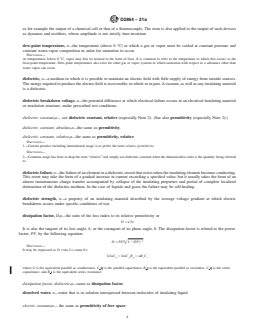
dissipation factor, D, n—the ratio of the loss index to its
photo–excited singlet energy level to a lower singlet level,
relative permittivity or
these transitions taking place generally within 10 nanosec-
onds after excitation.
D 5 κ"/κ'
It is also the tangent of its loss angle, δ, or the cotangent free electrons, n—an electron, not directly associated with the
of its phase angle, θ. The dissipation factor is related to the structure of an atom or molecule, free to move under the
power factor, PF, by the following equation: influence of an applied electric or magnetic field.
D 5 PF/=1 2 PF free radical, n—anatomoradiatomicorpolyatomicmolecule
~ !
DISCUSSION—It may be expressed as D=tan δ=cotan θ= which possesses one unpaired electron. Free radicals act a
D2864 − 21a
initiators or intermediates in such basic phenomena as insulating liquid, fluid or gas, n—a fluid (liquid or gaseous)
oxidation, combustion, photolysis, and polymerization. which does not readily conduct electricity. Electrical insu-
lating fluids typically provide both electrical insulation and
free water, n—water that is high enough in concentration to
heat transfer in electrical equipment.
form water droplets and separate from the insulating liquid.
insulating material, n—a material of relatively low electrical
furanic compounds, n—a class of chemical compounds char-
conductivity and high dielectric strength, usually used to
acterized by the presence of heterocyclic structures consist-
support or provide electrical separation for conductors, in
ing of a five-membered ring containing four carbon atoms
which a voltage applied between two points on or within the
and one oxygen atom. These compounds may be found
material produces a small and sometimes negligible current.
dissolved in electrical insulating fluids, either as residual
contaminants of refinery extraction processes in which interfacial tension, n—the force existing in a liquid-liquid
phase interface that tends to diminish the area of the
furfural is used, or from the degradation of cellulose insu-
lation. interface. This force, which is analogous to the surface
tension of liquid-vapor interfaces, acts at each point on the
gas chromatography,GC, n—allchromatographicmethodsin
interface in the plane tangent at that point. (Compilation of
which the moving phase is gaseous. The stationary phase
ASTM Standard Definitions, 7th Edition.)
may be either a dry granular solid or a liquid supported by
less-flammable insulating liquid, n—a used or unused insu-
thegranulesorbythewallofthecolumn,orboth.Separation
lating liquid with a measured fire point at or above 300 °C.
is achieved by differences in the partition-distribution of the
components of a sample between the mobile and stationary
loss angle, δ, n— the angle whose tangent is the dissipation
phases, causing them to move through the column at
factororarctan κ"/κ'.Itisalsothedifferencebetween90deg
different rates and from it at different times. (E355)
and the phase angle.
gas–liquid chromatography, GLC, n—gas chromatographic
loss angle, dielectric, n— same as loss angle.
method utilizing a liquid as the stationary phase, which acts
loss index, n—the same as loss index, dielectric.
as a solvent for the sample components.
loss index, dielectric, κ"(ε "), n—the product of the “relative
r
permittivity” and the dissipation factor and is a measure of
gas–solid chromatography, GSC, n—gas chromatographic
the ac dielectric loss. It is also the magnitude of the
method utilizing an active (absorbant) solid as the stationary
imaginary part of the “relative complex permittivity.”
phase.
DISCUSSION—It may be expressed as:
gassing tendency, n—the capability of an insulating li
...
This document is not an ASTM standard and is intended only to provide the user of an ASTM standard an indication of what changes have been made to the previous version. Because
it may not be technically possible to adequately depict all changes accurately, ASTM recommends that users consult prior editions as appropriate. In all cases only the current version
of the standard as published by ASTM is to be considered the official document.
Designation: D2864 − 21 D2864 − 21a
Standard Terminology Relating to
Electrical Insulating Liquids and Gases
This standard is issued under the fixed designation D2864; the number immediately following the designation indicates the year of
original adoption or, in the case of revision, the year of last revision. A number in parentheses indicates the year of last reapproval. A
superscript epsilon (´) indicates an editorial change since the last revision or reapproval.
INTRODUCTION
The definitions contained in this terminology pertain to terms as they are used in conjunction with
fluid insulating materials. Insofar as possible, the definitions are consistent with accepted general
usage, and may also contain additional information deemed to be of value in testing of fluid insulating
materials.
1. Referenced Documents
1.1 ASTM Standards:
D611 Test Methods for Aniline Point and Mixed Aniline Point of Petroleum Products and Hydrocarbon Solvents
D2007 Test Method for Characteristic Groups in Rubber Extender and Processing Oils and Other Petroleum-Derived Oils by the
Clay-Gel Absorption Chromatographic Method
D2140 Practice for Calculating Carbon-Type Composition of Insulating Oils of Petroleum Origin
D2300 Test Method for Gassing of Electrical Insulating Liquids Under Electrical Stress and Ionization (Modified Pirelli Method)
D2500 Test Method for Cloud Point of Petroleum Products and Liquid Fuels
D3117 Test Method for Wax Appearance Point of Distillate Fuels (Withdrawn 2010)
E355 Practice for Gas Chromatography Terms and Relationships
2. Terminology
ac, n—symbol used to designate an electric voltage or current whose amplitude varies periodically as a function of time, its
average value over one complete period being zero. One complete repetition of the wave pattern is referred to as a CYCLE, and
the number of cycles occurring in one second is called the FREQUENCY, measured in hertz (Hz). For example, the electricity
supplied by commercial utility companies in the United States is, in most localities, 60 Hz, although other frequencies may be
encountered.
acid treating, n—a refining process in which an unfinished petroleum insulating oil is contacted with sulfuric acid to improve
its color, odor, stability, and other properties.
ac loss characteristics, n—those properties of a dielectric or insulation system (such as dissipation factor, power factor, and loss
index) that may be used as a measure of the power or energy losses that would result from the use of such material in an ac
electric field.
This terminology is under the jurisdiction of ASTM Committee D27 on Electrical Insulating Liquids and Gases and is the direct responsibility of Subcommittee D27.15
on Planning Resource and Development.
Current edition approved June 1, 2021Nov. 1, 2021. Published June 2021December 2021. Originally approved in 1970. Last previous edition approved in 20202021 as
D2864 – 20.D2864 – 21. DOI: 10.1520/D2864-21.10.1520/D2864-21A.
For referenced ASTM standards, visit the ASTM website, www.astm.org, or contact ASTM Customer Service at service@astm.org. For Annual Book of ASTM Standards
volume information, refer to the standard’s Document Summary page on the ASTM website.
The last approved version of this historical standard is referenced on www.astm.org.
Copyright © ASTM International, 100 Barr Harbor Drive, PO Box C700, West Conshohocken, PA 19428-2959. United States
D2864 − 21a
additive, n—a chemical compound or compounds added to an insulating fluid for the purpose of imparting new properties or
altering those properties which the fluid already has.
ambient temperature, n—the temperature of the surrounding atmosphere as determined by an instrument shielded from direct
or reflected rays of the sun.
aniline point, n—the minimum temperature for complete miscibility of equal volumes of aniline and the sample under test. See
Test Methods D611. In comparing two samples of similar molecular weight, the aniline point can be used as a means of
comparing aromatic content of the two samples. A product of high aniline point will be low in aromatics and naphthenes, and
therefore high in paraffins.
API gravity, n—an arbitrary scale developed by the American Petroleum Institute and frequently used in reference to petroleum
insulating oil. The relationship between API gravity and specific gravity 60/60 °F is defined by the following:
Deg API Gravity at 60°F5 141.5/~sp gr 60/60°F!2 131.5
Deg API Gravity at 60°F5 141.5/ sp gr 60/60 °F 2 131.5
~ !
aromatics, n—that class of organic compounds which behave chemically like benzene. They are cyclic unsaturated organic
compounds that can sustain an induced electronic ring current due to delocalization of electrons around the ring.
DISCUSSION—
Empirically, the aromatic portion of a mineral insulating oil can be estimated by correlation with physical properties (See Test Method D2140), or by
selective adsorption on clay-gel (See Test Method D2007).
askarel, n—a generic term for a group of synthetic, fire-resistant, chlorinated aromatic hydrocarbons used as electrical insulating
liquids. They have a property under arcing conditions such that any gases produced will consist predominantly of
noncombustible hydrogen chloride with lesser amounts of combustible gases.
atomic absorption, n—the absorption of radiant energy by ground state atoms. Substances when dispersed as an atomic vapor
will absorb characteristic radiations identical to those which the same substances can emit. This property is the basis for analysis
by atomic absorption spectroscopy.
capacitivity,n—the same as permittivity, relative.
color, n—a quality of visible phenomena of insulating fluids, the numerical value for which is derived by comparing this quality
using transmitted light with that of a series of numbered reference standards.
combustible gases, n—flammable gases formed from breakdown (partial or complete) of some insulating materials subjected
to electrical or thermal stress, or both.
conductance, n—the ratio of the current carried through a material to the difference in potential applied across the material. It
−1
is the reciprocal of resistanceresistance. . The unit is: (ohm) or siemens.
DISCUSSION—
1—Conductance is a general term. Specific reference may be made to conductance dc and conductance ac.
DISCUSSION—
2—For dielectrics the conductance may be dependent on the electrification time.
conductance, apparent dc, n—the dc conductance measured at the end of a specific electrification time. The “apparent dc
−1
conductance” is the reciprocal of the “apparent dc resistance.” The unit is: (ohm) or siemens.
DISCUSSION—
The term “apparent dc conductance” is used to distinguish the current-voltage relationship found in electrical insulating materials, where the current
(leakage plus absorption) usually decreases with time, from the relationship found in metallic conductors where the steady-state current is reached in
a fraction of a second.
D2864 − 21a
conductance, dc, n—the ratio of the total current (in amperes) passing through a material to the dc voltage (in volts) applied
between two electrodes that are in contact with, or immersed in a specimen. The “dc conductance” is the reciprocal of the “dc
−1
resistance.” The unit is: (ohm) (ohm) or siemens.
conductivity, n—the ratio of the current density carried through a specimen to the potential gradient paralleling the current. This
is numerically equal to the conductance between opposite faces of a unit cube of liquid. It is the reciprocal of resistivity.
DISCUSSION—
1—Conductivity is a general term. Specific reference may be made to conductivity, dc.
DISCUSSION—
2—For dielectrics the conductivity may be dependent on the electrification time. (See also conductivity, apparent dc volume and conductivity, dc
volume.)
conductivity, apparent dc volume, n—the “dc volume conductivity” measured at the end of a specified electrification time. It
−1
is the reciprocal of the apparent dc volume resistivity. The unit most commonly used is: (ohm-centimetre) (ohm-centimetre)
−1
or siemens per centimetre. The SI unit is (ohm-metre) (ohm-metre) .
conductivity, dc, n—the ratio of the current density passing through a specimen at a given instant of time and under prescribed
conditions, to the dc potential gradient paralleling the current. It is the reciprocal of the dc resistivity. In common practice the
“dc conductivity” is numerically equal to the “dc conductance” between opposite faces of a centimetre cube of liquid. The unit
−1 −1
is: (ohm-centimetre) (ohm-centimetre) or siemens per centimetre. The SI unit is: (ohm-metre) (ohm-metre) .
DISCUSSION—
The “dc conductivity” may contain components of both surface conductance and volume conductance, but, in general, surface effects are not common
in measurements on fluid dielectrics. The property most commonly measured is either the “dc volume conductivity” or the “apparent dc volume
conductivity.”
conductivity, dc volume, n—the property of a material that permits the flow of electricity through its volume. It is numerically
equal to the ratio of the steady-state current density to the steady direct voltage gradient parallel with the current in the material.
−1
The dc volume conductivity is the reciprocal of the dc volume resistivity. The unit commonly used is: (ohm-centimetre) or
−1
siemens per centimetre. The SI unit is (ohm-metre) .
DISCUSSION—
For electrical insulating materials the time required for the steady-state current to be reached may be very long; from several minutes to several months
may be required.
corona, n—a luminous discharge due to ionization of the air surrounding an electrode, caused by the high electric field strength
in the vicinity of the electrode, exceeding a certain critical (that is, threshold) value.
corona effect, n—light emitted in the UV range of the electromagnetic spectrum by electronically excited molecules that have
reached a singlet state and have not consumed the absorbed energy by other physical process.
corona (partial discharge) inception voltage, CIV,n—the lowest voltage at which continuous partial discharge (or corona)
exceeding a specified intensity is observed as the applied voltage is gradually increased. Where the applied voltage is alternating,
the CIV is expressed as 1/=2 of the peak voltage.
corona (partial discharge) extinction voltage, CEV,n—the highest voltage at which partial discharge (or corona) no longer
exceeds a specified intensity as the applied voltage is gradually decreased from a value above the corona inception voltage.
=
Where the applied voltage is alternating the CEV is expressed as 1/ 2 of the peak voltage.
corrosive sulfur, n—elemental sulfur and thermally unstable sulfur compounds in electrical insulating oil that can cause
corrosion of certain transformer metals such as copper and silver.
dc, n—symbol used to designate an electric voltage or current whose amplitude does not vary periodically with respect to time,
D2864 − 21a
as for example the output of a chemical cell or that of a thermocouple. The term is also applied to the output of such devices
as dynamos and rectifiers, whose amplitude is not strictly time-invariant.
dew-point temperature, n—the temperature (above 0 °C) to which a gas or vapor must be cooled at constant pressure and
constant water-vapor composition in order for saturation to occur.
DISCUSSION—
At temperatures below 0 °C, vapor may first be noticed in the form of frost. It is common to refer to the temperature at which this occurs as the
frost-point temperature. Dew-point temperatures also exist for other gas or vapor systems in which saturation with respect to a substance other than
water vapor can occur.
dielectric, n—a medium in which it is possible to maintain an electric field with little supply of energy from outside sources.
The energy required to produce the electric field is recoverable, in whole or in part. A vacuum, as well as any insulating material
is a dielectric.
dielectric breakdown voltage, n—the potential difference at which electrical failure occurs in an electrical insulating material
or insulation structure, under prescribed test conditions.
dielectric constant,n— see dielectric constant, relative (especially Note 2). (See also permittivity (especially Note 2).)
dielectric constant, absolute,n—the same as permittivity.
dielectric constant, relative,n—the same as permittivity, relative.
DISCUSSION—
1—Current practice including international usage is to prefer the term relative permittivity.
DISCUSSION—
2—Common usage has been to drop the term “relative” and simply use dielectric constant when the dimensionless ratio is the quantity being referred
to.
dielectric failure, n—the failure of an element in a dielectric circuit that exists when the insulating element becomes conducting.
This event may take the form of a gradual increase in current exceeding a specified value, but it usually takes the form of an
almost instantaneous charge transfer accompanied by collapse of the insulating properties and partial of complete localized
destruction of the dielectric medium. In the case of liquids and gases the failure may be self-healing.
dielectric strength, n—a property of an insulating material described by the average voltage gradient at which electric
breakdown occurs under specific conditions of test.
dissipation factor, D,n—the ratio of the loss index to its relative permittivity or
D 5κ"/κ'
It is also the tangent of its loss angle, δ, or the cotangent of its phase angle, θ. The dissipation factor is related to the power
factor, PF, by the following equation:
D 5 PF/=12 PF
~ !
DISCUSSION—
It may be expressed as D = tan δ = cotan θ =
G/ωC 5 1/ωC R 5ωR C
p p p s s
where G is the equivalent parallel ac conductance, C is the parallel capacitance, R is the equivalent parallel ac resistance, C is the series
p p pp s s
capacitance, and R is the equivalent series resistance.
ss
dissipation factor, dielectric,n—same as dissipation factor.
dissolved water, n—water that is in solution interspersed between molecules of insulating liquid.
electric constant,n— the same as permittivity of free space.
D2864 − 21a
electric creepage strength, n—the average voltage gradient under specific conditions of test and for a specific electrode
configuration, at which dielectric failure occurs along the interface between a solid insulating material and the fluid in which
it is immersed, or at the interface between two solids that are in close physical contact with each other but are not bonded
chemically. Dielectric creepage failure may result in tracking.
electrical discharge, n—a discontinuous movement of electrical charges through an insulating medium, initiated by electron
avalanches and supplemented by secondary processes.
electrification time, n—the time during which a steady direct potential is applied to electrical insulating materials before the
current is measured.
emulsified water, n—water that is suspended in insulating liquid as clusters of water molecules. It usually gives insulating liquid
a milky appearance.
ester-based insulating liquid, n—an insulating liquid that may be either synthetic or natural-based. Synthetic ester liquids are
produced by the reaction of an organic acid with an alcohol, usually a diol, triol, or tetraol. Natural ester liquids are derived from
animal or agricultural (vegetable or seed) sources that have been suitably processed for use as electrical insulating medium. They
are generically referred to as triglycerides, being a combination of glycerol and various organic acids of varying molecular
weights.
fire point, n—the lowest temperature at which a specimen will sustain burning for 5 s under specified conditions of test.
flash point, n—the lowest temperature corrected to a barometric pressure of 101.3 kPa (760 mm Hg), at which application of
a test flame causes the vapor of a specimen to ignite under specified conditions of test.
fluid, n—a liquid or a gas.
fluorescence, n—photoluminescence in which the emitted optical radiation results from direct transitions from a photo–excited
singlet energy level to a lower singlet level, these transitions taking place generally within 10 nanoseconds after excitation.
free electrons, n—an electron, not directly associated with the structure of an atom or molecule, free to move under the influence
of an applied electric or magnetic field.
free radical, n—an atom or a diatomic or polyatomic molecule which possesses one unpaired electron. Free radicals act a
initiators or intermediates in such basic phenomena as oxidation, combustion, photolysis, and polymerization.
free water, n—water that is high enough in concentration to form water droplets and separate from the insulating liquid.
furanic compounds, n—a class of chemical compounds characterized by the presence of heterocyclic structures consisting of
a five-membered ring containing four carbon atoms and one oxygen atom. These compounds may be found dissolved in
electrical insulating fluids, either as residual contaminants of refinery extraction processes in which furfural is used, or from the
degradation of cellulose insulation.
gas chromatography, GC,n—all chromatographic methods in which the moving phase is gaseous. The stationary phase may
be either a dry granular solid or a liquid supported by the granules or by the wall of the column, or both. Separation is achieved
by differences in the partition-distribution of the components of a sample between the mobile and stationary phases, causing
them to move through the column at different rates and from it at different times. (E355)
gas–liquid chromatography, GLC,n—gas chromatographic method utilizing a liquid as the stationary phase, which acts as a
solvent for the sample components.
D2864 − 21a
gas–solid chromatography, GSC,n—gas chromatographic method utilizing an active (absorbant) solid as the stationary phase.
gassing tendency, n—the capability of an insulating liquid either to absorb or generate gases when exposed to voltage stress.
The measure of the gassing tendency is the volume of gas evolved or absorbed per unit time by an insulating liquid subjected
to electrical stress under prescribed conditions (by Test Method D2300). It is commonly expressed in units of microlitres per
minute (μL/min) with a positive value indicating gas is evolved and a negative value indicating gas is absorbed. The SI unit is
cubic millimetres per minute (mm /min).
DISCUSSION—
The term gassing is sometimes used synonymously with either gassing tendency or average gassing coeffıcient, AGC.
guard electrode, n—one or more electrically conducting elements, arranged and connected in an electrical instrument or
measuring circuit so as to divert unwanted conduction or displacement currents from, or confine wanted currents to, the
measuring device.
hank, n—specifically, a coiled or looped bundle (as of yarn, rope or wire) ususally containing a definite aggregate measure of
the material.
hydrogen treating, n—a refining process in which an unfinished petroleum insulating oil is contacted with hydrogen gas at
elevated temperatures and pressures in the presence of a catalyst, to improve its color, odor, stability, and other properties.
inhibitor, n—any substance which when added to an electrical insulating fluid retards or prevents undesirable reactions.
insulating liquid, fluid or gas, n—a fluid (liquid
...