

ASTM D7964/D7964M-19
(Test Method)Standard Test Method for Determining Activity of Fluid Catalytic Cracking (FCC) Catalysts in a Fluidized Bed
General Information
- Abstract
SIGNIFICANCE AND USE
5.1 The fluidized bed test provides data to assess the relative performances of FCC catalysts. Because results are affected by catalyst pretreatment, feedstock characteristics, and operating parameters, this test method is written specifically to address the accuracy and precision when a common catalyst and oil are tested under the same conditions but at different sites, using Kayser Technologies Advanced Catalytic Evaluation (ACE) unit.4,5 Analytical procedures may vary among the sites. However, significant variations are not expected.
Note 1: ASTM International takes no position respecting the validity of any patent rights asserted in connection with any item mentioned in this standard. Users of this standard are expressly advised that determination of the validity of any such patent rights, and the risk of infringement of such rights, are entirely their own responsibility.
5.2 The standard reaction temperature for purposes of the accuracy and precision statement is 532 °C [990 °F]. Other reaction temperatures can be used in practice; however, yield data developed at temperatures other than 532 °C [990 °F] will not be the same. Also, test precision may be different at other reaction temperatures.
SCOPE
1.1 This test method covers determining the activity and coke selectivity of either equilibrium or laboratory deactivated fluid catalytic cracking (FCC) catalysts. The activity is evaluated on the basis of mass percent conversion of gas oil feed in a fluidized bed reactor. The coke yield is defined as the mass of carbon laid down on the catalyst, also expressed as a percent of the gas oil feed. The scope of the round robin will be limited to the determination of activity and coke. All other analyses are thus beyond this scope and should be noted as “optional.”
1.2 The values stated in either SI units or inch-pound units are to be regarded separately as standard. The values stated in each system are not necessarily exact equivalents; therefore, to ensure conformance with the standard, each system shall be used independently of the other, and values from the two systems shall not be combined.
1.3 This standard does not purport to address all of the safety concerns, if any, associated with its use. It is the responsibility of the user of this standard to establish appropriate safety, health, and environmental practices and determine the applicability of regulatory limitations prior to use.
1.4 This international standard was developed in accordance with internationally recognized principles on standardization established in the Decision on Principles for the Development of International Standards, Guides and Recommendations issued by the World Trade Organization Technical Barriers to Trade (TBT) Committee.
- Status
- Published
- Publication Date
- 31-Mar-2019
- Technical Committee
- D32 - Catalysts
- Drafting Committee
- D32.04 - Catalytic Properties
Buy Documents
ASTM D7964/D7964M-19 - Standard Test Method for Determining Activity of Fluid Catalytic Cracking (FCC) Catalysts in a Fluidized Bed
REDLINE ASTM D7964/D7964M-19 - Standard Test Method for Determining Activity of Fluid Catalytic Cracking (FCC) Catalysts in a Fluidized Bed
Overview
ASTM D7964/D7964M-19 is the established standard test method for determining the activity of fluid catalytic cracking (FCC) catalysts using a fluidized bed reactor. Developed by ASTM International, this standard provides a structured approach for the evaluation of both equilibrium and laboratory deactivated FCC catalysts, focusing on catalyst activity and coke selectivity. The method is vital for consistent catalyst performance assessment in refining processes.
The core objective is to provide accurate and precise data on how FCC catalysts convert gas oil into more valuable products, while also quantifying the amount of coke deposited on the catalyst. This standardized procedure ensures comparability for testing carried out at different sites and underpins quality assurance in catalyst evaluation.
Key Topics
- Catalyst Activity Assessment: Measures the mass percent conversion of gas oil feedstock in a fluidized bed reactor, reflecting the effectiveness of the catalyst in breaking down hydrocarbons.
- Coke Selectivity: Evaluates the amount of carbon (coke) formed on the catalyst, expressed as a percentage of the original feed. This is critical as excess coke can impair catalyst performance.
- Test Conditions: While the standard reaction temperature is 532 °C [990 °F], the protocol allows for other temperatures, recognizing that results may vary accordingly.
- Precision and Reproducibility: The method addresses interlaboratory consistency, supporting testing using the Kayser Technologies Advanced Catalytic Evaluation (ACE) unit.
- Method Limitations: Focused on catalyst activity and coke; other analyses should be considered optional and outside the formal scope.
- Dual Unit Systems: Results can be reported in SI units or inch-pound units, but values should not be mixed within a single report.
Applications
ASTM D7964/D7964M-19 is widely used in oil refineries, catalyst manufacturing, research laboratories, and quality control environments. Practical applications include:
- Catalyst Development and Benchmarking: Supporting formulation and performance comparison of FCC catalysts from different suppliers or research initiatives.
- Process Optimization: Providing reliable data for adjusting operating parameters in FCC units to maximize fuel yields and minimize undesirable byproducts.
- Routine Quality Assurance: Ensuring that catalyst shipments meet specified activity and selectivity criteria before being deployed in commercial operations.
- Interlaboratory Studies: Facilitating collaborative testing by providing a repeatable and reproducible methodology to harmonize results from multiple sites.
- Research and Regulatory Compliance: Assisting in fundamental studies and meeting documentation requirements for standardized testing practices.
Related Standards
Professionals using ASTM D7964/D7964M-19 may also reference related standards to complement their FCC catalyst testing:
- ASTM D2887 - Boiling Range Distribution of Petroleum Fractions by Gas Chromatography
- ASTM D4463 - Guide for Metals Free Steam Deactivation of Fresh Fluid Cracking Catalysts
- ASTM D5154/D5154M - Determining Activity and Selectivity of Fluid Catalytic Cracking (FCC) Catalysts by Microactivity Test
- ASTM E105 - Practice for Probability Sampling of Materials
- ASTM E177 - Practice for Use of the Terms Precision and Bias in ASTM Test Methods
- ASTM E691 - Practice for Conducting an Interlaboratory Study to Determine the Precision of a Test Method
Keywords: FCC catalysts, catalytic cracking, fluidized bed, catalyst activity, coke selectivity, ASTM D7964, ACE unit, catalyst testing, refinery process optimization.
For more detailed methodology and up-to-date reference, users should consult the official ASTM documentation.
Relations
- Effective Date
- 01-Apr-2019
- Effective Date
- 01-Jul-2023
- Effective Date
- 01-Jul-2019
- Effective Date
- 01-Jul-2015
- Effective Date
- 01-May-2014
- Effective Date
- 01-May-2013
- Effective Date
- 01-May-2013
- Effective Date
- 01-May-2013
- Effective Date
- 01-Nov-2012
- Effective Date
- 01-Nov-2011
- Effective Date
- 01-Oct-2010
- Effective Date
- 01-Oct-2010
- Effective Date
- 01-Oct-2008
- Effective Date
- 01-Oct-2008
- Refers
ASTM E177-06b - Standard Practice for Use of the Terms Precision and Bias in ASTM Test Methods - Effective Date
- 15-Nov-2006
Buy Documents
ASTM D7964/D7964M-19 - Standard Test Method for Determining Activity of Fluid Catalytic Cracking (FCC) Catalysts in a Fluidized Bed
REDLINE ASTM D7964/D7964M-19 - Standard Test Method for Determining Activity of Fluid Catalytic Cracking (FCC) Catalysts in a Fluidized Bed
Get Certified
Connect with accredited certification bodies for this standard

ECOCERT
Organic and sustainability certification.

Element Materials Technology
Materials testing and product certification.

ABS Group Brazil
ABS Group certification services in Brazil.
Sponsored listings
Frequently Asked Questions
ASTM D7964/D7964M-19 is a standard published by ASTM International. Its full title is "Standard Test Method for Determining Activity of Fluid Catalytic Cracking (FCC) Catalysts in a Fluidized Bed". This standard covers: SIGNIFICANCE AND USE 5.1 The fluidized bed test provides data to assess the relative performances of FCC catalysts. Because results are affected by catalyst pretreatment, feedstock characteristics, and operating parameters, this test method is written specifically to address the accuracy and precision when a common catalyst and oil are tested under the same conditions but at different sites, using Kayser Technologies Advanced Catalytic Evaluation (ACE) unit.4,5 Analytical procedures may vary among the sites. However, significant variations are not expected. Note 1: ASTM International takes no position respecting the validity of any patent rights asserted in connection with any item mentioned in this standard. Users of this standard are expressly advised that determination of the validity of any such patent rights, and the risk of infringement of such rights, are entirely their own responsibility. 5.2 The standard reaction temperature for purposes of the accuracy and precision statement is 532 °C [990 °F]. Other reaction temperatures can be used in practice; however, yield data developed at temperatures other than 532 °C [990 °F] will not be the same. Also, test precision may be different at other reaction temperatures. SCOPE 1.1 This test method covers determining the activity and coke selectivity of either equilibrium or laboratory deactivated fluid catalytic cracking (FCC) catalysts. The activity is evaluated on the basis of mass percent conversion of gas oil feed in a fluidized bed reactor. The coke yield is defined as the mass of carbon laid down on the catalyst, also expressed as a percent of the gas oil feed. The scope of the round robin will be limited to the determination of activity and coke. All other analyses are thus beyond this scope and should be noted as “optional.” 1.2 The values stated in either SI units or inch-pound units are to be regarded separately as standard. The values stated in each system are not necessarily exact equivalents; therefore, to ensure conformance with the standard, each system shall be used independently of the other, and values from the two systems shall not be combined. 1.3 This standard does not purport to address all of the safety concerns, if any, associated with its use. It is the responsibility of the user of this standard to establish appropriate safety, health, and environmental practices and determine the applicability of regulatory limitations prior to use. 1.4 This international standard was developed in accordance with internationally recognized principles on standardization established in the Decision on Principles for the Development of International Standards, Guides and Recommendations issued by the World Trade Organization Technical Barriers to Trade (TBT) Committee.
SIGNIFICANCE AND USE 5.1 The fluidized bed test provides data to assess the relative performances of FCC catalysts. Because results are affected by catalyst pretreatment, feedstock characteristics, and operating parameters, this test method is written specifically to address the accuracy and precision when a common catalyst and oil are tested under the same conditions but at different sites, using Kayser Technologies Advanced Catalytic Evaluation (ACE) unit.4,5 Analytical procedures may vary among the sites. However, significant variations are not expected. Note 1: ASTM International takes no position respecting the validity of any patent rights asserted in connection with any item mentioned in this standard. Users of this standard are expressly advised that determination of the validity of any such patent rights, and the risk of infringement of such rights, are entirely their own responsibility. 5.2 The standard reaction temperature for purposes of the accuracy and precision statement is 532 °C [990 °F]. Other reaction temperatures can be used in practice; however, yield data developed at temperatures other than 532 °C [990 °F] will not be the same. Also, test precision may be different at other reaction temperatures. SCOPE 1.1 This test method covers determining the activity and coke selectivity of either equilibrium or laboratory deactivated fluid catalytic cracking (FCC) catalysts. The activity is evaluated on the basis of mass percent conversion of gas oil feed in a fluidized bed reactor. The coke yield is defined as the mass of carbon laid down on the catalyst, also expressed as a percent of the gas oil feed. The scope of the round robin will be limited to the determination of activity and coke. All other analyses are thus beyond this scope and should be noted as “optional.” 1.2 The values stated in either SI units or inch-pound units are to be regarded separately as standard. The values stated in each system are not necessarily exact equivalents; therefore, to ensure conformance with the standard, each system shall be used independently of the other, and values from the two systems shall not be combined. 1.3 This standard does not purport to address all of the safety concerns, if any, associated with its use. It is the responsibility of the user of this standard to establish appropriate safety, health, and environmental practices and determine the applicability of regulatory limitations prior to use. 1.4 This international standard was developed in accordance with internationally recognized principles on standardization established in the Decision on Principles for the Development of International Standards, Guides and Recommendations issued by the World Trade Organization Technical Barriers to Trade (TBT) Committee.
ASTM D7964/D7964M-19 is classified under the following ICS (International Classification for Standards) categories: 71.040.30 - Chemical reagents; 75.020 - Extraction and processing of petroleum and natural gas. The ICS classification helps identify the subject area and facilitates finding related standards.
ASTM D7964/D7964M-19 has the following relationships with other standards: It is inter standard links to ASTM D7964/D7964M-14, ASTM D2887-23, ASTM D2887-19, ASTM D2887-15, ASTM E177-14, ASTM E177-13, ASTM E691-13, ASTM D2887-13, ASTM D2887-12, ASTM E691-11, ASTM E105-10, ASTM E177-10, ASTM E691-08, ASTM E177-08, ASTM E177-06b. Understanding these relationships helps ensure you are using the most current and applicable version of the standard.
ASTM D7964/D7964M-19 is available in PDF format for immediate download after purchase. The document can be added to your cart and obtained through the secure checkout process. Digital delivery ensures instant access to the complete standard document.
Standards Content (Sample)
This international standard was developed in accordance with internationally recognized principles on standardization established in the Decision on Principles for the
Development of International Standards, Guides and Recommendations issued by the World Trade Organization Technical Barriers to Trade (TBT) Committee.
Designation: D7964/D7964M − 19
Standard Test Method for
Determining Activity of Fluid Catalytic Cracking (FCC)
Catalysts in a Fluidized Bed
This standard is issued under the fixed designation D7964/D7964M; the number immediately following the designation indicates the
year of original adoption or, in the case of revision, the year of last revision. A number in parentheses indicates the year of last
reapproval. A superscript epsilon (´) indicates an editorial change since the last revision or reapproval.
1. Scope D4463 Guide for Metals Free Steam Deactivation of Fresh
Fluid Cracking Catalysts
1.1 This test method covers determining the activity and
D5154/D5154M Test Method for Determining Activity and
coke selectivity of either equilibrium or laboratory deactivated
SelectivityofFluidCatalyticCracking(FCC)Catalystsby
fluid catalytic cracking (FCC) catalysts. The activity is evalu-
Microactivity Test
ated on the basis of mass percent conversion of gas oil feed in
E105 Practice for Probability Sampling of Materials
a fluidized bed reactor.The coke yield is defined as the mass of
E177 Practice for Use of the Terms Precision and Bias in
carbon laid down on the catalyst, also expressed as a percent of
ASTM Test Methods
the gas oil feed. The scope of the round robin will be limited
E691 Practice for Conducting an Interlaboratory Study to
tothedeterminationofactivityandcoke.Allotheranalysesare
Determine the Precision of a Test Method
thus beyond this scope and should be noted as “optional.”
1.2 The values stated in either SI units or inch-pound units
3. Terminology
are to be regarded separately as standard. The values stated in
3.1 Definitions of Terms Specific to This Standard:
each system are not necessarily exact equivalents; therefore, to
3.1.1 activity, n—a measure of the rate of a specific catalytic
ensure conformance with the standard, each system shall be
reaction, calculated in the present case by dividing conversion
used independently of the other, and values from the two
by the difference of 100 minus conversion.
systems shall not be combined.
3.1.2 catalyst/oil (C/O) ratio, n—the mass of catalyst used
1.3 This standard does not purport to address all of the
in the test divided by the mass of feed fed to the reactor.
safety concerns, if any, associated with its use. It is the
3.1.3 coke, n—mass of carbon laid down on the catalyst
responsibility of the user of this standard to establish appro-
during the FCC reaction times 1.083.
priate safety, health, and environmental practices and deter-
mine the applicability of regulatory limitations prior to use.
3.1.4 conversion, n—the starting mass of reactant feed
1.4 This international standard was developed in accor-
minus the mass of the liquid product that boils above 221 °C
dance with internationally recognized principles on standard-
[430 °F]; this delta is then reported as a percentage of the
ization established in the Decision on Principles for the
starting mass of feed.
Development of International Standards, Guides and Recom-
3.1.5 delivery time, n—this is the time, in seconds, during
mendations issued by the World Trade Organization Technical
which feed is introduced to the reactor.
Barriers to Trade (TBT) Committee.
3.1.6 FCC, n—fluid catalytic cracking.
2. Referenced Documents
3.1.7 gasoline, n—C compounds through compounds boil-
ing at 221 °C [430 °F].
2.1 ASTM Standards:
D2887 Test Method for Boiling Range Distribution of Pe- 3.1.8 HCO, n—theheavycycleoilproduct,whichisdefined
troleum Fractions by Gas Chromatography to have a minimum boiling point of 343 °C [650 °F].
3.1.9 LCO, n—the light cycle oil product, which is defined
to have a boiling point range of 221 to 343 °C [430 to 650 °F].
This test method is under the jurisdiction of ASTM Committee D32 on
Catalysts and is the direct responsibility of Subcommittee D32.04 on Catalytic 3.1.10 liquid product, n—all products formed in the cata-
Properties.
lytic reaction that can be condensed in the chiller bath
Current edition approved April 1, 2019. Published May 2019. Originally
afterward, usually a combination of gasoline, LCO, and HCO,
approved in 2014. Last previous edition approved in 2014 as D7964/D7964M – 14.
but can contain a trace of C and C minus compounds.
DOI: 10.1520/D7964-19.
4 4
For referenced ASTM standards, visit the ASTM website, www.astm.org, or
3.1.11 normalized product yield, n—the result obtained
contact ASTM Customer Service at service@astm.org. For Annual Book of ASTM
when each product yield has been corrected for non-perfect
Standards volume information, refer to the standard’s Document Summary page on
the ASTM website. mass balances.
Copyright © ASTM International, 100 Barr Harbor Drive, PO Box C700, West Conshohocken, PA 19428-2959. United States
D7964/D7964M − 19
3.1.11.1 Discussion—For a run to be judged acceptable, the reaction temperatures can be used in practice; however, yield
total recovery, mass % of feed, should be in the range of 96 to data developed at temperatures other than 532 °C [990 °F] will
102 % prior to normalization. If the recovery is outside this not be the same. Also, test precision may be different at other
range the test data should be discarded. reaction temperatures.
3.1.12 product yield, n—one hundred times the mass of a
6. Apparatus
specific product divided by the mass of feed used in the test.
3.1.13 selectivity, n—same as yield.
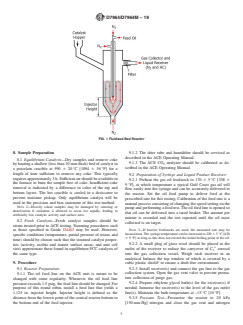
6.1 The fluidized bed reactor of this test method is shown in
3.1.13.1 Discussion—Selectivity generally refers to how
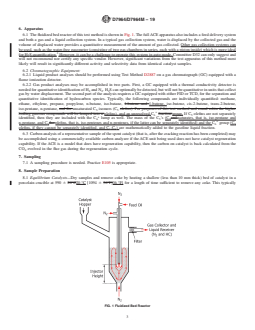
Fig. 1. The full ACE apparatus also includes a feed delivery
much of a particular product, such as coke, is formed during a
system and both a gas and a liquid collection system. In a
chemical reaction; selectivity is related to, but different from,
typical gas collection system, water is displaced by the
conversion, which is the total amount of all products formed
collected gas and the volume of displaced water provides a
during the reaction.
quantitativemeasurementoftheamountofgascollected.Other
gas collection systems can be used, such as the water-free
4. Summary of Test Method
gasometer (consisting of two gas chambers in series, each with
4.1 A sample of FCC catalyst is contacted with gas oil in a
a piston inside) which is more ideal for H S quantification.
fluidized bed reactor using a specified reaction temperature, a
However, it can be a challenge to operate this system in auto
specified mass of catalyst and oil, and specified oil feed rate.
mode. Committee D32 can only suggest and will not recom-
Reaction products (liquid product, gas, and coke on catalyst)
mend nor certify any specific vendor. However, significant
are analyzed. Conversion, coke, and individual product yields
variations from the test apparatus of this method most likely
are calculated for each experiment.
will result in significantly different activity and selectivity data
from identical catalyst samples.
4.2 Following analysis of the products, the total recovery
(that is, mass balance) of the feed as converted and uncon-
6.2 Chromatographic Equipment:
verted products is determined. If the recovery is less than 96 %
6.2.1 Liquid product analyses should be performed using
or greater than 102 %, then the test is rejected as unsatisfactory
Test Method D2887 on a gas chromatograph (GC) equipped
(an outlier).
with a flame ionization detector.
4.3 For each catalyst tested, a normalized conversion or
6.2.2 Gas product analyses may be accomplished in two
activity and a coke mass are determined.
parts. First, a GC equipped with a thermal conductivity
4.4 Further to this test method, a video has appeared in the detector is needed for quantitative identification of H and N .
2 2
literature along with a detailed protocol and a table of specific
H S can optionally be detected, but will not be quantitative in
materials/equipment to guide users in obtaining materials for unitsthatcollectgasbywaterdisplacement.Thesecondpartof
the tests.
the analysis requires a GC equipped with either FID or TCD,
for the separation and quantitative identification of hydrocar-
5. Significance and Use
bon species. Typically, the following compounds are individu-
5.1 Thefluidizedbedtestprovidesdatatoassesstherelative
ally quantified: methane, ethane, ethylene, propane, propylene,
performances of FCC catalysts. Because results are affected by n-butane, iso-butane, 1-butene, iso-butene, cis-2-butene, trans-
catalyst pretreatment, feedstock characteristics, and operating
2-butene, iso-pentane, n-pentane, unsaturated C isomers (C
5 5
+
parameters, this test method is written specifically to address olefins), and an unresolved C group. If C olefins are not
6 5
+
the accuracy and precision when a common catalyst and oil are
separately identified, then they are included with the C lump
tested under the same conditions but at different sites, using as well. The mass of the C ’s (C saturates, that is, iso-pentane
5 5
Kayser Technologies Advanced Catalytic Evaluation (ACE)
and n-pentane, and C olefins, that is, iso-pentenes and
4,5
unit. Analytical procedures may vary among the sites. n-pentenes, if the latter can be separately identified) and the
+
However, significant variations are not expected.
C group (C olefins, if they cannot be separately identified,
6 5
NOTE 1—ASTM International takes no position respecting the validity
and C -C ) are mathematically added to the gasoline liquid
6 9
ofanypatentrightsassertedinconnectionwithanyitemmentionedinthis
fraction.
standard. Users of this standard are expressly advised that determination
of the validity of any such patent rights, and the risk of infringement of
6.3 Carbon analysis of a representative sample of the spent
such rights, are entirely their own responsibility.
catalyst (that is, after the cracking reaction has been com-
5.2 The standard reaction temperature for purposes of the
pleted) may be accomplished using a commercially available
accuracy and precision statement is 532 °C [990 °F]. Other
carbon analyzer if the ACE unit being used does not have
catalystregenerationcapability.IftheACEisamodelthatdoes
have regeneration capability, then the carbon on catalyst is
Ng, S. H., Heshka, N. E., Zhang, Y., and Little, E., “Laboratory Production of
backcalculatedfromtheCO evolvedinthefluegasduringthe
Biofuels and Biochemicals from a Rapeseed Oil through Catalytic Cracking
Conversion,” J. Vis. Exp., e54390, doi:10.3791/54390.
regeneration cycle.
The fluidized bed reactor described herein is covered by US Patent 6,069,012.
Interested parties are invited to identify an alternative(s) to this patented reactor
7. Sampling
system. Alternative(s) should be submitted to ASTM International Headquarters.
Your comments will receive careful consideration at a meeting of the responsible
7.1 A sampling procedure is needed. Practice E105 is
technical committee, which you may attend.
Trademarked, ACE Technology. appropriate.
D7964/D7964M − 19
FIG. 1 Fluidized Bed Reactor
8. Sample Preparation 9.1.2 The drier tube and humidifier should be serviced as
described in the ACE Operating Manual.
8.1 Equilibrium Catalysts—Dry samples and remove coke
9.1.3 The ACE CO analyzer should be calibrated as de-
by heating a shallow (less than 10 mm thick) bed of catalyst in
scribed in the ACE Operating Manual.
a porcelain crucible at 590 6 20 °C [1094 6 36 °F] for a
length of time sufficient to remove any coke. This typically
9.2 Preparation of Syringe and Liquid Product Receiver:
requiresapproximately3h.Sufficientairshouldbeavailablein
9.2.1 Preheat the gas oil feedstock to 170 6 5 °C [338 6
the furnace to burn the sample free of coke. Insufficient coke
9 °F], at which temperature a typical Gulf Coast gas oil will
removal is indicated by a difference in color of the top and
flow easily into the syringe and can be accurately delivered to
bottom layers. The hot crucible is cooled in a desiccator to
the reactor. Set the oil feed pump to deliver feed at the
prevent moisture pickup. Only equilibrium catalyst will be
prescribed rate for this testing. Calibration of the feed rate is a
used in the precision and bias statement of this test method.
manual process consisting of changing the speed setting on the
NOTE 2—Heavily coked samples may be damaged by sintering or
pump and performing a feed test.The oil feed line is opened so
deactivation if oxidation is allowed to occur too rapidly, leading to
that oil can be delivered into a tared beaker. The amount per
artificially low catalytic activity and surface area.
minute is recorded and the test repeated until the oil mass
8.2 Fresh Catalysts—Fresh catalyst samples should be
collected is on target.
steam treated prior to ACE testing. Steaming procedures such
NOTE 3—If heavier feedstocks are used, the measured rate may be
as those specified in Guide D4463 may be used. However,
inconsistent.Thesyringetemperaturecanbeincreasedto220 65 °C[428
specific conditions (temperature, partial pressure of steam, and
6 9 °F] as long as this does not exceed the initial boiling point of the oil.
time) should be chosen such that the steamed catalyst proper-
9.2.2 A small plug of glass wool should be placed in the
ties (activity, zeolite and matrix surface areas, and unit cell
+
outlet of the receiver to reduce the carryover of C aerosol
size) approximate those found in equilibrium FCC catalysts of
into the gas collection vessel. Weigh each receiver in an
the same type.
analytical balance the top window of which is covered by a
9. Procedure
cubic plastic shield to ensure a draft-free environment.
9.2.3 Install receiver(s) and connect the gas line to the gas
9.1 Reactor Preparation:
collection system. Open the gas vent valve to prevent prema-
9.1.1 The oil feed line on the ACE unit is meant to be
ture collection of purge gas.
changed with some regularity. Whenever t
...
This document is not an ASTM standard and is intended only to provide the user of an ASTM standard an indication of what changes have been made to the previous version. Because
it may not be technically possible to adequately depict all changes accurately, ASTM recommends that users consult prior editions as appropriate. In all cases only the current version
of the standard as published by ASTM is to be considered the official document.
Designation: D7964/D7964M − 14 D7964/D7964M − 19
Standard Test Method for
Determining Activity of Fluid Catalytic Cracking (FCC)
Catalysts in a Fluidized Bed
This standard is issued under the fixed designation D7964/D7964M; the number immediately following the designation indicates the
year of original adoption or, in the case of revision, the year of last revision. A number in parentheses indicates the year of last
reapproval. A superscript epsilon (´) indicates an editorial change since the last revision or reapproval.
1. Scope
1.1 This test method covers determining the activity and coke selectivity of either equilibrium or laboratory deactivated fluid
catalytic cracking (FCC) catalysts. The activity is evaluated on the basis of mass percent conversion of gas oil feed in a fluidized
bed reactor. The coke yield is defined as the mass of carbon laid down on the catalyst, also expressed as a percent of the gas oil
feed. The scope of the round robin will be limited to the determination of activity and coke. All other analyses are thus beyond
this scope and should be noted as “optional.”
1.2 The values stated in either SI units or inch-pound units are to be regarded separately as standard. The values stated in each
system mayare not benecessarily exact equivalents; therefore, to ensure conformance with the standard, each system shall be used
independently of the other. Combiningother, and values from the two systems may result in non-conformance with the
standard.shall not be combined.
1.3 This standard does not purport to address all of the safety concerns, if any, associated with its use. It is the responsibility
of the user of this standard to establish appropriate safety safety, health, and healthenvironmental practices and determine the
applicability of regulatory limitations prior to use.
1.4 This international standard was developed in accordance with internationally recognized principles on standardization
established in the Decision on Principles for the Development of International Standards, Guides and Recommendations issued
by the World Trade Organization Technical Barriers to Trade (TBT) Committee.
2. Referenced Documents
2.1 ASTM Standards:
D2887 Test Method for Boiling Range Distribution of Petroleum Fractions by Gas Chromatography
D4463 Guide for Metals Free Steam Deactivation of Fresh Fluid Cracking Catalysts
D5154/D5154M Test Method for Determining Activity and Selectivity of Fluid Catalytic Cracking (FCC) Catalysts by
Microactivity Test
E105 Practice for Probability Sampling of Materials
E177 Practice for Use of the Terms Precision and Bias in ASTM Test Methods
E691 Practice for Conducting an Interlaboratory Study to Determine the Precision of a Test Method
3. Terminology
3.1 Definitions of Terms Specific to This Standard:
3.1.1 activity—activity, n—a measure of the rate of a specific catalytic reaction, calculated in the present case by dividing
conversion by the difference of 100 minus conversion.
3.1.2 catalyst/oil (C/O) ratio—ratio, n—the mass of catalyst used in the test divided by the mass of feed fed to the reactor.
3.1.3 coke—coke, n—mass of carbon laid down on the catalyst during the FCC reaction times 1.083.
3.1.4 conversion—conversion, n—the starting mass of reactant feed minus the mass of the liquid product that boils above 221°C
[430°F];221 °C [430 °F]; this delta is then reported as a percentage of the starting mass of feed.
3.1.5 delivery time—time, n—this is the time, in seconds, during which feed is introduced to the reactor.
This test method is under the jurisdiction of ASTM Committee D32 on Catalysts and is the direct responsibility of Subcommittee D32.04 on Catalytic Properties.
Current edition approved Nov. 1, 2014April 1, 2019. Published January 2015May 2019. Originally approved in 2014. Last previous edition approved in 2014 as
D7964/D7964M – 14. DOI: 10.1520/D7964-14.10.1520/D7964-19.
For referenced ASTM standards, visit the ASTM website, www.astm.org, or contact ASTM Customer Service at service@astm.org. For Annual Book of ASTM Standards
volume information, refer to the standard’s Document Summary page on the ASTM website.
Copyright © ASTM International, 100 Barr Harbor Drive, PO Box C700, West Conshohocken, PA 19428-2959. United States
D7964/D7964M − 19
3.1.6 FCC—FCC, n—fluid catalytic cracking.
3.1.7 gasoline—gasoline, n—C compounds through compounds boiling at 221°C [430°F].221 °C [430 °F].
3.1.8 HCO—HCO, n—the heavy cycle oil product, which is defined to have a minimum boiling point of 343°C [650°F].343 °C
[650 °F].
3.1.9 LCO—LCO, n—the light cycle oil product, which is defined to have a boiling point range of 221 to 343°C343 °C [430
to 650°F].650 °F].
3.1.10 liquid product—product, n—all products formed in the catalytic reaction that can be condensed in the chiller bath
afterward, usually a combination of gasoline, LCO, and HCO, but can contain a trace of C and C minus compounds.
4 4
3.1.11 normalized product yield—yield, n—the result obtained when each product yield has been corrected for non-perfect mass
balances.
3.1.11.1 Discussion—
For a run to be judged acceptable, the total recovery, mass % of feed, should be in the range of 96 to 102 % prior to normalization.
If the recovery is outside this range the test data should be discarded.
3.1.12 product yield—yield, n—one hundred times the mass of a specific product divided by the mass of feed used in the test.
3.1.13 selectivity—selectivity, n—same as yield. Selectivity generally refers to how much of a particular product, such as coke,
is formed during a chemical reaction; selectivity is related to, but different from, conversion, which is the total amount of all
products formed during the reaction.
3.1.13.1 Discussion—
Selectivity generally refers to how much of a particular product, such as coke, is formed during a chemical reaction; selectivity
is related to, but different from, conversion, which is the total amount of all products formed during the reaction.
4. Summary of Test Method
4.1 A sample of FCC catalyst is contacted with gas oil in a fluidized bed reactor using a specified reaction temperature, a
specified mass of catalyst and oil, and specified oil feed rate. Reaction products (liquid product, gas, and coke on catalyst) are
analyzed. Conversion, coke, and individual product yields are calculated for each experiment.
4.2 Following analysis of the products, the total recovery (that is, mass balance) of the feed as converted and unconverted
products is determined. If the recovery is less than 96 % or greater than 102 %, then the test is rejected as unsatisfactory (an
outlier).
4.3 For each catalyst tested, a normalized conversion or activity and a coke mass are determined.
4.4 Further to this test method, a video has appeared in the literature along with a detailed protocol and a table of specific
materials/equipment to guide users in obtaining materials for the tests.
5. Significance and Use
5.1 The fluidized bed test provides data to assess the relative performances of FCC catalysts. Because results are affected by
catalyst pretreatment, feedstock characteristics, and operating parameters, this test method is written specifically to address the
accuracy and precision when a common catalyst and oil are tested under the same conditions but at different sites, using Kayser
4,5
Technologies Advanced Catalytic Evaluation (ACE) unit. Analytical procedures may vary among the sites. However, significant
variations are not expected.
NOTE 1—ASTM International takes no position respecting the validity of any patent rights asserted in connection with any item mentioned in this
standard. Users of this standard are expressly advised that determination of the validity of any such patent rights, and the risk of infringement of such
rights, are entirely their own responsibility.
5.2 The standard reaction temperature for purposes of the accuracy and precision statement is 532°C [990°F].532 °C [990 °F].
Other reaction temperatures can be used in practice; however, yield data developed at temperatures other than 532°C
[990°F]532 °C [990 °F] will not be the same. Also, test precision may be different at other reaction temperatures.
Ng, S. H., Heshka, N. E., Zhang, Y., and Little, E., “Laboratory Production of Biofuels and Biochemicals from a Rapeseed Oil through Catalytic Cracking Conversion,”
J. Vis. Exp., e54390, doi:10.3791/54390.
The fluidized bed reactor described herein is covered by US Patent 6,069,012. Interested parties are invited to identify an alternative(s) to this patented reactor system.
Alternative(s) should be submitted to the ASTM International Headquarters. Your comments will receive careful consideration at a meeting of the responsible technical
committee, which you may attend.
Trademarked, ACE Technology.
D7964/D7964M − 19
6. Apparatus
6.1 The fluidized bed reactor of this test method is shown in Fig. 1. The full ACE apparatus also includes a feed delivery system
and both a gas and a liquid collection system. In a typical gas collection system, water is displaced by the collected gas and the
volume of displaced water provides a quantitative measurement of the amount of gas collected. Other gas collection systems can
be used, such as the water-free gasometer (consisting of two gas chambers in series, each with a piston inside) which is more ideal
for H S quantification. However, it can be a challenge to operate this system in auto mode. Committee D32 can only suggest and
will not recommend nor certify any specific vendor. However, significant variations from the test apparatus of this method most
likely will result in significantly different activity and selectivity data from identical catalyst samples.
6.2 Chromatographic Equipment:
6.2.1 Liquid product analyses should be performed using Test Method D2887 on a gas chromatograph (GC) equipped with a
flame ionization detector.
6.2.2 Gas product analyses may be accomplished in two parts. First, a GC equipped with a thermal conductivity detector is
needed for quantitative identification of H and N . H S can optionally be detected, but will not be quantitative in units that collect
2 2 2
gas by water displacement. The second part of the analysis requires a GC equipped with either FID or TCD, for the separation and
quantitative identification of hydrocarbon species. Typically, the following compounds are individually quantified: methane,
ethane, ethylene, propane, propylene, n-butane, iso-butane, 1-butene and 1-butene, iso-butene, cis-2-butene, trans-2-butene,
iso-pentane, n-pentane, and the unsaturated C isomers (C olefins). For purposes of this test method and round robin the higher
5 5
+
boiling gaseous compounds will be lumped into a olefins), and an unresolved C fraction.group. If C olefins are not separately
6 5
+
identified, then they are included with the C lump as well. The mass of the C ’s (C and saturates, that is, iso-pentane and
6 5 5
+
n-pentane, and C the olefins, that is, iso-pentenes and n-pentenes, if the latter can be separately identified) and the C group (C
5 6 5
olefins, if they cannot be separately identified, and C -C ) are mathematically added to the gasoline liquid fraction.
6 9
6.3 Carbon analysis of a representative sample of the spent catalyst (that is, after the cracking reaction has been completed) may
be accomplished using a commercially available carbon analyzer if the ACE unit being used does not have catalyst regeneration
capability. If the ACE is a model that does have regeneration capability, then the carbon on catalyst is back calculated from the
CO evolved in the flue gas during the regeneration cycle.
7. Sampling
7.1 A sampling procedure is needed. Practice E105 is appropriate.
8. Sample Preparation
8.1 Equilibrium Catalysts—Dry samples and remove coke by heating a shallow (less than 10 mm thick) bed of catalyst in a
porcelain crucible at 590 6 20°C20 °C [1094 6 36°F]36 °F] for a length of time sufficient to remove any coke. This typically
FIG. 1 Fluidized Bed Reactor
D7964/D7964M − 19
requires approximately 3 h. Sufficient air should be available in the furnace to burn the sample free of coke. Insufficient coke
removal is indicated by a difference in color of the top and bottom layers. The hot crucible is cooled in a desiccator to prevent
moisture pickup. Only equilibrium catalyst will be used in the precision and bias statement of this test method.
NOTE 2—Heavily coked samples may be damaged by sintering or deactivation if oxidation is allowed to occur too rapidly, leading to artificially low
catalytic activity and surface area.
8.2 Fresh Catalysts—Fresh catalyst samples should be steam treated prior to ACE testing. Steaming procedures such as those
specified in Guide D4463 may be used. However, specific conditions (temperature, partial pressure of steam, and time) should be
chosen such that the steamed catalyst properties (activity, zeolite and matrix surface areas, and unit cell size) approximate those
found in equilibrium FCC catalysts of the same type.
9. Procedure
9.1 Reactor Preparation:
9.1.1 The oil feed line on the ACE unit is meant to be changed with some regularity. Whenever the oil feed line pressure exceeds
1.5 psig, the feed line should be changed. For purpose of this round robin, install a feed line that yields a 1.125 in. injector height.
Injector height is defined as the distance from the lowest point of the conical reactor bottom to the bottom end of the feed injector.
9.1.2 The drier tube and humidifier should be serviced as described in the ACE Operating Manual.
9.1.3 The ACE CO analyzer should be calibrated as described in the ACE Operating Manual.
9.2 Preparation of Syringe and Liquid Product Receiver:
9.2.1 Preheat the gas oil feedstock to 170 6 5°C5 °C [338 6 9°F],9 °F], at which temperature a typical Gulf Coast gas oil will
flow easily into the syringe and can be accurately delivered to the reactor. Set the oil feed pump to deliver feed at the prescribed
rate for this testing. Calibration of the feed rate is a manual process consisting of changing the speed setting on the pump and
performing a feed test. The oil feed line is opened so that oil can be delivered into a tared beaker. The amount per minute is
recorded and the test repeated until the oil mass collected is on target.
NOTE 3—If heavier feedstocks are used, the measured rate may be inconsistent. The syringe temperature can be increased
...