

ASTM E1050-19
(Test Method)Standard Test Method for Impedance and Absorption of Acoustical Materials Using a Tube, Two Microphones and a Digital Frequency Analysis System
General Information
- Abstract
SIGNIFICANCE AND USE
5.1 This test method can be applied to measure sound absorption coefficients of absorptive materials at normal incidence, that is, 0°. It also can be used to determine specific impedance and admittance ratios. The properties measured with this test method are useful in basic research and product development of sound absorptive materials.
5.2 Normal incidence sound absorption coefficients can be quite useful in certain situations where the material is placed within a small acoustical cavity close to a sound source, for example a closely-fitted machine enclosure.
5.3 This test method allows one to compare relative values of sound absorption when it is impractical to procure large samples for accurate random-incidence measurements in a reverberation room. Estimates of the random incidence absorption coefficients can be obtained from normal impedance data for locally-reacting materials (2).
Note 2: The classification, “locally-reacting” includes fibrous materials having high internal losses. Formulas have been developed for converting sound absorption properties from normal incidence to random incidence, for both locally-reacting and bulk-reacing materials (3).
5.4 Measurements described in this test method can be made with high precision, but these measurements may be misleading. Uncertainties of greater magnitude than those from the measurements may occur from other sources. Care should be exercised to sample nonuniform materials adequately (see 11.1).
SCOPE
1.1 This test method covers the use of an impedance tube, two microphone locations, and a digital frequency analysis system for the determination of normal incidence sound absorption coefficients and normal specific acoustic impedance ratios of materials.
1.2 Laboratory Accreditation—A procedure for accrediting a laboratory for performing this test method is given in Annex A1.
1.3 The values stated in SI units are to be regarded as standard. No other units of measurement are included in this standard.
1.4 This standard does not purport to address all of the safety concerns, if any, associated with its use. It is the responsibility of the user of this standard to establish appropriate safety, health, and environmental practices and determine the applicability of regulatory limitations prior to use.
1.5 This international standard was developed in accordance with internationally recognized principles on standardization established in the Decision on Principles for the Development of International Standards, Guides and Recommendations issued by the World Trade Organization Technical Barriers to Trade (TBT) Committee.
- Status
- Published
- Publication Date
- 30-Sep-2019
- Technical Committee
- E33 - Building and Environmental Acoustics
- Drafting Committee
- E33.01 - Sound Absorption
Buy Documents
ASTM E1050-19 - Standard Test Method for Impedance and Absorption of Acoustical Materials Using a Tube, Two Microphones and a Digital Frequency Analysis System
REDLINE ASTM E1050-19 - Standard Test Method for Impedance and Absorption of Acoustical Materials Using a Tube, Two Microphones and a Digital Frequency Analysis System
Overview
ASTM E1050-19 is a widely recognized standard issued by ASTM International, titled Standard Test Method for Impedance and Absorption of Acoustical Materials Using a Tube, Two Microphones and a Digital Frequency Analysis System. This standard specifies a laboratory test method for determining the sound absorption coefficient and acoustic impedance ratios of acoustical materials at normal incidence (0°) using an impedance tube setup. The method is particularly useful for providing accurate and efficient measurements, especially when sample sizes are limited or where random-incidence reverberation room testing is impractical. ASTM E1050-19 plays a critical role in the development, evaluation, and quality assurance of sound-absorptive materials in various industries.
Key Topics
- Impedance Tube Methodology: Employs a straight, smooth tube with a sound source at one end and the test specimen at the other. Two microphones are positioned along the tube to measure sound pressure at distinct locations.
- Digital Frequency Analysis: Utilizes a two-channel digital frequency analysis system, often an FFT analyzer, to capture and process complex transfer functions from microphone signals.
- Normal Incidence Measurement: The focus on 0° incidence provides precise data for specific applications, such as small cavities near a sound source.
- Absorption Coefficient and Impedance Ratios: Measures normal incidence sound absorption coefficients, specific impedance, and admittance ratios-essential parameters for acoustical product characterization.
- Test Specimen Preparation: Detailed requirements for specimen shape, size, mounting, and sealing to ensure reliable and repeatable results.
- Calibration and Precision: Addresses calibration procedures for amplitude and phase correction, instrument response, and error reduction through ensemble averaging and other best practices.
Applications
ASTM E1050-19 serves as a foundational tool in both research and product development for acoustical materials. Its practical uses include:
- Material Characterization: Evaluating foam, fibrous panels, ceiling tiles, and other sound-absorptive materials, especially during R&D and quality control processes.
- Automotive and Transportation: Testing interior paneling, insulation, and trim components designed to reduce noise within vehicle cabins.
- Architectural Acoustics: Assessing sound absorption of wall and ceiling materials, particularly when used in enclosures or tight spaces where random-incidence data is less relevant.
- Industrial Noise Control: Measuring materials intended for use in machine enclosures and noise barriers.
- Comparative Analysis: Allows direct comparison of different materials’ absorption properties when full-size samples or reverberation room testing is not feasible.
Related Standards
Standards that complement or relate to ASTM E1050-19 include:
- ASTM C384: Test Method for Impedance and Absorption of Acoustical Materials by Impedance Tube Method.
- ASTM C634: Terminology Relating to Building and Environmental Acoustics.
- ISO 10534-1, ISO 10534-2: International test methods for acoustical material impedance and absorption using impedance tubes, both standing wave and transfer-function methods.
- ANSI/ASA S1.11: Octave-Band and Fractional-Octave-Band Analog and Digital Filters, relevant for frequency band determination and analysis.
Practical Value
Adopting ASTM E1050-19 ensures reliable, reproducible, and internationally comparable results when measuring sound absorption and impedance characteristics of acoustical materials. This standard streamlines laboratory testing, supports product innovation, and helps manufacturers, architects, and engineers select or validate materials for effective noise reduction. For laboratory accreditation purposes, E1050-19 includes reference procedures to verify compliance and competency, reinforcing its value in regulated or certified environments.
Keywords: ASTM E1050-19, acoustical materials, impedance tube method, sound absorption coefficient, sound impedance ratios, noise control, digital frequency analysis, laboratory acoustics testing, material characterization.
Relations
- Effective Date
- 01-Oct-2019
- Effective Date
- 01-Sep-2013
- Effective Date
- 01-Dec-2011
- Effective Date
- 01-Nov-2011
- Effective Date
- 01-Sep-2010
- Effective Date
- 01-Jun-2010
- Effective Date
- 01-Apr-2009
- Effective Date
- 01-Sep-2008
- Effective Date
- 15-Mar-2008
- Effective Date
- 01-Apr-2004
- Effective Date
- 10-Sep-2003
- Effective Date
- 10-Apr-2002
- Effective Date
- 10-Apr-2002
- Effective Date
- 10-Jun-2001
- Effective Date
- 10-Jun-2001
Buy Documents
ASTM E1050-19 - Standard Test Method for Impedance and Absorption of Acoustical Materials Using a Tube, Two Microphones and a Digital Frequency Analysis System
REDLINE ASTM E1050-19 - Standard Test Method for Impedance and Absorption of Acoustical Materials Using a Tube, Two Microphones and a Digital Frequency Analysis System
Frequently Asked Questions
ASTM E1050-19 is a standard published by ASTM International. Its full title is "Standard Test Method for Impedance and Absorption of Acoustical Materials Using a Tube, Two Microphones and a Digital Frequency Analysis System". This standard covers: SIGNIFICANCE AND USE 5.1 This test method can be applied to measure sound absorption coefficients of absorptive materials at normal incidence, that is, 0°. It also can be used to determine specific impedance and admittance ratios. The properties measured with this test method are useful in basic research and product development of sound absorptive materials. 5.2 Normal incidence sound absorption coefficients can be quite useful in certain situations where the material is placed within a small acoustical cavity close to a sound source, for example a closely-fitted machine enclosure. 5.3 This test method allows one to compare relative values of sound absorption when it is impractical to procure large samples for accurate random-incidence measurements in a reverberation room. Estimates of the random incidence absorption coefficients can be obtained from normal impedance data for locally-reacting materials (2). Note 2: The classification, “locally-reacting” includes fibrous materials having high internal losses. Formulas have been developed for converting sound absorption properties from normal incidence to random incidence, for both locally-reacting and bulk-reacing materials (3). 5.4 Measurements described in this test method can be made with high precision, but these measurements may be misleading. Uncertainties of greater magnitude than those from the measurements may occur from other sources. Care should be exercised to sample nonuniform materials adequately (see 11.1). SCOPE 1.1 This test method covers the use of an impedance tube, two microphone locations, and a digital frequency analysis system for the determination of normal incidence sound absorption coefficients and normal specific acoustic impedance ratios of materials. 1.2 Laboratory Accreditation—A procedure for accrediting a laboratory for performing this test method is given in Annex A1. 1.3 The values stated in SI units are to be regarded as standard. No other units of measurement are included in this standard. 1.4 This standard does not purport to address all of the safety concerns, if any, associated with its use. It is the responsibility of the user of this standard to establish appropriate safety, health, and environmental practices and determine the applicability of regulatory limitations prior to use. 1.5 This international standard was developed in accordance with internationally recognized principles on standardization established in the Decision on Principles for the Development of International Standards, Guides and Recommendations issued by the World Trade Organization Technical Barriers to Trade (TBT) Committee.
SIGNIFICANCE AND USE 5.1 This test method can be applied to measure sound absorption coefficients of absorptive materials at normal incidence, that is, 0°. It also can be used to determine specific impedance and admittance ratios. The properties measured with this test method are useful in basic research and product development of sound absorptive materials. 5.2 Normal incidence sound absorption coefficients can be quite useful in certain situations where the material is placed within a small acoustical cavity close to a sound source, for example a closely-fitted machine enclosure. 5.3 This test method allows one to compare relative values of sound absorption when it is impractical to procure large samples for accurate random-incidence measurements in a reverberation room. Estimates of the random incidence absorption coefficients can be obtained from normal impedance data for locally-reacting materials (2). Note 2: The classification, “locally-reacting” includes fibrous materials having high internal losses. Formulas have been developed for converting sound absorption properties from normal incidence to random incidence, for both locally-reacting and bulk-reacing materials (3). 5.4 Measurements described in this test method can be made with high precision, but these measurements may be misleading. Uncertainties of greater magnitude than those from the measurements may occur from other sources. Care should be exercised to sample nonuniform materials adequately (see 11.1). SCOPE 1.1 This test method covers the use of an impedance tube, two microphone locations, and a digital frequency analysis system for the determination of normal incidence sound absorption coefficients and normal specific acoustic impedance ratios of materials. 1.2 Laboratory Accreditation—A procedure for accrediting a laboratory for performing this test method is given in Annex A1. 1.3 The values stated in SI units are to be regarded as standard. No other units of measurement are included in this standard. 1.4 This standard does not purport to address all of the safety concerns, if any, associated with its use. It is the responsibility of the user of this standard to establish appropriate safety, health, and environmental practices and determine the applicability of regulatory limitations prior to use. 1.5 This international standard was developed in accordance with internationally recognized principles on standardization established in the Decision on Principles for the Development of International Standards, Guides and Recommendations issued by the World Trade Organization Technical Barriers to Trade (TBT) Committee.
ASTM E1050-19 has the following relationships with other standards: It is inter standard links to ASTM E1050-12, ASTM C634-13, ASTM C634-11, ASTM C384-04(2011), ASTM C634-10a, ASTM C634-10, ASTM C634-09, ASTM C634-08a, ASTM C634-08, ASTM C384-04, ASTM C384-03, ASTM C634-02e1, ASTM C634-02, ASTM C634-01, ASTM C634-00. Understanding these relationships helps ensure you are using the most current and applicable version of the standard.
ASTM E1050-19 is available in PDF format for immediate download after purchase. The document can be added to your cart and obtained through the secure checkout process. Digital delivery ensures instant access to the complete standard document.
Standards Content (Sample)
This international standard was developed in accordance with internationally recognized principles on standardization established in the Decision on Principles for the
Development of International Standards, Guides and Recommendations issued by the World Trade Organization Technical Barriers to Trade (TBT) Committee.
Designation: E1050 − 19
Standard Test Method for
Impedance and Absorption of Acoustical Materials Using a
Tube, Two Microphones and a Digital Frequency Analysis
System
This standard is issued under the fixed designation E1050; the number immediately following the designation indicates the year of
original adoption or, in the case of revision, the year of last revision. A number in parentheses indicates the year of last reapproval. A
superscript epsilon (´) indicates an editorial change since the last revision or reapproval.
1. Scope E548 Guide for General Criteria Used for Evaluating Labo-
ratory Competence (Withdrawn 2002)
1.1 This test method covers the use of an impedance tube,
2.2 ISO Standards:
two microphone locations, and a digital frequency analysis
ISO 10534-1 Acoustics—Determination of Sound Absorp-
system for the determination of normal incidence sound
tion Coefficient and Impedance or Admittance—Part 1:
absorption coefficients and normal specific acoustic impedance
Impedance Tube Method
ratios of materials.
ISO 10534–2 Acoustics—Determination of Sound Absorp-
1.2 Laboratory Accreditation—A procedure for accrediting
tionCoefficientandImpedanceinImpedanceTubes—Part
a laboratory for performing this test method is given in Annex
2: Transfer-Function Method
A1.
2.3 ANSI Standards:
1.3 The values stated in SI units are to be regarded as
ANSI/ASAS1.11 Octave-Band and Fractional-Octave-Band
standard. No other units of measurement are included in this
Analog and Digital Filters
standard.
3. Terminology
1.4 This standard does not purport to address all of the
safety concerns, if any, associated with its use. It is the
3.1 Definitions—Theacousticalterminologyusedinthistest
responsibility of the user of this standard to establish appro-
method is intended to be consistent with the definitions in
priate safety, health, and environmental practices and deter-
Terminology C634.
mine the applicability of regulatory limitations prior to use.
NOTE 1—Historical literature regarding the measurement of normal
1.5 This international standard was developed in accor-
incidence absorption coefficients referred to “transfer function” measure-
dance with internationally recognized principles on standard-
ments; however, the term arises from Laplace transform theory and is not
ization established in the Decision on Principles for the strictly rigorous when the initial conditions have a non-zero value. The
term “frequency response function” arises from more general Fourier
Development of International Standards, Guides and Recom-
transform theory (1). This test method shall retain the use of the former
mendations issued by the World Trade Organization Technical
term although not technically correct. Users should be aware that modern
Barriers to Trade (TBT) Committee.
FFT analyzers may employ the latter terminology.
3.2 Symbols: The following symbols are used in Section 8
2. Referenced Documents
(Procedure):
2.1 ASTM Standards:
3.2.1 bρc—normal specific acoustics susceptance ratio.
C384 Test Method for Impedance andAbsorption ofAcous-
3.2.2 c—speed of sound, m/s.
tical Materials by Impedance Tube Method
3.2.3 gρc—normal specific acoustic conductance ratio.
C634 Terminology Relating to Building and Environmental
Acoustics
3.2.4 G ,G —auto power spectra of the acoustic pressure
11 22
signal at microphone locations 1 and 2, respectively.
3.2.5 G —cross power spectrum of the acoustic pressure
ThistestmethodisunderthejurisdictionofASTMCommitteeE33onBuilding
signals at microphones locations 1 and 2.
and Environmental Acoustics and is the direct responsibility of Subcommittee
E33.01 on Sound Absorption.
Current edition approved Oct. 1, 2019. Published November 2019. Originally
approved in 1985. Last previous edition approved in 2012 as E1050 – 12. DOI: The last approved version of this historical standard is referenced on
10.1520/E1050-19. www.astm.org.
2 4
For referenced ASTM standards, visit the ASTM website, www.astm.org, or Available from American National Standards Institute (ANSI), 25 W. 43rd St.,
contact ASTM Customer Service at service@astm.org. For Annual Book of ASTM 4th Floor, New York, NY 10036, http://www.ansi.org.
Standards volume information, refer to the standard’s Document Summary page on The boldface numbers in parentheses refer to the list of references at the end of
the ASTM website. this test method.
Copyright © ASTM International, 100 Barr Harbor Drive, PO Box C700, West Conshohocken, PA 19428-2959. United States
E1050 − 19
3.2.6 H—transfer function of the two microphone signals incidence absorption coefficients for the acoustical material are
corrected for microphone response mismatch. performed by processing an array of complex data from the
measured transfer function.
¯
3.2.7 H—measured transfer function of the two microphone
signals.
4.2 The quantities are determined as functions of frequency
I II
with a resolution determined by the sampling rate of a digital
3.2.8 H,H —calibration transfer functions for the micro-
frequency analysis system. The usable frequency range de-
phones in the standard and switched configurations, respec-
pends on the diameter of the tube and the spacing between the
tively.
microphone positions. An extended frequency range may be
¯
3.2.9 H —complex microphone calibration factor.
c
obtained by using tubes with various diameters and micro-
=
3.2.10 j—equals 21 .
phones spacings.
-1
3.2.11 k—equal 2πf/c; wave number, m .
4.3 This test method is intended to provide a much faster
3.2.11.1 Discussion—In general the wave number is com-
measurement technique than that of Test Method C384.
plex where k = k' - jk". k' is the real component, 2πf/c and k"
is the imaginary component of the wave number, also referred
5. Significance and Use
-1
to as the attenuation constant, Nepers-m .
5.1 This test method can be applied to measure sound
3.2.12 l—distance from the test sample to the centre of the
absorption coefficients of absorptive materials at normal
nearest microphone, m.
incidence, that is, 0°. It also can be used to determine specific
3.2.13 r/ρc—normal specific acoustic resistance ratio.
impedance and admittance ratios. The properties measured
with this test method are useful in basic research and product
3.2.14 R—complex acoustic reflection coefficient.
development of sound absorptive materials.
3.2.15 s—centre-to-center spacing between microphones,
5.2 Normal incidence sound absorption coefficients can be
m.
quite useful in certain situations where the material is placed
3.2.16 x/ρc—normal specific acoustic reactance ratio.
within a small acoustical cavity close to a sound source, for
3.2.17 yρc—normal specific acoustic admittance ration.
example a closely-fitted machine enclosure.
3.2.18 z/ρc—normal specific acoustic impedance ratio.
5.3 This test method allows one to compare relative values
3.2.19 a—normal incidence sound absorption coefficient.
of sound absorption when it is impractical to procure large
samples for accurate random-incidence measurements in a
3.2.20 φ—phase of the complex transfer function, radians.
reverberation room. Estimates of the random incidence absorp-
3.2.21 φ —phase of the complex acoustic reflection
R
tion coefficients can be obtained from normal impedance data
coefficient, radians.
for locally-reacting materials (2).
3.2.22 ρ—density of air, kg/m .
NOTE 2—The classification, “locally-reacting” includes fibrous materi-
3.3 Subscripts, Superscripts, and Other Notation—The fol-
als having high internal losses. Formulas have been developed for
lowing symbols, which employ the variable X for illustrative
converting sound absorption properties from normal incidence to random
purposes, are used in Section 8: incidence, for both locally-reacting and bulk-reacing materials (3).
3.3.1 X —calibration.
c 5.4 Measurements described in this test method can be
3.3.2 X —imaginary part of a complex quantity. made with high precision, but these measurements may be
i
misleading.Uncertaintiesofgreatermagnitudethanthosefrom
3.3.3 X —real part of a complex quantity.
r
the measurements may occur from other sources. Care should
I II
3.3.4 X,X —calibration quantities measured with micro-
be exercised to sample nonuniform materials adequately (see
phones placed in the standard and switched configurations,
11.1).
respectively.
¯
3.3.5 X—measured quantity prior to correction for ampli-
6. Apparatus
tude and phase mismatch.
6.1 The apparatus is a hallow cylinder, or tube, with a test
3.3.6 |X|—magnitude of a complex quantity.
sample holder at one end and a sound source at the other.
Microphone ports are mounted at two or more locations along
4. Summary of Test Method
the wall of the tube. A two channel digital frequency analysis
4.1 This test method is similar to Test Method C384 in that
system is used for data acquisition and processing.
it also uses an impedance tube with a sound source connected
6.2 Tube:
to one end and the test sample mounted at the other end. The
6.2.1 Construction—The interior section of the tube may be
measurement techniques for the two methods are fundamen-
circular or rectangular with a constant dimension from end-to-
tally different, however. In this test method, plane waves are
end. The tube shall be straight and its inside surface shall be
generated in the tube using a broad band signal from a noise
smooth, nonporous, and free of dust to maintain low sound
source rather than a discrete sinusoid from an oscillator. The
attenuation. The tube construction shall be massive so sound
decomposition of the stationary sound wave pattern into
transmission through the tube wall is negligible.
forward- and backward-traveling components is achieved by
measuring sound pressures simultaneously at two spaced
NOTE 3—The tube can be constructed from materials including metal,
locations in the tube’s side wall. Calculations of the normal- plastic, cement, or wood. It may be necessary to seal the interior walls
E1050 − 19
withasmoothcoatinginordertomaintainlowsoundattenuationforplane
6.3 Test Specimen Holder:
waves.
6.3.1 General Features—The specimen holder may either
6.2.2 Working Frequency Range—The working frequency
be integrated with the impedance tube or may be a separate,
range is:
detachable extension of the tube. Provision must be made for
mounting the specimen with its face in a known position along
f ,f,f (1)
l u
the tube axis and for placing a heavy backing plate behind the
where:
specimen. For some measurements it may be desirable to
f = operating frequency, hertz,
maintain an airspace of known dimensions between the speci-
f = lower working frequency of the tube, hertz, and
l
men and the backing plate. One such arrangement may be to
f = upper working frequency of the tube, hertz.
u
simulate a suspended ceiling tile.
6.2.2.1 The lower frequency limit depends on the spacing of
6.3.2 Detachable Holder—As a detachable unit, the holder
the microphones and the accuracy of the analysis system. It is
must make an airtight fit with the end of the tube opposite the
recommended that the microphone spacing exceed one percent
sound source. The holder must conform with the interior shape
of the wavelength corresponding to the lower frequency of
and dimensions of the main part of the impedance tube. The
interest.
connecting joint must be finished carefully and the use of a
6.2.2.2 The upper frequency limit, f , and the corresponding
u sealant, such as petroleum jelly or silicone grease, is recom-
wavelength, λ , depends on the diameter of the tube and upon
u mended for sealing.
the speed of sound.
6.3.3 Integral Holder—If the sample holder is in an integral
6.2.3 Diameter—In order to maintain plane wave
part of the impedance tube, it is recommended to make the
propagation, the upper frequency limit (4) is defined as
installation section of the tube accessible for mounting of the
follows:
specimen by a removable cover. The mating surfaces must be
f ,Kc/dor d,Kc/f (2)
finished carefully, and the use of a sealant is recommended for
u u
sealing.
where:
6.3.4 Circular Holder—For circular tubes, it is recom-
f = upper frequency limit, hertz,
u
mended to make the specimen accessible from both the front
c = speed of sound in the tube, m/s,
and back end of the sample holder. It is possible then to check
d = diameter of the tube, m, and
the position and flatness of the front surface and back position.
K = 0.586.
Holders may be constructed from a rigid, clear material, such
6.2.3.1 For rectangular tubes, d is defined as the largest
as acrylic, to facilitate inspection.
section dimension the tube and K is defined as 0.500. Extreme
6.3.5 Rectangular Holder—With rectangular tubes, it is
aspect rations greater than 2:1 or less than 1:2 should be
recommended to install the specimen from the side, making it
avoided. A square cross-section is recommended.
possible to check the fitting and the position of the specimen in
6.2.3.2 It is best to conduct the plane wave measurements
the tube and to check the position and flatness of the front
well within these frequency limits in order to avoid cross-
surface.
modes that occur at higher frequencies when the acoustical
6.3.6 Backing Plate—The backing plate of the sample
wave length approaches the sectional dimension of the tube.
holder shall be rigid and shall be fixed tightly to the tube since
6.2.4 Length—The tube should be sufficiently long as plane
it serves to provide a sound-reflective termination in many
waves are fully developed before reaching the microphones
measurements. A metal plate having a minimum thickness of
and test specimen.Aminimum of three tube diameters must be
20 mm is recommended.
allowed between sound source and the nearest microphone.
The sound source may generate nonplane waves along with
6.4 Sound Source:
desired plane waves. The nonplane waves usually will subside
6.4.1 Kind and Placement—The sound sources should have
at a distance equivalent to three tube diameters from the
a uniform power response over the frequency range of interest.
source. If measurements are conducted over a wide frequency
It may either be coaxial with the main tube or joined to the
range, it may be desirable to use a tube which provides
main tube by means of a transition having a straight, tapered,
multiplemicrophonespacingsortoemployseparatetubes.The
or exponential section (see Fig. 1).
overall tube length also must be chosen to satisfy the require-
6.4.2 Isolation—The sound source and transition shall be
ments of 6.4.3, 6.5.3, and 6.5.4.
sealed and isolated from the tube to minimize structure-borne
6.2.5 Tube Venting—Some tube designs are such that, dur-
sound excitation of the impedance tube. If a direct radiator
ing during installation or removal of the test specimen, large
loudspeaker is utilized, it shall be contained in a sound-
temporary pressure variation may be generated. This may
isolating enclosure in order to avoid airborne flanking trans-
induce microphone diaphragm deflection. The potential for
mission to the microphones (see Fig. 1).
damagetoamicrophonediaphragmduetoexcessivedeflection
may be reduced including a pressure relief opening in the tube. 6.4.3 Termination—Resonances of the air column in the
impedance tube may arise if the mechanical impedance of the
This may be accomplished by drilling a small hole, 1 to 2 mm
through the wall of the tube. It is recommended to locate the loudspeaker membrane or diaphragm is high. In this case, it is
tube vent near the sound source, away from microphone recommended to apply a porous absorber coating or lining
locations, and to seal the vent during acoustic measurements. inside either the impedance tube near the loudspeaker or inside
E1050 − 19
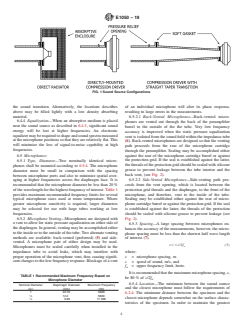
FIG. 1 Sound Source Configurations
the sound transition. Alternatively, the locations describes of an individual microphone will alter its phase response,
above may be filled lightly with a low density absorbing resulting in large errors in the measurements.
material.
6.5.2.1 Back-Vented Microphones—Back-vented micro-
6.4.4 Equalization—When an absorptive medium is placed
phones are vented out through the back of the preamplifier
near the sound source as described in 6.4.3, significant sound
barrel to the outside of the the tube. Very low frequency
energy will be lost at higher frequencies. An electronic
accuracy is improved when the static pressure equalization
equalizermayberequiredtoshapeandsoundspectrameasured
vent is isolated from the sound field within the impedance tube
at the microphone positions so that they are relatively flat.This
(6). Back-vented microphones are designed so that the venting
will minimize the loss of signal-to-noise capability at high
path proceeds from the rear of the microphone cartridge
frequencies.
through the preamplifier. Sealing may be accomplished either
against the rear of the microphone cartridge barrel or against
6.5 Microphones:
the protection grid. If the seal is established against the latter,
6.5.1 Type, Diameter—Two nominally identical micro-
the threads of the protection grid should be sealed with silicone
phones shall be mounted according to 6.5.4. The microphone
grease to prevent leakage between the tube interior and the
diameter must be small in comparison with the spacing
back vent, (see Fig. 2).
between microphone ports and also to minimize spatial aver-
aging at higher frequencies across the diaphragm face. It is 6.5.2.2 Side-Vented Microphones—Side-venting path pro-
recommended that the microphone diameter be less than 20 % ceeds from the vent opening, which is located between the
of the wavelength for the highest frequency of interest. Table 1 protection grid threads and the diaphragm, to the front of the
provides maximum recommended frequency limits for several microphone, and therefore, vent to the inside of the tube.
typical microphone sizes used at room temperature. Where Sealing may be established either against the rear of micro-
greater microphone sensitivity is required, larger diameters phone cartridge barrel or against the protection grid. If the seal
may be selected for use with large tubes working at low is established against the latter, the threads of the protection
frequencies. should be sealed with silicone grease to prevent leakage (see
6.5.2 Microphone Venting—Microphones are designed with
Fig. 2).
a vent to allow for static pressure equalization on either side of
6.5.3 Spacing—A large spacing between microphones en-
the diaphragm. In general, venting may be accomplished either
hances the accuracy of the measurements, however, the micro-
to the inside or to the outside of the tube.Two alternate venting
phone spacing must be less than the shortest half wave length
methods are available: back-vented (preferred) (5) and side-
of interest (7).
vented. A microphone pair of either design may be used.
s,,c/2f (3)
u
Microphones must be sealed carefully when installed in the
impedance tube to avoid leaks, which may interfere with where:
proper operation of the microphone vent, thus causing signifi-
s = microphone spacing, m
cantchangestothelowfrequencyresponse.Blockageofavent
c = speed of sound, m/s, and
f = upper frequency limit, hertz.
u
Itisrecommendedthatthemaximummicrophonespacing, s,
TABLE 1 Recommended Maximum Frequency Based on
be 80 % of c/2f .
u
Microphone Diameter
6.5.4 Location—The minimum between the sound source
Nominal Diameter Diaphragm Diameter Maximum Frequency
(in.) (mm) (Hz) and the closest microphone must follow the requirements of
1 22.70 3000
6.2.4. The minimum distance between the specimen and the
⁄2 12.2 5600
closest microphone depends somewhat on the surface charac-
⁄4 5.95 11 500
teristics of the specimen. In order to maintain the greatest
E1050 − 19
FIG. 2 Microphone Venting and Sealing
signal-to-noise ration, the minimum spacing between the 6.5.5.1 Alternate Mounting—In order to avoid the small
specimen and microphone can be modified as follows. recesscausedbymountingthemicrophonesaccordingto6.5.5,
6.5.4.1 Flat Surface—The closest microphone can be an alternative pinch block mounting technique may used as
moved to within one-half of the tube diameter, or one-half of
showninFig.3b.Thismethodhastheadvantageofpositioning
the largest section dimension in the case of a rectangular tube. the microphone diaphragm flush with the inside of the imped-
6.5.4.2 Nonhomogenous Surface—The closest microphone
ance tube (the protection grid will protrude slightly) and the
should be at least one tube diameter, or the largest section
pinch block provides lateral support for the microphone within
dimension in the case of rectangular tube, to help suppress the
the port. The pinch block must not interfere with venting
influence of higher-order modes induced by the rough surface
provided by the microphone preamplifier.
of the specimen.
6.5.5.2 Microphone Acoustic Centre—In order to help con-
6.5.4.3 Asymmetrical Surface—The closest microphone
trol measurement uncertainties in this test method, the lateral
should be at least two tube diameters (two times the largest
separation between the microphone axes needs to be precisely
section dimension in the case of a rectangular tube) to facilitate
known. Unfortunately, the acoustical separation between mi-
the dissipation of higher order modes generated from a rough
crophones axes may be different slightly than their physical
surface. The higher order modes will decay exponentially as
separation. This uncertainty becomes more pronounced as the
theypropagatealongthetube.Ifthespecimenisawedgeofthe
ratio between microphone diameter and separation distance
kind used in anechoic rooms, the microphones must be placed
increases.Sincethereisnoprocedureavailablefordetermining
far enough from the point of the wedge to measure the transfer
the acoustical separation, it is recommended that the physical
function in the plane wave region.
separation be controlled throughout the test series. If the
6.5.5 Mounting—It is desirable to mount both microphone
microphones are switched to reduce phase mismatch errors, as
diaphragmsflushwiththeinteriorsurfaceofthetubeusingport
discussed in Section 8, the physical separation should be
openings through the side of the tube. If the microphones are
maintained carefully with the aid of a jig, such as a rotating
switched (Section 8), care must be taken when the micro-
circular plate mounted in the sidewall of the tube. It is
phones are removed from their port so the original mounting
recommended the individual microphones be identified posi-
geometry is maintained when they are replaced. A small stop
tively to monitor their relative positions during switching (see
may be employed to control the depth of each microphone in
Fig. 4).
the port as shown in Fig. 3a. The lip should be kept small and
identical for both microphone ports. 6.6 Test Signal:
FIG. 3 Typical Microphone Mounting and Alternate Mounting
E1050 − 19
FIG. 4 Apparatus and Instrumentation
6.6.1 Signal Characteristic—It is recommended that the determine the acoustic absorption coefficient and normal spe-
test signal be random noise having a uniform spectral density cific impedance ratio from the measured transfer function data.
acrossthefrequencyrangeofinterest.Thespectrallinespacing One complete set of mathematical expressions is given in
of the test signal should be compatible with the analysis
Section 8 (7). Alternative methods of performing such calcu-
bandwidth. Alternative test signals also may be used if they lations are available (8).
have an equivalent spectral density. These alternative signals
6.7.3 Temperature Sensor—Athermometer or other ambient
include pseudo-random noise and swept or stepped sine
temperature sensing device shall be installed so the air tem-
generation.
perature is known to within 6 1°C.
NOTE 4—A signal generator capable of producing a compatible test
6.7.4 Barometric Pressure Indicator—Amercury barometer
signal often is incorporated within a two-channel digital frequency
or other equivalent indicating device shall be located in the
analysis system. When employing alternative signals, it is recommended
vicinity of the impedance tube. The atmospheric pressure shall
that each time block used in the frequency analysis be synchronized with
be measured with a tolerance 60.5 kPa.
individual repetitions of the test signal pattern.
6.7.5 Relative Humidity Indicator—A device capable of
6.6.2 Signal-to-Noise Ratio—The sound source shall gener-
determining the relative humidity of the air shall be located in
ate sufficient signal at both microphone locations such that the
the vicinity of the impedance tube. The relative humidity shall
measured signal in each test frequency band is at least 10 dB
be measured to within a tolerance of 5 %.
greater than the background noise.
6.7 Test Measuring Equipment:
7. Test Specimen
6.7.1 Measuring Apparatus—The signal processing equip-
7.1 Shape and Size—Each specimen must have the same
ment shall consist of two identical microphones, two identical
analog signal conditioners (optional) and a two-channel Fast shape and area as the tube cross section. It must fit snugly into
the specimen holder, not so tightly that is bulges in the center,
Fourier Transform (FFT) analyzer, or equivalent. The signal
from each microphone system is connected to an individual nor so loosely that there is space between its edge and the
holder. It is recommended to seal any peripheral cracks or gaps
channel of the analyzer, (see Fig. 4).
6.7.2 Computing Device—A desktop calculator or a with petroleum jelly or modelling clay. It is desirable to have
the specimen possess a relatively flat surface for reasons stated
microcomputer, either separate from or part of the digital
frequency analysis system, may be necessary in order to in 6.5.4.
E1050 − 19
7.2 Alignment—The front surface of test specimens shall be
T = room temperature,° C.
mounted normal to the tube axis unless the surface specifically
8.3.2 Air Density—The characteristic impedance of air, ρc,
is designed otherwise. When the specimen has a very uneven
may be found using the following expression for the air
back, which would introduce an unintended backing air space,
density:
for example, a specimen cut from a hollow concrete block, a
P 273.15
minimal amount or putty-like material may be placed between
ρ 5 1.290 (5)
S DS D
101.325 273.151T
the specimen and the backing plate. This material will seal and
shim the back of the specimen so it is parallel with the backing
where:
plate. Such a procedure should be used with caution as the
ρ = air density, gm/cm ,
results may be affected by the modification to the back surface
P = atmospheric pressure, kPa, and
of the test specimen.An unknown airspace between the rear of
T = room temperature,° C.
a specimen and the backing plate may be the ruling factor in
8.4 Calibration:
the result.
8.4.1 The procedure described herein provides a means of
7.3 Containment—With porous materials of low bulk
correcting the measured transfer function data for mismatch in
density, it may be helpful to define the front surface by a thin,
both the amplitude and phase responses of the two measure-
nonvibrating wire grid with wide mesh.
ment channels.
7.4 Number—A minimum of two specimens should be cut
8.4.2 Signal-to-Noise Ratio—Measure the sound pressure
from the sample and tested with the same mounting conditions.
level spectrum at each microphone with the sound source “on”
When the sample has a surface that is not uniform, for
and “off” to assure that the conditions of 6.6.2 are met. A
example, a fissured acoustical tile, additional specimens should
highly absorptive termination must be in place for this proce-
be selected in order to include representative regions of the
dure. Test data at specific frequencies where the criterion of
surface. In any case, the results should be averaged.
6.6.2 is not met, must be identified.
8.4.3 Averaging Considerations—The technique of en-
8. Procedure
sembleaveraginghastheeffectofreducinguncertaintiesdueto
8.1 Apparatus and Instrumentation—A suggested arrange-
the variance of random noise, however the ratio of signal to
ment of apparatus and instrumentation is shown in Fig. 4.
noise is unaltered. The number of averages needed is depen-
8.2 Reference Plane—Once the test specimen has been dent upon the required precision of the transfer function
estimate (see Section 9).
mounted in the impedance tube according to Section 7,
establish the reference plane so the distance, l, to the nearest 8.4.4 Windowing—FFT analysis is made on blocks of data
as a time record of finite length. This process is a truncation of
microphone may be de
...
This document is not an ASTM standard and is intended only to provide the user of an ASTM standard an indication of what changes have been made to the previous version. Because
it may not be technically possible to adequately depict all changes accurately, ASTM recommends that users consult prior editions as appropriate. In all cases only the current version
of the standard as published by ASTM is to be considered the official document.
Designation: E1050 − 12 E1050 − 19
Standard Test Method for
Impedance and Absorption of Acoustical Materials Using a
Tube, Two Microphones and a Digital Frequency Analysis
System
This standard is issued under the fixed designation E1050; the number immediately following the designation indicates the year of
original adoption or, in the case of revision, the year of last revision. A number in parentheses indicates the year of last reapproval. A
superscript epsilon (´) indicates an editorial change since the last revision or reapproval.
1. Scope
1.1 This test method covers the use of an impedance tube, two microphone locations, and a digital frequency analysis system
for the determination of normal incidence sound absorption coefficients and normal specific acoustic impedance ratios of materials.
1.2 Laboratory Accreditation—A procedure for accrediting a laboratory for performing this test method is given in Annex A1.
1.3 The values stated in SI units are to be regarded as standard. No other units of measurement are included in this standard.
1.4 This standard does not purport to address all of the safety concerns, if any, associated with its use. It is the responsibility
of the useuser of this standard to consult and establish appropriate safety safety, health, and healthenvironmental practices and
determine the applicability of regulatory limitations prior to use.
1.5 This international standard was developed in accordance with internationally recognized principles on standardization
established in the Decision on Principles for the Development of International Standards, Guides and Recommendations issued
by the World Trade Organization Technical Barriers to Trade (TBT) Committee.
2. Referenced Documents
2.1 ASTM Standards:
C384 Test Method for Impedance and Absorption of Acoustical Materials by Impedance Tube Method
C634 Terminology Relating to Building and Environmental Acoustics
E548 Guide for General Criteria Used for Evaluating Laboratory Competence (Withdrawn 2002)
2.2 ISO Standards:
ISO 10534-1 Acoustics—Determination of Sound Absorption Coefficient and Impedance or Admittance—Part 1: Impedance
Tube Method
ISO 10534–2 Acoustics—Determination of Sound Absorption Coefficient and Impedance in Impedance Tubes—Part 2:
Transfer-Function Method
2.3 ANSI Standards:
ANSI/ASA S1.11 Octave-Band and Fractional-Octave-Band Analog and Digital Filters
3. Terminology
3.1 Definitions—The acoustical terminology used in this test method is intended to be consistent with the definitions in
Terminology C634.
NOTE 1—Historical literature regarding the measurement of normal incidence absorption coefficients referred to “transfer function” measurements;
however, the term arises from Laplace transform theory and is not strictly rigorous when the initial conditions have a non-zero value. The term “frequency
response function” arises from more general Fourier transform theory (1). This test method shall retain the use of the former term although not technically
correct. Users should be aware that modern FFT analyzers may employ the latter terminology.
This test method is under the jurisdiction of ASTM Committee E33 on Building and Environmental Acoustics and is the direct responsibility of Subcommittee E33.01
on Sound Absorption.
Current edition approved April 1, 2012Oct. 1, 2019. Published July 2012November 2019. Originally approved in 1985. Last previous edition approved in 20102012 as
E1050 - 10.E1050 – 12. DOI: 10.1520/E1050-12.10.1520/E1050-19.
For referenced ASTM standards, visit the ASTM website, www.astm.org, or contact ASTM Customer Service at service@astm.org. For Annual Book of ASTM Standards
volume information, refer to the standard’s Document Summary page on the ASTM website.
The last approved version of this historical standard is referenced on www.astm.org.
Available from American National Standards Institute (ANSI), 25 W. 43rd St., 4th Floor, New York, NY 10036, http://www.ansi.org.
The boldface numbers in parentheses refer to the list of references at the end of this test method.
Copyright © ASTM International, 100 Barr Harbor Drive, PO Box C700, West Conshohocken, PA 19428-2959. United States
E1050 − 19
3.2 Symbols: The following symbols are used in Section 8 (Procedure):
3.2.1 bρc—normal specific acoustics susceptance ratio.
3.2.2 c—speed of sound, m/s.
3.2.3 gρc—normal specific acoustic conductance ratio.
3.2.4 G , G —auto power spectra of the acoustic pressure signal at microphone locations 1 and 2, respectively.
11 22
3.2.5 G —cross power spectrum of the acoustic pressure signals at microphones locations 1 and 2.
3.2.6 H—transfer function of the two microphone signals corrected for microphone response mismatch.
3.2.7 H¯—measured transfer function of the two microphone signals.
I II
3.2.8 H , H —calibration transfer functions for the microphones in the standard and switched configurations, respectively.
3.2.9 H¯ —complex microphone calibration factor.
c
=
3.2.10 j—equals 21 .
-1
3.2.11 k—equal 2πf/c; wave number, m .
3.2.11.1 Discussion—
In general the wave number is complex where k = k' - jk". k' is the real component, 2πf/c and k" is the imaginary component of
-1
the wave number, also referred to as the attenuation constant, Nepers-m .
3.2.12 l—distance from the test sample to the centre of the nearest microphone, m.
3.2.13 r/ρc—normal specific acoustic resistance ratio.
3.2.14 R—complex acoustic reflection coefficient.
3.2.15 s—centre-to-center spacing between microphones, m.
3.2.16 x/ρc—normal specific acoustic reactance ratio.
3.2.17 yρc—normal specific acoustic admittance ration.
3.2.18 z/ρc—normal specific acoustic impedance ratio.
3.2.19 a—normal incidence sound absorption coefficient.
3.2.20 φ—phase of the complex transfer function, radians.
3.2.21 φ —phase of the complex acoustic reflection coefficient, radians.
R
3.2.22 ρ—density of air, kg/m .
3.3 Subscripts, Superscripts, and Other Notation—The following symbols, which employ the variable X for illustrative
purposes, are used in Section 8:
3.3.1 X —calibration.
c
3.3.2 X —imaginary part of a complex quantity.
i
3.3.3 X —real part of a complex quantity.
r
I II
3.3.4 X , X —calibration quantities measured with microphones placed in the standard and switched configurations,
respectively.
3.3.5 X¯—measured quantity prior to correction for amplitude and phase mismatch.
3.3.6 |X|—magnitude of a complex quantity.
4. Summary of Test Method
4.1 This test method is similar to Test Method C384 in that it also uses an impedance tube with a sound source connected to
one end and the test sample mounted at the other end. The measurement techniques for the two methods are fundamentally
different, however. In this test method, plane waves are generated in the tube using a broad band signal from a noise source rather
than a discrete sinusoid from an oscillator. The decomposition of the stationary sound wave pattern into forward- and
backward-traveling components is achieved by measuring sound pressures simultaneously at two spaced locations in the tube’s
side wall. Calculations of the normal-incidence absorption coefficients for the acoustical material are performed by processing an
array of complex data from the measured transfer function.
4.2 The quantities are determined as functions of frequency with a resolution determined by the sampling rate of a digital
frequency analysis system. The usable frequency range depends on the diameter of the tube and the spacing between the
microphone positions. An extended frequency range may be obtained by using tubes with various diameters and microphones
spacings.
E1050 − 19
4.3 This test method is intended to provide a much faster measurement technique than that of Test Method C384.
5. Significance and Use
5.1 This test method can be applied to measure sound absorption coefficients of absorptive materials at normal incidence, that
is, 0°. It also can be used to determine specific impedance and admittance ratios. The properties measured with this test method
are useful in basic research and product development of sound absorptive materials.
5.2 Normal incidence sound absorption coefficients can be quite useful in certain situations where the material is placed within
a small acoustical cavity close to a sound source, for example a closely-fitted machine enclosure.
5.3 This test method allows one to compare relative values of sound absorption when it is impractical to procure large samples
for accurate random-incidence measurements in a reverberation room. Estimates of the random incidence absorption coefficients
can be obtained from normal impedance data for locally-reacting materials (2).
NOTE 2—The classification, “locally-reacting” includes fibrous materials having high internal losses. Formulas have been developed for converting
sound absorption properties from normal incidence to random incidence, for both locally-reacting and bulk-reacing materials (3).
5.4 Measurements described in this test method can be made with high precision, but these measurements may be misleading.
Uncertainties of greater magnitude than those from the measurements may occur from other sources. Care should be exercised to
sample nonuniform materials adequately (see 11.1).
6. Apparatus
6.1 The apparatus is a hallow cylinder, or tube, with a test sample holder at one end and a sound source at the other. Microphone
ports are mounted at two or more locations along the wall of the tube. A two channel digital frequency analysis system is used
for data acquisition and processing.
6.2 Tube:
6.2.1 Construction—The interior section of the tube may be circular or rectangular with a constant dimension from end-to-end.
The tube shall be straight and its inside surface shall be smooth, nonporous, and free of dust to maintain low sound attenuation.
The tube construction shall be massive so sound transmission through the tube wall is negligible.
NOTE 3—The tube can be constructed from materials including metal, plastic, cement, or wood. It may be necessary to seal the interior walls with a
smooth coating in order to maintain low sound attenuation for plane waves.
6.2.2 Working Frequency Range—The working frequency range is:
f ,f,f (1)
l u
where:
f = operating frequency, hertz,
f = lower working frequency of the tube, hertz, and
l
f = upper working frequency of the tube, hertz.
u
6.2.2.1 The lower frequency limit depends on the spacing of the microphones and the accuracy of the analysis system. It is
recommended that the microphone spacing exceed one percent of the wavelength corresponding to the lower frequency of interest.
6.2.2.2 The upper frequency limit, f , and the corresponding wavelength, λ , depends on the diameter of the tube and upon the
u u
speed of sound.
6.2.3 Diameter—In order to maintain plane wave propagation, the upper frequency limit (4) is defined as follows:
f ,K c/d or d,K c/f (2)
u u
where:
f = upper frequency limit, hertz,
u
c = speed of sound in the tube, m/s,
d = diameter of the tube, m, and
K = 0.586.
6.2.3.1 For rectangular tubes, d is defined as the largest section dimension the tube and K is defined as 0.500. Extreme aspect
rations greater than 2:1 or less than 1:2 should be avoided. A square cross-section is recommended.
6.2.3.2 It is best to conduct the plane wave measurements well within these frequency limits in order to avoid cross-modes that
occur at higher frequencies when the acoustical wave length approaches the sectional dimension of the tube.
6.2.4 Length—The tube should be sufficiently long as plane waves are fully developed before reaching the microphones and test
specimen. A minimum of three tube diameters must be allowed between sound source and the nearest microphone. The sound
source may generate nonplane waves along with desired plane waves. The nonplane waves usually will subside at a distance
equivalent to three tube diameters from the source. If measurements are conducted over a wide frequency range, it may be desirable
to use a tube which provides multiple microphone spacings or to employ separate tubes. The overall tube length also must be
chosen to satisfy the requirements of 6.4.3, 6.5.3, and 6.5.4.
E1050 − 19
6.2.5 Tube Venting—Some tube designs are such that, during during installation or removal of the test specimen, large temporary
pressure variation may be generated. This may induce microphone diaphragm deflection. The potential for damage to a microphone
diaphragm due to excessive deflection may be reduced including a pressure relief opening in the tube. This may be accomplished
by drilling a small hole, 1 to 2 mm through the wall of the tube. It is recommended to locate the tube vent near the sound source,
away from microphone locations, and to seal the vent during acoustic measurements.
6.3 Test Specimen Holder:
6.3.1 General Features—The specimen holder may either be integrated with the impedance tube or may be a separate,
detachable extension of the tube. Provision must be made for mounting the specimen with its face in a known position along the
tube axis and for placing a heavy backing plate behind the specimen. For some measurements it may be desirable to maintain an
airspace of known dimensions between the specimen and the backing plate. One such arrangement may be to simulate a suspended
ceiling tile.
6.3.2 Detachable Holder—As a detachable unit, the holder must make an airtight fit with the end of the tube opposite the sound
source. The holder must conform with the interior shape and dimensions of the main part of the impedance tube. The connecting
joint must be finished carefully and the use of a sealant, such as petroleum jelly or silicone grease, is recommended for sealing.
6.3.3 Integral Holder—If the sample holder is in an integral part of the impedance tube, it is recommended to make the
installation section of the tube accessible for mounting of the specimen by a removable cover. The mating surfaces must be finished
carefully, and the use of a sealant is recommended for sealing.
6.3.4 Circular Holder—For circular tubes, it is recommended to make the specimen accessible from both the front and back end
of the sample holder. It is possible then to check the position and flatness of the front surface and back position. Holders may be
constructed from a rigid, clear material, such as acrylic, to facilitate inspection.
FIG. 1 Sound Source Configurations
6.3.5 Rectangular Holder—With rectangular tubes, it is recommended to install the specimen from the side, making it possible
to check the fitting and the position of the specimen in the tube and to check the position and flatness of the front surface.
6.3.6 Backing Plate—The backing plate of the sample holder shall be rigid and shall be fixed tightly to the tube since it serves
to provide a sound-reflective termination in many measurements. A metal plate having a minimum thickness of 20 mm is
recommended.
6.4 Sound Source:
6.4.1 Kind and Placement—The sound sources should have a uniform power response over the frequency range of interest. It
may either be coaxial with the main tube or joined to the main tube by means of a transition having a straight, tapered, or
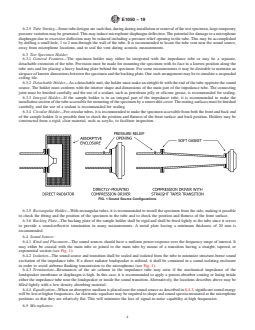
exponential section (see Fig. 1).
6.4.2 Isolation—The sound source and transition shall be sealed and isolated from the tube to minimize structure-borne sound
excitation of the impedance tube. If a direct radiator loudspeaker is utilized, it shall be contained in a sound-isolating enclosure
in order to avoid airborne flanking transmission to the microphones (see Fig. 1).
6.4.3 Termination—Resonances of the air column in the impedance tube may arise if the mechanical impedance of the
loudspeaker membrane or diaphragm is high. In this case, it is recommended to apply a porous absorber coating or lining inside
either the impedance tube near the loudspeaker or inside the sound transition. Alternatively, the locations describes above may be
filled lightly with a low density absorbing material.
6.4.4 Equalization—When an absorptive medium is placed near the sound source as described in 6.4.3, significant sound energy
will be lost at higher frequencies. An electronic equalizer may be required to shape and sound spectra measured at the microphone
positions so that they are relatively flat. This will minimize the loss of signal-to-noise capability at high frequencies.
6.5 Microphones:
E1050 − 19
6.5.1 Type, Diameter—Two nominally identical microphones shall be mounted according to 6.5.4. The microphone diameter
must be small in comparison with the spacing between microphone ports and also to minimize spatial averaging at higher
frequencies across the diaphragm face. It is recommended that the microphone diameter be less than 20 % of the wavelength for
the highest frequency of interest. Table 1 provides maximum recommended frequency limits for several typical microphone sizes
used at room temperature. Where greater microphone sensitivity is required, larger diameters may be selected for use with large
tubes working at low frequencies.
6.5.2 Microphone Venting—Microphones are designed with a vent to allow for static pressure equalization on either side of the
diaphragm. In general, venting may be accomplished either to the inside or to the outside of the tube. Two alternate venting
methods are available: back-vented (preferred) (5) and side-vented. A microphone pair of either design may be used. Microphones
must be sealed carefully when installed in the impedance tube to avoid leaks, which may interfere with proper operation of the
microphone vent, thus causing significant changes to the low frequency response. Blockage of a vent of an individual microphone
will alter its phase response, resulting in large errors in the measurements.
6.5.2.1 Back-Vented Microphones—Back-vented microphones are vented out through the back of the preamplifier barrel to the
outside of the the tube. Very low frequency accuracy is improved when the static pressure equalization vent is isolated from the
sound field within the impedance tube (6). Back-vented microphones are designed so that the venting path proceeds from the rear
of the microphone cartridge through the preamplifier. Sealing may be accomplished either against the rear of the microphone
cartridge barrel or against the protection grid. If the seal is established against the latter, the threads of the protection grid should
be sealed with silicone grease to prevent leakage between the tube interior and the back vent, (see Fig. 2).
6.5.2.2 Side-Vented Microphones—Side-venting path proceeds from the vent opening, which is located between the protection
grid threads and the diaphragm, to the front of the microphone, and therefore, vent to the inside of the tube. Sealing may be
established either against the rear of microphone cartridge barrel or against the protection grid. If the seal is established against
the latter, the threads of the protection should be sealed with silicone grease to prevent leakage (see Fig. 2).
6.5.3 Spacing—A large spacing between microphones enhances the accuracy of the measurements, however, the microphone
spacing must be less than the shortest half wave length of interest (7).
s,,c/2f (3)
u
where:
s = microphone spacing, m
c = speed of sound, m/s, and
f = upper frequency limit, hertz.
u
It is recommended that the maximum microphone spacing, s, be 80 % of c/2f .
u
6.5.4 Location—The minimum between the sound source and the closest microphone must follow the requirements of 6.2.4. The
minimum distance between the specimen and the closest microphone depends somewhat on the surface characteristics of the
specimen. In order to maintain the greatest signal-to-noise ration, the minimum spacing between the specimen and microphone can
be modified as follows.
6.5.4.1 Flat Surface—The closest microphone can be moved to within one-half of the tube diameter, or one-half of the largest
section dimension in the case of a rectangular tube.
6.5.4.2 Nonhomogenous Surface—The closest microphone should be at least one tube diameter, or the largest section dimension
in the case of rectangular tube, to help suppress the influence of higher-order modes induced by the rough surface of the specimen.
6.5.4.3 Asymmetrical Surface—The closest microphone should be at least two tube diameters (two times the largest section
dimension in the case of a rectangular tube) to facilitate the dissipation of higher order modes generated from a rough surface. The
higher order modes will decay exponentially as they propagate along the tube. If the specimen is a wedge of the kind used in
anechoic rooms, the microphones must be placed far enough from the point of the wedge to measure the transfer function in the
plane wave region.
6.5.5 Mounting—It is desirable to mount both microphone diaphragms flush with the interior surface of the tube using port
openings through the side of the tube. If the microphones are switched (Section 8), care must be taken when the microphones are
removed from their port so the original mounting geometry is maintained when they are replaced. A small stop may be employed
to control the depth of each microphone in the port as shown in Fig. 3a. The lip should be kept small and identical for both
microphone ports.
TABLE 1 Recommended Maximum Frequency Based on
Microphone Diameter
Nominal Diameter Diaphragm Diameter Maximum Frequency
(in.) (mm) (Hz)
1 22.70 3000
⁄2 12.2 5600
⁄4 5.95 11 500
E1050 − 19
FIG. 2 Microphone Venting and Sealing
FIG. 3 Typical Microphone Mounting and Alternate Mounting
6.5.5.1 Alternate Mounting—In order to avoid the small recess caused by mounting the microphones according to 6.5.5, an
alternative pinch block mounting technique may used as shown in Fig. 3b. This method has the advantage of positioning the
microphone diaphragm flush with the inside of the impedance tube (the protection grid will protrude slightly) and the pinch block
provides lateral support for the microphone within the port. The pinch block must not interfere with venting provided by the
microphone preamplifier.
6.5.5.2 Microphone Acoustic Centre—In order to help control measurement uncertainties in this test method, the lateral
separation between the microphone axes needs to be precisely known. Unfortunately, the acoustical separation between
microphones axes may be different slightly than their physical separation. This uncertainty becomes more pronounced as the ratio
between microphone diameter and separation distance increases. Since there is no procedure available for determining the
acoustical separation, it is recommended that the physical separation be controlled throughout the test series. If the microphones
are switched to reduce phase mismatch errors, as discussed in Section 8, the physical separation should be maintained carefully
with the aid of a jig, such as a rotating circular plate mounted in the sidewall of the tube. It is recommended the individual
microphones be identified positively to monitor their relative positions during switching (see Fig. 4).
6.6 Test Signal:
6.6.1 Signal Characteristic—It is recommended that the test signal be random noise having a uniform spectral density across
the frequency range of interest. The spectral line spacing of the test signal should be compatible with the analysis bandwidth.
Alternative test signals also may be used if they have an equivalent spectral density. These alternative signals include
pseudo-random noise and swept or stepped sine generation.
NOTE 4—A signal generator capable of producing a compatible test signal often is incorporated within a two-channel digital frequency analysis system.
When employing alternative signals, it is recommended that each time block used in the frequency analysis be synchronized with individual repetitions
of the test signal pattern.
6.6.2 Signal-to-Noise Ratio—The sound source shall generate sufficient signal at both microphone locations such that the
measured signal in each test frequency band is at least 10 dB greater than the background noise.
6.7 Test Measuring Equipment:
6.7.1 Measuring Apparatus—The signal processing equipment shall consist of two identical microphones, two identical analog
signal conditioners (optional) and a two-channel Fast Fourier Transform (FFT) analyzer, or equivalent. The signal from each
microphone system is connected to an individual channel of the analyzer, (see Fig. 4).
E1050 − 19
FIG. 4 Apparatus and Instrumentation
6.7.2 Computing Device—A desktop calculator or a microcomputer, either separate from or part of the digital frequency analysis
system, may be necessary in order to determine the acoustic absorption coefficient and normal specific impedance ratio from the
measured transfer function data. One complete set of mathematical expressions is given in Section 8 (7). Alternative methods of
performing such calculations are available (8).
6.7.3 Temperature Sensor—A thermometer or other ambient temperature sensing device shall be installed so the air temperature
is known to within 6 1°C.
6.7.4 Barometric Pressure Indicator—A mercury barometer or other equivalent indicating device shall be located in the vicinity
of the impedance tube. The atmospheric pressure shall be measured with a tolerance 60.5 kPa.
6.7.5 Relative Humidity Indicator—A device capable of determining the relative humidity of the air shall be located in the
vicinity of the impedance tube. The relative humidity shall be measured to within a tolerance of 5 %.
7. Test Specimen
7.1 Shape and Size—Each specimen must have the same shape and area as the tube cross section. It must fit snugly into the
specimen holder, not so tightly that is bulges in the center, nor so loosely that there is space between its edge and the holder. It
is recommended to seal any peripheral cracks or gaps with petroleum jelly or modelling clay. It is desirable to have the specimen
possess a relatively flat surface for reasons stated in 6.5.4.
7.2 Alignment—The front surface of test specimens shall be mounted normal to the tube axis unless the surface specifically is
designed otherwise. When the specimen has a very uneven back, which would introduce an unintended backing air space, for
example, a specimen cut from a hollow concrete block, a minimal amount or putty-like material may be placed between the
specimen and the backing plate. This material will seal and shim the back of the specimen so it is parallel with the backing plate.
Such a procedure should be used with caution as the results may be affected by the modification to the back surface of the test
specimen. An unknown airspace between the rear of a specimen and the backing plate may be the ruling factor in the result.
7.3 Containment—With porous materials of low bulk density, it may be helpful to define the front surface by a thin, nonvibrating
wire grid with wide mesh.
7.4 Number—A minimum of two specimens should be cut from the sample and tested with the same mounting conditions. When
the sample has a surface that is not uniform, for example, a fissured acoustical tile, additional specimens should be selected in order
to include representative regions of the surface. In any case, the results should be averaged.
E1050 − 19
8. Procedure
8.1 Apparatus and Instrumentation—A suggested arrangement of apparatus and instrumentation is shown in Fig. 4.
8.2 Reference Plane—Once the test specimen has been mounted in the impedance tube according to Section 7, establish the
reference plane so the distance, l, to the nearest microphone may be determined. Typically the reference plane is the frontal surface
of a flat test specimen. If the test specimen possesses a nonhomogenous or asymmetrical surface, the reference plane may be
difficult to establish. In this case, choose one or more planes suited to the intended application including a plane corresponding
to the extreme frontal edge of the material.
8.2.1 The exact location of the reference plane has no effect upon the calculated values of normal incidence sound absorption
coefficients since they are only a function of the magnitude of the reflection coefficient (see Eq 23*); however, the location does
affect the calculation of impedance and admittance ratios.
NOTE 5—The definition of the distance l as used in this test method is not the same as defined in Reference (7) where l is defined as the distance between
the reference plane and the microphone farthest away.
8.3 Calculations—Measurement of the transfer function between the two microphone signals along with the microphone
spacing, the distance from the reference plane to the nearest microphone, and the air temperature are required for the evaluation
of the normal incidence acoustical properties of the specimen.
8.3.1 Speed of Sound—The speed of sound in air changes with temperature. The value of the speed of sound shall be computed
from the measured temperature according to:
c 5 20.047 =273.151T (4)
where:
c = speed of sound, m/s, and
T = room temperature,° C.
8.3.2 Air Density—The characteristic impedance of air, ρc, may be found using the following expression for the air density:
P 27
...