

ASTM E2616-09(2020)
(Guide)Standard Guide for Remedy Selection Integrating Risk-Based Corrective Action and Non-Risk Considerations
General Information
- Abstract
SIGNIFICANCE AND USE
4.1 This guide is intended for use within a RBCA process or other risk-based framework for protection of human health and the environment that is based on an evaluation of sources, exposure pathways, and receptors.
4.2 This guide is intended to identify the factors that should be considered in the selection and implementation of an appropriate remedial action to address COCs present in environmental media at the site at concentrations above the remedial action levels. The specific process used to select the remedial action will vary widely from site to site. However, in all cases, the selected remedial action should be both a protective remedial action (that is, achieves the risk-based remedial action objectives) and an acceptable remedial action (that is, satisfies the non-risk remedial action objectives).
SCOPE
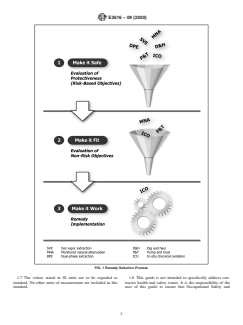
1.1 This guide covers the selection of appropriate remedial actions at sites where a release of chemicals (for example, vapor-phase, dissolved-phase, or non-aqueous phase liquids (NAPL)) into the environment has occurred. This overall remedy selection process is illustrated in Fig. 1. The guide is intended to be applied within a risk-based corrective action (RBCA) framework.
FIG. 1 Remedy Selection Process
1.2 The purpose of this guide is to facilitate the selection of acceptable remedial actions and to minimize bad decisions leading to the selection of remedial actions that do not satisfy both the risk-based remedial action objectives and the non-risk remedial action objectives.
1.3 This guide is intended to be applied at sites that require a remedial action to address unacceptable human heath or ecological risks, other regulatory requirements, and/or other unacceptable site conditions. Prior to use of this guide, a site assessment should be completed resulting in: (1) the establishment of remedial action objectives, (2) a determination that a remedial action is required to achieve the remedial action objectives, (3) an identification of site areas requiring a remedial action, and (4) a conceptual site model that reflects the results of the site assessment. The risk-based remedial action objectives are assumed to have been established using RBCA or another risk-based assessment method that results in the identification of appropriate remedial action objectives based on an evaluation of sources, exposure pathways, and potential receptors. Remedial action objectives may be established using Guide E1739, Guide E2081, and/or Guide E2205. In addition, applicable federal, state, and local regulations, statutes, and policies should be followed and should form the basis for determining risk-based and non-risk remedial action objectives. The remedial action objectives may include resource protection standards and the prevention of aesthetic or nuisance impacts in addition to protection of human health and the environment.
1.4 Each risk-based remedial action objective for an exposure pathway will typically include numeric remedial action levels for each chemical of concern (COC). Remedial action levels may also be developed for non-risk remedial action objectives such as resource protection standards. The non-risk remedial action levels may include thickness or mobility criteria for NAPL. The selected remedy must be effective and timely for each remedial action objective based on the consideration of the associated exposure pathway or resource protection standard.
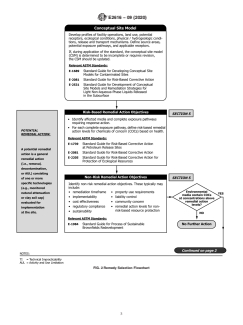
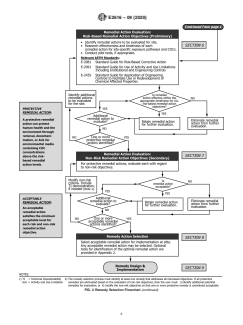
1.5 To facilitate the selection of acceptable remedial actions, this guide establishes a process for remedy selection (Fig. 2) that involves:
FIG. 2 Remedy Selection Flowchart
FIG. 2 Remedy Selection Flowchart (continued)
1.5.1 Development of risk-based remedial action objectives that includes identification of complete exposure pathways and numeric remedial action levels (Section 5).
1.5.2 Development of non-risk remedial action objectives based on resource protection and other non-risk considerations...
- Status
- Published
- Publication Date
- 31-Oct-2020
- Technical Committee
- E50 - Environmental Assessment, Risk Management and Corrective Action
- Drafting Committee
- E50.04 - Corrective Action
Overview
ASTM E2616-09(2020), Standard Guide for Remedy Selection Integrating Risk-Based Corrective Action and Non-Risk Considerations, is a critical ASTM standard that supports the assessment and remediation of sites impacted by chemical releases. This guide is designed for use within risk-based corrective action (RBCA) frameworks to protect human health and the environment by integrating risk-based and non-risk factors into the remedy selection process. Its holistic approach ensures the identification and implementation of remedial actions that not only meet risk-based requirements but also address broader regulatory, stakeholder, and resource protection goals.
Key Topics
- Risk-Based Corrective Action (RBCA): Applying a structured process that evaluates contamination sources, exposure pathways, and receptors to establish remedial objectives based on human health and ecological risk.
- Remedial Action Objectives: Distinction and integration of risk-based objectives (protection of health and environment, based on COC concentrations and exposure) with non-risk objectives (regulatory compliance, resource protection, community concerns, implementability, cost).
- Remedy Selection Process: Stepwise approach involving:
- Site assessment and development of a conceptual site model
- Determination of both risk-based and non-risk remedial action objectives
- Identification and screening of potential remedial action technologies (removal, decontamination, activity and use limitations)
- Evaluation, selection, and documentation of remedial actions considering effectiveness, timeliness, and stakeholder acceptance
- Remedy Implementation: Focus on monitoring, verifying remedy completion, and ongoing post-response care, particularly where institutional or engineering controls are used.
Applications
ASTM E2616-09(2020) is applicable in a wide range of environmental and regulatory contexts, including:
- Environmental Site Remediation: Guiding the cleanup of sites contaminated by chemicals in vapor, dissolved, or non-aqueous phase forms, such as industrial properties, brownfields, and former manufacturing locations.
- Regulatory Compliance: Used by consultants, site owners, and regulators to ensure remediation aligns with federal, state, and local environmental requirements.
- Risk Assessment Programs: Supports frameworks where risk-based decision making is required, facilitating the establishment of clear action objectives for diverse exposure pathways and receptor types.
- Resource and Community Protection: Ensures remedy selection factors in site reuse plans, aesthetic and nuisance issues, sustainable practices, and community stakeholder engagement.
- Documentation and Transparency: Provides a basis for detailed remedy selection documentation to support oversight, public communication, and legal defensibility.
Related Standards
ASTM E2616-09(2020) references several important ASTM standards and guidance documents that complement and strengthen the remedy selection process, including:
- ASTM E1739: Guide for Risk-Based Corrective Action Applied at Petroleum Release Sites
- ASTM E2081: Guide for Risk-Based Corrective Action
- ASTM E2205: Guide for Risk-Based Corrective Action for Protection of Ecological Resources
- ASTM E1689: Guide for Developing Conceptual Site Models for Contaminated Sites
- ASTM D6235: Practice for Expedited Site Characterization of Vadose Zone and Groundwater Contamination
- ASTM E2091: Guide for Use of Activity and Use Limitations, Including Institutional and Engineering Controls
- Other References: Guides supporting engineering controls, site assessments, and remediation strategies for specific types of contamination.
Practical Value
By integrating risk-based and non-risk considerations in remedy selection, ASTM E2616-09(2020) facilitates informed, transparent, and effective remediation decisions. It helps avoid ineffective or non-compliant remedial actions, improves confidence in remedy outcomes, and enhances stakeholder satisfaction and environmental stewardship. This standard is an essential tool for environmental professionals, regulators, and stakeholders seeking robust, science-based approaches to site remediation and corrective action planning.
Relations
- Effective Date
- 15-Dec-2018
- Effective Date
- 01-Nov-2017
- Effective Date
- 01-Apr-2015
- Effective Date
- 01-Apr-2015
- Effective Date
- 01-May-2011
- Effective Date
- 01-Sep-2010
- Effective Date
- 01-Sep-2010
- Effective Date
- 01-Sep-2010
- Effective Date
- 01-May-2010
- Refers
ASTM E1689-95(2008) - Standard Guide for Developing Conceptual Site Models for Contaminated Sites - Effective Date
- 01-Feb-2008
- Effective Date
- 01-Oct-2006
- Effective Date
- 01-May-2005
- Effective Date
- 01-Oct-2004
- Effective Date
- 01-May-2004
- Effective Date
- 01-May-2004
Get Certified
Connect with accredited certification bodies for this standard

BSI Group
BSI (British Standards Institution) is the business standards company that helps organizations make excellence a habit.

Bureau Veritas
Bureau Veritas is a world leader in laboratory testing, inspection and certification services.

DNV
DNV is an independent assurance and risk management provider.
Sponsored listings
Frequently Asked Questions
ASTM E2616-09(2020) is a guide published by ASTM International. Its full title is "Standard Guide for Remedy Selection Integrating Risk-Based Corrective Action and Non-Risk Considerations". This standard covers: SIGNIFICANCE AND USE 4.1 This guide is intended for use within a RBCA process or other risk-based framework for protection of human health and the environment that is based on an evaluation of sources, exposure pathways, and receptors. 4.2 This guide is intended to identify the factors that should be considered in the selection and implementation of an appropriate remedial action to address COCs present in environmental media at the site at concentrations above the remedial action levels. The specific process used to select the remedial action will vary widely from site to site. However, in all cases, the selected remedial action should be both a protective remedial action (that is, achieves the risk-based remedial action objectives) and an acceptable remedial action (that is, satisfies the non-risk remedial action objectives). SCOPE 1.1 This guide covers the selection of appropriate remedial actions at sites where a release of chemicals (for example, vapor-phase, dissolved-phase, or non-aqueous phase liquids (NAPL)) into the environment has occurred. This overall remedy selection process is illustrated in Fig. 1. The guide is intended to be applied within a risk-based corrective action (RBCA) framework. FIG. 1 Remedy Selection Process 1.2 The purpose of this guide is to facilitate the selection of acceptable remedial actions and to minimize bad decisions leading to the selection of remedial actions that do not satisfy both the risk-based remedial action objectives and the non-risk remedial action objectives. 1.3 This guide is intended to be applied at sites that require a remedial action to address unacceptable human heath or ecological risks, other regulatory requirements, and/or other unacceptable site conditions. Prior to use of this guide, a site assessment should be completed resulting in: (1) the establishment of remedial action objectives, (2) a determination that a remedial action is required to achieve the remedial action objectives, (3) an identification of site areas requiring a remedial action, and (4) a conceptual site model that reflects the results of the site assessment. The risk-based remedial action objectives are assumed to have been established using RBCA or another risk-based assessment method that results in the identification of appropriate remedial action objectives based on an evaluation of sources, exposure pathways, and potential receptors. Remedial action objectives may be established using Guide E1739, Guide E2081, and/or Guide E2205. In addition, applicable federal, state, and local regulations, statutes, and policies should be followed and should form the basis for determining risk-based and non-risk remedial action objectives. The remedial action objectives may include resource protection standards and the prevention of aesthetic or nuisance impacts in addition to protection of human health and the environment. 1.4 Each risk-based remedial action objective for an exposure pathway will typically include numeric remedial action levels for each chemical of concern (COC). Remedial action levels may also be developed for non-risk remedial action objectives such as resource protection standards. The non-risk remedial action levels may include thickness or mobility criteria for NAPL. The selected remedy must be effective and timely for each remedial action objective based on the consideration of the associated exposure pathway or resource protection standard. 1.5 To facilitate the selection of acceptable remedial actions, this guide establishes a process for remedy selection (Fig. 2) that involves: FIG. 2 Remedy Selection Flowchart FIG. 2 Remedy Selection Flowchart (continued) 1.5.1 Development of risk-based remedial action objectives that includes identification of complete exposure pathways and numeric remedial action levels (Section 5). 1.5.2 Development of non-risk remedial action objectives based on resource protection and other non-risk considerations...
SIGNIFICANCE AND USE 4.1 This guide is intended for use within a RBCA process or other risk-based framework for protection of human health and the environment that is based on an evaluation of sources, exposure pathways, and receptors. 4.2 This guide is intended to identify the factors that should be considered in the selection and implementation of an appropriate remedial action to address COCs present in environmental media at the site at concentrations above the remedial action levels. The specific process used to select the remedial action will vary widely from site to site. However, in all cases, the selected remedial action should be both a protective remedial action (that is, achieves the risk-based remedial action objectives) and an acceptable remedial action (that is, satisfies the non-risk remedial action objectives). SCOPE 1.1 This guide covers the selection of appropriate remedial actions at sites where a release of chemicals (for example, vapor-phase, dissolved-phase, or non-aqueous phase liquids (NAPL)) into the environment has occurred. This overall remedy selection process is illustrated in Fig. 1. The guide is intended to be applied within a risk-based corrective action (RBCA) framework. FIG. 1 Remedy Selection Process 1.2 The purpose of this guide is to facilitate the selection of acceptable remedial actions and to minimize bad decisions leading to the selection of remedial actions that do not satisfy both the risk-based remedial action objectives and the non-risk remedial action objectives. 1.3 This guide is intended to be applied at sites that require a remedial action to address unacceptable human heath or ecological risks, other regulatory requirements, and/or other unacceptable site conditions. Prior to use of this guide, a site assessment should be completed resulting in: (1) the establishment of remedial action objectives, (2) a determination that a remedial action is required to achieve the remedial action objectives, (3) an identification of site areas requiring a remedial action, and (4) a conceptual site model that reflects the results of the site assessment. The risk-based remedial action objectives are assumed to have been established using RBCA or another risk-based assessment method that results in the identification of appropriate remedial action objectives based on an evaluation of sources, exposure pathways, and potential receptors. Remedial action objectives may be established using Guide E1739, Guide E2081, and/or Guide E2205. In addition, applicable federal, state, and local regulations, statutes, and policies should be followed and should form the basis for determining risk-based and non-risk remedial action objectives. The remedial action objectives may include resource protection standards and the prevention of aesthetic or nuisance impacts in addition to protection of human health and the environment. 1.4 Each risk-based remedial action objective for an exposure pathway will typically include numeric remedial action levels for each chemical of concern (COC). Remedial action levels may also be developed for non-risk remedial action objectives such as resource protection standards. The non-risk remedial action levels may include thickness or mobility criteria for NAPL. The selected remedy must be effective and timely for each remedial action objective based on the consideration of the associated exposure pathway or resource protection standard. 1.5 To facilitate the selection of acceptable remedial actions, this guide establishes a process for remedy selection (Fig. 2) that involves: FIG. 2 Remedy Selection Flowchart FIG. 2 Remedy Selection Flowchart (continued) 1.5.1 Development of risk-based remedial action objectives that includes identification of complete exposure pathways and numeric remedial action levels (Section 5). 1.5.2 Development of non-risk remedial action objectives based on resource protection and other non-risk considerations...
ASTM E2616-09(2020) is classified under the following ICS (International Classification for Standards) categories: 13.020.30 - Environmental impact assessment; 13.020.40 - Pollution, pollution control and conservation. The ICS classification helps identify the subject area and facilitates finding related standards.
ASTM E2616-09(2020) has the following relationships with other standards: It is inter standard links to ASTM D6235-18, ASTM E2091-17, ASTM E1943-98(2015), ASTM E1739-95(2015), ASTM E2091-11, ASTM E1739-95(2010)e1, ASTM E2081-00(2010)e1, ASTM E1943-98(2010), ASTM D6235-04(2010), ASTM E1689-95(2008), ASTM D7294-06, ASTM E2091-05, ASTM E2081-00(2004)e1, ASTM E1912-98(2004), ASTM E1943-98(2004). Understanding these relationships helps ensure you are using the most current and applicable version of the standard.
ASTM E2616-09(2020) is available in PDF format for immediate download after purchase. The document can be added to your cart and obtained through the secure checkout process. Digital delivery ensures instant access to the complete standard document.
Standards Content (Sample)
This international standard was developed in accordance with internationally recognized principles on standardization established in the Decision on Principles for the
Development of International Standards, Guides and Recommendations issued by the World Trade Organization Technical Barriers to Trade (TBT) Committee.
Designation: E2616 − 09 (Reapproved 2020)
Standard Guide for
Remedy Selection Integrating Risk-Based Corrective Action
and Non-Risk Considerations
This standard is issued under the fixed designation E2616; the number immediately following the designation indicates the year of
original adoption or, in the case of revision, the year of last revision.Anumber in parentheses indicates the year of last reapproval.A
superscript epsilon (´) indicates an editorial change since the last revision or reapproval.
1. Scope 1.4 Each risk-based remedial action objective for an expo-
sure pathway will typically include numeric remedial action
1.1 This guide covers the selection of appropriate remedial
levels for each chemical of concern (COC). Remedial action
actions at sites where a release of chemicals (for example,
levels may also be developed for non-risk remedial action
vapor-phase, dissolved-phase, or non-aqueous phase liquids
objectives such as resource protection standards. The non-risk
(NAPL)) into the environment has occurred. This overall
remedial action levels may include thickness or mobility
remedy selection process is illustrated in Fig. 1. The guide is
criteria for NAPL. The selected remedy must be effective and
intended to be applied within a risk-based corrective action
timely for each remedial action objective based on the consid-
(RBCA) framework.
eration of the associated exposure pathway or resource protec-
1.2 The purpose of this guide is to facilitate the selection of
tion standard.
acceptable remedial actions and to minimize bad decisions
1.5 Tofacilitatetheselectionofacceptableremedialactions,
leading to the selection of remedial actions that do not satisfy
this guide establishes a process for remedy selection (Fig. 2)
both the risk-based remedial action objectives and the non-risk
that involves:
remedial action objectives.
1.5.1 Development of risk-based remedial action objectives
1.3 This guide is intended to be applied at sites that require
thatincludesidentificationofcompleteexposurepathwaysand
a remedial action to address unacceptable human heath or
numeric remedial action levels (Section 5).
ecological risks, other regulatory requirements, and/or other
1.5.2 Development of non-risk remedial action objectives
unacceptable site conditions. Prior to use of this guide, a site
basedonresourceprotectionandothernon-riskconsiderations.
assessment should be completed resulting in: (1) the establish-
Resource protection objectives typically include numeric re-
ment of remedial action objectives, (2) a determination that a
medial action levels while other non-risk criteria are typically
remedial action is required to achieve the remedial action
non-numeric and may include: remediation timeframe,
objectives, (3) an identification of site areas requiring a
implementability, cost effectiveness, regulatory compliance,
remedial action, and (4) a conceptual site model that reflects
property use requirements, liability control, and community
the results of the site assessment. The risk-based remedial
concern (Section 5).
action objectives are assumed to have been established using
1.5.3 Evaluation of protectiveness to identify protective
RBCAor another risk-based assessment method that results in
remedial actions that will be effective and timely for each
the identification of appropriate remedial action objectives
risk-based remedial action objective for the site (Section 6).
based on an evaluation of sources, exposure pathways, and
potential receptors. Remedial action objectives may be estab-
1.5.4 Evaluation of the retained remedies using the non-risk
lished using Guide E1739, Guide E2081, and/or Guide E2205.
remedial action objectives to identify acceptable remedial
In addition, applicable federal, state, and local regulations,
actions that satisfy the minimum level for each non-risk
statutes, and policies should be followed and should form the
criterion (Section 7).
basis for determining risk-based and non-risk remedial action
1.5.5 Remedial action selection to select the acceptable
objectives. The remedial action objectives may include re-
remedial action to be implemented at the site (Section 8).
source protection standards and the prevention of aesthetic or
1.5.6 Remedy design and implementation to ensure that the
nuisanceimpactsinadditiontoprotectionofhumanhealthand
selected remedy is effectively implemented at the site and
the environment.
satisfies the remedial action objectives (Section 9).
1.6 This guide is intended for use in the selection of final
ThisguideisunderthejurisdictionofASTMCommitteeE50onEnvironmental
Assessment, Risk Management and CorrectiveAction and is the direct responsibil-
remedial actions. This guide may also be used in the selection
ity of Subcommittee E50.04 on Corrective Action.
of interim measures provided that risk-based remedial action
Current edition approved Nov. 1, 2020. Published November 2020. Originally
objectivesandnon-riskremedialactionobjectivesareavailable
approvedin2009.Lastpreviouseditionapprovedin2014asE2616–09(2014).DOI:
10.1520/E2616-09R20. for the evaluation of these interim measures.
Copyright © ASTM International, 100 Barr Harbor Drive, PO Box C700, West Conshohocken, PA 19428-2959. United States
E2616 − 09 (2020)
FIG. 1 Remedy Selection Process
1.7 The values stated in SI units are to be regarded as 1.8 This guide is not intended to specifically address con-
standard. No other units of measurement are included in this tractor health and safety issues. It is the responsibility of the
standard. user of this guide to ensure that Occupational Safety and
E2616 − 09 (2020)
FIG. 2 Remedy Selection Flowchart
E2616 − 09 (2020)
FIG. 2 Remedy Selection Flowchart (continued)
E2616 − 09 (2020)
Health Administration (OSHA) regulatory requirements are 3.1.2 site assessment—The characterization of a site to
met, and appropriate industry practices are consulted for determinewhetherareleasehasoccurred,theconcentrationsof
guidance.
the COCs in environmental media, and the distribution of the
COCs. The site assessment collects data on soil, groundwater,
1.9 This standard does not purport to address all of the
air,andsurfacewaterquality;sitecharacteristics(forexample,
safety concerns, if any, associated with its use. It is the
subsurface geology, geochemistry, soil properties and
responsibility of the user of this standard to establish appro-
priate safety, health, and environmental practices and deter- structures, hydrology and surface characteristics), land and
resource use, and potential receptors, and generates informa-
mine the applicability of regulatory limitations prior to use.
1.10 This international standard was developed in accor- tion to develop a conceptual site model to support risk-based
dance with internationally recognized principles on standard- decision making.The results of the site assessment are used to
ization established in the Decision on Principles for the
(1) establish remedial action objectives, (2) determine whether
Development of International Standards, Guides and Recom-
a remedial action is required to achieve the remedial action
mendations issued by the World Trade Organization Technical
objectives, (3) identify site areas requiring a remedial action,
Barriers to Trade (TBT) Committee.
and (4)developaconceptualsitemodelthatreflectstheresults
of the site assessment. The site assessment may be conducted
2. Referenced Documents
using Practice D6235 or Guide E1912.
2.1 ASTM Standards:
3.1.3 complete exposure pathway—The route a COC takes
D6235Practice for Expedited Site Characterization of Va-
from the source area(s) to a human or ecological receptor. A
dose Zone and Groundwater Contamination at Hazardous
complete exposure pathway describes a mechanism by which
Waste Contaminated Sites
an individual or population is or could be exposed to COCs
D7294Guide for CollectingTreatment Process Design Data
originating from the site. Each exposure pathway is associated
at a Contaminated Site—A Site Contaminated With
withasource,apointofexposure,andanexposureroute.Ifthe
Chemicals of Interest
exposure point is not at the source, a transport/exposure
E1689Guide for Developing Conceptual Site Models for
mechanism is included.
Contaminated Sites
E1739Guide for Risk-Based Corrective Action Applied at
3.1.4 conceptual site model—The integrated representation
Petroleum Release Sites
of the physical and environmental context, the complete and
E1912Guide forAccelerated Site Characterization for Con-
potentially complete exposure pathways and the potential fate
firmed or Suspected Petroleum Releases (Withdrawn
and transport of chemicals(s) of concern at a site. The site
2013)
conceptual model should include both the current understand-
E1943Guide for Remediation of Ground Water by Natural
ing of the site and the understanding of the potential future
Attenuation at Petroleum Release Sites
conditions and uses for the site. It provides a method to
E2081Guide for Risk-Based Corrective Action
conduct the exposure pathway evaluation, inventory the expo-
E2091Guide for Use of Activity and Use Limitations,
sure pathways evaluated, and determine the status of the
Including Institutional and Engineering Controls
exposure pathways as incomplete, potentially complete, or
E2205Guide for Risk-Based Corrective Action for Protec-
complete.
tion of Ecological Resources
E2435Guide for Application of Engineering Controls to
3.1.5 risk-based remedial action objectives—Aset of objec-
Facilitate Use or Redevelopment of Chemical-Affected
tivesbasedonprotectionofhumanhealthandtheenvironment
Properties
developed for the site that identifies the COCs, affected
E2531Guide for Development of Conceptual Site Models
environmental media, complete exposure pathways, and risk-
and Remediation Strategies for Light Nonaqueous-Phase
based remedial action levels.
Liquids Released to the Subsurface
3.1.6 non-risk remedial action objectives—A set of objec-
3. Terminology tives based on non-risk considerations for current and future
site management. These objectives may include action levels
3.1 Conceptual Model Terms:
based on aesthetic criteria or other resource protection stan-
3.1.1 site—The area(s) defined by the likely physical distri-
dards with non-risk remedial action levels. In addition, these
bution of the COCs from a source area. A site could be an
objectives not directly based on COC concentrations such as:
entirepropertyorfacility,adefinedareaorportionofafacility
remediation timeframe, implementability, cost effectiveness,
or property, or multiple facilities or properties. One facility
regulatory compliance, property use requirements, liability
maycontainmultiplesites.Multiplesitesatonefacilitymaybe
control, and community concern.
addressed individually or as a group.
3.1.7 remedial action levels—Concentrations of COCs in
the source media and/or receptor media below which remedial
For referenced ASTM standards, visit the ASTM website, www.astm.org, or
contact ASTM Customer Service at service@astm.org. For Annual Book of ASTM
actions are not required in order to satisfy the remedial action
Standards volume information, refer to the standard’s Document Summary page on
objectives. Non-risk remedial action levels may include re-
the ASTM website.
3 source protection standards not linked to a complete exposure
The last approved version of this historical standard is referenced on
www.astm.org. pathway (that is, the application of drinking water standards to
E2616 − 09 (2020)
water resources not currently used for drinking water). Non- 3.4.9 IC—institutional control
risk remedial action levels may also include thickness or
3.4.10 ITRC—Interstate Technology & Regulatory Council
mobility criteria for NAPL.
3.4.11 NAPL—non-aqueous phase liquids
3.2 Types of Remedial Action Technologies:
3.4.12 NAVFAC—Naval Facilities Engineering Command
3.2.1 removal—A remedial action technology to take envi-
3.4.13 OSHA—OccupationalHealthandSafetyAdministra-
ronmental media away from the site to another location for
tion
storage, processing, or disposal in accordance with all appli-
3.4.14 RBCA—risk-based corrective action
cable requirements.
3.2.2 decontamination—A remedial action technology
4. Significance and Use
based on permanent and irreversible treatment processes to an
4.1 ThisguideisintendedforusewithinaRBCAprocessor
environmental medium so that the threat of release of COCs at
otherrisk-basedframeworkforprotectionofhumanhealthand
concentrations above the remedial action levels is eliminated.
the environment that is based on an evaluation of sources,
3.2.3 activity and use limitation (AUL)—A remedial action
exposure pathways, and receptors.
technology that relies on institutional controls (ICs) or engi-
4.2 This guide is intended to identify the factors that should
neeringcontrols(ECs)(collectively,ICsandECsareknownas
be considered in the selection and implementation of an
“activity and use limitations”) to prevent exposure to COCs
appropriate remedial action to address COCs present in envi-
present in environmental media at concentrations above the
ronmental media at the site at concentrations above the
remedial action levels. An AUL technology can be used to
remedial action levels. The specific process used to select the
eliminateacompleteorpotentiallycompleteexposurepathway
remedial action will vary widely from site to site. However, in
by eliminating the receptor or by preventing transport of the
all cases, the selected remedial action should be both a
COCs to the receptor. AUL measures must be combined with
protective remedial action (that is, achieves the risk-based
appropriate maintenance, monitoring, and any necessary fur-
remedial action objectives) and an acceptable remedial action
ther remedial action to satisfy the remedial action objectives
(that is, satisfies the non-risk remedial action objectives).
and be protective of human health and the environment.
5. Remedial Action Objectives
3.3 Remedy Selection:
3.3.1 remedial action—One or more technologies imple-
5.1 Conceptual Model—Aconceptualmodelisanimportant
mented at a site to address environmental media containing
tool that is utilized in the risk-based remedy selection process.
COCs at concentrations exceeding the remedial action levels
The conceptual model provides a systematic method for use of
defined for the site. A remedial action for a site may involve
site information based on current and potential future site-
removal, decontamination, and/orAULtechnologies including
specific land use considerations. The conceptual model should
monitoring.
identify source areas; complete, potentially complete, and
incomplete exposure pathways; and human and ecological
3.3.2 potential remedial action—Apotentialremedialaction
receptors. In addition, the conceptual model should identify
is any remedial action evaluated for implementation at the site
type and concentration of COCs, affected environmental
as part of the risk-based remedy selection process.
media, and specific areas within the affected environmental
3.3.3 protective remedial action—Aprotective remedial ac-
media to be addressed by the selected remedial action. Al-
tioncanachievealloftherisk-basedremedialactionobjectives
though a conceptual model should be developed prior to
through timely removal, decontamination, and/or implementa-
initiation of the risk-based remedy selection process, the
tion of AULs for environmental media containing COC con-
conceptualmodelshouldbeconsidereddynamicandshouldbe
centrations above the risk-based remedial action levels.
updated as needed during the risk-based remedy selection
3.3.4 acceptable remedial action—An acceptable remedial
process to reflect any changes in the understanding of the site.
action is able to achieve all of the risk-based and non-risk
A conceptual model may be developed using Guide E1689,
remedial action objectives.
Guide E2531, and/or Guide D7294.
3.4 Acronyms:
5.2 Identification of Risk-Based Remedial Action
3.4.1 AUL—activity and use limitation
Objectives—Risk-based remedial action objectives are used to
identify remedial actions that will be protective of human
3.4.2 CMS—corrective measures study
health and the environment. It is assumed that users of this
3.4.3 COC—chemical of concern
guide will have developed appropriate risk-based remedial
3.4.4 EC—engineering control
action objectives which are protective of human health and the
environment using RBCA or a similar risk-based framework.
3.4.5 ETCAP—Environmental Technology Cost Savings
The risk-based remedial action objectives should include: (1)
Analysis Project
identificationoftypesandconcentrationsofCOCs, (2)affected
3.4.6 FRTR—Federal Remediation Technologies Round-
environmental media, (3) complete exposure pathways and
table
resource protection requirements, and (4) remedial action
3.4.7 FS—feasibility study
levels and their basis. Remedial action objectives may be
3.4.8 GWRTAC—Ground Water Remediation Technologies established using Guide E1739, Guide E2081, and/or Guide
Analysis Center E2205.
E2616 − 09 (2020)
5.3 Identification of Non-Risk Remedial Action Objectives— action satisfies the non-risk objective. For the purpose of
Non-risk remedial action objectives are used to identify reme- identifying acceptable remedial actions, the acceptance stan-
dial actions that will satisfy the current and future non-risk dard will generally be absolute (that is, remediation time must
requirements for the site. While risk-based remedial action not exceed 10 years). Relative acceptance standards (that is,
objectivesensurelong-termprotectionofhumanhealthandthe one remedy is more cost effective than an alternative remedy)
environment,non-riskobjectivesaddressallothersiteremedial should not be used for the identification of acceptable rem-
action requirements and constraints, including applicable laws edies. Instead, relative standards should be used to select a
andregulatoryrequirementsnotalreadyincludedasrisk-based remedialactionforimplementationfromamongtheacceptable
remedial action objectives. The non-risk remedial action ob- remedial actions identified in the screening process (see
jectives should cover all non-risk site constraints that will Section 8).
define an acceptable remedy.
5.4 Need for a Remedial Action—A remedial action is
5.3.1 Example Non-Risk Remedial Action Objectives with
required if environmental media contain COCs at concentra-
Remedial Action Levels—Resource protection standards are
tionsabovetherisk-basedornon-riskremedialactionlevels.If
remedial action objectives that include remedial action levels
all COC concentrations are below the remedial action levels,
but are not directly tied to human or ecological exposure.
then no further action is required.
Containment or exposure control remedial actions (that is,
6. Remedial Action Evaluation: Risk-Based Remedial
AULs) may not be considered acceptable for some resource
Action Objectives
protectionobjectives.Examplenon-riskremedialactionobjec-
tives with remedial active levels include, but are not limited to
6.1 Identification of Potential Remedial Actions—In risk-
the following:
based remedial action screening, potential remedial actions are
5.3.1.1 Action levels to prevent aesthetic or nuisance im-
screened to identify protective remedial actions which can
pacts.
achieve all of the risk-based remedial action objectives. A
5.3.1.2 Application of drinking water standards to non- potential remedial action is one or more specific technologies
drinking water resources: remedial actions levels for drinking (for example, clay soil cap or monitored natural attenuation)
water are applied to water resources that will not be used as representing one or more classes of remedial action (that is,
drinking water in the foreseeable future. removal, decontamination, orAULs) evaluated for implemen-
5.3.1.3 NAPL removal requirements: NAPL thickness or tation at the site. Available resources for the identification of
potential remedial actions are provided in 6.3.3.
mobility criteria for groundwater resources where human
exposure will not occur in the foreseeable future.
6.2 Remedial Action Screening Process—Remedial action
5.3.2 Example Non-Risk Remedial Action Objectives with-
screening may be conducted in a staged manner where the
out Remedial Action Levels—Other non-risk remedial action
simplest and easiest remedial actions are screened first. If no
objectives are not directly tied to site COC concentrations and
acceptable remedial action is identified in this initial screen,
therefore do not include remedial action levels.
then more complex remedial actions can be identified and
5.3.2.1 Timeliness—Remedial action will be completed
screened. As an alternative, a comprehensive list of potential
within a timeframe that meets the site-specific requirements.
remedial actions may be screened in a single iteration.
5.3.2.2 Implementability—Remedial action can be imple-
6.3 Evaluation of Potential Remedial Actions—The user
mented and will protect human health and the environment
mustresearchtheeffectivenessandtimelinessofeachpotential
during implementation.
remedial action in order to determine whether the potential
5.3.2.3 Confidence—The level of confidence that the reme-
remedial action is capable of achieving all of the risk-based
dial action will achieve the remedial action objectives at the
remedial action objectives.
site.
6.3.1 Use of the Conceptual Site Model—The evaluation of
5.3.2.4 Sustainability—Remedy is sustainable based on
effectivenessandtimelinessforeachremedialactionshouldbe
evaluation of sustainability metrics such as energy usage,
made within the context of the conceptual site model (that is,
carbon dioxide emissions, natural resource usage/restoration,
the COCs, physical, geochemical, and hydrogeologic
etc.
conditions, and other site-specific factors affecting technology
5.3.2.5 Cost—Remedy cost is acceptable.
effectiveness).
5.3.2.6 Regulatory Compliance—Remedy satisfies regula-
6.3.2 Performance History—When evaluating effectiveness
tory requirements.
and timeliness of a potential remedial action, the user should
5.3.2.7 Property Use Compatibility—Remedy allows for
consider the performance history of the potential remedial
acceptable current and future property use.
action when applied to other sites with similar conceptual site
5.3.2.8 Liability Control—Remedy controls current and fu-
models (that is, similar COCs, site conditions, etc.).
ture liability associated with site.
6.3.3 Available Resources—A number of resources are
5.3.2.9 Community Acceptance—Remedy is acceptable to
availabletoassistwiththeevaluationoftechnicaleffectiveness
third party stakeholders. of potential remedial actions:
5.3.3 Acceptance Standards for Non-Risk Remedial Action 6.3.3.1 Federal Remediation Technologies Roundtable
Objectives—For each non-risk remedial action objective with- (FRTR): http://www.frtr.gov/
outremedialactionlevels,theusermustidentifyanacceptance 6.3.3.2 USEPA Technology Innovation Program Contami-
standard that will be used to determine whether a remedial nated Site Clean-Up Information: http://clu-in.org
E2616 − 09 (2020)
6.3.3.3 Ground-Water Remediation Technologies Analysis objectives through removal, decontamination, and/or imple-
Center (GWRTAC): http://www.gwrtac.org/ mentation of AULs for environmental media containing COC
6.3.3.4 NAVFAC Environmental Restoration and BRAC concentrations above the risk-based remedial action levels. To
Website: https://portal.navfac.navy.mil/portal/page/portal/ be retained as a protective remedial action, the remedial action
navfac/navfac_ww_pp/navfac_nfesc_ pp/environmental/erb
must be capable of being safely implemented and capable of
6.3.3.5 USEPA Guidance for Evaluating the Technical Im- achieving the remedial action objectives with an acceptable
practicability of Ground-Water Restoration. EPA 540-R-93-
level of confidence.
080: http://www.epa.gov/superfund/health/conmedia/gwdocs/
6.6.1 Confidence Criteria for Evaluation of Remedial Action
techimp.htm
Effectiveness—At a minimum, to be retained as a protective
6.3.3.6 ASTM Guides E1943, E2091, and E2435.
remedial action, the remedial action must be more likely than
6.4 Pilot Studies—Pilotstudiesmaybeconductedforoneor not capable of achieving the risk-based remedial action objec-
more potential remedial actions or specific technologies in- tives; however, higher confidence criteria may be appropriate
cluded in potential remedial actions in order to obtain site- at many sites. The level of confidence required to retain a
specific performance information. Pilot studies are typically remedial action will depend on the adverse consequences
conducted to obtain site-specific information concerning the associated with failure of the remedial action. For example, a
effectiveness for achieving risk-based remedial action objec- relatively low level of confidence would be more acceptable at
tives and/or to obtain a better understanding of performance a site where an alternative remedial action could be safely and
with respect to non-risk remedial action objectives such as easily implemented. Potential remedial actions must meet the
timeliness, implementability, and cost. If pilot studies have
minimum level of confidence to be retained through the
been conducted, the results should be considered in the risk-based remedial action screening.
screening of potential remedial actions.
6.6.2 Remedial Action Screening—Potential remedial ac-
tions that are determined to be protective (that is, able to
6.5 Screening of Potential Remedial Actions—Each poten-
tialremedialactionmustbeevaluatedwithrespecttoitsability achieve the risk-based remedial action objectives) with the
specifiedlevelofconfidenceareretainedforfurtherevaluation
to achieve each risk-based remedial action objective. Each
risk-based remedial action objective may impose different using the non-risk remedial action objectives. Potential reme-
requirements for effectiveness and timeliness. For example, to dial actions which are not protective are eliminated from
address vapor intrusion, a remedy must prevent unsafe vapor further evaluation. One or more protective remedial actions
intrusion impacts within the timeframe for which potentially must be identified as part of the risk-based remedial action
impacted buildings would be occupied (for example, the screening. If all potential remedial actions are eliminated
remedy must be immediately effective for currently occupied during the risk-based screening, then additional potential
buildings). However, for a remedial action objective applying remedial actions must be identified and taken through the
drinking water standards to a resource not currently used for screening process.At all sites, it should be possible to identify
drinking water, the remedy must be within a timeframe based one or more protective remedial actions. For some sites,
onthepotentialfutureusefortheresource.Thecriteriausedto removal or decontamination technologies alone may not be
evaluate the effectiveness and timeliness of each potential capable of lowering COC concentrations below remedial
remedial action may vary depending on the type of technolo- action levels. However, at these sites, it should be possible to
gies used. A remedial action may use one or more different identify AULs that prevent unsafe exposure to environmental
types of technologies.
media containing COCs at concentrations above these levels.
6.5.1 Effectiveness Criteria for Removal Technologies—A Remedial action objectives that require consideration of only
protectiveremovalremedialactionwillbecapableofremoving
removal or decontamination technologies (without AULs) are
all affected environmental media (that is, soil, groundwater, considered non-risk objectives. The situation where no poten-
etc.) containing COCs at concentrations exceeding the reme-
tial remedial action will satisfy all risk-based and non-risk
dial action levels. remedial action objectives is addressed in 7.4.
6.5.2 Effectiveness Criteria for Decontamination
Technologies—A protective decontamination remedial action 7. Remedial Action Evaluation: Non-risk Remedial
will be capable of decontaminating all affected environmental
Action Objectives
media such that the media no longer contain COCs at concen-
7.1 Identification of Remedial Actions for Non-Risk
trations exceeding the remedial action levels.
Screening—All remedial actions identified as protective based
6.5.3 Effectiveness Criteria for AUL Technologies—A pro-
on the evaluation using risk-based remedial action objectives
tective AUL remedial action will be capable of preventing
should be included in the non-risk remedial action screening.
exposure to affected environmental media containing COCs at
concentrations exceeding the remedial action levels.
7.2 Evaluation of Protective Remedial Actions—The user
6.5.4 Reme
...