

ASTM D6862-11(2021)
(Test Method)Standard Test Method for 90 Degree Peel Resistance of Adhesives
General Information
- Abstract
SIGNIFICANCE AND USE
5.1 This test method is useful for acceptance and quality control testing. Adherends, application procedure, and sample conditioning shall be as agreed upon by the manufacturer and the user of the adherends and the adhesive.
SCOPE
1.1 This test method covers the determination of the resistance-to-peel strength of an adhesive bond between one rigid adherend and one flexible adherend when tested at an angle of approximately 90 degrees under specified conditions of preparation and testing.
1.2 A variation in thickness of the adherends will generally influence test values. For this reason, the thickness of the adherends used to make the test specimens shall be specified in the material specification. When no thickness is specified, the flexible adherend shall be 0.60 mm (0.025 in.) thick and the rigid adherend shall be 1.60 mm (0.060 in.) thick.
Note 1: A heavy fabric, such as canvas, has been used as a flexible adherend.
1.3 The values stated in SI units are to be regarded as the standard. The values given in parentheses are for information only.
1.4 This standard does not purport to address all of the safety concerns, if any, associated with its use. It is the responsibility of the user of this standard to establish appropriate safety, health, and environmental practices and determine the applicability of regulatory limitations prior to use.
1.5 This international standard was developed in accordance with internationally recognized principles on standardization established in the Decision on Principles for the Development of International Standards, Guides and Recommendations issued by the World Trade Organization Technical Barriers to Trade (TBT) Committee.
- Status
- Published
- Publication Date
- 31-Mar-2021
- Technical Committee
- D14 - Adhesives
- Drafting Committee
- D14.10 - Working Properties
Overview
ASTM D6862-11(2021), Standard Test Method for 90 Degree Peel Resistance of Adhesives, is an international standard developed by ASTM International. This document specifies a test method to determine the resistance-to-peel strength of adhesive bonds between one rigid and one flexible adherend when subjected to a 90 degree peel under defined conditions. It provides reliable and repeatable results that are essential for acceptance, quality control, and comparison of adhesive products within a range of industries.
The consistent application of ASTM D6862 ensures valid test results when evaluating adhesives’ mechanical performance, supporting both manufacturers and users in qualifying materials and processes.
Key Topics
- Test Objective: This standard outlines methods to assess the peel resistance of adhesives, particularly in joints made with a rigid and a flexible member.
- Specimen Details:
- Typical flexible adherend: 0.60 mm (0.025 in.) thick, e.g. canvas or similar fabric.
- Typical rigid adherend: 1.60 mm (0.060 in.) thick.
- Test Procedure:
- The flexible adherend is peeled from the rigid member at a 90 degree angle using a standardized fixture.
- Constant crosshead speeds are maintained as agreed between manufacturer and user.
- Reporting Requirements:
- Complete identification of adhesives, including type, batch number, and manufacturer.
- Full description of adherends and bonding process.
- Average, maximum, and minimum resistance-to-peel values.
- Test conditions such as temperature, specimen construction, and crosshead separation rate.
- Precision and Reproducibility:
- Repeatability and reproducibility limits are provided for typical materials and test speeds, demonstrating the standard's reliability in both laboratory and industrial settings.
Applications
ASTM D6862 is widely employed across industries requiring durable adhesive bonds, including:
- Automotive and Aerospace: Evaluation of interior laminates, trim, and composite panel bonds for safety and longevity.
- Construction and Flooring: Quality control for flooring products, panels, and wall coverings where peel strength indicates bond durability.
- Textiles and Fabrics: Testing fabric-to-substrate bonds, essential for upholstery, garment, and carpet manufacturing.
- Manufacturing and Assembly: Ensuring adhesive joints meet product performance specifications in general assembly, especially where flexible-to-rigid joints are critical.
By standardizing peel resistance testing, manufacturers minimize product failures, meet regulatory requirements, and ensure consistent quality for their clients.
Related Standards
For a complete approach to adhesive evaluation, consider these related ASTM standards:
- ASTM D907 - Terminology of Adhesives: Provides standardized definitions used throughout adhesive testing.
- ASTM E4 - Practices for Force Verification of Testing Machines: Specifies requirements for verifying testing machine accuracy, essential for reliable peel strength measurement.
- ASTM E177 - Practice for Use of the Terms Precision and Bias in ASTM Test Methods: Supports statistical analysis and reporting of test data.
ASTM D6862-11(2021) is recognized internationally, developed according to WTO TBT (Technical Barriers to Trade) Committee principles, promoting global consistency and trade facilitation in the evaluation of adhesives by the 90 degree peel test method.
Keywords: ASTM D6862, 90 degree peel test, adhesive peel strength, peel resistance, adhesion testing, quality control adhesives, adhesive bond durability, flexible to rigid bond testing.
Relations
- Effective Date
- 01-Jun-2014
- Effective Date
- 01-May-2014
- Effective Date
- 01-May-2013
- Effective Date
- 01-Jul-2012
- Effective Date
- 01-May-2012
- Effective Date
- 01-Dec-2011
- Effective Date
- 01-Jan-2011
- Effective Date
- 01-Oct-2010
- Effective Date
- 01-Jun-2010
- Effective Date
- 01-Nov-2009
- Effective Date
- 01-Apr-2009
- Effective Date
- 01-Dec-2008
- Effective Date
- 01-Oct-2008
- Effective Date
- 01-Oct-2008
- Effective Date
- 15-Aug-2008
Get Certified
Connect with accredited certification bodies for this standard

DIN CERTCO
DIN Group product certification.

Smithers Quality Assessments
US management systems and product certification.
Sponsored listings
Frequently Asked Questions
ASTM D6862-11(2021) is a standard published by ASTM International. Its full title is "Standard Test Method for 90 Degree Peel Resistance of Adhesives". This standard covers: SIGNIFICANCE AND USE 5.1 This test method is useful for acceptance and quality control testing. Adherends, application procedure, and sample conditioning shall be as agreed upon by the manufacturer and the user of the adherends and the adhesive. SCOPE 1.1 This test method covers the determination of the resistance-to-peel strength of an adhesive bond between one rigid adherend and one flexible adherend when tested at an angle of approximately 90 degrees under specified conditions of preparation and testing. 1.2 A variation in thickness of the adherends will generally influence test values. For this reason, the thickness of the adherends used to make the test specimens shall be specified in the material specification. When no thickness is specified, the flexible adherend shall be 0.60 mm (0.025 in.) thick and the rigid adherend shall be 1.60 mm (0.060 in.) thick. Note 1: A heavy fabric, such as canvas, has been used as a flexible adherend. 1.3 The values stated in SI units are to be regarded as the standard. The values given in parentheses are for information only. 1.4 This standard does not purport to address all of the safety concerns, if any, associated with its use. It is the responsibility of the user of this standard to establish appropriate safety, health, and environmental practices and determine the applicability of regulatory limitations prior to use. 1.5 This international standard was developed in accordance with internationally recognized principles on standardization established in the Decision on Principles for the Development of International Standards, Guides and Recommendations issued by the World Trade Organization Technical Barriers to Trade (TBT) Committee.
SIGNIFICANCE AND USE 5.1 This test method is useful for acceptance and quality control testing. Adherends, application procedure, and sample conditioning shall be as agreed upon by the manufacturer and the user of the adherends and the adhesive. SCOPE 1.1 This test method covers the determination of the resistance-to-peel strength of an adhesive bond between one rigid adherend and one flexible adherend when tested at an angle of approximately 90 degrees under specified conditions of preparation and testing. 1.2 A variation in thickness of the adherends will generally influence test values. For this reason, the thickness of the adherends used to make the test specimens shall be specified in the material specification. When no thickness is specified, the flexible adherend shall be 0.60 mm (0.025 in.) thick and the rigid adherend shall be 1.60 mm (0.060 in.) thick. Note 1: A heavy fabric, such as canvas, has been used as a flexible adherend. 1.3 The values stated in SI units are to be regarded as the standard. The values given in parentheses are for information only. 1.4 This standard does not purport to address all of the safety concerns, if any, associated with its use. It is the responsibility of the user of this standard to establish appropriate safety, health, and environmental practices and determine the applicability of regulatory limitations prior to use. 1.5 This international standard was developed in accordance with internationally recognized principles on standardization established in the Decision on Principles for the Development of International Standards, Guides and Recommendations issued by the World Trade Organization Technical Barriers to Trade (TBT) Committee.
ASTM D6862-11(2021) is classified under the following ICS (International Classification for Standards) categories: 83.180 - Adhesives. The ICS classification helps identify the subject area and facilitates finding related standards.
ASTM D6862-11(2021) has the following relationships with other standards: It is inter standard links to ASTM E4-14, ASTM E177-14, ASTM E177-13, ASTM D907-12a, ASTM D907-12, ASTM D907-11a, ASTM D907-11, ASTM E177-10, ASTM E4-10, ASTM E4-09a, ASTM E4-09, ASTM E4-08, ASTM E177-08, ASTM D907-08b, ASTM D907-08a. Understanding these relationships helps ensure you are using the most current and applicable version of the standard.
ASTM D6862-11(2021) is available in PDF format for immediate download after purchase. The document can be added to your cart and obtained through the secure checkout process. Digital delivery ensures instant access to the complete standard document.
Standards Content (Sample)
This international standard was developed in accordance with internationally recognized principles on standardization established in the Decision on Principles for the
Development of International Standards, Guides and Recommendations issued by the World Trade Organization Technical Barriers to Trade (TBT) Committee.
Designation: D6862 − 11 (Reapproved 2021)
Standard Test Method for
90 Degree Peel Resistance of Adhesives
This standard is issued under the fixed designation D6862; the number immediately following the designation indicates the year of
original adoption or, in the case of revision, the year of last revision. A number in parentheses indicates the year of last reapproval. A
superscript epsilon (´) indicates an editorial change since the last revision or reapproval.
INTRODUCTION
The purpose of this test method is to provide for the determination of the resistance-to-peel strength
of adhesives when surfaces joined by an adhesive are separated by applying a force to one of the
surfaces at a 90 degree angle. The accuracy of the results of strength tests of adhesive bonds will
depend on the conditions under which the bonding process is carried out. Unless otherwise agreed
upon between the manufacturer and the purchaser, the bonding conditions shall be prescribed by the
manufacturer of the adhesive. In order to ensure that complete information is available to the
individual conducting the tests, the manufacturer of the adhesive shall furnish numerical values and
other specific information for each of the following variables:
(1) Procedure for preparation of the surfaces prior to application of the surfaces prior to application
of the adhesive, the cleaning and drying of surfaces, and special surface treatments, which are not
specifically limited by the pertinent test method.
(2) Complete mixing directions for the adhesive.
(3) Conditions for the application of the adhesive, including the rate of spread or thickness of the
film, number of coats to be applied, whether to one or both of the surfaces, and the conditions of
drying.
(4)Assembly conditions before the application of pressure, including room temperature and length
of time.
(5) Curing conditions, including the amount of pressure to be applied, the length of time under
pressure, and the temperature of the assembly when under pressure. It should be stated whether this
temperature is that of the glue line or of the atmosphere at which the assembly is to be maintained.
(6)Conditioningprocedurebeforetesting,unlessastandardprocedureisspecified,includinglength
of time and relative humidity.
Range may be prescribed for any variable provided it is acceptable to both the manufacturer and the
purchaser of the adhesive.
1. Scope adherends used to make the test specimens shall be specified in
the material specification. When no thickness is specified, the
1.1 This test method covers the determination of the
flexible adherend shall be 0.60 mm (0.025 in.) thick and the
resistance-to-peel strength of an adhesive bond between one
rigid adherend shall be 1.60 mm (0.060 in.) thick.
rigid adherend and one flexible adherend when tested at an
NOTE 1—A heavy fabric, such as canvas, has been used as a flexible
angle of approximately 90 degrees under specified conditions
adherend.
of preparation and testing.
1.3 The values stated in SI units are to be regarded as the
1.2 A variation in thickness of the adherends will generally
standard. The values given in parentheses are for information
influence test values. For this reason, the thickness of the
only.
1.4 This standard does not purport to address all of the
This test method is under the jurisdiction of ASTM Committee D14 on
Adhesives and is the direct responsibility of Subcommittee D14.10 on Working
safety concerns, if any, associated with its use. It is the
Properties.
responsibility of the user of this standard to establish appro-
Current edition approved April 1, 2021. Published April 2021. Originally
priate safety, health, and environmental practices and deter-
approved in 2003. Last previous edition approved in 2016 as D6862 – 11 (2016).
DOI: 10.1520/D6862-11R21. mine the applicability of regulatory limitations prior to use.
Copyright © ASTM International, 100 Barr Harbor Drive, PO Box C700, West Conshohocken, PA 19428-2959. United States
D6862 − 11 (2021)
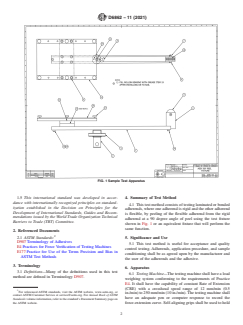
FIG. 1 Sample Test Apparatus
1.5 This international standard was developed in accor- 4. Summary of Test Method
dance with internationally recognized principles on standard-
4.1 This test method consists of testing laminated or bonded
ization established in the Decision on Principles for the
adherends, where one adherend is rigid and the other adherend
Development of International Standards, Guides and Recom-
is flexible, by peeling of the flexible adherend from the rigid
mendations issued by the World Trade Organization Technical
adherend at a 90 degree angle of peel using the test fixture
Barriers to Trade (TBT) Committee.
shown in Fig. 1 or an equivalent fixture that will perform the
same function.
2. Referenced Documents
2.1 ASTM Standards:
5. Significance and Use
D907 Terminology of Adhesives
5.1 This test method is useful for acceptance and quality
E4 Practices for Force Verification of Testing Machines
control testing. Adherends, application procedure, and sample
E177 Practice for Use of the Terms Precision and Bias in
conditioning shall be as agreed upon by the manufacturer and
ASTM Test Methods
the user of the adherends and the adhesive.
3. Terminology
6. Apparatus
3.1 Definitions—Many of the definitions used in this test
6.1 Testing Machine—The testing machine shall have a load
method are defined in Terminology D907.
weighing system conforming to the requirements of Practice
E4. It shall have the capability of constant Rate of Extension
(CRE) with a crosshead speed range of 12 mm/min (0.5
For referenced ASTM standards, visit the ASTM website, www.astm.org, or
in./min)to250mm/min(10in./min).Thetestingmachineshall
contact ASTM Customer Service at service@astm.org. For Annual Book of ASTM
have an adequate pen or computer response to record the
Standards volume information, refer to the standard’s Document Summary page on
the ASTM website. force-extension curve. Self-aligning grips shall be used to hold
D6862 − 11 (2021)
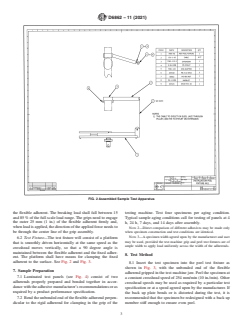
FIG. 2 Assembled Sample Test Apparatus
the flexible adherent. The breaking load shall fall between 15 testing machine. Test four specimens per aging condition.
and 85 % of the full scale load range.The grips need to engage
Typical sample aging conditions call for testing of panels at 4
the outer 25 mm (1 in.) of the flexible adherent firmly and,
h, 24 h, 7 days, and 14 days after assembly.
whenloadisapplied,thedirectionoftheappliedforceneedsto
NOTE 2—Direct comparison of different adhesives may be made only
be through the center line of the grip assembly.
when specimen construction and test conditions are identical.
NOTE 3—A specimen width agreed upon by the manufacturer and user
6.2 Test Fixture—The test fixture will consist of a platform
may be used, provided the test machine grip and peel test fixtures are of
that is smoothly driven horizontally at the same speed as the
ample width to apply load uniformly across the width of the adherends.
crosshead moves vertically, so that a 90 degree angle is
maintained between the
...