

ASTM F3523-21
(Test Method)Standard Test Method for Exoskeleton Use: Confined Space: Horizontal Movement
General Information
- Abstract
SIGNIFICANCE AND USE
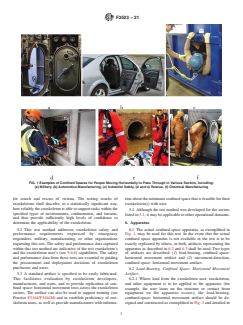
5.1 Exoskeletons are being used in the industrial, military, response, medical, and recreational sectors to enhance safety and effectiveness of the user to perform tasks. Confined spaces exist in many of these areas, as shown in Fig. 1, requiring people to fit through small spaces and this is potentially even more difficult while wearing an exoskeleton. For example, in the automobile manufacturing industry, workers wearing exoskeletons are required to fit into a confined automobile door opening while carrying tools to attach components to the car body. In emergency response operations, exoskeletons are used to enhance the safety and effectiveness of emergency responders operating in hazardous and confined space environments for search and rescue of victims. The testing results of exoskeletons shall describe, in a statistically significant way, how reliably the exoskeleton is able to support tasks within the specified types of environments, confinements, and terrains, and thus provide sufficiently high levels of confidence to determine the applicability of the exoskeleton.
5.2 This test method addresses exoskeleton safety and performance requirements expressed by emergency responders, military, manufacturing, or other organizations requesting this test. The safety and performance data captured within this test method are indicative of the test exoskeleton’s and the exoskeleton user’s (see 9.6.6) capabilities. The safety and performance data from these tests are essential to guiding the procurement and deployment decisions of exoskeleton purchasers and users.
5.3 A standard artifact is specified to be easily fabricated. This facilitates evaluation by exoskeleton developers, manufacturers, and users, and to provide replication of confined space: horizontal movement tests across the exoskeleton sectors. The artifact can also be used to support training (see Practice F3444/F3444M) and to establish proficiency of exoskeleton users, as well as provide manufacturers w...
SCOPE
1.1 Purpose:
1.1.1 The purpose of this test method, as a part of a suite of exoskeleton use test methods, is to quantitatively evaluate an exoskeleton’s (see Terminology F3323) performance or safety of usage, or both, by the exoskeleton user (see 1.4) in confined spaces with horizontal user movement.
1.1.2 Exoskeletons shall possess a certain set of allowable exoskeleton user movement capabilities, including user-motion adaptability, to suit operations such as: industrial, military, response, medical, or recreational. Environments in these typical sectors often pose constraints to exoskeleton user movement to various degrees. Being able to pass-through or maneuver, or both, effectively in confined spaces is essential for exoskeleton deployment for a variety of tasks. This test method specifies apparatuses to standardize this confined space task for testing exoskeleton user movement along the horizontal axis.
1.1.3 Exoskeletons shall be able to handle many types of task and terrain complexities. The required movement capabilities include, for example: walking, running, crawling, climbing, traversing gaps, hurdles, stairs, slopes, various types of floor surfaces or terrains, and confined spaces. Standard test methods are required to evaluate whether or not exoskeletons meet these requirements.
1.1.4 ASTM Subcommittee F48.03 develops and maintains international standards for task performance and environmental considerations that include but are not limited to, standards for safety, quality, and efficiency. This subcommittee aims to develop standards for any exoskeleton application as exemplified as in 1.1.2. The F48.03 test suite consists of a set of test methods for evaluating exoskeleton capability requirements. This confined space: horizontal movement test method is a part of the test suite. The apparatuses associated with the test methods challenge specific exoskeleton capabilities in repeatable ways to fac...
- Status
- Published
- Publication Date
- 31-Oct-2021
- Technical Committee
- F48 - Exoskeletons and Exosuits
- Drafting Committee
- F48.03 - Task Performance and Environmental Considerations
Overview
ASTM F3523-21 is an international standard developed by ASTM International that specifies a Standard Test Method for Exoskeleton Use in Confined Spaces: Horizontal Movement. This test method is designed to quantitatively evaluate the safety and performance of exoskeletons and their users while moving through confined spaces along a horizontal axis. Exoskeletons are being increasingly adopted across industrial, military, emergency response, medical, and recreational sectors to enhance both user safety and task effectiveness, often in challenging spaces and environments.
Key Topics
- Confined Space Testing: The standard focuses on scenarios where users must navigate restricted, horizontal spaces while wearing exoskeletons. Examples include industrial settings like automotive manufacturing and emergency response operations.
- Standardized Evaluation: By specifying testing apparatus and artifacts, ASTM F3523-21 ensures repeatability and comparability across different exoskeletons and operating environments.
- User Movement Capabilities: The test assesses essential exoskeleton-assisted movements such as walking, crawling, climbing, and lateral maneuvers in horizontal confined spaces, taking into account various terrain and surface challenges.
- Procurement and Deployment Guidance: Providing statistically significant data on exoskeleton performance and safety, this method supports decision-making for organizations considering exoskeleton adoption.
- Training and Proficiency: The standard artifact may also be used for user training and proficiency assessment, facilitating safer and more effective deployment.
Applications
Industrial and Manufacturing
Industries such as automotive assembly often require personnel to work inside tight enclosures or through limited access points. ASTM F3523-21 helps ensure exoskeletons do not hinder movement through automobile door openings or similar spaces, allowing for seamless performance of assembly or repair tasks.
Emergency Response and Military
Emergency responders and military personnel often operate in hazardous, confined spaces during rescue or tactical missions. This standard evaluates whether exoskeletons support efficient movement through environments such as tunnels, collapsed structures, or narrow access points, thus enhancing safety and mission success.
Medical and Rehabilitation
Medical professionals and patients using rehabilitation exoskeletons may encounter physical environment constraints. The standard provides a framework for verifying that exoskeleton systems can safely accommodate various spatial limitations commonly found in healthcare facilities.
Related Standards
- ASTM F3323: Terminology for Exoskeletons and Exosuits, providing definitions applicable across exoskeleton standards.
- ASTM F3444/F3444M: Practice for Training Exoskeleton Users, supporting standardized training regimens.
- ASTM F3128: Specification for Poly(Vinyl Chloride) (PVC) Pipe, referenced for artifact construction.
- ASTM F3427: Practice for Documenting Environmental Conditions, ensuring valid, repeatable test environments.
- ISO 13482: Robots and robotic devices - Safety requirements for personal care robots, referenced for exoskeleton safety.
- ASTM D4276: Practice for Confined Area Entry, outlining health and safety best practices in confined spaces.
Practical Value
ASTM F3523-21 addresses a critical need for standardized assessment of exoskeleton performance and safety in confined, horizontally-oriented spaces. It facilitates confidence in exoskeleton selection and deployment by providing quantitative, repeatable data. Relevant users include:
- Manufacturers seeking to validate product safety and effectiveness,
- Organizational purchasers making procurement decisions,
- End-users requiring assurance of fit-for-purpose exoskeleton functionality,
- Trainers providing user proficiency assessments in realistic settings.
By aligning with internationally recognized principles and referencing key related standards, ASTM F3523-21 strengthens the foundation for safe, productive exoskeleton integration in sectors where confined space navigation is part of routine operations.
Keywords: ASTM F3523-21, exoskeleton standard, confined space test, horizontal movement, exoskeleton safety, exoskeleton performance, industrial exoskeleton, emergency response exoskeleton, exoskeleton user training, exoskeleton test methods, international standards.
Relations
- Effective Date
- 15-Jun-2020
- Effective Date
- 01-Jun-2020
- Effective Date
- 01-Mar-2020
- Effective Date
- 01-Jan-2020
- Effective Date
- 01-Oct-2019
- Effective Date
- 01-Apr-2019
- Effective Date
- 01-Sep-2018
- Effective Date
- 01-Apr-2015
- Effective Date
- 01-Sep-2012
- Effective Date
- 01-Feb-2007
- Effective Date
- 10-Jan-2002
- Effective Date
- 10-Jan-2002
Get Certified
Connect with accredited certification bodies for this standard

CIS Institut d.o.o.
Personal Protective Equipment (PPE) certification body. Notified Body NB-2890 for EU Regulation 2016/425 PPE.

Kiwa BDA Testing
Building and construction product certification.
Kmetijski inštitut Slovenije
Agricultural Institute of Slovenia. Soil testing, plant health, agricultural product analysis.
Sponsored listings
Frequently Asked Questions
ASTM F3523-21 is a standard published by ASTM International. Its full title is "Standard Test Method for Exoskeleton Use: Confined Space: Horizontal Movement". This standard covers: SIGNIFICANCE AND USE 5.1 Exoskeletons are being used in the industrial, military, response, medical, and recreational sectors to enhance safety and effectiveness of the user to perform tasks. Confined spaces exist in many of these areas, as shown in Fig. 1, requiring people to fit through small spaces and this is potentially even more difficult while wearing an exoskeleton. For example, in the automobile manufacturing industry, workers wearing exoskeletons are required to fit into a confined automobile door opening while carrying tools to attach components to the car body. In emergency response operations, exoskeletons are used to enhance the safety and effectiveness of emergency responders operating in hazardous and confined space environments for search and rescue of victims. The testing results of exoskeletons shall describe, in a statistically significant way, how reliably the exoskeleton is able to support tasks within the specified types of environments, confinements, and terrains, and thus provide sufficiently high levels of confidence to determine the applicability of the exoskeleton. 5.2 This test method addresses exoskeleton safety and performance requirements expressed by emergency responders, military, manufacturing, or other organizations requesting this test. The safety and performance data captured within this test method are indicative of the test exoskeleton’s and the exoskeleton user’s (see 9.6.6) capabilities. The safety and performance data from these tests are essential to guiding the procurement and deployment decisions of exoskeleton purchasers and users. 5.3 A standard artifact is specified to be easily fabricated. This facilitates evaluation by exoskeleton developers, manufacturers, and users, and to provide replication of confined space: horizontal movement tests across the exoskeleton sectors. The artifact can also be used to support training (see Practice F3444/F3444M) and to establish proficiency of exoskeleton users, as well as provide manufacturers w... SCOPE 1.1 Purpose: 1.1.1 The purpose of this test method, as a part of a suite of exoskeleton use test methods, is to quantitatively evaluate an exoskeleton’s (see Terminology F3323) performance or safety of usage, or both, by the exoskeleton user (see 1.4) in confined spaces with horizontal user movement. 1.1.2 Exoskeletons shall possess a certain set of allowable exoskeleton user movement capabilities, including user-motion adaptability, to suit operations such as: industrial, military, response, medical, or recreational. Environments in these typical sectors often pose constraints to exoskeleton user movement to various degrees. Being able to pass-through or maneuver, or both, effectively in confined spaces is essential for exoskeleton deployment for a variety of tasks. This test method specifies apparatuses to standardize this confined space task for testing exoskeleton user movement along the horizontal axis. 1.1.3 Exoskeletons shall be able to handle many types of task and terrain complexities. The required movement capabilities include, for example: walking, running, crawling, climbing, traversing gaps, hurdles, stairs, slopes, various types of floor surfaces or terrains, and confined spaces. Standard test methods are required to evaluate whether or not exoskeletons meet these requirements. 1.1.4 ASTM Subcommittee F48.03 develops and maintains international standards for task performance and environmental considerations that include but are not limited to, standards for safety, quality, and efficiency. This subcommittee aims to develop standards for any exoskeleton application as exemplified as in 1.1.2. The F48.03 test suite consists of a set of test methods for evaluating exoskeleton capability requirements. This confined space: horizontal movement test method is a part of the test suite. The apparatuses associated with the test methods challenge specific exoskeleton capabilities in repeatable ways to fac...
SIGNIFICANCE AND USE 5.1 Exoskeletons are being used in the industrial, military, response, medical, and recreational sectors to enhance safety and effectiveness of the user to perform tasks. Confined spaces exist in many of these areas, as shown in Fig. 1, requiring people to fit through small spaces and this is potentially even more difficult while wearing an exoskeleton. For example, in the automobile manufacturing industry, workers wearing exoskeletons are required to fit into a confined automobile door opening while carrying tools to attach components to the car body. In emergency response operations, exoskeletons are used to enhance the safety and effectiveness of emergency responders operating in hazardous and confined space environments for search and rescue of victims. The testing results of exoskeletons shall describe, in a statistically significant way, how reliably the exoskeleton is able to support tasks within the specified types of environments, confinements, and terrains, and thus provide sufficiently high levels of confidence to determine the applicability of the exoskeleton. 5.2 This test method addresses exoskeleton safety and performance requirements expressed by emergency responders, military, manufacturing, or other organizations requesting this test. The safety and performance data captured within this test method are indicative of the test exoskeleton’s and the exoskeleton user’s (see 9.6.6) capabilities. The safety and performance data from these tests are essential to guiding the procurement and deployment decisions of exoskeleton purchasers and users. 5.3 A standard artifact is specified to be easily fabricated. This facilitates evaluation by exoskeleton developers, manufacturers, and users, and to provide replication of confined space: horizontal movement tests across the exoskeleton sectors. The artifact can also be used to support training (see Practice F3444/F3444M) and to establish proficiency of exoskeleton users, as well as provide manufacturers w... SCOPE 1.1 Purpose: 1.1.1 The purpose of this test method, as a part of a suite of exoskeleton use test methods, is to quantitatively evaluate an exoskeleton’s (see Terminology F3323) performance or safety of usage, or both, by the exoskeleton user (see 1.4) in confined spaces with horizontal user movement. 1.1.2 Exoskeletons shall possess a certain set of allowable exoskeleton user movement capabilities, including user-motion adaptability, to suit operations such as: industrial, military, response, medical, or recreational. Environments in these typical sectors often pose constraints to exoskeleton user movement to various degrees. Being able to pass-through or maneuver, or both, effectively in confined spaces is essential for exoskeleton deployment for a variety of tasks. This test method specifies apparatuses to standardize this confined space task for testing exoskeleton user movement along the horizontal axis. 1.1.3 Exoskeletons shall be able to handle many types of task and terrain complexities. The required movement capabilities include, for example: walking, running, crawling, climbing, traversing gaps, hurdles, stairs, slopes, various types of floor surfaces or terrains, and confined spaces. Standard test methods are required to evaluate whether or not exoskeletons meet these requirements. 1.1.4 ASTM Subcommittee F48.03 develops and maintains international standards for task performance and environmental considerations that include but are not limited to, standards for safety, quality, and efficiency. This subcommittee aims to develop standards for any exoskeleton application as exemplified as in 1.1.2. The F48.03 test suite consists of a set of test methods for evaluating exoskeleton capability requirements. This confined space: horizontal movement test method is a part of the test suite. The apparatuses associated with the test methods challenge specific exoskeleton capabilities in repeatable ways to fac...
ASTM F3523-21 is classified under the following ICS (International Classification for Standards) categories: 13.180 - Ergonomics. The ICS classification helps identify the subject area and facilitates finding related standards.
ASTM F3523-21 has the following relationships with other standards: It is inter standard links to ASTM F3443-20, ASTM F3444/F3444M-20, ASTM F3427-20, ASTM D4276-02(2020), ASTM F3323-19a, ASTM F3323-19, ASTM F3323-18, ASTM F3128-15, ASTM D4276-02(2012), ASTM D4276-02(2007), ASTM D4276-02, ASTM D4276-95. Understanding these relationships helps ensure you are using the most current and applicable version of the standard.
ASTM F3523-21 is available in PDF format for immediate download after purchase. The document can be added to your cart and obtained through the secure checkout process. Digital delivery ensures instant access to the complete standard document.
Standards Content (Sample)
This international standard was developed in accordance with internationally recognized principles on standardization established in the Decision on Principles for the
Development of International Standards, Guides and Recommendations issued by the World Trade Organization Technical Barriers to Trade (TBT) Committee.
Designation:F3523 −21
Standard Test Method for
Exoskeleton Use: Confined Space: Horizontal Movement
This standard is issued under the fixed designation F3523; the number immediately following the designation indicates the year of
original adoption or, in the case of revision, the year of last revision. A number in parentheses indicates the year of last reapproval. A
superscript epsilon (´) indicates an editorial change since the last revision or reapproval.
1. Scope able ways to facilitate comparison of different exoskeleton
modelsortofacilitateapplicationofexoskeletoncapabilitiesto
1.1 Purpose:
intended tasks.
1.1.1 The purpose of this test method, as a part of a suite of
1.1.5 The test methods quantify elemental exoskeleton use
exoskeleton use test methods, is to quantitatively evaluate an
capabilities necessary for sector applications listed in 1.1.2 and
exoskeleton’s (see Terminology F3323) performance or safety
of usage, or both, by the exoskeleton user (see 1.4) in confined perhaps others. As such, users of this test method should use
spaces with horizontal user movement. either the entire suite or a subset based on their particular
1.1.2 Exoskeletons shall possess a certain set of allowable requirements. Users are also allowed to weight particular test
exoskeletonusermovementcapabilities,includinguser-motion methods or particular metrics within a test method differently
adaptability, to suit operations such as: industrial, military,
based on their specific requirements. The testing results should
response, medical, or recreational. Environments in these
collectively represent an exoskeleton’s overall safety or
typical sectors often pose constraints to exoskeleton user
performance, or both, as required for the task. These perfor-
movement to various degrees. Being able to pass-through or
mance data can be used: to guide procurement specifications,
maneuver, or both, effectively in confined spaces is essential
for acceptance testing, and for training to use exoskeletons
for exoskeleton deployment for a variety of tasks. This test
intended for specified applications.
methodspecifiesapparatusestostandardizethisconfinedspace
NOTE 1—Additional test methods within the suite are anticipated to be
task for testing exoskeleton user movement along the horizon-
developed to address additional exoskeleton capability requirements,
tal axis.
including newly identified requirements, and even for new application
1.1.3 Exoskeletons shall be able to handle many types of
domains.
task and terrain complexities. The required movement capa-
1.2 Performing Location—This test method shall be per-
bilities include, for example: walking, running, crawling,
formed in a testing laboratory or the field where the specified
climbing, traversing gaps, hurdles, stairs, slopes, various types
apparatus and environmental conditions are implemented.
of floor surfaces or terrains, and confined spaces. Standard test
methods are required to evaluate whether or not exoskeletons
1.3 Units—The values stated in SI units are to be regarded
meet these requirements.
as the standard.The values given in parentheses are not precise
1.1.4 ASTM Subcommittee F48.03 develops and maintains
mathematical conversions to inch-pound units. They are close
internationalstandardsfortaskperformanceandenvironmental
approximate equivalents for the purpose of specifying material
considerations that include but are not limited to, standards for
dimensions or quantities that are readily available to avoid
safety, quality, and efficiency. This subcommittee aims to
excessive fabrication costs of test apparatuses while maintain-
develop standards for any exoskeleton application as exempli-
ing repeatability and reproducibility of the test method results.
fied as in 1.1.2. The F48.03 test suite consists of a set of test
These values given in parentheses are provided for information
methods for evaluating exoskeleton capability requirements.
only and are not considered standard.
This confined space: horizontal movement test method is a part
of the test suite. The apparatuses associated with the test
1.4 This standard does not purport to address all of the
methods challenge specific exoskeleton capabilities in repeat-
safety concerns, if any, associated with its use. It is the
responsibility of the user of this standard to establish appro-
priate safety, health, and environmental practices and deter-
mine the applicability of regulatory limitations prior to use.
This test method is under the jurisdiction of ASTM Committee F48 on
Exoskeletons and Exosuits and is the direct responsibility of Subcommittee F48.03
1.5 This international standard was developed in accor-
on Task Performance and Environmental Considerations.
dance with internationally recognized principles on standard-
Current edition approved Nov. 1, 2021. Published November 2021. DOI:
10.1520/F3523-21. ization established in the Decision on Principles for the
Copyright © ASTM International, 100 Barr Harbor Drive, PO Box C700, West Conshohocken, PA 19428-2959. United States
F3523−21
Development of International Standards, Guides and Recom- the START point after passing completely back through the
mendations issued by the World Trade Organization Technical confined space again, thus enabling continuous repetitions.
Barriers to Trade (TBT) Committee. Either 4.1 (1)or(2) shall be defined by the test requestor prior
to the test. The specified path from the START point to the
2. Referenced Documents
END point shall be defined by the test requestor prior to the
test. The confined space: horizontal movement apparatuses are
2.1 ASTM Standards:
described in Section 5. See Fig. 1 for an illustration. Artifacts
D4276 Practice for Confined Area Entry
representing real apparatuses are described in Section 6.
F3128 Specification for Poly(Vinyl Chloride) (PVC) Sched-
ule 40 Drain, Waste, and Vent Pipe with a Cellular Core
4.2 The exoskeleton’s capability is defined as the exoskel-
F3323 Terminology for Exoskeletons and Exosuits
eton’s ability to complete the confined space: horizontal
F3427 Practice for Documenting Environmental Conditions
movement task where the user is capable of passing through
for Utilization with Exoskeleton Test Methods
the set confined space and, if requested by the test requestor,
F3443 Practice for Load Handling When Using an Exoskel-
can perform the task at the desired time to complete the test.
eton
Further, the test requestor can specify the statistical reliability
F3444/F3444M Practice for Training Exoskeleton Users
and confidence levels of such a capability and thus dictate the
F3474 Practice for Establishing Exoskeleton Functional Er-
number of successful task performance repetitions that are
gonomic Parameters and Test Metrics
required. In such a case, the average time to complete the test
F3517 Practice for Movement Tests When Using an Exo-
shall be used as the exoskeleton user’s capability.
skeleton
4.3 The exoskeleton user is allowed to practice before the
2.2 Other Standards:
test.
ISO 13482 Robots and robotic devices — Safety require-
ments for personal care robots 4.4 Once the test begins, there shall be no verbal commu-
nication between the exoskeleton user and the test supervisor
3. Terminology
regarding the performance of a test repetition, other than
instructions on when to start and notifications of faults and any
3.1 General terminology for ASTM Committee F48 stan-
safety related conditions. The user shall have the full respon-
dards are listed inTerminology F3323.Terminology specific to
sibility to determine whether and when they have completed a
this test method are shown in this section.
repetition and notify the test supervisor accordingly. However,
3.2 Definitions:
it is the test supervisor’s authority to judge the completeness of
3.2.1 apparatus, n—a structure, object, test component, or
the repetition.
artifactthereof,foundorplacedinanenvironmentandusedfor
a test. NOTE 2—Practice within the test apparatus could help establish the
applicability of the exoskeleton for the given test method. It allows the
3.2.2 artifact, n—a representative of real structure(s),
operator to gain familiarity with the standard apparatus and environmental
object(s), or test component(s) and used for a test.
conditions.Italsohelpsthetestsupervisortoestablishtheinitialapparatus
setting for the test when applicable.
3.2.3 confined space, n—limited entry and egress.
4.5 The test requestor has the authority to select the con-
3.2.4 horizontal movement, v—user moves on the horizontal
fined space opening for the traversing task. The test requestor
plane.
also has the authority to select test methods that constitute the
3.2.5 movement, v—a particular instance or manner of user
test event, to select one or more test site(s) at which the test
motion.
methods are implemented, to determine the corresponding
3.2.6 test suite, n—designed collection of test methods that
statistical reliability and confidence levels of the results for
are used, collectively, to evaluate an exoskeleton’s safety
eachofthetestmethods,andtoestablishtheparticipationrules
and/or performance.
including the testing schedules and the test environmental
conditions.
4. Summary of Test Method
4.1 The task for this test method, exoskeleton-user moving
5. Significance and Use
through a confined space with horizontal movement, is defined
5.1 Exoskeletons are being used in the industrial, military,
as the exoskeleton-user traversing from the START point
response, medical, and recreational sectors to enhance safety
specified by the test supervisor, and ending at the END point.
and effectiveness of the user to perform tasks. Confined spaces
A test repetition shall be (1) when the user passes completely
exist in many of these areas, as shown in Fig. 1, requiring
through the confined space or (2) when the user passes
people to fit through small spaces and this is potentially even
completely through the confined space and then returns back to
more difficult while wearing an exoskeleton. For example, in
the automobile manufacturing industry, workers wearing exo-
skeletons are required to fit into a confined automobile door
For referenced ASTM standards, visit the ASTM website, www.astm.org, or
contact ASTM Customer Service at service@astm.org. For Annual Book of ASTM
opening while carrying tools to attach components to the car
Standards volume information, refer to the standard’s Document Summary page on
body. In emergency response operations, exoskeletons are used
the ASTM website.
to enhance the safety and effectiveness of emergency respond-
Available fromAmerican National Standards Institute (ANSI), 25 W. 43rd St.,
4th Floor, New York, NY 10036, http://www.ansi.org. ers operating in hazardous and confined space environments
F3523−21
FIG. 1Examples of Confined Spaces for People Moving Horizontally to Pass Through in Various Sectors, including:
(a) Military, (b) Automotive Manufacturing, (c) Industrial Safety, (d and e) Rescue, (f) Chemical Manufacturing
for search and rescue of victims. The testing results of tionabouttheminimumconfinedspacethatisfeasiblefortheir
exoskeletons shall describe, in a statistically significant way, exoskeleton(s) with user.
how reliably the exoskeleton is able to support tasks within the
5.4 Although the test method was developed for the sectors
specified types of environments, confinements, and terrains,
listed in 5.1, it may be applicable to other operational domains.
and thus provide sufficiently high levels of confidence to
determine the applicability of the exoskeleton.
6. Apparatus
5.2 This test method addresses exoskeleton safety and 6.1 The actual confined space apparatus, as exemplified in
performance requirements expressed by emergency Fig. 1, may be used for this test. In the event that the actual
responders, military, manufacturing, or other organizations confined space apparatus is not available or the test is to be
requesting this test. The safety and performance data captured exactly replicated by others, or both, artifacts representing the
within this test method are indicative of the test exoskeleton’s apparatus as described in 6.2 and 6.3 shall be used. Two types
and the exoskeleton user’s (see 9.6.6) capabilities. The safety of artifacts are described: (1) load-bearing, confined space:
and performance data from these tests are essential to guiding horizontal movement artifact and (2) movement-detection,
the procurement and deployment decisions of exoskeleton confined space: horizontal movement artifact.
purchasers and users.
6.2 Load-Bearing, Confined Space: Horizontal Movement
5.3 A standard artifact is specified to be easily fabricated. Artifact:
This facilitates evaluation by exoskeleton developers, 6.2.1 Where load from the exoskeleton user, exoskeleton,
manufacturers, and users, and to provide replication of con- and other equipment is to be applied to the apparatus (for
fined space: horizontal movement tests across the exoskeleton example, the user leans on the structure or contact from
sectors. The artifact can also be used to support training (see equipment on the apparatus occurs), the load-bearing,
Practice F3444/F3444M) and to establish proficiency of exo- confined-space: horizontal movement artifact should be de-
skeleton users, as well as provide manufacturers with informa- signed and constructed as exemplified in Fig. 2 and detailed in
F3523−21
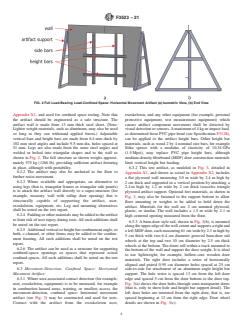
FIG. 2Full Load-Bearing Load-Confined Space: Horizontal Movement Artifact (a) Isometric View, (b) End View
Appendix X1, and used for confined space testing. Note that exoskeleton, and any other equipment (for example, personal
the artifact should be engineered as a safe structure. The protective equipment, test measurement equipment) which
artifact wall is made from 13 mm thick steel sheet. (Note: causes artifact component movement shall be detected by
Lighter weight materials, such as aluminum, may also be used visualdetectionorsensors.Amaximumof4kg-mimpactload,
so long as they can withstand applied forces.) Adjustable as determined from PVC pipe bend (see Specification F3128),
vertical bars and height bars are made from 6.4 mm thick by can be applied to the artifact height bars. Other height bar
102 mm steel angles and include 9.5 mm dia. holes spaced at materials, such as wood 2 by 4 nominal size bars, for example
51 mm. Legs are also made from the same steel angles and Sitka spruce with a modulus of elasticity of 10.34 GPa
welded or bolted into triangular shapes and to the wall as (1.5 Mpsi), may replace PVC pipe height bars, although
shown in Fig. 2. The full structure as shown weighs approxi- medium-density fiberboard (MDF) door construction materials
mately 575 kg (1266 lb), providing sufficient artifact fixturing limit vertical height bar loading.
in place, although with portability.
6.3.2 This test artifact, as modeled in Fig. 3, detailed in
6.2.2 The artifact may also be anchored to the floor to
Appendix X1, and shown as actual in Appendix X2, includes
further resist movement.
a flat plywood wall measuring 3.0 m wide by 2.4 m high by
6.2.3 Where available and appropriate, an alternative to
2 cm thick and supported in a vertical position by attaching a
using legs (that is, triangular frames or triangular side panels)
2.4 m high by 1.2 m wide by 2 cm thick isosceles triangle
is to attach the artifact wall directly to a super-structure (for
plywood artifact support. Optional feet materials, as shown in
example, masonry wall with rollup door opening) that is
Fig. 3, may also be fastened to the support bottom to allow
structurally capable of supporting the artifact, user,
floor mounting or weights to be added to hold down the
exoskeleton, equipment, etc. Leg and mounting alternatives
artifact. Materials for the wall are 2 cm nominal plywood,
shall be noted on the test report.
plastic, or similar. The wall includes a 1.5 m wide by 2.1 m
6.2.4 Paddingorothermaterialsmaybeaddedtotheartifact
high centered opening measured from the floor.
to limit risk of user injury during tests.All such additions shall
6.3.3 Abarn-door style rail, shown in Fig. 3(b), is mounted
be noted on the test report.
alongtheupperedgeofthewallcutoutandsupportsarightand
6.2.5 Additional vertical or height bar confinement angle, or
a left MDF door, each measuring 61 cm wide by 2.3 m high by
both, c-channel, or other forms may be added to the confine-
5 cm thick with two 6.4 cm diameter grooved barn-door rail
ment framing. All such additions shall be noted on the test
wheels at the top and two 10 cm diameter by 2.5 cm thick
report.
wheels at the bottom. The doors roll within a track mounted to
6.2.6 The artifact can be used as a structure for supporting
the bottom of the wall and support the door weight. It is ideal
confined-space openings or spaces that represent actual
to use lightweight, for example, hollow-core wooden door
confined-spaces. All such additions shall be noted on the test
materials. The right door includes a series of horizontally
report.
aligned and paired 0.95 cm diameter holes spaced at 25 cm
6.3 Movement-Detection, Confined Space: Horizontal side-to-side for attachment of an aluminum angle height bar
Movement Artifact: support. The hole series is spaced 13 cm from the left door
6.3.1 Where user-associated contact detection (for example, edge and spaced 5 cm from the door bottom to the door top.
user, exoskeleton, equipment) is to be measured, for example Fig. 3(a) shows the door holes through semi-transparent doors
in combustion hazard areas, training, or smallest access, the (that is, only to show hole and height bar support detail). The
movement-detection, confined space: horizontal movement left door holes are mirrored from the right door, that is, are
artifact (see Fig. 3) may be constructed and used for tests. spaced beginning at 13 cm from the right edge. Door wheel
Contact with the artifact from the exoskeleton user, details are shown in Fig. 3(c).
F3523−21
NOTE 1—Doors are shown as translucent to show hole and other details.
FIG. 3Movement-Detection, Confined Space: Horizontal Movement Artifact
(a) Full Artifact, (b) End View of Barn-door Support Design, and (c) End Views of Height Bar and Door Wheel Details
6.3.4 Height bars ideally made of nominal 7.6 cm diameter 2 by 4 height bars are less ideal than PVC pipe due to
plastic tubing (for example, schedule 40 PVC pipe) by 2.3 m additional hazards of user head, limb, etc. contact with wood
long rest on the left and right height bar supports as detailed in height bars, and minimized movement detection from applied
Fig. 3(c). Plastic tubing pipe includes rounded edges where force.
exoskeleton user contact hazards are minimized.Alternatively, 6.3.5 The open space defined by the left and right doors and
the height bars can be made of 2 by 4 nominal wood. Wooden the upper and lower height bars, if included, is considered the
F3523−21
confined space: horizontal. Doors are intended to be on wheels electronic methods. Fig. 4 shows examples of electronic
so that they will move if the exoskeleton user applies minimal detection methods for artifact contact or movement, or both.
force to the door. Similarly, the height bars are intended to be Electronic or other detection methods may be applied to either
lightweight to detect their movement upon contact by the artifact or the real apparatus.
exoskeleton user. In the event that contact is allowed between 6.3.7 Various test conditions, such as apparatus surface
theexoskeletonuserandtheartifact,thedoorsmaybeclamped types and conditions, or environmental conditions, for
to the wall and the height bars made of heavier materials, as example, wetness and floor friction level, and temperature,
described in 6.3, or may also be clamped to the doors. shall be facilitated as the test requestor requires. The apparatus
condition shall be recorded on the test report and the environ-
NOTE 3—In Fig. 3(a), the lower bar placement can define the confined
mental condition shall be recorded as defined in Practice
space pass-through as below or above the lower bar, dependent upon the
F3427.
requested test.
6.3.6 The test supervisor or test technician is intended to 6.4 The confined space: horizontal movement artifacts,
monitor the apparatus (that is, real or artifact) during the test to either movement-detection or load-bearing, can be modified as
detect any unintentional movement of the apparatus, especially needed to mimic closer to the actual confined space or task, or
when using the movement-detection artifact. Fig. 4(a) shows a both. Example modifications are provided in 6.4.2 and 6.4.3.
door-movementmethodwithathinbarcloselymountedabove, All modifications to the apparatus (real or artifact) shall be
without contact, and a tape line of the same width. Once the detailed on the test report such that exact replication can occur.
doormoves,thethinbarwillmoveawayfromthealignedtape. 6.4.1 If curved confinements exist within the pass-through
Alternative detection methods may also or instead be used, area, they are either (1) for example, formed using 3D printed
such as tape switches (see Fig. 4(b)), emitters/detectors (see materials from computer aided design models or cutout from
Fig. 4(c)), optical tracking systems, cameras, or other similar wood, plastic, metal, or other materials and attached to the
(a) Door-movement detection bar above floor tape, (b) height bar-movement detection with tape, (c) switch tape for contact detection in the opening, and (d)
emitter/detector for horizontal bar movement detection.
FIG. 4Examples of Detection Methods
F3523−21
confinement pass-through area (see example in Fig. 5), or (2) these references address typical risks and mitigation
attaching straight bar(s) defining the chord between two curve procedures, they may not address safety issues for an exoskel-
points and attached to the artifact. Note that (2) may provide a eton user.
slightly smaller confined space pass-through than in (1)or
7.2 Safety standards providing risks and mitigation proce-
using the real apparatus.
dures for hazards when using an exoskeleton are developed or
6.4.2 Artifact Modification Example 1 – Automobile Door—
being developed, including:
This artifact modification mimics an automobile door opening
7.2.1 ISO 13482;
measuring 91 cm wide by 122 cm high with the opening
7.2.2 Test Method for Measuring Exoskeleton Ease of Use,
bottom being 40 cm above the floor (see Fig. 6(a)).The further 5
Usefulness, and Use Intent;
confinement of a windshield-limiting space is also included in
7.2.3 Guide for General Guidelines to Risk Management of
the artifact. An angled bar matching the windshield angle is 5
Exoskeletons;
also hinged to the upper height bar and rests on an additional
7.2.4 Guide for Management of Internal and of External
height bar support as shown in Fig. 6(b). Further confinement 5
Sources of Risk.
can also be added to the artifact and documented on the test
report if additional opening complexities exist. For example,
8. Calibration and Standardization
curved areas or a raised floor as appropriate to mimic the real
8.1 The exoskeleton configuration as tested shall be de-
application.
scribedindetailonthetestreport,includingallsubsystemsand
6.4.3 Artifact Modification Example 2 – Aircraft Aisle—This
components and their respective features and functionalities,
artifact modification mimics an aircraft aisle (see Fig. 7(a))
including version or iterations details as applicable. The
opening measuring 41 cm wide by 213 cm high above the floor
configuration shall be subjected to all the appropriate tests
(seeFig.7(b)).Woodenpanels,measuring109cmhigh,thatis,
within the suite of exoskeleton test methods. Any variation in
similartoaircraftseatheights,restonthefloorandareattached
the configuration shall cause the resulting exoskeleton variant
totheleftandrightdoorstodefinethe41cmopeningfor2.4 m
to be re-tested across all the test suites to provide a consistent
or more.Additional floor support or bracing can also be added
and comprehensive representation of the performance. Upon
to the panels for panel stability.Additional panels can be added
publication and to ensure standardized documentation, a future
to increase aisle length, and additional contours, for example,
Practice for Documenting Exoskeleton Configuration shall be
seat armrests, can be also added.
used to record the exoskeleton configuration.Additional infor-
mation describing the exoskeleton, exoskeleton user, and the
7. Hazards
exoskeleton fit to the user should also be documented.
7.1 Examples of hazards for confined space: horizontal
8.2 Once an exoskeleton user begins a test, by starting to
movement tasks when using exoskeletons include: being stuck
execute the
...