

ASTM E1264-23
(Classification)Standard Classification for Acoustical Ceiling Products
General Information
- Abstract
SIGNIFICANCE AND USE
4.1 This classification is used to classify and aid in the selection of acoustical ceiling products.
SCOPE
1.1 This classification covers ceiling products that provide acoustical performance and interior finish in buildings. Products used in performance spaces and other special applications in some cases require more detailed specification than provided by this classification.
1.2 This classification classifies acoustical ceilings by type, pattern, and certain ratings for acoustical performance, light reflectance, and fire safety. It does not cover the aspects of acoustical ceilings when used as a component of a system or assembly tested for fire endurance or floor/ceiling sound transmission.
1.3 This classification does not include physical properties, such as structural hardness, friability, sag, linear expansion and contraction, and transverse strength, which affect the handling, installation, and use of acoustical ceiling products (see Test Methods C367).
1.4 The values stated in inch-pound units are to be regarded as standard. The values given in parentheses are mathematical conversions to SI units that are provided for information only and are not considered standard.
1.5 This international standard was developed in accordance with internationally recognized principles on standardization established in the Decision on Principles for the Development of International Standards, Guides and Recommendations issued by the World Trade Organization Technical Barriers to Trade (TBT) Committee.
- Status
- Published
- Publication Date
- 14-May-2023
- Technical Committee
- E33 - Building and Environmental Acoustics
- Drafting Committee
- E33.04 - Application of Acoustical Materials and Systems
Overview
ASTM E1264-23: Standard Classification for Acoustical Ceiling Products establishes a systematic approach for classifying acoustical ceiling products used in building interiors. Developed by ASTM International, this standard aids architects, designers, contractors, and manufacturers in selecting appropriate ceiling products based on their acoustical performance, light reflectance, and fire safety ratings. ASTM E1264-23 is widely referenced for achieving effective sound control and aesthetic quality in commercial, institutional, and residential environments.
Key Topics
Classification Scope
The standard covers ceiling products that provide acoustical performance and serve as interior finishes. It addresses general interior spaces, while noting that specialized performance spaces may need further specification.Ceiling Product Types
Acoustical ceiling products are classified by type (cellulose, mineral, glass fiber, metal, wood, gypsum, plastic, and more) and by overlay or finish (painted, membrane-faced, scrubbable, fabric-faced, etc.).Pattern and Form
Multiple surface patterns are described, including perforated, fissured, textured, smooth, printed, embossed, and scored designs to support both acoustic function and design requirements.Performance Ratings
- Acoustical Ratings: Noise Reduction Coefficient (NRC), Articulation Class (AC), and Ceiling Attenuation Class (CAC) are specified and measured per referenced ASTM test methods.
- Light Reflectance: Assessed to encourage energy efficiency and lighting uniformity.
- Fire Safety: Surface burning characteristics are classified as Class A, B, or C, referencing standardized test methods.
Exclusions
Physical properties affecting handling and installation, such as structural hardness and expansion/contraction, are not covered by this classification but are referenced in other ASTM standards.
Applications
Acoustical Design in Buildings
ASTM E1264-23 supports the selection of ceiling systems that improve noise control, optimize privacy, and enhance speech intelligibility in spaces like offices, schools, healthcare facilities, and public buildings.Interior Finish and Aesthetics
With a variety of patterns, finishes, and materials, the standard enables design flexibility to meet interior architectural preferences while maintaining necessary performance.Regulatory Compliance
Classifications for fire performance and light reflectance help ensure compliance with local building codes and contribute to occupant safety and comfort.Specification and Procurement
The standard provides a framework for clear communication between designers, specifiers, and manufacturers, supporting efficient procurement of compliant ceiling systems.
Related Standards
ASTM E1264-23 references several related ASTM standards for terminology, test methods, and further classification, including:
- ASTM C367: Test Methods for Strength Properties of Prefabricated Architectural Acoustical Tile or Lay-In Ceiling Panels
- ASTM C423: Test Method for Sound Absorption and Sound Absorption Coefficients by the Reverberation Room Method
- ASTM E84: Test Method for Surface Burning Characteristics of Building Materials
- ASTM E413: Classification for Rating Sound Insulation
- ASTM E1414: Test Method for Airborne Sound Attenuation Between Rooms Sharing a Common Ceiling Plenum
- ASTM E1477: Test Method for Luminous Reflectance Factor of Acoustical Materials
These referenced documents provide essential procedures for determining the performance characteristics necessary for classifying and selecting ceiling products under ASTM E1264-23.
Keywords: acoustical ceilings, ceiling classification, acoustical performance, NRC, CAC, articulation class, fire safety, light reflectance, ASTM E1264-23, interior finish, sound absorption, building acoustics
Relations
- Effective Date
- 01-Dec-2023
- Effective Date
- 01-Sep-2023
- Effective Date
- 01-Jul-2019
- Effective Date
- 15-Apr-2019
- Effective Date
- 01-Apr-2019
- Effective Date
- 01-Mar-2019
- Effective Date
- 01-Oct-2018
- Effective Date
- 01-Jul-2018
- Effective Date
- 01-Mar-2018
- Effective Date
- 01-Nov-2017
- Effective Date
- 01-Aug-2017
- Effective Date
- 01-Jun-2017
- Effective Date
- 01-Jul-2016
- Effective Date
- 15-Dec-2015
- Effective Date
- 01-Apr-2015
Get Certified
Connect with accredited certification bodies for this standard

DIBt (Deutsches Institut für Bautechnik)
German Institute for Building Technology.
DIN CERTCO
DIN Group product certification.

Aboma Certification B.V.
Specialized in construction, metal, and transport sectors.
Sponsored listings
Frequently Asked Questions
ASTM E1264-23 is a standard published by ASTM International. Its full title is "Standard Classification for Acoustical Ceiling Products". This standard covers: SIGNIFICANCE AND USE 4.1 This classification is used to classify and aid in the selection of acoustical ceiling products. SCOPE 1.1 This classification covers ceiling products that provide acoustical performance and interior finish in buildings. Products used in performance spaces and other special applications in some cases require more detailed specification than provided by this classification. 1.2 This classification classifies acoustical ceilings by type, pattern, and certain ratings for acoustical performance, light reflectance, and fire safety. It does not cover the aspects of acoustical ceilings when used as a component of a system or assembly tested for fire endurance or floor/ceiling sound transmission. 1.3 This classification does not include physical properties, such as structural hardness, friability, sag, linear expansion and contraction, and transverse strength, which affect the handling, installation, and use of acoustical ceiling products (see Test Methods C367). 1.4 The values stated in inch-pound units are to be regarded as standard. The values given in parentheses are mathematical conversions to SI units that are provided for information only and are not considered standard. 1.5 This international standard was developed in accordance with internationally recognized principles on standardization established in the Decision on Principles for the Development of International Standards, Guides and Recommendations issued by the World Trade Organization Technical Barriers to Trade (TBT) Committee.
SIGNIFICANCE AND USE 4.1 This classification is used to classify and aid in the selection of acoustical ceiling products. SCOPE 1.1 This classification covers ceiling products that provide acoustical performance and interior finish in buildings. Products used in performance spaces and other special applications in some cases require more detailed specification than provided by this classification. 1.2 This classification classifies acoustical ceilings by type, pattern, and certain ratings for acoustical performance, light reflectance, and fire safety. It does not cover the aspects of acoustical ceilings when used as a component of a system or assembly tested for fire endurance or floor/ceiling sound transmission. 1.3 This classification does not include physical properties, such as structural hardness, friability, sag, linear expansion and contraction, and transverse strength, which affect the handling, installation, and use of acoustical ceiling products (see Test Methods C367). 1.4 The values stated in inch-pound units are to be regarded as standard. The values given in parentheses are mathematical conversions to SI units that are provided for information only and are not considered standard. 1.5 This international standard was developed in accordance with internationally recognized principles on standardization established in the Decision on Principles for the Development of International Standards, Guides and Recommendations issued by the World Trade Organization Technical Barriers to Trade (TBT) Committee.
ASTM E1264-23 is classified under the following ICS (International Classification for Standards) categories: 91.060.30 - Ceilings. Floors. Stairs. The ICS classification helps identify the subject area and facilitates finding related standards.
ASTM E1264-23 has the following relationships with other standards: It is inter standard links to ASTM E84-23d, ASTM E84-23c, ASTM E84-19b, ASTM E84-19a, ASTM E1110-06(2019), ASTM E84-19, ASTM E84-18b, ASTM E84-18a, ASTM E84-18, ASTM E84-17a, ASTM E84-17, ASTM E1477-98a(2017), ASTM E84-16, ASTM E84-15b, ASTM E84-15a. Understanding these relationships helps ensure you are using the most current and applicable version of the standard.
ASTM E1264-23 is available in PDF format for immediate download after purchase. The document can be added to your cart and obtained through the secure checkout process. Digital delivery ensures instant access to the complete standard document.
Standards Content (Sample)
This international standard was developed in accordance with internationally recognized principles on standardization established in the Decision on Principles for the
Development of International Standards, Guides and Recommendations issued by the World Trade Organization Technical Barriers to Trade (TBT) Committee.
Designation: E1264 − 23
Standard Classification for
Acoustical Ceiling Products
This standard is issued under the fixed designation E1264; the number immediately following the designation indicates the year of
original adoption or, in the case of revision, the year of last revision. A number in parentheses indicates the year of last reapproval. A
superscript epsilon (´) indicates an editorial change since the last revision or reapproval.
This standard has been approved for use by agencies of the U.S. Department of Defense.
1. Scope Architectural Acoustical Tile or Lay-In Ceiling Panels
C423 Test Method for Sound Absorption and Sound Absorp-
1.1 This classification covers ceiling products that provide
tion Coefficients by the Reverberation Room Method
acoustical performance and interior finish in buildings. Prod-
C634 Terminology Relating to Building and Environmental
ucts used in performance spaces and other special applications
Acoustics
in some cases require more detailed specification than provided
E84 Test Method for Surface Burning Characteristics of
by this classification.
Building Materials
1.2 This classification classifies acoustical ceilings by type,
E413 Classification for Rating Sound Insulation
pattern, and certain ratings for acoustical performance, light
E795 Practices for Mounting Test Specimens During Sound
reflectance, and fire safety. It does not cover the aspects of
Absorption Tests
acoustical ceilings when used as a component of a system or
E1110 Classification for Determination of Articulation Class
assembly tested for fire endurance or floor/ceiling sound
E1111 Test Method for Measuring the Interzone Attenuation
transmission.
of Open Office Components
E1414 Test Method for Airborne Sound Attenuation Be-
1.3 This classification does not include physical properties,
such as structural hardness, friability, sag, linear expansion and tween Rooms Sharing a Common Ceiling Plenum
E1477 Test Method for Luminous Reflectance Factor of
contraction, and transverse strength, which affect the handling,
installation, and use of acoustical ceiling products (see Test Acoustical Materials by Use of Integrating-Sphere Reflec-
tometers
Methods C367).
1.4 The values stated in inch-pound units are to be regarded
3. Terminology
as standard. The values given in parentheses are mathematical
3.1 Terms used in this standard are defined either in Termi-
conversions to SI units that are provided for information only
nology C634 or within this standard. The definition of terms
and are not considered standard.
explicitly given within this standard take precedence over
1.5 This international standard was developed in accor-
definitions given in Terminology C634. The definitions within
dance with internationally recognized principles on standard-
Terminology C634 and this standard take precedence over any
ization established in the Decision on Principles for the
other definitions of defined terms found in any other
Development of International Standards, Guides and Recom-
documents, including other documents that may be referenced
mendations issued by the World Trade Organization Technical
in this standard.
Barriers to Trade (TBT) Committee.
3.2 Definitions of Terms Specific to This Standard:
3.2.1 acoustical panel, n—a form of a prefabricated sound
2. Referenced Documents
absorbing ceiling element used with exposed suspension sys-
2.1 ASTM Standards:
tems.
C367 Test Methods for Strength Properties of Prefabricated
3.2.2 acoustical tile, n—a form of a prefabricated sound
absorbing ceiling element used with concealed or semi-
exposed suspension systems, stapling, or adhesive bonding.
This classification is under the jurisdiction of ASTM Committee E33 on
Building and Environmental Acoustics and is the direct responsibility of Subcom- 3.2.3 butt, n—a joint detail for acoustical tile, butt bevel, or
mittee E33.04 on Application of Acoustical Materials and Systems.
butt square edge, without kerfing of the edges, intended for
Current edition approved May 15, 2023. Published June 2023. Originally
adhesive bonding to solid backing.
approved in 1988. Last previous edition approved in 2022 as E1264 – 22. DOI:
10.1520/E1264-23.
3.2.4 cast or molded, n—making ceiling products in a way
For referenced ASTM standards, visit the ASTM website, www.astm.org, or
that the raw materials are mixed with water or liquid binder,
contact ASTM Customer Service at service@astm.org. For Annual Book of ASTM
then deposited in a mold or form, and then dried/cured before
Standards volume information, refer to the standard’s Document Summary page on
the ASTM website. being de-molded.
Copyright © ASTM International, 100 Barr Harbor Drive, PO Box C700, West Conshohocken, PA 19428-2959. United States
E1264 − 23
3.2.5 dry felted, n—making ceiling products in a way that
mixes dry raw materials together and then air laid and cured
with heat to form a fibrous or felted structure.
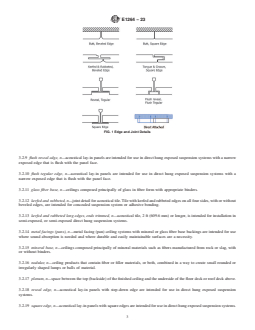
3.2.6 edge and joint detail, n—various edge and joint details
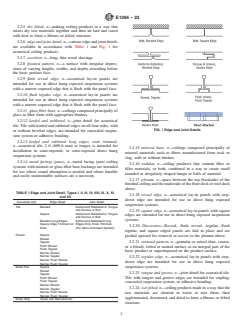
are available in accordance with Table 1 and Fig. 1 for
acoustical ceiling products.
3.2.7 excelsior, n—long, thin wood shavings.
3.2.8 fissured pattern, n—a surface with irregular depres-
sions of varying lengths, widths, and depths extending below
the basic product face.
3.2.9 flush reveal edge, n—acoustical lay-in panels are
intended for use in direct hung exposed suspension systems
with a narrow exposed edge that is flush with the panel face.
3.2.10 flush tegular edge, n—acoustical lay-in panels are
intended for use in direct hung exposed suspension systems
with a narrow exposed edge that is flush with the panel face.
3.2.11 glass fiber base, n—ceilings composed principally of
glass in fiber form with appropriate binders.
3.2.12 kerfed and rabbeted, n—joint detail for acoustical
tile. Tile with kerfed and rabbeted edges on all four sides, with
FIG. 1 Edge and Joint Details
or without beveled edges, are intended for concealed suspen-
sion system or adhesive bonding.
3.2.13 kerfed and rabbeted long edges, ends trimmed,
n—acoustical tile, 2 ft (609.6 mm) or longer, is intended for
3.2.15 mineral base, n—ceilings composed principally of
installation in semi-exposed, or semi-exposed direct hung
mineral materials such as fibers manufactured from rock or
suspension systems.
slag, with or without binders.
3.2.14 metal facings (pans), n—metal facing (pan) ceiling
3.2.16 nodular, n—ceiling products that contain fiber or
systems with mineral or glass fiber base backings are intended
filler materials, or both, combined in a way to create small
for use where sound absorption is needed and where durable
rounded or irregularly shaped lumps or balls of material.
and easily maintainable surfaces are a necessity.
3.2.17 plenum, n—space between the top (backside) of the
finished ceiling and the underside of the floor deck or roof deck
above.
TABLE 1 Edge and Joint Detail, Types I, II, III, IV, VIII, IX, X, XI,
3.2.18 reveal edge, n—acoustical lay-in panels with step-
and XII
down edge are intended for use in direct hung exposed
Acoustical Unit Edge Detail Joint Detail
suspension systems.
Tile Beveled Kerfed and Rabbeted or Tongue
and Groove or Butt
3.2.19 square edge, n—acoustical lay-in panels with square
Square Kerfed and Rabbeted or Tongue
edges are intended for use in direct hung exposed suspension
and Groove or Butt
systems.
Beveled Long Edges, Kerfed and Rabbeted Long
Square Edge Trimmed on Edges Only, Ends Trimmed.
3.2.20 Discussion—Reveal, flush reveal, tegular, flush
Ends (For Semi-concealed System)
tegular, and square edged panels are laid in place and are
Panels Square
pushed upward for removal or access to the plenum above.
Reveal
3.2.21 textured pattern, n—granular or raised (fine, coarse,
Tegular
Flush Reveal
or a blend), felted or matted surface as an integral part of the
Flush Tegular
basic product or superimposed on the product surface.
Narrow Reveal
Narrow Tegular
3.2.22 tegular edge, n—acoustical lay-in panels with step-
Narrow Flush Reveal
down edge are intended for use in direct hung exposed
Narrow Flush Tegular
Metal Pan Square suspension systems.
Reveal
3.2.23 tongue and groove, n—joint detail for acoustical tile.
Tegular
Flush Reveal Tile with tongue and groove edges are intended for stapling,
Flush Tegular
concealed suspension system, or adhesive bonding.
Narrow Reveal
Narrow Tegular 3.2.24 wet felted, n—ceiling products made in a way that the
Narrow Flush Reveal
raw materials are slurried in water to mix them, then
Narrow Flush Tegular
agglomerated, dewatered, and dried to form a fibrous or felted
Metal Strip Varies with Manufacturer
structure.
E1264 − 23
4. Significance and Use Form F1 – Perforated
Form F2 – Non perforated
4.1 This classification is used to classify and aid in the
Type G – Gypsum
selection of acoustical ceiling products.
Form G1 – Perforated
Form G2 – Non-perforated
5. Basis of Classification
Type H – Polycarbonate or Plastic
5.1 Acoustical ceiling products described using this classi-
Type I – Felt including polyester, wool, cotton, and
fication are one or more of the following types, forms, patterns,
cellulose
acoustical ratings, light reflectance values, and fire classes, as
Type J – Melamine foam tiles, planks and panels
specified.
Type XX – Other type (describe)
5.2 Ceiling Types:
NOTE 1—The facings specified in Type A and Type B shall be separate
Type A – Mineral Base
overlays and not coatings similar to paint.
Form A1 – with painted finish
1.1 Nodular
6. Ceiling Pattern
1.2 Wet formed
6.1 Patterns for acoustical ceilings shall be described by one
1.3 Dry formed
or more of the following:
1.4 Cast or molded
Pattern Designation Pattern Description
1.5 Other
A Perforated, regularly spaced large holes
Form A2 – with membrane-faced overlay
B Perforated, randomly spaced large holes
C Perforated, small holes
2.1 Nodular
D Fissured
2.2 Wet formed
E Lightly textured
2.3 Dry formed
F Heavily textured
G Smooth
2.4 Cast or molded
H Printed
2.5 Other
I Embossed
Form A3 – with a scrubbable pigment or clear finish
J Embossed-in-register
K Surface scored
3.1 Nodular
L Random swirl
3.2 Wet formed
Z Other patterns (describe)
3.3 Dry formed
7. Ratings
3.4 Cast or molded
3.5 Other
7.1 acoustical ratings—An acoustical ceiling product shall
Form A4 – with plastic or aluminum faced overlay
meet one or more of the following acoustical performance
4.1 Nodular
requirements:
4.2 Wet formed
7.1.1 noise reduction coeffıcient (NRC)—When NRC is to be
4.3 Dry formed
part of the classification, an acoustical ceiling product NRC
4.4 Cas
...
This document is not an ASTM standard and is intended only to provide the user of an ASTM standard an indication of what changes have been made to the previous version. Because
it may not be technically possible to adequately depict all changes accurately, ASTM recommends that users consult prior editions as appropriate. In all cases only the current version
of the standard as published by ASTM is to be considered the official document.
Designation: E1264 − 22 E1264 − 23
Standard Classification for
Acoustical Ceiling Products
This standard is issued under the fixed designation E1264; the number immediately following the designation indicates the year of
original adoption or, in the case of revision, the year of last revision. A number in parentheses indicates the year of last reapproval. A
superscript epsilon (´) indicates an editorial change since the last revision or reapproval.
This standard has been approved for use by agencies of the U.S. Department of Defense.
1. Scope
1.1 This classification covers ceiling products that provide acoustical performance and interior finish in buildings. Products used
in performance spaces and other special applications in some cases require more detailed specification than provided by this
classification.
1.2 This classification classifies acoustical ceilings by type, pattern, and certain ratings for acoustical performance, light
reflectance, and fire safety. It does not cover the aspects of acoustical ceilings when used as a component of a system or assembly
tested for fire endurance or floor/ceiling sound transmission.
1.3 This classification does not include physical properties, such as structural hardness, friability, sag, linear expansion and
contraction, and transverse strength, which affect the handling, installation, and use of acoustical ceiling products (see Test
Methods C367).
1.4 The values stated in inch-pound units are to be regarded as standard. The values given in parentheses are mathematical
conversions to SI units that are provided for information only and are not considered standard.
1.5 This international standard was developed in accordance with internationally recognized principles on standardization
established in the Decision on Principles for the Development of International Standards, Guides and Recommendations issued
by the World Trade Organization Technical Barriers to Trade (TBT) Committee.
2. Referenced Documents
2.1 ASTM Standards:
C367 Test Methods for Strength Properties of Prefabricated Architectural Acoustical Tile or Lay-In Ceiling Panels
C423 Test Method for Sound Absorption and Sound Absorption Coefficients by the Reverberation Room Method
C634 Terminology Relating to Building and Environmental Acoustics
E84 Test Method for Surface Burning Characteristics of Building Materials
E413 Classification for Rating Sound Insulation
E795 Practices for Mounting Test Specimens During Sound Absorption Tests
E1110 Classification for Determination of Articulation Class
E1111 Test Method for Measuring the Interzone Attenuation of Open Office Components
E1414 Test Method for Airborne Sound Attenuation Between Rooms Sharing a Common Ceiling Plenum
This classification is under the jurisdiction of ASTM Committee E33 on Building and Environmental Acoustics and is the direct responsibility of Subcommittee E33.04
on Application of Acoustical Materials and Systems.
Current edition approved April 1, 2022May 15, 2023. Published April 2022June 2023. Originally approved in 1988. Last previous edition approved in 20192022 as
E1264 – 19.E1264 – 22. DOI: 10.1520/E1264-22.10.1520/E1264-23.
For referenced ASTM standards, visit the ASTM website, www.astm.org, or contact ASTM Customer Service at service@astm.org. For Annual Book of ASTM Standards
volume information, refer to the standard’s Document Summary page on the ASTM website.
Copyright © ASTM International, 100 Barr Harbor Drive, PO Box C700, West Conshohocken, PA 19428-2959. United States
E1264 − 23
E1477 Test Method for Luminous Reflectance Factor of Acoustical Materials by Use of Integrating-Sphere Reflectometers
3. Terminology
3.1 Terms used in this standard are defined either in Terminology C634 or within this standard. The definition of terms explicitly
given within this standard take precedence over definitions given in Terminology C634. The definitions within Terminology C634
and this standard take precedence over any other definitions of defined terms found in any other documents, including other
documents that may be referenced in this standard.
3.2 Definitions of Terms Specific to This Standard:
3.2.1 acoustical panel, n—a form of a prefabricated sound absorbing ceiling element used with exposed suspension systems.
3.2.2 acoustical tile, n—a form of a prefabricated sound absorbing ceiling element used with concealed or semi-exposed
suspension systems, stapling, or adhesive bonding.
3.2.3 butt, n—a joint detail for acoustical tile, butt bevel, or butt square edge, without kerfing of the edges, intended for adhesive
bonding to solid backing.
3.2.4 cast or molded, n—making ceiling products in a way that the raw materials are mixed with water or liquid binder, then
deposited in a mold or form, and then dried/cured before being de-molded.
3.2.5 dry felted, n—making ceiling products in a way that mixes dry raw materials together and then air laid and cured with heat
to form a fibrous or felted structure.
3.2.6 edge and joint detail, n—various edge and joint details are available in accordance with Table 1 and Fig. 1 for acoustical
ceiling products.
3.2.7 excelsior, n—long, thin wood shavings.
3.2.8 fissured pattern, n—a surface with irregular depressions of varying lengths, widths, and depths extending below the basic
product face.
TABLE 1 Edge and Joint Detail, Types I, II, III, IV, VIII, IX, X, XI,
and XII
Acoustical Unit Edge Detail Joint Detail
Tile Beveled Kerfed and Rabbeted or Tongue
and Groove or Butt
Square Kerfed and Rabbeted or Tongue
and Groove or Butt
Beveled Long Edges, Kerfed and Rabbeted Long
Square Edge Trimmed on Edges Only, Ends Trimmed.
Ends (For Semi-concealed System)
Panels Square
Reveal
Tegular
Flush Reveal
Flush Tegular
Narrow Reveal
Narrow Tegular
Narrow Flush Reveal
Narrow Flush Tegular
Metal Pan Square
Reveal
Tegular
Flush Reveal
Flush Tegular
Narrow Reveal
Narrow Tegular
Narrow Flush Reveal
Narrow Flush Tegular
Metal Strip Varies with Manufacturer
E1264 − 23
FIG. 1 Edge and Joint Details
3.2.9 flush reveal edge, n—acoustical lay-in panels are intended for use in direct hung exposed suspension systems with a narrow
exposed edge that is flush with the panel face.
3.2.10 flush tegular edge, n—acoustical lay-in panels are intended for use in direct hung exposed suspension systems with a
narrow exposed edge that is flush with the panel face.
3.2.11 glass fiber base, n—ceilings composed principally of glass in fiber form with appropriate binders.
3.2.12 kerfed and rabbeted, n—joint detail for acoustical tile. Tile with kerfed and rabbeted edges on all four sides, with or without
beveled edges, are intended for concealed suspension system or adhesive bonding.
3.2.13 kerfed and rabbeted long edges, ends trimmed, n—acoustical tile, 2 ft (609.6 mm) or longer, is intended for installation in
semi-exposed, or semi-exposed direct hung suspension systems.
3.2.14 metal facings (pans), n—metal facing (pan) ceiling systems with mineral or glass fiber base backings are intended for use
where sound absorption is needed and where durable and easily maintainable surfaces are a necessity.
3.2.15 mineral base, n—ceilings composed principally of mineral materials such as fibers manufactured from rock or slag, with
or without binders.
3.2.16 nodular, n—ceiling products that contain fiber or filler materials, or both, combined in a way to create small rounded or
irregularly shaped lumps or balls of material.
3.2.17 plenum, n—space between the top (backside) of the finished ceiling and the underside of the floor deck or roof deck above.
3.2.18 reveal edge, n—acoustical lay-in panels with step-down edge are intended for use in direct hung exposed suspension
systems.
3.2.19 square edge, n—acoustical lay-in panels with square edges are intended for use in direct hung exposed suspension systems.
E1264 − 23
3.2.20 Discussion—Reveal, flush reveal, tegular, flush tegular, and square edged panels are laid in place and are pushed upward
for removal or access to the plenum above.
3.2.21 textured pattern, n—granular or raised (fine, coarse, or a blend), felted or matted surface as an integral part of the basic
product or superimposed on the product surface.
3.2.22 tegular edge, n—acoustical lay-in panels with step-down edge are intended for use in direct hung exposed suspension
systems.
3.2.23 tongue and groove, n—joint detail for acoustical tile. Tile with tongue and groove edges are intended for stapling, concealed
suspension system, or adhesive bonding.
3.2.24 wet felted, n—ceiling products made in a way that the raw materials are slurried in water to mix them, then agglomerated,
dewatered, and dried to form a fibrous or felted structure.
4. Significance and Use
4.1 This classification is used to classify and aid in the selection of acoustical ceiling products.
5. Basis of Classification
5.1 Acoustical ceiling products described using this classification are one or more of the following types, forms, patterns,
acoustical ratings, light reflectance values, and fire classes, as specified.
5.2 Ceiling Types:
5.2.1 Type I—Cellulose base with painted finish.
Type A – Mineral Base
Form A1 – with painted finish
1.1 Nodular
1.2 Wet formed
1.3 Dry formed
1.4 Cast or molded
1.5 Other
Form A2 – with membrane-faced overlay
2.1 Nodular
2.2 Wet formed
2.3 Dry formed
2.4 Cast or molded
2.5 Other
Form A3 – with a scrubbable pigment or clear finish
3.1 Nodular
3.2 Wet formed
3.3 Dry formed
3.4 Cast or molded
3.5 Other
Form A4 – with plastic or aluminum faced overlay
4.1 Nodular
4.2 Wet formed
4.3 Dry formed
4.4 Cast or molded
4.5 Other
Form A5 – with fabric faced overlay
5.1 Nodular
5.2 Wet formed
5.3 Dry formed
E1264 − 23
5.4 Cast or molded
5.5 Other
Type B – Glass fiber base with membrane overlay
Form B1 – Plastic
Form B2 – Cloth
Form B3 – Other
Type C – Aluminum or steel facing pan with mineral or glass backing
Form C1 – Perforated
Form C2 – Non perforated
Type D – Aluminum or steel facing plank with mineral or glass fiber backing
Form D1 – Perforated
Form D2 – Non perforated
Type E – Excelsior bonded with inorganics
Form E1 – with a scrubbable pigment
Form E2 – with a mineral or glass fiber facing
Form E3 – with a mineral or glass fiber backing
Type F – Wood with a mineral or glass fiber backing
Form F1 – Perforated
Form F2 – Non perforated
Type G – Gypsum
Form G1 – Perforated
Form G2 – Non-perforated
Type H – Polycarbonate or Plastic
Type I – Felt including polyester, wool, cotton, and cellulose
Type J – Melamine foam tiles, planks and panels
Type XX – Other type (describe)
5.2.2 Type II—Cellulose base with membrane-faced overlay.
NOTE 1—The facings specified in Type A and Type B shall be separate overlays and not coatings similar to paint.
5.2.3 Type III—Mineral base with painted finish.
5.2.3.1 Form 1—Nodular.
5.2.3.2 Form 2—Wet felted.
5.2.3.3 Form 3—Dry felted.
5.2.3.4 Form 4—Cast or molded.
5.2.3.5 Form 5—Other (describe).
5.2.4 Type IV—Mineral base with membrane-faced overlay.
5.2.4.1 Form 1—Nodular.
5.2.4.2 Form 2—Wet felted.
5.2.4.3 Form 3—Dry felted.
5.2.4.4 Form 4—Cast or molded.
5.2.4.5 Form 5—Other (describe).
5.2.5 Type V—Perforated steel facing (pan) with mineral or glass fiber base backing.
5.2.6 Type VI—Perforated stainless steel facing (pan) with mineral or glass fiber base backing.
E1264 − 23
5.2.7 Type VII—Perforated aluminum facing (pan) with mineral or glass fiber base backing.
5.2.8 Type VIII—Cellulose base with scrubbable pigmented or clear finish.
5.2.9 Type IX—Mineral base with scrubbable pigmented or clear finish.
5.2.9.1 Form 1—Nodular.
5.2.9.2 Form 2—Wet felted.
5.2.9
...