

ASTM E1111/E1111M-14(2022)
(Test Method)Standard Test Method for Measuring the Interzone Attenuation of Open Office Components
General Information
- Abstract
SIGNIFICANCE AND USE
5.1 Providing speech privacy in open-plan spaces depends upon many factors, the most significant of which are the following: (1) the shadow zone of part-height space dividers and the diffraction of sound from the edges of space dividers; (2) the primary sound reflective properties of the ceiling system; (3) the level of masking sound present in the space; and (4) the distance between speaker and listener. Guide E1374 provides additional detail on the factors contributing to speech privacy in open-plan spaces.
5.2 In this test method the third factor, masking sound, is eliminated and the fourth factor, the distance between speaker and listener, is standardized for all specimen types. For the measurement of ceiling systems, the first factor, the shadow zone, is also standardized for each divider height used. Experience has indicated that results obtained by this test method may not fairly represent the speech privacy that may be achievable with non-flat ceiling systems. For the measurement of furniture panels used as acoustical barriers, the second of these factors, the sound reflectance of the ceiling, is standardized. For the measurement of reflective and absorptive vertical surfaces used as wall finishings or furniture panels, the first and second factors are standardized and all paths between the speaker and listener reflecting only off of the ceiling are eliminated.
5.3 This test method provides standardized techniques to assess the contribution of specific components of an open-plan space. The test method specifies an acoustical testing environment for each component type that isolates its contribution from the contribution of other components, which may in actual open-plan environments contribute significantly to the overall speech privacy.
5.4 The significance of test results obtained by this test method must also be considered with regard to the attainable measurement accuracy. The attainment of speech privacy in the presence of masking sound is cri...
SCOPE
1.1 This test method covers the measurement of the interzone attenuation for three components of open-plan spaces:
1.1.1 Ceiling systems when used in conjunction with partial-height space dividers. This arrangement is commonly used in offices to achieve speech privacy between work zones in the absence of full-height partitions. This test method is applicable to any ceiling configuration, including, for example, a pattern of sound-reflective panels in an otherwise sound-absorptive ceiling. This test method generally requires use of a fixed space divider height of 1.50 m [5 ft]. In recognition of trends toward alternate divider heights in open office environments, measurements with an alternate divider height may be conducted in accordance with this standard.
1.1.2 Furniture panels used as acoustical barriers in open-plan spaces to provide speech privacy or sound isolation between working positions.
1.1.3 Vertical panels, including wall finishes such as sound-absorbent panels, and furniture panels or screens which may reflect sound. It may not be applicable to such items as window finishes or furniture other than panels if these differ significantly from flat wall panels.
1.1.4 The combination of results from the various components of an open-plan office is beyond the scope of this standard.
1.2 The values stated in either SI units or inch-pound units are to be regarded separately as standard. The values stated in each system are not necessarily exact equivalents; therefore, to ensure conformance with the standard, each system shall be used independently of the other, and values from the two systems shall not be combined.
1.3 Unless otherwise qualified, all dimensions specified in this test method shall be understood to have a tolerance of ±6 mm (±1/4 in.) The values stated in SI units are to be regarded as the standard. The values given in parentheses are provided for information only.
1.4 This standa...
- Status
- Published
- Publication Date
- 31-Mar-2022
- Technical Committee
- E33 - Building and Environmental Acoustics
- Drafting Committee
- E33.02 - Speech Privacy
Overview
ASTM E1111/E1111M-14(2022), titled Standard Test Method for Measuring the Interzone Attenuation of Open Office Components, is an internationally recognized ASTM standard for evaluating the acoustical performance of individual components in open-plan office environments. The standard provides a systematic method to measure how well ceilings, furniture panels, and wall panels attenuate or block sound transmission between different work zones, helping to assess their contribution to speech privacy in open-plan layouts.
Addressing the complex challenge of achieving adequate speech privacy in open-plan offices, ASTM E1111/E1111M sets out objective procedures to test and compare the effectiveness of architectural components under controlled conditions. The results support building designers, facility managers, manufacturers, and acoustic consultants in decision-making and compliance with building acoustics standards.
Key Topics
- Speech Privacy Factors: Identifies the main elements affecting speech privacy in open-plan offices, including space divider height and design, ceiling reflectivity, masking sound levels, and distance between speaker and listener.
- Isolation of Component Performance: The method isolates the contribution of each component (ceiling, furniture barrier, wall finish) by eliminating or standardizing other variables, such as masking sound and speaker-listener distance.
- Measurement Procedures: Specifies laboratory and field test arrangements for each component:
- Ceilings with partial-height space dividers: Evaluates ceiling system performance in conjunction with standardized divider heights.
- Furniture panels: Tests panels as acoustical barriers as well as their ability to reduce reflected sound.
- Vertical wall finishes: Assesses both sound-absorptive and reflective finishes, including furniture panels used as wall screens.
- Standardized Test Conditions: Outlines requirements for test facility dimensions, specimen placement, microphone calibration, and measurement accuracy.
- Reporting and Classification: Details the information to be included in test reports, including the location/orientation of components, survey paths, and the calculated articulation class (AC) to indicate sound attenuation effectiveness.
Applications
ASTM E1111/E1111M holds practical value for a variety of stakeholders in the fields of office design, construction, and acoustical engineering:
- Architects and Interior Designers: Utilize test data to select and specify components (e.g., ceiling tiles, workstation panels, wall finishes) that enhance speech privacy and meet project requirements.
- Manufacturers of Office Furniture and Building Materials: Rely on standardized testing to validate and market the acoustic performance of their products.
- Acoustic Consultants and Engineers: Reference test results and methodology to advise clients, create acoustic models, and troubleshoot privacy issues in existing spaces.
- Facility and Workplace Managers: Use results to implement modifications that improve working conditions and productivity in open office environments.
- Compliance and Certification: Provides an objective, repeatable method to meet guidelines under broader standards related to building acoustics and speech privacy.
Related Standards
Users of ASTM E1111/E1111M-14(2022) frequently refer to related standards and guidelines, including:
- ASTM E1374 – Guide for Office Acoustics and Applicable ASTM Standards
- ASTM E423 – Test Method for Sound Absorption and Sound Absorption Coefficients by the Reverberation Room Method
- ASTM E1179 – Specification for Sound Sources Used for Testing Open Office Components and Systems
- ASTM C634 – Terminology Relating to Building and Environmental Acoustics
- ASTM E1110 – Classification for Determination of Articulation Class
Through these references, ASTM E1111/E1111M supports a comprehensive approach to open-plan office acoustics, promoting informed product selection and workplace design for optimal noise control and privacy.
Keywords: ASTM E1111, office acoustics standard, speech privacy, interzone attenuation, open-plan office, ceiling sound attenuation, furniture acoustical panels, sound absorption, articulation class, building acoustics testing, acoustics compliance.
Relations
- Effective Date
- 01-Apr-2019
- Effective Date
- 01-Apr-2019
- Effective Date
- 01-Jan-2018
- Effective Date
- 01-Jan-2018
- Effective Date
- 01-Sep-2013
- Effective Date
- 01-Aug-2013
- Refers
ASTM E795-05(2012) - Standard Practices for Mounting Test Specimens During Sound Absorption Tests - Effective Date
- 01-Sep-2012
- Effective Date
- 01-Dec-2011
- Effective Date
- 01-Nov-2011
- Effective Date
- 01-Nov-2011
- Effective Date
- 01-Nov-2011
- Effective Date
- 01-Sep-2010
- Effective Date
- 01-Jun-2010
- Effective Date
- 15-Oct-2009
- Effective Date
- 01-Oct-2009
Get Certified
Connect with accredited certification bodies for this standard

DIBt (Deutsches Institut für Bautechnik)
German Institute for Building Technology.
DIN CERTCO
DIN Group product certification.

Aboma Certification B.V.
Specialized in construction, metal, and transport sectors.
Sponsored listings
Frequently Asked Questions
ASTM E1111/E1111M-14(2022) is a standard published by ASTM International. Its full title is "Standard Test Method for Measuring the Interzone Attenuation of Open Office Components". This standard covers: SIGNIFICANCE AND USE 5.1 Providing speech privacy in open-plan spaces depends upon many factors, the most significant of which are the following: (1) the shadow zone of part-height space dividers and the diffraction of sound from the edges of space dividers; (2) the primary sound reflective properties of the ceiling system; (3) the level of masking sound present in the space; and (4) the distance between speaker and listener. Guide E1374 provides additional detail on the factors contributing to speech privacy in open-plan spaces. 5.2 In this test method the third factor, masking sound, is eliminated and the fourth factor, the distance between speaker and listener, is standardized for all specimen types. For the measurement of ceiling systems, the first factor, the shadow zone, is also standardized for each divider height used. Experience has indicated that results obtained by this test method may not fairly represent the speech privacy that may be achievable with non-flat ceiling systems. For the measurement of furniture panels used as acoustical barriers, the second of these factors, the sound reflectance of the ceiling, is standardized. For the measurement of reflective and absorptive vertical surfaces used as wall finishings or furniture panels, the first and second factors are standardized and all paths between the speaker and listener reflecting only off of the ceiling are eliminated. 5.3 This test method provides standardized techniques to assess the contribution of specific components of an open-plan space. The test method specifies an acoustical testing environment for each component type that isolates its contribution from the contribution of other components, which may in actual open-plan environments contribute significantly to the overall speech privacy. 5.4 The significance of test results obtained by this test method must also be considered with regard to the attainable measurement accuracy. The attainment of speech privacy in the presence of masking sound is cri... SCOPE 1.1 This test method covers the measurement of the interzone attenuation for three components of open-plan spaces: 1.1.1 Ceiling systems when used in conjunction with partial-height space dividers. This arrangement is commonly used in offices to achieve speech privacy between work zones in the absence of full-height partitions. This test method is applicable to any ceiling configuration, including, for example, a pattern of sound-reflective panels in an otherwise sound-absorptive ceiling. This test method generally requires use of a fixed space divider height of 1.50 m [5 ft]. In recognition of trends toward alternate divider heights in open office environments, measurements with an alternate divider height may be conducted in accordance with this standard. 1.1.2 Furniture panels used as acoustical barriers in open-plan spaces to provide speech privacy or sound isolation between working positions. 1.1.3 Vertical panels, including wall finishes such as sound-absorbent panels, and furniture panels or screens which may reflect sound. It may not be applicable to such items as window finishes or furniture other than panels if these differ significantly from flat wall panels. 1.1.4 The combination of results from the various components of an open-plan office is beyond the scope of this standard. 1.2 The values stated in either SI units or inch-pound units are to be regarded separately as standard. The values stated in each system are not necessarily exact equivalents; therefore, to ensure conformance with the standard, each system shall be used independently of the other, and values from the two systems shall not be combined. 1.3 Unless otherwise qualified, all dimensions specified in this test method shall be understood to have a tolerance of ±6 mm (±1/4 in.) The values stated in SI units are to be regarded as the standard. The values given in parentheses are provided for information only. 1.4 This standa...
SIGNIFICANCE AND USE 5.1 Providing speech privacy in open-plan spaces depends upon many factors, the most significant of which are the following: (1) the shadow zone of part-height space dividers and the diffraction of sound from the edges of space dividers; (2) the primary sound reflective properties of the ceiling system; (3) the level of masking sound present in the space; and (4) the distance between speaker and listener. Guide E1374 provides additional detail on the factors contributing to speech privacy in open-plan spaces. 5.2 In this test method the third factor, masking sound, is eliminated and the fourth factor, the distance between speaker and listener, is standardized for all specimen types. For the measurement of ceiling systems, the first factor, the shadow zone, is also standardized for each divider height used. Experience has indicated that results obtained by this test method may not fairly represent the speech privacy that may be achievable with non-flat ceiling systems. For the measurement of furniture panels used as acoustical barriers, the second of these factors, the sound reflectance of the ceiling, is standardized. For the measurement of reflective and absorptive vertical surfaces used as wall finishings or furniture panels, the first and second factors are standardized and all paths between the speaker and listener reflecting only off of the ceiling are eliminated. 5.3 This test method provides standardized techniques to assess the contribution of specific components of an open-plan space. The test method specifies an acoustical testing environment for each component type that isolates its contribution from the contribution of other components, which may in actual open-plan environments contribute significantly to the overall speech privacy. 5.4 The significance of test results obtained by this test method must also be considered with regard to the attainable measurement accuracy. The attainment of speech privacy in the presence of masking sound is cri... SCOPE 1.1 This test method covers the measurement of the interzone attenuation for three components of open-plan spaces: 1.1.1 Ceiling systems when used in conjunction with partial-height space dividers. This arrangement is commonly used in offices to achieve speech privacy between work zones in the absence of full-height partitions. This test method is applicable to any ceiling configuration, including, for example, a pattern of sound-reflective panels in an otherwise sound-absorptive ceiling. This test method generally requires use of a fixed space divider height of 1.50 m [5 ft]. In recognition of trends toward alternate divider heights in open office environments, measurements with an alternate divider height may be conducted in accordance with this standard. 1.1.2 Furniture panels used as acoustical barriers in open-plan spaces to provide speech privacy or sound isolation between working positions. 1.1.3 Vertical panels, including wall finishes such as sound-absorbent panels, and furniture panels or screens which may reflect sound. It may not be applicable to such items as window finishes or furniture other than panels if these differ significantly from flat wall panels. 1.1.4 The combination of results from the various components of an open-plan office is beyond the scope of this standard. 1.2 The values stated in either SI units or inch-pound units are to be regarded separately as standard. The values stated in each system are not necessarily exact equivalents; therefore, to ensure conformance with the standard, each system shall be used independently of the other, and values from the two systems shall not be combined. 1.3 Unless otherwise qualified, all dimensions specified in this test method shall be understood to have a tolerance of ±6 mm (±1/4 in.) The values stated in SI units are to be regarded as the standard. The values given in parentheses are provided for information only. 1.4 This standa...
ASTM E1111/E1111M-14(2022) is classified under the following ICS (International Classification for Standards) categories: 91.060.30 - Ceilings. Floors. Stairs. The ICS classification helps identify the subject area and facilitates finding related standards.
ASTM E1111/E1111M-14(2022) has the following relationships with other standards: It is inter standard links to ASTM E1110-06(2019), ASTM E1179-13(2019), ASTM E1374-18e1, ASTM E1374-18, ASTM C634-13, ASTM E1179-13, ASTM E795-05(2012), ASTM C634-11, ASTM E1374-06(2011), ASTM E1110-06(2011), ASTM E1179-11, ASTM C634-10a, ASTM C634-10, ASTM C423-09a, ASTM C423-09. Understanding these relationships helps ensure you are using the most current and applicable version of the standard.
ASTM E1111/E1111M-14(2022) is available in PDF format for immediate download after purchase. The document can be added to your cart and obtained through the secure checkout process. Digital delivery ensures instant access to the complete standard document.
Standards Content (Sample)
This international standard was developed in accordance with internationally recognized principles on standardization established in the Decision on Principles for the
Development of International Standards, Guides and Recommendations issued by the World Trade Organization Technical Barriers to Trade (TBT) Committee.
Designation: E1111/E1111M − 14 (Reapproved 2022)
Standard Test Method for
Measuring the Interzone Attenuation of Open Office
Components
This standard is issued under the fixed designation E1111/E1111M; the number immediately following the designation indicates the year
of original adoption or, in the case of revision, the year of last revision. A number in parentheses indicates the year of last reapproval.
A superscript epsilon (´) indicates an editorial change since the last revision or reapproval.
INTRODUCTION
This test method describes the measurement and evaluation of acoustical performance of
components affecting speech privacy in open-plan spaces. The maximum privacy theoretically
availableatnormalworkingdistancesinopen-planspaces,withpartialheightspacedividers(screens),
isinsufficientwithouttheassistanceofrelativelyelevatedbackgroundmaskingsoundlevels.Thus,the
provision of adequate speech privacy in open-plan offices and schools is one of the most difficult tasks
in the architectural acoustics field. This test method provides a means of objectively measuring the
relevant acoustical characteristics of three major components of open-plan spaces, the ceiling system,
furniture panels used as acoustical barriers, and wall finishes which attenuate reflected sound.
Furniture panels may be tested for their capacity as an acoustical barrier and/or the degree to which
they may reduce reflected sound.
1. Scope finishes or furniture other than panels if these differ signifi-
cantly from flat wall panels.
1.1 This test method covers the measurement of the inter-
1.1.4 The combination of results from the various compo-
zone attenuation for three components of open-plan spaces:
nents of an open-plan office is beyond the scope of this
1.1.1 Ceiling systems when used in conjunction with
partial-height space dividers. This arrangement is commonly standard.
used in offices to achieve speech privacy between work zones
1.2 The values stated in either SI units or inch-pound units
in the absence of full-height partitions. This test method is
are to be regarded separately as standard. The values stated in
applicable to any ceiling configuration, including, for example,
each system are not necessarily exact equivalents; therefore, to
a pattern of sound-reflective panels in an otherwise sound-
ensure conformance with the standard, each system shall be
absorptive ceiling. This test method generally requires use of a
used independently of the other, and values from the two
fixed space divider height of 1.50 m [5 ft]. In recognition of
systems shall not be combined.
trends toward alternate divider heights in open office
environments, measurements with an alternate divider height
1.3 Unless otherwise qualified, all dimensions specified in
may be conducted in accordance with this standard.
this test method shall be understood to have a tolerance of 66
1.1.2 Furniture panels used as acoustical barriers in open-
mm (6 ⁄4 in.) The values stated in SI units are to be regarded
plan spaces to provide speech privacy or sound isolation
as the standard. The values given in parentheses are provided
between working positions.
for information only.
1.1.3 Vertical panels, including wall finishes such as sound-
1.4 This standard does not purport to address all of the
absorbent panels, and furniture panels or screens which may
safety concerns, if any, associated with its use. It is the
reflectsound.Itmaynotbeapplicabletosuchitemsaswindow
responsibility of the user of this standard to establish appro-
priate safety, health, and environmental practices and deter-
ThistestmethodisunderthejurisdictionofASTMCommitteeE33onBuilding
mine the applicability of regulatory limitations prior to use.
and Environmental Acoustics and is the direct responsibility of Subcommittee
E33.02 on Speech Privacy.
1.5 This international standard was developed in accor-
Current edition approved April 1, 2022. Published April 2022. Originally
dance with internationally recognized principles on standard-
approved in 1986. Last previous edition approved in 2014 as E1111/E1111M – 14.
DOI: 10.1520/E1111_E1111M-14R22. ization established in the Decision on Principles for the
Copyright © ASTM International, 100 Barr Harbor Drive, PO Box C700, West Conshohocken, PA 19428-2959. United States
E1111/E1111M − 14 (2022)
Development of International Standards, Guides and Recom- point in question and for two adjacent positions 0.30 m (1 ft)
mendations issued by the World Trade Organization Technical along the survey path.
Barriers to Trade (TBT) Committee.
4. Summary of Test Method
2. Referenced Documents
4.1 The test facility is essentially an expanse of floor and
2.1 ASTM Standards:
ceiling in which all surfaces excluding the floor and test
C423 Test Method for SoundAbsorption and SoundAbsorp-
specimen have negligible sound reflections. The facility may
tion Coefficients by the Reverberation Room Method
be set up in a laboratory, in a mock-up of a proposed building,
C634 Terminology Relating to Building and Environmental
or in a completed building. The configuration of the room will
Acoustics
depend on the open-plan component being tested.
E795 Practices for Mounting Test Specimens During Sound
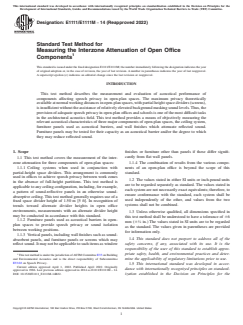
4.1.1 For testing a ceiling system, a standard space divider
Absorption Tests
is positioned with such dimensions and construction that sound
E1110 Classification for Determination ofArticulation Class
generated on one side can reach a measuring point on the other
E1179 Specification for Sound Sources Used for Testing
sideonlybywayofdiffractionoverthetopofthespacedivider
Open Office Components and Systems
and by reflection from the ceiling. With the diffracted compo-
E1374 Guide for Office Acoustics and Applicable ASTM
nent fixed by the dimensions of the space divider and by the
Standards
height of the source and measurement position, the difference
2.2 ANSI Standards:
betweenthesoundpressurelevelsmeasuredoneachsideofthe
S1.4 Specification for Sound Level Meters
space divider provides a comparative measure of the contribu-
S1.6 Preferred Frequencies and Band Numbers for Acousti-
tionofceilingsystemreflectiontothetotalsoundtransmission.
cal Measurements
See Figs. 1 and 2.
S1.11 Specification for Octave Band and Fractional-Octave-
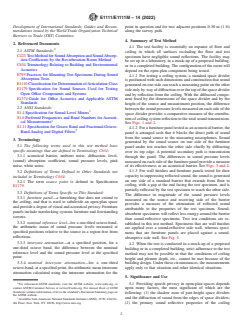
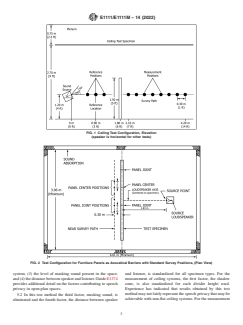
4.1.2 Forafurniturepaneltestedasanacousticalbarrier,the
Band Analog and Digital Filters
panel is arranged such that it blocks the direct path of sound
from the sound source to the measuring microphones. Sound
3. Terminology
generated by the sound source on one side of the furniture
3.1 The following terms used in this test method have
panel under test reaches the other side chiefly by diffracting
specific meanings that are defined in Terminology C634:
over its top edge. A potential secondary path is transmission
3.1.1 acoustical barrier, ambient noise, diffraction, level,
through the panel. The differences in sound pressure levels
(sound) absorption coefficient, sound pressure levels, pink
measured on each side of the furniture panel provide a measure
noise, white noise.
of its effectiveness as an acoustical barrier. See Figs. 3 and 4.
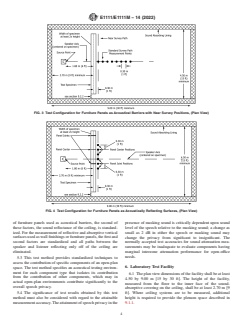
4.1.3 For wall finishes and furniture panels tested for their
3.2 Definitions of Terms Defined in Other Standards not
capacity in suppressing reflected sound, the sound is generated
included in Terminology C634:
on one side of a standard barrier that extends from floor to
3.2.1 The term source point is defined in Specification
ceiling, with a gap at the end facing the test specimen, and is
E1179.
partially reflected by the test specimen to reach the other side.
3.3 Definitions of Terms Specific to This Standard:
The difference in magnitude of the sound pressure levels
3.3.1 furniture panel—a furnishing that does not extend to
measured on the source and receiving side of the barrier
the ceiling, and that is used to subdivide an open-plan space
provides a measure of the attenuation of reflected sound
andprovideadegreeofvisualandacousticalprivacy.Furniture
attributable to the properties of the test specimen. Sound-
panels include interlocking systems furniture and freestanding
absorbent specimens will reflect less energy around the barrier
screens.
than sound-reflective specimens. Two test conditions are es-
3.3.2 nominal reference level—for a one-third octave-band,
tablished in this test method. Specimens that are wall finishes
the arithmetic mean of sound pressure levels measured at
are applied over a sound-reflective side wall, whereas speci-
specified positions relative to the source in a region free from
mens that are furniture panels are placed against a sound-
reflections.
absorptive side wall. See Fig. 5.
3.3.3 interzone attenuation—at a specified position, for a
4.2 When the test is conducted in a mock-up of a proposed
one-third octave band, the difference between the nominal
building or in a completed building, strict adherence to the test
reference level and the sound pressure level at the specified
method may not be possible in that the conditions of ceiling
point.
height and plenum depth, etc., cannot be met because of the
3.3.4 nominal interzone attenuation—for a one-third building design. Under these circumstances, the measurements
octave-band,ataspecifiedpoint,thearithmeticmeaninterzone apply only to that situation and other identical situations.
attenuation calculated using the interzone attenuation for the
5. Significance and Use
5.1 Providing speech privacy in open-plan spaces depends
For referenced ASTM standards, visit the ASTM website, www.astm.org, or
contact ASTM Customer Service at service@astm.org. For Annual Book of ASTM
upon many factors, the most significant of which are the
Standards volume information, refer to the standard’s Document Summary page on
following: (1) the shadow zone of part-height space dividers
the ASTM website.
and the diffraction of sound from the edges of space dividers;
Available from American National Standards Institute (ANSI), 25 W. 43rd St.,
4th Floor, New York, NY 10036, http://www.ansi.org. (2) the primary sound reflective properties of the ceiling
E1111/E1111M − 14 (2022)
FIG. 1 Ceiling Test Configuration, Elevation
(speaker is horizontal for other tests)
FIG. 2 Test Configuration for Furniture Panels as Acoustical Barriers with Standard Survey Positions, (Plan View)
system; (3) the level of masking sound present in the space; and listener, is standardized for all specimen types. For the
and (4)thedistancebetweenspeakerandlistener.GuideE1374
measurement of ceiling systems, the first factor, the shadow
provides additional detail on the factors contributing to speech
zone, is also standardized for each divider height used.
privacy in open-plan spaces.
Experience has indicated that results obtained by this test
methodmaynotfairlyrepresentthespeechprivacythatmaybe
5.2 In this test method the third factor, masking sound, is
achievable with non-flat ceiling systems. For the measurement
eliminated and the fourth factor, the distance between speaker
E1111/E1111M − 14 (2022)
FIG. 3 Test Configuration for Furniture Panels as Acoustical Barriers with Near Survey Positions, (Plan View)
FIG. 4 Test Configuration for Furniture Panels as Acoustically Reflecting Surfaces, (Plan View)
of furniture panels used as acoustical barriers, the second of presence of masking sound is critically dependent upon sound
these factors, the sound reflectance of the ceiling, is standard- level of the speech relative to the masking sound; a change as
ized. For the measurement of reflective and absorptive vertical
small as 2 dB in either the speech or masking sound may
surfacesusedaswallfinishingsorfurniturepanels,thefirstand change the privacy from significant to insignificant. The
second factors are standardized and all paths between the
normally accepted test accuracies for sound attenuation mea-
speaker and listener reflecting only off of the ceiling are surements may be inadequate to evaluate components having
eliminated.
marginal interzone attenuation performance for open-office
needs.
5.3 This test method provides standardized techniques to
assess the contribution of specific components of an open-plan
6. Laboratory Test Facility
space. The test method specifies an acoustical testing environ-
ment for each component type that isolates its contribution
6.1 The plan view dimensions of the facility shall be at least
from the contribution of other components, which may in
4.50 by 9.00 m [15 by 30 ft]. The height of the facility,
actual open-plan environments contribute significantly to the
measured from the floor to the inner face of the sound-
overall speech privacy.
absorptive covering on the ceiling, shall be at least 2.70 m [9
5.4 The significance of test results obtained by this test ft]. Where ceiling systems are to be measured, additional
height is required to provide the plenum space described in
method must also be considered with regard to the attainable
measurementaccuracy.Theattainmentofspeechprivacyinthe 9.1.1.
E1111/E1111M − 14 (2022)
FIG. 5 Measurement Positions for Reference Levels, (Plan View)
NOTE 1—Since the core and absorptive facings of the divider extend to
6.2 The floor shall be of a solid material such as concrete or
2 2
its top, the divider may not be capped.
plywood weighing at least 20 kg/m (4 lb⁄ft ). It shall be
coveredwithcarpetwithoutanunderlayment.Thisistypicalof
6.4.2 For measurements on furniture panels tested as acous-
openplanspaces.Theabsorptioncoefficientsofthecarpetshall tical barriers: The ceiling covering shall have random inci-
be measured in accordance with Test Method C423, and the
dence sound absorption coefficients of at least 0.95 at all
sound absorption average (SAA) shall lie in the range from frequencies at which measurements are to be made. See Figs.
0.15 to 0.40.
2 and 3.
6.3 Thewallsshallhaverandomincidencesoundabsorption
NOTE 2—Since reflections from those portions of the walls and ceiling
coefficients of at least 0.90 for all test frequencies. The wall
ofthefacilitywhicharenotpartofthespecimenmayreducethemeasured
attenuations, it is important to eliminate these reflections as much as
covering sound absorption shall be measured in accordance
possible.
with Test Method C423 with a mounting equivalent to that
used in the test facility except where the requirements of 9.3
6.4.3 For measurements of wall finishes or furniture panels
are to be met. To meet the requirements of 9.3, the sound tested for the ability to attenuate reflected sound:
absorbing material on sections of a wall may either be
6.4.3.1 The ceiling coverings shall have random incidence
demountable or be covered with a hard surface.
sound absorption coefficients of at least 0.95 at all frequencies
at which measurements are to be made.
6.4 Test configuration shall be as follows:
6.4.3.2 A standard barrier shall extend from the floor to the
6.4.1 For measurements of a ceiling system, a space divider
ceiling of the test facility and shall be no greater than 200 mm
shall extend the full width of the facility between the side walls
[8 in.] thick. It shall comprise a septum of rigid, impermeable
and shall be placed at least 2.70 m [9 ft] from both end walls.
material having a surface weight of approximately 10 kg/m [2
The divider shall have a core of rigid, impermeable material
2 2
lb/ft ] such as 12 mm [0.5 in.] gypsum board or plywood, and
weighing not less than 7.0 kg/m [1.4 lb/ft ], and shall be faced
sound-absorbing material on both sides of the septum. This
on both sides with a 50 mm [2.0 in.] thickness of sound
sound absorbing material shall have a minimum SAA of 0.80
absorbing material.The core shall extend fully to the top of the
when measured in a Type A mounting (see Practices E795)in
space divider, as shall the sound absorption facing material.
accordance with Test Method C423. See Fig. 5.
The space divider shall have a minimum SAA of 0.80 when
6.4.3.3 The bottom edge of the barrier shall fit snugly
measured in general accordance with the provisions for testing
against the floor. If the barrier is assembled in sections, care
office space dividers in Test Method C423. There shall be no
shall be taken to minimize sound leaks at the joints.At the end
gap between the bottom of the space divider and the floor. If
remote from the specimen, the barrier should be extended to
the space divider is assembled in sections, care shall be taken
meet the wall of the test chamber to prevent sound transmis-
to minimize sound transmission at the joints. Measurements
shall be made with a space divider 1.50 m [5 ft] high. sion.
Measurements may also be made with a space divider 1.80 m 6.4.3.4 The standard barrier shall be placed at least 2.7 m [9
[6 ft] high. See Figs. 1 and 2. ft] from both end walls.
E1111/E1111M − 14 (2022)
NOTE 3—In a ceiling containing both sound absorptive and reflective
7. Apparatus
areas such as light fixtures, interzone attenuation values may differ widely
7.1 A sound source meeting the specifications and require-
depending on the location of the survey line with respect to the ceiling
ments of Specification E1179 is required. It is best described as
layout. It is therefore advantageous to choose two or three survey lines in
such a way as to yield both maximum and minimum attenuations. The
a loudspeaker within an enclosure with special constraints on
orientation and survey line for minimum attenuation shall always be
directivity.
measured and reported.
7.1.1 The sound power generated by the sound source shall
9.2 Furniture Panels Tested as Acoustical Barriers:
be adequate to maintain one-third octave band sound pressure
9.2.1 Furniture panels to be tested shall be assembled in
levels at least 10 dB above the ambient noise levels of the test
accordance with the manufacturer’s instructions and shall be
facility and the internal noise levels of the measuring instru-
arranged as they would normally be arranged in an open office.
mentation at each of the desired measurement locations.
Joints between panels shall be sealed by no other means than
7.2 Microphones:
those provided or recommended by the manufacturer.
7.2.1 All microphones shall meet ANSI S1.4 Type 1 speci-
9.2.2 Inordertopreventflankingaroundtheendsofapanel,
fication and have a documented frequency response provided
the width of the specimen shall be at least twice its height or its
by a calibration laboratory or manufacturer, measured by either
width may be the same as the width of the test facility. Two or
the electrostatic actuator or reciprocity method.
morepanelsmaybeplacedorjoinededgetoedgetomeetthese
7.2.2 Each microphone shall have a free field frequency
recommendations. Normal installation procedure shall be fol-
response of 60.5 dB from 200 to 5000 Hz and at angles of
lowed.
incidence between 0 an 90 degrees.
9.2.3 The specimen shall be placed at least 2.70 m [9 ft]
7.2.3 If multiple microphones are used, channels for all
from both end walls.
microphones shall have the sensitivity adjusted with the same
9.2.4 Report the height of the specimen. The height of the
calibrator such that all channels read the same value 60.1 dB
specimen should not exceed 2.40 m [8 ft]. If the specimen is
at the calibrator frequency.
higher than 2.40 m [8 ft], the height shall be completely
7.2.4 Instrumentation used to measure sound pressure levels
documented in the test report as discussed in 12.1.12.
shall meet the meter response requirements of ANSI S1.4.
9.2.5 Furniture panels may be tested with accessories at-
7.3 Filters—Filters used with the microphone or source
tached to them. The accessories and the positions where they
amplifiers shall conform toANSI Specification S1.11 for Or
...