

ASTM F2195-18(2023)
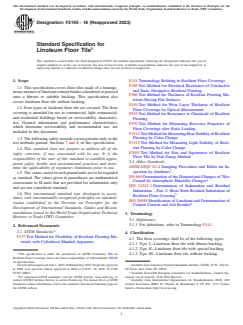
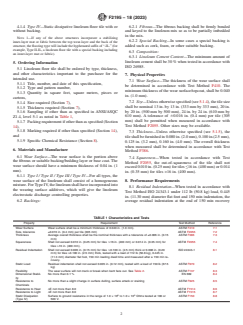
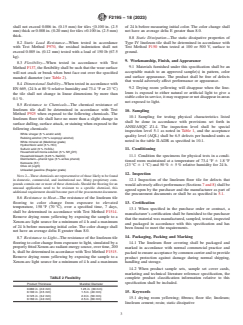
(Specification)Standard Specification for Linoleum Floor Tile
General Information
- Abstract
ABSTRACT
This specification covers floor tiles made of a homogeneous mixture of linoleum cement binder calendered or pressed onto a fibrous or suitable backing for use in commercial, light commercial and residential buildings based on serviceability characteristics. General information and performance characteristics, which determine serviceability and recommended use, are included in this document. The floor coverings shall be of the following types: Type I—linoleum floor tile with fibrous backing; Type II—linoleum floor tile with special backing; Type III—linoleum floor tile without backing; and Type IV—static dissipative linoleum floor tile with or without backing. Materials shall be tested and the individual grades shall conform to specified values of physical properties such as wear surface, size, thickness, and squareness; performance requirements such as residual indentation, static load resistance, flexibility, dimensional stability, resistance to chemicals, resistance to heat, resistance to light, and static dissipation.
SCOPE
1.1 This specification covers floor tiles made of a homogeneous mixture of linoleum cement binder calendered or pressed onto a fibrous or suitable backing. This specification also covers linoleum floor tile without backing.
1.2 Four types of linoleum floor tile are covered. The floor covering is intended for use in commercial, light commercial, and residential buildings based on serviceability characteristics. General information and performance characteristics, which determine serviceability and recommended use, are included in this document.
1.3 The following safety hazards caveat pertains only to the test methods portion, Sections 7 and 8, of this specification.
1.4 This standard does not purport to address all of the safety concerns, if any, associated with its use. It is the responsibility of the user of this standard to establish appropriate safety, health, and environmental practices and determine the applicability of regulatory limitations prior to use.
1.5 The values stated in inch-pound units are to be regarded as standard. The values given in parentheses are mathematical conversions to SI units that are provided for information only and are not considered standard.
1.6 This international standard was developed in accordance with internationally recognized principles on standardization established in the Decision on Principles for the Development of International Standards, Guides and Recommendations issued by the World Trade Organization Technical Barriers to Trade (TBT) Committee.
- Status
- Published
- Publication Date
- 31-May-2023
- Technical Committee
- F06 - Resilient Floor Coverings
- Drafting Committee
- F06.80 - Specifications

Overview
ASTM F2195-18(2023) - Standard Specification for Linoleum Floor Tile establishes comprehensive requirements for the manufacture and performance of linoleum floor tiles. Developed by ASTM International, this standard provides crucial specifications for floor tiles made from a homogeneous mixture of linoleum cement binder, with or without backing, intended for use in commercial, light commercial, and residential buildings. The document details the key physical and performance characteristics that ensure the serviceability and durability of linoleum flooring products.
Key Topics
Types of Linoleum Floor Tile
- Type I: Linoleum floor tile with fibrous backing
- Type II: Linoleum floor tile with special backing (e.g., cork, foam)
- Type III: Linoleum floor tile without backing
- Type IV: Static dissipative linoleum floor tile with or without backing
Material and Manufacturing Requirements
- Minimum 30% linoleum cement content
- Wear surface minimum thickness: 0.040 in. (1.0 mm)
- Allowable backings include fibrous, special (e.g., cork), or none
Critical Performance Characteristics
- Dimensional Stability: Not more than 0.1% change (EN 669)
- Wear Surface, Size, and Thickness: Strict tolerance requirements
- Squareness: Tight tolerances based on tile dimensions
- Indentation Resistance: Maximum allowable residual indentation under static load
- Flexibility: Wear surface must not crack or break under testing
- Resistance to Chemicals: Must withstand exposure to typical household and commercial chemicals
- Heat and Light Resistance: Limited color change when exposed to heat and simulated light
- Static Dissipation (Type IV): Meets specified surface-to-ground resistance
Workmanship and Appearance
- Tiles must match approved patterns and colors, with no defects affecting performance or look
- Temporary yellowing from manufacturing dissipates with light exposure
Applications
Linoleum floor tiles covered by ASTM F2195-18(2023) are ideal for:
- Commercial buildings: Offices, healthcare, retail spaces requiring durable, low-maintenance flooring
- Light commercial settings: Schools, public buildings, hospitality venues that need reliable, resilient surfaces
- Residential installations: Kitchens, bathrooms, and living areas seeking eco-friendly, long-lasting floor solutions
Type IV static dissipative tiles are especially suitable for environments where electrostatic discharge control is vital, such as electronics manufacturing, server rooms, and laboratories.
Benefits of Standardized Linoleum Floor Tiles Include:
- Consistent product quality and performance
- Reliable durability and resistance to everyday wear
- Improved safety through chemical and static resistance
- Streamlined procurement and installation via clear ordering requirements
Related Standards
This standard references and aligns with several related documents to ensure comprehensive quality and compatibility.
ASTM Standards:
- ASTM F141: Terminology for resilient floor coverings
- ASTM F137: Flexibility test methods
- ASTM F386: Method for measuring thickness
- ASTM F410: Wear surface optical measurement
- ASTM F925: Chemical resistance testing
- ASTM F970: Static load recovery testing
- ASTM F1514 and F1515: Heat and light stability tests
- ASTM F150: Electrical resistance measurement (for static dissipative tile)
- ASTM F2055: Size and squareness testing
Other Standards:
- ANSI/ASQC Z1.4: Sampling procedures for inspection
- EN 669: Dimensional changes from humidity
- ISO 24343-1: Residual indentation determination
- ISO 26985: Linoleum identification, cement content, and ash residue analysis
- ISO 24011: Additional guidance for linoleum floor coverings
These references support compliance with internationally recognized principles for standardization, as outlined by the World Trade Organization's Technical Barriers to Trade (TBT) Committee, further enhancing the global relevance and acceptance of ASTM F2195-18(2023).
Keywords: linoleum floor tile, ASTM F2195, resilient flooring, commercial flooring, residential flooring, static dissipative flooring, flooring standard, chemical resistance, floor tile performance, ASTM International
Relations
- Effective Date
- 01-Aug-2023
- Effective Date
- 01-Jul-2020
- Effective Date
- 15-Jan-2020
- Effective Date
- 01-Nov-2019
- Effective Date
- 01-Oct-2018
- Effective Date
- 01-Oct-2018
- Effective Date
- 01-Dec-2015
- Effective Date
- 01-Dec-2013
- Effective Date
- 01-Dec-2013
- Effective Date
- 15-May-2013
- Effective Date
- 01-May-2013
- Effective Date
- 01-May-2013
- Effective Date
- 01-Mar-2012
- Effective Date
- 01-Dec-2011
- Effective Date
- 01-Nov-2011
Get Certified
Connect with accredited certification bodies for this standard

DIBt (Deutsches Institut für Bautechnik)
German Institute for Building Technology.
DIN CERTCO
DIN Group product certification.

Aboma Certification B.V.
Specialized in construction, metal, and transport sectors.
Sponsored listings
Frequently Asked Questions
ASTM F2195-18(2023) is a technical specification published by ASTM International. Its full title is "Standard Specification for Linoleum Floor Tile". This standard covers: ABSTRACT This specification covers floor tiles made of a homogeneous mixture of linoleum cement binder calendered or pressed onto a fibrous or suitable backing for use in commercial, light commercial and residential buildings based on serviceability characteristics. General information and performance characteristics, which determine serviceability and recommended use, are included in this document. The floor coverings shall be of the following types: Type I—linoleum floor tile with fibrous backing; Type II—linoleum floor tile with special backing; Type III—linoleum floor tile without backing; and Type IV—static dissipative linoleum floor tile with or without backing. Materials shall be tested and the individual grades shall conform to specified values of physical properties such as wear surface, size, thickness, and squareness; performance requirements such as residual indentation, static load resistance, flexibility, dimensional stability, resistance to chemicals, resistance to heat, resistance to light, and static dissipation. SCOPE 1.1 This specification covers floor tiles made of a homogeneous mixture of linoleum cement binder calendered or pressed onto a fibrous or suitable backing. This specification also covers linoleum floor tile without backing. 1.2 Four types of linoleum floor tile are covered. The floor covering is intended for use in commercial, light commercial, and residential buildings based on serviceability characteristics. General information and performance characteristics, which determine serviceability and recommended use, are included in this document. 1.3 The following safety hazards caveat pertains only to the test methods portion, Sections 7 and 8, of this specification. 1.4 This standard does not purport to address all of the safety concerns, if any, associated with its use. It is the responsibility of the user of this standard to establish appropriate safety, health, and environmental practices and determine the applicability of regulatory limitations prior to use. 1.5 The values stated in inch-pound units are to be regarded as standard. The values given in parentheses are mathematical conversions to SI units that are provided for information only and are not considered standard. 1.6 This international standard was developed in accordance with internationally recognized principles on standardization established in the Decision on Principles for the Development of International Standards, Guides and Recommendations issued by the World Trade Organization Technical Barriers to Trade (TBT) Committee.
ABSTRACT This specification covers floor tiles made of a homogeneous mixture of linoleum cement binder calendered or pressed onto a fibrous or suitable backing for use in commercial, light commercial and residential buildings based on serviceability characteristics. General information and performance characteristics, which determine serviceability and recommended use, are included in this document. The floor coverings shall be of the following types: Type I—linoleum floor tile with fibrous backing; Type II—linoleum floor tile with special backing; Type III—linoleum floor tile without backing; and Type IV—static dissipative linoleum floor tile with or without backing. Materials shall be tested and the individual grades shall conform to specified values of physical properties such as wear surface, size, thickness, and squareness; performance requirements such as residual indentation, static load resistance, flexibility, dimensional stability, resistance to chemicals, resistance to heat, resistance to light, and static dissipation. SCOPE 1.1 This specification covers floor tiles made of a homogeneous mixture of linoleum cement binder calendered or pressed onto a fibrous or suitable backing. This specification also covers linoleum floor tile without backing. 1.2 Four types of linoleum floor tile are covered. The floor covering is intended for use in commercial, light commercial, and residential buildings based on serviceability characteristics. General information and performance characteristics, which determine serviceability and recommended use, are included in this document. 1.3 The following safety hazards caveat pertains only to the test methods portion, Sections 7 and 8, of this specification. 1.4 This standard does not purport to address all of the safety concerns, if any, associated with its use. It is the responsibility of the user of this standard to establish appropriate safety, health, and environmental practices and determine the applicability of regulatory limitations prior to use. 1.5 The values stated in inch-pound units are to be regarded as standard. The values given in parentheses are mathematical conversions to SI units that are provided for information only and are not considered standard. 1.6 This international standard was developed in accordance with internationally recognized principles on standardization established in the Decision on Principles for the Development of International Standards, Guides and Recommendations issued by the World Trade Organization Technical Barriers to Trade (TBT) Committee.
ASTM F2195-18(2023) is classified under the following ICS (International Classification for Standards) categories: 91.060.30 - Ceilings. Floors. Stairs. The ICS classification helps identify the subject area and facilitates finding related standards.
ASTM F2195-18(2023) has the following relationships with other standards: It is inter standard links to ASTM F141-23, ASTM F925-13(2020), ASTM F141-12(2020), ASTM F1514-19, ASTM F137-08(2018), ASTM F150-06(2018), ASTM F970-15, ASTM F137-08(2013), ASTM F410-08(2013), ASTM F150-06(2013), ASTM F1514-03(2013), ASTM F925-13, ASTM F141-12, ASTM F141-11, ASTM F970-07(2011). Understanding these relationships helps ensure you are using the most current and applicable version of the standard.
ASTM F2195-18(2023) is available in PDF format for immediate download after purchase. The document can be added to your cart and obtained through the secure checkout process. Digital delivery ensures instant access to the complete standard document.
Standards Content (Sample)
This international standard was developed in accordance with internationally recognized principles on standardization established in the Decision on Principles for the
Development of International Standards, Guides and Recommendations issued by the World Trade Organization Technical Barriers to Trade (TBT) Committee.
Designation: F2195 − 18 (Reapproved 2023)
Standard Specification for
Linoleum Floor Tile
This standard is issued under the fixed designation F2195; the number immediately following the designation indicates the year of
original adoption or, in the case of revision, the year of last revision. A number in parentheses indicates the year of last reapproval. A
superscript epsilon (´) indicates an editorial change since the last revision or reapproval.
1. Scope F141 Terminology Relating to Resilient Floor Coverings
F150 Test Method for Electrical Resistance of Conductive
1.1 This specification covers floor tiles made of a homoge-
and Static Dissipative Resilient Flooring
neous mixture of linoleum cement binder calendered or pressed
F386 Test Method for Thickness of Resilient Flooring Ma-
onto a fibrous or suitable backing. This specification also
terials Having Flat Surfaces
covers linoleum floor tile without backing.
F410 Test Method for Wear Layer Thickness of Resilient
1.2 Four types of linoleum floor tile are covered. The floor
Floor Coverings by Optical Measurement
covering is intended for use in commercial, light commercial,
F925 Test Method for Resistance to Chemicals of Resilient
and residential buildings based on serviceability characteris-
Flooring
tics. General information and performance characteristics,
F970 Test Method for Measuring Recovery Properties of
which determine serviceability and recommended use, are
Floor Coverings after Static Loading
included in this document.
F1514 Test Method for Measuring Heat Stability of Resilient
1.3 The following safety hazards caveat pertains only to the Flooring by Color Change
F1515 Test Method for Measuring Light Stability of Resil-
test methods portion, Sections 7 and 8, of this specification.
ient Flooring by Color Change
1.4 This standard does not purport to address all of the
F2055 Test Method for Size and Squareness of Resilient
safety concerns, if any, associated with its use. It is the
Floor Tile by Dial Gauge Method
responsibility of the user of this standard to establish appro-
2.2 Other Standards:
priate safety, health, and environmental practices and deter-
ANSI/ASQC Z1.4 Sampling Procedures and Tables for In-
mine the applicability of regulatory limitations prior to use.
spection by Attributes
1.5 The values stated in inch-pound units are to be regarded
EN 669 Determination of the Dimensional Changes of Tiles
as standard. The values given in parentheses are mathematical
Caused by Atmospheric Humidity Changes
conversions to SI units that are provided for information only
ISO 24343-1 Determination of Indentation and Residual
and are not considered standard.
Indentation – Part 2: Short-Term Residual Indentation of
1.6 This international standard was developed in accor-
Resilient Floor Covering
dance with internationally recognized principles on standard-
ISO 26985 Identification of Linoleum and Determination of
ization established in the Decision on Principles for the
Cement Content and Ash Residue
Development of International Standards, Guides and Recom-
mendations issued by the World Trade Organization Technical
3. Terminology
Barriers to Trade (TBT) Committee.
3.1 Definitions:
3.1.1 For definitions, refer to Terminology F141.
2. Referenced Documents
2.1 ASTM Standards:
4. Classification
F137 Test Method for Flexibility of Resilient Flooring Ma-
4.1 The floor coverings shall be of the following types:
terials with Cylindrical Mandrel Apparatus
4.1.1 Type I—Linoleum floor tile with fibrous backing.
4.1.2 Type II—Linoleum floor tile with special backing.
4.1.3 Type III—Linoleum floor tile without backing.
This specification is under the jurisdiction of ASTM Committee F06 on
Resilient Floor Coverings and is the direct responsibility of Subcommittee F06.80
on Specifications.
Current edition approved June 1, 2023. Published July 2023. Originally approved Available from American National Standards Institute (ANSI), 25 W. 43rd St.,
in 2002. Last previous edition approved in 2018 as F2195 – 18. DOI: 10.1520/ 4th Floor, New York, NY 10036.
F2195-18R23. Available from CEN European Committee for Standardization—Central Sec-
For referenced ASTM standards, visit the ASTM website, www.astm.org, or retariat: rue de Stassart, 36 B-1050 Brussels.
contact ASTM Customer Service at service@astm.org. For Annual Book of ASTM Available from International Organization for Standardization (ISO), ISO
Standards volume information, refer to the standard’s Document Summary page on Central Secretariat, BIBC II, Chemin de Blandonnet 8, CP 401, 1214 Vernier,
the ASTM website. Geneva, Switzerland, http://www.iso.org.
Copyright © ASTM International, 100 Barr Harbor Drive, PO Box C700, West Conshohocken, PA 19428-2959. United States
F2195 − 18 (2023)
4.1.4 Type IV—Static dissipative linoleum floor tile with or 6.2.1 Fibrous—The fibrous backing shall be firmly bonded
without backing. and keyed to the linoleum mix so as to be partially imbedded
in the mix.
NOTE 1—If any of the above structures incorporate a stabilizing
6.2.2 Special Backing—In some cases a special backing is
inner-layer mat or fabric between the top wear-layer and the back of the
added such as cork, foam, or other suitable backing.
structure, the flooring type will include the hyphenated suffix of “-IL.” (for
example, Type II-IL, a linoleum floor tile with a special backing including
6.3 Composition:
an inner-layer mat or fabric).
6.3.1 Linoleum Cement Content—The minimum amount of
linoleum cement shall be 30 % when tested in accordance with
5. Ordering Information
ISO 26985.
5.1 Linoleum floor tile shall be ordered by type, thickness,
and other characteristics important to the purchaser for the
7. Physical Properties
intended use.
7.1 Wear Surface—The thickness of the wear surface shall
5.1.1 Title, number, and date of this specification,
be determined in accordance with Test Method F410. The
5.1.2 Type and pattern number,
minimum thickness of the wear surface/topcoat, shall be 0.040
5.1.3 Quantity in square feet, square meters, pieces or
in. (1.0 mm).
cartons,
7.2 Size—Unless otherwise specified (see 5.1.4), the tile size
5.1.4 Size required (Section 7),
shall be nominal 13 in. by 13 in. (333 mm by 333 mm), 20 in.
5.1.5 Thickness required (Section 7),
by 20 in. (500 mm by 500 mm), 24 in. by 24 in. (610 mm by
5.1.6 Sampling if other than as specified in ANSI/ASQC
610 mm). A tolerance of 60.016 in. (0.4 mm) per tile (305
Z1.4, level 5-1 as noted in Table 1,
mm) shall be permitted when measured in accordance with
5.1.7 Packing requirement if other than as specified (Section
Test Method F2055. Other sizes may be available.
14),
5.1.8 Marking required if other than specified (Section 14),
7.3 Thickness—Unless otherwise specified (see 5.1.5), the
and
tile shall be furnished in 0.080 in. (2.0 mm), 0.100 in.(2.5 mm),
5.1.9 Specific Chemical Resistance (Section 8).
0.125 in. (3.2 mm), 0.160 in. (4.0 mm). The overall thickness
when measured shall be determined in accordance with Test
6. Materials and Manufacture
Method F386.
6.1 Wear Surface—The wear surface is the portion above
7.4 Squareness—When tested in accordance with Test
the fibrous or suitable backing/bedding layer or base coat. The
Method F2055, the out-of-squareness of the tile shall not
wear surface should have a minimum thickness of 0.04 in. (1
exceed 0.010 in. (0.25 mm) for tiles ≤16 in. (400 mm) or 0.014
mm).
in. (0.35 mm) for tiles >16 in. (400 mm).
6.1.1 Type I / Type II / Type III / Type IV—For all types, the
wear surface of the linoleum shall consist of a homogeneous 8. Performance Requirements
mixture. For Type IV, the linoleum shall have incorporated into
8.1 Residual Indentation—When tested in accordance with
the wearing surface additives, which will give the linoleum
Test Method ISO 24343-1 under 112 lb (50.8 kg) load, 0.445
electrostatic discharge controlling properties.
in. (11.30 mm) diameter flat foot and 150 min indentation, the
6.2 Backings: average residual indentation at the end of 150 min recovery
TABLE 1 Characteristics and Tests
Property Requirement Test Method Reference
Wear Surface Wear surface shall be a minimum thickness of 0.040 in. (1.0 mm). ASTM F410 7.1
Size, tolerance ±0.016 in. (0.4 mm) per tile (305 mm) ASTM F2055 7.2
Thickness Average overall thickness shall be t
...