

ASTM F141-23
(Terminology)Standard Terminology Relating to Resilient Floor Coverings
General Information
- Abstract
- Status
- Published
- Publication Date
- 31-Jul-2023
- Technical Committee
- F06 - Resilient Floor Coverings
- Drafting Committee
- F06.10 - Terminology

Overview
ASTM F141-23: Standard Terminology Relating to Resilient Floor Coverings is an essential terminology standard developed by ASTM International. It provides clear and consistent definitions for terms widely used within the resilient floor covering industry. This standard supports manufacturers, architects, installers, designers, regulators, and product specifiers by ensuring a common understanding of technical language related to a diverse range of resilient floor coverings, including vinyl, rubber, cork, linoleum, and polymeric poured floors.
The terminology standard contributes to improved communication, product specification accuracy, regulatory compliance, and quality assurance within the resilient flooring sector.
Key Topics
ASTM F141-23 covers critical concepts and terminology in the field of resilient flooring. Some core focus areas include:
- Product Types: Definitions for flooring materials such as vinyl composition tile (VCT), sheet vinyl, solid vinyl tile, cork tile, rubber flooring, linoleum, and polymeric poured (seamless) floors.
- Material Structure: Terms related to product composition-such as homogeneous, heterogeneous, and cushioned constructions.
- Performance Properties: Includes definitions of dimensional stability, abrasion, flexibility, slip resistance, and coefficient of friction (COF, DCOF, SCOF).
- Installation-Related Terms: Concepts such as above-grade, below-grade, on-grade, substrate, subfloor, underlayment, and patching compound.
- Environmental and Sustainability Concepts: Key definitions such as pre-consumer recycled content, post-consumer recycled content, and recycled content.
- Physical Phenomena: Common terms like gouge, scratch, mar, scuff, lippage, and wear.
- Industry Practices: Details on installation methods (e.g., heat welded seam, embossed finishes), machining directions, and decorative techniques (e.g., inlaid and printed sheet vinyl).
Applications
The ASTM F141-23 terminology standard has widespread applicability across the resilient flooring industry:
- Product Development: Assists manufacturers in ensuring consistent labeling, product descriptions, and marketing materials for resilient flooring products.
- Specification and Selection: Enables architects, designers, and project managers to accurately specify resilient floor coverings that meet project requirements.
- Regulatory Compliance: Provides a reference for codes, regulations, and procurement documents, aiding compliance and reducing ambiguity.
- Installation Guidance: Supports installers and contractors in understanding substrate requirements, installation sites (above-grade, on-grade, below-grade), and specific material properties.
- Training and Education: Used as a foundational document for onboarding and training within manufacturing, design, or installation companies, and in vocational or technical education.
- Quality Control: Facilitates clear communication regarding product performance, sustainability attributes, and physical characteristics for quality assurance purposes.
Related Standards
ASTM F141-23 references and complements other important resilient flooring standards, including:
- ASTM F1066 - Specification for Vinyl Composition Floor Tile
- ASTM F1303 - Specification for Sheet Vinyl Floor Covering with Backing
- ASTM F1344 - Specification for Rubber Floor Tile
- ASTM F1700 - Specification for Solid Vinyl Floor Tile
- ASTM F1859 - Specification for Rubber Sheet Floor Covering Without Backing
- ASTM F1860 - Specification for Rubber Sheet Floor Covering With Backing
- ASTM F1913 - Specification for Vinyl Sheet Floor Covering Without Backing
- ASTM F2034 - Specification for Sheet Linoleum Floor Covering
- ASTM F2195 - Specification for Linoleum Floor Tile
These related ASTM standards ensure uniform performance, testing, and characterization of resilient floor coverings across various applications and environments.
ASTM F141-23 serves as a foundational reference, supporting consistent terminology and industry best practices for resilient flooring worldwide. For full content and the latest official version, consult the ASTM website.
Relations
- Effective Date
- 01-Aug-2023
- Effective Date
- 01-Dec-2023
- Effective Date
- 01-Oct-2018
- Effective Date
- 01-Aug-2023
- Effective Date
- 01-Aug-2023
- Effective Date
- 01-Aug-2023
- Effective Date
- 01-Aug-2023
- Effective Date
- 01-Aug-2023
- Effective Date
- 01-Aug-2023
- Effective Date
- 01-Aug-2023
- Effective Date
- 01-Aug-2023
- Effective Date
- 01-Aug-2023
- Effective Date
- 01-Aug-2023
- Effective Date
- 01-Aug-2023
- Referred By
ASTM F1265-03a(2020) - Standard Test Method for Resistance to Impact for Resilient Floor Tile - Effective Date
- 01-Aug-2023
Frequently Asked Questions
ASTM F141-23 is a standard published by ASTM International. Its full title is "Standard Terminology Relating to Resilient Floor Coverings". This standard covers: Standard Terminology Relating to Resilient Floor Coverings
Standard Terminology Relating to Resilient Floor Coverings
ASTM F141-23 is classified under the following ICS (International Classification for Standards) categories: 97.150 - Floor coverings. The ICS classification helps identify the subject area and facilitates finding related standards.
ASTM F141-23 has the following relationships with other standards: It is inter standard links to ASTM F141-12(2020), ASTM F1066-23, ASTM F1066-04(2018), ASTM F1860-21a, ASTM F511-17(2021), ASTM F1303-04(2021), ASTM F3009-14(2018), ASTM F137-08(2018), ASTM F2873-20, ASTM F3261-20, ASTM F3008-13(2020), ASTM F3191-23, ASTM F2753-21, ASTM F1304-18, ASTM F1265-03a(2020). Understanding these relationships helps ensure you are using the most current and applicable version of the standard.
ASTM F141-23 is available in PDF format for immediate download after purchase. The document can be added to your cart and obtained through the secure checkout process. Digital delivery ensures instant access to the complete standard document.
Standards Content (Sample)
This international standard was developed in accordance with internationally recognized principles on standardization established in the Decision on Principles for the
Development of International Standards, Guides and Recommendations issued by the World Trade Organization Technical Barriers to Trade (TBT) Committee.
Designation: F141 − 23
Standard Terminology Relating to
Resilient Floor Coverings
This standard is issued under the fixed designation F141; the number immediately following the designation indicates the year of original
adoption or, in the case of revision, the year of last revision. A number in parentheses indicates the year of last reapproval. A superscript
epsilon (´) indicates an editorial change since the last revision or reapproval.
This standard has been approved for use by agencies of the U.S. Department of Defense.
1. Referenced Documents below-grade, adj—below the surface of the ground, as related
2 to floor location, part or all of the floor is below the ground.
1.1 ASTM Standards:
F1066 Specification for Vinyl Composition Floor Tile
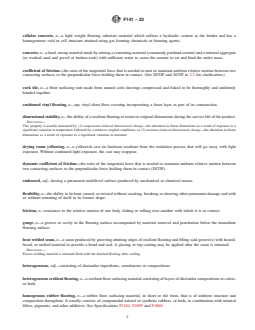
cellular concrete, n—a light weight flooring substrate material
F1303 Specification for Sheet Vinyl Floor Covering with
which utilizes a hydraulic cement as the binder and has a
Backing
homogeneous void or cell structure attained using gas
F1344 Specification for Rubber Floor Tile
forming chemicals or foaming agents.
F1700 Specification for Solid Vinyl Floor Tile
concrete, n—a hard, strong material made by mixing a
F1859 Specification for Rubber Sheet Floor Covering With-
cementing material (commonly portland cement) and a
out Backing
mineral aggregate (as washed sand and gravel or broken
F1860 Specification for Rubber Sheet Floor Covering With
rock) with sufficient water to cause the cement to set and
Backing
bind the entire mass.
F1913 Specification for Vinyl Sheet Floor Covering Without
coefficient of friction—the ratio of the tangential force that is
Backing
needed to start or maintain uniform relative motion between
F2034 Specification for Sheet Linoleum Floor Covering
two contacting surfaces to the perpendicular force holding
F2195 Specification for Linoleum Floor Tile
them in contact. (See DCOF and SCOF in 2.2 for clarifica-
2. Terminology
tion.)
2.1 Terms and Definitions:
cork tile, n—a floor surfacing unit made from natural cork
above-grade, adj—above the surface of the ground, as related
shavings compressed and baked to be thoroughly and
to floor location, above a well-ventilated space with at least
uniformly bonded together.
18 in. (457.2 mm) between the bottom of the lowest
cushioned vinyl flooring, n—any vinyl sheet floor covering
horizontal structural member and any point of the ground.
incorporating a foam layer as part of its construction.
abrasion, n—wearing, grinding, or rubbing away by friction.
dimensional stability, n—the ability of a resilient flooring to
acclimation, v—the process in which materials adjust to
retain its original dimensions during the service life of the
environmental conditions such as ambient temperature and
product.
humidity prior to installation. DISCUSSION—This property is usually measured by: (1) temperature-
induced dimensional change—the alteration in linear dimensions as a
across machine direction, n—the direction perpendicular to
result of exposure to a significant variation in temperature followed by
which a product moves through the manufacturing process.
a return to original conditions; or (2) moisture-induced dimensional
change—the alteration in linear dimensions as a result of exposure to
asphalt tile, n—an obsolete floor surfacing unit composed of
a significant variation in moisture.
asphalt or hydrocarbon resins, or both, crysotile asbestos
drying room yellowing, n—a yellowish cast on linoleum
fibers, mineral fillers, and pigments.
resultant from the oxidation process that will go away with
light exposure. Without continued light exposure, the cast
This terminology is under the jurisdiction of ASTM Committee F06 on
may reappear.
Resilient Floor Coverings and is the direct responsibility of Subcommittee F06.10
on Terminology.
dynamic coefficient of friction—the ratio of the tangential
Current edition approved Aug. 1, 2023. Published October 2023. Originally
force that is needed to maintain uniform relative motion
approved in 1971. Last previous edition approved in 2020 as F141– 12 (2020). DOI:
between two contacting surfaces to the perpendicular force
10.1520/F0141-23.
holding them in contact (DCOF).
For referenced ASTM standards, visit the ASTM website, www.astm.org, or
contact ASTM Customer Service at service@astm.org. For Annual Book of ASTM
embossed, adj—having a permanent multilevel surface pro-
Standards volume information, refer to the standard’s Document Summary page on
the ASTM website. duced by mechanical or chemical means.
Copyright © ASTM International, 100 Barr Harbor Drive, PO Box C700, West Conshohocken, PA 19428-2959. United States
F141 − 23
flexibility, n—the ability to be bent, turned, or twisted without lippage, n—abrupt, height difference in elevation between
cracking, breaking or showing other permanent damage and edges of adjacent resilient flooring, usually as it relates to
with or without returning of itself to its former shape. installed tile.
friction, n—resistance to the relative motion of one body luxury vinyl tile (LVT), n—a marketing term that is applied to
sliding or rolling over another with which it is in contact. resilient floor tile products.
gouge, n—a groove or cavity in the flooring surface accompa- machine direction, n—the direction in which a product moves
through the manufacturing process.
nied by material removal and penetration below the imme-
diate flooring surface.
mar, n—a mark made on the flooring surface by the deposition
of material from friction or rubbing of traffic bodies against
heat welded seam, n—a seam produced by grooving abutting
edges of resilient flooring and filling said groove(s) with the surface.
heated, fused, or melted material to provide a bond and seal.
oleoresin, n—a plant product containing chiefly essential oil
A glazing or top coating may be applied after the seam is
and resin.
trimmed.
DISCUSSION—Excess welding material is trimmed flush with the
on-grade—in contact with the ground, as related to floor
finished flooring after cooling.
location, in contact with the ground or with less than 18 in.
(457.2 mm) of well-ventilated space between the bottom of
heterogeneous, adj—consisting of dissimilar ingredients, con-
the lowest horizontal structural member and any point of the
stituents or compositions.
ground.
heterogeneous resilient flooring, n—a resilient floor surfacing
patching compound, n—compound used to fill or smooth
material consisting of layers of dissimilar compositions or
minor depressions or irregularities in a flooring surface.
colors, or both.
plank, n—a form of resilient floor covering having an aspect
homogenous rubber flooring, n—a rubber floor surfacing
ratio greater than 2:1.
material, in sheet or tile form, that is of uniform structure and
composition throughout. It usually consists of compounded
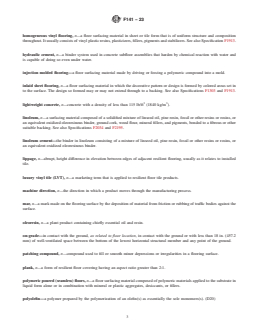
polymeric poured (seamless) floors, n—a floor surfacing
natural or synthetic rubbers, or both, in combination with
material composed of polymeric materials applied to the
mineral fillers, pigments, and other additives. See Specifica-
substrate in liquid form alone or in combination with mineral
tions F1344, F1859 and F1860.
or plastic aggregates, desiccants, or fillers.
homogeneous vinyl flooring, n—a floor surfacing material in
polyolefin—a polymer prepared by the polymerization of an
sheet or tile form that is of uniform structure and composi-
olefin(s) as essentially the sole monomers(s). (D20)
tion throughout. It usually consists of vinyl plastic resins,
post-consumer recycled content, n—the portion, often ex-
plasticizers, fillers, pigments and stabilizers. See also Speci-
pressed as a percent by weight, of material used in the
fication F1913.
manufacture of a new product, where the material ex. works
hydraulic cement, n—a binder system used in concrete
has been recovered or otherwise diverted from disposal.
subfloor assemblies that harden by chemical reaction with
pre-consumer recycle content, n—material recovered or di-
water and is capable of doing so even under water.
verted from industrial waste streams for use in the manufac-
injection molded flooring—a floor surfacing material made
ture of a new product or a product made by a new process,
by driving or forcing a polymeric
...
This document is not an ASTM standard and is intended only to provide the user of an ASTM standard an indication of what changes have been made to the previous version. Because
it may not be technically possible to adequately depict all changes accurately, ASTM recommends that users consult prior editions as appropriate. In all cases only the current version
of the standard as published by ASTM is to be considered the official document.
Designation: F141 − 12 (Reapproved 2020) F141 − 23
Standard Terminology Relating to
Resilient Floor Coverings
This standard is issued under the fixed designation F141; the number immediately following the designation indicates the year of original
adoption or, in the case of revision, the year of last revision. A number in parentheses indicates the year of last reapproval. A superscript
epsilon (´) indicates an editorial change since the last revision or reapproval.
This standard has been approved for use by agencies of the U.S. Department of Defense.
1. Referenced Documents
1.1 ASTM Standards:
F1066 Specification for Vinyl Composition Floor Tile
F1303 Specification for Sheet Vinyl Floor Covering with Backing
F1344 Specification for Rubber Floor Tile
F1700 Specification for Solid Vinyl Floor Tile
F1859 Specification for Rubber Sheet Floor Covering Without Backing
F1860 Specification for Rubber Sheet Floor Covering With Backing
F1913 Specification for Vinyl Sheet Floor Covering Without Backing
F2034 Specification for Sheet Linoleum Floor Covering
F2195 Specification for Linoleum Floor Tile
2. Terminology
2.1 Terms and Definitions:
above-grade, adj—above the surface of the ground, as related to floor location, above a well-ventilated space with at least 18
in. (457.2 mm) between the bottom of the lowest horizontal structural member and any point of the ground.
abrasion, n—wearing, grinding, or rubbing away by friction.
acclimation, v—the process in which materials adjust to environmental conditions such as ambient temperature and humidity
prior to installation.
across machine direction, n—the direction perpendicular to which a product moves through the manufacturing process.
asphalt tile, n—an obsolete floor surfacing unit composed of asphalt or hydrocarbon resins, or both, crysotile asbestos fibers,
mineral fillers, and pigments.
below-grade, adj—below the surface of the ground, as related to floor location, part or all of the floor is below the ground.
This terminology is under the jurisdiction of ASTM Committee F06 on Resilient Floor Coverings and is the direct responsibility of Subcommittee F06.10 on Terminology.
Current edition approved Jan. 15, 2020Aug. 1, 2023. Published February 2020October 2023. Originally approved in 1971. Last previous edition approved in 20122020
as F141-12. DOI: 10.1520/F0141-12R20.– 12 (2020). DOI: 10.1520/F0141-23.
For referenced ASTM standards, visit the ASTM website, www.astm.org, or contact ASTM Customer Service at service@astm.org. For Annual Book of ASTM Standards
volume information, refer to the standard’s Document Summary page on the ASTM website.
Copyright © ASTM International, 100 Barr Harbor Drive, PO Box C700, West Conshohocken, PA 19428-2959. United States
F141 − 23
cellular concrete, n—a light weight flooring substrate material which utilizes a hydraulic cement as the binder and has a
homogeneous void or cell structure attained using gas forming chemicals or foaming agents.
concrete, n—a hard, strong material made by mixing a cementing material (commonly portland cement) and a mineral aggregate
(as washed sand and gravel or broken rock) with sufficient water to cause the cement to set and bind the entire mass.
coefficient of friction—the ratio of the tangential force that is needed to start or maintain uniform relative motion between two
contacting surfaces to the perpendicular force holding them in contact. (See DCOF and SCOF in 2.2 for clarification.)
cork tile, n—a floor surfacing unit made from natural cork shavings compressed and baked to be thoroughly and uniformly
bonded together.
cushioned vinyl flooring, n—any vinyl sheet floor covering incorporating a foam layer as part of its construction.
dimensional stability, n—the ability of a resilient flooring to retain its original dimensions during the service life of the product.
DISCUSSION—
This property is usually measured by: (1) temperature-induced dimensional change—the alteration in linear dimensions as a result of exposure to a
significant variation in temperature followed by a return to original conditions; or (2) moisture-induced dimensional change—the alteration in linear
dimensions as a result of exposure to a significant variation in moisture.
drying room yellowing, n—a yellowish cast on linoleum resultant from the oxidation process that will go away with light
exposure. Without continued light exposure, the cast may reappear.
dynamic coefficient of friction—the ratio of the tangential force that is needed to maintain uniform relative motion between
two contacting surfaces to the perpendicular force holding them in contact (DCOF).
embossed, adj—having a permanent multilevel surface produced by mechanical or chemical means.
flexibility, n—the ability to be bent, turned, or twisted without cracking, breaking or showing other permanent damage and with
or without returning of itself to its former shape.
friction, n—resistance to the relative motion of one body sliding or rolling over another with which it is in contact.
gouge, n—a groove or cavity in the flooring surface accompanied by material removal and penetration below the immediate
flooring surface.
heat welded seam, n—a seam produced by grooving abutting edges of resilient flooring and filling said groove(s) with heated,
fused, or melted material to provide a bond and seal. A glazing or top coating may be applied after the seam is trimmed.
DISCUSSION—
Excess welding material is trimmed flush with the finished flooring after cooling.
heterogeneous, adj—consisting of dissimilar ingredients, constituents or compositions.
heterogeneous resilient flooring, n—a resilient floor surfacing material consisting of layers of dissimilar compositions or colors,
or both.
homogenous rubber flooring, n—a rubber floor surfacing material, in sheet or tile form, that is of uniform structure and
composition throughout. It usually consists of compounded natural or synthetic rubbers, or both, in combination with mineral
fillers, pigments, and other additives. See Specifications F1344, F1859 and F1860.
F141 − 23
homogeneous vinyl flooring, n—a floor surfacing material in sheet or tile form that is of uniform structure and composition
throughout. It usually consists of vinyl plastic resins, plasticizers, fillers, pigments and stabilizers. See also Specification F1913.
hydraulic cement, n—a binder system used in concrete subfloor assemblies that harden by chemical reaction with water and
is capable of doing so even under water.
injection molded flooring—a floor surfacing material made by driving or forcing a polymeric compound into a mold.
inlaid sheet flooring, n—a floor surfacing material in which the decorative pattern or design is formed by colored areas set in
to the surface. The design so formed may or may not extend through to a backing. See also Specifications F1303 and F1913.
3 3
lightweight concrete, n—concrete with a density of less than 115 lb/ft (1840 kg/m ).
linoleum, n—a surfacing material composed of a solidified mixture of linseed oil, pine rosin, fossil or other resins or rosins, or
an equivalent oxidized oleoresinous binder, ground cork, wood flour, mineral fillers, and pigments, bonded to a fibrous or other
suitable backing. See also Specifications F2034 and F2195.
linoleum cement—the binder in linoleum consisting of a mixture of linseed oil, pine rosin, fossil or other resins or rosins, or
an equivalent oxidized oleoresinous binder.
lippage, n—abrupt, height difference in elevation between edges of adjacent resilient flooring, usually as it relates to installed
tile.
luxury vinyl tile (LVT), n—a marketing term that is applied to resilient floor tile products.
machine direction, n—the direction in which a product moves through the manufacturing process.
mar, n—a mark made on the flooring surface by the deposition of material from friction or rubbing of traffic bodies against the
surface.
oleoresin, n—a plant product containing chiefly essential oil and resin.
on-grade—in contact with the ground, as related to floor location, in contact with the ground or with less than 18 in. (457.2
mm) of well-ventilated space between the bottom of the lowest horizontal structural member and any point of the ground
...