

ASTM F1066-23
(Specification)Standard Specification for Vinyl Composition Floor Tile
General Information
- Abstract
ABSTRACT
This specification covers vinyl composition floor tile with either smooth or embossed surfaces. Vinyl composition tile shall conform to the materials, color, pattern, wearing surface, size, thickness, and squareness indicated in this specification. The material shall be tested for indentation and impact. Performance requirements for vinyl composition tiles include deflection limit, dimensional stability, chemical resistance, and heat resistance. Basic chemicals for chemical resistance test include vinegar, alcohol, mineral oil, sodium hydroxide solution, household ammonia solution, household bleach, olive oil, kerosene, unleaded gasoline, and phenol.
SCOPE
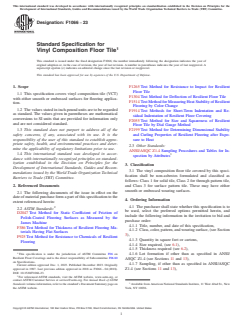
1.1 This specification covers vinyl composition tile (VCT) with either smooth or embossed surfaces for flooring application.
1.2 The values stated in inch-pound units are to be regarded as standard. The values given in parentheses are mathematical conversions to SI units that are provided for information only and are not considered standard.
1.3 This standard does not purport to address all of the safety concerns, if any, associated with its use. It is the responsibility of the user of this standard to establish appropriate safety, health, and environmental practices and determine the applicability of regulatory limitations prior to use.
1.4 This international standard was developed in accordance with internationally recognized principles on standardization established in the Decision on Principles for the Development of International Standards, Guides and Recommendations issued by the World Trade Organization Technical Barriers to Trade (TBT) Committee.
- Status
- Published
- Publication Date
- 30-Nov-2023
- Technical Committee
- F06 - Resilient Floor Coverings
- Drafting Committee
- F06.80 - Specifications
Overview
ASTM F1066-23 is the internationally recognized standard specification for vinyl composition floor tile (VCT). Developed by ASTM International, this standard offers detailed guidance for the manufacture, classification, and performance of VCT for use in flooring applications in residential, commercial, and institutional settings. The specification addresses both smooth and embossed surface tiles, outlining requirements to ensure quality, durability, and reliable performance under expected use conditions.
By adhering to ASTM F1066-23, manufacturers, specifiers, and purchasers ensure that vinyl composition tile products meet established benchmarks for physical properties, manufacturing consistency, and chemical and heat resistance, aligning with global expectations for resilient flooring.
Key Topics
- Product Classification: Outlines three classes of VCT: solid tile, through pattern tile, and surface pattern tile, each available with smooth or embossed finishes.
- Material Composition: Requires specific constituents such as poly(vinyl chloride) or its copolymers, compounded with selected plasticizers, stabilizers, fillers, and pigments for uniform coloration and pattern consistency.
- Performance Criteria: Details minimum requirements for:
- Indentation and impact resistance
- Deflection capability
- Dimensional stability and squareness
- Chemical resistance to everyday agents like vinegar, alcohol, bleach, and oils
- Heat resistance and acceptable color change after exposure
- Slip resistance (static coefficient of friction)
- Testing & Inspection: Specifies referenced ASTM testing methods and sampling requirements for quality control, including tests for thickness, squareness, chemical resistance, and indentation resistance.
- Quality Assurance: Emphasizes manufacturing consistency, defect-free finishes, proper packaging, marking, and certification upon request.
Applications
Vinyl composition floor tiles produced in accordance with ASTM F1066-23 are widely used for:
- Commercial Buildings: Offices, retail spaces, hospitals, schools, and public facilities where high-traffic durability is essential.
- Institutional Environments: Healthcare, educational, and government buildings benefit from VCT's resilience and ease of maintenance.
- Residential Installations: Kitchens, basements, mudrooms, and other areas requiring cost-effective, hard-wearing flooring solutions.
Typical reasons for specifying VCT to ASTM F1066-23 include:
- Consistent performance under foot traffic and rolling loads
- Resistance to common chemicals, stains, and cleaning agents
- Long-lasting appearance and color stability
- Ease of installation and maintenance
- Availability in a variety of colors, patterns, and embossing for design flexibility
Related Standards
For comprehensive flooring solutions and quality control, ASTM F1066-23 references several related standards:
- ASTM D2047 - Standard Test Method for Static Coefficient of Friction of Polish-Coated Flooring Surfaces
- ASTM F386 - Standard Test Method for Thickness of Resilient Flooring Materials
- ASTM F925 - Standard Test Method for Resistance to Chemicals of Resilient Flooring
- ASTM F1265 - Test Method for Resistance to Impact for Resilient Floor Tile
- ASTM F2055 - Test Method for Size and Squareness of Resilient Floor Tile
- ANSI/ASQC Z1.4 - Sampling Procedures and Tables for Inspection by Attributes
Additional standards may be consulted for installation practices (e.g., ASTM F710 for preparing subfloors), maintenance methods, abrasion resistance, and terminology.
Practical Value
Compliance with ASTM F1066-23 supports building owners, facility managers, architects, and contractors by:
- Minimizing flooring failures and costly repairs
- Ensuring compatibility with maintenance protocols and cleaning products
- Supporting project specifications and procurement contracts for resilient, high-performance floors
- Enabling manufacturers to demonstrate product quality and reliability
Vinyl composition floor tile manufactured to this standard delivers proven, long-term value for a wide range of demanding environments.
Relations
- Effective Date
- 01-Dec-2023
- Effective Date
- 01-Dec-2023
- Effective Date
- 01-Dec-2023
- Effective Date
- 01-Dec-2023
- Effective Date
- 01-Dec-2023
- Effective Date
- 01-Dec-2023
Frequently Asked Questions
ASTM F1066-23 is a technical specification published by ASTM International. Its full title is "Standard Specification for Vinyl Composition Floor Tile". This standard covers: ABSTRACT This specification covers vinyl composition floor tile with either smooth or embossed surfaces. Vinyl composition tile shall conform to the materials, color, pattern, wearing surface, size, thickness, and squareness indicated in this specification. The material shall be tested for indentation and impact. Performance requirements for vinyl composition tiles include deflection limit, dimensional stability, chemical resistance, and heat resistance. Basic chemicals for chemical resistance test include vinegar, alcohol, mineral oil, sodium hydroxide solution, household ammonia solution, household bleach, olive oil, kerosene, unleaded gasoline, and phenol. SCOPE 1.1 This specification covers vinyl composition tile (VCT) with either smooth or embossed surfaces for flooring application. 1.2 The values stated in inch-pound units are to be regarded as standard. The values given in parentheses are mathematical conversions to SI units that are provided for information only and are not considered standard. 1.3 This standard does not purport to address all of the safety concerns, if any, associated with its use. It is the responsibility of the user of this standard to establish appropriate safety, health, and environmental practices and determine the applicability of regulatory limitations prior to use. 1.4 This international standard was developed in accordance with internationally recognized principles on standardization established in the Decision on Principles for the Development of International Standards, Guides and Recommendations issued by the World Trade Organization Technical Barriers to Trade (TBT) Committee.
ABSTRACT This specification covers vinyl composition floor tile with either smooth or embossed surfaces. Vinyl composition tile shall conform to the materials, color, pattern, wearing surface, size, thickness, and squareness indicated in this specification. The material shall be tested for indentation and impact. Performance requirements for vinyl composition tiles include deflection limit, dimensional stability, chemical resistance, and heat resistance. Basic chemicals for chemical resistance test include vinegar, alcohol, mineral oil, sodium hydroxide solution, household ammonia solution, household bleach, olive oil, kerosene, unleaded gasoline, and phenol. SCOPE 1.1 This specification covers vinyl composition tile (VCT) with either smooth or embossed surfaces for flooring application. 1.2 The values stated in inch-pound units are to be regarded as standard. The values given in parentheses are mathematical conversions to SI units that are provided for information only and are not considered standard. 1.3 This standard does not purport to address all of the safety concerns, if any, associated with its use. It is the responsibility of the user of this standard to establish appropriate safety, health, and environmental practices and determine the applicability of regulatory limitations prior to use. 1.4 This international standard was developed in accordance with internationally recognized principles on standardization established in the Decision on Principles for the Development of International Standards, Guides and Recommendations issued by the World Trade Organization Technical Barriers to Trade (TBT) Committee.
ASTM F1066-23 is classified under the following ICS (International Classification for Standards) categories: 97.150 - Floor coverings. The ICS classification helps identify the subject area and facilitates finding related standards.
ASTM F1066-23 has the following relationships with other standards: It is inter standard links to ASTM F1066-04(2018), ASTM F1914-18(2023), ASTM F963-23, ASTM F141-23, ASTM F1914-18, ASTM F2982-18. Understanding these relationships helps ensure you are using the most current and applicable version of the standard.
ASTM F1066-23 is available in PDF format for immediate download after purchase. The document can be added to your cart and obtained through the secure checkout process. Digital delivery ensures instant access to the complete standard document.
Standards Content (Sample)
This international standard was developed in accordance with internationally recognized principles on standardization established in the Decision on Principles for the
Development of International Standards, Guides and Recommendations issued by the World Trade Organization Technical Barriers to Trade (TBT) Committee.
Designation: F1066 − 23
Standard Specification for
Vinyl Composition Floor Tile
This standard is issued under the fixed designation F1066; the number immediately following the designation indicates the year of
original adoption or, in the case of revision, the year of last revision. A number in parentheses indicates the year of last reapproval. A
superscript epsilon (´) indicates an editorial change since the last revision or reapproval.
This standard has been approved for use by agencies of the U.S. Department of Defense.
1. Scope F1265 Test Method for Resistance to Impact for Resilient
Floor Tile
1.1 This specification covers vinyl composition tile (VCT)
F1304 Test Method for Deflection of Resilient Floor Tile
with either smooth or embossed surfaces for flooring applica-
F1514 Test Method for Measuring Heat Stability of Resilient
tion.
Flooring by Color Change
1.2 The values stated in inch-pound units are to be regarded
F1914 Test Methods for Short-Term Indentation and Re-
as standard. The values given in parentheses are mathematical
sidual Indentation of Resilient Floor Covering
conversions to SI units that are provided for information only
F2055 Test Method for Size and Squareness of Resilient
and are not considered standard.
Floor Tile by Dial Gauge Method
1.3 This standard does not purport to address all of the F2199 Test Method for Determining Dimensional Stability
safety concerns, if any, associated with its use. It is the
and Curling Properties of Resilient Flooring after Expo-
responsibility of the user of this standard to establish appro- sure to Heat
priate safety, health, and environmental practices and deter-
2.3 Other Standards:
mine the applicability of regulatory limitations prior to use.
ANSI/ASQC Z1.4 Sampling Procedures and Tables for In-
1.4 This international standard was developed in accor- 3
spection by Attributes
dance with internationally recognized principles on standard-
ization established in the Decision on Principles for the
3. Classification
Development of International Standards, Guides and Recom-
3.1 The vinyl composition floor tile covered by this speci-
mendations issued by the World Trade Organization Technical
fication shall be non-asbestos formulated and classified as
Barriers to Trade (TBT) Committee.
follows: Class 1 for solid tile, Class 2 for through pattern tile,
and Class 3 for surface pattern tile. These may have either
2. Referenced Documents
smooth or embossed wearing surfaces.
2.1 The following documents of the issue in effect on the
date of material purchase form a part of this specification to the
4. Ordering Information
extent referenced herein:
2 4.1 The purchaser shall state whether this specification is to
2.2 ASTM Standards:
be used, select the preferred options permitted herein, and
D2047 Test Method for Static Coefficient of Friction of
include the following information in the invitation to bid and
Polish-Coated Flooring Surfaces as Measured by the
purchase order:
James Machine
4.1.1 Title, number, and date of this specification,
F386 Test Method for Thickness of Resilient Flooring Ma-
4.1.2 Class, color, pattern, and wearing surface, (see Section
terials Having Flat Surfaces
3),
F925 Test Method for Resistance to Chemicals of Resilient
4.1.3 Quantity in square feet or cartons,
Flooring
4.1.4 Size required, (see 6.1),
4.1.5 Thickness required (see 6.2),
This specification is under the jurisdiction of ASTM Committee F06 on 4.1.6 Lot formation if other than as specified in ANSI/
Resilient Floor Coverings and is the direct responsibility of Subcommittee F06.80
ASQC Z1.4 (see Sections 11 and 13),
on Specifications.
4.1.7 Sampling, if other than as specified in ANSI/ASQC
Current edition approved Dec. 1, 2023. Published December 2023. Originally
Z1.4 (see Sections 11 and 13),
approved in 1987. Last previous edition approved in 2018 as F1066 – 04 (2018).
DOI: 10.1520/F1066-23.
For referenced ASTM standards, visit the ASTM website, www.astm.org, or
contact ASTM Customer Service at service@astm.org. For Annual Book of ASTM
Standards volume information, refer to the standard’s Document Summary page on Available from American National Standards Institute, 11 West 42nd St., New
the ASTM website. York, NY 10036.
Copyright © ASTM International, 100 Barr Harbor Drive, PO Box C700, West Conshohocken, PA 19428-2959. United States
F1066 − 23
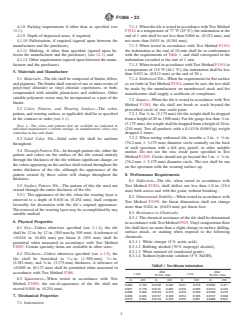
4.1.8 Packing requirements if other than as specified (see 7.1.1 When the tile is tested in accordance with Test Method
15.1), F1914 at a temperature of 77 °F (25 °C), the indentation at the
4.1.9 Depth of depressed areas, if required, end of 1 min shall be not less than 0.006 in. (0.152 mm), and
4.1.10 Palletization, if required (agreed upon between the not more than 0.015 in. (0.381 mm).
manufacturer and the purchaser), 7.1.2 When tested in accordance with Test Method F1914
4.1.11 Marking, if other than specified (agreed upon be- the indentation at the end of 10 min shall be in conformance
tween the manufacturer and the purchaser), (see 14.1), and with the requirements of Table 1, and shall correspond to the
4.1.12 Other requirements (agreed upon between the manu- indentation recorded at the end of 1 min.
facturer and the purchaser). 7.1.3 When tested in accordance with Test Method F1914 at
a temperature of 115 °F (46.1 °C), the indentation shall be less
5. Materials and Manufacture
than 0.032 in. (0.813 mm) at the end of 30 s.
5.1 Materials—The tile shall be composed of binder, fillers,
7.1.4 Embossed Tile—When the requirement for flat surface
and pigments. The binder shall consist of one or more resins of
as set forth in Test Method F1914 cannot be met, the test shall
poly(vinyl chloride) or vinyl chloride copolymers, or both,
be made by the manufacturer on unembossed stock and the
compounded with suitable plasticizers and stabilizers. Other
manufacturer shall supply a certificate of compliance.
suitable polymeric resins may be incorporated as a part of the
7.2 Impact—When the tile is tested in accordance with Test
binder.
Method F1265, the tile shall not break or crack beyond the
5.2 Color, Pattern, and Wearing Surface—The color, prescribed circle of zinc oxide paste.
pattern, and wearing surface, as applicable shall be as specified
7.2.1 For ⁄8 in. (3.175 mm) tile the weight shall be dropped
in the contract or order (see 4.1).
from a height of 20 in. (508 mm). For tile gauge less than ⁄8 in.
(3.175 mm), the weight shall be dropped from a height of 10 in.
NOTE 1—The colors and patterns that are available are indicated in
(254 mm). Test all products with a 0.143 lb (0.065 kg) weight
individual manufacturer’s current catalogs. As manufactured, colors vary
somewhat in hue and shade. dropped 4 times.
7.2.2 When testing embossed tile, inscribe a 3 in. 6 ⁄8 in.
5.3 Solid Color Tile—Solid color tile shall be uniform
(76.2 mm 6 3.175 mm) diameter circle centrally on the back
throughout.
of each specimen with a felt pen, pencil, or other suitable
5.4 Through Pattern Tile—In through pattern tile, either the
marker. Do not use the zinc oxide paste specified in Test
pattern and colors on the surface of the tile extend entirely
Method F1265. Cracks should not go beyond the 3 in. 6 ⁄8 in.
through the thickness of the tile without significant change, or
(76.2 mm 6 3.175 mm) diameter circle. The test shall be run
the colors appearing on the surface shall extend throughout the
on the specimen with the wearing surface up.
entire thickness of the tile, although the appearance of the
pattern created by these colors will change throughout the
8. Performance Requirements
thickness.
8.1 Deflection—The tile, when tested in accordance with
5.5 Surface Pattern Tile—The pattern of this tile need not
Test Method F1304, shall deflect not less than 1.0 in. (25.4
extend through the entire thickness of the tile.
mm) both across and with the grain, without breaking.
5.5.1 The appearance of the tile, when the wearing layer is
8.2 Dimensional Stability—When tested in accordance with
removed to a depth of 0.010 in. (0.254 mm), shall compare
Test Method F2199, the linear dimensions shall not change
favorably for decoration with the tile’s original appearance.
more than 0.024 in. (0.610 mm) per linear foot.
The removal of the wearing layer may be accomplished by any
8.3 Resistance to Chemicals:
suitable method.
8.3.1 The chemical resistance of the tile shall be determined
6. Physical Properties
in accordance with Test Method F925. Vinyl composition floor
tile shall have no more than a slight change in surface dulling,
6.1 Size—Unless otherwise specified (see 4.1.4), the tile
surface attack, or staining when exposed to the following
shall be 12 in. by 12 in. (305 mm by 305 mm). A tolerance of
chemicals:
60.016 in. (0.406 mm) per linear ft (305 mm) shall be
8.3.1.1 White vinegar (5 % acetic acid),
permitted when measured in accordance with Test Method
8.3.1.2 Rubbing alcohol (70 % isopropyl alcohol),
F2055. Certain specialty items are available in other sizes.
8.3.1.3 White mineral oil (medicinal grade),
6.2 Thickness—Unless otherwise specified (see 4.1.5), the
8.3.1.4 Sodium hydroxide solution (5 % NaOH),
1 3
tile shall be furnished in ⁄16 in. (1.588 mm), ⁄32 in.
(2.381 mm), and ⁄8 in. (3.175 mm) thickness. A tolerance of
TABLE 1 Ten Minute Indentation
60.005 in. (0.127 mm) shall be permitted when measured in
After After
accordance with Test Method F386.
1 min 1 min
10 min, max 10 min, max
6.3 Squareness—Whe
...
This document is not an ASTM standard and is intended only to provide the user of an ASTM standard an indication of what changes have been made to the previous version. Because
it may not be technically possible to adequately depict all changes accurately, ASTM recommends that users consult prior editions as appropriate. In all cases only the current version
of the standard as published by ASTM is to be considered the official document.
Designation: F1066 − 04 (Reapproved 2018) F1066 − 23
Standard Specification for
Vinyl Composition Floor Tile
This standard is issued under the fixed designation F1066; the number immediately following the designation indicates the year of
original adoption or, in the case of revision, the year of last revision. A number in parentheses indicates the year of last reapproval. A
superscript epsilon (´) indicates an editorial change since the last revision or reapproval.
This standard has been approved for use by agencies of the U.S. Department of Defense.
1. Scope
1.1 This specification covers vinyl composition tile (VCT) with either smooth or embossed surfaces for flooring application.
1.2 The values stated in inch-pound units are to be regarded as standard. The values given in parentheses are mathematical
conversions to SI units that are provided for information only and are not considered standard.
1.3 This standard does not purport to address all of the safety concerns, if any, associated with its use. It is the responsibility
of the user of this standard to establish appropriate safety, health, and environmental practices and determine the applicability of
regulatory limitations prior to use.
1.4 This international standard was developed in accordance with internationally recognized principles on standardization
established in the Decision on Principles for the Development of International Standards, Guides and Recommendations issued
by the World Trade Organization Technical Barriers to Trade (TBT) Committee.
2. Referenced Documents
2.1 The following documents of the issue in effect on the date of material purchase form a part of this specification to the extent
referenced herein:
2.2 ASTM Standards:
D2047 Test Method for Static Coefficient of Friction of Polish-Coated Flooring Surfaces as Measured by the James Machine
F386 Test Method for Thickness of Resilient Flooring Materials Having Flat Surfaces
F925 Test Method for Resistance to Chemicals of Resilient Flooring
F1265 Test Method for Resistance to Impact for Resilient Floor Tile
F1304 Test Method for Deflection of Resilient Floor Tile
F1514 Test Method for Measuring Heat Stability of Resilient Flooring by Color Change
F1914 Test Methods for Short-Term Indentation and Residual Indentation of Resilient Floor Covering
F2055 Test Method for Size and Squareness of Resilient Floor Tile by Dial Gauge Method
F2199 Test Method for Determining Dimensional Stability and Curling Properties of Resilient Flooring after Exposure to Heat
2.3 Other Standards:
ANSI/ASQC Z1.4 Sampling Procedures and Tables for Inspection by Attributes
This specification is under the jurisdiction of ASTM Committee F06 on Resilient Floor Coverings and is the direct responsibility of Subcommittee F06.80 on
Specifications.
Current edition approved Oct. 1, 2018Dec. 1, 2023. Published October 2018December 2023. Originally approved in 1987. Last previous edition approved in 20142018
ε1
as F1066 – 04 (2018).(2014) . DOI: 10.1520/F1066-04R18.10.1520/F1066-23.
For referenced ASTM standards, visit the ASTM website, www.astm.org, or contact ASTM Customer Service at service@astm.org. For Annual Book of ASTM Standards
volume information, refer to the standard’s Document Summary page on the ASTM website.
Available from American National Standards Institute, 11 West 42nd St., New York, NY 10036.
Copyright © ASTM International, 100 Barr Harbor Drive, PO Box C700, West Conshohocken, PA 19428-2959. United States
F1066 − 23
3. Classification
3.1 The vinyl composition floor tile covered by this specification shall be non-asbestos formulated and classified as follows: Class
1 for solid tile, Class 2 for through pattern tile, and Class 3 for surface pattern tile. These may have either smooth or embossed
wearing surfaces.
4. Ordering Information
4.1 The purchaser shall state whether this specification is to be used, select the preferred options permitted herein, and include the
following information in the invitation to bid and purchase order:
4.1.1 Title, number, and date of this specification,
4.1.2 Class, color, pattern, and wearing surface, (see Section 3),
4.1.3 Quantity in square feet or cartons,
4.1.4 Size required, (see 6.1),
4.1.5 Thickness required (see 6.2),
4.1.6 Lot formation if other than as specified in ANSI/ASQC Z1.4 (see Sections 11 and 13),
4.1.7 Sampling, if other than as specified in ANSI/ASQC Z1.4 (see Sections 11 and 13),
4.1.8 Packing requirements if other than as specified (see 15.1),
4.1.9 Depth of depressed areas, if required,
4.1.10 Palletization, if required (agreed upon between the manufacturer and the purchaser),
4.1.11 Marking, if other than specified (agreed upon between the manufacturer and the purchaser), (see 14.1), and
4.1.12 Other requirements (agreed upon between the manufacturer and the purchaser).
5. Materials and Manufacture
5.1 Materials—The tile shall be composed of binder, fillers, and pigments. The binder shall consist of one or more resins of
poly(vinyl chloride) or vinyl chloride copolymers, or both, compounded with suitable plasticizers and stabilizers. Other suitable
polymeric resins may be incorporated as a part of the binder.
5.2 Color, Pattern, and Wearing Surface—The color, pattern, and wearing surface, as applicable shall be as specified in the
contract or order (see 4.1).
NOTE 1—The colors and patterns that are available are indicated in individual manufacturer’s current catalogs. As manufactured, colors vary somewhat
in hue and shade.
5.3 Solid Color Tile—Solid color tile shall be uniform throughout.
5.4 Through Pattern Tile—In through pattern tile, either the pattern and colors on the surface of the tile extend entirely through
the thickness of the tile without significant change, or the colors appearing on the surface shall extend throughout the entire
thickness of the tile, although the appearance of the pattern created by these colors will change throughout the thickness.
5.5 Surface Pattern Tile—The pattern of this tile need not extend through the entire thickness of the tile.
5.5.1 The appearance of the tile, when the wearing layer is removed to a depth of 0.010 in. (0.254 mm), shall compare favorably
for decoration with the tile’s original appearance. The removal of the wearing layer may be accomplished by any suitable method.
F1066 − 23
6. Physical Properties
6.1 Size—Unless otherwise specified (see 4.1.4), the tile shall be 1212 in. by 12 in. (305(305 mm by 305 mm). A tolerance of
60.016 in. (0.406 mm) per linear ft (305 mm) shall be permitted when measured in accordance with Test Method F2055. Certain
specialty items are available in other sizes.
1 3
6.2 Thickness—Unless otherwise specified (see 4.1.5), the tile shall be furnished in ⁄16 –in. in. (1.588 mm), ⁄32(1.588-mm), in.
3 1
⁄32-in. (2.381- mm), (2.381 mm), and ⁄8-in. (3.175-mm) in. (3.175 mm) thickness. A tolerance of 60.005 in. (0.127 mm) shall be
permitted when measured in accordance with Test Method F386.
6.3 Squareness—When tested in accordance with Test Method F2055, the out-of-squareness of the tile shall not exceed 0.010 in.
(0.254 mm).
7. Mechanical Properties
7.1 Indentation:
7.1.1 When the tile is tested in accordance with Test Method F1914 at a temperature of 77°F (25°C),77 °F (25 °C), the indentation
at the end of 1 min shall be not less than 0.006 in. (0.152 mm), and not more than 0.015 in. (0.381 mm).
7.1.2 When tested in accordance with Test Method F1914 the indentation at the end of 10 min shall be in conformance with the
requirements of Table 1, and shall correspond to the indentation recorded at the end of 1 min.
7.1.3 When tested in accordance with Test Method F1914 at a temperature of 115°F (46.1°C),115 °F (46.1 °C), the indentation
shall be less than 0.032 in. (0.813 mm) at the end of 30 s.
7.1.4 Embossed Tile—When the requirement for flat surface as set forth in Test Method F1914 cannot be met, the test shall be
made by the manufacturer on unembossed stock and the manufacturer shall supply a certificate of compliance.
7.2 Impact—When the tile is tested in accordance with Test Method F1265, the tile shall not break or crack beyond the prescribed
circle of zinc oxide paste.
7.2.1 For ⁄8-in. (3.175-mm) in. (3.175 mm) tile the weight shall be dropped from a height of 20 in. (508 mm). For tile gagegauge
less than ⁄8-in. (3.175-mm), in. (3.175 mm), the weight shall be dropped from a height of 10 in. (254 mm). Test all products with
a 0.143-lb (0.065-kg)0.143 lb (0.065 kg) weight dropped 4 times.
7.2.2 When testing embossed tile, inscribe a 33 in. 6 ⁄8-in. (76.2 6 3.175-mm) in. (76.2 mm 6 3.175 mm) diameter circle
centrally on the back of each specimen with a felt pen, pencil, or other suitable marker. Do not use the zinc oxide paste specified
in Test Method F1265. Cracks should not go beyond the 33 in. 6 ⁄8-in. (76.2 6 3.175-mm) in. (76.2 mm 6 3.175 mm) diameter
circle. The test shall be run on the specimen with the wearing surface up.
8. Performance Requirements
8.1 Deflection—The tile, when tested in accordance with Test Method F1304, shall deflect not less than 1.0 in. (25.4 mm) both
across and with the grain, without breaking.
TABLE 1 Ten Minute Indentation
After After
1 min 1 min
10 min, max 10 min, max
in. mm in. mm in. mm in. mm
0.006 0.152 0.0100 0.254 0.011 0.279 0.0162 0.411
0.007 0.178 0.0112 0.284 0.012 0.305 0.0174 0.442
0.008 0.203 0.0124 0.315 0.013 0.330 0.0186 0.472
0.009 0.229 0.0137 0.348 0.014 0.356 0.0197 0.500
0.010 0.254 0.0149 0.378 0.015 0.381 0.0209 0.531
...