

ASTM F1860-21a
(Specification)Standard Specification for Rubber Sheet Floor Covering With Backing
General Information
- Abstract
ABSTRACT
This specification covers the requirements for the compound and physical characteristics of homogeneous (Type I) and layered (Type II) rubber sheet floor covering with backing. Both types shall be fibrous and foamed rubber, and may also contain intermediate layers. They may either have smooth, embossed, or molded pattern surfaces, and shall not contain asbestos. They shall be tested on, and conform accordingly to the following requirements: chemical composition; hardness; modulus of 10 % elongation; static load limit; resistance to chemicals such as white vinegar, rubbing alcohol, sodium hydroxide solution, hydrochloric acid solution, sulfuric acid solution, household ammonia solution, and household bleach; resistance to heat; resistance to light; width and length; and base, wear layer, and overall thicknesses.
SCOPE
1.1 This specification covers the requirements for the compound and physical characteristics of rubber sheet floor covering having a rubber wear layer with backing. Products may also contain intermediate layers.
1.2 The values stated in inch-pound units are to be regarded as standard. The values given in parentheses are mathematical conversions to SI units that are provided for information only and are not considered standard.
1.3 The following precautionary statement pertains only to the test method portion, Section 10, of this specification: This standard does not purport to address all of the safety concerns, if any, associated with its use. It is the responsibility of the user of this standard to establish appropriate safety, health, and environmental practices and determine the applicability of regulatory limitations prior to use.
1.4 This international standard was developed in accordance with internationally recognized principles on standardization established in the Decision on Principles for the Development of International Standards, Guides and Recommendations issued by the World Trade Organization Technical Barriers to Trade (TBT) Committee.
- Status
- Published
- Publication Date
- 30-Sep-2021
- Technical Committee
- F06 - Resilient Floor Coverings
- Drafting Committee
- F06.80 - Specifications
Buy Documents

ASTM F1860-21a - Standard Specification for Rubber Sheet Floor Covering With Backing
REDLINE ASTM F1860-21a - Standard Specification for Rubber Sheet Floor Covering With Backing
Overview
ASTM F1860-21a defines the standard specification for rubber sheet floor covering with backing, addressing both homogeneous (Type I) and heterogeneous (Type II) products. These floor coverings are manufactured with a rubber wear layer and a backing, which may be fibrous or foamed rubber. This standard outlines the requirements for composition, physical properties, and essential performance characteristics to ensure product quality and suitability for use in commercial, institutional, and residential settings. Importantly, the specification prohibits the use of asbestos and requires conformity to standardized testing and measurement methods.
Key Topics
- Floor Covering Types:
- Type I: Homogeneous (through-pattern composition)
- Type II: Layered/Heterogeneous (distinct wear, intermediate, and backing layers)
- Backing Grades:
- Grade 1: Fibrous backing for enhanced stability
- Grade 2: Foamed rubber backing for added cushioning
- Surface Options: Smooth, embossed, or molded patterns are allowed for aesthetic and functional choices
- Physical and Chemical Requirements:
- Minimum wear layer thickness
- Minimum hardness (Shore A)
- Resistance to indentation under static load
- Chemical resistance (e.g., to cleaners, acids, ammonia, bleach)
- Color and appearance after abrasion, heat, and light exposure
- Dimensional Consistency: Strict tolerances for thickness, width, and length ensure reliable installation and performance
- Workmanship: Finished products must be free from defects that compromise performance or appearance
Applications
Rubber sheet floor coverings produced under ASTM F1860-21a are widely used for:
- Commercial and Institutional Flooring: Hospitals, schools, offices, and labs benefit from the durable, resilient nature of rubber flooring, as well as its resistance to common cleaning chemicals and its ease of maintenance.
- Residential Use: Homes and apartments, especially in areas requiring safety, comfort underfoot, and noise reduction.
- High-Traffic Areas: Durable wear layers and resistance to indentation make these floor coverings excellent choices for corridors, entrances, and retail spaces.
- Special Environments: Their chemical and heat resistance allows installation in areas exposed to cleaning agents or temperature fluctuations, such as kitchens and laboratories.
- Design Flexibility: Variety in patterns and colors enables integration into diverse interior design schemes.
Related Standards
ASTM F1860-21a references several key standards for testing and terminology, including:
- ASTM D2240: Test Method for Rubber Property-Durometer Hardness
- ASTM D412: Test Methods for Vulcanized Rubber and Thermoplastic Elastomers-Tension
- ASTM F925: Test Method for Resistance to Chemicals of Resilient Flooring
- ASTM F410: Method for Wear Layer Thickness by Optical Measurement
- ASTM F970: Measuring Recovery Properties After Static Loading
- ASTM F387: Thickness Measurement for Resilient Flooring with Foam Layer
- ANSI/ASQC Z1.4: Sampling Procedures for Inspection by Attributes
- ASTM F710 and F1482: Practices for preparing and installing substrates for resilient flooring
- ASTM D3389: Abrasion Resistance of Coated Fabrics
Practical Value
Complying with ASTM F1860-21a ensures manufacturers provide consistent, high-quality rubber sheet flooring that meets the demands of modern building environments. Specifying this standard in procurement documents and project plans delivers:
- Reliable product quality and performance
- Assured safety and compliance with international guidelines
- Easier project planning through standardized dimensions and properties
- Long-term durability and value for property owners and facility managers
Adhering to the guidelines of ASTM F1860-21a not only enhances installation outcomes but also streamlines specifications for architects, designers, and end-users seeking resilient, high-performance flooring solutions.
Relations
- Effective Date
- 01-Feb-2024
- Effective Date
- 01-Nov-2023
- Effective Date
- 01-Aug-2023
- Effective Date
- 01-Jul-2020
- Effective Date
- 15-Jan-2020
- Effective Date
- 01-Jan-2020
- Effective Date
- 01-Nov-2019
- Effective Date
- 01-Aug-2019
- Effective Date
- 15-Apr-2019
- Effective Date
- 01-Feb-2019
- Effective Date
- 01-Feb-2019
- Effective Date
- 01-Dec-2018
- Effective Date
- 01-Nov-2018
- Effective Date
- 01-Sep-2017
- Effective Date
- 15-Aug-2017
Buy Documents
ASTM F1860-21a - Standard Specification for Rubber Sheet Floor Covering With Backing
REDLINE ASTM F1860-21a - Standard Specification for Rubber Sheet Floor Covering With Backing
Frequently Asked Questions
ASTM F1860-21a is a technical specification published by ASTM International. Its full title is "Standard Specification for Rubber Sheet Floor Covering With Backing". This standard covers: ABSTRACT This specification covers the requirements for the compound and physical characteristics of homogeneous (Type I) and layered (Type II) rubber sheet floor covering with backing. Both types shall be fibrous and foamed rubber, and may also contain intermediate layers. They may either have smooth, embossed, or molded pattern surfaces, and shall not contain asbestos. They shall be tested on, and conform accordingly to the following requirements: chemical composition; hardness; modulus of 10 % elongation; static load limit; resistance to chemicals such as white vinegar, rubbing alcohol, sodium hydroxide solution, hydrochloric acid solution, sulfuric acid solution, household ammonia solution, and household bleach; resistance to heat; resistance to light; width and length; and base, wear layer, and overall thicknesses. SCOPE 1.1 This specification covers the requirements for the compound and physical characteristics of rubber sheet floor covering having a rubber wear layer with backing. Products may also contain intermediate layers. 1.2 The values stated in inch-pound units are to be regarded as standard. The values given in parentheses are mathematical conversions to SI units that are provided for information only and are not considered standard. 1.3 The following precautionary statement pertains only to the test method portion, Section 10, of this specification: This standard does not purport to address all of the safety concerns, if any, associated with its use. It is the responsibility of the user of this standard to establish appropriate safety, health, and environmental practices and determine the applicability of regulatory limitations prior to use. 1.4 This international standard was developed in accordance with internationally recognized principles on standardization established in the Decision on Principles for the Development of International Standards, Guides and Recommendations issued by the World Trade Organization Technical Barriers to Trade (TBT) Committee.
ABSTRACT This specification covers the requirements for the compound and physical characteristics of homogeneous (Type I) and layered (Type II) rubber sheet floor covering with backing. Both types shall be fibrous and foamed rubber, and may also contain intermediate layers. They may either have smooth, embossed, or molded pattern surfaces, and shall not contain asbestos. They shall be tested on, and conform accordingly to the following requirements: chemical composition; hardness; modulus of 10 % elongation; static load limit; resistance to chemicals such as white vinegar, rubbing alcohol, sodium hydroxide solution, hydrochloric acid solution, sulfuric acid solution, household ammonia solution, and household bleach; resistance to heat; resistance to light; width and length; and base, wear layer, and overall thicknesses. SCOPE 1.1 This specification covers the requirements for the compound and physical characteristics of rubber sheet floor covering having a rubber wear layer with backing. Products may also contain intermediate layers. 1.2 The values stated in inch-pound units are to be regarded as standard. The values given in parentheses are mathematical conversions to SI units that are provided for information only and are not considered standard. 1.3 The following precautionary statement pertains only to the test method portion, Section 10, of this specification: This standard does not purport to address all of the safety concerns, if any, associated with its use. It is the responsibility of the user of this standard to establish appropriate safety, health, and environmental practices and determine the applicability of regulatory limitations prior to use. 1.4 This international standard was developed in accordance with internationally recognized principles on standardization established in the Decision on Principles for the Development of International Standards, Guides and Recommendations issued by the World Trade Organization Technical Barriers to Trade (TBT) Committee.
ASTM F1860-21a is classified under the following ICS (International Classification for Standards) categories: 97.150 - Floor coverings. The ICS classification helps identify the subject area and facilitates finding related standards.
ASTM F1860-21a has the following relationships with other standards: It is inter standard links to ASTM D883-24, ASTM D883-23, ASTM F141-23, ASTM F925-13(2020), ASTM F141-12(2020), ASTM D883-20, ASTM F1514-19, ASTM D883-19c, ASTM D883-19a, ASTM F710-19, ASTM D883-19, ASTM D883-18a, ASTM D883-18, ASTM F710-17, ASTM D883-17. Understanding these relationships helps ensure you are using the most current and applicable version of the standard.
ASTM F1860-21a is available in PDF format for immediate download after purchase. The document can be added to your cart and obtained through the secure checkout process. Digital delivery ensures instant access to the complete standard document.
Standards Content (Sample)
This international standard was developed in accordance with internationally recognized principles on standardization established in the Decision on Principles for the
Development of International Standards, Guides and Recommendations issued by the World Trade Organization Technical Barriers to Trade (TBT) Committee.
Designation:F1860 −21a
Standard Specification for
Rubber Sheet Floor Covering With Backing
This standard is issued under the fixed designation F1860; the number immediately following the designation indicates the year of
original adoption or, in the case of revision, the year of last revision. A number in parentheses indicates the year of last reapproval. A
superscript epsilon (´) indicates an editorial change since the last revision or reapproval.
1. Scope D3389 Test Method for Coated FabricsAbrasion Resistance
(Rotary Platform Abrader)
1.1 This specification covers the requirements for the com-
F141 Terminology Relating to Resilient Floor Coverings
pound and physical characteristics of rubber sheet floor cov-
F387 Test Method for Measuring Thickness of Resilient
ering having a rubber wear layer with backing. Products may
Floor Covering With Foam Layer
also contain intermediate layers.
F410 Test Method for Wear Layer Thickness of Resilient
1.2 The values stated in inch-pound units are to be regarded
Floor Coverings by Optical Measurement
as standard. The values given in parentheses are mathematical
F710 Practice for Preparing Concrete Floors to Receive
conversions to SI units that are provided for information only
Resilient Flooring
and are not considered standard.
F925 Test Method for Resistance to Chemicals of Resilient
1.3 The following precautionary statement pertains only to
Flooring
the test method portion, Section 10, of this specification: This F970 Test Method for Measuring Recovery Properties of
standard does not purport to address all of the safety concerns,
Floor Coverings after Static Loading
if any, associated with its use. It is the responsibility of the user F1482 Practice for Installation and Preparation of Panel
of this standard to establish appropriate safety, health, and
Type Underlayments to Receive Resilient Flooring
environmental practices and determine the applicability of F1514 TestMethodforMeasuringHeatStabilityofResilient
regulatory limitations prior to use.
Flooring by Color Change
1.4 This international standard was developed in accor-
2.3 ANSI Standards:
dance with internationally recognized principles on standard-
ANSI/ASQC Z1.4 Sampling Procedures and Tables for In-
ization established in the Decision on Principles for the 3
spection by Attributes
Development of International Standards, Guides and Recom-
mendations issued by the World Trade Organization Technical
3. Terminology
Barriers to Trade (TBT) Committee.
3.1 Definitions—For definitions of other terms used in this
2. Referenced Documents
standard, see Terminology F141.
2.1 The following documents if the issue in effect on the
dateofthematerialpurchaseformapartofthisspecificationto 4. Classification
the extent referenced herein:
4.1 Types—Rubber sheet floor covering covered by this
2.2 ASTM Standards:
specification shall conform to the following types:
D412 Test Methods forVulcanized Rubber andThermoplas-
4.1.1 Type I—Homogeneous
tic Elastomers—Tension
4.1.2 Type II—Heterogeneous
D883 Terminology Relating to Plastics
4.2 Grades—Rubber sheet floor covering shall be one of the
D1566 Terminology Relating to Rubber
following grades:
D2240 Test Method for Rubber Property—Durometer Hard-
4.2.1 Grade 1—Fibrous backing
ness
4.2.2 Grade 2—Foamed rubber backing
This specification is under the jurisdiction of ASTM Committee F06 on
4.3 The above may have either smooth, embossed, or
ResilientFloorCoveringsandisthedirectresponsibilityofSubcommitteeF06.80on
molded pattern surfaces.
Specifications.
Current edition approved Oct. 1, 2021. Published January 2022. Originally
4.4 These products shall not contain asbestos.
approved in 1998. Last previous edition approved in 2021 as F1860-21. DOI:
10.1520/F1860-21A.
For referenced ASTM standards, visit the ASTM website, www.astm.org, or
contact ASTM Customer Service at service@astm.org. For Annual Book of ASTM
Standards volume information, refer to the standard’s Document Summary page on Available fromAmerican National Standards Institute (ANSI), 25 W. 43rd St.,
the ASTM website. 4th Floor, New York, NY 10036, http://www.ansi.org.
Copyright © ASTM International, 100 Barr Harbor Drive, PO Box C700, West Conshohocken, PA 19428-2959. United States
F1860−21a
5. Ordering Information original appearance. The removal of the wear layer may be
accomplished by any suitable method.
5.1 Purchasers shall state whether this specification is to be
6.3.4 The wear layer may have a smooth, embossed, or
used, select the preferred options permitted herein and include
molded pattern surface.
the following information in the invitation to bid or purchase
order: 6.4 Intermediate Layers—The layer(s) may consist of, but
5.1.1 Title, number, and date of this specification, not be limited to, rubber, foamed rubber, or other materials,
which are intended to improve the performance characteristics
5.1.2 Type, color, and surface (see Section 4 and 6),
of the product.
5.1.3 Quantity, in square feet, square yards, or square
meters,
6.5 Backings—The composition of the backings shall be
5.1.4 Thickness required (see 8.3),
fibrous or foamed rubber and may contain other ingredients
5.1.5 Overall thickness, if molded pattern flooring is speci-
provided the resultant backing is suitable for installation on
fied (see 8.1),
floors above-, on-, or below-grade when installed according to
5.1.6 Width required (see 8.4),
manufacturer’s installation recommendations.
5.1.7 Length required (see 8.5),
6.6 Color, Pattern, and Wearing Surface—The color,
5.1.8 Resistance to chemicals, (see 7.4),
pattern, and wear layer surface, as applicable, shall be as
5.1.9 Lot information, if other than as specified in AANSI/
specified in the contract or order (see 5.1).
ASQC Z1.4. (see 10.1 and 11.1),
NOTE 1—The colors and patterns that are available are indicated in
5.1.10 Sampling, if other than as specified in ANSI/ASQC
individual manufacturer’s current catalogs. As manufactured, colors may
Z1.4 (see 10.1 and 11.1),
vary somewhat in hue or shade from the catalog.
5.1.11 Statement requesting certification, if certification of
NOTE 2—Where color match is a concern, samples from the manufac-
compliance is required (see 12.1), turer shall be obtained to verify color acceptability.
5.1.12 Packaging and packing requirements, if other than as
7. Performance Requirements
specified (see 14.1),
5.1.13 Palletization, if required,
7.1 Hardness—The rubber sheet floor covering shall have a
5.1.14 Marking required, if other than specified (see 13.1),
durometer hardness of not less than 85 (Shore, Type A) when
and
tested in accordance with Test Method D2240. The backing
5.1.15 Other requirements.
material shall be removed prior to testing and may be accom-
plished by any suitable method.
6. Materials and Manufacture
7.2 Modulus at 10 % Elongation—When tested in accor-
6.1 Homogeneous Rubber Sheet Floor Covering—The dance with Test Method D412 at a rate of 6 in. (152.4
product shall consist of a wear layer and backing. The surface mm)/min, using a 1 in. (25.4 mm) by 5 in. (127 mm) gage
length rectangular specimen, the modulus shall not be less than
coloring or mottling shall be uniform throughout the entire
thickness of the wear layer. The backing shall be fibrous or 300 psi (2.07 MPa). For molded pattern rubber sheet floor
covering, the raised pattern shall be removed by any suitable
foamed rubber and thoroughly bonded to the wear layer so as
not to delaminate under normal use. method. Prior to testing, the backing material shall be removed
and may be accomplished by any suitable method.
6.2 Heterogeneous Rubber Sheet Floor Covering—The
7.3 Static Loading—When tested in accordance with Test
product shall consist of a wear layer, intermediate layer(s), and
a backing. The surface coloring or mottling shall be uniform Method F970, with an applied load of 250 lb (113.4 kg), the
residual indentation shall not be greater than 0.005 in. (0.127
throughout the entire thickness of the wear layer, but need not
extend through the intermediate layer(s). The backing shall be mm).
fibrous or foamed rubber.The wear layer, intermediate layer(s)
7.4 Resistance to Chemicals—When tested in accordance
andbackingshallbethoroughlybondedsoasnottodelaminate
with Test Method F925, the rubber sheet floor covering shall
under normal use.
have no more than a slight change in surface dulling, color
change or surface attack when exposed to the flowing chemi-
6.3 Wear Layer:
cals:
6.3.1 The polymeric binder of the wear layer shall satisfy
7.4.1 White vinegar (5 % acetic acid),
the definition of rubber in Terminology D1566, and have been
vulcanized, as defined in Terminology D1566 (under 7.4.2 Rubbing alcohol (70 % isopropyl alcohol),
vulcanization), such that it becomes thermoset as defined in 7.4.3 Sodium hydroxide solution (5 % NaOH),
Terminology D883. The wear layer made from this compound 7.4.4 Hydrochloric acid solution (5 % HCl),
shall be resistant to neutral pH cleaners. 7.4.5 Sulfuric acid solution (5 % H SO ),
2 4
6.3.2 The wear layer must have a minimum thickness of
7.4.6 Household ammonia solution (5 % NH OH), and
0.040 in. (1.0 mm) when measured in accordance with Test
7.4.7 Household bleach solution (5.25 % NaOCl).
Method F410.
NOTE 3—These basic chemicals are representa
...
This document is not an ASTM standard and is intended only to provide the user of an ASTM standard an indication of what changes have been made to the previous version. Because
it may not be technically possible to adequately depict all changes accurately, ASTM recommends that users consult prior editions as appropriate. In all cases only the current version
of the standard as published by ASTM is to be considered the official document.
Designation: F1860 − 21 F1860 − 21a
Standard Specification for
Rubber Sheet Floor Covering With Backing
This standard is issued under the fixed designation F1860; the number immediately following the designation indicates the year of
original adoption or, in the case of revision, the year of last revision. A number in parentheses indicates the year of last reapproval. A
superscript epsilon (´) indicates an editorial change since the last revision or reapproval.
1. Scope
1.1 This specification covers the requirements for the compound and physical characteristics of rubber sheet floor covering having
a rubber wear layer with backing. Products may also contain intermediate layers.
1.2 The values stated in inch-pound units are to be regarded as standard. The values given in parentheses are mathematical
conversions to SI units that are provided for information only and are not considered standard.
1.3 The following precautionary statement pertains only to the test method portion, Section 10, of this specification: This
standard does not purport to address all of the safety concerns, if any, associated with its use. It is the responsibility of the user
of this standard to establish appropriate safety, health, and environmental practices and determine the applicability of regulatory
limitations prior to use.
1.4 This international standard was developed in accordance with internationally recognized principles on standardization
established in the Decision on Principles for the Development of International Standards, Guides and Recommendations issued
by the World Trade Organization Technical Barriers to Trade (TBT) Committee.
2. Referenced Documents
2.1 The following documents if the issue in effect on the date of the material purchase form a part of this specification to the extent
referenced herein:
2.2 ASTM Standards:
D412 Test Methods for Vulcanized Rubber and Thermoplastic Elastomers—Tension
D883 Terminology Relating to Plastics
D1566 Terminology Relating to Rubber
D2240 Test Method for Rubber Property—Durometer Hardness
D3389 Test Method for Coated Fabrics Abrasion Resistance (Rotary Platform Abrader)
F141 Terminology Relating to Resilient Floor Coverings
F387 Test Method for Measuring Thickness of Resilient Floor Covering With Foam Layer
F410 Test Method for Wear Layer Thickness of Resilient Floor Coverings by Optical Measurement
F710 Practice for Preparing Concrete Floors to Receive Resilient Flooring
F925 Test Method for Resistance to Chemicals of Resilient Flooring
F970 Test Method for Measuring Recovery Properties of Floor Coverings after Static Loading
F1482 Practice for Installation and Preparation of Panel Type Underlayments to Receive Resilient Flooring
This specification is under the jurisdiction of ASTM Committee F06 on Resilient Floor Coveringsand is the direct responsibility of Subcommittee F06.80 on
Specifications.
Current edition approved July 1, 2021Oct. 1, 2021. Published August 2021January 2022. Originally approved in 1998. Last previous edition approved in 20142021 as
ɛ1
F1860-14-21. . DOI: 10.1520/F1860-21.10.1520/F1860-21A.
For referenced ASTM standards, visit the ASTM website, www.astm.org, or contact ASTM Customer Service at service@astm.org. For Annual Book of ASTM Standards
volume information, refer to the standard’s Document Summary page on the ASTM website.
Copyright © ASTM International, 100 Barr Harbor Drive, PO Box C700, West Conshohocken, PA 19428-2959. United States
F1860 − 21a
F1514 Test Method for Measuring Heat Stability of Resilient Flooring by Color Change
2.3 ANSI Standards:
ANSI/ASQC Z1.4 Sampling Procedures and Tables for Inspection by Attributes
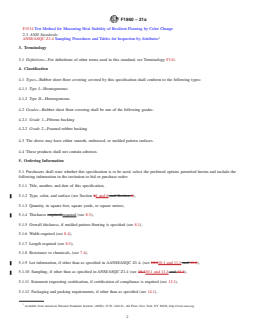
3. Terminology
3.1 Definitions—For definitions of other terms used in this standard, see Terminology F141.
4. Classification
4.1 Types—Rubber sheet floor covering covered by this specification shall conform to the following types:
4.1.1 Type I—Homogeneous
4.1.2 Type II—Heterogeneous
4.2 Grades—Rubber sheet floor covering shall be one of the following grades:
4.2.1 Grade 1—Fibrous backing
4.2.2 Grade 2—Foamed rubber backing
4.3 The above may have either smooth, embossed, or molded pattern surfaces.
4.4 These products shall not contain asbestos.
5. Ordering Information
5.1 Purchasers shall state whether this specification is to be used, select the preferred options permitted herein and include the
following information in the invitation to bid or purchase order:
5.1.1 Title, number, and date of this specification,
5.1.2 Type, color, and surface (see Section 44 and 6 and Section 6),
5.1.3 Quantity, in square feet, square yards, or square meters,
5.1.4 Thickness required.required (see 8.3),
5.1.5 Overall thickness, if molded pattern flooring is specified (see 8.1),
5.1.6 Width required (see 8.4),
5.1.7 Length required (see 8.5),
5.1.8 Resistance to chemicals, (see 7.4),
5.1.9 Lot information, if other than as specified in AANSI/ASQC Z1.4. (see 10.110.1 and 11.1 and 11.1),
5.1.10 Sampling, if other than as specified in ANSI/ASQC Z1.4 (see 10.110.1 and 11.1 and 11.1),
5.1.11 Statement requesting certification, if certification of compliance is required (see 12.1),
5.1.12 Packaging and packing requirements, if other than as specified (see 14.1),
Available from American National Standards Institute (ANSI), 25 W. 43rd St., 4th Floor, New York, NY 10036, http://www.ansi.org.
F1860 − 21a
5.1.13 Palletization, if required,
5.1.14 Marking required, if other than specified (see 13.1), and
5.1.15 Other requirements.
6. Materials and Manufacture
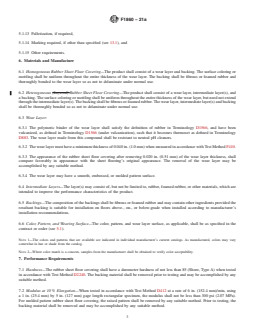
6.1 Homogeneous Rubber Sheet Floor Covering—The product shall consist of a wear layer and backing. The surface coloring or
mottling shall be uniform throughout the entire thickness of the wear layer. The backing shall be fibrous or foamed rubber and
thoroughly bonded to the wear layer so as not to delaminate under normal use.
6.2 Heterogeneous (Layered) Rubber Sheet Floor Covering—The product shall consist of a wear layer, intermediate layer(s), and
a backing. The surface coloring or mottling shall be uniform throughout the entire thickness of the wear layer, but need not extend
through the intermediate layer(s). The backing shall be fibrous or foamed rubber. The wear layer, intermediate layer(s) and backing
shall be thoroughly bonded so as not to delaminate under normal use.
6.3 Wear Layer:
6.3.1 The polymeric binder of the wear layer shall satisfy the definition of rubber in Terminology D1566, and have been
vulcanized, as defined in Terminology D1566 (under vulcanization), such that it becomes thermoset as defined in Terminology
D883. The wear layer made from this compound shall be resistant to neutral pH cleaners.
6.3.2 The wear layer must have a minimum thickness of 0.040 in. (1.0 mm) when measured in accordance with Test Method F410.
6.3.3 The appearance of the rubber sheet floor covering after removing 0.020 in. (0.51 mm) of the wear layer thickness, shall
compare favorably in appearance with the sheet flooring’s original appearance. The removal of the wear layer may be
accomplished by any suitable method.
6.3.4 The wear layer may have a smooth, embossed, or molded pattern surface.
6.4 Intermediate Layers—The layer(s) may consist of, but not be limited to, rubber, foamed rubber, or other materials, which are
intended to improve the performance characteristics of the product.
6.5 Backings—The composition of the backings shall be fibrous or foamed rubber and may contain other ingredients provided the
resultant backing is suitable for installation on floors above-, on-, or below-grade when installed according to manufacturer’s
installation recommendations.
6.6 Color, Pattern, and Wearing Surface—The color, pattern, and wear layer surface, as applicable, shall be as specified in the
contract or order (see 5.1).
NOTE 1—The colors and patterns that are available are indicated in individual manufacturer’s current catalogs. As manufactured, colors may vary
somewhat in hue or shade from the catalog.
NOTE 2—Where color match is a concern, samples from the manufacturer shall be obtained to verify color acceptability.
7. Performance Requirements
7.1 Hardness—The rubber sheet floor covering shall have a durometer hardness of not less than 85 (Shore, Type A) when tested
in accordance with Test Method D2240. The backing material shall be removed prior to testing and may be accomplished by any
suitable method.
7.2 Modulus at 10 % Elongation—When tested in accordance with Test Method D412 at a rate of 6 in. (152.4 mm)/min, using
a 1 in. (25.4 mm) by 5 in. (127 mm) gage length rectangular specimen, the modulus shall not be less than 300 psi (2.07 MPa).
For molded pattern rubber sheet floor covering, the raised pattern shall be removed by any suitable method. Prior to testing, the
backing material shall be removed and may be accomplished by any suitable method.
F1860 − 21a
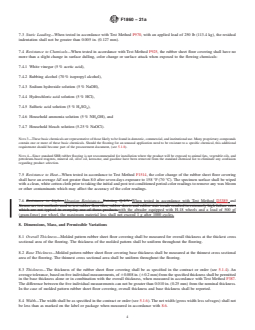
7.3 Static Loading—When tested in accordance with Test Method F970, with an applied load of 250 lb (113.4 kg), the residual
indentation shall not be greater than 0.005 in. (0.127 mm).
7.4 Resistance to Chemicals—When tested in accordance with Test Method F925, the rubber sheet floor covering shall have no
more than a slight change in surface dulling, color change or surface attack when exposed to the flowing chemicals:
7.4.1 White vinegar (5 % acetic acid),
7.4.2 Rubbing alcohol (70 % isopropyl alcohol),
7.4.3 Sodium hydroxide solution (5 % NaOH),
7.4.4 Hydrochloric acid solution (5 % HCl),
7.4.5 Sulfuric
...