

ASTM F1265-03a(2020)
(Test Method)Standard Test Method for Resistance to Impact for Resilient Floor Tile
General Information
- Abstract
SIGNIFICANCE AND USE
4.1 Resilient floor tile is subjected to impacts from objects that may be inadvertently dropped on to surfaces. It is not possible to know all of the factors related to the dropped objects (shape, weight, height of drop) or the condition of the environment in which the tile is located (types of subfloor, degree of adhesion to subfloor, temperature). Therefore, this test method can only provide a relative measure of resistance of resilient floor tile to impact.
SCOPE
1.1 This test method measures the resistance to impact of resilient floor tile.
1.2 The values stated in inch-pound units are to be regarded as standard. The values given in parentheses are mathematical conversions to SI units that are provided for information only and are not considered standard.
1.3 This standard does not purport to address all of the safety concerns, if any, associated with its use. It is the responsibility of the user of this standard to establish appropriate safety, health, and environmental practices and determine the applicability of regulatory limitations prior to use.
1.4 This international standard was developed in accordance with internationally recognized principles on standardization established in the Decision on Principles for the Development of International Standards, Guides and Recommendations issued by the World Trade Organization Technical Barriers to Trade (TBT) Committee.
- Status
- Published
- Publication Date
- 31-Jan-2020
- Technical Committee
- F06 - Resilient Floor Coverings
- Drafting Committee
- F06.20 - Test Methods


Overview
ASTM F1265-03a(2020) is an internationally recognized standard test method developed by ASTM International for evaluating the resistance to impact of resilient floor tile. This method provides a consistent way of assessing how well different resilient floor tiles withstand the forces resulting from dropped objects, contributing to the durability and longevity of flooring in residential, commercial, and industrial settings. As resilient flooring is frequently exposed to accidental impacts, understanding its resistance performance is critical for manufacturers, specifiers, and end users.
Key Topics
- Purpose of the Test: The test method serves to provide a relative measure of impact resistance for resilient floor tiles. It cannot account for all possible use conditions, such as varying object shapes, weights, heights of drop, or environmental factors like type of subfloor, adhesion, or temperature.
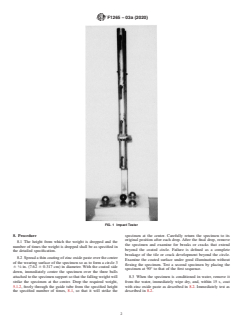
- Apparatus Utilized: The specified apparatus includes a specimen support (comprising steel balls on a rigid steel base), specialized weights (a steel ball or steel cylinder), and a guide tube to ensure accurate impact. Zinc oxide paste is used as a marker on the test specimen surface to assist in the assessment of breaks and cracks.
- Conditioning of Specimens: Prior to testing, specimens undergo conditioning either in air at controlled temperature and humidity or in water at prescribed temperatures to simulate actual environmental exposure.
- Test Procedure: A weighted object is dropped a specified number of times from a set height onto the coated center of the resilient tile specimen. The number of drops, weight, height, and test conditions are all carefully recorded.
- Evaluation Criteria: The occurrence of cracks or breaks extending beyond the marked circle determines failure. Two specimens, positioned at 90-degree intervals, are typically tested to ensure reliable results.
Applications
ASTM F1265-03a(2020) plays a key role in several practical scenarios:
- Product Development: Flooring manufacturers use this standard during the research and development phase to select materials, formulations, and constructions that provide superior impact resistance.
- Quality Assurance: Production lots can be regularly tested according to this method to ensure consistent compliance with required impact resistance specifications.
- Specification and Procurement: Architects, builders, and procurement professionals rely on ASTM F1265 results to compare flooring products, ensuring that the materials selected meet the necessary performance benchmarks for their application.
- Market Differentiation: Certified results according to ASTM F1265 allow manufacturers to distinguish their products in the marketplace by demonstrating durability under impact.
- Regulatory and Compliance: This standard supports compliance with both national and international regulations by ensuring flooring products meet recognized testing protocols.
Related Standards
The following related standards provide further context and support for users of ASTM F1265-03a(2020):
- ASTM F141 - Terminology Relating to Resilient Floor Coverings, which defines the technical vocabulary used in this and associated standards.
- Other Flooring Performance Standards: Additional ASTM methods evaluate wear, indentation, chemical resistance, and dimensional stability, and may be referenced in product specifications alongside ASTM F1265.
- International Standards Principles: This standard aligns with principles outlined by the World Trade Organization (WTO) Technical Barriers to Trade (TBT) Committee, emphasizing its relevance for international trade and regulatory frameworks.
Key SEO Keywords: ASTM F1265, resilient floor tile, impact resistance test, flooring durability standard, ASTM flooring methods, floor tile testing, resilient flooring impact, commercial flooring standards
Relations
- Replaces
ASTM F1265-03a(2013) - Standard Test Method for Resistance to Impact for Resilient Floor Tile - Effective Date
- 01-Feb-2020
- Effective Date
- 01-Aug-2023
- Effective Date
- 15-Jan-2020
- Effective Date
- 01-Mar-2012
- Effective Date
- 01-Dec-2011
- Effective Date
- 01-Dec-2008
- Effective Date
- 01-Nov-2008
- Effective Date
- 01-Nov-2004
- Effective Date
- 10-Jun-2003
- Effective Date
- 10-Aug-2001
- Effective Date
- 10-Aug-2001
- Effective Date
- 10-Aug-2001
- Effective Date
- 10-Aug-2001
- Effective Date
- 01-Feb-2020
- Effective Date
- 01-Feb-2020
Frequently Asked Questions
ASTM F1265-03a(2020) is a standard published by ASTM International. Its full title is "Standard Test Method for Resistance to Impact for Resilient Floor Tile". This standard covers: SIGNIFICANCE AND USE 4.1 Resilient floor tile is subjected to impacts from objects that may be inadvertently dropped on to surfaces. It is not possible to know all of the factors related to the dropped objects (shape, weight, height of drop) or the condition of the environment in which the tile is located (types of subfloor, degree of adhesion to subfloor, temperature). Therefore, this test method can only provide a relative measure of resistance of resilient floor tile to impact. SCOPE 1.1 This test method measures the resistance to impact of resilient floor tile. 1.2 The values stated in inch-pound units are to be regarded as standard. The values given in parentheses are mathematical conversions to SI units that are provided for information only and are not considered standard. 1.3 This standard does not purport to address all of the safety concerns, if any, associated with its use. It is the responsibility of the user of this standard to establish appropriate safety, health, and environmental practices and determine the applicability of regulatory limitations prior to use. 1.4 This international standard was developed in accordance with internationally recognized principles on standardization established in the Decision on Principles for the Development of International Standards, Guides and Recommendations issued by the World Trade Organization Technical Barriers to Trade (TBT) Committee.
SIGNIFICANCE AND USE 4.1 Resilient floor tile is subjected to impacts from objects that may be inadvertently dropped on to surfaces. It is not possible to know all of the factors related to the dropped objects (shape, weight, height of drop) or the condition of the environment in which the tile is located (types of subfloor, degree of adhesion to subfloor, temperature). Therefore, this test method can only provide a relative measure of resistance of resilient floor tile to impact. SCOPE 1.1 This test method measures the resistance to impact of resilient floor tile. 1.2 The values stated in inch-pound units are to be regarded as standard. The values given in parentheses are mathematical conversions to SI units that are provided for information only and are not considered standard. 1.3 This standard does not purport to address all of the safety concerns, if any, associated with its use. It is the responsibility of the user of this standard to establish appropriate safety, health, and environmental practices and determine the applicability of regulatory limitations prior to use. 1.4 This international standard was developed in accordance with internationally recognized principles on standardization established in the Decision on Principles for the Development of International Standards, Guides and Recommendations issued by the World Trade Organization Technical Barriers to Trade (TBT) Committee.
ASTM F1265-03a(2020) is classified under the following ICS (International Classification for Standards) categories: 97.150 - Floor coverings. The ICS classification helps identify the subject area and facilitates finding related standards.
ASTM F1265-03a(2020) has the following relationships with other standards: It is inter standard links to ASTM F1265-03a(2013), ASTM F141-23, ASTM F141-12(2020), ASTM F141-12, ASTM F141-11, ASTM F141-08a, ASTM F141-08, ASTM F141-04, ASTM F141-03, ASTM F141-00B, ASTM F141-00A, ASTM F141-01, ASTM F141-01a, ASTM F1066-04(2018), ASTM F2982-18. Understanding these relationships helps ensure you are using the most current and applicable version of the standard.
ASTM F1265-03a(2020) is available in PDF format for immediate download after purchase. The document can be added to your cart and obtained through the secure checkout process. Digital delivery ensures instant access to the complete standard document.
Standards Content (Sample)
This international standard was developed in accordance with internationally recognized principles on standardization established in the Decision on Principles for the
Development of International Standards, Guides and Recommendations issued by the World Trade Organization Technical Barriers to Trade (TBT) Committee.
Designation: F1265 − 03a (Reapproved 2020)
Standard Test Method for
Resistance to Impact for Resilient Floor Tile
This standard is issued under the fixed designation F1265; the number immediately following the designation indicates the year of
original adoption or, in the case of revision, the year of last revision. A number in parentheses indicates the year of last reapproval. A
superscript epsilon (´) indicates an editorial change since the last revision or reapproval.
1. Scope degree of adhesion to subfloor, temperature). Therefore, this
testmethodcanonlyprovidearelativemeasureofresistanceof
1.1 This test method measures the resistance to impact of
resilient floor tile to impact.
resilient floor tile.
1.2 The values stated in inch-pound units are to be regarded
5. Apparatus
as standard. The values given in parentheses are mathematical
5.1 Impact Testing Apparatus, consisting essentially of a
conversions to SI units that are provided for information only
specimen support, weights, and a device for guiding a freely
and are not considered standard.
falling weight. A suitable apparatus is shown in Fig. 1.
1.3 This standard does not purport to address all of the
5.1.1 Specimen Support, consisting of three steel balls, each
safety concerns, if any, associated with its use. It is the
1 in. in diameter, equally spaced over a rigid steel base so that
responsibility of the user of this standard to establish appro-
a circle drawn through the center of the balls is 5 in. in
priate safety, health, and environmental practices and deter-
diameter. The three balls shall be firmly attached to the base
mine the applicability of regulatory limitations prior to use.
plate and the balls and the base plate shall weigh not less than
1.4 This international standard was developed in accor-
10 lbs (4.5 kg).
dance with internationally recognized principles on standard-
ization established in the Decision on Principles for the 5.1.2 Steel Ball, 1-in. (2.54-cm diameter) weighing 0.143 6
Development of International Standards, Guides and Recom- 0.002 lb (0.065 6 0.001 kg) shall be used for testing ⁄8 (0.317
mendations issued by the World Trade Organization Technical cm) and thinner floor covering; and a 1-in. (2.54 cm) diameter
Barriers to Trade (TBT) Committee. steel cylinder weighing 0.350 6 0.005 lb (0.159 6 0.002 kg)
shall be used and having a hemispherical end, for testing ⁄16 in.
2. Referenced Documents 1
(0.476 cm) and ⁄4 in. (0.635 cm) material.
2.1 ASTM Standards: 5.1.3 Slotted Tube, graduated in ⁄4 in. (0.635 cm) divisions,
F141 Terminology Relating to Resilient Floor Coverings about 20 in. (50.8 cm) in height and of sufficient size to permit
the weight to fall through it freely, is mounted vertically over
3. Terminology
the specimen support so as to guide the freely falling weight to
the center of the circle formed by the three balls.
3.1 Definitions—For definitions of terms used in this test
method refer to Terminology F141.
5.2 Zinc Oxide Paste, made by mixing powdered zinc oxide
with water to form a thin paste.
4. Significance and Use
4.1 Resilient floor tile is subjected to impacts from objects
6. Test Specimen
that may be inadvertently dropped on to surfaces. It is not
6.1 The specimen shall consist of a 6-in. by 6-in. (15 cm by
possible to know all of the factors related to the dropped
15 cm) portion of the test unit.
objects (shape, weight, height of drop) or the condition of the
environment in which the tile is located (types of subfloor,
7. Conditioning
7.1 Conditioning in Air—Condition the specimens for
This test method is under jurisdiction of ASTM Committee F06 on Resilient
physical test in air maintained at 73.4 6 1.8°F (25 6 1°C) and
Floor Coverings and is the direct responsibility of Subcommittee F06.20 on Test
Methods. 50 6 5 % relative humidity for not less than 24 h before
Current edition approved Feb. 1, 2020. Published February 2020. Originally
testing.
approved in 1989. Last previous edition approved in 2013 as F1265 – 03a (2013).
DOI: 10.1520/F1265-03AR20.
7.2 Conditioning in
...