

ASTM F1869-23
(Test Method)Standard Test Method for Measuring Moisture Vapor Emission Rate of Concrete Subfloor Using Anhydrous Calcium Chloride
General Information
- Abstract
SIGNIFICANCE AND USE
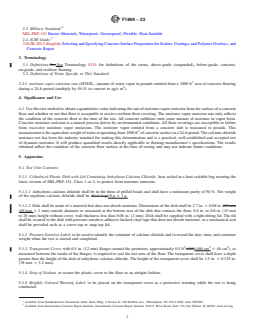
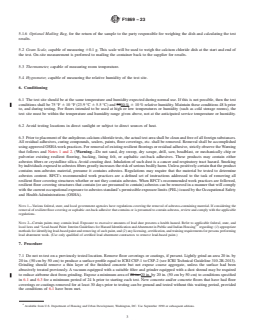
4.1 Use this test method to obtain a quantitative value indicating the rate of moisture vapor emission from the surface of a concrete floor and whether or not that floor is acceptable to receive resilient floor covering. The moisture vapor emission rate only reflects the condition of the concrete floor at the time of the test. All concrete subfloors emit some amount of moisture in vapor form. Concrete moisture emission is a natural process driven by environmental conditions. All floor coverings are susceptible to failure from excessive moisture vapor emissions. The moisture vapor emitted from a concrete slab is measured in pounds. This measurement is the equivalent weight of water evaporating from 1000 ft2 of concrete surface in a 24-h period. The calcium chloride moisture test has been the industry standard for making this determination and is a practical, well-established and accepted test of dynamic moisture. It will produce quantified results directly applicable to flooring manufacturer's specifications. The results obtained reflect the condition of the concrete floor surface at the time of testing and may not indicate future conditions.
SCOPE
1.1 This test method covers the quantitative determination of the rate of moisture vapor emitted from below-grade, on-grade, and above-grade (suspended) bare concrete floors.
1.2 This test shall not be used to evaluate the rate of moisture vapor emitted by gypsum concrete or floors containing lightweight aggregate.
1.3 This test shall not be used to evaluate moisture vapor emissions over coatings on concrete or through reactive penetrants or over patching or leveling compounds.
1.4 This quantity of moisture shall be expressed as the rate of moisture vapor emission, measured in pounds of moisture over a 1000 ft2 area during a 24-h period.
1.5 The values stated in inch-pound units are to be regarded as standard. The values given in parentheses are mathematical conversions to SI units that are provided for information only and are not considered standard.
1.6 This standard does not purport to address all of the safety concerns, if any, associated with its use. It is the responsibility of the user of this standard to establish appropriate safety, health, and environmental practices and determine the applicability of regulatory limitations prior to use.
1.7 This international standard was developed in accordance with internationally recognized principles on standardization established in the Decision on Principles for the Development of International Standards, Guides and Recommendations issued by the World Trade Organization Technical Barriers to Trade (TBT) Committee.
- Status
- Published
- Publication Date
- 31-Jul-2023
- Technical Committee
- F06 - Resilient Floor Coverings
- Drafting Committee
- F06.40 - Practices
Buy Documents

ASTM F1869-23 - Standard Test Method for Measuring Moisture Vapor Emission Rate of Concrete Subfloor Using Anhydrous Calcium Chloride
REDLINE ASTM F1869-23 - Standard Test Method for Measuring Moisture Vapor Emission Rate of Concrete Subfloor Using Anhydrous Calcium Chloride
Overview
ASTM F1869-23 is the standard test method established by ASTM International for measuring the moisture vapor emission rate (MVER) from concrete subfloors using anhydrous calcium chloride. This test provides a quantitative determination of how much moisture vapor is emitted from the surface of bare, below-grade, on-grade, or above-grade (suspended) concrete floors. It is a widely accepted, practical, and established industry method, particularly important in evaluating if a concrete floor's moisture levels are suitable for the installation of resilient flooring or other moisture-sensitive flooring materials.
Key Topics
- Moisture Vapor Emission Rate (MVER): Expressed in pounds of moisture per 1,000 square feet over 24 hours, MVER indicates the actual rate at which moisture exits the concrete slab surface at the time of testing.
- Testing Scope: This method applies only to bare concrete floors, excluding gypsum concrete, floors with lightweight aggregate, surfaces with coatings or reactive penetrants, and those over patching or leveling compounds.
- Test Procedure Overview:
- Use anhydrous calcium chloride sealed in a plastic dish, placed under a transparent, airtight cover on a prepared, clean section of the bare concrete.
- After a set period (typically 60-72 hours), calculate the weight gain of the calcium chloride to quantify moisture vapor emission.
- The calculated value is vital for comparing against manufacturers’ installation requirements for floor coverings.
- Environmental Considerations: Testing should be conducted under normal operating temperature and humidity, or according to specified standard conditions, ensuring meaningful and reproducible results.
Applications
- Flooring Installation Readiness: Quantitative assessment of moisture vapor emission is crucial in determining suitability before installing moisture-sensitive floor coverings, such as vinyl, rubber, and other resilient materials.
- Building Renovation & New Construction: Ensures concrete subfloors are within required moisture limits to prevent adhesive failure, floor covering delamination, or mold growth.
- Facility Maintenance: Used for monitoring the ongoing condition of concrete slabs, especially in facilities subject to variable humidity or water exposure.
- Compliance with Manufacturer Requirements: Results from ASTM F1869-23 offer direct applicability to product warranties, performance specifications, and installation guidelines set by flooring manufacturers.
Related Standards
- ASTM E1745 - Specification for Plastic Water Vapor Retarders Used in Contact with Soil or Granular Fill under Concrete Slabs. Establishes recommended materials to help manage sub-slab moisture migration.
- ASTM E1993 - Specification for Bituminous Water Vapor Retarders. Provides additional guidance on moisture control at the subgrade level.
- ASTM F141 - Terminology for Resilient Floor Coverings. Defines terms referenced in this and related standards.
- ICRI 310.2R-2013 - Guide for Concrete Surface Preparation for Sealers, Coatings, and Polymer Overlays. Outlines best practices for preparing concrete surfaces prior to testing or installing finish flooring.
- Resilient Floor Covering Institute (RFCI) Recommended Work Practices - Best practices for removal or treatment of existing flooring to avoid hazardous exposure to asbestos or lead.
Practical Value
Using ASTM F1869-23 helps contractors, facility managers, and specifiers prevent costly flooring failures caused by excessive moisture vapor from concrete subfloors. The method's standardized process produces reliable, documented data for decision-making in new construction, renovation, or maintenance projects. Proper application ensures compliance with industry protocols and supports warranty claims, while helping safeguard occupant health and building durability through effective moisture management.
Keywords: ASTM F1869-23, moisture vapor emission rate, concrete subfloor, anhydrous calcium chloride test, resilient floor covering, flooring installation, moisture testing, MVER, concrete moisture control.
Relations
- Effective Date
- 01-Aug-2023
- Effective Date
- 15-Jan-2020
- Effective Date
- 01-Mar-2012
- Effective Date
- 01-Dec-2011
- Effective Date
- 01-Oct-2011
- Effective Date
- 15-Feb-2009
- Effective Date
- 01-Dec-2008
- Effective Date
- 01-Nov-2008
- Effective Date
- 01-Oct-2008
- Effective Date
- 01-Nov-2004
- Effective Date
- 01-May-2004
- Effective Date
- 10-Jun-2003
- Effective Date
- 10-Aug-2001
- Effective Date
- 10-Aug-2001
- Effective Date
- 10-Aug-2001
Buy Documents
ASTM F1869-23 - Standard Test Method for Measuring Moisture Vapor Emission Rate of Concrete Subfloor Using Anhydrous Calcium Chloride
REDLINE ASTM F1869-23 - Standard Test Method for Measuring Moisture Vapor Emission Rate of Concrete Subfloor Using Anhydrous Calcium Chloride
Get Certified
Connect with accredited certification bodies for this standard

DIBt (Deutsches Institut für Bautechnik)
German Institute for Building Technology.
DIN CERTCO
DIN Group product certification.

Aboma Certification B.V.
Specialized in construction, metal, and transport sectors.
Sponsored listings
Frequently Asked Questions
ASTM F1869-23 is a standard published by ASTM International. Its full title is "Standard Test Method for Measuring Moisture Vapor Emission Rate of Concrete Subfloor Using Anhydrous Calcium Chloride". This standard covers: SIGNIFICANCE AND USE 4.1 Use this test method to obtain a quantitative value indicating the rate of moisture vapor emission from the surface of a concrete floor and whether or not that floor is acceptable to receive resilient floor covering. The moisture vapor emission rate only reflects the condition of the concrete floor at the time of the test. All concrete subfloors emit some amount of moisture in vapor form. Concrete moisture emission is a natural process driven by environmental conditions. All floor coverings are susceptible to failure from excessive moisture vapor emissions. The moisture vapor emitted from a concrete slab is measured in pounds. This measurement is the equivalent weight of water evaporating from 1000 ft2 of concrete surface in a 24-h period. The calcium chloride moisture test has been the industry standard for making this determination and is a practical, well-established and accepted test of dynamic moisture. It will produce quantified results directly applicable to flooring manufacturer's specifications. The results obtained reflect the condition of the concrete floor surface at the time of testing and may not indicate future conditions. SCOPE 1.1 This test method covers the quantitative determination of the rate of moisture vapor emitted from below-grade, on-grade, and above-grade (suspended) bare concrete floors. 1.2 This test shall not be used to evaluate the rate of moisture vapor emitted by gypsum concrete or floors containing lightweight aggregate. 1.3 This test shall not be used to evaluate moisture vapor emissions over coatings on concrete or through reactive penetrants or over patching or leveling compounds. 1.4 This quantity of moisture shall be expressed as the rate of moisture vapor emission, measured in pounds of moisture over a 1000 ft2 area during a 24-h period. 1.5 The values stated in inch-pound units are to be regarded as standard. The values given in parentheses are mathematical conversions to SI units that are provided for information only and are not considered standard. 1.6 This standard does not purport to address all of the safety concerns, if any, associated with its use. It is the responsibility of the user of this standard to establish appropriate safety, health, and environmental practices and determine the applicability of regulatory limitations prior to use. 1.7 This international standard was developed in accordance with internationally recognized principles on standardization established in the Decision on Principles for the Development of International Standards, Guides and Recommendations issued by the World Trade Organization Technical Barriers to Trade (TBT) Committee.
SIGNIFICANCE AND USE 4.1 Use this test method to obtain a quantitative value indicating the rate of moisture vapor emission from the surface of a concrete floor and whether or not that floor is acceptable to receive resilient floor covering. The moisture vapor emission rate only reflects the condition of the concrete floor at the time of the test. All concrete subfloors emit some amount of moisture in vapor form. Concrete moisture emission is a natural process driven by environmental conditions. All floor coverings are susceptible to failure from excessive moisture vapor emissions. The moisture vapor emitted from a concrete slab is measured in pounds. This measurement is the equivalent weight of water evaporating from 1000 ft2 of concrete surface in a 24-h period. The calcium chloride moisture test has been the industry standard for making this determination and is a practical, well-established and accepted test of dynamic moisture. It will produce quantified results directly applicable to flooring manufacturer's specifications. The results obtained reflect the condition of the concrete floor surface at the time of testing and may not indicate future conditions. SCOPE 1.1 This test method covers the quantitative determination of the rate of moisture vapor emitted from below-grade, on-grade, and above-grade (suspended) bare concrete floors. 1.2 This test shall not be used to evaluate the rate of moisture vapor emitted by gypsum concrete or floors containing lightweight aggregate. 1.3 This test shall not be used to evaluate moisture vapor emissions over coatings on concrete or through reactive penetrants or over patching or leveling compounds. 1.4 This quantity of moisture shall be expressed as the rate of moisture vapor emission, measured in pounds of moisture over a 1000 ft2 area during a 24-h period. 1.5 The values stated in inch-pound units are to be regarded as standard. The values given in parentheses are mathematical conversions to SI units that are provided for information only and are not considered standard. 1.6 This standard does not purport to address all of the safety concerns, if any, associated with its use. It is the responsibility of the user of this standard to establish appropriate safety, health, and environmental practices and determine the applicability of regulatory limitations prior to use. 1.7 This international standard was developed in accordance with internationally recognized principles on standardization established in the Decision on Principles for the Development of International Standards, Guides and Recommendations issued by the World Trade Organization Technical Barriers to Trade (TBT) Committee.
ASTM F1869-23 is classified under the following ICS (International Classification for Standards) categories: 91.060.30 - Ceilings. Floors. Stairs; 91.100.30 - Concrete and concrete products. The ICS classification helps identify the subject area and facilitates finding related standards.
ASTM F1869-23 has the following relationships with other standards: It is inter standard links to ASTM F141-23, ASTM F141-12(2020), ASTM F141-12, ASTM F141-11, ASTM E1745-11, ASTM E1745-09, ASTM F141-08a, ASTM F141-08, ASTM E1993-98(2008), ASTM F141-04, ASTM E1745-97(2004), ASTM F141-03, ASTM F141-01a, ASTM F141-00B, ASTM F141-00A. Understanding these relationships helps ensure you are using the most current and applicable version of the standard.
ASTM F1869-23 is available in PDF format for immediate download after purchase. The document can be added to your cart and obtained through the secure checkout process. Digital delivery ensures instant access to the complete standard document.
Standards Content (Sample)
This international standard was developed in accordance with internationally recognized principles on standardization established in the Decision on Principles for the
Development of International Standards, Guides and Recommendations issued by the World Trade Organization Technical Barriers to Trade (TBT) Committee.
Designation: F1869 − 23
Standard Test Method for
Measuring Moisture Vapor Emission Rate of Concrete
Subfloor Using Anhydrous Calcium Chloride
This standard is issued under the fixed designation F1869; the number immediately following the designation indicates the year of
original adoption or, in the case of revision, the year of last revision. A number in parentheses indicates the year of last reapproval. A
superscript epsilon (´) indicates an editorial change since the last revision or reapproval.
1. Scope E1745 Specification for Plastic Water Vapor Retarders Used
in Contact with Soil or Granular Fill under Concrete Slabs
1.1 This test method covers the quantitative determination
E1993 Specification for Bituminous Water Vapor Retarders
of the rate of moisture vapor emitted from below-grade,
Used in Contact with Soil or Granular Fill Under Concrete
on-grade, and above-grade (suspended) bare concrete floors.
Slabs
1.2 This test shall not be used to evaluate the rate of
F141 Terminology Relating to Resilient Floor Coverings
moisture vapor emitted by gypsum concrete or floors contain- 3
2.2 Resilient Floor Covering Institute Standard:
ing lightweight aggregate.
Recommended Work Practices
1.3 This test shall not be used to evaluate moisture vapor
2.3 Military Standard:
emissions over coatings on concrete or through reactive
MIL-PRF-131 Barrier Materials, Waterproof, Greaseproof,
penetrants or over patching or leveling compounds.
Flexible, Heat-Sealable
2.4 ICRI Guide:
1.4 This quantity of moisture shall be expressed as the rate
310.2R-2013 (English) Selecting and Specifying Concrete
of moisture vapor emission, measured in pounds of moisture
Surface Preparation for Sealers, Coatings, and Polymer
over a 1000 ft area during a 24-h period.
Overlays, and Concrete Repair
1.5 The values stated in inch-pound units are to be regarded
as standard. The values given in parentheses are mathematical
3. Terminology
conversions to SI units that are provided for information only
3.1 Definitions: See Terminology F141 for definitions of the
and are not considered standard.
terms, above-grade (suspended), below-grade, concrete, on-
1.6 This standard does not purport to address all of the
grade, and resilient flooring.
safety concerns, if any, associated with its use. It is the
3.2 Definitions of Terms Specific to This Standard:
responsibility of the user of this standard to establish appro-
3.2.1 moisture vapor emission rate (MVER)—amount of
priate safety, health, and environmental practices and deter- 2
water vapor in pounds emitted from a 1000 ft area of concrete
mine the applicability of regulatory limitations prior to use.
flooring during a 24-h period (multiply by 56.51 to convert to
1.7 This international standard was developed in accor- 2
μg/s m ).
dance with internationally recognized principles on standard-
ization established in the Decision on Principles for the
4. Significance and Use
Development of International Standards, Guides and Recom-
4.1 Use this test method to obtain a quantitative value
mendations issued by the World Trade Organization Technical
indicating the rate of moisture vapor emission from the surface
Barriers to Trade (TBT) Committee.
of a concrete floor and whether or not that floor is acceptable
to receive resilient floor covering. The moisture vapor emission
2. Referenced Documents
rate only reflects the condition of the concrete floor at the time
2.1 ASTM Standards:
of the test. All concrete subfloors emit some amount of
moisture in vapor form. Concrete moisture emission is a
natural process driven by environmental conditions. All floor
This test method is under the jurisdiction of ASTM Committee F06 on Resilient
coverings are susceptible to failure from excessive moisture
Floor Coverings and is the direct responsibility of Subcommittee F06.40 on
Practices.
Current edition approved Aug. 1, 2023. Published September 2023. Originally
approved in 1998. Last previous edition approved in 2022 as F1869 – 22. DOI: Available from Resilient Floor Covering Institute, 966 Hungerford Drive, Suite
10.1520/F1869-23. 12-B, Rockville, MD 20850.
2 4
For referenced ASTM standards, visit the ASTM website, www.astm.org, or Available from Standardization Documents Order Desk, Bldg. 4 Section D, 700
contact ASTM Customer Service at service@astm.org. For Annual Book of ASTM Robbins Ave., Philadelphia, PA 19111-5094, Attn: NPODS.
Standards volume information, refer to the standard’s Document Summary page on Available from International Concrete Repair Institute, International Concrete
the ASTM website. Repair Institute 3166 S. River Road, Suite 132, Des Plaines, IL 60018; www.icri.org
Copyright © ASTM International, 100 Barr Harbor Drive, PO Box C700, West Conshohocken, PA 19428-2959. United States
F1869 − 23
vapor emissions. The moisture vapor emitted from a concrete then the test conditions shall be 75 °F 6 10 °F (23.9 °C 6
slab is measured in pounds. This measurement is the equivalent 5.5 °C) and 50 % 6 10 % relative humidity. Maintain these
weight of water evaporating from 1000 ft of concrete surface conditions 48 h prior to, and during testing. For floors intended
in a 24-h period. The calcium chloride moisture test has been to be used at high or low temperatures or humidity (such as
the industry standard for making this determination and is a cold storage rooms), the test site must be within the tempera-
practical, well-established and accepted test of dynamic mois- ture and humidity range given above, not at the anticipated
ture. It will produce quantified results directly applicable to service temperature or humidity.
flooring manufacturer’s specifications. The results obtained
6.2 Avoid testing locations in direct sunlight or subject to
reflect the condition of the concrete floor surface at the time of
direct sources of heat.
testing and may not indicate future conditions.
6.3 Prior to placement of the anhydrous calcium chloride
5. Apparatus
tests, the actual test area shall be clean and free of all foreign
substances. All residual adhesives, curing compounds, sealers,
5.1 Test Unit Contents:
paints, floor coverings, etc. shall be removed. Removal shall be
5.1.1 Cylindrical Plastic Dish with Lid Containing Anhy-
accomplished using approved OSHA work practices. For
drous Calcium Chloride, heat sealed in a heat sealable bag
removal of existing resilient floorings or residual adhesive,
meeting the latest version of MIL-PRF-131, Class 1 or 2, to
strictly observe the Warning that follows and Notes 1 and 2.
protect from moisture intrusion.
(Warning—Do not sand, dry sweep, dry scrape, drill, saw,
5.1.1.1 Anhydrous calcium chloride shall be in the form of
beadblast, or mechanically chip or pulverize existing resilient
prilled beads and shall have a minimum purity of 94 %. Net
flooring, backing, lining felt, or asphaltic cut-back adhesives.
weight of the anydrous calcium chloride shall be 16 g 6 1 g.
These products may contain either asbestos fibers or crystalline
5.1.1.2 Dish shall be made of a material that does not absorb
silica. Avoid creating dust. Inhalation of such dust is a cancer
moisture. Dimensions of the dish shall be 2.7 in. 6 0.08 in.
and respiratory tract hazard. Smoking by individuals exposed
(69 mm 6 2 mm) outside diameter as measured at the bottom
to asbestos fibers greatly increases the risk of serious bodily
area of the dish that contacts the floor, 0.6 in. to 0.8 in. (15 mm
harm. Unless positively certain that the product contains
to 20 mm) height without cover, wall thickness less than 0.08
non-asbestos material, presume it contains asbestos. Regula-
in. (2 mm). Dish shall be supplied with a tight-fitting lid. The
tions may require that the material be tested to determine
lid shall be secured to the dish with pressure-sensitive-adhesive
asbestos content. RFCI’s recommended work practices are a
backed vinyl tape that does not absorb moisture, or a mechani-
defined set of instructions addressed to the task of removing all
cal seal shall be provided such as a screw-top or snap-top lid.
resilient floor covering structures whether or not they contain
5.1.2 Pressure Sensitive Label, to be used to identify the
asbestos. When RFCI’s recommended work practices are
container of calcium chloride and to record the date, time, and
followed, resilient floor covering structures that contain (or are
container weight when the test is started and completed.
presumed to contain) asbestos can be removed in a manner that
5.1.3 Transparent Cover, with 0.5 in. (12 mm) flanges
2 2
will comply with the current occupational exposure to asbestos
around the perimeter, approximately 0.5 ft (460 cm 6 46
standard’s permissible exposure limits (PEL) issued by the
cm ), as measured between the inside of the flanges, is required
Occupational Safety and Health Administrations (OSHA).
to seal the test area of the floor. The transparent cover shall
have a depth greater than the height of the dish of anhydrous
NOTE 1—Various federal, state, and local government agencies have
calcium chloride. The height of the transparent cover shall be regulations covering the removal of asbestos-containing material. If
considering the removal of resilient floor covering or asphaltic cut-back
1.5 in. 6 0.125 in. (38 mm 6 3.2 mm).
adhesive that contains or is presumed to contain asbestos, review and
5.1.4 Strip of Sealant, to secure the plastic cover to the floor
comply with the applicable regulation
...
This document is not an ASTM standard and is intended only to provide the user of an ASTM standard an indication of what changes have been made to the previous version. Because
it may not be technically possible to adequately depict all changes accurately, ASTM recommends that users consult prior editions as appropriate. In all cases only the current version
of the standard as published by ASTM is to be considered the official document.
Designation: F1869 − 22 F1869 − 23
Standard Test Method for
Measuring Moisture Vapor Emission Rate of Concrete
Subfloor Using Anhydrous Calcium Chloride
This standard is issued under the fixed designation F1869; the number immediately following the designation indicates the year of
original adoption or, in the case of revision, the year of last revision. A number in parentheses indicates the year of last reapproval. A
superscript epsilon (´) indicates an editorial change since the last revision or reapproval.
1. Scope
1.1 This test method covers the quantitative determination of the rate of moisture vapor emitted from below-grade, on-grade, and
above-grade (suspended) bare concrete floors.
1.2 This test shall not be used to evaluate the rate of moisture vapor emitted by gypsum concrete or floors containing lightweight
aggregate.
1.3 This test shall not be used to evaluate moisture vapor emissions over coatings on concrete or through reactive penetrants or
over patching or leveling compounds.
1.4 This quantity of moisture shall be expressed as the rate of moisture vapor emission, measured in pounds of moisture over a
1000 ft area during a 24-h period.
1.5 The values stated in inch-pound units are to be regarded as standard. The values given in parentheses are mathematical
conversions to SI units that are provided for information only and are not considered standard.
1.6 This standard does not purport to address all of the safety concerns, if any, associated with its use. It is the responsibility
of the user of this standard to establish appropriate safety, health, and environmental practices and determine the applicability of
regulatory limitations prior to use.
1.7 This international standard was developed in accordance with internationally recognized principles on standardization
established in the Decision on Principles for the Development of International Standards, Guides and Recommendations issued
by the World Trade Organization Technical Barriers to Trade (TBT) Committee.
2. Referenced Documents
2.1 ASTM Standards:
E1745 Specification for Plastic Water Vapor Retarders Used in Contact with Soil or Granular Fill under Concrete Slabs
E1993 Specification for Bituminous Water Vapor Retarders Used in Contact with Soil or Granular Fill Under Concrete Slabs
F141 Terminology Relating to Resilient Floor Coverings
2.2 Resilient Floor Covering Institute Standard:
Recommended Work Practices
This test method is under the jurisdiction of ASTM Committee F06 on Resilient Floor Coverings and is the direct responsibility of Subcommittee F06.40 on Practices.
Current edition approved June 1, 2022Aug. 1, 2023. Published July 2022September 2023. Originally approved in 1998. Last previous edition approved in 20162022 as
F1869F1869 – 22.–16. DOI: 10.1520/F1869-22.10.1520/F1869-23.
For referenced ASTM standards, visit the ASTM website, www.astm.org, or contact ASTM Customer Service at service@astm.org. For Annual Book of ASTM Standards
volume information, refer to the standard’s Document Summary page on the ASTM website.
Available from Resilient Floor Covering Institute, 966 Hungerford Drive, Suite 12-B, Rockville, MD 20850.
Copyright © ASTM International, 100 Barr Harbor Drive, PO Box C700, West Conshohocken, PA 19428-2959. United States
F1869 − 23
2.3 Military Standard:
MIL-PRF-131 Barrier Materials, Waterproof, Greaseproof, Flexible, Heat-Sealable
2.4 ICRI Guide:
310.2R-2013 (English) Selecting and Specifying Concrete Surface Preparation for Sealers, Coatings, and Polymer Overlays, and
Concrete Repair
3. Terminology
3.1 Definitions:See See Terminology F141 for definitions of the terms, above-grade (suspended), below-grade, concrete,
on-grade, and resilient flooring.
3.2 Definitions of Terms Specific to This Standard:
3.2.1 moisture vapor emission rate (MVER)—amount of water vapor in pounds emitted from a 1000 ft area of concrete flooring
during a 24-h period (multiply by 56.51 to convert to μg/s m ).
4. Significance and Use
4.1 Use this test method to obtain a quantitative value indicating the rate of moisture vapor emission from the surface of a concrete
floor and whether or not that floor is acceptable to receive resilient floor covering. The moisture vapor emission rate only reflects
the condition of the concrete floor at the time of the test. All concrete subfloors emit some amount of moisture in vapor form.
Concrete moisture emission is a natural process driven by environmental conditions. All floor coverings are susceptible to failure
from excessive moisture vapor emissions. The moisture vapor emitted from a concrete slab is measured in pounds. This
measurement is the equivalent weight of water evaporating from 1000 ft of concrete surface in a 24-h period. The calcium chloride
moisture test has been the industry standard for making this determination and is a practical, well-established and accepted test
of dynamic moisture. It will produce quantified results directly applicable to flooring manufacturer’s specifications. The results
obtained reflect the condition of the concrete floor surface at the time of testing and may not indicate future conditions.
5. Apparatus
5.1 Test Unit Contents:
5.1.1 Cylindrical Plastic Dish with Lid Containing Anhydrous Calcium Chloride, heat sealed in a heat sealable bag meeting the
latest version of MIL-PRF-131, Class 1 or 2, to protect from moisture intrusion.
5.1.1.1 Anhydrous calcium chloride shall be in the form of prilled beads and shall have a minimum purity of 94 %. Net weight
of the anydrous calcium chloride shall be 16 6 1 g.16 g 6 1 g.
5.1.1.2 Dish shall be made of a material that does not absorb moisture. Dimensions of the dish shall be 2.7 in. 6 0.08 in. (69 mm
(69 mm 6 2 mm) outside diameter as measured at the bottom area of the dish that contacts the floor, 0.6 in. to 0.8 in. (15 mm
to 20 mm) height without cover, wall thickness less than 0.08 in. (2 mm). Dish shall be supplied with a tight-fitting lid. The lid
shall be secured to the dish with pressure-sensitive-adhesive backed vinyl tape that does not absorb moisture, or a mechanical seal
shall be provided such as a screw-top or snap-top lid.
5.1.2 Pressure Sensitive Label, to be used to identify the container of calcium chloride and to record the date, time, and container
weight when the test is started and completed.
2 2 2
5.1.3 Transparent Cover, with 0.5 in. (12 mm) flanges around the perimeter, approximately 0.5 ft (460 (460 cm 6 46 cm ), as
measured between the inside of the flanges, is required to seal the test area of the floor. The transparent cover shall have a depth
greater than the height of the dish of anhydrous calcium chloride. The height of the transparent cover shall be 1.5 in. 6 0.125 in.
(38 mm 6 3.2 mm).
5.1.4 Strip of Sealant, to secure the plastic cover to the floor in an airtight fashion.
5.1.5 Brightly Colored Warning Label, to be placed on the transparent cover as a protective warning while the test is being
conducted.
Available from Standardization Documents Order Desk, Bldg. 4 Section D, 700 Robbins Ave., Philadelphia, PA 19111-5094, Attn: NPODS.
Available from International Concrete Repair Institute, International Concrete Repair Institute 3166 S. River Road, Suite 132, Des Plaines, IL 60018; www.icri.org
F1869 − 23
5.1.6 Optional Mailing Bag, for the return of the sample to the party responsible for weighing the dish and calculating the test
results.
5.2 Gram Scale, capable of measuring 60.1 g. This scale will be used to weigh the calcium chloride dish at the start and end of
the test. On-site measurement is preferred to mailing the container back to the supplier for results.
5.3 Thermometer, capable of measuring room temperature.
5.4 Hygrometer, capable of measuring the relative humidity of the test site.
6. Conditioning
6.1 The test site should be at the same temperature and humidity expected during normal use. If this is not possible, then the test
conditions shall be 75 °F 6 10 °F (23.9 °C 6 5.5 °C) and 5050 % 6 10 % relative humidity. Maintain these conditions 48 h prior
to, and during testing. For floors intended to be used at high or low temperatures or humidity (such as cold storage rooms), the
test site must be within the temperature and humidity range given above, not at the anticipated service temperature or humidity.
6.2 Avoid testing locations in direct sunlight or subject to direct sources of heat.
6.3 Prior to placement of the anhydrous calcium chloride tests, the actual test area shall be clean and free of all foreign substances.
All residual adhesives, curing compounds, sealers, paints, floor coverings, etc. shall be removed. Removal shall be accomplished
using approved OSHA work practices. For removal of existing resilient floorings or residual adhesive, strictly observe the Warning
that follows and Notes 1 and 2. (Warning—Do not sand, dry sweep, dry scrape, drill, saw, beadblast, or mechanically chip or
pulverize existing resilient flooring, backing, lining felt, or asphaltic cut-back adhesives. These products may contain either
asbestos fibers or crystalline silica. Avoid creating dust. Inhalation of such dust is a cancer and respiratory tract hazard. Smoking
by individuals exposed to asbestos fibers greatly increases the risk of serious bodily harm. Unless positively certain that the product
contains non-asbestos material, presume it contains asbestos. Regulations may require that the material be tested to determine
asbestos content. RFCI’s recommended wor
...