

ASTM F2659-23
(Guide)Standard Guide for Preliminary Evaluation of Comparative Moisture Condition of Concrete, Gypsum Cement and Other Floor Slabs and Screeds Using a Non-Destructive Electronic Moisture Meter
General Information
- Abstract
SIGNIFICANCE AND USE
5.1 Moisture in concrete floor slabs affects the performance of flooring systems such as resilient, wood, and textile floor coverings and coatings. Manufacturers of such systems generally require moisture testing be performed before installation of coverings on floor slabs and screeds. The measurement of sub-surface comparative moisture condition in the upper 1.0 in. (25.4 mm) stratum of a concrete slab with a non-destructive moisture meter is one such method.
5.2 Excessive moisture in floor slabs after installation can cause floor covering system failures such as delamination, bonding failure, deterioration of finish flooring and coatings, and microbial growth.
5.3 5.3 Comparative moisture content tests indicate the moisture in the slab, which is usually referenced to the percentage of dry weight. That is:
Results indicate conditions at the time of the test.
5.4 Methods of meter calibration and factors affecting equilibration are described in Section 8.
SCOPE
1.1 This guide focuses on obtaining the comparative moisture condition within the upper 1.0 in. (25.4 mm) stratum in concrete, gypsum, anhydrite floor slabs and screeds for field tests. Due to the wide variation of material mixtures and additives used in floor slabs and screeds, this methodology may not be appropriate for all applications. See 1.2 through 1.8 and Section 11. Where appropriate or when specified, use further testing as outlined in Test Methods F1869 or F2170 before installing a resilient floor covering.
1.2 This guide is intended for use to determine if there are moisture-related conditions existing on, or in, the floor slabs that could adversely impact the successful application and performance of resilient flooring products.
1.3 This guide may be used to aid in the diagnosis of failures of installed resilient flooring.
1.4 This guide is intended to be used in conjunction with meter manufacturer’s operation instructions and interpretive data where available.
1.5 Where possible or when results need to be quantified, use this guide to determine where additional testing such as Test Methods F1869 or F2170 as specified to characterize the floor slab and the test area environment for moisture, humidity and temperature conditions.
1.6 This guide may not be suitable for areas that have surface applied moisture migration systems, curing compounds or coatings that cannot be removed or cleaned off sufficiently to allow the moisture to move upwards through the slab. For a floor slab of 6 in. (150 mm) plus thickness, low porosity slabs, slabs with no vapor retarder installed, and slabs where the above surface environmental conditions can have a greater than normal influence on the moisture reduction gradient of the floor slab or screed, consider Test Method F2170 (below surface in situ rh method) as a more suitable test method under these circumstances.
1.7 This guide is not intended to provide quantitative results as a basis for acceptance of a floor for installation of moisture sensitive flooring finishes systems. Test Methods F1869 or F2170 provide quantitative information for determining if moisture levels are within specific limits. Results from this guide do not provide vital information when evaluating thick slabs, slabs without effective vapor retarders directly under the slab, lightweight aggregate concrete floors, and slabs with curing compound or sealers on the surface.
1.8 The values stated in inch-pound units are to be regarded as standard. The values given in parentheses are mathematical conversions to SI units that are provided for information only and are not considered standard.
1.9 This standard does not purport to address all of the safety concerns, if any, associated with its use. It is the responsibility of the user of this standard to establish appropriate safety, health, and environmental practices and determine the applicability of regulatory limitations prior to use...
- Status
- Published
- Publication Date
- 14-Mar-2023
- Technical Committee
- F06 - Resilient Floor Coverings
- Drafting Committee
- F06.40 - Practices
Buy Documents
ASTM F2659-23 - Standard Guide for Preliminary Evaluation of Comparative Moisture Condition of Concrete, Gypsum Cement and Other Floor Slabs and Screeds Using a Non-Destructive Electronic Moisture Meter
REDLINE ASTM F2659-23 - Standard Guide for Preliminary Evaluation of Comparative Moisture Condition of Concrete, Gypsum Cement and Other Floor Slabs and Screeds Using a Non-Destructive Electronic Moisture Meter
Overview
ASTM F2659-23: Standard Guide for Preliminary Evaluation of Comparative Moisture Condition of Concrete, Gypsum Cement and Other Floor Slabs and Screeds Using a Non-Destructive Electronic Moisture Meter provides important guidance for determining the relative moisture condition in the upper 1 inch (25.4 mm) of concrete, gypsum, anhydrite floor slabs, and screeds. Moisture content in floor slabs is a critical factor influencing the success of floor coverings, such as resilient, wood, and textile flooring. This guide outlines a non-destructive, comparative method using electronic moisture meters, empowering flooring professionals to assess risk before installation and diagnose possible flooring failures post-installation.
Key Topics
Purpose of Moisture Measurement
- Identifies pre-installation moisture conditions that could affect floor covering performance.
- Supports the diagnosis of floor failures caused by excessive moisture, such as delamination or mold growth.
Scope of Application
- Focuses on the upper 1.0 inch of slabs and screeds for preliminary field assessment.
- Suitable for concrete, gypsum, and anhydrite materials but may not apply to all variations or where certain surface treatments exist.
Use of Non-Destructive Electronic Moisture Meters
- Relies on calibrated, purpose-made moisture meters using electrical impedance, capacitance, or electrical field sensing.
- Non-destructive, allowing for rapid and repeatable assessment without damaging the slab.
Limitations
- Not a quantitative method; results are comparative and provide conditions at the time of testing.
- Not recommended for thick slabs, low porosity concrete, or where vapor retarders are ineffective.
- Additional quantitative testing (e.g., ASTM F1869 or F2170) is necessary for specific acceptance decisions.
Applications
Pre-Installation Risk Assessment
- Flooring installers and contractors use this guide to evaluate slab moisture conditions before applying resilient floor coverings or coatings, helping prevent installation failures.
Failure Analysis
- Assists facility managers and inspectors in diagnosing existing failures, such as debonding or surface deterioration, related to sub-slab moisture migration.
Quality Control and Monitoring
- Useful throughout construction and renovation projects for ongoing monitoring of drying progress and risk areas.
Supplement to Quantitative Testing
- Identifies areas where more intensive, quantitative moisture testing methods (such as calcium chloride tests or relative humidity probes) are warranted.
Related Standards
- ASTM F1869: Test Method for Measuring Moisture Vapor Emission Rate of Concrete Subfloor Using Anhydrous Calcium Chloride
- ASTM F2170: Test Method for Determining Relative Humidity in Concrete Floor Slabs Using In Situ Probes
- ASTM D4259: Practice for Preparation of Concrete by Abrasion Prior to Coating Application
- ASTM F710: Practice for Preparing Concrete Floors to Receive Resilient Flooring
- ASTM F141: Terminology Relating to Resilient Floor Coverings
Using ASTM F2659-23 as part of your floor preparation and evaluation processes helps ensure the long-term performance of installed flooring materials, mitigates the risk of expensive remedial work, and contributes to healthier, more durable building interiors. For best practices, always refer to this standard alongside detailed manufacturer instructions and relevant quantitative test methods.
Relations
- Effective Date
- 01-Dec-2019
- Effective Date
- 01-Mar-2019
- Effective Date
- 15-Dec-2018
- Effective Date
- 01-Jan-2018
- Effective Date
- 01-Sep-2017
- Effective Date
- 01-Dec-2016
- Effective Date
- 01-Jul-2016
- Effective Date
- 01-May-2016
- Effective Date
- 01-Mar-2016
- Effective Date
- 01-May-2012
- Effective Date
- 01-Aug-2011
- Effective Date
- 01-Jul-2011
- Effective Date
- 01-Jul-2010
- Effective Date
- 01-Dec-2009
- Effective Date
- 15-Jul-2009
Buy Documents
ASTM F2659-23 - Standard Guide for Preliminary Evaluation of Comparative Moisture Condition of Concrete, Gypsum Cement and Other Floor Slabs and Screeds Using a Non-Destructive Electronic Moisture Meter
REDLINE ASTM F2659-23 - Standard Guide for Preliminary Evaluation of Comparative Moisture Condition of Concrete, Gypsum Cement and Other Floor Slabs and Screeds Using a Non-Destructive Electronic Moisture Meter
Get Certified
Connect with accredited certification bodies for this standard

DIBt (Deutsches Institut für Bautechnik)
German Institute for Building Technology.
DIN CERTCO
DIN Group product certification.

Aboma Certification B.V.
Specialized in construction, metal, and transport sectors.
Sponsored listings
Frequently Asked Questions
ASTM F2659-23 is a guide published by ASTM International. Its full title is "Standard Guide for Preliminary Evaluation of Comparative Moisture Condition of Concrete, Gypsum Cement and Other Floor Slabs and Screeds Using a Non-Destructive Electronic Moisture Meter". This standard covers: SIGNIFICANCE AND USE 5.1 Moisture in concrete floor slabs affects the performance of flooring systems such as resilient, wood, and textile floor coverings and coatings. Manufacturers of such systems generally require moisture testing be performed before installation of coverings on floor slabs and screeds. The measurement of sub-surface comparative moisture condition in the upper 1.0 in. (25.4 mm) stratum of a concrete slab with a non-destructive moisture meter is one such method. 5.2 Excessive moisture in floor slabs after installation can cause floor covering system failures such as delamination, bonding failure, deterioration of finish flooring and coatings, and microbial growth. 5.3 5.3 Comparative moisture content tests indicate the moisture in the slab, which is usually referenced to the percentage of dry weight. That is: Results indicate conditions at the time of the test. 5.4 Methods of meter calibration and factors affecting equilibration are described in Section 8. SCOPE 1.1 This guide focuses on obtaining the comparative moisture condition within the upper 1.0 in. (25.4 mm) stratum in concrete, gypsum, anhydrite floor slabs and screeds for field tests. Due to the wide variation of material mixtures and additives used in floor slabs and screeds, this methodology may not be appropriate for all applications. See 1.2 through 1.8 and Section 11. Where appropriate or when specified, use further testing as outlined in Test Methods F1869 or F2170 before installing a resilient floor covering. 1.2 This guide is intended for use to determine if there are moisture-related conditions existing on, or in, the floor slabs that could adversely impact the successful application and performance of resilient flooring products. 1.3 This guide may be used to aid in the diagnosis of failures of installed resilient flooring. 1.4 This guide is intended to be used in conjunction with meter manufacturer’s operation instructions and interpretive data where available. 1.5 Where possible or when results need to be quantified, use this guide to determine where additional testing such as Test Methods F1869 or F2170 as specified to characterize the floor slab and the test area environment for moisture, humidity and temperature conditions. 1.6 This guide may not be suitable for areas that have surface applied moisture migration systems, curing compounds or coatings that cannot be removed or cleaned off sufficiently to allow the moisture to move upwards through the slab. For a floor slab of 6 in. (150 mm) plus thickness, low porosity slabs, slabs with no vapor retarder installed, and slabs where the above surface environmental conditions can have a greater than normal influence on the moisture reduction gradient of the floor slab or screed, consider Test Method F2170 (below surface in situ rh method) as a more suitable test method under these circumstances. 1.7 This guide is not intended to provide quantitative results as a basis for acceptance of a floor for installation of moisture sensitive flooring finishes systems. Test Methods F1869 or F2170 provide quantitative information for determining if moisture levels are within specific limits. Results from this guide do not provide vital information when evaluating thick slabs, slabs without effective vapor retarders directly under the slab, lightweight aggregate concrete floors, and slabs with curing compound or sealers on the surface. 1.8 The values stated in inch-pound units are to be regarded as standard. The values given in parentheses are mathematical conversions to SI units that are provided for information only and are not considered standard. 1.9 This standard does not purport to address all of the safety concerns, if any, associated with its use. It is the responsibility of the user of this standard to establish appropriate safety, health, and environmental practices and determine the applicability of regulatory limitations prior to use...
SIGNIFICANCE AND USE 5.1 Moisture in concrete floor slabs affects the performance of flooring systems such as resilient, wood, and textile floor coverings and coatings. Manufacturers of such systems generally require moisture testing be performed before installation of coverings on floor slabs and screeds. The measurement of sub-surface comparative moisture condition in the upper 1.0 in. (25.4 mm) stratum of a concrete slab with a non-destructive moisture meter is one such method. 5.2 Excessive moisture in floor slabs after installation can cause floor covering system failures such as delamination, bonding failure, deterioration of finish flooring and coatings, and microbial growth. 5.3 5.3 Comparative moisture content tests indicate the moisture in the slab, which is usually referenced to the percentage of dry weight. That is: Results indicate conditions at the time of the test. 5.4 Methods of meter calibration and factors affecting equilibration are described in Section 8. SCOPE 1.1 This guide focuses on obtaining the comparative moisture condition within the upper 1.0 in. (25.4 mm) stratum in concrete, gypsum, anhydrite floor slabs and screeds for field tests. Due to the wide variation of material mixtures and additives used in floor slabs and screeds, this methodology may not be appropriate for all applications. See 1.2 through 1.8 and Section 11. Where appropriate or when specified, use further testing as outlined in Test Methods F1869 or F2170 before installing a resilient floor covering. 1.2 This guide is intended for use to determine if there are moisture-related conditions existing on, or in, the floor slabs that could adversely impact the successful application and performance of resilient flooring products. 1.3 This guide may be used to aid in the diagnosis of failures of installed resilient flooring. 1.4 This guide is intended to be used in conjunction with meter manufacturer’s operation instructions and interpretive data where available. 1.5 Where possible or when results need to be quantified, use this guide to determine where additional testing such as Test Methods F1869 or F2170 as specified to characterize the floor slab and the test area environment for moisture, humidity and temperature conditions. 1.6 This guide may not be suitable for areas that have surface applied moisture migration systems, curing compounds or coatings that cannot be removed or cleaned off sufficiently to allow the moisture to move upwards through the slab. For a floor slab of 6 in. (150 mm) plus thickness, low porosity slabs, slabs with no vapor retarder installed, and slabs where the above surface environmental conditions can have a greater than normal influence on the moisture reduction gradient of the floor slab or screed, consider Test Method F2170 (below surface in situ rh method) as a more suitable test method under these circumstances. 1.7 This guide is not intended to provide quantitative results as a basis for acceptance of a floor for installation of moisture sensitive flooring finishes systems. Test Methods F1869 or F2170 provide quantitative information for determining if moisture levels are within specific limits. Results from this guide do not provide vital information when evaluating thick slabs, slabs without effective vapor retarders directly under the slab, lightweight aggregate concrete floors, and slabs with curing compound or sealers on the surface. 1.8 The values stated in inch-pound units are to be regarded as standard. The values given in parentheses are mathematical conversions to SI units that are provided for information only and are not considered standard. 1.9 This standard does not purport to address all of the safety concerns, if any, associated with its use. It is the responsibility of the user of this standard to establish appropriate safety, health, and environmental practices and determine the applicability of regulatory limitations prior to use...
ASTM F2659-23 is classified under the following ICS (International Classification for Standards) categories: 91.060.30 - Ceilings. Floors. Stairs. The ICS classification helps identify the subject area and facilitates finding related standards.
ASTM F2659-23 has the following relationships with other standards: It is inter standard links to ASTM F2170-19a, ASTM F2170-19, ASTM D4259-18, ASTM F2170-18, ASTM F2170-17, ASTM F2170-16b, ASTM F2170-16a, ASTM F2170-16, ASTM F1869-16, ASTM D4259-88(2012), ASTM F2170-11, ASTM F1869-11, ASTM F1869-10, ASTM F1869-09, ASTM F2170-09. Understanding these relationships helps ensure you are using the most current and applicable version of the standard.
ASTM F2659-23 is available in PDF format for immediate download after purchase. The document can be added to your cart and obtained through the secure checkout process. Digital delivery ensures instant access to the complete standard document.
Standards Content (Sample)
This international standard was developed in accordance with internationally recognized principles on standardization established in the Decision on Principles for the
Development of International Standards, Guides and Recommendations issued by the World Trade Organization Technical Barriers to Trade (TBT) Committee.
Designation: F2659 − 23
Standard Guide for
Preliminary Evaluation of Comparative Moisture Condition
of Concrete, Gypsum Cement and Other Floor Slabs and
Screeds Using a Non-Destructive Electronic Moisture Meter
This standard is issued under the fixed designation F2659; the number immediately following the designation indicates the year of
original adoption or, in the case of revision, the year of last revision. A number in parentheses indicates the year of last reapproval. A
superscript epsilon (´) indicates an editorial change since the last revision or reapproval.
1. Scope slab or screed, consider Test Method F2170 (below surface in
situ rh method) as a more suitable test method under these
1.1 This guide focuses on obtaining the comparative mois-
circumstances.
ture condition within the upper 1.0 in. (25.4 mm) stratum in
1.7 This guide is not intended to provide quantitative results
concrete, gypsum, anhydrite floor slabs and screeds for field
as a basis for acceptance of a floor for installation of moisture
tests. Due to the wide variation of material mixtures and
sensitive flooring finishes systems. Test Methods F1869 or
additives used in floor slabs and screeds, this methodology may
F2170 provide quantitative information for determining if
not be appropriate for all applications. See 1.2 through 1.8 and
moisture levels are within specific limits. Results from this
Section 11. Where appropriate or when specified, use further
guide do not provide vital information when evaluating thick
testing as outlined in Test Methods F1869 or F2170 before
slabs, slabs without effective vapor retarders directly under the
installing a resilient floor covering.
slab, lightweight aggregate concrete floors, and slabs with
1.2 This guide is intended for use to determine if there are
curing compound or sealers on the surface.
moisture-related conditions existing on, or in, the floor slabs
1.8 The values stated in inch-pound units are to be regarded
that could adversely impact the successful application and
as standard. The values given in parentheses are mathematical
performance of resilient flooring products.
conversions to SI units that are provided for information only
1.3 This guide may be used to aid in the diagnosis of
and are not considered standard.
failures of installed resilient flooring.
1.9 This standard does not purport to address all of the
safety concerns, if any, associated with its use. It is the
1.4 This guide is intended to be used in conjunction with
responsibility of the user of this standard to establish appro-
meter manufacturer’s operation instructions and interpretive
priate safety, health, and environmental practices and deter-
data where available.
mine the applicability of regulatory limitations prior to use.
1.5 Where possible or when results need to be quantified,
Specific warnings are given in Section 7.
use this guide to determine where additional testing such as
1.10 This international standard was developed in accor-
Test Methods F1869 or F2170 as specified to characterize the
dance with internationally recognized principles on standard-
floor slab and the test area environment for moisture, humidity
ization established in the Decision on Principles for the
and temperature conditions.
Development of International Standards, Guides and Recom-
mendations issued by the World Trade Organization Technical
1.6 This guide may not be suitable for areas that have
Barriers to Trade (TBT) Committee.
surface applied moisture migration systems, curing compounds
or coatings that cannot be removed or cleaned off sufficiently to
2. Referenced Documents
allow the moisture to move upwards through the slab. For a
2.1 ASTM Standards:
floor slab of 6 in. (150 mm) plus thickness, low porosity slabs,
slabs with no vapor retarder installed, and slabs where the D4259 Practice for Preparation of Concrete by Abrasion
Prior to Coating Application
above surface environmental conditions can have a greater than
normal influence on the moisture reduction gradient of the floor F1869 Test Method for Measuring Moisture Vapor Emission
Rate of Concrete Subfloor Using Anhydrous Calcium
Chloride
This guide is under the jurisdiction of ASTM Committee F06 on Resilient Floor
Coverings and is the direct responsibility of Subcommittee F06.40 on Practices. For referenced ASTM standards, visit the ASTM website, www.astm.org, or
Current edition approved March 15, 2023. Published April 2023. Originally contact ASTM Customer Service at service@astm.org. For Annual Book of ASTM
approved in 2010. Last previous edition approved in 2022 as F2659 – 22. DOI: Standards volume information, refer to the standard’s Document Summary page on
10.1520/F2659-23. the ASTM website.
Copyright © ASTM International, 100 Barr Harbor Drive, PO Box C700, West Conshohocken, PA 19428-2959. United States
F2659 − 23
F2170 Test Method for Determining Relative Humidity in
Concrete Floor Slabs Using in situ Probes
NOTE 1—Also see Related Materials at the end of this standard.
3. Terminology
3.1 Definitions:
3.1.1 dew point, n—dew point temperature is the tempera-
ture at which condensation begins. It is the temperature at
which air must be cooled in order to reach saturation (assuming
NOTE 1—Not to scale.
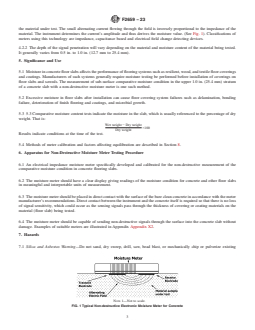
air pressure and moisture content are constant). FIG. 1 Typical Non-destructive Electronic Moisture Meter for Con-
crete
3.1.2 moisture content (MC), n—moisture content tests
indicate the moisture content in the slab at the time of the test.
This can be defined as the mass of moisture per unit mass of
5. Significance and Use
dry material, for example:
5.1 Moisture in concrete floor slabs affects the performance
Wet weight 2 Dry weight
× 100
of flooring systems such as resilient, wood, and textile floor
Dry weight
coverings and coatings. Manufacturers of such systems gener-
.
ally require moisture testing be performed before installation of
3.1.3 relative humidity, n—ratio of the amount of water
coverings on floor slabs and screeds. The measurement of
vapor actually in the air compared to the amount of water vapor
sub-surface comparative moisture condition in the upper 1.0 in.
required for saturation at that particular temperature and
(25.4 mm) stratum of a concrete slab with a non-destructive
pressure, expressed as a percentage.
moisture meter is one such method.
3.1.4 service temperature and relative humidity, n—the
5.2 Excessive moisture in floor slabs after installation can
ambient air temperature and relative humidity that typically
cause floor covering system failures such as delamination,
will be found in the building’s occupied spaces during normal
bonding failure, deterioration of finish flooring and coatings,
use.
and microbial growth.
3.1.5 vapor emission, n—moisture vapor emission is used to
5.3 5.3 Comparative moisture content tests indicate the
define the amount of water vapor emitting from the concrete
moisture in the slab, which is usually referenced to the
floor slab when using the Anhydrous Calcium Chloride test.
percentage of dry weight. That is:
This is usually expressed in lb/1000 ft during a 24 h period.
Wet weight 2 Dry weight
× 100
Dry weight
4. Summary of Guide
Results indicate conditions at the time of the test.
4.1 Procedure:
5.4 Methods of meter calibration and factors affecting
4.1.1 This guide covers a procedure in which a purpose-
equilibration are described in Section 8.
made and calibrated electronic moisture meter is used in
conjunction with interpretive methods provided by meter or the
6. Apparatus for Non-Destructive Moisture Meter
meter manufacturer, or both, to determine the comparative
Testing Procedure
moisture content in the upper 1 in. (25.4 mm) stratum of
6.1 An electrical impedance moisture meter specifically
concrete and other floor slabs and screeds by non-destructively
developed and calibrated for the non-destructive measurement
measuring the electrical ac impedance.
of the comparative moisture condition in concrete flooring
4.2 Principles of Operation:
slabs.
4.2.1 The electrical impedance of a material varies in
6.2 The moisture meter should have a clear display giving
proportion to its comparative moisture condition. The electrical
readings of the moisture condition for concrete and other floor
impedance of the floor slab directly under the footprint of the
slabs in meaningful and interpretable units of measurement.
instrument is measured by creating an alternating electric field
6.3 The moisture meter should be placed in direct contact
that penetrates the material under test. The small alternating
with the surface of the bare clean concrete in accordance with
current flowing through the field is inversely proportional to
the meter manufacturer’s recommendations. Direct contact
the impedance of the material. The instrument determines the
between the instrument and the concrete itself is required so
current’s amplitude and thus derives the moisture value. (See
that there is no loss of signal sensitivity, which could occur as
Fig. 1). Classifications of meters using this technology are
the sensing signals pass through the thickness of covering or
impedance, capacitance based and electrical field change
coating materials on the material (floor slab) being tested.
detecting devices.
4.2.2 The depth of the signal penetration will vary depend- 6.4 The moisture meter should be capable of sending
ing on the material and moisture content of the material being non-destructive signals through the surface into the concrete
tested. It generally varies from 0.5 in. to 1.0 in. (12.7 mm to slab without damage. Examples of suitable meters are illus-
25.4 mm). trated in Appendix Appendix X2.
F2659 − 23
7. Hazards testing otherwise results may not accurately reflect the amount
of moisture present in the slab during normal operating
7.1 Silica and Asbestos Warning—Do not sand, dry sweep,
conditions.
drill, saw, bead blast, or mechanically chip or pulverize
existing resilient flooring, backing, lining felt, paint, asphaltic
9.2 No visible water in liquid form should be present on the
cutback adhesives, or other adhesives. These products may
concrete at the time this testing procedure is being carried out.
contain asbestos fibers or crystalline silica. Avoid creating dust.
9.3 Avoid testing locations in direct sunlight or subject to
Inhalation of such dust is a cancer and respiratory tract hazard.
direct sources of heat.
Smoking by individuals exposed to asbestos fibers greatly
increases the risk of serious bodily harm. Unless positively 9.4 Prior to moisture testing the concrete, the surface of the
test area shall be clean and free of any covering, coatings,
certain that the product is non-asbestos-containing material,
presume that it contains asbestos. Regulations may require that adhesive residue, finishes, dirt, curing compounds, or other
substances. Non-chemical methods for removal, such as abra-
the material be tested to determine asbestos content. The
Resilient Floor Covering Institute’s (RFCI) recommended sive cleaning or bead blasting, including methods described in
Practice D4259 may be used on existing slabs with deleterious
work practices for removal of existing resilient floor coverings
residues to achieve an appropriate state for testing. Surface
should be consulted for a defined set of instructions addressed
to the task of removing all resilient floor covering structures. preparation shall take place as follows:
7.1.1 Various federal, state, and local government laws have
9.5 Concrete slabs covered by existing resilient floor cov-
regulations covering the removal of asbestos-containing mate-
erings must have such coverings and all three-dimensional
rials. If considering the removal of resilient flooring or asphal-
adhesive removed, and the test area should be exposed to
tic cut–back adhesive that contains or presumes to contain
condit
...
This document is not an ASTM standard and is intended only to provide the user of an ASTM standard an indication of what changes have been made to the previous version. Because
it may not be technically possible to adequately depict all changes accurately, ASTM recommends that users consult prior editions as appropriate. In all cases only the current version
of the standard as published by ASTM is to be considered the official document.
Designation: F2659 − 22 F2659 − 23
Standard Guide for
Preliminary Evaluation of Comparative Moisture Condition
of Concrete, Gypsum Cement and Other Floor Slabs and
Screeds Using a Non-Destructive Electronic Moisture Meter
This standard is issued under the fixed designation F2659; the number immediately following the designation indicates the year of
original adoption or, in the case of revision, the year of last revision. A number in parentheses indicates the year of last reapproval. A
superscript epsilon (´) indicates an editorial change since the last revision or reapproval.
1. Scope
1.1 This guide focuses on obtaining the comparative moisture condition within the upper 1.0 in. (25.4 mm) stratum in concrete,
gypsum, anhydrite floor slabs and screeds for field tests. Due to the wide variation of material mixtures and additives used in floor
slabs and screeds, this methodology may not be appropriate for all applications. See 1.2 through 1.8 and Section 11. Where
appropriate or when specified, use further testing as outlined in Test Methods F1869 or F2170 before installing a resilient floor
covering.
1.2 This guide is intended for use to determine if there are moisture-related conditions existing on, or in, the floor slabs that could
adversely impact the successful application and performance of resilient flooring products.
1.3 This guide may be used to aid in the diagnosis of failures of installed resilient flooring.
1.4 This guide is intended to be used in conjunction with meter manufacturer’s operation instructions and interpretive data where
available.
1.5 Where possible or when results need to be quantified, use this guide to determine where additional testing such as Test
Methods F1869 or F2170 as specified to characterize the floor slab and the test area environment for moisture, humidity and
temperature conditions.
1.6 This guide may not be suitable for areas that have surface applied moisture migration systems, curing compounds or coatings
that cannot be removed or cleaned off sufficiently to allow the moisture to move upwards through the slab. For a floor slab of 6
in. (150 mm) plus thickness, low porosity slabs, slabs with no vapor retarder installed, and slabs where the above surface
environmental conditions can have a greater than normal influence on the moisture reduction gradient of the floor slab or screed,
consider Test Method F2170 (below surface in situ rh method) as a more suitable test method under these circumstances.
1.7 This guide is not intended to provide quantitative results as a basis for acceptance of a floor for installation of moisture
sensitive flooring finishes systems. Test Methods F1869 or F2170 provide quantitative information for determining if moisture
levels are within specific limits. Results from this guide do not provide vital information when evaluating thick slabs, slabs without
effective vapor retarders directly under the slab, lightweight aggregate concrete floors, and slabs with curing compound or sealers
on the surface.
This guide is under the jurisdiction of ASTM Committee F06 on Resilient Floor Coverings and is the direct responsibility of Subcommittee F06.40 on Practices.
Current edition approved June 15, 2022March 15, 2023. Published July 2022April 2023. Originally approved in 2010. Last previous edition approved in 2015 as F2659-10
(2015). DOI: 10.1520/F2659-22.2022 as F2659 – 22. DOI: 10.1520/F2659-23.
Copyright © ASTM International, 100 Barr Harbor Drive, PO Box C700, West Conshohocken, PA 19428-2959. United States
F2659 − 23
1.8 The values stated in inch-pound units are to be regarded as standard. The values given in parentheses are mathematical
conversions to SI units that are provided for information only and are not considered standard.
1.9 This standard does not purport to address all of the safety concerns, if any, associated with its use. It is the responsibility
of the user of this standard to establish appropriate safety, health, and environmental practices and determine the applicability of
regulatory limitations prior to use. Specific warnings are given in Section 7.
1.10 This international standard was developed in accordance with internationally recognized principles on standardization
established in the Decision on Principles for the Development of International Standards, Guides and Recommendations issued
by the World Trade Organization Technical Barriers to Trade (TBT) Committee.
2. Referenced Documents
2.1 ASTM Standards:
D4259 Practice for Preparation of Concrete by Abrasion Prior to Coating Application
F1869 Test Method for Measuring Moisture Vapor Emission Rate of Concrete Subfloor Using Anhydrous Calcium Chloride
F2170 Test Method for Determining Relative Humidity in Concrete Floor Slabs Using in situ Probes
NOTE 1—Also see Related Documents section Materials at the end of this standard.
3. Terminology
3.1 Definitions:
3.1.1 dew point, n—dew point temperature is the temperature at which condensation begins. It is the temperature at which air must
be cooled in order to reach saturation (assuming air pressure and moisture content are constant).
3.1.2 moisture content (MC), n—moisture content tests indicate the moisture content in the slab at the time of the test. This can
be defined as the mass of moisture per unit mass of dry material, for example:
Wet weight 2 Dry weight
×100
Dry weight
.
3.1.3 relative humidity, n—ratio of the amount of water vapor actually in the air compared to the amount of water vapor required
for saturation at that particular temperature and pressure, expressed as a percentage.
3.1.4 service temperature and relative humidity, n—the average ambient air temperature and relative humidity that typically will
be found in the buildingsbuilding’s occupied spaces during normal use.
3.1.5 vapor emission, n—moisture vapor emission is used to define the amount of water vapor emitting from the concrete floor
slab when using the Anhydrous Calcium Chloride test. This is usually expressed in lb/1000 ft during a 24-h24 h period.
4. Summary of Guide
4.1 Procedure:
4.1.1 This guide covers a procedure in which a purpose-made and calibrated electronic moisture meter is used in conjunction with
interpretive methods provided by meter or the meter manufacturer, or both, to determine the comparative moisture content in the
upper 1 in. (25.4 mm) stratum of concrete and other floor slabs and screeds by non-destructively measuring the electrical ac
impedance.
4.2 Principles of Operation:
4.2.1 The electrical impedance of a material varies in proportion to its comparative moisture condition. The electrical impedance
of the floor slab directly under the footprint of the instrument is measured by creating an alternating electric field that penetrates
For referenced ASTM standards, visit the ASTM website, www.astm.org, or contact ASTM Customer Service at service@astm.org. For Annual Book of ASTM Standards
volume information, refer to the standard’s Document Summary page on the ASTM website.
F2659 − 23
the material under test. The small alternating current flowing through the field is inversely proportional to the impedance of the
material. The instrument determines the current’s amplitude and thus derives the moisture value. (See Fig. 1). Classifications of
meters using this technology are impedance, capacitance based and electrical field change detecting devices.
4.2.2 The depth of the signal penetration will vary depending on the material and moisture content of the material being tested.
It generally varies from 0.5 in. to 1.0 in. (12.7 mm to 25.4 mm).
5. Significance and Use
5.1 Moisture in concrete floor slabs affects the performance of flooring systems such as resilient, wood, and textile floor coverings
and coatings. Manufacturers of such systems generally require moisture testing be performed before installation of coverings on
floor slabs and screeds. The measurement of sub-surface comparative moisture condition in the upper 1.0 in. (25.4 mm) stratum
of a concrete slab with a non-destructive moisture meter is one such method.
5.2 Excessive moisture in floor slabs after installation can cause floor covering system failures such as delamination, bonding
failure, deterioration of finish flooring and coatings, and microbial growth.
5.3 5.3 Comparative moisture content tests indicate the moisture in the slab, which is usually referenced to the percentage of dry
weight. That is:
Wet weight 2 Dry weight
×100
Dry weight
Results indicate conditions at the time of the test.
5.4 Methods of meter calibration and factors affecting equilibration are described in Section 8.
6. Apparatus for Non-Destructive Moisture Meter Testing Procedure
6.1 An electrical impedance moisture meter specifically developed and calibrated for the non-destructive measurement of the
comparative moisture condition in concrete flooring slabs.
6.2 The moisture meter should have a clear display giving readings of the moisture condition for concrete and other floor slabs
in meaningful and interpretable units of measurement.
6.3 The moisture meter should be placed in direct contact with the surface of the bare clean concrete in accordance with the meter
manufacturer’s recommendations. Direct contact between the instrument and the concrete itself is required so that there is no loss
of signal sensitivity, which could occur as the sensing signals pass through the thickness of covering or coating materials on the
material (floor slab) being tested.
6.4 The moisture meter should be capable of sending non-destructive signals through the surface into the concrete slab without
damage. Examples of suitable meters are illustrated in Appendix Appendix X2.
7. Hazards
7.1 Silica and Asbestos Warning—Do not sand, dry sweep, drill, saw, bead blast, or mechanically chip or pulverize existing
NOTE 1—Not to scale.
FIG. 1 Typical Non-destructive Electronic Moisture Meter for Concrete
F2659 − 23
resilient flooring, backing, lining felt, paint, asphaltic cutback adhesives, or other adhesives. These products may contain asbestos
fibers or crystalline silica. Avoid creating dust. Inhalation of such dust is a cancer and respiratory tract hazard. Smoking by
individuals exposed to asbestos fibers greatly increases the risk of serious bodily harm. Unless positively certain that the product
is non-asbestos-containing material, presume that it contains asbestos. Regulations may require that the material be tested to
determine asbestos content. The Resilient Floor Covering Institute’s (RFCI) recommended work practices for removal of existing
resilient floor coverings should be consulted for a defined set of instructions addressed to the task of removing all resilient floor
covering structures.
7.1.1 Various federal, state, and local government laws have regulations covering the removal of asbestos-containing materials.
If considering the removal of resilient flooring or asphaltic cut–back adhesive that contains or presumes to contain asbestos, review
and comply with the applicable regulations.
7.2 Lead Warning—Certain paints may contain lead. Exposure to excessive amounts of lead dust presents a health hazard. Refer
to applicable federal, state, and local laws and guidelines for hazard identification and abatement of lead-based paint published by
the US Department of Housing and Urban Development regarding appropriate methods for identifying lead-based paint and
removing such paint, and any licensing, certification, and training requirements for persons performing lead abatement work.
8. Calibration
8.1 Moisture Measurementmeasurement meters should be manufactured with traceable calibration procedures and have
manufacturer’s certification, or documentation, available stating the range of calibration and the accuracy of the meter. Moisture
Metersmeters should be initially calibrated at a minimum of two points.
8.2 The Moisture Metermoisture meter should be of a desig
...