

ASTM F945-22
(Test Method)Standard Test Method for Stress-Corrosion of Titanium Alloys by Aircraft Engine Cleaning Materials
General Information
- Abstract
SIGNIFICANCE AND USE
3.1 Because of the tendency of prestressed titanium alloy parts to crack if heated while in contact with certain chemical reagents, it is necessary to ensure that cleaning and maintenance materials will not initiate stress corrosion of titanium alloys under controlled conditions. For test specimens, two common titanium alloys are selected, one that is very susceptible (AMS 4916 or AMS 4919) and one that is not very susceptible (AMS 4911) to stress corrosion cracking.
SCOPE
1.1 This test method establishes a test procedure for determining the propensity of aircraft turbine engine cleaning and maintenance materials for causing stress corrosion cracking of titanium alloy parts.
1.2 The evaluation is conducted on representative titanium alloys by determining the effect of contact with cleaning and maintenance materials on tendency of prestressed titanium alloys to crack when subsequently heated to elevated temperatures.
1.3 Test conditions are based upon manufacturer's maximum recommended operating solution concentration.
1.4 Units—The values stated in inch-pound units are to be regarded as standard. The values given in parentheses are mathematical conversions to SI units that are provided for information only and are not considered standard.
1.5 This standard does not purport to address all of the safety concerns, if any, associated with its use. It is the responsibility of the user of this standard to establish appropriate safety, health, and environmental practices and determine the applicability of regulatory limitations prior to use. For specific precautionary statements, see 5.3 and 5.6.
1.6 This international standard was developed in accordance with internationally recognized principles on standardization established in the Decision on Principles for the Development of International Standards, Guides and Recommendations issued by the World Trade Organization Technical Barriers to Trade (TBT) Committee.
- Status
- Published
- Publication Date
- 31-Aug-2022
- Technical Committee
- F07 - Aerospace and Aircraft
- Drafting Committee
- F07.07 - Qualification Testing of Aircraft Cleaning Materials
Buy Documents
ASTM F945-22 - Standard Test Method for Stress-Corrosion of Titanium Alloys by Aircraft Engine Cleaning Materials
REDLINE ASTM F945-22 - Standard Test Method for Stress-Corrosion of Titanium Alloys by Aircraft Engine Cleaning Materials
Overview
ASTM F945-22: Standard Test Method for Stress-Corrosion of Titanium Alloys by Aircraft Engine Cleaning Materials is a crucial international standard developed by ASTM International. This specification provides laboratories, aerospace manufacturers, and maintenance professionals with a defined test procedure to determine whether aircraft turbine engine cleaning and maintenance materials have the potential to cause stress-corrosion cracking (SCC) of titanium alloy parts. Stress corrosion cracking is a critical failure mode, especially for titanium alloys under stress and exposed to chemical agents at elevated temperatures. This standard is vital for aircraft engine safety, reliability, and long-term component performance.
Key Topics
- Stress-Corrosion Cracking (SCC) of Titanium Alloys: Focuses on the risk of cracking in prestressed titanium alloys when in contact with certain cleaning chemicals, particularly during heating cycles.
- Representative Alloys: Specifies the use of both highly susceptible (AMS 4916, AMS 4919) and less susceptible (AMS 4911) titanium alloys for testing to ensure a comprehensive assessment.
- Testing Procedures: Outlines detailed steps for specimen preparation, cleaning, exposure to candidate solutions, controlled heating, and evaluation through visual and metallographic inspection.
- Solution Concentrations: Emphasizes testing at the manufacturer’s maximum recommended operating concentrations of cleaning agents to simulate worst-case exposure.
- Acceptance Criteria: Defines clear guidelines for acceptance or rejection of cleaning compounds based on presence or absence of cracking in test specimens.
- Documentation and Reporting: Requires comprehensive documentation, including chemical identification, test outcomes, and any observed corrosion phenomena.
Applications
ASTM F945-22 is widely used in the aerospace industry to qualify and approve cleaning and maintenance products for use on titanium components in aircraft turbine engines. Its applications include:
- Qualification of Cleaning and Maintenance Chemicals: Ensures that compounds do not induce stress-corrosion cracking in titanium engine parts.
- Aerospace Component Safety: Supports the safety protocols of manufacturers and operators by preventing premature failures due to SCC.
- Material Selection and Quality Control: Assists material engineers and maintenance facilities in selecting compatible cleaning products for titanium parts.
- Regulatory Compliance: Fulfills requirements for chemical qualification as mandated by aerospace OEMs and the U.S. Department of Defense.
- Extended Equipment Life: Contributes to longer component service life and reduced maintenance costs by preventing stress-corrosion failures.
Related Standards
- ASTM D740: Specification for Methyl Ethyl Ketone, a reagent sometimes used in cleaning or testing.
- ASTM D841: Specification for Nitration Grade Toluene, used as a solvent in laboratory testing.
- ASTM D1193: Specification for Reagent Water, ensuring water purity in preparation and cleaning procedures.
- SAE AMS 4911 / AMS 4916 / AMS 4919: Aerospace Material Specifications for titanium alloys used in stress-corrosion susceptibility testing.
Practical Value
Adopting ASTM F945-22 delivers several practical advantages for aerospace operators and suppliers:
- Risk Mitigation: Minimizes the likelihood of catastrophic failures in flight by ensuring cleaning materials are SCC-safe for titanium alloys.
- Consistent Testing: Provides repeatable, standardized procedures for qualifying engine maintenance products and materials.
- Industry Confidence: Helps establish trust in the safety and durability of products used in critical aerospace systems.
- International Recognition: Aligns with global best practices in standardization, supporting compliance in diverse regulatory environments.
Use of ASTM F945-22 is a proactive measure for managing stress corrosion risk and sustaining the integrity of modern aerospace materials.
Relations
- Effective Date
- 15-Nov-2019
- Effective Date
- 01-Apr-2019
- Effective Date
- 01-Jul-2017
- Effective Date
- 01-Jun-2017
- Effective Date
- 01-Feb-2013
- Effective Date
- 01-Nov-2012
- Effective Date
- 01-Nov-2011
- Effective Date
- 01-Jul-2011
- Effective Date
- 01-Jan-2010
- Effective Date
- 01-Jan-2008
- Effective Date
- 01-Mar-2006
- Effective Date
- 15-May-2005
- Effective Date
- 10-Jan-2002
- Effective Date
- 01-Jan-2001
- Effective Date
- 01-Jan-2001
Buy Documents
ASTM F945-22 - Standard Test Method for Stress-Corrosion of Titanium Alloys by Aircraft Engine Cleaning Materials
REDLINE ASTM F945-22 - Standard Test Method for Stress-Corrosion of Titanium Alloys by Aircraft Engine Cleaning Materials
Get Certified
Connect with accredited certification bodies for this standard

BUREAU VERITAS Certification Germany
Bureau Veritas certification in Germany.

Element Materials Technology
Materials testing and product certification.

AQMS Ltd.
AQMS provides ISO certification to SMEs across the UK.
Sponsored listings
Frequently Asked Questions
ASTM F945-22 is a standard published by ASTM International. Its full title is "Standard Test Method for Stress-Corrosion of Titanium Alloys by Aircraft Engine Cleaning Materials". This standard covers: SIGNIFICANCE AND USE 3.1 Because of the tendency of prestressed titanium alloy parts to crack if heated while in contact with certain chemical reagents, it is necessary to ensure that cleaning and maintenance materials will not initiate stress corrosion of titanium alloys under controlled conditions. For test specimens, two common titanium alloys are selected, one that is very susceptible (AMS 4916 or AMS 4919) and one that is not very susceptible (AMS 4911) to stress corrosion cracking. SCOPE 1.1 This test method establishes a test procedure for determining the propensity of aircraft turbine engine cleaning and maintenance materials for causing stress corrosion cracking of titanium alloy parts. 1.2 The evaluation is conducted on representative titanium alloys by determining the effect of contact with cleaning and maintenance materials on tendency of prestressed titanium alloys to crack when subsequently heated to elevated temperatures. 1.3 Test conditions are based upon manufacturer's maximum recommended operating solution concentration. 1.4 Units—The values stated in inch-pound units are to be regarded as standard. The values given in parentheses are mathematical conversions to SI units that are provided for information only and are not considered standard. 1.5 This standard does not purport to address all of the safety concerns, if any, associated with its use. It is the responsibility of the user of this standard to establish appropriate safety, health, and environmental practices and determine the applicability of regulatory limitations prior to use. For specific precautionary statements, see 5.3 and 5.6. 1.6 This international standard was developed in accordance with internationally recognized principles on standardization established in the Decision on Principles for the Development of International Standards, Guides and Recommendations issued by the World Trade Organization Technical Barriers to Trade (TBT) Committee.
SIGNIFICANCE AND USE 3.1 Because of the tendency of prestressed titanium alloy parts to crack if heated while in contact with certain chemical reagents, it is necessary to ensure that cleaning and maintenance materials will not initiate stress corrosion of titanium alloys under controlled conditions. For test specimens, two common titanium alloys are selected, one that is very susceptible (AMS 4916 or AMS 4919) and one that is not very susceptible (AMS 4911) to stress corrosion cracking. SCOPE 1.1 This test method establishes a test procedure for determining the propensity of aircraft turbine engine cleaning and maintenance materials for causing stress corrosion cracking of titanium alloy parts. 1.2 The evaluation is conducted on representative titanium alloys by determining the effect of contact with cleaning and maintenance materials on tendency of prestressed titanium alloys to crack when subsequently heated to elevated temperatures. 1.3 Test conditions are based upon manufacturer's maximum recommended operating solution concentration. 1.4 Units—The values stated in inch-pound units are to be regarded as standard. The values given in parentheses are mathematical conversions to SI units that are provided for information only and are not considered standard. 1.5 This standard does not purport to address all of the safety concerns, if any, associated with its use. It is the responsibility of the user of this standard to establish appropriate safety, health, and environmental practices and determine the applicability of regulatory limitations prior to use. For specific precautionary statements, see 5.3 and 5.6. 1.6 This international standard was developed in accordance with internationally recognized principles on standardization established in the Decision on Principles for the Development of International Standards, Guides and Recommendations issued by the World Trade Organization Technical Barriers to Trade (TBT) Committee.
ASTM F945-22 is classified under the following ICS (International Classification for Standards) categories: 49.025.30 - Titanium. The ICS classification helps identify the subject area and facilitates finding related standards.
ASTM F945-22 has the following relationships with other standards: It is inter standard links to ASTM D841-19, ASTM D740-11(2019), ASTM D841-17a, ASTM D841-17, ASTM D841-13, ASTM D841-12, ASTM D740-11, ASTM D841-11, ASTM D841-10, ASTM D841-02(2008)e1, ASTM D1193-06, ASTM D740-05, ASTM D841-02, ASTM D740-94(2001), ASTM D740-94(1997). Understanding these relationships helps ensure you are using the most current and applicable version of the standard.
ASTM F945-22 is available in PDF format for immediate download after purchase. The document can be added to your cart and obtained through the secure checkout process. Digital delivery ensures instant access to the complete standard document.
Standards Content (Sample)
This international standard was developed in accordance with internationally recognized principles on standardization established in the Decision on Principles for the
Development of International Standards, Guides and Recommendations issued by the World Trade Organization Technical Barriers to Trade (TBT) Committee.
Designation: F945 − 22
Standard Test Method for
Stress-Corrosion of Titanium Alloys by Aircraft Engine
Cleaning Materials
ThisstandardisissuedunderthefixeddesignationF945;thenumberimmediatelyfollowingthedesignationindicatestheyearoforiginal
adoption or, in the case of revision, the year of last revision.Anumber in parentheses indicates the year of last reapproval.Asuperscript
epsilon (´) indicates an editorial change since the last revision or reapproval.
This standard has been approved for use by agencies of the U.S. Department of Defense.
INTRODUCTION
Chemical solutions and compounds used for preinspection cleaning or for preservation of titanium
alloy aircraft turbine engine parts shall be subject to qualification requirements of this test method.
1. Scope mendations issued by the World Trade Organization Technical
Barriers to Trade (TBT) Committee.
1.1 This test method establishes a test procedure for deter-
mining the propensity of aircraft turbine engine cleaning and
2. Referenced Documents
maintenance materials for causing stress corrosion cracking of
2.1 ASTM Standards:
titanium alloy parts.
D740 Specification for Methyl Ethyl Ketone
1.2 The evaluation is conducted on representative titanium
D841 Specification for Nitration Grade Toluene
alloys by determining the effect of contact with cleaning and
D1193 Specification for Reagent Water
maintenance materials on tendency of prestressed titanium
2.2 SAE Aerospace Material Specifications:
alloys to crack when subsequently heated to elevated tempera-
AMS 4911 Sheet, Strip and Plate-6AL-4VAnnealed 0.050”
tures.
Thick
AMS 4916 Sheet, Strip, and Plate-8AL 1MO 1V, Duplex
1.3 Test conditions are based upon manufacturer’s maxi-
Annealed 0.050” Thick
mum recommended operating solution concentration.
AMS 4919 Sheet, Strip, and Plate-6AL 2 Sn, 4 Zr, 2 Mo,
1.4 Units—The values stated in inch-pound units are to be
Duplex Annealed 0.050” Thick
regarded as standard. The values given in parentheses are
mathematical conversions to SI units that are provided for
3. Significance and Use
information only and are not considered standard.
3.1 Because of the tendency of prestressed titanium alloy
1.5 This standard does not purport to address all of the
parts to crack if heated while in contact with certain chemical
safety concerns, if any, associated with its use. It is the
reagents, it is necessary to ensure that cleaning and mainte-
responsibility of the user of this standard to establish appro-
nance materials will not initiate stress corrosion of titanium
priate safety, health, and environmental practices and deter-
alloys under controlled conditions. For test specimens, two
mine the applicability of regulatory limitations prior to use.
common titanium alloys are selected, one that is very suscep-
For specific precautionary statements, see 5.3 and 5.6.
tible (AMS 4916 or AMS 4919) and one that is not very
1.6 This international standard was developed in accor-
susceptible (AMS 4911) to stress corrosion cracking.
dance with internationally recognized principles on standard-
4. Apparatus
ization established in the Decision on Principles for the
Development of International Standards, Guides and Recom-
4.1 Measuring Devicecapableoflinearmeasurementwitha
60.01 in. (60.25 mm) tolerance.
1 2
This test method is under the jurisdiction of ASTM Committee F07 on For referenced ASTM standards, visit the ASTM website, www.astm.org, or
Aerospace and Aircraft and is the direct responsibility of Subcommittee F07.07 on contact ASTM Customer Service at service@astm.org. For Annual Book of ASTM
Qualification Testing of Aircraft Cleaning Materials. Standards volume information, refer to the standard’s Document Summary page on
Current edition approved Sept. 1, 2022. Published September 2022. Originally the ASTM website.
approvedin1985.Lastpreviouseditionapprovedin2019asF945 – 12(2019).DOI: Available from Society of Automotive Engineers, 400 Commonwealth Dr.,
10.1520/F0945-22. Warrendale, PA 15096.
Copyright © ASTM International, 100 Barr Harbor Drive, PO Box C700, West Conshohocken, PA 19428-2959. United States
F945 − 22
4 5
4.2 Press Forming Apparatus with 0.56 in. (14 mm) diam- where such specifications are available. Other grades may be
eter mandrel capable of producing approximately 65° bends in used, provided it is first ascertained that the reagent is of
0.050 in. (1.25 mm) titanium alloy sheet specimens. sufficiently high purity to permit its use without lessening the
accuracy of analysis.
4.3 Beakers or Small Tanks for containment of cleaning,
rinsing, and test solutions, appropriately lined to prevent
5.2 Purity of Water—Unless otherwise indicated, references
contamination of the solutions by container materials. towatershallbeunderstoodtomeanreagentwaterconforming
to Specification D1193 Type IV.
4.4 Vise, capable of precise manipulation at jaw opening of
0.65 in. (16.5 mm). A standard sheet metal worker’s vise with
5.3 Cleaning Solution, mix 35 volume % nitric acid (42°
a 3 in. jaw has been found satisfactory.
Be') (Warning —See Annex A1.2) and 3 volume % hydro-
fluoric acid (70 %) or 4.5 volume % hydrofluoric acid (49 %)
4.5 Air Circulation Furnace capable of operating at 900 °F
(Warning—See Annex A1.3) with reagent water.
(480 °C) with control to 620 °F (10 °C).
5.4 2–Propanol (Isopropanol), HPLC grade.
4.6 Magnifier capable of 20-diameters magnification.
5.5 Salt Solutions:
4.7 Microscope capable of 500-diameters magnification.
5.5.1 100–ppm sodium chloride solution in 2–propanol.
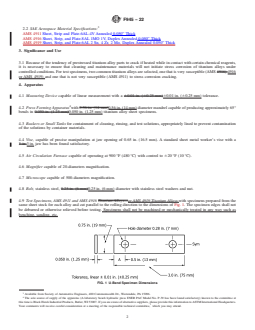
4.8 Bolt, stainless steel, 0.25 in. (6 mm) diameter with
5.5.1.1 Preparation of 1000–ppm NaCl in 2–Propanol Stock
stainless steel washers and nut.
Solution (Shelf Life Three Months in Flask, see 4.11)—Weigh
4.9 Test Specimens, AMS 4911 and AMS 4916 or AMS 4919
1.000 g NaCl 6 0.001 g into a 1000 mLvolumetric flask.Add
Titanium Alloys with specimens prepared from the same sheet
250- 6 25-mL reagent water and stir to dissolve. Fill to the
stock for each alloy and cut parallel to the rolling direction to
mark with 2–propanol and mix.
the dimensions of Fig. 1. The specimen edges shall not be
5.5.1.2 Preparation of 100–ppm NaCl Test Solution (Shelf
deburred or otherwise relieved before testing. Specimens shall
Life Seven Days in Flask, see 4.11)—Pipette10mLofthestock
not be machined or mechanically treated in any way such as
solution into a 100 mL volumetric flask. Fill to the mark with
benching, sanding, etc.
2-propanol and mix.
4.10 Cotton Gloves, white.
5.5.2 Preparation of 3 Weight % Sodium Chloride in 2–Pro-
panol (Shelf Life Three Months)—Weight 3.00 g NaCl into a
4.11 Volumetric Flask of Low Sodium Glass with Ground
100 mL volumetric flask (see 4.13). Add about 50 mL of
Glass Stopper, 1000 and 100 mL.
reagent water and stir to dissolve. Fill to the mark with
4.12 Volumetric Pipette, 10 mL.
2–propanol and mix.
4.13 Volumetric Flask with Ground Glass Stopper, 100 mL.
5.6 Solvent, toluene conforming to Specification D841 or
methyl ethyl ketone conforming to Specification D740.
5. Reagents and Materials
(Warning—See Annex A1.1).
5.1 Purity of Reagent—Reagent grade chemicals shall be
NOTE 1—The use of 2–propanol is important to ensure an even
used in all cases. Unless otherwise indicated, it is intended that
distribution of the salt by evaporating quickly.This decreases the effect of
all reagents shall conform to the specifications of the Commit-
a “drop” at the bottom of the specimens.
tee onAnalytical Reagents of theAmerican Chemical Society,
Reagent Chemicals, American Chemical Society Specifications, American
Chemical Society, Washington, DC. For suggestions on the testing of reagents not
The sole source of supply of the apparatus (Alaboratory bench hydraulic press
listed by the American Chemical Society, see Analar Standards for Laboratory
ENER PAC Model No. P-39 has been found satisfactory) known to the committee
Chemicals, BDH Ltd., Poole, Dorset, U.K., and the United States Pharmacopeia
at this time is Black Hawk Industrial Products, Butler, WI 53007. If you are aware
and National Formulary, U.S. Pharmacopeial Convention, Inc. (USPC), Rockville,
of alternative suppliers, please provide this information to ASTM International
MD.
Headquarters.Your comments will receive careful consideration at a meeting of the
responsible technical committee, which you may attend.
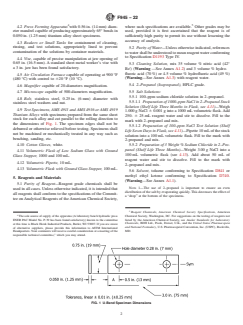
FIG. 1 U-Bend Specimen Dimensions
F945 − 22
6. Precleaning Test Specimens
6.1 Handlingcontaminationandshopsoilsshallberemoved
by washing in a solvent. Dry thoroughly.
7. Specimen Fabrication
7.1 With the short specimen axis as the bend axis, press
form the specimen around an approximately 0.45 in. (14 mm)
diameter mandrel in one operation so that an unrestrained
preform angle of approximately 65° is obtained. See Fig. 2.
7.2 Clean the specimen preform by immersing in cleaning
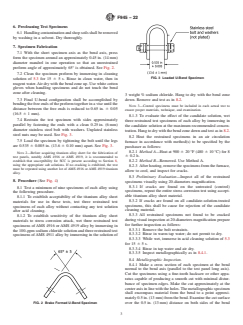
FIG. 3 Loaded U-Bend Specimen
solution of 5.3 for 15 6 5 s. Rinse in clean water, then in
reagent water.Air dry with the bend zone up. Use white cotton
gloves when handling specimens and do not touch the bend
zone after cleaning.
3 weight % sodium chloride. Hang to dry with the bend zone
7.3 Final U-bend configuration shall be accomplished by down. Remove and test as in 8.2.
bending the free ends of the preform together in a vise until the
NOTE 3—Control specimens must be included in each actual test to
distance between the free ends is reduced to 0.65 in. 6 0.05
ensure proper materials, technique, and examination.
(16.5 6 1 mm).
8.1.3 To evaluate the effect of the can
...
This document is not an ASTM standard and is intended only to provide the user of an ASTM standard an indication of what changes have been made to the previous version. Because
it may not be technically possible to adequately depict all changes accurately, ASTM recommends that users consult prior editions as appropriate. In all cases only the current version
of the standard as published by ASTM is to be considered the official document.
Designation: F945 − 12 (Reapproved 2019) F945 − 22
Standard Test Method for
Stress-Corrosion of Titanium Alloys by Aircraft Engine
Cleaning Materials
This standard is issued under the fixed designation F945; the number immediately following the designation indicates the year of original
adoption or, in the case of revision, the year of last revision. A number in parentheses indicates the year of last reapproval. A superscript
epsilon (´) indicates an editorial change since the last revision or reapproval.
This standard has been approved for use by agencies of the U.S. Department of Defense.
INTRODUCTION
Chemical solutions and compounds used for preinspection cleaning or for preservation of titanium
alloy aircraft turbine engine parts shall be subject to qualification requirements of this test method.
1. Scope
1.1 This test method establishes a test procedure for determining the propensity of aircraft turbine engine cleaning and
maintenance materials for causing stress corrosion cracking of titanium alloy parts.
1.2 The evaluation is conducted on representative titanium alloys by determining the effect of contact with cleaning and
maintenance materials on tendency of prestressed titanium alloys to crack when subsequently heated to elevated temperatures.
1.3 Test conditions are based upon manufacturer’s maximum recommended operating solution concentration.
1.4 Units—The values stated in inch-pound units are to be regarded as standard. The values given in parentheses are mathematical
conversions to SI units that are provided for information only and are not considered standard.
1.5 This standard does not purport to address all of the safety concerns, if any, associated with its use. It is the responsibility
of the user of this standard to establish appropriate safety, health, and environmental practices and determine the applicability of
regulatory limitations prior to use. For specific precautionary statements, see 5.3 and 5.6.
1.6 This international standard was developed in accordance with internationally recognized principles on standardization
established in the Decision on Principles for the Development of International Standards, Guides and Recommendations issued
by the World Trade Organization Technical Barriers to Trade (TBT) Committee.
2. Referenced Documents
2.1 ASTM Standards:
D740 Specification for Methyl Ethyl Ketone
D841 Specification for Nitration Grade Toluene
D1193 Specification for Reagent Water
This test method is under the jurisdiction of ASTM Committee F07 on Aerospace and Aircraft and is the direct responsibility of Subcommittee F07.07 on Qualification
Testing of Aircraft Cleaning Materials.
Current edition approved May 1, 2019Sept. 1, 2022. Published June 2019September 2022. Originally approved in 1985. Last previous edition approved in 20122019 as
F945 – 12.F945 – 12(2019). DOI: 10.1520/F0945-12R19.10.1520/F0945-22.
For referenced ASTM standards, visit the ASTM website, www.astm.org, or contact ASTM Customer Service at service@astm.org. For Annual Book of ASTM Standards
volume information, refer to the standard’s Document Summary page on the ASTM website.
Copyright © ASTM International, 100 Barr Harbor Drive, PO Box C700, West Conshohocken, PA 19428-2959. United States
F945 − 22
2.2 SAE Aerospace Material Specifications:
AMS 4911 Sheet, Strip and Plate-6AL-4V Annealed 0.050” Thick
AMS 4916 Sheet, Strip, and Plate-8AL 1MO 1V, Duplex Annealed 0.050” Thick
AMS 4919 Sheet, Strip, and Plate-6AL 2 Sn, 4 Zr, 2 Mo, Duplex Annealed 0.050” Thick
3. Significance and Use
3.1 Because of the tendency of prestressed titanium alloy parts to crack if heated while in contact with certain chemical reagents,
it is necessary to ensure that cleaning and maintenance materials will not initiate stress corrosion of titanium alloys under
controlled conditions. For test specimens, two common titanium alloys are selected, one that is very susceptible (AMS 4916) 4916
or AMS 4919) and one that is not very susceptible (AMS 4911) to stress corrosion cracking.
4. Apparatus
4.1 Measuring Device capable of linear measurement with a 60.01-in. (60.25-mm)60.01 in. (60.25 mm) tolerance.
4.2 Press Forming Apparatus with 0.56-in. (14-mm)0.56 in. (14 mm) diameter mandrel capable of producing approximately 65°
bends in 0.050-in. (1.25-mm)0.050 in. (1.25 mm) titanium alloy sheet specimens.
4.3 Beakers or Small Tanks for containment of cleaning, rinsing, and test solutions, appropriately lined to prevent contamination
of the solutions by container materials.
4.4 Vise, capable of precise manipulation at jaw opening of 0.65 in. (16.5 mm). A standard sheet metal worker’s vise with a
3-in.3 in. jaw has been found satisfactory.
4.5 Air Circulation Furnace capable of operating at 900 °F (480 °C) with control to 620 °F (10 °C).
4.6 Magnifier capable of 20-diameters magnification.
4.7 Microscope capable of 500-diameters magnification.
4.8 Bolt, stainless steel, 0.25-in. (6-mm)0.25 in. (6 mm) diameter with stainless steel washers and nut.
4.9 Test Specimens, AMS 4911 and AMS 4916 Titanium Alloys—or AMS 4919 Titanium Alloys with specimens prepared from the
same sheet stock for each alloy and cut parallel to the rolling direction to the dimensions of Fig. 1. The specimen edges shall not
be deburred or otherwise relieved before testing. Specimens shall not be machined or mechanically treated in any way such as
benching, sanding, etc.
FIG. 1 U-Bend Specimen Dimensions
Available from Society of Automotive Engineers, 400 Commonwealth Dr., Warrendale, PA 15096.
The sole source of supply of the apparatus (A laboratory bench hydraulic press ENER PAC Model No. P-39 has been found satisfactory) known to the committee at
this time is Black Hawk Industrial Products, Butler, WI 53007. If you are aware of alternative suppliers, please provide this information to ASTM International Headquarters.
Your comments will receive careful consideration at a meeting of the responsible technical committee, which you may attend.
F945 − 22
4.10 Cotton Gloves, white.
4.11 Volumetric Flask of Low Sodium Glass with Ground Glass Stopper, 1000 and 100 mL.100 mL.
4.12 Volumetric Pipette, 10 mL.10 mL.
4.13 Volumetric Flask with Ground Glass Stopper, 100 mL.100 mL.
5. Reagents and Materials
5.1 Purity of Reagent—Reagent grade chemicals shall be used in all cases. Unless otherwise indicated, it is intended that all
reagents shall conform to the specifications of the Committee on Analytical Reagents of the American Chemical Society, where
such specifications are available. Other grades may be used, provided it is first ascertained that the reagent is of sufficiently high
purity to permit its use without lessening the accuracy of analysis.
5.2 Purity of Water—Unless otherwise indicated, references to water shall be understood to mean reagent water conforming to
Specification D1193 Type IV.
5.3 Cleaning Solution, mix 35 volume % nitric acid (42° Be') (Warning —See Annex A1.2) and 3 volume % hydro–hydro-
fluoric acid (70 %) or 4.5 volume % hydrofluoric acid (49 %) (Warning—See Annex A1.3) with reagent water.
5.4 2–Propanol (Isopropanol), HPLC grade.
5.5 Salt Solutions:
5.5.1 100–ppm sodium chloride solution in 2–propanol.
5.5.1.1 Preparation of 1000–ppm NaCl in 2–Propanol Stock Solution (Shelf Life Three Months in Flask, see 4.11)—Weigh
1.000–g1.000 g NaCl 6 0.001 g into a 1000–mL1000 mL volumetric flask. Add 250- 6 25-mL reagent water and stir to dissolve.
Fill to the mark with 2–propanol and mix.
5.5.1.2 Preparation of 100–ppm NaCl Test Solution (Shelf Life Seven Days in Flask, see 4.11)—Pipette 10 mL of the stock solution
into a 100–mL100 mL volumetric flask. Fill to the mark with 2-propanol and mix.
5.5.2 Preparation of 3 Weight % Sodium Chloride in 2–Propanol (Shelf Life Three Months)—Weight 3.00–g3.00 g NaCl into a
100–mL100 mL volumetric flask (see 4.13). Add about 50 mL of reagent water and stir to dissolve. Fill to the mark with
2–propanol and mix.
5.6 Solvent, toluene conforming to Specification D841 or methyl ethyl ketone conforming to Specification D740. (Warning—See
Annex A1.1).
NOTE 1—The use of 2–propanol is important to ensure an even distribution of the salt by evaporating quickly. This decreases the effect of a “drop” at
the bottom of the specimens.
6. Precleaning Test Specimens
6.1 Handling contamination and shop soils shall be removed by washing in a solvent. Dry thoroughly.
Reagent Chemicals, American Chemical Society Specifications, American Chemical Society, Washington, DC. For suggestions on the testing of reagents not listed by
the American Chemical Society, see Analar Standards for Laboratory Chemicals, BDH Ltd., Poole, Dorset, U.K., and the United States Pharmacopeia and National
Formulary, U.S. Pharmacopeial Convention, Inc. (USPC), Rockville, MD.
F945 − 22
7. Specimen Fabrication
7.1 With the short specimen axis as the bend axis, press form the specimen around an approximately 0.45-in. (14-mm)0.45 in.
(14 mm) diameter mandrel in one operation so that an unrestrained preform angle of approximately 65° is obtained. See Fig. 2.
7.2 Clean the specimen preform by immersing in cleaning solution of 5.3 for 15 6 5 s. Rinse in clean water, then in reagent water.
Air dry with the bend zone up. Use white cotton gloves when handling specimens and do not touch the bend zone after cleaning.
7.3 Final U-bend configuration shall be accomplished by bending the free ends of the preform together in a vise until the distance
between the free ends is reduced to 0.65 in. 6 0.05 (16.5 6 1 mm).
7.4 Restrain the test specimen with sides approximately parallel by fastening the ends with a clean 0.25-in. (6-mm)0.25 in. (6 mm)
diame
...