

ASTM C578-23
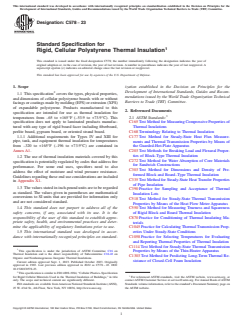
(Specification)Standard Specification for Rigid, Cellular Polystyrene Thermal Insulation
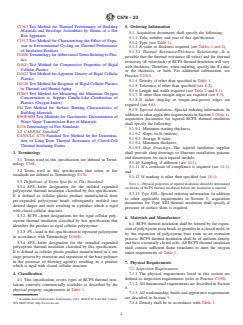
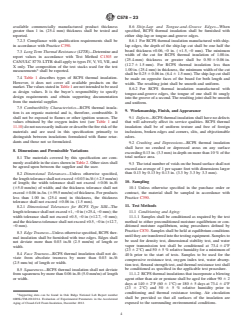
General Information
- Abstract
ABSTRACT
This specification covers the standards for the types, physical properties and dimensions of cellular polystyrene boards with or without facings or coatings made by molding (EPS) or extrusion (XPS) of expandable polystyrene proposed for use as thermal insulation. This specification, however, does not cover laminated products manufactured with any type of rigid board facer including fiberboard, perlite board, gypsum board, or oriented strand board. All thermal insulation shall be of uniform density and shall contain sufficient flame retardants to meet the oxygen index of requirements. They shall also meet the physical requirements such as thermal resistance, compressive resistance, flexural strength, water vapor permeance, water absorption, dimensional stability, and oxygen index specified herein.
SCOPE
1.1 This specification2 covers the types, physical properties, and dimensions of cellular polystyrene boards with or without facings or coatings made by molding (EPS) or extrusion (XPS) of expandable polystyrene. Products manufactured to this specification are intended for use as thermal insulation for temperatures from –65 to +165°F (–53.9 to +73.9°C). This specification does not apply to laminated products manufactured with any type of rigid board facer including fiberboard, perlite board, gypsum board, or oriented strand board.
1.1.1 Additional requirements for Types IV and XIII for pipe, tank, and equipment thermal insulation for temperatures from –320 to +165°F (–196 to +73.9°C) are contained in Annex A1.
1.2 The use of thermal insulation materials covered by this specification is potentially regulated by codes that address fire performance. For some end uses, specifiers need to also address the effect of moisture and wind pressure resistance. Guidelines regarding these end use considerations are included in Appendix X1.
1.3 The values stated in inch-pound units are to be regarded as standard. The values given in parentheses are mathematical conversions to SI units that are provided for information only and are not considered standard.
1.4 This standard does not purport to address all of the safety concerns, if any, associated with its use. It is the responsibility of the user of this standard to establish appropriate safety, health, and environmental practices and determine the applicability of regulatory limitations prior to use.
1.5 This international standard was developed in accordance with internationally recognized principles on standardization established in the Decision on Principles for the Development of International Standards, Guides and Recommendations issued by the World Trade Organization Technical Barriers to Trade (TBT) Committee.
- Status
- Published
- Publication Date
- 31-Aug-2023
- Technical Committee
- C16 - Thermal Insulation
- Drafting Committee
- C16.22 - Organic and Nonhomogeneous Inorganic Thermal Insulations
Buy Documents
ASTM C578-23 - Standard Specification for Rigid, Cellular Polystyrene Thermal Insulation
REDLINE ASTM C578-23 - Standard Specification for Rigid, Cellular Polystyrene Thermal Insulation
Overview
ASTM C578-23 is a comprehensive standard specification developed by ASTM International for rigid, cellular polystyrene thermal insulation. The document defines requirements for expanded polystyrene (EPS) and extruded polystyrene (XPS) boards, produced either by molding or extrusion, that are used as thermal insulation in various construction, industrial, and mechanical applications. Products compliant with ASTM C578-23 are designed for use across a temperature range of –65 to +165°F (–53.9 to +73.9°C), with additional specifications for certain types used in cryogenic environments as low as –320°F (–196°C). By covering multiple types and grades, the standard helps ensure quality, safety, and uniformity in the manufacturing and application of rigid polystyrene insulation.
Key Topics
- Types of Insulation Products: Specifies a range of EPS and XPS rigid board types, each with defined minimum requirements for density, R-value, compressive resistance, and other key properties.
- Physical Property Requirements: Sets performance standards for thermal resistance, compressive strength, flexural strength, water vapor permeance, water absorption, dimensional stability, and oxygen index.
- Manufacturing and Material Guidelines: Details requirements for board manufacture to ensure uniform density, closed-cell structure, and incorporation of flame retardants.
- Dimensional Tolerances: Defines permissible variations in length, width, thickness, squareness, and trueness for consistent product quality.
- Marking and Identification: Outlines labeling requirements, including specification number, type, manufacturer, and R-value or k-Factor as appropriate.
- Inspection and Testing: References mandatory ASTM test methods to validate conformance with physical property criteria.
Applications
Rigid, cellular polystyrene insulation boards specified under ASTM C578-23 offer a range of practical applications, including:
- Building Envelopes: Used in wall, floor, and roof assemblies to provide thermal resistance and improve energy efficiency in residential, commercial, and industrial buildings.
- Mechanical and Cryogenic Insulation: Selected types are suitable for controlling heat transfer in pipes, tanks, and equipment, even at extremely low (cryogenic) temperatures.
- Sheathing and Under-Slab Insulation: Used below-grade and under-slab to prevent heat loss and moisture ingress, critical in foundation and slab design.
- Specialty Construction: Manufactured with ship-lap or tongue-and-groove edges for easier installation and improved performance in demanding environments.
- Water-Resistant Insulation: Suitable for installations with exposure to moisture, provided that performance criteria for water vapor permeance and absorption are met.
Specifiers must consider local building codes, end-use fire performance requirements, and environmental conditions such as wind pressure and freeze/thaw cycles when selecting products according to ASTM C578-23.
Related Standards
ASTM C578-23 references and is aligned with several other important industry standards, including:
- ASTM C165: Compressive Properties of Thermal Insulations
- ASTM C177, C518, C1114, C1363: Methods for thermal resistance and conductivity measurements
- ASTM C203, D1621: Flexural and compressive strength of cellular plastics
- ASTM C272: Water absorption of core materials
- ASTM C303: Dimensions and density of block- and board-type thermal insulation
- CAN/ULC S770: Long-Term Thermal Resistance of Closed-Cell Thermal Insulating Foams
Compliance with ASTM C578-23 ensures that rigid polystyrene insulation meets industry benchmarks for performance, quality, and safety, supporting consistent results in building and construction projects.
Relations
- Effective Date
- 01-Sep-2023
- Effective Date
- 15-Apr-2024
- Effective Date
- 01-Mar-2024
- Effective Date
- 01-Mar-2024
- Effective Date
- 01-Mar-2024
- Effective Date
- 01-Mar-2024
- Effective Date
- 01-Jan-2024
- Effective Date
- 01-Dec-2023
- Effective Date
- 15-Nov-2023
- Effective Date
- 01-Oct-2023
- Effective Date
- 01-Sep-2023
- Effective Date
- 01-Aug-2023
- Effective Date
- 15-Oct-2022
- Effective Date
- 01-May-2022
- Effective Date
- 01-Dec-2021
Buy Documents
ASTM C578-23 - Standard Specification for Rigid, Cellular Polystyrene Thermal Insulation
REDLINE ASTM C578-23 - Standard Specification for Rigid, Cellular Polystyrene Thermal Insulation
Get Certified
Connect with accredited certification bodies for this standard

DIN CERTCO
DIN Group product certification.
DIBt (Deutsches Institut für Bautechnik)
German Institute for Building Technology.

Aboma Certification B.V.
Specialized in construction, metal, and transport sectors.
Sponsored listings
Frequently Asked Questions
ASTM C578-23 is a technical specification published by ASTM International. Its full title is "Standard Specification for Rigid, Cellular Polystyrene Thermal Insulation". This standard covers: ABSTRACT This specification covers the standards for the types, physical properties and dimensions of cellular polystyrene boards with or without facings or coatings made by molding (EPS) or extrusion (XPS) of expandable polystyrene proposed for use as thermal insulation. This specification, however, does not cover laminated products manufactured with any type of rigid board facer including fiberboard, perlite board, gypsum board, or oriented strand board. All thermal insulation shall be of uniform density and shall contain sufficient flame retardants to meet the oxygen index of requirements. They shall also meet the physical requirements such as thermal resistance, compressive resistance, flexural strength, water vapor permeance, water absorption, dimensional stability, and oxygen index specified herein. SCOPE 1.1 This specification2 covers the types, physical properties, and dimensions of cellular polystyrene boards with or without facings or coatings made by molding (EPS) or extrusion (XPS) of expandable polystyrene. Products manufactured to this specification are intended for use as thermal insulation for temperatures from –65 to +165°F (–53.9 to +73.9°C). This specification does not apply to laminated products manufactured with any type of rigid board facer including fiberboard, perlite board, gypsum board, or oriented strand board. 1.1.1 Additional requirements for Types IV and XIII for pipe, tank, and equipment thermal insulation for temperatures from –320 to +165°F (–196 to +73.9°C) are contained in Annex A1. 1.2 The use of thermal insulation materials covered by this specification is potentially regulated by codes that address fire performance. For some end uses, specifiers need to also address the effect of moisture and wind pressure resistance. Guidelines regarding these end use considerations are included in Appendix X1. 1.3 The values stated in inch-pound units are to be regarded as standard. The values given in parentheses are mathematical conversions to SI units that are provided for information only and are not considered standard. 1.4 This standard does not purport to address all of the safety concerns, if any, associated with its use. It is the responsibility of the user of this standard to establish appropriate safety, health, and environmental practices and determine the applicability of regulatory limitations prior to use. 1.5 This international standard was developed in accordance with internationally recognized principles on standardization established in the Decision on Principles for the Development of International Standards, Guides and Recommendations issued by the World Trade Organization Technical Barriers to Trade (TBT) Committee.
ABSTRACT This specification covers the standards for the types, physical properties and dimensions of cellular polystyrene boards with or without facings or coatings made by molding (EPS) or extrusion (XPS) of expandable polystyrene proposed for use as thermal insulation. This specification, however, does not cover laminated products manufactured with any type of rigid board facer including fiberboard, perlite board, gypsum board, or oriented strand board. All thermal insulation shall be of uniform density and shall contain sufficient flame retardants to meet the oxygen index of requirements. They shall also meet the physical requirements such as thermal resistance, compressive resistance, flexural strength, water vapor permeance, water absorption, dimensional stability, and oxygen index specified herein. SCOPE 1.1 This specification2 covers the types, physical properties, and dimensions of cellular polystyrene boards with or without facings or coatings made by molding (EPS) or extrusion (XPS) of expandable polystyrene. Products manufactured to this specification are intended for use as thermal insulation for temperatures from –65 to +165°F (–53.9 to +73.9°C). This specification does not apply to laminated products manufactured with any type of rigid board facer including fiberboard, perlite board, gypsum board, or oriented strand board. 1.1.1 Additional requirements for Types IV and XIII for pipe, tank, and equipment thermal insulation for temperatures from –320 to +165°F (–196 to +73.9°C) are contained in Annex A1. 1.2 The use of thermal insulation materials covered by this specification is potentially regulated by codes that address fire performance. For some end uses, specifiers need to also address the effect of moisture and wind pressure resistance. Guidelines regarding these end use considerations are included in Appendix X1. 1.3 The values stated in inch-pound units are to be regarded as standard. The values given in parentheses are mathematical conversions to SI units that are provided for information only and are not considered standard. 1.4 This standard does not purport to address all of the safety concerns, if any, associated with its use. It is the responsibility of the user of this standard to establish appropriate safety, health, and environmental practices and determine the applicability of regulatory limitations prior to use. 1.5 This international standard was developed in accordance with internationally recognized principles on standardization established in the Decision on Principles for the Development of International Standards, Guides and Recommendations issued by the World Trade Organization Technical Barriers to Trade (TBT) Committee.
ASTM C578-23 is classified under the following ICS (International Classification for Standards) categories: 83.100 - Cellular materials; 91.100.60 - Thermal and sound insulating materials. The ICS classification helps identify the subject area and facilitates finding related standards.
ASTM C578-23 has the following relationships with other standards: It is inter standard links to ASTM C578-22, ASTM C168-24, ASTM C870-24, ASTM C1363-24, ASTM C390-08(2024), ASTM E96/E96M-24, ASTM E176-24, ASTM E84-23d, ASTM E96/E96M-23, ASTM D2863-23, ASTM E84-23c, ASTM E84-23b, ASTM E96/E96M-22ae1, ASTM C168-22, ASTM E176-21ae1. Understanding these relationships helps ensure you are using the most current and applicable version of the standard.
ASTM C578-23 is available in PDF format for immediate download after purchase. The document can be added to your cart and obtained through the secure checkout process. Digital delivery ensures instant access to the complete standard document.
Standards Content (Sample)
This international standard was developed in accordance with internationally recognized principles on standardization established in the Decision on Principles for the
Development of International Standards, Guides and Recommendations issued by the World Trade Organization Technical Barriers to Trade (TBT) Committee.
Designation: C578 − 23
Standard Specification for
Rigid, Cellular Polystyrene Thermal Insulation
This standard is issued under the fixed designation C578; the number immediately following the designation indicates the year of
original adoption or, in the case of revision, the year of last revision. A number in parentheses indicates the year of last reapproval. A
superscript epsilon (´) indicates an editorial change since the last revision or reapproval.
This standard has been approved for use by agencies of the U.S. Department of Defense.
1. Scope ization established in the Decision on Principles for the
2 Development of International Standards, Guides and Recom-
1.1 This specification covers the types, physical properties,
mendations issued by the World Trade Organization Technical
and dimensions of cellular polystyrene boards with or without
Barriers to Trade (TBT) Committee.
facings or coatings made by molding (EPS) or extrusion (XPS)
of expandable polystyrene. Products manufactured to this
2. Referenced Documents
specification are intended for use as thermal insulation for
temperatures from –65 to +165°F (–53.9 to +73.9°C). This 2.1 ASTM Standards:
specification does not apply to laminated products manufac-
C165 Test Method for Measuring Compressive Properties of
tured with any type of rigid board facer including fiberboard, Thermal Insulations
perlite board, gypsum board, or oriented strand board. C168 Terminology Relating to Thermal Insulation
1.1.1 Additional requirements for Types IV and XIII for C177 Test Method for Steady-State Heat Flux Measure-
pipe, tank, and equipment thermal insulation for temperatures ments and Thermal Transmission Properties by Means of
from –320 to +165°F (–196 to +73.9°C) are contained in the Guarded-Hot-Plate Apparatus
Annex A1. C203 Test Methods for Breaking Load and Flexural Proper-
ties of Block-Type Thermal Insulation
1.2 The use of thermal insulation materials covered by this
C272 Test Method for Water Absorption of Core Materials
specification is potentially regulated by codes that address fire
for Sandwich Constructions
performance. For some end uses, specifiers need to also
C303 Test Method for Dimensions and Density of Pre-
address the effect of moisture and wind pressure resistance.
formed Block and Board–Type Thermal Insulation
Guidelines regarding these end use considerations are included
C335 Test Method for Steady-State Heat Transfer Properties
in Appendix X1.
of Pipe Insulation
1.3 The values stated in inch-pound units are to be regarded
C390 Practice for Sampling and Acceptance of Thermal
as standard. The values given in parentheses are mathematical
Insulation Lots
conversions to SI units that are provided for information only
C518 Test Method for Steady-State Thermal Transmission
and are not considered standard.
Properties by Means of the Heat Flow Meter Apparatus
1.4 This standard does not purport to address all of the
C550 Test Method for Measuring Trueness and Squareness
safety concerns, if any, associated with its use. It is the
of Rigid Block and Board Thermal Insulation
responsibility of the user of this standard to establish appro-
C870 Practice for Conditioning of Thermal Insulating Ma-
priate safety, health, and environmental practices and deter- terials
mine the applicability of regulatory limitations prior to use.
C1045 Practice for Calculating Thermal Transmission Prop-
1.5 This international standard was developed in accor- erties Under Steady-State Conditions
dance with internationally recognized principles on standard-
C1058 Practice for Selecting Temperatures for Evaluating
and Reporting Thermal Properties of Thermal Insulation
C1114 Test Method for Steady-State Thermal Transmission
This specification is under the jurisdiction of ASTM Committee C16 on
Properties by Means of the Thin-Heater Apparatus
Thermal Insulation and is the direct responsibility of Subcommittee C16.22 on
C1303 Test Method for Predicting Long-Term Thermal Re-
Organic and Nonhomogeneous Inorganic Thermal Insulations.
sistance of Closed-Cell Foam Insulation
Current edition approved Sept. 1, 2023. Published October 2023. Originally
approved in 1965. Last previous edition approved in 2022 as C578 – 22. DOI:
10.1520/C0578-23.
This specification is similar to ISO 4898-1984, “Cellular Plastics–Specification
for Rigid Cellular Materials Used in the Thermal Insulation of Buildings,” in title For referenced ASTM standards, visit the ASTM website, www.astm.org, or
only. The scope and technical content are significantly different. contact ASTM Customer Service at service@astm.org. For Annual Book of ASTM
ISO standards are available from American National Standards Institute (ANSI), Standards volume information, refer to the standard’s Document Summary page on
25 W. 43rd St., 4th Floor, New York, NY 10036, http://www.ansi.org. the ASTM website.
Copyright © ASTM International, 100 Barr Harbor Drive, PO Box C700, West Conshohocken, PA 19428-2959. United States
C578 − 23
C1363 Test Method for Thermal Performance of Building 5. Ordering Information
Materials and Envelope Assemblies by Means of a Hot
5.1 Acquisition documents shall specify the following:
Box Apparatus
5.1.1 Title, number, and year of this specification,
C1512 Test Method for Characterizing the Effect of Expo-
5.1.2 Type (see Table 1),
sure to Environmental Cycling on Thermal Performance
5.1.3 R-value or thickness required (see Tables 1 and 2),
of Insulation Products
5.1.3.1 Thermal Resistance/Thickness Relationship—It is
D1600 Terminology for Abbreviated Terms Relating to Plas-
possible that the thermal resistance (R-value) and the thermal
tics
resistivity (R-value/inch) of RCPS thermal insulation will vary
D1621 Test Method for Compressive Properties of Rigid
with thickness. Therefore, when ordering, specify the R-value
Cellular Plastics
or the thickness, or both. For additional information, see
D1622 Test Method for Apparent Density of Rigid Cellular
Practice C1045.
Plastics
5.1.4 Density, if other than specified in Table 1,
D2126 Test Method for Response of Rigid Cellular Plastics
5.1.5 Tolerance, if other than specified (see 8.2),
to Thermal and Humid Aging
5.1.6 Length and width required (see Table 2 and 8.1),
D2863 Test Method for Measuring the Minimum Oxygen
5.1.7 If other than straight edges are required (see 8.3),
Concentration to Support Candle-Like Combustion of
5.1.8 If either ship-lap or tongue-and-groove edges are
Plastics (Oxygen Index)
required (see 8.6),
E84 Test Method for Surface Burning Characteristics of
5.1.9 Tapered Insulation—Special ordering information. In
Building Materials
addition to other applicable requirements in Section 5 (Note 1),
E96/E96M Test Methods for Gravimetric Determination of
acquisition documents for tapered RCPS thermal insulation
Water Vapor Transmission Rate of Materials
shall specify the following:
E176 Terminology of Fire Standards
5.1.9.1 Minimum starting thickness,
2.2 CAN/ULC Standard
5.1.9.2 Slope, in./ft (mm/m),
CAN/ULC S770 Standard Test Method for the Determina-
5.1.9.3 Average R-value,
tion of Long-Term Thermal Resistance of Closed-Cell
5.1.9.4 Minimum thickness,
Thermal Insulating Foams
5.1.9.5 Shop Drawings—The tapered insulation supplier
shall provide shop drawings to illustrate installation patterns
3. Terminology
and dimensions for each tapered module,
3.1 Terms used in this specification are defined in Termi-
5.1.10 Sampling, if different (see 10.1),
nology C168.
5.1.11 If a certificate of compliance is required (see 14.1),
3.2 Terms used in this specification that relate to fire
and
standards are defined in Terminology E176.
5.1.12 If marking is other than specified (see 15.1).
3.3 Definitions of Terms Specific to This Standard:
NOTE 1—Physical properties of tapered insulation should be determined
3.3.1 EPS—letter designation for the molded expanded
on blocks of RCPS thermal insulation before the insulation is tapered.
polystyrene thermal insulation classified by this specification.
5.1.13 Type XIII—Special ordering information. In addition
It is defined as cellular plastic product manufactured from
to other applicable requirements in Section 5, acquisition
pre-expanded polystyrene beads subsequently molded into
documents for Type XIII thermal insulation shall specify if
desired shapes and sizes resulting in a product which is rigid
presence of surface skins is required.
with closed cellular structure.
3.3.2 RCPS—letter designations for the rigid cellular poly-
6. Materials and Manufacture
styrene thermal insulation classified by this specification that
6.1 RCPS thermal insulation shall be formed by the expan-
identifies the product as rigid cellular polystyrene.
sion of polystyrene resin beads or granules in a closed mold, or
3.3.3 PS—used in this specification to represent polystyrene
by the expansion of polystyrene base resin in an extrusion
in accordance with Terminology D1600.
process. RCPS thermal insulation shall be of uniform density
3.3.4 XPS—letter designation for the extruded expanded
and have essentially closed cells. All RCPS thermal insulation
polystyrene thermal insulation classified by this specification.
shall contain sufficient flame retardants to meet the oxygen
It is defined as cellular plastic product manufactured in a one
index requirements of Table 1.
stage process by extrusion and expansion of the base polymer
in the presence of blowing agent(s) resulting in a product
7. Physical Requirements
which is rigid with closed cellular structure.
7.1 Inspection Requirements:
4. Classification
7.1.1 The physical requirements listed in this section are
defined as inspection requirements (refer to Practice C390).
4.1 This specification covers types of RCPS thermal insu-
7.1.2 All dimensional requirements are described in Section
lations currently commercially available as described by the
8.
physical property requirements in Table 1.
7.1.3 All workmanship, finish, and appearance requirements
are described in Section 9.
Available from Underwriters Laboratories (UL), 2600 N.W. Lake Rd., Camas,
WA 98607-8542, http://www.ul.com. 7.1.4 Density shall be in accordance with Table 1.
C578 − 23
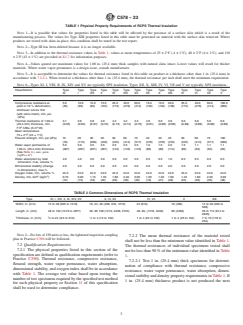
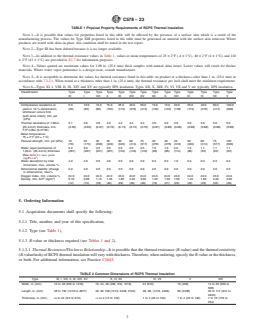
TABLE 1 Physical Property Requirements of RCPS Thermal Insulation
NOTE 1—It is possible that values for properties listed in this table will be affected by the presence of a surface skin which is a result of the
manufacturing process. The values for Type XIII properties listed in this table must be generated on material with the surface skin removed. Where
products are tested with skins-in-place, this condition shall be noted in the test report.
NOTE 2—Type III has been deleted because it is no longer available.
NOTE 3—In addition to the thermal resistance values in Table 1, values at mean temperatures of 25 ± 2°F (-4 ± 1°C), 40 ± 2°F (4 ± 1°C), and 110
± 2°F (43 ± 1°C) are provided in X1.7 for information purposes.
NOTE 4—Values quoted are maximum values for 1.00 in. (25.4 mm) thick samples with natural skins intact. Lower values will result for thicker
materials. Where water vapor permeance is a design issue, consult manufacturer.
NOTE 5—It is acceptable to determine the values for thermal resistance listed in this table on product at a thickness other than 1 in. (25.4 mm) in
accordance with 7.2.2.1. When tested at a thickness other than 1 in. (25.4 mm), the thermal resistance per inch shall meet the minimum requirement.
NOTE 6—Types XI, I, VIII, II, IX, XIV and XV are typically EPS insulation. Types XII, X, XIII, IV, VI, VII and V are typically XPS insulation.
Classification Type Type Type Type Type Type Type Type Type Type Type Type Type Type
XI I VIII II IX XIV XV XII X XIII IV VI VII V
Compressive resistance at 5.0 10.0 13.0 15.0 25.0 40.0 60.0 15.0 15.0 20.0 25.0 40.0 60.0 100.0
yield or 10 % deformation, (35) (69) (90) (104) (173) (276) (414) (104) (104) (138) (173) (276) (414) (690)
whichever occurs first
(with skins intact), min, psi
(kPa)
Thermal resistance of 1.00-in. 3.1 3.6 3.8 4.0 4.2 4.2 4.3 4.6 5.0 3.9 5.0 5.0 5.0 5.0
(25.4-mm) thickness, min, (0.55) (0.63) (0.67) (0.70) (0.74) (0.74) (0.76) (0.81) (0.88) (0.68) (0.88) (0.88) (0.88) (0.88)
2 2
F·ft ·h/Btu (K·m /W)
Mean temperature:
75 ± 2°F (24 ± 1°C)
Flexural strength, min, psi (kPa) 10 25 30 35 50 60 75 40 40 45 50 60 75 100
(70) (173) (208) (240) (345) (414) (517) (276) (276) (310) (345) (414) (517) (690)
Water vapor permeance of 5.0 5.0 3.5 3.5 2.5 2.5 2.5 1.5 1.5 2.0 1.5 1.1 1.1 1.1
1.00-in. (25.4-mm) thickness (287) (287) (201) (201) (143) (143) (143) (86) (86) (114) (86) (63) (63) (63)
(See Note 4.), max, perm
(ng/Pa·s·m )
Water absorption by total 4.0 4.0 3.0 3.0 2.0 2.0 2.0 0.3 0.3 1.0 0.3 0.3 0.3 0.3
immersion, max, volume %
Dimensional stability (change 2.0 2.0 2.0 2.0 2.0 2.0 2.0 2.0 2.0 2.0 2.0 2.0 2.0 2.0
in dimensions), max,%
Oxygen index, min, volume % 24.0 24.0 24.0 24.0 24.0 24.0 24.0 24.0 24.0 24.0 24.0 24.0 24.0 24.0
3 3
Density, min, lb/ft (kg/m ) 0.70 0.90 1.15 1.35 1.80 2.40 3.00 1.20 1.30 1.60 1.45 1.80 2.20 3.00
(12) (15) (18) (22) (29) (38) (48) (19) (21) (26) (23) (29) (35) (48)
TABLE 2 Common Dimensions of RCPS Thermal Insulation
Type XI, I, VIII, II, IX, XIV, XV X, IV, XII VI, VII V XIII
Width, in. (mm) 12 to 48 (305 to 1219) 16, 24, 48 (406, 610, 1219) 24 (610) 16 (406) 14 to 20 (356 to
508)
Length, in. (mm) 48 to 192 (1219 to 4877) 48, 96 108 (1219, 2438, 2743) 48, 96, (1219, 2438) 96 (2438) 36 to 112 (914 to
2845)
3 1
Thickness, in. (mm) ⁄8 to 24 (9.5 to 610) ⁄2 to 4 (13 to 102) 1 to 4 (25 to 102) 1 to 4 (25 to 102) 7 to 10 (178 to
254)
NOTE 2—For lots of 150 units or less, the tightened inspection sampling
7.2.2 The mean thermal resistance of the material tested
plan in Practice C390 will be followed.
shall not be less than the minimum value identified in Table 1.
7.2 Qualification Requirements:
The thermal resistances of individual specimens tested shall
7.2.1 The physical properties listed in this section of the
not be less than 90 % of the minimum value identified in Table
specification are defined as qualification requirements (refer to
1.
Practice C390). Thermal resistance, compressive resistance,
7.2.2.1 Test 1 in. (25.4 mm) thick specimens for determi-
flexural strength, water vapor permeance, water absorption,
nation of compliance with thermal resistance, compressive
dimensional stability, and oxygen index shall be in accordance
resistance, water vapor permeance, water absorption, dimen-
with Table 1. The average test value based upon testing the
sional stability and density property requirements in Table 1. If
number of test specimens required by the specified test method
1 in. (25.4 mm) thickness product is not produced the next
for each physical property or Section 11 of this specification
shall be used to determine compliance.
C578 − 23
available commercially manufactured product thickness 8.6 Ship-Lap and Tongue-and-Groove Edges—When
greater than 1 in. (25.4 mm) thickness shall be tested and specified, RCPS thermal insulation shall be furnished with
reported. either ship-lap or tongue-and-groove edges.
7.2.3 Compliance with qualification requirements shall be 8.6.1 For RCPS thermal insulation manufactured with ship-
in accordance with Practice C390. lap edges, the depth of the ship-lap cut shall be one half the
board thickness +0.06, −0 in. ( +1.5, −0 mm). The minimum
7.3 Long Term Thermal Resistance (LTTR)—Determine and
width of the cut for RCPS thermal insulation of 1.00-in.
report values in accordance with Test Method C1303 or
(25.4-mm) thickness or greater shall be 0.50 6 0.06 in.
CAN/ULC S770. LTTR shall apply to types IV, V, VI, VII, and
(12.7 6 1.5 mm). For RCPS thermal insulation less than
X only. The composition of the test stacks used for the test
1.00 in. (25.4 mm) in thickness, the minimum width of the cut
measurements shall be reported.
shall be 0.25 6 0.06 in. (6.4 6 1.5 mm). The ship-lap cut shall
7.4 Table 1 describes types of RCPS thermal insulation.
be made on opposite faces of the board for both length and
However, it does not cover all available products on the
width. The resulting joint shall be smooth and uniform.
market. The values stated in Table 1 are not intended to be used
8.6.2 For RCPS thermal insulation manufactured with
as design values. It is the buyer’s responsibility to specify
tongue-and-groove edges, the tongue of one shall fit snugly
design requirements and obtain supporting documentation
into the groove of a second. The resulting joint shall be smooth
from the material supplier.
and uniform.
7.5 Combustibility Characteristics—RCPS thermal insula-
9. Workmanship, Finish, and Appearance
tion is an organic material and is, therefore, combustible. It
shall not be exposed to flames or other ignition sources. The 9.1 Defects—RCPS thermal insulation shall have no defects
that will adversely affect its service qualities. RCPS thermal
values obtained by the oxygen index test (see Table 1 and
11.10) do not necessarily indicate or describe the fire risk of the insulation shall be of uniform texture and free of foreign
materials and are used in this specification primarily to inclusions, broken edges and corners, slits, and objectionable
distinguish between insulations formulated with flame retar- odors.
dants and those not so formulated.
9.2 Crushing and Depressions—RCPS thermal insulation
shall have no crushed or depressed areas on any surface
8. Dimensions and Permissible Variations
exceeding 0.13 in. (3.3 mm) in depth on more than 10 % of the
8.1 The materials covered by this specification are com- total surface area.
monly available in the sizes shown in Table 2. Other sizes shall
9.3 The total number of voids on the board surface shall not
be agreed upon between the supplier and the user.
exceed an average of 1 per square foot with dimensions larger
than 0.13 by 0.13 by 0.13 in. (3.3 by 3.3 by 3.3 mm).
8.2 Dimensional Tolerances—Unless otherwise specified,
the length tolerance shall not exceed 60.03 in./ft (62.5 mm/m)
10. Sampling
of length; the width tolerance shall not exceed 60.06 in./ft
(65.0 mm/m) of width; and the thickness tolerance shall not 10.1 Unless otherwise specified in the purchase order or
exceed 60.06 in./in. (659.5 mm/m) of thickness. For products contract, the material shall be sampled in accordance with
less than 1.00 in. (25.4 mm) in thickness, the thickness Practice C390.
tolerance shall not exceed 60.06 in. (1.5 mm).
11. Test Methods
8.2.1 Dimensional Tolerances for RCPS Type XIII—The
length tolerance shall not exceed +1, −0 in (+25.4, −0 mm); the 11.1 Conditioning and Aging:
width tolerance shall not exceed +0.5, −0 in (+12.7, −0 mm);
11.1.1 Samples shall be conditioned as required by the test
and the thickness tolerance shall not exceed +0.5, −0 in (+12.7, method to either precondi
...
This document is not an ASTM standard and is intended only to provide the user of an ASTM standard an indication of what changes have been made to the previous version. Because
it may not be technically possible to adequately depict all changes accurately, ASTM recommends that users consult prior editions as appropriate. In all cases only the current version
of the standard as published by ASTM is to be considered the official document.
Designation: C578 − 22 C578 − 23
Standard Specification for
Rigid, Cellular Polystyrene Thermal Insulation
This standard is issued under the fixed designation C578; the number immediately following the designation indicates the year of
original adoption or, in the case of revision, the year of last revision. A number in parentheses indicates the year of last reapproval. A
superscript epsilon (´) indicates an editorial change since the last revision or reapproval.
This standard has been approved for use by agencies of the U.S. Department of Defense.
1. Scope
1.1 This specification covers the types, physical properties, and dimensions of cellular polystyrene boards with or without facings
or coatings made by molding (EPS) or extrusion (XPS) of expandable polystyrene. Products manufactured to this specification are
intended for use as thermal insulation for temperatures from –65 to +165°F (–53.9 to +73.9°C). This specification does not apply
to laminated products manufactured with any type of rigid board facer including fiberboard, perlite board, gypsum board, or
oriented strand board.
1.1.1 Additional requirements for Types IV and XIII for pipe, tank, and equipment thermal insulation for temperatures from –320
to +165°F (–196 to +73.9°C) are contained in Annex A1.
1.2 The use of thermal insulation materials covered by this specification is potentially regulated by codes that address fire
performance. For some end uses, specifiers need to also address the effect of moisture and wind pressure resistance. Guidelines
regarding these end use considerations are included in Appendix X1.
1.3 The values stated in inch-pound units are to be regarded as standard. The values given in parentheses are mathematical
conversions to SI units that are provided for information only and are not considered standard.
1.4 This standard does not purport to address all of the safety concerns, if any, associated with its use. It is the responsibility
of the user of this standard to establish appropriate safety, health, and environmental practices and determine the applicability of
regulatory limitations prior to use.
1.5 This international standard was developed in accordance with internationally recognized principles on standardization
established in the Decision on Principles for the Development of International Standards, Guides and Recommendations issued
by the World Trade Organization Technical Barriers to Trade (TBT) Committee.
2. Referenced Documents
2.1 ASTM Standards:
C165 Test Method for Measuring Compressive Properties of Thermal Insulations
C168 Terminology Relating to Thermal Insulation
This specification is under the jurisdiction of ASTM Committee C16 on Thermal Insulation and is the direct responsibility of Subcommittee C16.22 on Organic and
Nonhomogeneous Inorganic Thermal Insulations.
Current edition approved Aug. 1, 2022Sept. 1, 2023. Published August 2022October 2023. Originally approved in 1965. Last previous edition approved in 20192022 as
C578 – 19.C578 – 22. DOI: 10.1520/C0578-22.10.1520/C0578-23.
This specification is similar to ISO 4898-1984, “Cellular Plastics–Specification for Rigid Cellular Materials Used in the Thermal Insulation of Buildings,” in title only.
The scope and technical content are significantly different.
ISO standards are available from American National Standards Institute (ANSI), 25 W. 43rd St., 4th Floor, New York, NY 10036, http://www.ansi.org.
For referenced ASTM standards, visit the ASTM website, www.astm.org, or contact ASTM Customer Service at service@astm.org. For Annual Book of ASTM Standards
volume information, refer to the standard’s Document Summary page on the ASTM website.
Copyright © ASTM International, 100 Barr Harbor Drive, PO Box C700, West Conshohocken, PA 19428-2959. United States
C578 − 23
C177 Test Method for Steady-State Heat Flux Measurements and Thermal Transmission Properties by Means of the
Guarded-Hot-Plate Apparatus
C203 Test Methods for Breaking Load and Flexural Properties of Block-Type Thermal Insulation
C272 Test Method for Water Absorption of Core Materials for Sandwich Constructions
C303 Test Method for Dimensions and Density of Preformed Block and Board–Type Thermal Insulation
C335 Test Method for Steady-State Heat Transfer Properties of Pipe Insulation
C390 Practice for Sampling and Acceptance of Thermal Insulation Lots
C518 Test Method for Steady-State Thermal Transmission Properties by Means of the Heat Flow Meter Apparatus
C550 Test Method for Measuring Trueness and Squareness of Rigid Block and Board Thermal Insulation
C870 Practice for Conditioning of Thermal Insulating Materials
C1045 Practice for Calculating Thermal Transmission Properties Under Steady-State Conditions
C1058 Practice for Selecting Temperatures for Evaluating and Reporting Thermal Properties of Thermal Insulation
C1114 Test Method for Steady-State Thermal Transmission Properties by Means of the Thin-Heater Apparatus
C1303 Test Method for Predicting Long-Term Thermal Resistance of Closed-Cell Foam Insulation
C1363 Test Method for Thermal Performance of Building Materials and Envelope Assemblies by Means of a Hot Box Apparatus
C1512 Test Method for Characterizing the Effect of Exposure to Environmental Cycling on Thermal Performance of Insulation
Products
D1600 Terminology for Abbreviated Terms Relating to Plastics
D1621 Test Method for Compressive Properties of Rigid Cellular Plastics
D1622 Test Method for Apparent Density of Rigid Cellular Plastics
D2126 Test Method for Response of Rigid Cellular Plastics to Thermal and Humid Aging
D2863 Test Method for Measuring the Minimum Oxygen Concentration to Support Candle-Like Combustion of Plastics
(Oxygen Index)
E84 Test Method for Surface Burning Characteristics of Building Materials
E96/E96M Test Methods for Gravimetric Determination of Water Vapor Transmission Rate of Materials
E176 Terminology of Fire Standards
2.2 CAN/ULC Standard
CAN/ULC S770 Standard Test Method for the Determination of Long-Term Thermal Resistance of Closed-Cell Thermal
Insulating Foams
3. Terminology
3.1 Terms used in this specification are defined in Terminology C168.
3.2 Terms used in this specification that relate to fire standards are defined in Terminology E176.
3.3 Definitions of Terms Specific to This Standard:
3.3.1 EPS—letter designation for the molded expanded polystyrene thermal insulation classified by this specification. It is defined
as cellular plastic product manufactured from pre-expanded polystyrene beads subsequently molded into desired shapes and sizes
resulting in a product which is rigid with closed cellular structure.
3.3.2 RCPS—letter designations for the rigid cellular polystyrene thermal insulation classified by this specification that identifies
the product as rigid cellular polystyrene.
3.3.3 PS—used in this specification to represent polystyrene in accordance with Terminology D1600.
3.3.4 XPS—letter designation for the extruded expanded polystyrene thermal insulation classified by this specification. It is defined
as cellular plastic product manufactured in a one stage process by extrusion and expansion of the base polymer in the presence
of blowing agent(s) resulting in a product which is rigid with closed cellular structure.
4. Classification
4.1 This specification covers types of RCPS thermal insulations currently commercially available as described by the physical
property requirements in Table 1.
Available from Underwriters Laboratories (UL), 2600 N.W. Lake Rd., Camas, WA 98607-8542, http://www.ul.com.
C578 − 23
TABLE 1 Physical Property Requirements of RCPS Thermal Insulation
NOTE 1—It is possible that values for properties listed in this table will be affected by the presence of a surface skin which is a result of the
manufacturing process. The values for Type XIII properties listed in this table must be generated on material with the surface skin removed. Where
products are tested with skins-in-place, this condition shall be noted in the test report.
NOTE 2—Type III has been deleted because it is no longer available.
NOTE 3—In addition to the thermal resistance values in Table 1, values at mean temperatures of 25 ± 2°F (-4 ± 1°C), 40 ± 2°F (4 ± 1°C), and 110
± 2°F (43 ± 1°C) are provided in X1.7 for information purposes.
NOTE 4—Values quoted are maximum values for 1.00 in. (25.4 mm) thick samples with natural skins intact. Lower values will result for thicker
materials. Where water vapor permeance is a design issue, consult manufacturer.
NOTE 5—It is acceptable to determine the values for thermal resistance listed in this table on product at a thickness other than 1 in. (25.4 mm) in
accordance with 7.2.2.1. When tested at a thickness other than 1 in. (25.4 mm), the thermal resistance per inch shall meet the minimum requirement.
NOTE 6—Types XI, I, VIII, II, IX, XIV and XV are typically EPS insulation. Types XII, X, XIII, IV, VI, VII and V are typically XPS insulation.
Classification Type Type Type Type Type Type Type Type Type Type Type Type Type Type
XI I VIII II IX XIV XV XII X XIII IV VI VII V
Compressive resistance at 5.0 10.0 13.0 15.0 25.0 40.0 60.0 15.0 15.0 20.0 25.0 40.0 60.0 100.0
yield or 10 % deformation, (35) (69) (90) (104) (173) (276) (414) (104) (104) (138) (173) (276) (414) (690)
whichever occurs first
(with skins intact), min, psi
(kPa)
Thermal resistance of 1.00-in. 3.1 3.6 3.8 4.0 4.2 4.2 4.3 4.6 5.0 3.9 5.0 5.0 5.0 5.0
(25.4-mm) thickness, min, (0.55) (0.63) (0.67) (0.70) (0.74) (0.74) (0.76) (0.81) (0.88) (0.68) (0.88) (0.88) (0.88) (0.88)
2 2
F·ft ·h/Btu (K·m /W)
Mean temperature:
75 ± 2°F (24 ± 1°C)
Flexural strength, min, psi (kPa) 10 25 30 35 50 60 75 40 40 45 50 60 75 100
(70) (173) (208) (240) (345) (414) (517) (276) (276) (310) (345) (414) (517) (690)
Water vapor permeance of 5.0 5.0 3.5 3.5 2.5 2.5 2.5 1.5 1.5 2.0 1.5 1.1 1.1 1.1
1.00-in. (25.4-mm) thickness (287) (287) (201) (201) (143) (143) (143) (86) (86) (114) (86) (63) (63) (63)
(See Note 4.), max, perm
(ng/Pa·s·m )
Water absorption by total 4.0 4.0 3.0 3.0 2.0 2.0 2.0 0.3 0.3 1.0 0.3 0.3 0.3 0.3
immersion, max, volume %
Dimensional stability (change 2.0 2.0 2.0 2.0 2.0 2.0 2.0 2.0 2.0 2.0 2.0 2.0 2.0 2.0
in dimensions), max,%
Oxygen index, min, volume % 24.0 24.0 24.0 24.0 24.0 24.0 24.0 24.0 24.0 24.0 24.0 24.0 24.0 24.0
3 3
Density, min, lb/ft (kg/m ) 0.70 0.90 1.15 1.35 1.80 2.40 3.00 1.20 1.30 1.60 1.45 1.80 2.20 3.00
(12) (15) (18) (22) (29) (38) (48) (19) (21) (26) (23) (29) (35) (48)
5. Ordering Information
5.1 Acquisition documents shall specify the following:
5.1.1 Title, number, and year of this specification,
5.1.2 Type (see Table 1),
5.1.3 R-value or thickness required (see Tables 1 and 2),
5.1.3.1 Thermal Resistance/Thickness Relationship—It is possible that the thermal resistance (R-value) and the thermal resistivity
(R-value/inch) of RCPS thermal insulation will vary with thickness. Therefore, when ordering, specify the R-value or the thickness,
or both. For additional information, see Practice C1045.
TABLE 2 Common Dimensions of RCPS Thermal Insulation
Type XI, I, VIII, II, IX, XIV, XV X, IV, XII VI, VII V XIII
Width, in. (mm) 12 to 48 (305 to 1219) 16, 24, 48 (406, 610, 1219) 24 (610) 16 (406) 14 to 20 (356 to
508)
Length, in. (mm) 48 to 192 (1219 to 4877) 48, 96 108 (1219, 2438, 2743) 48, 96, (1219, 2438) 96 (2438) 36 to 112 (914 to
2845)
3 1
Thickness, in. (mm) ⁄8 to 24 (9.5 to 610) ⁄2 to 4 (13 to 102) 1 to 4 (25 to 102) 1 to 4 (25 to 102) 7 to 10 (178 to
254)
C578 − 23
5.1.4 Density, if other than specified in Table 1,
5.1.5 Tolerance, if other than specified (see 8.2),
5.1.6 Length and width required (see Table 2 and 8.1),
5.1.7 If other than straight edges are required (see 8.3),
5.1.8 If either ship-lap or tongue-and-groove edges are required (see 8.6),
5.1.9 Tapered Insulation—Special ordering information. In addition to other applicable requirements in Section 5 (Note 1),
acquisition documents for tapered RCPS thermal insulation shall specify the following:
5.1.9.1 Minimum starting thickness,
5.1.9.2 Slope, in./ft (mm/m),
5.1.9.3 Average R-value,
5.1.9.4 Minimum thickness,
5.1.9.5 Shop Drawings—The tapered insulation supplier shall provide shop drawings to illustrate installation patterns and
dimensions for each tapered module,
5.1.10 Sampling, if different (see 10.1),
5.1.11 If a certificate of compliance is required (see 14.1), and
5.1.12 If marking is other than specified (see 15.1).
NOTE 1—Physical properties of tapered insulation should be determined on blocks of RCPS thermal insulation before the insulation is tapered.
5.1.13 Type XIII—Special ordering information. In addition to other applicable requirements in Section 5, acquisition documents
for Type XIII thermal insulation shall specify if presence of surface skins is required.
6. Materials and Manufacture
6.1 RCPS thermal insulation shall be formed by the expansion of polystyrene resin beads or granules in a closed mold, or by the
expansion of polystyrene base resin in an extrusion process. RCPS thermal insulation shall be of uniform density and have
essentially closed cells. All RCPS thermal insulation shall contain sufficient flame retardants to meet the oxygen index
requirements of Table 1.
7. Physical Requirements
7.1 Inspection Requirements:
7.1.1 The physical requirements listed in this section are defined as inspection requirements (refer to Practice C390).
7.1.2 All dimensional requirements are described in Section 8.
7.1.3 All workmanship, finish, and appearance requirements are described in Section 9.
7.1.4 Density shall be in accordance with Table 1.
NOTE 2—For lots of 150 units or less, the tightened inspection sampling plan in Practice C390 will be followed.
C578 − 23
7.2 Qualification Requirements:
7.2.1 The physical properties listed in this section of the specification are defined as qualification requirements (refer to Practice
C390). Thermal resistance, compressive resistance, flexural strength, water vapor permeance, water absorption, dimensional
stability, and oxygen index shall be in accordance with Table 1. The average test value based upon testing the number of test
specimens required by the specified test method for each physical property or Section 11 of this specification shall be used to
determine compliance.
7.2.2 The mean thermal resistance of the material tested shall not be less than the minimum value identified in Table 1. The
thermal resistances of individual specimens tested shall not be less than 90 % of the minimum value identified in Table 1.
7.2.2.1 Test 1 in. (25.4 mm) thick specimens for determination of compliance with thermal resistance, compressive resistance,
water vapor permeance, water absorption, dimensional stability and density property requirements in Table 1. If 1 in. (25.4 mm)
thickness product is not produced the next available commercially manufactured product thickness greater than 1 in. (25.4 mm)
thickness shall be tested and reported.
7.2.3 Compliance with qualification requirements shall be in accordance with Practice C390.
7.3 Long Term Thermal Resistance (LTTR)—Determine and report values in accordance with Test Method C1303 or CAN/ULC
S770. LTTR shall apply to types IV, V, VI, VII, and X only. The composition of the test stacks used for the test measurements
shall be reported.
7.4 Table 1 describes types of RCPS thermal insulation. However, it does not cover all available products on the market. The
values stated in Table 1 are not intended to be used as design values. It is the buyer’s responsibility to specify design requirements
and obtain supporting documentation from the material supplier.
7.5 Combustibility Characteristics—RCPS thermal insulation is an organic material and is, therefore, combustible. It shall not be
exposed to flames or other ignition sources. The values obtained by the oxygen index test (see Table 1 and 11.10) do not necessarily
indicate or describe the fire risk of the materials and are used in this specification primarily to distinguish between insulations
formulated with flame retardants and those not so formulated.
8. Dimensions and Permissible Variations
8.1 The materials covered by this specification are commonly available in the sizes shown in Table 2. Other sizes shall be agreed
upon between the supplier and the user.
8.2 Dimensional Tolerances—Unless otherwise specified, the length tolerance shall not exceed 60.03 in./ft (62.5 mm/m) of
length; the width tolerance shall not exceed 60.06 in./ft (65.0 mm/m) of width; and the thickness tolerance shall not exceed 60.06
in./in. (659.5 mm/m) of thickness. For products less than 1.00 in. (25.4 mm) in thickness, the thickness tolerance shall not exceed
60.06 in. (1.5 mm).
8.2.1 Dimensional Tolerances for RCPS Type XIII—The length tolerance shall not exceed +1, −0 in (+25.4, −0 mm); the width
tolerance shall not exceed +0.5, −0 in (+12.7, −0 mm); and the thickness tolerance shall not exceed +0.5, −0 in (+12.7, −0 mm).
8.3 Edge Trueness—Unless otherwise specified, RCPS thermal insulation shall be furnished with true edges. Edges shall not
deviate more than 0.03 in./ft (2.5 mm/m) of length or width.
8.4 Face Trueness—RCPS thermal insulation shall not deviate from absolute trueness by more than 0.03 in./ft (2.5 mm ⁄m) of
length or width.
8.5 Squareness—RCPS thermal insulation shall not deviate from squareness by more than 0.06 in./ft (5.0 mm/m) of length or
width.
Supporting data can be found in Oak Ridge National Lab Report number ORNL/TM-2012/214. Evaluation of Experimental Parameters in the Accelerated Aging of
Closed-Cell Foam Insulation, December 2012.
C578 − 23
8.6 Ship-Lap and Tongue-and-Groove Edges—When specified, RCPS thermal insulation shall be furnished with either ship-lap or
tongue-and-groove edges.
8.6.1 For RCPS thermal insulation manufactured with ship-lap edges, the depth of the ship-lap cut shall be one half the board
thickness +0.06, −0 in. ( +1.5, −0 mm). The minimum width of the cut for RCPS thermal insulation of 1.00-in. (25.4-mm)
thickness or greater shall be 0.50 6 0.06 in. (12.7 6 1.5 mm). For RCPS thermal insulation less than 1.00 in. (25.4 mm) in
thickness, the minimum width of the cut shall be 0.25 6 0.06 in. (6.4 6 1.5 mm). The ship-lap cut shall be made on opposite faces
of the board for both length and width. The resulting joint shall be smooth and uniform.
8.6.2 For RCPS thermal insulation manufactured with tongue-and-groove edges, the tongue of one shall fit snugly into the groove
of a second. The resulting joint shall be smooth and uniform.
9. Workmanship, Finish, and Appearance
9.1 Defects—RCPS thermal insulation shall have no defects that will adversely affect its service qualities. RCPS thermal insulation
shall be of uniform texture and
...