

ASTM A732/A732M-20
(Specification)Standard Specification for Castings, Investment, Carbon and Low-Alloy Steel for General Application, and Cobalt Alloy for High Strength at Elevated Temperatures
General Information
- Abstract
ABSTRACT
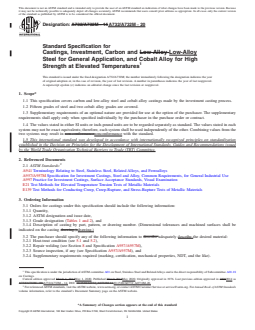
This specification covers carbon and low-alloy steel and cobalt alloy castings made by the investment casting process. Fifteen grades of steel and two cobalt alloy grades are covered. Steel castings shall be heat treated either by full annealing, normalizing, normalizing and tempering, or quenching and tempering to obtain the specified properties or other properties that have been agreed upon within each grade. The castings shall conform to the requirements for chemical composition specified.
SCOPE
1.1 This specification covers carbon and low-alloy steel and cobalt alloy castings made by the investment casting process.
1.2 Fifteen grades of steel and two cobalt alloy grades are covered.
1.3 Supplementary requirements of an optional nature are provided for use at the option of the purchaser. The supplementary requirements shall apply only when specified individually by the purchaser in the purchase order or contract.
1.4 The values stated in either SI units or inch-pound units are to be regarded separately as standard. The values stated in each system may not be exact equivalents; therefore, each system shall be used independently of the other. Combining values from the two systems may result in nonconformance with the standard.
1.5 This international standard was developed in accordance with internationally recognized principles on standardization established in the Decision on Principles for the Development of International Standards, Guides and Recommendations issued by the World Trade Organization Technical Barriers to Trade (TBT) Committee.
- Status
- Published
- Publication Date
- 30-Apr-2020
- Technical Committee
- A01 - Steel, Stainless Steel and Related Alloys
- Drafting Committee
- A01.18 - Castings
Buy Documents
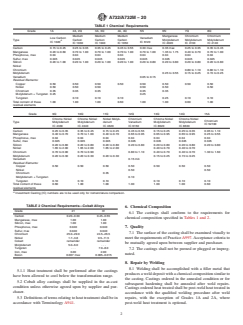
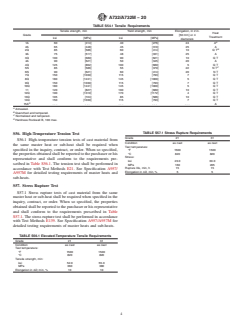
ASTM A732/A732M-20 - Standard Specification for Castings, Investment, Carbon and Low-Alloy Steel for General Application, and Cobalt Alloy for High Strength at Elevated Temperatures
REDLINE ASTM A732/A732M-20 - Standard Specification for Castings, Investment, Carbon and Low-Alloy Steel for General Application, and Cobalt Alloy for High Strength at Elevated Temperatures
Overview
ASTM A732/A732M-20 is a standard specification published by ASTM International for investment castings made of carbon steel, low-alloy steel, and cobalt alloys. This standard provides guidelines for the manufacture, chemical composition, heat treatment, and testing of fifteen grades of steel and two grades of cobalt alloy castings. The scope of the document ensures these investment castings are suitable for general applications as well as high-strength requirements at elevated temperatures. ASTM A732/A732M-20 establishes a framework for quality, performance, and consistency, making it essential for manufacturers and purchasers involved in critical casting applications.
Key Topics
- Scope and Coverage
- Carbon steel, low-alloy steel, and cobalt alloy investment castings
- Fifteen steel grades and two cobalt alloy grades
- Heat Treatment Requirements
- Steel castings must be heat treated by annealing, normalizing, normalizing and tempering, or quenching and tempering
- Cobalt alloy castings are supplied as-cast unless otherwise specified
- Chemical Composition
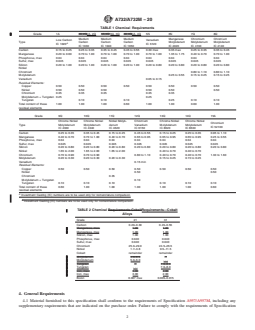
- Detailed chemical requirements for all grades ensure consistency and quality
- Requirements cover carbon, manganese, silicon, phosphorus, sulfur, chromium, nickel, molybdenum, tungsten, and other elements specific to each grade
- Mechanical Properties
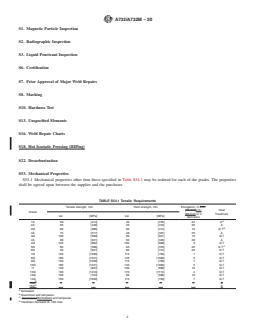
- Specification for properties such as tensile strength, yield strength, and elongation for cast and heat treated materials
- Supplementary requirements available for custom mechanical property agreements
- Inspection and Quality Assurance
- Visual examination standards
- Optional supplementary tests, including magnetic particle inspection, radiographic inspection, and liquid penetrant inspection
- Supplementary Requirements
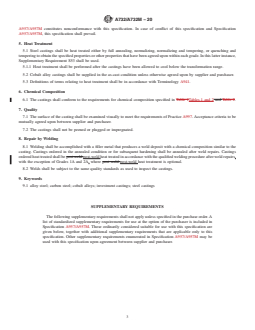
- Marking, certification, mechanical properties, hardness tests, heat treatment verification, and weld repair standards available as buyer options
Applications
ASTM A732/A732M-20 is designed to serve a broad range of industries that demand reliable, precision-manufactured steel and cobalt alloy castings:
- General Industrial Applications
- Machinery parts
- Structural components
- Aerospace and Power Generation
- Turbine blades, vanes, and components that operate at high temperatures
- Turbochargers and related high stress, high-temperature hardware
- Automotive and Transport
- High-strength, wear-resistant components for engines and drivetrain assemblies
- Oil & Gas and Energy Sectors
- Valves, pumps, and process equipment components exposed to extreme service conditions
- Custom Engineering Projects
- Projects requiring bespoke mechanical and chemical properties, using the specification’s supplementary and negotiated requirements
Related Standards
For comprehensive use and conformity with ASTM A732/A732M-20, reference to related ASTM standards is highly recommended:
- ASTM A941 - Terminology Relating to Steel, Stainless Steel, Related Alloys, and Ferroalloys
- ASTM A957/A957M - Standard Specification for Investment Castings, Steel and Alloy, Common Requirements, for General Industrial Use
- ASTM A997 - Practice for Investment Castings, Surface Acceptance Standards, Visual Examination
- ASTM E21 - Test Methods for Elevated Temperature Tension Tests of Metallic Materials
- ASTM E139 - Test Methods for Conducting Creep, Creep-Rupture, and Stress-Rupture Tests of Metallic Materials
Practical Value
Implementing the ASTM A732/A732M-20 specification ensures:
- Consistent Product Quality: Standardized chemical and mechanical properties for reliable application performance
- Process Flexibility: Supplementary requirements and buyer-supplier agreements accommodate specialized needs
- Global Acceptance: Developed in line with WTO Technical Barriers to Trade (TBT) principles, supporting international trade and procurement
- Risk Mitigation: Thorough inspection and test procedures reduce the likelihood of failures in critical applications
- Material Traceability: Clear documentation and marking requirements assist in quality control and traceability throughout the supply chain
This standard underscores best practices for investment castings, supporting the integrity and efficiency of industrial operations requiring high-performance steel and cobalt alloy parts.
Relations
- Effective Date
- 01-May-2020
- Effective Date
- 01-Mar-2024
- Effective Date
- 01-Sep-2018
- Effective Date
- 15-May-2018
- Effective Date
- 01-Sep-2017
- Effective Date
- 01-Nov-2015
- Effective Date
- 01-Nov-2015
- Effective Date
- 01-Mar-2015
- Effective Date
- 01-Oct-2014
- Effective Date
- 01-Jun-2013
- Effective Date
- 01-May-2013
- Effective Date
- 01-May-2013
- Effective Date
- 01-Apr-2013
- Effective Date
- 01-Sep-2012
- Effective Date
- 01-Sep-2012
Buy Documents
ASTM A732/A732M-20 - Standard Specification for Castings, Investment, Carbon and Low-Alloy Steel for General Application, and Cobalt Alloy for High Strength at Elevated Temperatures
REDLINE ASTM A732/A732M-20 - Standard Specification for Castings, Investment, Carbon and Low-Alloy Steel for General Application, and Cobalt Alloy for High Strength at Elevated Temperatures
Get Certified
Connect with accredited certification bodies for this standard

Element Materials Technology
Materials testing and product certification.

Inštitut za kovinske materiale in tehnologije
Institute of Metals and Technology. Materials testing, metallurgical analysis, NDT.
Sponsored listings
Frequently Asked Questions
ASTM A732/A732M-20 is a technical specification published by ASTM International. Its full title is "Standard Specification for Castings, Investment, Carbon and Low-Alloy Steel for General Application, and Cobalt Alloy for High Strength at Elevated Temperatures". This standard covers: ABSTRACT This specification covers carbon and low-alloy steel and cobalt alloy castings made by the investment casting process. Fifteen grades of steel and two cobalt alloy grades are covered. Steel castings shall be heat treated either by full annealing, normalizing, normalizing and tempering, or quenching and tempering to obtain the specified properties or other properties that have been agreed upon within each grade. The castings shall conform to the requirements for chemical composition specified. SCOPE 1.1 This specification covers carbon and low-alloy steel and cobalt alloy castings made by the investment casting process. 1.2 Fifteen grades of steel and two cobalt alloy grades are covered. 1.3 Supplementary requirements of an optional nature are provided for use at the option of the purchaser. The supplementary requirements shall apply only when specified individually by the purchaser in the purchase order or contract. 1.4 The values stated in either SI units or inch-pound units are to be regarded separately as standard. The values stated in each system may not be exact equivalents; therefore, each system shall be used independently of the other. Combining values from the two systems may result in nonconformance with the standard. 1.5 This international standard was developed in accordance with internationally recognized principles on standardization established in the Decision on Principles for the Development of International Standards, Guides and Recommendations issued by the World Trade Organization Technical Barriers to Trade (TBT) Committee.
ABSTRACT This specification covers carbon and low-alloy steel and cobalt alloy castings made by the investment casting process. Fifteen grades of steel and two cobalt alloy grades are covered. Steel castings shall be heat treated either by full annealing, normalizing, normalizing and tempering, or quenching and tempering to obtain the specified properties or other properties that have been agreed upon within each grade. The castings shall conform to the requirements for chemical composition specified. SCOPE 1.1 This specification covers carbon and low-alloy steel and cobalt alloy castings made by the investment casting process. 1.2 Fifteen grades of steel and two cobalt alloy grades are covered. 1.3 Supplementary requirements of an optional nature are provided for use at the option of the purchaser. The supplementary requirements shall apply only when specified individually by the purchaser in the purchase order or contract. 1.4 The values stated in either SI units or inch-pound units are to be regarded separately as standard. The values stated in each system may not be exact equivalents; therefore, each system shall be used independently of the other. Combining values from the two systems may result in nonconformance with the standard. 1.5 This international standard was developed in accordance with internationally recognized principles on standardization established in the Decision on Principles for the Development of International Standards, Guides and Recommendations issued by the World Trade Organization Technical Barriers to Trade (TBT) Committee.
ASTM A732/A732M-20 is classified under the following ICS (International Classification for Standards) categories: 77.140.80 - Iron and steel castings. The ICS classification helps identify the subject area and facilitates finding related standards.
ASTM A732/A732M-20 has the following relationships with other standards: It is inter standard links to ASTM A732/A732M-14, ASTM A941-24, ASTM A957/A957M-18a, ASTM A957/A957M-18, ASTM A941-17, ASTM A941-15, ASTM A957/A957M-15a, ASTM A957/A957M-15, ASTM A957/A957M-14, ASTM A941-13b, ASTM A941-13a, ASTM A957/A957M-13, ASTM A941-13, ASTM A957/A957M-12a, ASTM A997-08(2012). Understanding these relationships helps ensure you are using the most current and applicable version of the standard.
ASTM A732/A732M-20 is available in PDF format for immediate download after purchase. The document can be added to your cart and obtained through the secure checkout process. Digital delivery ensures instant access to the complete standard document.
Standards Content (Sample)
This international standard was developed in accordance with internationally recognized principles on standardization established in the Decision on Principles for the
Development of International Standards, Guides and Recommendations issued by the World Trade Organization Technical Barriers to Trade (TBT) Committee.
Designation:A732/A732M −20
Standard Specification for
Castings, Investment, Carbon and Low-Alloy Steel for
General Application, and Cobalt Alloy for High Strength at
Elevated Temperatures
This standard is issued under the fixed designationA732/A732M; the number immediately following the designation indicates the year
of original adoption or, in the case of revision, the year of last revision. A number in parentheses indicates the year of last reapproval.
A superscript epsilon (´) indicates an editorial change since the last revision or reapproval.
1. Scope* Standards, Visual Examination
E21 TestMethodsforElevatedTemperatureTensionTestsof
1.1 This specification covers carbon and low-alloy steel and
Metallic Materials
cobalt alloy castings made by the investment casting process.
E139 Test Methods for Conducting Creep, Creep-Rupture,
1.2 Fifteen grades of steel and two cobalt alloy grades are
and Stress-Rupture Tests of Metallic Materials
covered.
3. Ordering Information
1.3 Supplementary requirements of an optional nature are
provided for use at the option of the purchaser. The supple- 3.1 Orders for castings under this specification should
mentary requirements shall apply only when specified indi- include the following information:
vidually by the purchaser in the purchase order or contract. 3.1.1 Quantity,
3.1.2 ASTM designation and issue date,
1.4 The values stated in either SI units or inch-pound units
3.1.3 Grade designation (Tables 1 and 2), and
are to be regarded separately as standard. The values stated in
3.1.4 Description of casting by part, pattern, or drawing
each system may not be exact equivalents; therefore, each
number. (Dimensional tolerances and machined surfaces shall
system shall be used independently of the other. Combining
be indicated on the casting drawing.)
values from the two systems may result in nonconformance
with the standard. 3.2 The purchaser should specify any of the following
information to adequately describe the desired material:
1.5 This international standard was developed in accor-
3.2.1 Heat-treat condition (see 5.1 and 5.2),
dance with internationally recognized principles on standard-
3.2.2 Repairwelding(seeSection8andSpecificationA957/
ization established in the Decision on Principles for the
A957M),
Development of International Standards, Guides and Recom-
3.2.3 Source inspection, if any (see Specification A957/
mendations issued by the World Trade Organization Technical
A957M), and
Barriers to Trade (TBT) Committee.
3.2.4 Supplementary requirements required (marking,
2. Referenced Documents certification, mechanical properties, NDT, and the like).
2.1 ASTM Standards:
4. General Requirements
A941 TerminologyRelatingtoSteel,StainlessSteel,Related
4.1 Material furnished to this specification shall conform to
Alloys, and Ferroalloys
the requirements of Specification A957/A957M, including any
A957/A957M Specification for Investment Castings, Steel
supplementary requirements that are indicated on the purchase
and Alloy, Common Requirements, for General Industrial
order. Failure to comply with the requirements of Specification
Use
A957/A957M constitutes nonconformance with this specifica-
A997 Practice for Investment Castings, Surface Acceptance
tion. In case of conflict of this specification and Specification
A957/A957M, this specification shall prevail.
This specification is under the jurisdiction of ASTM committee A01 on Steel,
5. Heat Treatment
Stainless Steel and Related Alloys and is the direct responsibility of Subcommittee
A01.18 on Castings.
5.1 Steel castings shall be heat treated either by full
Current edition approved May 1, 2020. Published May 2020. Originally
annealing,normalizing,normalizingandtempering,orquench-
approved in 1976. Last previous edition approved in 2014 as A732/A732M – 14.
DOI: 10.1520/A0732_A0732M-20.
ing and tempering to obtain the specified properties or other
For referenced ASTM standards, visit the ASTM website, www.astm.org, or
properties that have been agreed upon within each grade. In
contact ASTM Customer Service at service@astm.org. For Annual Book of ASTM
this latter instance, Supplementary Requirement S53 shall be
Standards volume information, refer to the standard’s Document Summary page on
the ASTM website. used.
*A Summary of Changes section appears at the end of this standard
Copyright © ASTM International, 100 Barr Harbor Drive, PO Box C700, West Conshohocken, PA 19428-2959. United States
A732/A732M−20
TABLE 1 Chemical Requirements
Grade 1A 2A, 2Q 3A, 3Q 4A, 4Q 5N 6N 7Q 8Q
Medium Medium Medium Manganese Chromium Chromium
Low Carbon Vanadium
Type Carbon Carbon Carbon Molybdenum Molybdenum Molybdenum
A
IC 1020 IC 6120
IC 1030 IC 1040 IC 1050 IC 4020 IC 4130 IC 4140
Carbon 0.15 to 0.25 0.25 to 0.35 0.35 to 0.45 0.45 to 0.55 0.30 max 0.35 max 0.25 to 0.35 0.35 to 0.45
Manganese 0.20 to 0.60 0.70 to 1.00 0.70 to 1.00 0.70 to 1.00 0.70 to 1.00 1.35 to 1.75 0.40 to 0.70 0.70 to 1.00
Phosphorus, max 0.04 0.04 0.04 0.04 0.04 0.04 0.04 0.04
Sulfur, max 0.045 0.045 0.045 0.045 0.045 0.045 0.045 0.045
Silicon 0.20 to 1.00 0.20 to 1.00 0.20 to 1.00 0.20 to 1.00 0.20 to 0.80 0.20 to 0.80 0.20 to 0.80 0.20 to 0.80
Nickel
Chromium 0.80 to 1.10 0.80 to 1.10
Molybdenum 0.25 to 0.55 0.15 to 0.25 0.15 to 0.25
Vanadium 0.05 to 0.15
Residual Elements:
Copper 0.50 0.50 0.50 0.50 0.50 0.50 0.50 0.50
Nickel 0.50 0.50 0.50 0.50 0.50 0.50
Chromium 0.35 0.35 0.35 0.35 0.35
Molybdenum + Tungsten 0.25 0.25
Tungsten 0.10 0.10 0.10 0.25 0.10 0.10
Total content of these 1.00 1.00 1.00 0.60 1.00 1.00 0.60 1.00
residual elements
Grade 9Q 10Q 11Q 12Q 13Q 14Q 15A
Chrome Nickel Chrome Nickel Nickel Molyb- Chromium Chrome Nickel Chrome Nickel
Chromium
Type Molybdenum Molybdenum denum Vanadium Molybdenum Molybdenum
IC 52100
IC 4330 IC 4340 IC 4620 IC 6150 IC 8620 IC 8630
Carbon 0.25 to 0.35 0.35 to 0.45 0.15 to 0.25 0.45 to 0.55 0.15 to 0.25 0.25 to 0.35 0.95 to 1.10
Manganese 0.40 to 0.70 0.70 to 1.00 0.40 to 0.70 0.65 to 0.95 0.65 to 0.95 0.65 to 0.95 0.25 to 0.55
Phosphorus, max 0.04 0.04 0.04 0.04 0.04 0.04 0.04
Sulfur, max 0.045 0.045 0.045 0.045 0.045 0.045 0.045
Silicon 0.20 to 0.80 0.20 to 0.80 0.20 to 0.80 0.20 to 0.80 0.20 to 0.80 0.20 to 0.80 0.20 to 0.80
Nickel 1.65 to 2.00 1.65 to 2.00 1.65 to 2.00 0.40 to 0.70 0.40 to 0.70
Chromium 0.70 to 0.90 0.70 to 0.90 0.80 to 1.10 0.40 to 0.70 0.40 to 0.70 1.30 to 1.60
Molybdenum 0.20 to 0.30 0.20 to 0.30 0.20 to 0.30 0.15 to 0.25 0.15 to 0.25
Vanadium 0.15 min
Residual Elements:
Copper 0.50 0.50 0.50 0.50 0.50 0.50 0.50
Nickel 0.50 0.50
Chromium 0.35
Molybdenum + Tungsten 0.10
Tungsten 0.10 0.10 0.10 0.10 0.10 0.10
Total content of these 0.60 1.00 1.00 1.00 1.00 1.00 0.60
residual elements
A
Investment Casting (IC) numbers are to be used only for nomenclature comparison.
TABLE 2 Chemical Requirements—Cobalt Alloys
6. Chemical Composition
Grade 21 31
6.1 The castings shall conform to the requirements for
Carbon 0.20–0.30 0.45–0.55
chemical composition specified in Tables 1 and 2.
Manganese, max 1.00 1.00
Silicon, max 1.00 1.00
7. Quality
Phosphorus, max 0.040 0.040
Sulfur, max 0.040 0.040
7.1 The surface of the casting shall be examined visually to
Chromium 25.0–29.0 24.5–26.5
Nickel 1.7–3.8 9.5–11.5
meet the requirements of Practice A997.Acceptance criteria to
Cobalt remainder remainder
be mutually agreed upon between supplier and purchaser.
Molybdenum 5.0–6.0 . . .
Tungsten . . . 7.0–8.0
7.2 The castings shall not be peened or plugged or impreg-
Iron, max 3.00 2.00
nated.
Boron 0.007 max 0.005–0.015
8. Repair by Welding
8.1 Welding shall be accomplished with a filler metal that
5.1.1 Heat treatment shall be performed after the castings
producesawelddepositwithachemicalcompositionsimilarto
have been allowed to cool below the transformation range.
the casting. Castings ordered in the annealed condition or for
5.2 Cobalt alloy castings shall be supplied in the as-cast
subsequent hardening shall be annealed after weld repairs.
condition unless otherwise agreed upon by supplier and pur-
Castings ordered heat treated shall be post-weld heat treated in
chaser.
accordance with the qualified welding procedure after weld
5.3 Definitionsoftermsrelatingtoheattreatmentshallbein repairs, with the exception of Grades 1A and 2A, where
accordance with Terminology A941. post-weld heat treatment is optional.
A732/A732M−20
8.2 Welds shall be subject to the same quality standards as
used to inspect the castings.
9. Keywords
9.1 alloy steel; carbon steel; cobalt alloys; investment cast-
ings; steel castings
SUPPLEMENTARY REQUIREMENTS
The following supplementary requirements shall not apply unless specified in the purchase order.A
list of standardized supplementary requirements for use at the option of the purchaser is included in
Specification A957/A957M. Those ordinarily considered suitable for use with this specification are
given below, together with additional supplementary requirements that are applicable only to this
specification. Other supplementary requirements enumerated in Specification A957/A957M may be
used with this specification upon agreement between supplier and purchaser.
S1. Magnetic Particle Inspection S54. Tension Test (Castings Heat Treated by Supplier)
S2. Radiographic Inspection S54.1 Tensile properties shall be determined from cast
material representing each master heat or sub-heat. The results
S3. Liquid Penetrant Inspection
shall conform to the requirements specified in Table S54.1,or
to properties agreed upon, and shall be reported to the
S6. Certification
purchaser or his representative. See Specification A957/
S7. Prior Approval of Major Weld Repairs
A957M for detailed testing requirements of master heats and
sub-heats.
S8. Marking
S10. Hardness Test
S55. Tension Test (Castings Heat Treated by Purchaser)
S13. Unspecified Elements
S55.1 The supplier shall heat treat a tension specimen of
cast material from the same master heat or sub-heat to
S16. Weld Repair Charts
determine whether the castings are capable of being heat
S18. Ho
...
This document is not an ASTM standard and is intended only to provide the user of an ASTM standard an indication of what changes have been made to the previous version. Because
it may not be technically possible to adequately depict all changes accurately, ASTM recommends that users consult prior editions as appropriate. In all cases only the current version
of the standard as published by ASTM is to be considered the official document.
Designation: A732/A732M − 14 A732/A732M − 20
Standard Specification for
Castings, Investment, Carbon and Low Alloy Low-Alloy
Steel for General Application, and Cobalt Alloy for High
Strength at Elevated Temperatures
This standard is issued under the fixed designation A732/A732M; the number immediately following the designation indicates the year
of original adoption or, in the case of revision, the year of last revision. A number in parentheses indicates the year of last reapproval.
A superscript epsilon (´) indicates an editorial change since the last revision or reapproval.
1. Scope*
1.1 This specification covers carbon and low-alloy steel and cobalt alloy castings made by the investment casting process.
1.2 Fifteen grades of steel and two cobalt alloy grades are covered.
1.3 Supplementary requirements of an optional nature are provided for use at the option of the purchaser. The supplementary
requirements shall apply only when specified individually by the purchaser in the purchase order or contract.
1.4 The values stated in either SI units or inch-pound units are to be regarded separately as standard. The values stated in each
system may not be exact equivalents; therefore, each system shall be used independently of the other. Combining values from the
two systems may result in non-conformancenonconformance with the standard.
1.5 This international standard was developed in accordance with internationally recognized principles on standardization
established in the Decision on Principles for the Development of International Standards, Guides and Recommendations issued
by the World Trade Organization Technical Barriers to Trade (TBT) Committee.
2. Referenced Documents
2.1 ASTM Standards:
A941 Terminology Relating to Steel, Stainless Steel, Related Alloys, and Ferroalloys
A957/A957M Specification for Investment Castings, Steel and Alloy, Common Requirements, for General Industrial Use
A997 Practice for Investment Castings, Surface Acceptance Standards, Visual Examination
E21 Test Methods for Elevated Temperature Tension Tests of Metallic Materials
E139 Test Methods for Conducting Creep, Creep-Rupture, and Stress-Rupture Tests of Metallic Materials
3. Ordering Information
3.1 Orders for castings under this specification should include the following information:
3.1.1 Quantity,
3.1.2 ASTM designation and issue date,
3.1.3 Grade designation (Tables 1 and 2), and
3.1.4 Description of casting by part, pattern, or drawing number. (Dimensional tolerances and machined surfaces shall be
indicated on the casting drawing.).drawing.)
3.2 The purchaser should specify any of the following information to describe adequately describe the desired material:
3.2.1 Heat-treat condition (see 5.1 and 5.2),
3.2.2 Repair welding (see Section 8 and Specification A957/A957M),
3.2.3 Source inspection, if any (see Specification A957/A957M), and
3.2.4 Supplementary requirements required (marking, certification, mechanical properties, NDT, and the like).
This specification is under the jurisdiction of ASTM committee A01 on Steel, Stainless Steel and Related Alloys and is the direct responsibility of Subcommittee A01.18
on Castings.
Current edition approved March 1, 2014May 1, 2020. Published March 2014May 2020. Originally approved in 1976. Last previous edition approved in 20092014 as
A732/A732M – 09.A732/A732M – 14. DOI: 10.1520/A0732_A0732M-14.10.1520/A0732_A0732M-20.
For referenced ASTM standards, visit the ASTM website, www.astm.org, or contact ASTM Customer Service at service@astm.org. For Annual Book of ASTM Standards
volume information, refer to the standard’s Document Summary page on the ASTM website.
*A Summary of Changes section appears at the end of this standard
Copyright © ASTM International, 100 Barr Harbor Drive, PO Box C700, West Conshohocken, PA 19428-2959. United States
A732/A732M − 20
TABLE 1 Chemical Requirements
Grade 1A 2A,2Q2A, 2Q 3A,3Q 3A, 3Q 4A,4Q4A, 4Q 5N 6N 7Q 8Q
Medium Medium Medium Manganese Chromium Chromium
Low Carbon Vanadium
Type Carbon Carbon Carbon Molybdenum Molybdenum Molybdenum
A
IC 1020 IC 6120
IC 1030 IC 1040 IC 1050 IC 4020 IC 4130 IC 4140
Carbon 0.15 to 0.25 0.25 to 0.35 0.35 to 0.45 0.45 to 0.55 0.30 max 0.35 max 0.25 to 0.35 0.35 to 0.45
Manganese 0.20 to 0.60 0.70 to 1.00 0.70 to 1.00 0.70 to 1.00 0.70 to 1.00 1.35 to 1.75 0.40 to 0.70 0.70 to 1.00
Phosphorus, max 0.04 0.04 0.04 0.04 0.04 0.04 0.04 0.04
Sulfur, max 0.045 0.045 0.045 0.045 0.045 0.045 0.045 0.045
Silicon 0.20 to 1.00 0.20 to 1.00 0.20 to 1.00 0.20 to 1.00 0.20 to 0.80 0.20 to 0.80 0.20 to 0.80 0.20 to 0.80
Nickel
Chromium 0.80 to 1.10 0.80 to 1.10
Molybdenum 0.25 to 0.55 0.15 to 0.25 0.15 to 0.25
Vanadium 0.05 to 0.15
Residual Elements:
Copper 0.50 0.50 0.50 0.50 0.50 0.50 0.50 0.50
Nickel 0.50 0.50 0.50 0.50 0.50 0.50
Chromium 0.35 0.35 0.35 0.35 0.35
Molybdenum + Tungsten 0.25 0.25
Tungsten 0.10 0.10 0.10 0.25 0.10 0.10
Total content of these 1.00 1.00 1.00 0.60 1.00 1.00 0.60 1.00
residual elements
Grade 9Q 10Q 11Q 12Q 13Q 14Q 15A
Chrome Nickel Chrome Nickel Nickel Molyb- Chromium Chrome Nickel Chrome Nickel
Chromium
Type Molybdenum Molybdenum denum Vanadium Molybdenum Molybdenum
IC 52100
IC 4330 IC 4340 IC 4620 IC 6150 IC 8620 IC 8630
Carbon 0.25 to 0.35 0.35 to 0.45 0.15 to 0.25 0.45 to 0.55 0.15 to 0.25 0.25 to 0.35 0.95 to 1.10
Manganese 0.40 to 0.70 0.70 to 1.00 0.40 to 0.70 0.65 to 0.95 0.65 to 0.95 0.65 to 0.95 0.25 to 0.55
Phosphorus, max 0.04 0.04 0.04 0.04 0.04 0.04 0.04
Sulfur, max 0.045 0.045 0.045 0.045 0.045 0.045 0.045
Silicon 0.20 to 0.80 0.20 to 0.80 0.20 to 0.80 0.20 to 0.80 0.20 to 0.80 0.20 to 0.80 0.20 to 0.80
Nickel 1.65 to 2.00 1.65 to 2.00 1.65 to 2.00 0.40 to 0.70 0.40 to 0.70
Chromium 0.70 to 0.90 0.70 to 0.90 0.80 to 1.10 0.40 to 0.70 0.40 to 0.70 1.30 to 1.60
Molybdenum 0.20 to 0.30 0.20 to 0.30 0.20 to 0.30 0.15 to 0.25 0.15 to 0.25
Vanadium 0.15 min
Residual Elements:
Copper 0.50 0.50 0.50 0.50 0.50 0.50 0.50
Nickel 0.50 0.50
Chromium 0.35
Molybdenum + Tungsten 0.10
Tungsten 0.10 0.10 0.10 0.10 0.10 0.10
Total content of these 0.60 1.00 1.00 1.00 1.00 1.00 0.60
residual elements
A
Investment Casting (IC) numbers are to be used only for nomenclature comparison.
A
Investment Casting (IC) numbers are to be used only for nomenclature comparison.
TABLE 2 Chemical Requirements-CobaltRequirements—Cobalt
Alloys
Grade 21 31
Carbon 0.20–0.30 0.45–0.55
Manganese, max. 1.00 1.00
Manganese, max 1.00 1.00
Silicon, max 1.00 1.00
Phosphorus, max 0.040 0.040
Sulfur, max 0.040 0.040
Chromium 25.0–29.0 24.5–26.5
Nickel 1.7–3.8 9.5–11.5
Cobalt remainder remainder
Molybdenum 5.0–6.0 .
Molybdenum 5.0–6.0 . . .
Tungsten . 7.0–8.0
Tungsten . . . 7.0–8.0
Iron, max. 3.00 2.00
Iron, max 3.00 2.00
Boron 0.007 max 0.005–0.015
4. General Requirements
4.1 Material furnished to this specification shall conform to the requirements of Specification A957/A957M, including any
supplementary requirements that are indicated on the purchase order. Failure to comply with the requirements of Specification
A732/A732M − 20
A957/A957M constitutes nonconformance with this specification. In case of conflict of this specification and Specification
A957/A957M, this specification shall prevail.
5. Heat Treatment
5.1 Steel castings shall be heat treated either by full annealing, normalizing, normalizing and tempering, or quenching and
tempering to obtain the specified properties or other properties that have been agreed upon within each grade. In this latter instance,
Supplementary Requirement S53 shall be used.
5.1.1 Heat treatment shall be performed after the castings have been allowed to cool below the transformation range.
5.2 Cobalt alloy castings shall be supplied in the as-cast condition unless otherwise agreed upon by supplier and purchaser.
5.3 Definitions of terms relating to heat treatment shall be in accordance with Terminology A941.
6. Chemical Composition
6.1 The castings shall conform to the requirements for chemical composition specified in Table 1Tables 1 and 2 and Table 2.
7. Quality
7.1 The surface of the casting shall be examined visually to meet the requirements of Practice A997. Acceptance criteria to be
mutually agreed upon between supplier and purchaser.
7.2 The castings shall not be peened or plugged or impregnated.
8. Repair by Welding
8.1 Welding shall be accomplished with a filler metal that produces a weld deposit with a chemical composition similar to the
casting. Castings ordered in the annealed condition or for subsequent hardening shall be annealed after weld repairs. Castings
ordered heat treated shall be post weld post-weld heat treated in accordance with the qualified welding procedure after weld repairs,
with the exception of Grades 1A and 2A, where post weld post-weld heat treatment is optional.
8.2 Welds shall be subject to the same quality standards as used to inspect the castings.
9. Keywords
9.1 alloy steel; carbon steel; cobalt alloys; investment castings; steel castings
SUPPLEMENTARY REQUIREMENTS
The following supplementary requirements shall not apply unless specified in the purchase order. A
list of standardized supplementary requirements for use at the option of the purchaser is included in
Specification A957/A957M. Those ordinarily considered suitable for use with this specification are
given below, together with additional supplementary requirements that are applicable only to this
specification. Other supplementary requirements enumerated in Specification A957/A957M may be
used with this specification upon agreement between supplier and purchaser.
A732/A732M − 20
S1. Magnetic Particle Inspection
S2. Radiographic Inspection
S3. Liquid Penetrant Inspection
S6. Certification
S7. Prior Approval of Major Weld Repairs
S8. Marking
S10. Hardness Test
S13. Unspecified Elements
S16. Weld Repair Charts
S18. Hot Isostatic Pressing (HIPing)
S22. Decarburization
S53. Mechanical Properties
S53.1 Mechanical properties other than those specified in Table S54.1 may be ordered for each of the grades. The properties
shall be agreed upon between the supplier and the purchaser.
TABLE S54.1 Tensile Requirements
Tensile strength, min Yield strength, min Elongation, in 2-in.
[50-mm]2 in. Heat
Grade
[50 mm] or 4 Treatment
ksi [MPa] ksi [MPa]
diameters
A
1A 60 [414] 40 [276] 24 A
2A 65 [448] 45 [310] 25 A
B
2Q 85 [586] 60 [414] 10 Q T
3A 75 [517] 48 [331] 25 A
3Q 100 [689] 90 [621] 10 Q T
4A 90 [621] 50 [345] 20 A
4Q 125 [862] 100 [689] 5 Q T
C
5N 85 [586] 55 [379] 22 N T
6N 90 [621]
...