

ASTM C1925-22
(Test Method)Standard Test Method for Strength Properties of Direct Hung, Suspended T-bar Type Ceiling System Components Intended to Receive Gypsum Panel Products
General Information
- Abstract
SCOPE
1.1 This test method covers metal ceiling suspension systems used primarily to support screw-attached gypsum panel products.
1.2 The method of determining strength properties of suspended ceiling grid system components is as follows:
Tests
Sections
Uniform Load Testing
6 – 10
Connection Strength Testing
11 – 15
Wire Pullout Resistance
16 – 20
1.3 The values stated in inch-pound and SI (metric) units are to be regarded separately as standard. Within the text, the SI (metric) units are shown in brackets. The values stated in each system of units shall be used independently of the other. Values from the two systems of units shall not be combined.
1.4 This standard does not purport to address all of the safety concerns, if any, associated with its use. It is the responsibility of the user of this standard to establish appropriate safety, health, and environmental practices and determine the applicability of regulatory limitations prior to use.
1.5 This international standard was developed in accordance with internationally recognized principles on standardization established in the Decision on Principles for the Development of International Standards, Guides and Recommendations issued by the World Trade Organization Technical Barriers to Trade (TBT) Committee.
- Status
- Published
- Publication Date
- 31-Oct-2022
- Technical Committee
- C11 - Gypsum and Related Building Materials and Systems
Overview
ASTM C1925-22 - Standard Test Method for Strength Properties of Direct Hung, Suspended T-bar Type Ceiling System Components Intended to Receive Gypsum Panel Products specifies procedures for evaluating the strength properties of metal ceiling suspension systems designed primarily to support screw-attached gypsum panel products. This international standard provides test methods to determine uniform load capacity, connection strength, and wire pullout resistance of suspended ceiling grid system components. Applicable to both inch-pound and SI units, ASTM C1925-22 helps ensure performance, reliability, and safety in building and construction projects that utilize grid ceiling systems for gypsum board ceilings.
Key Topics
Scope and Purpose:
The standard establishes testing protocols for main runners, cross runners, and other components in suspended T-bar ceiling systems made for receiving gypsum panels.Testing Procedures:
ASTM C1925-22 details methods to measure:- Uniform Load Testing: Assessing how components react to evenly distributed loads, both upward and downward.
- Connection Strength Testing: Evaluating tension and compression strength of splices and connections in primary ceiling members.
- Wire Pullout Resistance: Measuring the resistance of ceiling grid members to hanger wire pullout in various directions.
Units of Measurement:
Both inch-pound and SI (metric) systems are covered in the standard with units used independently.Deflection and Load Evaluation:
The standard guides users on evaluating deformations (deflections) and maximum load-bearing capacity at specific deflection limits, such as L/240 and L/360 of the span length.Reporting Requirements:
Comprehensive reporting is required, including manufacturer details, test configurations, results, and system identification.
Applications
The ASTM C1925-22 test methodology is valuable for:
Product Qualification:
Manufacturers use this standard to validate the strength and reliability of ceiling suspension system components for gypsum panel ceilings.Design and Engineering:
Engineers and designers refer to the results of these tests to select appropriate grid components, ensuring installations meet structural and safety requirements.Code Compliance and Quality Assurance:
Building inspectors, architects, and contractors rely on data generated by ASTM C1925-22 for documenting compliance with relevant building codes and industry best practices.Installation Verification:
Verifies that suspension systems for gypsum panel products meet load and safety expectations before and after installation.Global Projects:
Because this standard adheres to World Trade Organization technical barriers to trade principles, it facilitates the acceptance and use of tested products in international markets.
Related Standards
- ASTM C754 - Specification for Installation of Steel Framing Members to Receive Screw-Attached Gypsum Panel Products
- ASTM E631 - Terminology of Building Constructions
- AISI S220 - North American Standard for Cold-Formed Steel Nonstructural Framing
- ASTM C11 - Terminology Relating to Gypsum and Related Building Materials and Systems
Practical Value
ASTM C1925-22 provides a consistent, reproducible way to assess the structural integrity and installation suitability of suspended T-bar grid systems for gypsum panel ceilings. Implementing this standard helps ensure:
Safety:
Systems are tested for maximum load and connection strength, mitigating the risk of ceiling failures or collapse.Performance Verification:
Quantifiable, repeatable test data builds confidence in product selection and use.Regulatory Alignment:
Assists project teams and manufacturers in meeting international building codes and market access requirements.
Keywords: ceiling suspension system, T-bar ceiling, gypsum panel products, load capacity test, strength properties, wire pullout resistance, suspended ceiling grid, uniform load testing, connection strength, building standards, ASTM C1925-22.
Relations
- Effective Date
- 01-May-2020
- Refers
ASTM C11-18a - Standard Terminology Relating to Gypsum and Related Building Materials and Systems - Effective Date
- 01-Oct-2018
- Refers
ASTM C11-18 - Standard Terminology Relating to Gypsum and Related Building Materials and Systems - Effective Date
- 01-Jun-2018
- Effective Date
- 01-Apr-2018
- Refers
ASTM C11-17a - Standard Terminology Relating to Gypsum and Related Building Materials and Systems - Effective Date
- 01-Oct-2017
- Refers
ASTM C11-17 - Standard Terminology Relating to Gypsum and Related Building Materials and Systems - Effective Date
- 15-May-2017
- Effective Date
- 01-Jan-2017
- Refers
ASTM C11-16 - Standard Terminology Relating to Gypsum and Related Building Materials and Systems - Effective Date
- 15-May-2016
- Refers
ASTM C11-15a - Standard Terminology Relating to Gypsum and Related Building Materials and Systems - Effective Date
- 01-Oct-2015
- Refers
ASTM C11-15 - Standard Terminology Relating to Gypsum and Related Building Materials and Systems - Effective Date
- 01-Apr-2015
- Effective Date
- 01-Mar-2015
- Effective Date
- 01-Feb-2015
- Effective Date
- 01-Nov-2014
- Refers
ASTM C11-13 - Standard Terminology Relating to Gypsum and Related Building Materials and Systems - Effective Date
- 01-Mar-2013
- Effective Date
- 01-Aug-2011
Get Certified
Connect with accredited certification bodies for this standard

DIBt (Deutsches Institut für Bautechnik)
German Institute for Building Technology.
DIN CERTCO
DIN Group product certification.

Aboma Certification B.V.
Specialized in construction, metal, and transport sectors.
Sponsored listings
Frequently Asked Questions
ASTM C1925-22 is a standard published by ASTM International. Its full title is "Standard Test Method for Strength Properties of Direct Hung, Suspended T-bar Type Ceiling System Components Intended to Receive Gypsum Panel Products". This standard covers: SCOPE 1.1 This test method covers metal ceiling suspension systems used primarily to support screw-attached gypsum panel products. 1.2 The method of determining strength properties of suspended ceiling grid system components is as follows: Tests Sections Uniform Load Testing 6 – 10 Connection Strength Testing 11 – 15 Wire Pullout Resistance 16 – 20 1.3 The values stated in inch-pound and SI (metric) units are to be regarded separately as standard. Within the text, the SI (metric) units are shown in brackets. The values stated in each system of units shall be used independently of the other. Values from the two systems of units shall not be combined. 1.4 This standard does not purport to address all of the safety concerns, if any, associated with its use. It is the responsibility of the user of this standard to establish appropriate safety, health, and environmental practices and determine the applicability of regulatory limitations prior to use. 1.5 This international standard was developed in accordance with internationally recognized principles on standardization established in the Decision on Principles for the Development of International Standards, Guides and Recommendations issued by the World Trade Organization Technical Barriers to Trade (TBT) Committee.
SCOPE 1.1 This test method covers metal ceiling suspension systems used primarily to support screw-attached gypsum panel products. 1.2 The method of determining strength properties of suspended ceiling grid system components is as follows: Tests Sections Uniform Load Testing 6 – 10 Connection Strength Testing 11 – 15 Wire Pullout Resistance 16 – 20 1.3 The values stated in inch-pound and SI (metric) units are to be regarded separately as standard. Within the text, the SI (metric) units are shown in brackets. The values stated in each system of units shall be used independently of the other. Values from the two systems of units shall not be combined. 1.4 This standard does not purport to address all of the safety concerns, if any, associated with its use. It is the responsibility of the user of this standard to establish appropriate safety, health, and environmental practices and determine the applicability of regulatory limitations prior to use. 1.5 This international standard was developed in accordance with internationally recognized principles on standardization established in the Decision on Principles for the Development of International Standards, Guides and Recommendations issued by the World Trade Organization Technical Barriers to Trade (TBT) Committee.
ASTM C1925-22 is classified under the following ICS (International Classification for Standards) categories: 91.060.30 - Ceilings. Floors. Stairs. The ICS classification helps identify the subject area and facilitates finding related standards.
ASTM C1925-22 has the following relationships with other standards: It is inter standard links to ASTM C754-20, ASTM C11-18a, ASTM C11-18, ASTM C754-18, ASTM C11-17a, ASTM C11-17, ASTM C754-17, ASTM C11-16, ASTM C11-15a, ASTM C11-15, ASTM E631-15, ASTM C754-15, ASTM E631-14, ASTM C11-13, ASTM C754-11. Understanding these relationships helps ensure you are using the most current and applicable version of the standard.
ASTM C1925-22 is available in PDF format for immediate download after purchase. The document can be added to your cart and obtained through the secure checkout process. Digital delivery ensures instant access to the complete standard document.
Standards Content (Sample)
This international standard was developed in accordance with internationally recognized principles on standardization established in the Decision on Principles for the
Development of International Standards, Guides and Recommendations issued by the World Trade Organization Technical Barriers to Trade (TBT) Committee.
Designation: C1925 − 22
Standard Test Method for
Strength Properties of Direct Hung, Suspended T-bar Type
Ceiling System Components Intended to Receive Gypsum
Panel Products
This standard is issued under the fixed designation C1925; the number immediately following the designation indicates the year of
original adoption or, in the case of revision, the year of last revision. A number in parentheses indicates the year of last reapproval. A
superscript epsilon (´) indicates an editorial change since the last revision or reapproval.
1. Scope C754 Specification for Installation of Steel Framing Mem-
bers to Receive Screw-Attached Gypsum Panel Products
1.1 This test method covers metal ceiling suspension sys-
E631 Terminology of Building Constructions
tems used primarily to support screw-attached gypsum panel
2.2 Other Standards:
products.
AISI S220 NorthAmerican Standard for Cold-Formed Steel
1.2 The method of determining strength properties of sus-
Nonstructural Framing
pended ceiling grid system components is as follows:
Tests Sections
3. Terminology
Uniform Load Testing 6–10
3.1 For definitions relating to building constructions, see
Connection Strength Testing 11–15
Wire Pullout Resistance 16–20 Terminology E631.
1.3 Thevaluesstatedininch-poundandSI(metric)unitsare
3.2 For definitions relating to gypsum and related building
to be regarded separately as standard. Within the text, the SI
materials and systems, see Terminology C11.
(metric) units are shown in brackets. The values stated in each
3.3 Definitions of Terms Specific to This Standard:
system of units shall be used independently of the other.Values
3.3.1 cross runner, n—a member installed perpendicularly
from the two systems of units shall not be combined.
to the main runner members designed to receive screw-
1.4 This standard does not purport to address all of the
attached gypsum panel products.
safety concerns, if any, associated with its use. It is the
3.3.2 grid suspension system, n—a ceiling system composed
responsibility of the user of this standard to establish appro-
of modular interlocking steel components designed to receive
priate safety, health, and environmental practices and deter-
screw-attached gypsum panel product.
mine the applicability of regulatory limitations prior to use.
3.3.3 main runner, n—the main support member of a grid
1.5 This international standard was developed in accor-
suspension system that receives cross runner members.
dance with internationally recognized principles on standard-
3.3.4 suspended ceiling, n—a ceiling in which the main
ization established in the Decision on Principles for the
Development of International Standards, Guides and Recom- runner members and cross runner members are suspended
below the structural members of the building.
mendations issued by the World Trade Organization Technical
Barriers to Trade (TBT) Committee.
3.3.5 ultimate load, n—the maximum load applied before
test specimen failure.
2. Referenced Documents
4. Summary of Test Method
2.1 ASTM Standards:
C11 Terminology Relating to Gypsum and Related Building
4.1 This test method can be used to determine the strength
Materials and Systems
properties of nonstructural steel framing members to receive
screw-attached gypsum panel products. Strength properties are
determined by application of uniformly distributed loads to
This test method is under the jurisdiction ofASTM Committee C11 on Gypsum
and Related Building Materials and Systems and is the direct responsibility of suspended ceiling main runner and cross runner members,
Subcommittee C11.02 on Specifications and Test Methods for Accessories and
tension and compression loading to splices, and wire pullout
Related Products.
resistance testing.
Current edition approved Nov. 1, 2022. Published December 2022. DOI:
10.1520/C1925-22.
For referenced ASTM standards, visit the ASTM website, www.astm.org, or
contact ASTM Customer Service at service@astm.org. For Annual Book of ASTM Available from American Iron and Steel (AISI), https://www.steel.org, or the
Standards volume information, refer to the standard’s Document Summary page on Cold-Formed Steel Engineers Institute (CFSEI), https://www.cfsei.org, 25 Massa-
the ASTM website. chusetts Avenue, NW, Suite 800, Washington, DC 20001.
Copyright © ASTM International, 100 Barr Harbor Drive, PO Box C700, West Conshohocken, PA 19428-2959. United States
C1925 − 22
5. Significance and Use 7.2 Main runner/cross runner members that are part of a fire
resistance rated assembly that contain fire expansion relief
5.1 This test method provides a standard for determining
cutouts shall be evaluated for load performance where field
ultimate load and loads at design deflection of main runner and
application of the expansion relief is designed to be more than
cross runner members to evaluate their suitability for sus-
3 in. [75 mm] from the closest support point.
pended ceiling installations. Design of cold-formed steel non-
structural framing members shall be in accordance with AISI 7.3 Each weight attachment to the test specimen must be
S220. Installation of cold-formed steel nonstructural framing
such that the contact surface is no greater than 1 in. [25.4 mm]
members shall be in accordance with Specification C754. in the direction of the length of the test specimen to ensure that
the weight attachment does not increase the rigidity of the test
5.2 The procedure detailed in this standard is intended to be
specimen. The weight attachment device shall bear on either
used for determining allowable uniform loads for member
the flange, the bulb, or hanger wire hole in the web of the
spans of 2 ft [600 mm] or greater. Spans tested shall be
member.
determined by the manufacturer and documented in the test
report. Each member shall be tested in both the upward and
7.4 The length of the specimen shall not exceed the length
downward loading directions.
of the span being tested by more than 12 in. [300 mm].
7.5 The specimens shall be tested in both upward and
Uniform Load Testing
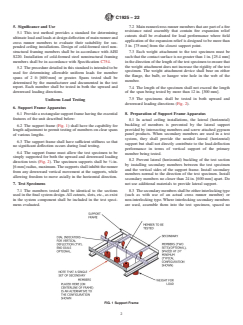
downward loading directions (Fig. 2).
6. Support Frame Apparatus
8. Preparation of Support Frame Apparatus
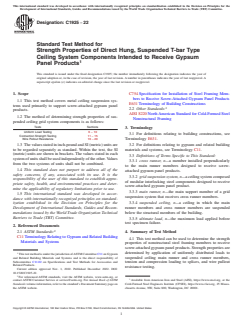
6.1 Provide a rectangular support frame having the essential
features of the unit described below:
8.1 In actual ceiling installations, the lateral (horizontal)
buckling of members is prevented by the lateral support
6.2 The support frame (Fig. 1) shall have the capability for
provided by intersecting members and screw attached gypsum
length adjustment to permit testing of members on clear spans
panel products. When secondary members are used in a test
of various lengths.
system, they shall provide the needed lateral (horizontal)
6.3 The support frame shall have sufficient stiffness so that
support but shall not directly contribute to the load-deflection
no significant deflection occurs during load testing.
performance in terms of vertical support of the primary
6.4 The support frame must allow the test specimen to be
member being tested.
simply supported for both the upward and downward loading
8.2 Prevent lateral (horizontal) buckling of the test section
direction tests (Fig. 2). The specimen supports shall be ⁄4 in.
by installing secondary members between the test specimen
[6 mm] radius, maximum.The supports shall inhibit the runner
and the vertical sides of the support frame. Install secondary
from any downward vertical movement at the supports, while
members normal to the direction of the test specimen. Install
allowing freedom to move axially in the horizontal direction.
secondary members no closer than 24 in. [600 mm] apart. Do
not use additional materials to provide lateral support.
7. Test Specimens
8.3 Thesecondarymembersshallbeeitherinterlockingtype
7.1 The members tested shall be identical to the sections
used in the final system design.All cutouts, slots, etc., as exist (such as with use of an actual cross runner member) or
non-interlocking type. Where interlocking secondary members
in the system component shall be included in the test speci-
mens evaluated. are used, assemble them into the test specimen, spaced no
FIG. 1 Support Frame
C1925 − 22
FIG. 2 Test Specimen Simple Support & Loading Direction Orientation
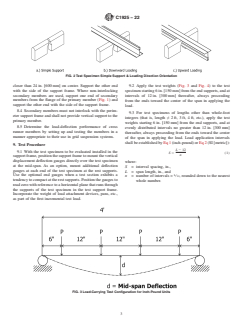
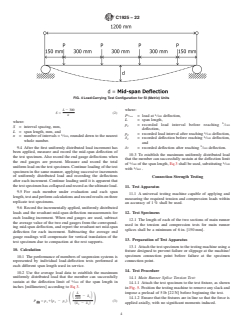
closer than 24 in. [600 mm] on center. Support the other end 9.2 Apply the test weights (Fig. 3 and Fig. 4) to the test
with the side of the support frame. Where non-interlocking
specimen starting 6 in. [150 mm] from the end supports, and at
secondary members are used, support one end of secondary
intervals of 12 in. [300 mm] thereafter, always proceeding
members from the flange of the primary member (Fig. 1) and
from the ends toward the center of the span in applying the
support the other end with the side of the support frame.
load.
8.4 Secondary members must not interlock with the perim-
9.3 For test specimens of lengths other than whole-foot
eter support frame and shall not provide vertical support to the
integers (that is, length ≠ 2 ft, 3 ft, 4 ft, etc.), apply the test
primary member.
weights starting 6 in. [150 mm] from the end supports, and at
8.5 Determine the load-deflection performance of cross
evenly distributed intervals no greater than 12 in. [300 mm]
runner members by setting up and testing the members in a
thereafter, always proceeding from the ends toward the center
manner appropriate to their use in grid suspension systems.
of the span in applying the load. Load application intervals
shall be established by Eq 1 (inch-pound) or Eq 2 (SI [metric]):
9. Test Procedure
L 2 12
9.1 With the test specimen to be evaluated installed in the
S 5 (1)
n
support frame, position the support frame to mount the vertical
displacement deflection gauges directly over the test specimen
where:
at the mid-span. As an option, mount additional deflection
S = interval spacing, in.,
gauges at each end of the test specimen at the rest supports.
L = span length, in., and
L
Use the optional end gauges when a test section exhibits a
n = number of intervals = ⁄12, rounded down to the nearest
tendency to compact at the rest supports. Position the gauges to
whole number.
read zero with reference to a horizontal plane that runs through
the supports of the test specimen in the test support frame.
Incorporate the weight of load attachment devices, pans, etc.,
as part of the first incremental test load.
FIG. 3 Load-Carrying Test Configuration for Inch-Pound Units
C1925 − 22
FIG. 4 Load-Carrying Test Configuration for SI (Metric) Uni
...