

ASTM D8317-23
(Test Method)Standard Test Method for Measuring Friction and Wear Properties of Greases Under Rolling Motion Using SRV Test Machine
General Information
- Abstract
SIGNIFICANCE AND USE
5.1 This test method can be used to determine anti-wear properties and coefficients of friction of greases under rolling type of movement at selected temperatures and loads specified for use in slip-rolling contacts in which high-speed vibrational or start-stop motions are present for extended periods of time under initial high Hertzian line contact pressures. It has found application as a screening test for lubricants used in gears, rolling bearings or cam/follower systems. Users of this test method should determine whether results correlate with field performance or other applications.
SCOPE
1.1 This test method covers a procedure for determining the coefficient of friction of greases and their ability to protect against wear under a rolling type of motion when subjected to high-frequency, linear oscillation.
1.2 The values stated in SI units are to be regarded as standard. No other units of measurement are included in this standard.
1.3 This standard does not purport to address all of the safety concerns, if any, associated with its use. It is the responsibility of the user of this standard to establish appropriate safety, health, and environmental practices and determine the applicability of regulatory limitations prior to use.
1.4 This international standard was developed in accordance with internationally recognized principles on standardization established in the Decision on Principles for the Development of International Standards, Guides and Recommendations issued by the World Trade Organization Technical Barriers to Trade (TBT) Committee.
- Status
- Published
- Publication Date
- 31-Oct-2023
- Technical Committee
- D02 - Petroleum Products, Liquid Fuels, and Lubricants
- Drafting Committee
- D02.G0.04 - Functional Tests - Tribology
Overview
ASTM D8317-23 sets forth a standard test method for measuring the friction and wear properties of greases under rolling motion using the SRV (Schwingung, Reibung, Verschleiss) test machine. This method covers the evaluation of lubricating greases under high-frequency linear oscillation and high Hertzian contact pressures. It is widely applied to assess grease performance in slip-rolling contacts where high-speed vibrational or start-stop motions occur over extended periods, such as in gears, rolling bearings, or cam/follower systems.
This standard provides a consistent procedure to determine the coefficient of friction and wear characteristics of greases, supporting quality assurance and product development for lubricant manufacturers and end-users.
Key Topics
- Scope: The method measures the anti-wear properties and coefficients of friction of greases during rolling motion, especially under conditions typical of demanding mechanical systems.
- Test Procedure: Utilizes a SRV test machine with standardized procedures for specimen preparation, test setup, and data acquisition.
- Performance Metrics:
- Coefficient of friction under defined oscillating loads and temperatures
- Anti-wear characteristics as assessed by measuring planimetric wear on test disks
- Evaluation under different frequencies, loads, and temperature conditions
- Precision and Repeatability: The method provides repeatable quantitative results, making it effective for comparative and screening purposes.
- Applicability: Especially relevant for lubricants destined for systems enduring rolling, slip-rolling, and oscillatory stresses.
Applications
The ASTM D8317-23 test method has significant value in both industrial and research settings, including:
- Lubricant Selection: Engineers and specifiers use this standard to compare and select greases for use in rolling element bearings, gears, and cam/follower interfaces where rolling motion predominates.
- Failure Prevention: By assessing wear and friction properties, this test method aids in identifying greases that minimize material loss and extend equipment life, particularly in high-load, high-vibration conditions.
- Quality Assurance and R&D:
- Lubricant manufacturers validate the performance of new formulations using this method before market release.
- Ongoing comparative testing supports continuous improvement and troubleshooting.
- Field Correlation: While primarily a screening test, the results can sometimes be correlated with field performance, offering insight into real-world lubricant effectiveness.
Industries benefiting from ASTM D8317-23 include:
- Automotive and transportation (bearings, gears)
- Heavy machinery and industrial equipment
- Railway and aerospace componentry
- Lubricant formulation and testing laboratories
Related Standards
ASTM D8317-23 references and aligns with other key standards relevant to the testing and characterization of lubricants and related materials:
- ASTM D4175: Terminology relating to petroleum products and lubricants
- ASTM D6425: Friction and wear properties of extreme pressure lubricating oils using SRV test machine
- ASTM D7755: Wear volume measurement on test pieces used by high-frequency, linear-oscillation test machines
- DIN 5402-1: Rolling bearings - parts of rolling bearings: cylindrical rollers
- DIN 51631: Mineral spirits - requirements for cleaning
- DIN 51834: Tribological tests in translatory oscillation apparatus
For comprehensive friction and wear analysis, these standards provide supplementary guidance and terminology.
Keywords: ASTM D8317-23, friction properties, wear properties, greases, SRV test machine, rolling motion, lubricant testing, anti-wear, coefficient of friction, rolling bearings, gear lubrication, tribology standard
Relations
- Effective Date
- 01-Nov-2023
- Effective Date
- 15-Dec-2019
Frequently Asked Questions
ASTM D8317-23 is a standard published by ASTM International. Its full title is "Standard Test Method for Measuring Friction and Wear Properties of Greases Under Rolling Motion Using SRV Test Machine". This standard covers: SIGNIFICANCE AND USE 5.1 This test method can be used to determine anti-wear properties and coefficients of friction of greases under rolling type of movement at selected temperatures and loads specified for use in slip-rolling contacts in which high-speed vibrational or start-stop motions are present for extended periods of time under initial high Hertzian line contact pressures. It has found application as a screening test for lubricants used in gears, rolling bearings or cam/follower systems. Users of this test method should determine whether results correlate with field performance or other applications. SCOPE 1.1 This test method covers a procedure for determining the coefficient of friction of greases and their ability to protect against wear under a rolling type of motion when subjected to high-frequency, linear oscillation. 1.2 The values stated in SI units are to be regarded as standard. No other units of measurement are included in this standard. 1.3 This standard does not purport to address all of the safety concerns, if any, associated with its use. It is the responsibility of the user of this standard to establish appropriate safety, health, and environmental practices and determine the applicability of regulatory limitations prior to use. 1.4 This international standard was developed in accordance with internationally recognized principles on standardization established in the Decision on Principles for the Development of International Standards, Guides and Recommendations issued by the World Trade Organization Technical Barriers to Trade (TBT) Committee.
SIGNIFICANCE AND USE 5.1 This test method can be used to determine anti-wear properties and coefficients of friction of greases under rolling type of movement at selected temperatures and loads specified for use in slip-rolling contacts in which high-speed vibrational or start-stop motions are present for extended periods of time under initial high Hertzian line contact pressures. It has found application as a screening test for lubricants used in gears, rolling bearings or cam/follower systems. Users of this test method should determine whether results correlate with field performance or other applications. SCOPE 1.1 This test method covers a procedure for determining the coefficient of friction of greases and their ability to protect against wear under a rolling type of motion when subjected to high-frequency, linear oscillation. 1.2 The values stated in SI units are to be regarded as standard. No other units of measurement are included in this standard. 1.3 This standard does not purport to address all of the safety concerns, if any, associated with its use. It is the responsibility of the user of this standard to establish appropriate safety, health, and environmental practices and determine the applicability of regulatory limitations prior to use. 1.4 This international standard was developed in accordance with internationally recognized principles on standardization established in the Decision on Principles for the Development of International Standards, Guides and Recommendations issued by the World Trade Organization Technical Barriers to Trade (TBT) Committee.
ASTM D8317-23 has the following relationships with other standards: It is inter standard links to ASTM D6425-23, ASTM D6425-19. Understanding these relationships helps ensure you are using the most current and applicable version of the standard.
ASTM D8317-23 is available in PDF format for immediate download after purchase. The document can be added to your cart and obtained through the secure checkout process. Digital delivery ensures instant access to the complete standard document.
Standards Content (Sample)
This international standard was developed in accordance with internationally recognized principles on standardization established in the Decision on Principles for the
Development of International Standards, Guides and Recommendations issued by the World Trade Organization Technical Barriers to Trade (TBT) Committee.
Designation: D8317 − 23
Standard Test Method for
Measuring Friction and Wear Properties of Greases Under
Rolling Motion Using SRV Test Machine
This standard is issued under the fixed designation D8317; the number immediately following the designation indicates the year of
original adoption or, in the case of revision, the year of last revision. A number in parentheses indicates the year of last reapproval. A
superscript epsilon (´) indicates an editorial change since the last revision or reapproval.
1. Scope Oscillation (SRV) Test Machine
E45 Test Methods for Determining the Inclusion Content of
1.1 This test method covers a procedure for determining the
Steel
coefficient of friction of greases and their ability to protect
G40 Terminology Relating to Wear and Erosion
against wear under a rolling type of motion when subjected to
2.2 DIN Standards:
high-frequency, linear oscillation.
DIN EN ISO 683–17 Heat-treated steels, alloy steels and
1.2 The values stated in SI units are to be regarded as
free-cutting steels – Part 17: Ball and roller bearing steels
standard. No other units of measurement are included in this
DIN 5402-1 Rolling bearings - Parts of rolling bearings –
standard.
Part 1: Cylindrical rollers
1.3 This standard does not purport to address all of the
DIN 51631:2019 Mineral spirits; special boiling point spir-
safety concerns, if any, associated with its use. It is the
its; requirements
responsibility of the user of this standard to establish appro-
DIN 51834 Tribological Test in the Translatory Oscillation
priate safety, health, and environmental practices and deter-
Apparatus (Part 4: Determination of friction and wear data
mine the applicability of regulatory limitations prior to use.
for lubricating oils with the cylindrical roller-disk geom-
1.4 This international standard was developed in accor-
etry)
dance with internationally recognized principles on standard-
ization established in the Decision on Principles for the 3. Terminology
Development of International Standards, Guides and Recom-
3.1 Definitions:
mendations issued by the World Trade Organization Technical
3.1.1 For definitions of terms used in this test method, refer
Barriers to Trade (TBT) Committee.
to Terminologies D4175 or G40.
3.1.2 break-in, n—in tribology, an initial transition process
2. Referenced Documents
occurring in newly established wearing contacts, often accom-
2.1 ASTM Standards:
panied by transients in coefficient of friction or wear rate, or
A295 Specification for High-Carbon Anti-Friction Bearing
both, that are uncharacteristic of the given tribological system’s
Steel
longterm behavior. (Synonym: run-in, wear-in)
D235 Specification for Mineral Spirits (Petroleum Spirits)
3.1.3 coeffıcient of friction μ or f, n—in tribology, the
(Hydrocarbon Dry Cleaning Solvent)
dimensionless ratio of the friction force (F ) between two
f
D4175 Terminology Relating to Petroleum Products, Liquid
bodies to the normal force (F ) pressing these bodies together.
n
Fuels, and Lubricants
μ 5 ~F ⁄ F ! (1)
D6425 Test Method for Measuring Friction and Wear Prop- f n
erties of Extreme Pressure (EP) Lubricating Oils Using
3.1.4 extreme pressure (EP) lubricant, n—formulations
SRV Test Machine whose effects may become observable at different operating
D7755 Practice for Determining the Wear Volume on Stan-
conditions, preventing adhesive wear under mixed or boundary
dard Test Pieces Used by High-Frequency, Linear- lubrication regimes and are characterized by an increased load
carrying capacity or increased tribofilm strength.
3.1.5 Hertzian contact area, n—the apparent area of contact
This test method is under the jurisdiction of ASTM Committee D02 on
Petroleum Products, Liquid Fuels, and Lubricants and is the direct responsibility of between two nonconforming solid bodies pressed against each
Subcommittee D02.G0.04 on Functional Tests - Tribology.
other, as calculated from Hertz’s equations of elastic deforma-
Current edition approved Nov. 1, 2023. Published January 2024. DOI: 10.1520/
tion.
D8317-23.
For referenced ASTM standards, visit the ASTM website, www.astm.org, or
contact ASTM Customer Service at service@astm.org. For Annual Book of ASTM
Standards volume information, refer to the standard’s Document Summary page on Available from Deutsches Institut für Normung, Beuth Verlag GmbH, Burg-
the ASTM website. grafenstraße 6, D-10787 Berlin, Germany, http://www.din.de.
Copyright © ASTM International, 100 Barr Harbor Drive, PO Box C700, West Conshohocken, PA 19428-2959. United States
D8317 − 23
those specified in this test method. The test rollers yield Hertzian line
3.1.6 Hertzian contact pressure, n—the magnitude of the
contact geometry
pressure at any specified location in a Hertzian contact area, as
calculated from Hertz’s equations of elastic deformation. 4.2 The friction force, F , is measured by a piezo-electric
f
3.1.6.1 Discussion—The Hertzian contact pressure can also device in the test disk assembly. Peak values of coefficient of
be calculated and reported as maximum value P in the friction, f, are determined and recorded as a function of time.
max
centre of the contact or as P as average over the total
average
4.3 After the preset test period, the test machine and data
contact area.
acquisition are stopped and the wear on the disks is determined
3.1.7 lubricating grease, n—a semifluid to solid product of
by means of profilmetry and expressed as planimetric wear
a dispersion of a thickener in a liquid lubricant.
(μm ). The planimetric wear is measured in the middle of the
3.1.7.1 Discussion—The dispersion of the thickener forms a
wear track perpendicular to the wear track on the test disk.
two-phase system and immobilizes the liquid lubricant by
NOTE 2—No wear scars on the rollers can be detected due to the
surface tension and other physical forces. Other ingredients are
lubricated rolling movement.
commonly included to impart special properties.
5. Significance and Use
3.1.8 P , n—geometric contact pressure describes the
geom
load carrying capacity at test end.
5.1 This test method can be used to determine anti-wear
3.1.9 Ra (C.L.A.), n—in measuring surface finish, the arith- properties and coefficients of friction of greases under rolling
type of movement at selected temperatures and loads specified
metic average of the absolute distances of all profile points
from the mean line for a given distance. for use in slip-rolling contacts in which high-speed vibrational
or start-stop motions are present for extended periods of time
3.1.10 Rz (DIN), n—in measuring surface finish, the aver-
under initial high Hertzian line contact pressures. It has found
age of all Ry values (peak to valley heights) in the assessment
4 application as a screening test for lubricants used in gears,
length.
rolling bearings or cam/follower systems. Users of this test
3.1.11 wear, n—damage to a solid surface, generally involv-
method should determine whether results correlate with field
ing progressive loss of material, due to relative motion between
performance or other applications.
that surface and a contacting substance or substances.
6. Apparatus
3.2 Definitions of Terms Specific to This Standard:
3.2.1 seizure, n—localized fusion of metal between the
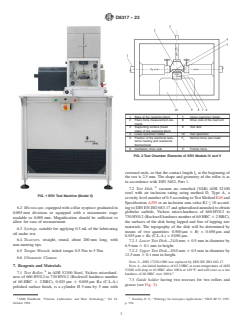
6.1 SRV Test Machine, illustrated in Figs. 1 and 2 consists
rubbing surfaces of the test pieces.
of an linear oscillation drive capable to parallel movement of
3.2.1.1 Discussion—In this test method, seizure is indicated
the tribological contact, a test chamber (see Fig. 2) and a
by a sharp rise in the coefficient of friction, over steady state,
loading device with a servomotor and a load cell. The machine
of greater than 0.2 for over 20 s. In severe cases, a stoppage in
is operated by a control device for the oscillating drive, a timer,
the motor will occur.
a load control, a frequency control, a stroke control, a data
3.2.2 planimetric wear, Wq, n—seen in the center of the amplifier to determine the friction coefficient, and a switch and
wear track of the disk perpendicular to the sliding direction at
a controller for the heating. An oscilloscope may be used for
test end and can be understood as cross section area of wear. monitoring of quantities. Friction coefficients are recorded in
3.2.2.1 Discussion—In the understanding of this test
relation to time by data acquisition in a computer.
method, the planimetric wear area is determined on cleaned 6.1.1 The axis of the two rollers are mounted in the holder
surfaces, but with tribofilm, if formed. Some cleaning solvents
so that the longitudinal axis of the rollers is perpendicular to
have the ability to clean away or dissolve solid tribofilms, like the rolling direction.
ethylene diaminetetraacetate (EDTA).
6.1.2 On the firmly mounted receiving block (1) in the test
chamber (see Fig. 1 and Fig. 2), there is a piezoelectric device
3.3 Abbreviations: ®
(2) to measure the friction force, F , and the friction coefficient,
f
3.3.1 SRV —Schwingung, Reibung, Verschleiss (German);
f, the holder for the test disk (3) with a thermostat-controlled
oscillation, friction, wear (English translation).
electrical resistance heating element (4); a resistance thermom-
eter (5); the oscillation drive rods (6); an exchangeable holder
4. Summary of Test Method
for the test rollers (7); and the load rods of the loading device
4.1 This test method is performed on a SRV test machine
(8).
using two test rollers oscillated between two flat disks at
6.1.3 The design of the receiving block for the test disk
constant frequency and stroke amplitude and under constant
should be such that it has integrated cooling coils, or that
load (F ), against a test disk. The type of movement of the
n
cooling coils are wound around it, so that the receiving block
rollers is rolling with a small portion of slip. The receiving
must be capable to maintaining test temperatures down to
block to which the lower test disk is attached is held at a
233 K. The test disks (9) and the test roller (10) are inserted
constant temperature.
into their respective holders (3, 4) (see Fig. 1 and Fig. 2).
NOTE 1—The frequency of oscillation, stroke length, test temperature,
6.1.4 Disks are generally used as the lower and upper test
test load, test duration, and test roller and disk material can be varied from
piece.
Amstutz Hu, “Surface Texture: The Parameters,” Bulletin MI-TP-003-0785,
Sheffield Measurement Division, Warner and Swazey, 1985 p. 21.
D8317 − 23
1 Base of the receiving block 7 Upper specimen holder
2 Piezo force measurement ele- 8 Drive rods of the load unit
ments
3 Supporting surface (head 9 Test disk
plate) of the receiving block
4 Lower specimen holder 10 Test specimen
5 Position of the electrical resis- F Normal force (test load)
n
tance heating and resistance
thermometer
6 Oscillation drive rods F Friction force
f
FIG. 2 Test Chamber Elements of SRV Models IV and V
crowned ends, so that the contact length l at the beginning of
the test is 2.5 mm. The shape and geometry of the roller is as
in accordance with DIN 5402, Part 1.
7.2 Test Disk, vacuum arc remelted (VAR) AISI 52100
steel with an inclusion rating using method D, Type A, a
FIG. 1 SRV Test Machine (Model 5)
severity level number of 0.5 according to Test Method E45 and
Specification A295 or an inclusion sum value K1 ≤ 10 accord-
ing to DIN EN ISO 683-17 and spherodized annealed to obtain
6.2 Microscope, equipped with a filar eyepiece graduated in
globular carbide, Vickers micro-hardness of 660 HV0.2 to
0.005 mm divisions or equipped with a micrometre stage
730 HV0.2 (Rockwell hardness number of 60 HRC 6 2 HRC),
readable to 0.005 mm. Magnification should be sufficient to
the surfaces of the disk being lapped and free of lapping raw
allow for ease of measurement.
materials. The topography of the disk will be determined by
6.3 Syringe, suitable for applying 0.3 mL of the lubricating
means of two quantities: 0.500 μm < Rz < 0.650 μm and
oil under test.
0.035 μm < Ra (C.L.A.) < 0.050 μm.
6.4 Tweezers, straight, round, about 200 mm long, with
7.2.1 Lower Test Disk—24.0 mm 6 0.5 mm in diameter by
non-marring tips.
6.9 mm 6 0.1 mm in height.
7.2.2 Upper Test Disk—20.0 mm 6 0.5 mm in diameter by
6.5 Torque Wrench, initial torque 0.5 Nm to 5 Nm.
12.5 mm 6 0.1 mm in height.
6.6 Ultrasonic Cleaner.
NOTE 3—DIN 17230-1980 was replaced by DIN EN ISO 683-17.
7. Reagents and Materials NOTE 4—An initial hardness of 62.5 HRC at room temperature of AISI
52100 will drop to 61 HRC after 100 h at 149 ºC and will exist as a hot
7.1 Test Roller, in AISI 52100 Steel, Vickers microhard-
hardness of 60 HRC over 100 h.
ness of 660 HV0.2 to 730 HV0.2 (Rockwell hardness number
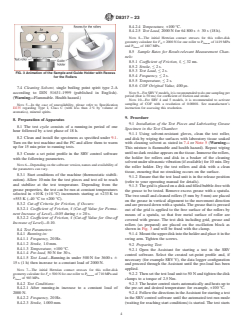
7.3 Guide holder having two recesses for two rollers and
of 60 HRC 6 2 HRC), 0.025 μm 6 0.005 μm Ra (C.L.A.)
grease (see Fig. 3).
polished surface finish, is a cylinder Ø 5 mm by 5 mm with
6 7
ASM Handbook, “Friction, Lubrication, and Wear Technology,” Vol 18, Zaretsky, E. V., “Tribology for Aerospace Applications,” STLE SP-37, 1997,
October 1992. p. 358.
D8317 − 23
8.4.2.4 Temperature, +100 °C.
8.4.2.5 Test Load, 2000 N for 64 800 s 6 30 s (18 h).
NOTE 8—The initial Hertzian contact stresses for this roller-disk
geometry calculate for F = 2000 N for one roller to P of 1419 MPa
N 0mean
and P of 1807 MPa.
0max
8.5 Sample Rates for Result-relevant Measurement Chan-
nels:
8.5.1 Coeffıcient of Friction, f, ≤ 32 ms.
8.5.2 Stroke, ≤ 2 s.
8.5.3 Test Load, ≤ 2 s.
FIG. 3 Animation of the Sample and Guide Holder with Recess
8.5.4 Frequency, ≤ 2 s.
for the Rollers
8.5.5 Temperature, ≤ 2 s.
8.5.6 COF Origin
...