

ASTM E3113-23
(Specification)Standard Specification for Ballistic-resistant Vehicle Door Panels Used by Public Safety Agencies
General Information
- Abstract
SCOPE
1.1 This specification specifies requirements for ballistic-resistant panels to be mounted in or on public safety vehicle doors to protect against complete penetration of projectiles from small arms.2
1.2 The purpose of this specification is to define minimum performance for ballistic-resistant vehicle door panels.
1.2.1 In addition to the required tests, optional tests with specific conditions are provided that allow testing beyond the minimum requirements of this specification. Statements of conformance with this specification do not include any optional test unless the optional test is conducted, and the results are included in the test report.
1.3 This specification requires ballistic testing of vehicle door panels mounted either in a test fixture or mounted on a vehicle door for which the panel is designed.
1.3.1 Door panels intended to be mounted inside a vehicle door shall be assessed in a test fixture with air backing.
1.3.1.1 Two optional ballistic tests are provided for vehicle door panels intended to be mounted inside a vehicle door:
(1) The preferred optional ballistic test assesses the panel in a vehicle door for which the panel is designed.
(2) If a vehicle door for which the panel is designed is not available, a second optional ballistic test assesses the panel in a test fixture with air backing and a door skin simulant in front of the strike face of the panel.
1.3.2 Door panels intended to be mounted on the exterior of a vehicle door shall be assessed on a vehicle door for which the panel is designed.
1.3.3 An optional extreme temperature ballistic test is provided for purchasers concerned with performance of vehicle door panels in very hot or very cold environments.
1.3.4 The optional ballistic tests are provided in Appendix X1.
1.4 Selection and procurement guidance is provided in Appendix X2 to assist purchasers in using this specification to procure vehicles with ballistic-resistant door panels or to retrofit existing vehicles with ballistic-resistant door panels.
1.5 Units—The values stated in SI units are to be regarded as standard. The values given in parentheses are mathematical conversions to non-SI units that are provided for information only.
1.6 This standard does not purport to address all of the safety concerns, if any, associated with its use. It is the responsibility of the user of this standard to establish appropriate safety, health, and environmental practices and determine the applicability of regulatory limitations prior to use.
1.7 This international standard was developed in accordance with internationally recognized principles on standardization established in the Decision on Principles for the Development of International Standards, Guides and Recommendations issued by the World Trade Organization Technical Barriers to Trade (TBT) Committee.
- Status
- Published
- Publication Date
- 31-May-2023
- Technical Committee
- E54 - Homeland Security Applications
- Drafting Committee
- E54.04 - Public Safety Equipment
Buy Documents
ASTM E3113-23 - Standard Specification for Ballistic-resistant Vehicle Door Panels Used by Public Safety Agencies
REDLINE ASTM E3113-23 - Standard Specification for Ballistic-resistant Vehicle Door Panels Used by Public Safety Agencies
Overview
ASTM E3113-23: Standard Specification for Ballistic-resistant Vehicle Door Panels Used by Public Safety Agencies defines the minimum performance requirements, test methods, and procurement guidance for ballistic-resistant panels intended for use in or on vehicle doors for public safety and law enforcement agencies. This international standard addresses the need for protection against complete penetration from small arms projectiles, enhancing officer safety during critical incidents.
By establishing performance levels, rigorous ballistic testing protocols, and clear requirements for conformity, ASTM E3113-23 supports agencies and manufacturers in selecting, installing, or retrofitting vehicle door panels that fulfill field-ready protection standards.
Key Topics
- Minimum Performance Requirements: Specifies the essential level of protection ballistic-resistant vehicle door panels must provide, preventing complete projectile penetration.
- Ballistic Testing Methods: Describes required and optional test protocols for panels mounted both inside and outside vehicle doors, with provisions for using actual vehicle doors, test fixtures, or door skin simulants.
- Environmental Testing: Includes optional tests for verifying ballistic resistance under extreme temperature conditions, relevant for agencies operating in varied climates.
- Panel Design and Configuration: Details requirements ensuring door panels do not interfere with vehicle functionality, such as window and locking mechanisms.
- Documentation and Product Marking: Outlines requirements for supplier documentation, user information, and permanently attached product labels including protection levels, threat ratings, and compliance identifiers.
- Procurement Guidance: Offers best practices for specifying, validating, and procuring ballistic-resistant vehicle door panels for both new vehicle purchases and retrofits, supporting accurate supplier declarations and conformity to international assessment standards.
Applications
The ASTM E3113-23 standard applies to:
- Law Enforcement Vehicles: Used by police departments, sheriffs, and other public safety agencies to provide officers with enhanced protection during vehicle-based operations.
- Vehicle Retrofits: Guidance for upgrading existing vehicle fleets with compliant ballistic-resistant panels while ensuring continued safety and adherence to regulatory standards.
- Manufacturer Compliance: Ensures suppliers and manufacturers adopt uniform testing, certification, and documentation practices for ballistic-resistant products, facilitating international consistency.
- Procurement and Contracting: Supports purchasing authorities in writing clear specifications for vehicle purchases or upgrades, effectively communicating required ballistic protection levels and performance standards.
Key benefits include improved officer safety, standardized product evaluation, and risk reduction for agencies facing ballistic threats during operations.
Related Standards
ASTM E3113-23 references and complements the following key standards:
- ASTM E3005: Terminology for Body Armor, providing consistent definitions.
- ASTM E3062: Specification for Indoor Ballistic Test Ranges, ensuring valid test environments.
- ASTM E3078: Practice for Conditioning of Hard Armor Test Items, detailing preparation protocols.
- ASTM E3112: Test Method for Ballistic-resistant Products, governing test execution and reporting.
- ISO/IEC 17050-1 & 17050-2: Establish requirements for supplier’s declaration of conformity and supporting documentation.
- ISO/IEC 17065: Requirements for product certification, ensuring independent conformity assessment.
Keywords: ballistic-resistant door panel, public safety vehicle, ASTM E3113-23, law enforcement protection, vehicle armor standard, ballistic testing, vehicle door armor, procurement guidance.
Relations
- Effective Date
- 01-Apr-2024
- Effective Date
- 01-Feb-2020
- Effective Date
- 01-Oct-2018
- Effective Date
- 01-Dec-2017
- Effective Date
- 01-Feb-2017
- Effective Date
- 15-Jul-2016
- Effective Date
- 15-Jul-2016
- Effective Date
- 01-Nov-2015
Buy Documents
ASTM E3113-23 - Standard Specification for Ballistic-resistant Vehicle Door Panels Used by Public Safety Agencies
REDLINE ASTM E3113-23 - Standard Specification for Ballistic-resistant Vehicle Door Panels Used by Public Safety Agencies
Get Certified
Connect with accredited certification bodies for this standard

TÜV Rheinland
TÜV Rheinland is a leading international provider of technical services.

TÜV SÜD
TÜV SÜD is a trusted partner of choice for safety, security and sustainability solutions.

BSI Group
BSI (British Standards Institution) is the business standards company that helps organizations make excellence a habit.
Sponsored listings
Frequently Asked Questions
ASTM E3113-23 is a technical specification published by ASTM International. Its full title is "Standard Specification for Ballistic-resistant Vehicle Door Panels Used by Public Safety Agencies". This standard covers: SCOPE 1.1 This specification specifies requirements for ballistic-resistant panels to be mounted in or on public safety vehicle doors to protect against complete penetration of projectiles from small arms.2 1.2 The purpose of this specification is to define minimum performance for ballistic-resistant vehicle door panels. 1.2.1 In addition to the required tests, optional tests with specific conditions are provided that allow testing beyond the minimum requirements of this specification. Statements of conformance with this specification do not include any optional test unless the optional test is conducted, and the results are included in the test report. 1.3 This specification requires ballistic testing of vehicle door panels mounted either in a test fixture or mounted on a vehicle door for which the panel is designed. 1.3.1 Door panels intended to be mounted inside a vehicle door shall be assessed in a test fixture with air backing. 1.3.1.1 Two optional ballistic tests are provided for vehicle door panels intended to be mounted inside a vehicle door: (1) The preferred optional ballistic test assesses the panel in a vehicle door for which the panel is designed. (2) If a vehicle door for which the panel is designed is not available, a second optional ballistic test assesses the panel in a test fixture with air backing and a door skin simulant in front of the strike face of the panel. 1.3.2 Door panels intended to be mounted on the exterior of a vehicle door shall be assessed on a vehicle door for which the panel is designed. 1.3.3 An optional extreme temperature ballistic test is provided for purchasers concerned with performance of vehicle door panels in very hot or very cold environments. 1.3.4 The optional ballistic tests are provided in Appendix X1. 1.4 Selection and procurement guidance is provided in Appendix X2 to assist purchasers in using this specification to procure vehicles with ballistic-resistant door panels or to retrofit existing vehicles with ballistic-resistant door panels. 1.5 Units—The values stated in SI units are to be regarded as standard. The values given in parentheses are mathematical conversions to non-SI units that are provided for information only. 1.6 This standard does not purport to address all of the safety concerns, if any, associated with its use. It is the responsibility of the user of this standard to establish appropriate safety, health, and environmental practices and determine the applicability of regulatory limitations prior to use. 1.7 This international standard was developed in accordance with internationally recognized principles on standardization established in the Decision on Principles for the Development of International Standards, Guides and Recommendations issued by the World Trade Organization Technical Barriers to Trade (TBT) Committee.
SCOPE 1.1 This specification specifies requirements for ballistic-resistant panels to be mounted in or on public safety vehicle doors to protect against complete penetration of projectiles from small arms.2 1.2 The purpose of this specification is to define minimum performance for ballistic-resistant vehicle door panels. 1.2.1 In addition to the required tests, optional tests with specific conditions are provided that allow testing beyond the minimum requirements of this specification. Statements of conformance with this specification do not include any optional test unless the optional test is conducted, and the results are included in the test report. 1.3 This specification requires ballistic testing of vehicle door panels mounted either in a test fixture or mounted on a vehicle door for which the panel is designed. 1.3.1 Door panels intended to be mounted inside a vehicle door shall be assessed in a test fixture with air backing. 1.3.1.1 Two optional ballistic tests are provided for vehicle door panels intended to be mounted inside a vehicle door: (1) The preferred optional ballistic test assesses the panel in a vehicle door for which the panel is designed. (2) If a vehicle door for which the panel is designed is not available, a second optional ballistic test assesses the panel in a test fixture with air backing and a door skin simulant in front of the strike face of the panel. 1.3.2 Door panels intended to be mounted on the exterior of a vehicle door shall be assessed on a vehicle door for which the panel is designed. 1.3.3 An optional extreme temperature ballistic test is provided for purchasers concerned with performance of vehicle door panels in very hot or very cold environments. 1.3.4 The optional ballistic tests are provided in Appendix X1. 1.4 Selection and procurement guidance is provided in Appendix X2 to assist purchasers in using this specification to procure vehicles with ballistic-resistant door panels or to retrofit existing vehicles with ballistic-resistant door panels. 1.5 Units—The values stated in SI units are to be regarded as standard. The values given in parentheses are mathematical conversions to non-SI units that are provided for information only. 1.6 This standard does not purport to address all of the safety concerns, if any, associated with its use. It is the responsibility of the user of this standard to establish appropriate safety, health, and environmental practices and determine the applicability of regulatory limitations prior to use. 1.7 This international standard was developed in accordance with internationally recognized principles on standardization established in the Decision on Principles for the Development of International Standards, Guides and Recommendations issued by the World Trade Organization Technical Barriers to Trade (TBT) Committee.
ASTM E3113-23 is classified under the following ICS (International Classification for Standards) categories: 13.310 - Protection against crime; 43.020 - Road vehicles in general. The ICS classification helps identify the subject area and facilitates finding related standards.
ASTM E3113-23 has the following relationships with other standards: It is inter standard links to ASTM E3005-24, ASTM E3005-20, ASTM E3005-18, ASTM E3112-17, ASTM E3078-17, ASTM E3062-16, ASTM E3062-16e1, ASTM E3005-15. Understanding these relationships helps ensure you are using the most current and applicable version of the standard.
ASTM E3113-23 is available in PDF format for immediate download after purchase. The document can be added to your cart and obtained through the secure checkout process. Digital delivery ensures instant access to the complete standard document.
Standards Content (Sample)
This international standard was developed in accordance with internationally recognized principles on standardization established in the Decision on Principles for the
Development of International Standards, Guides and Recommendations issued by the World Trade Organization Technical Barriers to Trade (TBT) Committee.
Designation: E3113 − 23
Standard Specification for
Ballistic-resistant Vehicle Door Panels Used by Public
Safety Agencies
This standard is issued under the fixed designation E3113; the number immediately following the designation indicates the year of
original adoption or, in the case of revision, the year of last revision. A number in parentheses indicates the year of last reapproval. A
superscript epsilon (´) indicates an editorial change since the last revision or reapproval.
1. Scope 1.4 Selection and procurement guidance is provided in
Appendix X2 to assist purchasers in using this specification to
1.1 This specification specifies requirements for ballistic-
procure vehicles with ballistic-resistant door panels or to
resistant panels to be mounted in or on public safety vehicle
retrofit existing vehicles with ballistic-resistant door panels.
doors to protect against complete penetration of projectiles
from small arms. 1.5 Units—The values stated in SI units are to be regarded
as standard. The values given in parentheses are mathematical
1.2 The purpose of this specification is to define minimum
conversions to non-SI units that are provided for information
performance for ballistic-resistant vehicle door panels.
only.
1.2.1 In addition to the required tests, optional tests with
1.6 This standard does not purport to address all of the
specific conditions are provided that allow testing beyond the
safety concerns, if any, associated with its use. It is the
minimum requirements of this specification. Statements of
responsibility of the user of this standard to establish appro-
conformance with this specification do not include any optional
priate safety, health, and environmental practices and deter-
test unless the optional test is conducted, and the results are
mine the applicability of regulatory limitations prior to use.
included in the test report.
1.7 This international standard was developed in accor-
1.3 This specification requires ballistic testing of vehicle
dance with internationally recognized principles on standard-
door panels mounted either in a test fixture or mounted on a
ization established in the Decision on Principles for the
vehicle door for which the panel is designed.
Development of International Standards, Guides and Recom-
1.3.1 Door panels intended to be mounted inside a vehicle
mendations issued by the World Trade Organization Technical
door shall be assessed in a test fixture with air backing.
Barriers to Trade (TBT) Committee.
1.3.1.1 Two optional ballistic tests are provided for vehicle
door panels intended to be mounted inside a vehicle door:
2. Referenced Documents
(1) The preferred optional ballistic test assesses the panel
2.1 ASTM Standards:
in a vehicle door for which the panel is designed.
E3005 Terminology for Body Armor
(2) If a vehicle door for which the panel is designed is not
E3062 Specification for Indoor Ballistic Test Ranges for
available, a second optional ballistic test assesses the panel in
Small Arms and Fragmentation Testing of Ballistic-
a test fixture with air backing and a door skin simulant in front
resistant Items
of the strike face of the panel.
E3078 Practice for Conditioning of Hard Armor Test Items
1.3.2 Door panels intended to be mounted on the exterior of
E3112 Test Method for Ballistic-resistant Products and
a vehicle door shall be assessed on a vehicle door for which the
Shoot Packs
panel is designed.
1.3.3 An optional extreme temperature ballistic test is pro-
2.2 ISO/IEC Standards:
vided for purchasers concerned with performance of vehicle
ISO/IEC 17050-1 Conformity assessment – Supplier’s dec-
door panels in very hot or very cold environments.
laration of conformity – Part 1: General requirements
1.3.4 The optional ballistic tests are provided in Appendix
ISO/IEC 17050-2 Conformity assessment – Supplier’s dec-
X1.
laration of conformity – Part 2: Supporting documentation
This specification is under the jurisdiction of ASTM Committee E54 on
Homeland Security Applications and is the direct responsibility of Subcommittee For referenced ASTM standards, visit the ASTM website, www.astm.org, or
E54.04 on Public Safety Equipment. contact ASTM Customer Service at service@astm.org. For Annual Book of ASTM
Current edition approved June 1, 2023. Published July 2023. Originally approved Standards volume information, refer to the standard’s Document Summary page on
in 2018. Last previous edition approved in 2018 as E3113 – 18. DOI: 10.1520/ the ASTM website.
E3113-23. Available from International Organization for Standardization (ISO), ISO
Small arms are defined as portable firearms, typically including handguns, Central Secretariat, BIBC II, Chemin de Blandonnet 8, CP 401, 1214 Vernier,
shotguns, rifles, and light machine guns (Terminology E3005). Geneva, Switzerland, http://www.iso.org.
Copyright © ASTM International, 100 Barr Harbor Drive, PO Box C700, West Conshohocken, PA 19428-2959. United States
E3113 − 23
ISO/IEC 17065 Conformity assessment – Requirements for 5.2.1 One or more additional test items may be needed to fit
bodies certifying products, process and services the necessary shots for testing with a door skin simulant. The
additional test item(s) shall be either a 60 cm by 60 cm (24 in.
3. Terminology
by 24 in.) shoot pack or a complete door panel.
5.2.2 One or more additional test items may be needed to fit
3.1 For terms not defined in this test method, the following
the necessary shots for testing at extreme temperatures. The
definitions apply:
additional test item(s) shall be either a 60 cm by 60 cm (24 in.
3.1.1 From Terminology E3005: ballistic material, com-
by 24 in.) shoot pack or a complete door panel.
plete penetration, obliquity, small arms, test item, test threat.
3.1.2 From Practice E3078: controlled ambient.
6. Performance Requirements
3.2 Definitions of Terms Specific to This Standard:
6.1 There shall be no visible separation or delamination of
3.2.1 ballistic layup, n—the layering and arrangement of
the test item upon the completion of each conditioning proce-
ballistic materials through the thickness of a protective prod-
dure.
uct.
6.2 There shall be no complete penetration of any test item
3.2.2 door skin, n—the metal that comprises the outer
when tested in accordance with this specification.
surface of a vehicle door.
3.2.3 shoot pack, n—a test item prepared with materials, or
7. Test Item Conditioning
with materials and construction features, utilized in body armor
or other ballistic-resistant products, but not intended to be used 7.1 The conditioning requirements of this section are not
as body armor, an accessory, or a protective product. applicable for the optional tests of Appendix X1.
Adapted from Terminology E3005
7.2 Test items shall be stored at controlled ambient condi-
3.2.4 supplier, n—the party that is responsible for ensuring
tions for at least 24 h prior to the start of the required
that products meet and, if applicable, continue to meet, the
conditioning.
requirements. Adapted from ISO/IEC 17065
7.3 Each test item shall be subjected sequentially to the
3.2.5 supplier’s declaration of conformity (SDOC), n—the
conditioning steps below.
procedure by which a first party or supplier conveys assurance
7.3.1 Subject the test item to one cycle of Temperature
that the object of conformity fulfills specified requirements.
Conditioning as specified in Test Method E3112 – 17, subsec-
tion 9.3.
4. Design and Configuration Requirements
7.3.2 Subject the test item to conditioning by submersion in
4.1 The panel may be single-piece or multiple-piece. plain water as specified in Test Method E3112 – 17, subsection
9.7.
4.2 The panel shall allow for proper operation and function-
ing of the vehicle door handles, door pulls, door locks, 7.4 Ballistic testing of each test item shall be completed
within two hours of the completion of the last conditioning
windows, and window controls.
procedure.
4.3 The panel shall not impede vehicle door operations.
4.4 The panel shall be free of any unintended holes, voids,
8. Required Ballistic Testing
bulges, protrusions, or dents. The surfaces of the panel shall be
8.1 Each test item shall be installed in a test setup which
free from any blisters, cracks, crazing, chipped corners or
represents how the panel is mounted in or on the vehicle door,
edges, sharp edges, or delamination.
using the panel’s mounting holes, mounting points, or attach-
ments.
5. Test Item Requirements
8.1.1 For door panels intended to be installed inside a
5.1 Test Items for Required Testing:
vehicle door, the test item shall be mounted in a test fixture and
5.1.1 Two test items are required per test threat. One test
air-backed.
item shall be for the left side of the vehicle, and one shall be for
8.1.2 For door panels intended to be installed on the exterior
the right side of the vehicle.
of a vehicle door, the test item shall be mounted on the actual
NOTE 1—It is recommended that spare test items be provided. vehicle door for which the panel is designed, with the structural
door components and door skin intact. Other vehicle door
5.1.2 The two test items shall be complete door panels
components shall be removed.
representative of the ballistic layup, composition, configuration
8.1.3 The supplier shall be responsible for providing the test
(for example, shape, with attachments, seams, mounting
fixture to the test laboratory, unless the test laboratory has a test
method), and size as intended for use.
fixture that is acceptable to the supplier.
NOTE 2—The composition and configuration of the pieces of a
8.1.4 The test fixture shall be capable of maintaining the
multi-piece panel may or may not be identical to each other.
position of the test item, witness panel, and actual vehicle door
5.2 Test Items for Optional Testing:
or door skin simulant (when required) and withstanding the
forces from the test.
8.2 The witness panel shall meet the requirements of Test
Definition source: https://www.standardsportal.org/usa_en/conformity_
assessment/suppliers_declaration.aspx. Method E3112 – 17 with the modifications listed below:
E3113 − 23
TABLE 1 Common Types of Potential Weak Points and Shot
8.2.1 Subsection 10.2 of Test Method E3112 – 17 shall not
Details
apply.
Types of Potential Weak Number Location of Shot Impact
8.2.2 The witness panel shall be mounted to the test fixture
Points of Shots Relative to Weak Point
parallel to the test item at the intended point of impact. 3 1
Mounting holes, mounting 1 45 mm ± 6 mm (1 ⁄4 in. ± ⁄4 in.)
points, or mounting brackets
NOTE 3—Typically the test item mounting holes are used to establish a 3 1
Adjacent to cutouts for vehicle 1 45 mm ± 6 mm (1 ⁄4 in. ± ⁄4 in.)
reference plane for the test item, and the witness panel is positioned
door mechanisms
3 1
Corners 1 45 mm ± 6 mm (1 ⁄4 in. ± ⁄4 in.) of
parallel to that plane.
corner midpoint
8.2.3 The witness panel shall be mounted at a distance of 1
Seams, folds, or bends 1 0 mm + 6 mm (0 in. + ⁄4 in.) of
seam midpoint
152 mm 6 25 mm (6 in. 6 1 in.) from the back side directly
Joints in multi-part panels 1 0 mm + 6 mm (0 in. + ⁄4 in.) of
behind the test item at the intended point of impact. The
joint centerline
3 1
measurement direction is normal to the reference plane used
Edges 2 45 mm ± 6 mm (1 ⁄4 in. ± ⁄4 in.)
for positioning the witness panel.
8.2.4 The witness panel shall be sized to catch all debris
from the back of the test item.
8.5.2 The testing laboratory shall determine which of the
8.3 The test range setup and relative distances shall be as
weak points of each type identified will be shot based on visual
defined in Specification E3062.
examination of the test items and the drawing provided by the
supplier.
8.4 The vehicle door panel performance levels, test threats,
and shot requirements are specified in Annex A1.
NOTE 4—Every weak point of each type identified is not required to be
shot because it is assumed that all similar weak points will perform the
8.4.1 Table A1.1 specifies the performance levels and test
same during testing.
threat details.
8.5.3 Common types of potential weak points and required
8.4.2 Table A1.2 specifies shot requirements for air-backed
shots for each are described in Table 1. If any of these weak
or car door-backed test items, including minimum number of
points is not present on a panel, the respective shot(s) shall be
shots. Additional shots shall be allowed and are recommended.
taken at other weak points listed in Table 1.
8.4.3 Fig. A1.1 specifies the shot locations for the 5-shot
8.5.4 Other (uncommon) potential weak points not listed in
dice pattern. The 3-shot triangle pattern is the same as shots 1,
Table 1 may be present in a panel. At least one of each type of
2, and 3 of the 5-shot dice pattern. The pattern may be rotated
uncommon potential weak point shall be shot, and the shot
on the face of the test item as needed.
impact shall be 0 mm to 12.7 mm (0 in. to ⁄2 in.) from the weak
8.4.4 Each performance level is independent of the others.
point.
8.4.5 For each performance level, ballistic testing shall be
8.5.5 The purchaser may specify additional weak points to
performed using all listed threats for that performance level.
be tested.
8.5 Potential weak points can be present in vehicle door
8.5.6 When possible, different weak points shall be targeted
panels, and a sampling of each type of potential weak point
on the two test items for each threat. However, when assessing
shall be shot.
areas adjacent to door handle cutouts, the area near the handle
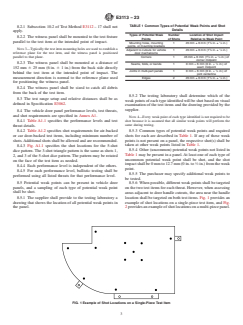
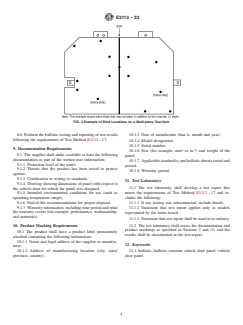
8.5.1 The supplier shall provide to the testing laboratory a location shall be targeted on both test items. Fig. 1 provides an
drawing that shows the location of all potential weak points in example of shot locations on a single-piece test item, and Fig.
the panel. 2 provides an example of shot locations on a multi-piece panel.
FIG. 1 Example of Shot Locations on a Single-Piece Test Item
E3113 − 23
FIG. 2 Example of Shot Locations on a Multi-piece Test Item
8.6 Perform the ballistic testing and reporting of test results 10.1.3 Date of manufacture (that is, month and year).
following the requirements of Test Method E3112 – 17.
10.1.4 Model designation.
10.1.5 Serial number.
9. Documentation Requirements
2 2
10.1.6 Size (for example, mm or in. ) and weight of the
9.1 The supplier shall make available at least the following
panel.
documentation as part of the written user information:
10.1.7 Applicable standard(s) and ballistic threats tested and
9.1.1 Protection level of the panel.
passed.
9.1.2 Threats that the product has been tested to protect
10.1.8 Warranty period.
against.
9.1.3 Certification or testing to standards.
11. Test Laboratory
9.1.4 Drawing showing dimensions of panel with respect to
the vehicle door for which the panel was designed. 11.1 The test laboratory shall develop a test report that
meets the requirements of Test Method E3112 – 17 and in-
9.1.5 Intended environmental conditions for use (such as
cludes the following:
operating temperature range).
9.1.6 End-of-life recommendations for proper disposal. 11.1.1 If any testing was subcontracted, include details.
9.1.7 Warranty information, including time period and what
11.1.2 Statement that test report applies only to models
the warranty covers (for example, performance, workmanship,
represented by the items tested.
and materials).
11.1.3 Statement that test report shall be used in its entirety.
11.2 The test laboratory shall assess the documentation and
10. Product Marking Requirements
product markings as specified in Sections 9 and 10, and the
10.1 The product shall have a product label permanently
results shall be documented in the test report.
attached containing the following information:
10.1.1 Name and legal address of the supplier or manufac-
12. Keywords
turer.
10.1.2 Address of manufacturing location (city, state/ 12.1 ballistic; ballistic resistant vehicle door panel; vehicle
province, country). door panel
E3113 − 23
ANNEX
(Mandatory Information)
A1. VEHICLE DOOR PANEL PERFORMANCE LEVELS, TEST THREATS, AND SHOT REQUIREMENTS
A1.1 This specification identifies three ASTM vehicle door
panel (VDP) ballistic protection levels, one for handgun (HG)
protection and two for rifle (RF) protection:
ASTM-VDP-HG2
ASTM-VDP-RF1/RF2
ASTM-VDP-RF3
TABLE A1.1 Test Threats and Velocities
NOTE 1—Due to the similarity of other non-conforming projectiles, the projectiles should be traceable to the original manufacturer. Generally,
projectiles bought in bulk in the manufacturer’s packaging or projectiles taken from cartridges that confirm provenance either through headstamps or the
cartridge manufacturer’s packaging provide this traceability.
Vehicle Door Panel (VDP)
Threat # Test Threat Test Threat Velocity
Performance Levels
448 m ⁄s ± 9.1 m ⁄s
T1 Handgun, 9 mm Luger FMJ RN 124 grain
(1470 ft ⁄s ± 30 ft ⁄s)
ASTM-VDP-HG2
436 m ⁄s ± 9.1 m/s
T2 Handgun, .44 MAG JHP 240 grain
(1430 ft ⁄s ± 30 ft/s)
Rifle, 7.62 × 51 mm M80 Ball NATO FMJ Steel Jacket,
847 m ⁄s ± 9.1 m/s
T3 147 +0/-3 grain
(2780 ft ⁄s ± 30 ft/s)
(U.
...
This document is not an ASTM standard and is intended only to provide the user of an ASTM standard an indication of what changes have been made to the previous version. Because
it may not be technically possible to adequately depict all changes accurately, ASTM recommends that users consult prior editions as appropriate. In all cases only the current version
of the standard as published by ASTM is to be considered the official document.
Designation: E3113 − 18 E3113 − 23
Standard Specification for
Ballistic-resistant Vehicle Door Panels Used by Public
Safety Agencies
This standard is issued under the fixed designation E3113; the number immediately following the designation indicates the year of
original adoption or, in the case of revision, the year of last revision. A number in parentheses indicates the year of last reapproval. A
superscript epsilon (´) indicates an editorial change since the last revision or reapproval.
1. Scope
1.1 This specification specifies requirements for ballistic-resistant panels to be mounted in or on public safety vehicle doors to
protect against complete penetration of projectiles from small arms.
1.2 The purpose of this specification is to define minimum performance for ballistic-resistant vehicle door panels.
1.2.1 In addition to the required tests, optional tests with specific conditions are provided that allow testing beyond the minimum
requirements of this specification. Statements of conformance with this specification do not include any optional test unless the
optional test is conducted, and the results are included in the test report.
1.3 This specification requires ballistic testing of vehicle door panels mounted either in a test fixture or mounted on a vehicle door
for which the panel is designed.
1.3.1 Door panels intended to be mounted inside a vehicle door shall be assessed in a test fixture with air backing.
1.3.1.1 Two optional ballistic tests are provided for vehicle door panels intended to be mounted inside a vehicle door:
(1) The preferred optional ballistic test assesses the panel in a vehicle door for which the panel is designed.
(2) If a vehicle door for which the panel is designed is not available, a second optional ballistic test assesses the panel in a test
fixture with air backing and a door skin simulant in front of the strike face of the panel.
1.3.2 Door panels intended to be mounted on the exterior of a vehicle door shall be assessed on a vehicle door for which the panel
is designed.
1.3.3 An optional extreme temperature ballistic test is provided for purchasers concerned with performance of vehicle door panels
in very hot or very cold environments.
1.3.4 The optional ballistic tests are provided in Appendix X1.
1.4 Selection and procurement guidance is provided in Appendix X2 to assist purchasers in using this specification to procure
vehicles with ballistic-resistant door panels or to retrofit existing vehicles with ballistic-resistant door panels.
This specification is under the jurisdiction of ASTM Committee E54 on Homeland Security Applications and is the direct responsibility of Subcommittee E54.04 on
Personal Protective Equipment (PPE)Public Safety Equipment.
Current edition approved Nov. 1, 2018June 1, 2023. Published December 2018July 2023. Originally approved in 2018. Last previous edition approved in 2018 as
E3113 – 18. DOI: 10.1520/E3113-18.10.1520/E3113-23.
Small arms are defined as portable firearms, typically including handguns, shotguns, rifles, and light machine guns (Terminology E3005).
Copyright © ASTM International, 100 Barr Harbor Drive, PO Box C700, West Conshohocken, PA 19428-2959. United States
E3113 − 23
1.5 Units—The values stated in SI units are to be regarded as standard. The values given in parentheses are mathematical
conversions to non-SI units that are provided for information only.
1.6 This standard does not purport to address all of the safety concerns, if any, associated with its use. It is the responsibility
of the user of this standard to establish appropriate safety, health, and environmental practices and determine the applicability of
regulatory limitations prior to use.
1.7 This international standard was developed in accordance with internationally recognized principles on standardization
established in the Decision on Principles for the Development of International Standards, Guides and Recommendations issued
by the World Trade Organization Technical Barriers to Trade (TBT) Committee.
2. Referenced Documents
2.1 ASTM Standards:
E3005 Terminology for Body Armor
E3062 Specification for Indoor Ballistic Test Ranges for Small Arms and Fragmentation Testing of Ballistic-resistant Items
E3078 Practice for Conditioning of Hard Armor Test Items
E3112 Test Method for Ballistic-resistant Products and Shoot Packs
2.2 ISO/IEC Standards:
ISO/IEC 17050-1 Conformity assessment – Supplier’s declaration of conformity – Part 1: General requirements
ISO/IEC 17050-2 Conformity assessment – Supplier’s declaration of conformity – Part 2: Supporting documentation
ISO/IEC 17065 Conformity assessment – Requirements for bodies certifying products, process and services
3. Terminology
3.1 For terms not defined in this test method, the following definitions apply:
3.1.1 From Terminology E3005: ballistic material, complete penetration, obliquity, small arms, test item, test threat.
3.1.2 From Practice E3078: controlled ambient.
3.2 Definitions of Terms Specific to This Standard:
3.2.1 ballistic layup, n—the layering and arrangement of ballistic materials through the thickness of a protective product.
3.2.2 door skin, n—the metal that comprises the outer surface of a vehicle door.
3.2.3 shoot pack, n—a test item prepared with materials, or with materials and construction features, utilized in body armor or
other ballistic-resistant products, but not intended to be used as body armor, an accessory, or a protective product.
Adapted from Terminology E3005
3.2.4 supplier, n—the party that is responsible for ensuring that products meet and, if applicable, continue to meet, the
requirements. Adapted from ISO/IEC 17065
3.2.5 supplier’s declaration of conformity (SDOC), n—the procedure by which a first party or supplier conveys assurance that the
object of conformity fulfills specified requirements.
4. Design and Configuration Requirements
4.1 The panel may be single-piece or multiple-piece.
4.2 The panel shall allow for proper operation and functioning of the vehicle door handles, door pulls, door locks, windows, and
window controls.
For referenced ASTM standards, visit the ASTM website, www.astm.org, or contact ASTM Customer Service at service@astm.org. For Annual Book of ASTM Standards
volume information, refer to the standard’s Document Summary page on the ASTM website.
Available from International Organization for Standardization (ISO), ISO Central Secretariat, BIBC II, Chemin de Blandonnet 8, CP 401, 1214 Vernier, Geneva,
Switzerland, http://www.iso.org.
Definition source: https://www.standardsportal.org/usa_en/conformity_assessment/suppliers_declaration.aspx.
E3113 − 23
4.3 The panel shall not impede vehicle door operations.
4.4 The panel shall be free of any unintended holes, voids, bulges, protrusions, or dents. The surfaces of the panel shall be free
from any blisters, cracks, crazing, chipped corners or edges, sharp edges, or delamination.
5. Test Item Requirements
5.1 Test Items for Required Testing:
5.1.1 Two test items are required per test threat. One test item shall be for the left side of the vehicle, and one shall be for the right
side of the vehicle.
NOTE 1—It is recommended that spare test items be provided.
5.1.2 The two test items shall be complete door panels representative of the ballistic layup, composition, configuration (for
example, shape, with attachments, seams, mounting method), and size as intended for use.
NOTE 2—The composition and configuration of the pieces of a multi-piece panel may or may not be identical to each other.
5.2 Test Items for Optional Testing:
5.2.1 One or more additional test items may be needed to fit the necessary shots for testing with a door skin simulant. The
additional test item(s) shall be either a 60 cm by 60 cm (24 in. by 24 in.) shoot pack or a complete door panel.
5.2.2 One or more additional test items may be needed to fit the necessary shots for testing at extreme temperatures. The additional
test item(s) shall be either a 60 cm by 60 cm (24 in. by 24 in.) shoot pack or a complete door panel.
6. Performance Requirements
6.1 There shall be no visible separation or delamination of the test item upon the completion of each conditioning procedure.
6.2 There shall be no complete penetration of any test item when tested in accordance with this specification.
7. Test Item Conditioning
7.1 The conditioning requirements of this section are not applicable for the optional tests of Appendix X1.
7.2 Test items shall be stored at controlled ambient conditions for at least 24 hoursh prior to the start of the required conditioning.
7.3 Each test item shall be subjected sequentially to the conditioning steps below.
7.3.1 Subject the test item to one cycle of Temperature Conditioning as specified in Test Method E3112 – 17, Sectionsubsection
9.3.
7.3.2 Subject the test item to conditioning by submersion in plain water as specified in Test Method E3112 – 17, Sectionsubsection
9.7.
7.4 Ballistic testing of each test item shall be completed within two hours of the completion of the last conditioning procedure.
8. Required Ballistic Testing
8.1 Each test item shall be installed in a test setup which represents how the panel is mounted in or on the vehicle door, using
the panel’s mounting holes, mounting points, or attachments.
8.1.1 For door panels intended to be installed inside a vehicle door, the test item shall be mounted in a test fixture and air-backed.
E3113 − 23
8.1.2 For door panels intended to be installed on the exterior of a vehicle door, the test item shall be mounted on the actual vehicle
door for which the panel is designed, with the structural door components and door skin intact. Other vehicle door components
shall be removed.
8.1.3 The supplier shall be responsible for providing the test fixture to the test laboratory, unless the test laboratory has a test
fixture that is acceptable to the supplier.
8.1.4 The test fixture shall be capable of maintaining the position of the test item, witness panel, and actual vehicle door or door
skin simulant (when required) and withstanding the forces from the test.
8.2 The witness panel shall meet the requirements of Test Method E3112 – 17 with the modifications listed below:
8.2.1 SectionSubsection 10.2 of Test Method E3112 – 17 shall not apply.
8.2.2 The witness panel shall be mounted to the test fixture parallel to the test item at the intended point of impact.
NOTE 3—Typically the test item mounting holes are used to establish a reference plane for the test item, and the witness panel is positioned parallel to
that plane.
8.2.3 The witness panel shall be mounted at a distance of 152152 mm 6 25 mm (6(6 in. 6 1 in.) from the back side directly behind
the test item at the intended point of impact. The measurement direction is normal to the reference plane used for positioning the
witness panel.
8.2.4 The witness panel shall be sized to catch all debris from the back of the test item.
8.3 The test range setup and relative distances shall be as defined in Specification E3062.
8.4 The vehicle door panel performance levels, test threats, and shot requirements are specified in Annex A1.
8.4.1 Table A1.1 specifies the performance levels and test threat details.
8.4.2 Table A1.2 specifies shot requirements for air-backed or car door-backed test items, including minimum number of shots.
Additional shots shall be allowed and are recommended.
8.4.3 Fig. A1.1 specifies the shot locations for the 5-shot dice pattern. The 3-shot triangle pattern is the same as shots 1, 2, and
3 of the 5-shot dice pattern. The pattern may be rotated on the face of the test item as needed.
8.4.4 Each performance level is independent of the others.
8.4.5 For each performance level, ballistic testing shall be performed using all listed threats for that performance level.
8.5 Potential weak points can be present in vehicle door panels, and a sampling of each type of potential weak point shall be shot.
8.5.1 The supplier shall provide to the testing laboratory a drawing that shows the location of all potential weak points in the panel.
8.5.2 The testing laboratory shall determine which of the weak points of each type identified will be shot based on visual
examination of the test items and the drawing provided by the supplier.
NOTE 4—Every weak point of each type identified is not required to be shot because it is assumed that all similar weak points will perform the same during
testing.
8.5.3 Common types of potential weak points and required shots for each are described in Table 1 below. . If any of these weak
points is not present on a panel, the respective shot(s) shall be taken at other weak points listed in Table 1.
E3113 − 23
TABLE 1 Common Types of Potential Weak Points and Shot
Details
Types of Potential Weak Number Location of Shot Impact
Points of Shots Relative to Weak Point
3 1
Mounting holes, mounting points, 1 45 ± 6 mm (1 ⁄4 ± ⁄4 in.)
or mounting brackets
3 1
Mounting holes, mounting points, 1 45 mm ± 6 mm (1 ⁄4 in. ± ⁄4 in.)
or mounting brackets
3 1
Adjacent to cutouts for vehicle 1 45 ± 6 mm (1 ⁄4 ± ⁄4 in.)
door mechanisms
3 1
Adjacent to cutouts for vehicle 1 45 mm ± 6 mm (1 ⁄4 in. ± ⁄4 in.)
door mechanisms
3 1
Corners 1 45 ± 6 mm (1 ⁄4 ± ⁄4 in.) of corner
midpoint
3 1
Corners 1 45 mm ± 6 mm (1 ⁄4 in. ± ⁄4 in.) of
corner midpoint
Seams, folds, or bends 1 0 + 6 mm (0 + ⁄4 in.) of seam
midpoint
Seams, folds, or bends 1 0 mm + 6 mm (0 in. + ⁄4 in.) of
seam midpoint
Joints in multi-part panels 1 0 + 6 mm (0 + ⁄4 in.) of joint
centerline
Joints in multi-part panels 1 0 mm + 6 mm (0 in. + ⁄4 in.) of joint
centerline
3 1
Edges 2 45 ± 6 mm (1 ⁄4 ± ⁄4 in.)
3 1
Edges 2 45 mm ± 6 mm (1 ⁄4 in. ± ⁄4 in.)
8.5.4 Other (uncommon) potential weak points not listed in Table 1 may be present in a panel. At least one of each type of
uncommon potential weak point shall be shot, and the shot impact shall be 00 mm to 12.7 mm (0(0 in. to ⁄2 in.) from the weak
point.
8.5.5 The purchaser may specify additional weak points to be tested.
8.5.6 When possible, different weak points shall be targeted on the two test items for each threat. However, when assessing areas
adjacent to door handle cutouts, the area near the handle location shall be targeted on both test items. Fig. 1 provides an example
of shot locations on a single-piece test item, and Fig. 2 provides an example of shot locations on a multi-piece panel.
8.6 Perform the ballistic testing and reporting of test results following the requirements of Test Method E3112 – 17.
9. Documentation Requirements
9.1 The supplier shall make available at least the following documentation as part of the written user information:
9.1.1 Protection level of the panel.
FIG. 1 Example of Shot Locations on a Single-Piece Test Item
E3113 − 23
9.1.2 Threats that the product has been tested to protect against.
9.1.3 Certification or testing to standards.
9.1.4 Drawing showing dimensions of panel with respect to the vehicle door for which the panel was designed.
9.1.5 Intended environmental conditions for use (such as operating temperature range).
9.1.6 End-of-life recommendations for proper disposal.
9.1.7 Warranty information, including time period and what the warranty covers (for example, performance, workmanship, and
materials).
10. Product Marking Requirements
10.1 The product shall have a product label permanently attached containing the following information:
10.1.1 Name and legal address of the supplier or manufacturer.
10.1.2 Address of manufacturing location (city, state/province, country).
10.1.3 Date of manufacture (that is, month and year).
10.1.4 Model designation.
10.1.5 Serial number.
2 2
10.1.6 Size (for example, mm or in. ) and weight of the panel.
10.1.7 Applicable standard(s) and ballistic threats tested and passed.
10.1.8 Warranty period.
E3113 − 23
11. Test Laboratory
11.1 The test laboratory shall develop a test report that meets the requirements of Test Method E3112 – 17 and includes the
following:
11.1.1 If any testing was subcontracted, include details.
11.1.2 Statement that test report applies only to models represented by the items tested.
11.1.3 Statement that test report shall be used in its entirety.
11.2 The test laboratory shall assess the documentation and product markings as specified in Sections 9 and 10, and the results
shall be documented in the test report.
12. Keywords
12.1 ballistic; ballistic resistant vehicle door panel; vehicle door panel
FIG. 2 Example of Shot Locations on a Multi-piece Test Item
ANNEX
(Mandatory Information)
A1. VEHICLE DOOR PANEL PERFORMANCE LEVELS, TEST THREATS, AND SHOT REQUIREMENTS
A1.1 This specification identifies three ASTM vehicle door panel (VDP) ballistic protection levels, one for handgun (HG)
protection and two for rifle (RF) protection:
ASTM-VDP-HG2
ASTM-VDP-RF1/RF2
ASTM-VDP-RF3
E3113 − 23
TABLE A1.1 Test Threats and Velocities
NOTE 1—Due to the similarity of other non-conforming projectiles, the projectiles should be traceable to the original manufacturer. Generally,
projectiles bought in bulk in the manufacturer’s packaging or projectiles taken from cartridges that confirm provenance either through headstamps or the
cartridge manufacturer’s packaging provide this traceability.
Panel
Threat # Test Threat Test Threat Velocity
Performance Levels
9 mm Luger FMJ RN 124 grain 448 ± 9.1 m/s
T1
(product code: Remington #23558) (1470 ± 30 ft/s)
Level A
.44 MAG JHP 240 grain 436 ± 9.1 m/s
T2
A,B
(product code: Speer #4453 or #4736 ) (1430 ± 30 ft/s)
7.62 × 51 mm, NATO (M80), Steel jacket,
847 ± 9.1 m/s
T3 Spire Point Boattail
(2780 ± 30 ft/s)
147 grain
7.62 × 39 mm, Type 56 756 ± 9.1 m/s
T4
Ball, FMJ MSC, 123 grain (2480 ± 30 ft/s)
Level B
5.56 × 45 mm, M193, FMJ, Boattail, 55 1036 ± 9.1 m/s
T5
grain (3400 ± 30 ft/s)
5.56 × 45 mm, M855, FMJ, Boattail, 62 975 ± 9.1 m/s
T6
grain (3200 ± 30 ft/s)
878 ± 9.1 m/s
Level C T7 30 Calibre M2 AP, 166 grain
(2880 ± 30 ft/s)
TABLE A1.1 Test Threats and Velocities
NOTE 1—Due to t
...