

ASTM F3279-24
(Test Method)Standard Test Method for Ballistic-Resistant Security Glazing Materials
General Information
- Abstract
SIGNIFICANCE AND USE
5.1 This test method provides a basis for the comparative evaluation of the ballistic resistance of security glazing and should not be used to establish or confirm the absolute prevention of damage, harm, or injuries from such attacks.
5.2 Ballistic threat levels and corresponding test ammunition of historical commercial significance are indicated in Table 1. The description, weights, and velocities have been updated to correspond with available and in-use ammunitions. If a user desires to utilize these threat levels, then the BTI for the corresponding Threat/Performance level needs to be met. Additional threat level(s) and corresponding test ammunition are included in Table X1.1.
SCOPE
1.1 This test method sets forth procedures whose purpose is limited to the evaluation of the resistance of security glazing materials against ballistic threats.
1.1.1 Glazing tested in accordance with these methods is able to be assigned a ballistic resistant class (BRC) criterion.
1.1.2 Glazing tested in accordance with these methods is able to be assigned a ballistic test identity (BTI).
1.1.3 BRC’s by themselves are not indicators of performance ranking. Only the BTI is the performance indicator of ballistic resistance derived from this test method. BRC by itself is not an indication of the complete ballistic resistance performance.
1.2 The values stated in SI units are to be regarded as standard. The values given in parentheses after SI units are provided for information only and are not considered standard.
1.3 This standard does not purport to address all of the safety concerns, if any, associated with its use. It is the responsibility of the user of this standard to establish appropriate safety, health, and environmental practices and determine the applicability of regulatory limitations prior to use.
1.4 This international standard was developed in accordance with internationally recognized principles on standardization established in the Decision on Principles for the Development of International Standards, Guides and Recommendations issued by the World Trade Organization Technical Barriers to Trade (TBT) Committee.
- Status
- Published
- Publication Date
- 31-Dec-2023
- Technical Committee
- F12 - Security Systems and Equipment
- Drafting Committee
- F12.10 - Systems Products and Services
Overview
ASTM F3279-24: Standard Test Method for Ballistic-Resistant Security Glazing Materials provides industry-recognized procedures for evaluating the ballistic resistance of security glazing. Developed by ASTM International, this standard serves as a comparative test method to classify and identify the performance of glazing materials against various ballistic threats, including both small arms and fragmentation projectiles. The standard is widely used to support safety, security, and product compliance in settings where resistance to ballistic penetration is required.
Key Topics
- Ballistic Threat Levels: Defines multiple threat classifications based on the caliber, type, and velocity of ammunition commonly encountered in security scenarios.
- Ballistic Resistant Class (BRC): Assigns a Ballistic Resistant Class to glazing after testing; this alone does not indicate complete ballistic resistance, as detailed results depend on the Ballistic Test Identity (BTI).
- Ballistic Test Identity (BTI): A specific performance indicator derived from testing that accounts for threat, ammunition, and test parameters.
- Test Methods and Procedures:
- Test setups include selection of ammunition, witness materials, fixture specifications, and temperature conditioning.
- Clear protocols for specimen preparation, shot patterns, projectile velocities, and report requirements.
- Witness Material Criteria: Establishes requirements for the use of witness materials (typically aluminum alloy sheets) to evaluate penetration, spall, and other post-test outcomes.
- Temperature Categories: Encompasses ambient, high, low, and gradient temperature tests to simulate real-world operating environments.
- Fair/Unfair Hit Determination: Sets guidelines for defining valid test results, including criteria for projectile yaw, velocity, and shot placement.
Applications
ASTM F3279-24 is critical in areas that demand ballistic-resistant glazing to protect people and property from firearm attacks and explosions. Typical applications include:
- Bank Teller and Reception Windows: For financial institutions requiring high levels of bullet-resistant security glass.
- Government Facilities: Security glazing in public buildings, embassies, and law enforcement offices.
- Retail Security: High-value retail environments, such as jewelry stores, where ballistic threats are a concern.
- Transportation Infrastructure: Vehicle and train windows where passenger safety from ballistic threats is necessary.
- Architectural Design: Used in specifying products for buildings that require certified ballistic-resistant construction.
- Product Development and Procurement: Manufacturers, specifiers, and buyers reference this standard to select, develop, and document glazing material performance.
Using ASTM F3279-24 ensures standardized testing and documentation, aiding both regulatory compliance and meaningful comparative assessments for security glazing selection.
Related Standards
Organizations and professionals working with ballistic-resistant glazing materials often consult ASTM F3279-24 alongside related standards to ensure a comprehensive approach:
- ASTM E3062 - Specification for Indoor Ballistic Test Ranges for Small Arms and Fragmentation Testing
- ASTM D1415 - Test Method for Rubber Property-International Hardness for materials used in supporting fixtures
- ASTM E3005 - Terminology for Body Armor
- SAAMI - Ammunition specifications from the Sporting Arms and Ammunition Manufacturers’ Institute
- Relevant Military Ammunition Specifications - United States Military Ammunition Specifications
- WTO TBT Principles - Complies with guidelines from the World Trade Organization Technical Barriers to Trade Committee
Practical Value
Adopting ASTM F3279-24 helps ensure:
- Repeatable and reliable ballistic testing of security glazing materials
- Accurate comparison and classification of security glazing performance
- Support for safety, risk management, and compliance with international trade and building security requirements
- Comprehensive documentation for manufacturers, specifiers, and buyers
Keywords: ballistic-resistant glazing, security glazing test, ballistic penetration, spall, ballistic threat levels, Ballistic Resistant Class, Ballistic Test Identity, witness material, ASTM F3279
Relations
- Effective Date
- 01-Apr-2024
- Effective Date
- 01-Feb-2020
Frequently Asked Questions
ASTM F3279-24 is a standard published by ASTM International. Its full title is "Standard Test Method for Ballistic-Resistant Security Glazing Materials". This standard covers: SIGNIFICANCE AND USE 5.1 This test method provides a basis for the comparative evaluation of the ballistic resistance of security glazing and should not be used to establish or confirm the absolute prevention of damage, harm, or injuries from such attacks. 5.2 Ballistic threat levels and corresponding test ammunition of historical commercial significance are indicated in Table 1. The description, weights, and velocities have been updated to correspond with available and in-use ammunitions. If a user desires to utilize these threat levels, then the BTI for the corresponding Threat/Performance level needs to be met. Additional threat level(s) and corresponding test ammunition are included in Table X1.1. SCOPE 1.1 This test method sets forth procedures whose purpose is limited to the evaluation of the resistance of security glazing materials against ballistic threats. 1.1.1 Glazing tested in accordance with these methods is able to be assigned a ballistic resistant class (BRC) criterion. 1.1.2 Glazing tested in accordance with these methods is able to be assigned a ballistic test identity (BTI). 1.1.3 BRC’s by themselves are not indicators of performance ranking. Only the BTI is the performance indicator of ballistic resistance derived from this test method. BRC by itself is not an indication of the complete ballistic resistance performance. 1.2 The values stated in SI units are to be regarded as standard. The values given in parentheses after SI units are provided for information only and are not considered standard. 1.3 This standard does not purport to address all of the safety concerns, if any, associated with its use. It is the responsibility of the user of this standard to establish appropriate safety, health, and environmental practices and determine the applicability of regulatory limitations prior to use. 1.4 This international standard was developed in accordance with internationally recognized principles on standardization established in the Decision on Principles for the Development of International Standards, Guides and Recommendations issued by the World Trade Organization Technical Barriers to Trade (TBT) Committee.
SIGNIFICANCE AND USE 5.1 This test method provides a basis for the comparative evaluation of the ballistic resistance of security glazing and should not be used to establish or confirm the absolute prevention of damage, harm, or injuries from such attacks. 5.2 Ballistic threat levels and corresponding test ammunition of historical commercial significance are indicated in Table 1. The description, weights, and velocities have been updated to correspond with available and in-use ammunitions. If a user desires to utilize these threat levels, then the BTI for the corresponding Threat/Performance level needs to be met. Additional threat level(s) and corresponding test ammunition are included in Table X1.1. SCOPE 1.1 This test method sets forth procedures whose purpose is limited to the evaluation of the resistance of security glazing materials against ballistic threats. 1.1.1 Glazing tested in accordance with these methods is able to be assigned a ballistic resistant class (BRC) criterion. 1.1.2 Glazing tested in accordance with these methods is able to be assigned a ballistic test identity (BTI). 1.1.3 BRC’s by themselves are not indicators of performance ranking. Only the BTI is the performance indicator of ballistic resistance derived from this test method. BRC by itself is not an indication of the complete ballistic resistance performance. 1.2 The values stated in SI units are to be regarded as standard. The values given in parentheses after SI units are provided for information only and are not considered standard. 1.3 This standard does not purport to address all of the safety concerns, if any, associated with its use. It is the responsibility of the user of this standard to establish appropriate safety, health, and environmental practices and determine the applicability of regulatory limitations prior to use. 1.4 This international standard was developed in accordance with internationally recognized principles on standardization established in the Decision on Principles for the Development of International Standards, Guides and Recommendations issued by the World Trade Organization Technical Barriers to Trade (TBT) Committee.
ASTM F3279-24 has the following relationships with other standards: It is inter standard links to ASTM E3005-24, ASTM E3005-20. Understanding these relationships helps ensure you are using the most current and applicable version of the standard.
ASTM F3279-24 is available in PDF format for immediate download after purchase. The document can be added to your cart and obtained through the secure checkout process. Digital delivery ensures instant access to the complete standard document.
Standards Content (Sample)
This international standard was developed in accordance with internationally recognized principles on standardization established in the Decision on Principles for the
Development of International Standards, Guides and Recommendations issued by the World Trade Organization Technical Barriers to Trade (TBT) Committee.
Designation: F3279 − 24
Standard Test Method for
Ballistic-Resistant Security Glazing Materials
This standard is issued under the fixed designation F3279; the number immediately following the designation indicates the year of
original adoption or, in the case of revision, the year of last revision. A number in parentheses indicates the year of last reapproval. A
superscript epsilon (´) indicates an editorial change since the last revision or reapproval.
1. Scope Small Arms and Fragmentation Testing of Ballistic-
resistant Items
1.1 This test method sets forth procedures whose purpose is
limited to the evaluation of the resistance of security glazing 2.2 Other Documents:
materials against ballistic threats. Sporting Arms and Ammunition Manufacturer’s Institute
1.1.1 Glazing tested in accordance with these methods is (SAAMI)—Ammunition
able to be assigned a ballistic resistant class (BRC) criterion. United States Military Ammunition Specifications—
1.1.2 Glazing tested in accordance with these methods is Ammunition
able to be assigned a ballistic test identity (BTI). American Iron and Steel Institute M-1020—Structural
1.1.3 BRC’s by themselves are not indicators of perfor- Steel
mance ranking. Only the BTI is the performance indicator of
ballistic resistance derived from this test method. BRC by itself 3. Terminology
is not an indication of the complete ballistic resistance perfor-
3.1 Definitions:
mance.
3.1.1 bullet yaw, n—the angular deviation between the
1.2 The values stated in SI units are to be regarded as
projectile’s axis of symmetry and its line of travel.
standard. The values given in parentheses after SI units are
3.1.2 spall, n—material fragments from the back face (side
provided for information only and are not considered standard.
opposite the attack) of the test specimen that have completely
1.3 This standard does not purport to address all of the
detached from the larger test specimen body during testing.
safety concerns, if any, associated with its use. It is the
3.1.3 splinter collection box, n—a box placed securely at the
responsibility of the user of this standard to establish appro-
back-side (side opposite the attack) of the test specimen which
priate safety, health, and environmental practices and deter-
is designed to collect spall.
mine the applicability of regulatory limitations prior to use.
3.1.4 strike face, n—the first surface of the test specimen
1.4 This international standard was developed in accor-
that is impacted by projectiles once the test specimen is
dance with internationally recognized principles on standard-
mounted in the frame.
ization established in the Decision on Principles for the
Development of International Standards, Guides and Recom-
3.1.5 test projectiles, n—projectiles or ammunition selected
mendations issued by the World Trade Organization Technical
from Table 1 or Table X1.1 that are used to determine the BRC
Barriers to Trade (TBT) Committee.
of a test specimen (see Table 4 for BRC criteria).
3.1.6 test specimen, n—the particular security glazing ma-
2. Referenced Documents
terial configuration which is being evaluated by this test
2.1 ASTM Standards:
method.
D1415 Test Method for Rubber Property—International
3.1.7 test weapon, n—a mounted firearm or receiver and test
Hardness
barrel which is capable of shooting a test projectile with
E3005 Terminology for Body Armor
accurate, precise, and repeatable performance.
E3062 Specification for Indoor Ballistic Test Ranges for
3.1.8 witness material, n—material located beyond the back
face (side opposite the attack) of the test specimen during
This test method is under the jurisdiction of ASTM Committee F12 on Security
Systems and Equipment and is the direct responsibility of Subcommittee F12.10 on
Systems Products and Services.
Current edition approved Jan. 1, 2024. Published January 2024. DOI: 10.1520/ Available from Sporting Arms and Ammunition Manufacturers’ Association
F3279-24. (SAAMI), Box 1075, Riverside, CT 06878.
2 4
For referenced ASTM standards, visit the ASTM website, www.astm.org, or Available from Standardization Documents Order Desk, DODSSP, Bldg. 4,
contact ASTM Customer Service at service@astm.org. For Annual Book of ASTM Section D, 700 Robbins Ave., Philadelphia, PA 19111-5098.
Standards volume information, refer to the standard’s Document Summary page on Available from American Iron and Steel Institute (AISI), 1101 17th St., NW,
the ASTM website. Suite 1300, Washington, DC 20036.
Copyright © ASTM International, 100 Barr Harbor Drive, PO Box C700, West Conshohocken, PA 19428-2959. United States
F3279 − 24
TABLE 1 Threat and Corresponding Test Ammunition
Threat/
Ammunition Identity Bullet Weight Velocity (Meters (fps))
Performance Threat Ammunition Description Required BTI
Classification (AIC) gram (grain) ±15 m ⁄s (±50 fps)
Level
1 H2 9 mm Luger, Copper 8.04 g (124 grain) 436 m ⁄s (1430 fps) H2-T1-A3-2L
Jacket Lead Core, RN, None
FMJ
2 H5 .357 Magnum, Copper 10.24 g (158 grain) 436 m ⁄s (1430 fps) H5-T1-A3-2L
None
Jacket Lead Core, JSP
3 H6 .44 Magnum, Copper 15.55 g (240 grain) 436 m ⁄s (1430 fps) H6-T1-A3-2L
None
Jacket Lead Core, SJHP
4 R1 5.56 × 45 mm, M193, 3.56 g (55 grain) 960 m ⁄s (3150 fps) R1-T1-C5-2L
Copper Jacket Lead M193
Core, FMJ
5 R2 5.56 × 45 mm, Copper 4.0 g (62 grain) 930 m ⁄s (3050 fps) R2-T1-C5-2L
Jacketed Steel and Lead M855
Core, FMJ
6 R3 7.62 × 39 mm, Mild Core Hardness HRB 7.97 g (123 grain) 716 m ⁄s (2350 fps) R3-T1-C5-2L
Steel Core (Type 56) 80 ± 5
7 R4 7.62 × 51 mm, NATO 9.65 g (149 grain) 838 m ⁄s (2750 fps) R4-T1-C5-2L
Ball, Copper Jacketed M80 Ball
Lead Core, FMJ
8 R7 .30-06 Caliber Rifle, 10.75 g (166 grain) 868 m ⁄s (2850 fps) R7-T1-B3-2L
Original Ammunition
Copper Jacketed Steel
Design
Core, APM2, (AP)
9 R9 .50 caliber (12.7 × 45.94 g (709 grain) 887 m ⁄s (2910 fps) R9-T1-S-2L
99 mm) Rifle, APM2 Original Ammunition
(AP), Copper Jacketed Design
steel core
testing, used to determine the BRC of a test specimen (see 3.2.1.10 RN—Round Nose bullet
Table 2 for witness material thickness and makeup; see Table
3.2.1.11 SJHP—Semi-Jacketed Hollow Point bullet
1 for BRC criteria).
3.2.1.12 SP—Soft Point bullet
3.1.9 witness material impact, n—any part of the test
3.2.2 Other Abbreviations:
projectile or the test specimen, or both, which impacts the
3.2.2.1 AIC—ammunition identity classification
witness material.
3.2.2.2 A”x”—Additional Test Rounds
3.1.9.1 Discussion—A witness material impact will not
necessarily result in a perforation of the witness material as
3.2.2.3 BRC—Ballistic Resistance Class
described in 9.4, for example, if witness material dents but no
3.2.2.4 BTI—Ballistic Test Identity
perforation occurs.
3.2.2.5 D1—distance from muzzle to test specimen
3.1.10 witness material penetration, n—when any part of
3.2.2.6 D2—distance from velocity sampling to test speci-
the test projectile or the test specimen, or both, makes a hole
men
(perforation) in the witness material as described in 9.4.
3.2.2.7 fps —feet per second
3.2 Abbreviations:
3.2.1 Bullet Types:
3.2.2.8 FSP—Fragment Simulating Projectiles
3.2.1.1 AP—Armor Piercing bullet
3.2.2.9 ft—feet
3.2.1.2 API—Armor Piercing Incendiary bullet
3.2.2.10 H”x”—Handgun Rounds
3.2.1.3 BT—Boat Tail bullet
3.2.2.11 lm—lumen
3.2.1.4 BTHP—Boat Tail Hollow Point bullet
3.2.2.12 mm—millimeter
3.2.1.5 FMJ—Full Metal Jacket bullet
3.2.2.13 m/s—meters per second
3.2.1.6 FN—Flat Nose bullet
3.2.2.14 N/A—not applicable
3.2.1.7 JHP—Jacketed Hollow Point bullet
3.2.2.15 rcc—right circular cylinders
3.2.1.8 JSP—Jacketed Soft Point bullet
3.2.2.16 R”x”—Rifle Rounds
3.2.1.9 MSC—Mild Steel Core bullet
3.2.2.17 S”x”—Shotgun Rounds
3.2.2.18 T”x”—Temperature category
TABLE 2 Witness Material Thickness and Makeup
Performance Level Witness Material Thickness and Makeup
4. Summary of Test Method
O 0.051 mm (0.002 in.) thick Aluminum Alloy Material
(that is, 5052)
4.1 The ballistic resistance of the glazing shall be deter-
L 0.51 mm (0.020 in.) thick 2024-T3 or 2024-T4
mined by ballistics testing only, using the following: the setup
Aluminum Alloy Sheet
shown in Fig. 1, a threat selected from Table 1 or Table X1.1,
F3279 − 24
NOTE 1—Not drawn to scale.
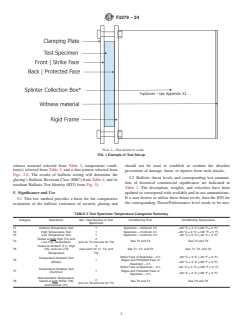
FIG. 1 Example of Test Set-up
witness material selected from Table 2, temperature condi- should not be used to establish or confirm the absolute
tion(s) selected from Table 3, and a shot pattern selected from prevention of damage, harm, or injuries from such attacks.
Figs. 2-6. The results of ballistic testing will determine the
5.2 Ballistic threat levels and corresponding test ammuni-
glazing’s Ballistic Resistant Class (BRC) from Table 4, and its
tion of historical commercial significance are indicated in
resultant Ballistic Test Identity (BTI) from Fig. 5).
Table 1. The description, weights, and velocities have been
5. Significance and Use updated to correspond with available and in-use ammunitions.
If a user desires to utilize these threat levels, then the BTI for
5.1 This test method provides a basis for the comparative
the corresponding Threat/Performance level needs to be met.
evaluation of the ballistic resistance of security glazing and
TABLE 3 Test Specimen Temperature Categories Summary
Category Description Min. Total Number of Test Conditioning Time Conditioning Temperature
Specimens
T1 Ambient Temperature Test 1 Specimen – minimum 3 h +20 °C ± 3 °C (+68 °F ± 5 °F)
T2 High Temperature Test 1 Specimen – minimum 3 h +49 °C ± 3 °C (+120 °F ± 5 °F)
T3 Low Temperature Test 1 Specimen – minimum 3 h –29 °C ± 3 °C (–20 °F ± 5 °F)
Tested at both High (T2) and 2
T4 See T2 and T3 See T2 and T3
Low (T3) Temperature (one for T2 and one for T3)
Tested at Ambient (T1), High 3
T5 (T2), and Low (T3) (one each for T1, T2, and See T1, T2, and T3 See T1, T2, and T3
Temperature T3)
Strike Face of Specimen – 3 h –29 °C ± 3 °C (–20 °F ± 5 °F)
Temperature Gradient Test
T6 1 Edges and Protected Face of
(Winter) +20 °C ± 3 °C (+68 °F ± 5 °F)
Specimen – 3 h
Strike Face of Specimen – 3 h +49 °C ± 3 °C (+120 °F ± 5 °F)
Temperature Gradient Test
T7 1 Edges and Protected Face of
(Summer) +20 °C ± 3 °C (+68 °F ± 5 °F)
Specimen – 3 h
Multi-Gradient Temperature,
T8 Tested at both Winter (T6) See T6 and T7 See T5 and T6
(one for T6 and one for T7)
and Summer (T7)
F3279 − 24
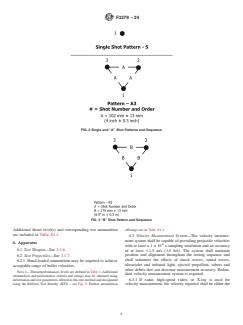
FIG. 2 Single and “A” Shot Patterns and Sequence
FIG. 3 “B” Shot Pattern and Sequence
offerings are in Table X1.1.
Additional threat level(s) and corresponding test ammunition
are included in Table X1.1.
6.3 Velocity Measurement System—The velocity measure-
ment system shall be capable of providing projectile velocities
6. Apparatus
-6
with at least a 1 × 10 s sampling resolution and an accuracy
6.1 Test Weapon—See 3.1.6.
of at least 61.5 m/s (65 ft/s). The system shall maintain
position and alignment throughout the testing sequence and
6.2 Test Projectiles—See 3.1.7.
shall minimize the effects of shock waves, sound waves,
6.2.1 Hand-loaded ammunition may be required to achieve
ultraviolet and infrared light, ejected propellant, sabots and
acceptable range of bullet velocities.
other debris that can decrease measurement accuracy. Redun-
NOTE 1—Threat/performances levels are defined in Table 1. Additional
dant velocity measurement system is required.
ammunition and performance criteria and ratings may be obtained using
6.3.1 If radar, high-speed video, or X-ray is used for
information and test parameters offered in this test method and designated
using the Ballistic Test Identity (BTI) – see Fig. 5. Further ammunition velocity measurement, the velocity reported shall be either the
F3279 − 24
FIG. 4 “C” Shot Patterns and Sequence
NOTE 1—No required sequence but debris from prior shots should not accumulate so as to influence the testing results.
FIG. 5 “D” Shot Pattern
velocity measured at the location given in Table 3 of Specifi- 6.3.2.4 The distance from the last light screen to the test
cation E3062 or the velocity measured at the test specimen as specimen reference plane shall be no greater than 1.5 m (5 ft).
specified.
6.3.2.5 The light screens shall be fastened together to
6.3.2 If light screens are used for velocity measurement, the
prevent inadvertent changes in spacing.
requirements in 6.3.2.1 – 6.3.2.5 shall be met.
NOTE 2—The spacing between the light screens may be adjusted to
6.3.2.1 The light screens shall be positioned as shown in
meet velocity measurement requirements.
Specification E3062.
6.3.2.2 The inner screens shall be paired together, and the
6.4 Support Fixture and Frame—The test specimen shall be
outer screens shall be paired together.
mounted in the frame along the full length of all specimen
6.3.2.3 The light screen pairs shall be parallel to each other
edges.
and perpendicular to the projectile firing system barrel.
F3279 − 24
NOTE 1—No required sequence but debris from prior shots should not accumulate so as to influence the testing results.
FIG. 6 “E” Shot Pattern
TABLE 4 Ballistic Resistant Class (BRC) Criteria Summary
BRC Witness Material Performance Thickness (T);
Witness Material Impact Allowed Witness Material Penetration Allowed
Table 2
1O O
No No
1L L
2O O
Yes No
2L L
3O O
A
Yes Yes
3L L
A
No perforation formed by spall in the witness material may be greater than 3 mm (0.125 in.) in length or width when measured as presented.
6.4.1 The frame shall have a clamping plate to hold the in accordance with manufacturer’s documentation. Manufac-
glazing in position and means for producing uniform clamping turer shall clearly mark the strike face on each specimen. The
of the glazing. support and retention system shall be reported.
6.4.2 All edges of the test specimen shall be uniformly
6.5 Witness Material and Dimensions:
clamped with a clamping pressure sufficiently large that the
6.5.1 Witness Material Thickness and Makeup—Select wit-
edges remain in position during the test.
ness material thickness and makeup from Table 2 for the
desired safety performance described in X1.3.
NOTE 3—The clamping pressure has relatively little effect on the test
results for glass but can have considerable influence on the test results for
6.5.2 Witness Material Mounting—The witness material
plastic glazing sheet materials. For these materials, the manner of support
shall be securely mounted perpendicular to the projectile line
and retention shall be reported.
of flight and rigidly affixed to its support so that it remains in
6.4.3 The specimen shall have an edge support/coverage on
position throughout the test to minimize the likelihood of
all edges of 25 mm 6 6 mm (1 in. 6 0.25 in.). The specimen
premature tear or excessive in-plane displacement at material
shall be separated from the frame and the clamping plate by
supports. A singular witness material shall be spaced at a
continuous rubber strips, 5 mm 6 0.5 mm (0.197 in. 6
distance consistent with the Ballistic Resistant Class (BRC)
0.02 in.) thick, 30 mm 6 5 mm (1.18 in. 6 0.197 in.) wide, and
shown in Table 4. Witness material shall be spaced 152 mm 6
of hardness (50 6 10) IRHD, in accordance with Test Method
13 mm (6 in. 6 0.5 in.) beyond the back face of a test
D1415.
specimen.
6.5.3 Witness Material Length and Width—The witness
NOTE 4—The rigidly supported fixture prevents specimen translation
material shall be centered on either the current shot, or the shot
along the line of flight but permits its position and attitude to be readily
adjusted so that it is perpendicular to the line of flight at the projectile
pattern as a whole (see Figs. 2-6 for shot patterns), as
point of impact.
appropriate. The size of the witness material shall be in
6.4.4 The test specimen in the frame shall be placed normal accordance with Table 5 and sufficiently large to cover the
to the direction of attack with an accuracy of 61°(degree) in affected area by adding a minimum of 152 cm (6 in.) on all
any orientation. Test specimen shall be oriented to strike face sides.
F3279 − 24
TABLE 5 Test Specimen Size
Number of Shots Pattern Type Test Specimen Minimum Size Test Specimen Maximum Size Witness Panel Size
1 (single-shot test) S 300 mm × 300 mm ± 6 mm 610 mm × 610 mm ± 6 mm 610 mm × 610 mm ± 6 mm
(12 in. × 12 in. ± 0.25 in.) (24 in. × 24 in. ± 0.25 in.) (24 in. × 24 in. ± 0.25 in.)
>1 (multi-shot test) A, B, C, or D 510 mm × 510 mm ± 6 mm 1067 mm × 1067 mm ± 6 mm At least
(20 in. × 20 in. ± 0.25 in.) (42 in. × 42 in. ± 0.25 in.) 610 mm × 610 mm ± 6 mm
(24 in. × 24 in. ± 0.25 in.)
$1 (multi-shot test) E 810 mm × 810 mm ± 6 mm 1220 mm × 1220 mm ± 6 mm At least
(32 in. × 32 in. ± 0.25 in.) (48 in. × 48 in. ± 0.25 in.) 810 mm × 810 mm ± 6 mm
(32 in. × 32 in. ± 0.25 in.)
6.6 Spacing of Test Equipment and Test Specimen—The test 8. Test Specimen
equipment shall be set up in accordance with Specification
8.1 Test Specimen Shape—Test specimen shall be square.
E3062. Test range distances are defined in Table 6.
8.2 Test Specimen Size—Refer to Table 5. Multiple speci-
6.6.1 The test equipment shall be set up as though the shot
mens are required to satisfy particular test conditions (for
were to be taken at a zero-degree obliquity; the test equipment
example, T7 temperature), and all test specimens shall be
shall not be moved, except as it pertains to translating for
identical to each other in size and configuration.
aiming and rotating to accommodate obliquity requirements.
6.6.2 The distance from muzzle to test item reference plane
9. Test Procedure
may be adjusted to minimize yaw. Adjustments for blast effects
are currently outside the scope of this test method. The reason
9.1 Test Environment, All Tests—Test specimens shall be
for the adjustment and the distance used shall be documented.
tested to one or more of the temperature categories shown in
The distance from the location of velocity measurement to the
Table 3. The ambient temperature of the test environment
test specimen reference plane shall not be adjusted.
obtained from calibrated thermometers shall be recorded and
6.6.3 The test
...