

ASTM D2339-20
(Test Method)Standard Test Method for Strength Properties of Adhesives in Two-Ply Wood Construction in Shear by Tension Loading
General Information
- Abstract
SIGNIFICANCE AND USE
4.1 By the nature of the way adhesives are used in two-ply wood construction, shear strength is an important performance criteria.
4.2 Shear strength measured by this test method is suitable for use in adhesive development, manufacturing quality control, and in materials-performance specifications.
SCOPE
1.1 This test method covers the determination of the comparative shear strengths of adhesives when tested on a standard specimen and under specified conditions of preparation, conditioning, and testing. This test method is intended to be applied only to adhesives used in bonding wood to wood.
1.2 The values stated in SI units are to be regarded as the standard. The values given in parentheses are for information only.
1.3 This standard does not purport to address all of the safety concerns, if any, associated with its use. It is the responsibility of the user of this standard to establish appropriate safety, health, and environmental practices and determine the applicability of regulatory limitations prior to use.
1.4 This international standard was developed in accordance with internationally recognized principles on standardization established in the Decision on Principles for the Development of International Standards, Guides and Recommendations issued by the World Trade Organization Technical Barriers to Trade (TBT) Committee.
- Status
- Published
- Publication Date
- 31-Mar-2020
- Technical Committee
- D14 - Adhesives
- Drafting Committee
- D14.30 - Wood Adhesives
Buy Documents


ASTM D2339-20 - Standard Test Method for Strength Properties of Adhesives in Two-Ply Wood Construction in Shear by Tension Loading
REDLINE ASTM D2339-20 - Standard Test Method for Strength Properties of Adhesives in Two-Ply Wood Construction in Shear by Tension Loading
Overview
ASTM D2339-20: Standard Test Method for Strength Properties of Adhesives in Two-Ply Wood Construction in Shear by Tension Loading establishes a uniform procedure for evaluating the comparative shear strength of adhesives used exclusively for bonding wood to wood. Given the importance of shear strength for structural integrity in two-ply wood assemblies, this test method is vital for adhesive development, manufacturing quality control, and validation against materials-performance specifications.
This standard is developed by ASTM Committee D14 on Adhesives and adheres to internationally recognized standardization principles. ASTM D2339-20 provides guidance for specimen preparation, conditioning, and testing, ensuring consistency and reliability of test results across laboratories and industries.
Key Topics
Scope and Applicability:
- Applies to adhesives for wood-to-wood bonding in two-ply construction.
- Specifies standard specimen preparation, conditioning, and tension loading shear test procedure.
- Requires the use of SI units as the standard of measure.
Test Conditions and Variables:
- Defines all key variables in adhesive bonding, such as wood moisture content at bonding, adhesive preparation and application, assembly, curing, and conditioning procedures.
- Prescribes manufacturer-supplied information on application variables (film thickness, assembly and curing times, pressures, and temperatures).
Testing Procedure:
- Utilizes a standard specimen cut from defect-free veneer, typically sweet birch or yellow birch.
- Details machine and grip requirements to maintain specimen alignment and consistent load application.
- Specifies that the veneer’s fiber direction be carefully maintained to ensure valid test results.
- Outlines the method for recording failure load, calculating peak shear stress, and estimating the percentage of wood failure at the bondline.
Reporting Requirements:
- Includes full adhesion process documentation (adhesive type, wood species, specifics of preparation and testing).
- Requires reporting of temperature, humidity, number of samples, and statistical summaries of results.
Applications
This standard test method for shear strength of adhesives in wood construction is essential for several practical applications in the wood adhesives industry:
Adhesive Development:
- Provides manufacturers and researchers with an objective benchmark for comparing the shear strength of various wood adhesives under controlled conditions, facilitating product innovation and improvement.
Quality Control:
- Used in manufacturing settings to verify batch-to-batch consistency of adhesive products, and to ensure production processes yield reliable wood joints.
- Helps identify any deviations or variability in adhesive performance, supporting troubleshooting and corrective actions.
Specification and Certification:
- Serves as a reference method for specifying adhesive performance criteria in procurement documents for construction and engineered wood products.
- Assists buyers, inspectors, and regulatory agencies in confirming compliance with industry or project-specific requirements.
Performance Evaluation:
- A fundamental test for assessing whether adhesive-bonded wood joints meet the durability and strength requirements for their intended structural applications.
Related Standards
Several other ASTM standards are frequently referenced alongside ASTM D2339-20 for a comprehensive approach to wood adhesive performance:
- ASTM D907: Terminology of Adhesives
- ASTM D1038: Terminology Relating to Veneer, Plywood, and Wood Structural Panels
- ASTM D143: Test Methods for Small Clear Specimens of Timber
- ASTM D4442: Direct Moisture Content Measurement of Wood and Wood-Based Materials
- ASTM D5266: Practice for Estimating the Percentage of Wood Failure in Adhesive Bonded Joints
Utilizing ASTM D2339-20 in concert with these related standards ensures robust, standardized evaluation and reporting of wood adhesive strength properties under shear by tension loading, supporting innovation, quality assurance, and regulatory compliance within the wood adhesives and structural wood products industries.
Relations
- Effective Date
- 01-Apr-2020
- Effective Date
- 01-Apr-2020
- Effective Date
- 01-Mar-2020
- Effective Date
- 01-Mar-2019
- Effective Date
- 15-Nov-2016
- Effective Date
- 01-Jun-2015
- Effective Date
- 01-May-2013
- Effective Date
- 01-Jul-2012
- Effective Date
- 01-May-2012
- Effective Date
- 01-Dec-2011
- Effective Date
- 01-Nov-2011
- Effective Date
- 01-Jan-2011
- Effective Date
- 01-Oct-2008
- Effective Date
- 15-Aug-2008
- Effective Date
- 01-Mar-2008
Buy Documents
ASTM D2339-20 - Standard Test Method for Strength Properties of Adhesives in Two-Ply Wood Construction in Shear by Tension Loading
REDLINE ASTM D2339-20 - Standard Test Method for Strength Properties of Adhesives in Two-Ply Wood Construction in Shear by Tension Loading
Get Certified
Connect with accredited certification bodies for this standard

DIN CERTCO
DIN Group product certification.

Smithers Quality Assessments
US management systems and product certification.
Sponsored listings
Frequently Asked Questions
ASTM D2339-20 is a standard published by ASTM International. Its full title is "Standard Test Method for Strength Properties of Adhesives in Two-Ply Wood Construction in Shear by Tension Loading". This standard covers: SIGNIFICANCE AND USE 4.1 By the nature of the way adhesives are used in two-ply wood construction, shear strength is an important performance criteria. 4.2 Shear strength measured by this test method is suitable for use in adhesive development, manufacturing quality control, and in materials-performance specifications. SCOPE 1.1 This test method covers the determination of the comparative shear strengths of adhesives when tested on a standard specimen and under specified conditions of preparation, conditioning, and testing. This test method is intended to be applied only to adhesives used in bonding wood to wood. 1.2 The values stated in SI units are to be regarded as the standard. The values given in parentheses are for information only. 1.3 This standard does not purport to address all of the safety concerns, if any, associated with its use. It is the responsibility of the user of this standard to establish appropriate safety, health, and environmental practices and determine the applicability of regulatory limitations prior to use. 1.4 This international standard was developed in accordance with internationally recognized principles on standardization established in the Decision on Principles for the Development of International Standards, Guides and Recommendations issued by the World Trade Organization Technical Barriers to Trade (TBT) Committee.
SIGNIFICANCE AND USE 4.1 By the nature of the way adhesives are used in two-ply wood construction, shear strength is an important performance criteria. 4.2 Shear strength measured by this test method is suitable for use in adhesive development, manufacturing quality control, and in materials-performance specifications. SCOPE 1.1 This test method covers the determination of the comparative shear strengths of adhesives when tested on a standard specimen and under specified conditions of preparation, conditioning, and testing. This test method is intended to be applied only to adhesives used in bonding wood to wood. 1.2 The values stated in SI units are to be regarded as the standard. The values given in parentheses are for information only. 1.3 This standard does not purport to address all of the safety concerns, if any, associated with its use. It is the responsibility of the user of this standard to establish appropriate safety, health, and environmental practices and determine the applicability of regulatory limitations prior to use. 1.4 This international standard was developed in accordance with internationally recognized principles on standardization established in the Decision on Principles for the Development of International Standards, Guides and Recommendations issued by the World Trade Organization Technical Barriers to Trade (TBT) Committee.
ASTM D2339-20 is classified under the following ICS (International Classification for Standards) categories: 83.180 - Adhesives. The ICS classification helps identify the subject area and facilitates finding related standards.
ASTM D2339-20 has the following relationships with other standards: It is inter standard links to ASTM D2339-98(2017), ASTM D5266-13(2020), ASTM D4442-20, ASTM D1038-19, ASTM D4442-16, ASTM D4442-15, ASTM D5266-13, ASTM D907-12a, ASTM D907-12, ASTM D907-11a, ASTM D1038-11, ASTM D907-11, ASTM D907-08b, ASTM D907-08a, ASTM D907-08. Understanding these relationships helps ensure you are using the most current and applicable version of the standard.
ASTM D2339-20 is available in PDF format for immediate download after purchase. The document can be added to your cart and obtained through the secure checkout process. Digital delivery ensures instant access to the complete standard document.
Standards Content (Sample)
This international standard was developed in accordance with internationally recognized principles on standardization established in the Decision on Principles for the
Development of International Standards, Guides and Recommendations issued by the World Trade Organization Technical Barriers to Trade (TBT) Committee.
Designation: D2339 − 20
Standard Test Method for
Strength Properties of Adhesives in Two-Ply Wood
Construction in Shear by Tension Loading
This standard is issued under the fixed designation D2339; the number immediately following the designation indicates the year of
original adoption or, in the case of revision, the year of last revision. A number in parentheses indicates the year of last reapproval. A
superscript epsilon (´) indicates an editorial change since the last revision or reapproval.
INTRODUCTION
The accuracy of the results of strength tests of adhesive bonds depends on the conditions under
which the bonding process is carried out. Unless otherwise agreed upon between the manufacturer and
the purchaser, the bonding conditions shall be prescribed by the manufacturer of the adhesive. In order
to ensure that complete information is available to the individual conducting the tests, the
manufacturer of the adhesive shall furnish numerical values and other specific information for each of
the following variables:
(1) The moisture content of the wood at the time of bonding.
(2) Complete mixing directions for the adhesive.
(3) Conditions for application of the adhesive including the rate of spread or thickness of film,
number of coats to be applied, whether to be applied to one or both surfaces and the conditions of
drying where more than one coat is required.
(4) Assembly conditions before application of pressure, including the room temperature, length of
time, and whether open or closed assembly is to be used.
(5) Curing conditions, including the amount of pressure to be applied, the length of time under
pressure, and the temperature of the assembly when under pressure. It should be stated whether this
temperature is that of the bondline, or of the atmosphere at which the assembly is to be maintained.
(6) Conditioning procedure before testing, unless a standard procedure is specified, including the
length of time, temperature, and relative humidity.
A range for any variable or combination of variables is permitted provided any arbitrarily chosen
value within the range or combinations specified is acceptable to both the manufacturer and the
purchaser of the adhesives.
1. Scope responsibility of the user of this standard to establish appro-
priate safety, health, and environmental practices and deter-
1.1 This test method covers the determination of the com-
mine the applicability of regulatory limitations prior to use.
parative shear strengths of adhesives when tested on a standard
1.4 This international standard was developed in accor-
specimen and under specified conditions of preparation,
dance with internationally recognized principles on standard-
conditioning, and testing. This test method is intended to be
ization established in the Decision on Principles for the
applied only to adhesives used in bonding wood to wood.
Development of International Standards, Guides and Recom-
1.2 The values stated in SI units are to be regarded as the
mendations issued by the World Trade Organization Technical
standard. The values given in parentheses are for information
Barriers to Trade (TBT) Committee.
only.
1.3 This standard does not purport to address all of the 2. Referenced Documents
safety concerns, if any, associated with its use. It is the
2.1 ASTM Standards:
D907 Terminology of Adhesives
This test method is under the jurisdiction of ASTM Committee D14 on
Adhesives and is the direct responsibility of Subcommittee D14.30 on Wood
Adhesives. For referenced ASTM standards, visit the ASTM website, www.astm.org, or
Current edition approved April 1, 2020. Published April 2020. Originally contact ASTM Customer Service at service@astm.org. For Annual Book of ASTM
approved in 1965. Last previous edition approved in 2017 as D2339 – 98 (2017). Standards volume information, refer to the standard’s Document Summary page on
DOI: 10.1520/D2339-20. the ASTM website.
Copyright © ASTM International, 100 Barr Harbor Drive, PO Box C700, West Conshohocken, PA 19428-2959. United States
D2339 − 20
D1038 Terminology Relating toVeneer, Plywood, andWood 5.3 The testing machine shall be located in an atmosphere
Structural Panels such that the moisture content of the specimens developed
D4442 Test Methods for Direct Moisture Content Measure- under the conditions prescribed in Section 7 is not noticeably
ment of Wood and Wood-Based Materials altered during testing.
D5266 Practice for Estimating the Percentage of Wood
6. Preparation of Test Panels
Failure in Adhesive Bonded Joints
6.1 The standard substrate for this test is 1.6 mm ( ⁄16 in.)
3. Terminology
thick rotary-cut or sliced veneer of sweet birch (Betula lenta)
or yellow birch (Betula alleghaniensis). Upon written agree-
3.1 Definitions:
ment between the party requesting this test and the manufac-
3.1.1 Many terms in this test method are defined in Termi-
turer of the adhesive, any other thickness or species of veneer
nology D907 and D1038.
is permitted. Select veneer that is free of defects such as knots
3.1.2 shear, n—in an adhesively bonded joint, stress, strain,
or distorted grain around knots, cracks, short grain (fibers out
or failure resulting from applied forces that tends to cause
of plane), rough surfaces, or unusual discoloration which
adjacent planes of a body to slide parallel in opposite direc-
would indicate decay. Do not sand the veneer.
tions.
6.2 Cut the selected veneer into a size suitable for pressing
4. Significance and Use
and for cutting specimens with minimal waste. Allow at least
13 mm ( ⁄2 in.) for trim around the edges.
4.1 By the nature of the way adhesives are used in two-ply
wood construction, shear strength is an important performance
NOTE 3—When cutting the veneer to size, ensure that the fiber direction
criteria. is parallel and perpendicular to the edges.Appearance could potentially be
deceptive. If there is any question, check the fiber direction with a scratch
4.2 Shear strength measured by this test method is suitable
awl.
for use in adhesive development, manufacturing quality
6.3 Condition the veneer to within 61 % of the moisture
control, and in materials-performance specifications.
content recommended by the adhesive manufacturer or the
party requesting this test. In the absence of any guideline,
5. Apparatus
condition the veneer to 10 to 12 % moisture content based on
5.1 Adjust the loading rate of the testing machine between
the oven dry weight.
4.535 and 7.560 kg/s (600
...
This document is not an ASTM standard and is intended only to provide the user of an ASTM standard an indication of what changes have been made to the previous version. Because
it may not be technically possible to adequately depict all changes accurately, ASTM recommends that users consult prior editions as appropriate. In all cases only the current version
of the standard as published by ASTM is to be considered the official document.
Designation: D2339 − 98 (Reapproved 2017) D2339 − 20
Standard Test Method for
Strength Properties of Adhesives in Two-Ply Wood
Construction in Shear by Tension Loading
This standard is issued under the fixed designation D2339; the number immediately following the designation indicates the year of
original adoption or, in the case of revision, the year of last revision. A number in parentheses indicates the year of last reapproval. A
superscript epsilon (´) indicates an editorial change since the last revision or reapproval.
INTRODUCTION
The accuracy of the results of strength tests of adhesive bonds depends on the conditions under
which the bonding process is carried out. Unless otherwise agreed upon between the manufacturer and
the purchaser, the bonding conditions shall be prescribed by the manufacturer of the adhesive. In order
to ensure that complete information is available to the individual conducting the tests, the
manufacturer of the adhesive shall furnish numerical values and other specific information for each of
the following variables:
(1) The moisture content of the wood at the time of bonding.
(2) Complete mixing directions for the adhesive.
(3) Conditions for application of the adhesive including the rate of spread or thickness of film,
number of coats to be applied, whether to be applied to one or both surfaces and the conditions of
drying where more than one coat is required.
(4) Assembly conditions before application of pressure, including the room temperature, length of
time, and whether open or closed assembly is to be used.
(5) Curing conditions, including the amount of pressure to be applied, the length of time under
pressure, and the temperature of the assembly when under pressure. It should be stated whether this
temperature is that of the bondline, or of the atmosphere at which the assembly is to be maintained.
(6) Conditioning procedure before testing, unless a standard procedure is specified, including the
length of time, temperature, and relative humidity.
A range for any variable or combination of variables is permitted provided any arbitrarily chosen
value within the range or combinations specified is acceptable to both the manufacturer and the
purchaser of the adhesives.
(1) The moisture content of the wood at the time of bonding.
(2) Complete mixing directions for the adhesive.
(3) Conditions for application of the adhesive including the rate of spread or thickness of film,
number of coats to be applied, whether to be applied to one or both surfaces and the conditions of
drying where more than one coat is required.
(4) Assembly conditions before application of pressure, including the room temperature, length of
time, and whether open or closed assembly is to be used.
(5) Curing conditions, including the amount of pressure to be applied, the length of time under
pressure, and the temperature of the assembly when under pressure. It should be stated whether this
temperature is that of the bondline, or of the atmosphere at which the assembly is to be maintained.
(6) Conditioning procedure before testing, unless a standard procedure is specified, including the
length of time, temperature, and relative humidity.
A range may be prescribed for any variable by the manufacturer of the adhesive if it can be assumed
by the test operator that any arbitrarily chosen value within such a range or any combination of such
values for several variables will be acceptable to both the manufacturer and the purchaser of the
adhesive.
This test method is under the jurisdiction of ASTM Committee D14 on Adhesives and is the direct responsibility of Subcommittee D14.30 on Wood Adhesives.
Current edition approved Aug. 1, 2017April 1, 2020. Published August 2017April 2020. Originally approved in 1965. Last previous edition approved in 20112017 as
D2339 – 98 (2011).(2017). DOI: 10.1520/D2339-98R17.10.1520/D2339-20.
Copyright © ASTM International, 100 Barr Harbor Drive, PO Box C700, West Conshohocken, PA 19428-2959. United States
D2339 − 20
1. Scope
1.1 This test method covers the determination of the comparative shear strengths of adhesives when tested on a standard
specimen and under specified conditions of preparation, conditioning, and testing. This test method is intended to be applied only
to adhesives used in bonding wood to wood.
1.2 The values stated in SI units are to be regarded as the standard. The values given in parentheses are for information only.
1.3 This standard does not purport to address all of the safety concerns, if any, associated with its use. It is the responsibility
of the user of this standard to establish appropriate safety, health, and environmental practices and determine the applicability of
regulatory limitations prior to use.
1.4 This international standard was developed in accordance with internationally recognized principles on standardization
established in the Decision on Principles for the Development of International Standards, Guides and Recommendations issued
by the World Trade Organization Technical Barriers to Trade (TBT) Committee.
2. Referenced Documents
2.1 ASTM Standards:
D907 Terminology of Adhesives
D1038 Terminology Relating to Veneer, Plywood, and Wood Structural Panels
D143D4442 Test Methods for Small Clear Specimens of TimberDirect Moisture Content Measurement of Wood and
Wood-Based Materials
D907D5266 Terminology of AdhesivesPractice for Estimating the Percentage of Wood Failure in Adhesive Bonded Joints
3. Terminology
3.1 Definitions:
3.1.1 Many terms in this test method are defined in Terminology D907 and D1038.
3.1.2 shear, n—in an adhesively bonded joint, stress, strain, or failure resulting from applied forces that tends to cause adjacent
planes of a body to slide parallel in opposite directions.
4. Significance and Use
4.1 By the nature of the way adhesives are used in two-ply wood construction, shear strength is an important performance
criteria.
4.2 Shear strength measured by this test method is suitable for use in adhesive development, manufacturing quality control, and
in materials-performance specifications.
5. Apparatus
5.1 Adjust the loading rate of the testing machine between 45354.535 and 7560 g/s7.560 kg/s (600 and 1000 lb/min). Where
the testing machine is adjusted by rate of crosshead movement rather than load application rate, select an appropriate head
movement rate so as to yield an average load application rate in the 4535 and 7560 g/s (600 and 1000 lb/min) range. Provide
suitable grips and jaws so that the specimen can be gripped tightly and held in alignment as the load is applied. The grips and jaws
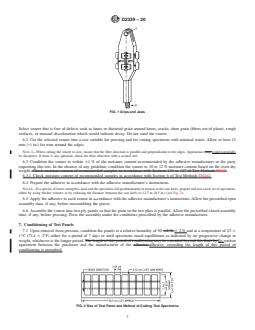
shown in Fig. 1 have been found satisfactory. Locate the testing machine in an atmosphere such that the moisture content of the
specimens developed under the conditions prescribed in Section 7 is not noticeably altered during testing.
NOTE 1—Where the testing machine is adjusted by rate of crosshead movement rather than load application rate, select an appropriate head movement
rate so as to yield an average load application rate in the 4.535 and 7.560 kg/s (600 and 1000 lbs./min) range.
5.2 The testing machine shall be provided with suitable grips and jaws so that the specimen can be gripped tightly and held in
alignment as the load is applied.
NOTE 2—The grips and jaws shown in Fig. 1 have been found satisfactory.
5.3 The testing machine shall be located in an atmosphere such that the moisture content of the specimens developed under the
conditions prescribed in Section 7 is not noticeably altered during testing.
6. Preparation of Test Panels
6.1 The standard substrate for this test is 1.6 mm ( ⁄16 in.) thick rotary-cut or sliced veneer of sweet birch (Betula lenta) or yellow
birch (Betula alleghaniensis). Any other thickness or species of veneer may be substituted upon Upon written agreement between
the party requesting this test and the manufacturer of the adhesive. adhesive, any other thickness or species of veneer is permitted.
For referenced ASTM standards, visit the ASTM website, www.astm.org, or contact ASTM Customer Service at service@astm.org. For Annual Book of ASTM Standards
volume information, refer to the standard’s Document Summary page on the ASTM website.
D2339 − 20
FIG. 1 Grips and Jaws
Select veneer that is free of defects such as knots or distorted grain a
...