

ASTM D8053-18
(Guide)Standard Guide for Data Management and Reporting Associated with Oil and Gas Development Involving Hydraulic Fracturing
General Information
- Abstract
SIGNIFICANCE AND USE
5.1 Limitations of Guide—This guide is for use by stakeholders involved with collecting, managing, reporting, and delivering data during oil and gas development operations using hydraulic fracturing. Some data collected for operational and business concerns regarding hydraulic fracturing is classified as proprietary and can be classified as such by individual operators based on state regulatory conditions. Accordingly, this guide will not address the collection, management, and reporting of proprietary operator data other than to note that significant benefits may be achieved by narrowing the classification of proprietary data, and standardizing the definition of “proprietary data” between regulators. Regulators’ interests in data vary widely based upon a specific agency’s charter, statutory/legislative mandates, legacy requirements, and considerations relating to operator compliance. Depending upon jurisdictional boundaries, multiple regulatory agencies generally have statutory responsibilities regarding oil and gas development operations. These agencies properly determine what information will be collected based on agency specific responsibilities. Accordingly, this guide will not address the selection of data elements to be collected by regulatory agencies other than to note that significant efficiencies may be achieved by using integrated or common, interagency, data management processes, protocols, systems, and best practices and by reviewing data collection activities against those of sister agencies to minimize gaps and overlaps.
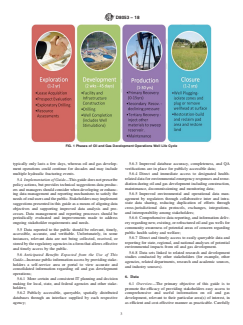
5.2 Oil and gas development operations include the entire well life cycle, as shown in Fig. 1.
FIG. 1 Phases of Oil and Gas Development Operations Well Life Cycle
5.3 This guide distinguishes the term hydraulic fracturing from oil and gas development operations. Many consider the terms interchangeable. The industry typically refers to hydraulic fracturing as the explicit act of pressurizing a well in a shale formation to fra...
SCOPE
1.1 This guide presents a series of options regarding data collection, data management, and information delivery and reporting associated with oil and gas development involving hydraulic fracturing. Options presented for data management and reporting are intended to improve the transparent information exchange between three primary stakeholder groups: operators, regulators, and the public. Improved information exchange is expected to enhance public understanding of oil and gas development.
1.2 Suggestions contained in this guide may not be applicable in all circumstances. This guide is not intended to represent or replace the standard of care by which the adequacy of a given professional service should be judged, nor should this guide be applied without consideration of a project’s many unique aspects. The word “Standard” in the title of this document means that the document has been approved through the ASTM process.
1.3 Units—The values stated in inch-pound units are to be regarded as the standard. The values given in parentheses are mathematical conversions to SI units that are provided for information only and are not considered standard.
1.4 This standard does not purport to address all of the safety concerns, if any, associated with its use. It is the responsibility of the user of this standard to establish appropriate safety, health, and environmental practices and determine the applicability of regulatory limitations prior to use.
1.5 This international standard was developed in accordance with internationally recognized principles on standardization established in the Decision on Principles for the Development of International Standards, Guides and Recommendations issued by the World Trade Organization Technical Barriers to Trade (TBT) Committee.
- Status
- Published
- Publication Date
- 31-Oct-2018
- Technical Committee
- D18 - Soil and Rock
- Drafting Committee
- D18.26 - Hydraulic Fracturing
Overview
ASTM D8053-18 is the Standard Guide for Data Management and Reporting Associated with Oil and Gas Development Involving Hydraulic Fracturing. Developed by ASTM International, this guide addresses the collection, management, delivery, and reporting of data related to oil and gas operations involving hydraulic fracturing. It is intended for use by operators, regulators, and public stakeholders, enhancing transparency and fostering better understanding of hydraulic fracturing activities. While it does not dictate proprietary data handling or the specific data elements required by regulatory agencies, it emphasizes best practices and efficiencies in data management to support stakeholder information needs throughout the oil and gas well life cycle.
Key Topics
- Data Management Practices: The standard outlines options for collecting, managing, and reporting data from all phases of oil and gas development, with a strong focus on hydraulic fracturing activities.
- Stakeholder Communication: It highlights the importance of transparent information exchange among operators, regulators, and the public to promote understanding and trust.
- Data Quality Assurance: The guide recommends adopting national or international data quality standards, such as ASQ/ANSI E4 and ISO 14001, and implementing project-specific quality assurance plans.
- Public Access and Transparency: Encourages publicly accessible, timely, and accurate data reporting through online databases, dashboards, and web portals, improving public understanding of operational and environmental aspects.
- Collaboration Across Agencies: Suggests cross-jurisdictional coordination and adoption of integrated data management protocols among regulatory agencies to minimize data gaps and overlaps.
- Distinction in Data Types: Addresses the treatment of proprietary operator data, noting benefits of standardizing definitions and reducing proprietary classifications when possible.
Applications
ASTM D8053-18 provides actionable guidance for organizations involved in hydraulic fracturing and oil and gas development:
- Operators can use the guide to streamline data management processes and ensure regulatory reporting aligns with best practices for quality and transparency.
- Regulators benefit from recommendations on standardizing and integrating data requirements, enabling more effective oversight and facilitating public access to critical environmental and operational information.
- Public Stakeholders gain improved visibility into oil and gas activities through enhanced reporting mechanisms, supporting informed community dialogue and environmental monitoring.
- Industry Consultants and Service Providers can reference the guide when designing data collection frameworks, preparing environmental reports, or managing stakeholder communications related to hydraulic fracturing.
Recommended reporting options include online dashboards, searchable databases, and web portals, which empower users to access, analyze, and visualize data relevant to well construction, operations, safety, and environmental impact.
Related Standards
In developing best-in-class data management and reporting frameworks, ASTM D8053-18 references and aligns with several key industry standards:
- ASTM D653: Terminology Relating to Soil, Rock, and Contained Fluids
- API RP100-2: Environmental Aspects Associated with Exploration and Production Operations Including Hydraulic Fracturing
- API RP100-3: Community Engagement Guidelines
- ASQ/ANSI E4: Quality Management Systems for Environmental Information and Technology Programs
- ISO 14001: Environmental Management Systems
By integrating principles from these standards, organizations can establish robust, interoperable systems that support regulatory compliance, operational efficiency, and stakeholder engagement.
Relevant Keywords: data management, hydraulic fracturing, oil and gas development, information exchange, environmental reporting, stakeholder transparency, well stimulation, quality assurance, public access, regulatory compliance.
Relations
- Effective Date
- 01-Aug-2014
- Effective Date
- 01-Sep-2011
- Effective Date
- 01-Jan-2009
- Effective Date
- 01-Dec-2008
- Effective Date
- 01-Nov-2008
- Effective Date
- 15-Dec-2007
- Effective Date
- 01-Nov-2007
- Effective Date
- 01-Aug-2007
- Effective Date
- 01-Jul-2007
- Effective Date
- 01-May-2007
- Effective Date
- 01-Nov-2006
- Effective Date
- 01-Jul-2005
- Effective Date
- 01-Aug-2004
- Effective Date
- 01-Dec-2003
- Effective Date
- 10-Dec-2002
Get Certified
Connect with accredited certification bodies for this standard

BSI Group
BSI (British Standards Institution) is the business standards company that helps organizations make excellence a habit.

Element Materials Technology
Materials testing and product certification.

ABS Group Brazil
ABS Group certification services in Brazil.
Sponsored listings
Frequently Asked Questions
ASTM D8053-18 is a guide published by ASTM International. Its full title is "Standard Guide for Data Management and Reporting Associated with Oil and Gas Development Involving Hydraulic Fracturing". This standard covers: SIGNIFICANCE AND USE 5.1 Limitations of Guide—This guide is for use by stakeholders involved with collecting, managing, reporting, and delivering data during oil and gas development operations using hydraulic fracturing. Some data collected for operational and business concerns regarding hydraulic fracturing is classified as proprietary and can be classified as such by individual operators based on state regulatory conditions. Accordingly, this guide will not address the collection, management, and reporting of proprietary operator data other than to note that significant benefits may be achieved by narrowing the classification of proprietary data, and standardizing the definition of “proprietary data” between regulators. Regulators’ interests in data vary widely based upon a specific agency’s charter, statutory/legislative mandates, legacy requirements, and considerations relating to operator compliance. Depending upon jurisdictional boundaries, multiple regulatory agencies generally have statutory responsibilities regarding oil and gas development operations. These agencies properly determine what information will be collected based on agency specific responsibilities. Accordingly, this guide will not address the selection of data elements to be collected by regulatory agencies other than to note that significant efficiencies may be achieved by using integrated or common, interagency, data management processes, protocols, systems, and best practices and by reviewing data collection activities against those of sister agencies to minimize gaps and overlaps. 5.2 Oil and gas development operations include the entire well life cycle, as shown in Fig. 1. FIG. 1 Phases of Oil and Gas Development Operations Well Life Cycle 5.3 This guide distinguishes the term hydraulic fracturing from oil and gas development operations. Many consider the terms interchangeable. The industry typically refers to hydraulic fracturing as the explicit act of pressurizing a well in a shale formation to fra... SCOPE 1.1 This guide presents a series of options regarding data collection, data management, and information delivery and reporting associated with oil and gas development involving hydraulic fracturing. Options presented for data management and reporting are intended to improve the transparent information exchange between three primary stakeholder groups: operators, regulators, and the public. Improved information exchange is expected to enhance public understanding of oil and gas development. 1.2 Suggestions contained in this guide may not be applicable in all circumstances. This guide is not intended to represent or replace the standard of care by which the adequacy of a given professional service should be judged, nor should this guide be applied without consideration of a project’s many unique aspects. The word “Standard” in the title of this document means that the document has been approved through the ASTM process. 1.3 Units—The values stated in inch-pound units are to be regarded as the standard. The values given in parentheses are mathematical conversions to SI units that are provided for information only and are not considered standard. 1.4 This standard does not purport to address all of the safety concerns, if any, associated with its use. It is the responsibility of the user of this standard to establish appropriate safety, health, and environmental practices and determine the applicability of regulatory limitations prior to use. 1.5 This international standard was developed in accordance with internationally recognized principles on standardization established in the Decision on Principles for the Development of International Standards, Guides and Recommendations issued by the World Trade Organization Technical Barriers to Trade (TBT) Committee.
SIGNIFICANCE AND USE 5.1 Limitations of Guide—This guide is for use by stakeholders involved with collecting, managing, reporting, and delivering data during oil and gas development operations using hydraulic fracturing. Some data collected for operational and business concerns regarding hydraulic fracturing is classified as proprietary and can be classified as such by individual operators based on state regulatory conditions. Accordingly, this guide will not address the collection, management, and reporting of proprietary operator data other than to note that significant benefits may be achieved by narrowing the classification of proprietary data, and standardizing the definition of “proprietary data” between regulators. Regulators’ interests in data vary widely based upon a specific agency’s charter, statutory/legislative mandates, legacy requirements, and considerations relating to operator compliance. Depending upon jurisdictional boundaries, multiple regulatory agencies generally have statutory responsibilities regarding oil and gas development operations. These agencies properly determine what information will be collected based on agency specific responsibilities. Accordingly, this guide will not address the selection of data elements to be collected by regulatory agencies other than to note that significant efficiencies may be achieved by using integrated or common, interagency, data management processes, protocols, systems, and best practices and by reviewing data collection activities against those of sister agencies to minimize gaps and overlaps. 5.2 Oil and gas development operations include the entire well life cycle, as shown in Fig. 1. FIG. 1 Phases of Oil and Gas Development Operations Well Life Cycle 5.3 This guide distinguishes the term hydraulic fracturing from oil and gas development operations. Many consider the terms interchangeable. The industry typically refers to hydraulic fracturing as the explicit act of pressurizing a well in a shale formation to fra... SCOPE 1.1 This guide presents a series of options regarding data collection, data management, and information delivery and reporting associated with oil and gas development involving hydraulic fracturing. Options presented for data management and reporting are intended to improve the transparent information exchange between three primary stakeholder groups: operators, regulators, and the public. Improved information exchange is expected to enhance public understanding of oil and gas development. 1.2 Suggestions contained in this guide may not be applicable in all circumstances. This guide is not intended to represent or replace the standard of care by which the adequacy of a given professional service should be judged, nor should this guide be applied without consideration of a project’s many unique aspects. The word “Standard” in the title of this document means that the document has been approved through the ASTM process. 1.3 Units—The values stated in inch-pound units are to be regarded as the standard. The values given in parentheses are mathematical conversions to SI units that are provided for information only and are not considered standard. 1.4 This standard does not purport to address all of the safety concerns, if any, associated with its use. It is the responsibility of the user of this standard to establish appropriate safety, health, and environmental practices and determine the applicability of regulatory limitations prior to use. 1.5 This international standard was developed in accordance with internationally recognized principles on standardization established in the Decision on Principles for the Development of International Standards, Guides and Recommendations issued by the World Trade Organization Technical Barriers to Trade (TBT) Committee.
ASTM D8053-18 is classified under the following ICS (International Classification for Standards) categories: 35.240.50 - IT applications in industry; 75.020 - Extraction and processing of petroleum and natural gas. The ICS classification helps identify the subject area and facilitates finding related standards.
ASTM D8053-18 has the following relationships with other standards: It is inter standard links to ASTM D653-14, ASTM D653-11, ASTM D653-09, ASTM D653-08a, ASTM D653-08, ASTM D653-07f, ASTM D653-07e, ASTM D653-07d, ASTM D653-07c, ASTM D653-07b, ASTM D653-06, ASTM D653-05, ASTM D653-04, ASTM D653-03, ASTM D653-02a. Understanding these relationships helps ensure you are using the most current and applicable version of the standard.
ASTM D8053-18 is available in PDF format for immediate download after purchase. The document can be added to your cart and obtained through the secure checkout process. Digital delivery ensures instant access to the complete standard document.
Standards Content (Sample)
This international standard was developed in accordance with internationally recognized principles on standardization established in the Decision on Principles for the
Development of International Standards, Guides and Recommendations issued by the World Trade Organization Technical Barriers to Trade (TBT) Committee.
Designation: D8053 − 18
Standard Guide for
Data Management and Reporting Associated with Oil and
Gas Development Involving Hydraulic Fracturing
This standard is issued under the fixed designation D8053; the number immediately following the designation indicates the year of
original adoption or, in the case of revision, the year of last revision. A number in parentheses indicates the year of last reapproval. A
superscript epsilon (´) indicates an editorial change since the last revision or reapproval.
1. Scope 2. Referenced Documents
2.1 ASTM Standards:
1.1 This guide presents a series of options regarding data
D653 Terminology Relating to Soil, Rock, and Contained
collection, data management, and information delivery and
Fluids
reporting associated with oil and gas development involving
2.2 API Standards:
hydraulic fracturing. Options presented for data management
API RP100-2 Environmental Aspects Associated with Ex-
and reporting are intended to improve the transparent informa-
ploration and Production Operations Including Hydraulic
tion exchange between three primary stakeholder groups:
Fracturing
operators, regulators, and the public. Improved information
API RP100-3 Community Engagement Guidelines
exchange is expected to enhance public understanding of oil
2.3 ASQ Standards:
and gas development.
ASQ/ANSI E4:2014 Quality Management Systems for En-
vironmental Information and Technology Programs
1.2 Suggestions contained in this guide may not be appli-
2.4 ISO Standards:
cable in all circumstances. This guide is not intended to
ISO 14001 Environmental Management Systems
representorreplacethestandardofcarebywhichtheadequacy
of a given professional service should be judged, nor should
3. Terminology
this guide be applied without consideration of a project’s many
3.1 Definitions—For definitions of terms used in this guide,
unique aspects. The word “Standard” in the title of this
refer to Terminology D653.
document means that the document has been approved through
the ASTM process.
3.2 Definitions of Terms Specific to This Standard:
3.2.1 flowback, v—the act of recovering produced fluids
1.3 Units—The values stated in inch-pound units are to be
from the formation after hydraulic fracturing operations. (API)
regarded as the standard. The values given in parentheses are
3.2.2 hydraulic fracturing fluid, n—a fluid blend that can
mathematical conversions to SI units that are provided for
include a base fluid, proppant, and other additives, that is
information only and are not considered standard.
expressly designed to hydraulically induce fractures in the
1.4 This standard does not purport to address all of the
target formation. (API)
safety concerns, if any, associated with its use. It is the
3.3 Acronyms:
responsibility of the user of this standard to establish appro-
3.3.1 API—American Petroleum Institute
priate safety, health, and environmental practices and deter-
3.3.2 ANSI—American National Standards Institute
mine the applicability of regulatory limitations prior to use.
3.3.3 ASQ—American Society for Quality
1.5 This international standard was developed in accor-
3.3.4 ISO—International Organization for Standardization
dance with internationally recognized principles on standard-
ization established in the Decision on Principles for the
3.3.5 IT—Information technology
Development of International Standards, Guides and Recom-
mendations issued by the World Trade Organization Technical
For referenced ASTM standards, visit the ASTM website, www.astm.org, or
Barriers to Trade (TBT) Committee.
contact ASTM Customer Service at service@astm.org. For Annual Book of ASTM
Standards volume information, refer to the standard’s Document Summary page on
the ASTM website.
Available from American Petroleum Institute (API), 1220 L. St., NW,
ThistestmethodisunderthejurisdictionofASTMCommitteeD18onSoiland Washington, DC 20005-4070, http://www.api.org.
Rock and is the direct responsibility of Subcommittee D18.26 on Hydraulic Available from American National Standards Institute (ANSI), 25 W. 43rd St.,
Fracturing. 4th Floor, New York, NY 10036, http://www.ansi.org.
Current edition approved Nov. 1, 2018. Published November 2018. DOI: Available from American National Standards Institute (ANSI), 25 W. 43rd St.,
10.1520/D8053-18. 4th Floor, New York, NY 10036, http://www.ansi.org.
Copyright © ASTM International, 100 Barr Harbor Drive, PO Box C700, West Conshohocken, PA 19428-2959. United States
D8053 − 18
3.3.6 QA—Quality assurance 4.3.4 Stakeholders should strive to improve transparency
and communication through publicly accessible (internet)
3.3.7 QAPP—Quality assurance project plan
reporting,transitioningtoanautomatedself-servicemodel,and
3.3.8 QC—Quality control
significantly expanded mobile applications.
3.3.9 USEPA—United States Environmental Protection
4.3.5 Stakeholders should benefit by improved timeliness of
Agency
oil and gas development operations information reported to the
public including frequency of data collection and updates.
4. Summary of Guide
4.3.6 Regulators, operators, and other non-governmental
4.1 Thegoalofthisconsensusstandardistofosteragreater
organizations should improve interagency and industry coor-
degree of transparency regarding oil and gas development
dination through cross-jurisdictional collaboration among
through improved information delivery to the public. This
federal, state and local agencies involved in oil and gas
guide examines the regulatory frameworks of data flow,
development regulation and leverage resources for more effec-
reporting and information delivery, and offers suggestions for
tive data management, information delivery and reporting to
improving the communication throughout oil and gas develop-
the public.
ment operations. The benefits of collaborative stakeholder
4.4 Stakeholders should benefit by improved public under-
relationships and better-defined roles and responsibilities re-
standing of the oil and gas development activity.
garding data capture, collection, and storage are suggested to
enhance interagency and industry coordination resulting in
5. Significance and Use
improved information delivery to the public.
4.2 The guide’s primary objective is to promote the efficacy
5.1 Limitations of Guide—This guide is for use by stake-
of providing stakeholders easy access to comprehensive high-
holders involved with collecting, managing, reporting, and
quality information on oil and gas development operations,
delivering data during oil and gas development operations
allowing for better decision making during each phase relevant
using hydraulic fracturing. Some data collected for operational
to their particular areas of interest, in as efficient and cost-
and business concerns regarding hydraulic fracturing is classi-
effective manner as practicable. A challenge for regulators is
fied as proprietary and can be classified as such by individual
the presentation of important technical data in layman’s terms
operators based on state regulatory conditions. Accordingly,
so the public understands potential ramifications of certain
this guide will not address the collection, management, and
values. Finally, the collection of insufficient data may result in
reporting of proprietary operator data other than to note that
a failure to identify and, thereby, prevent damage or harm to
significant benefits may be achieved by narrowing the classi-
the environment, natural resources, and public health.
fication of proprietary data, and standardizing the definition of
“proprietary data” between regulators. Regulators’ interests in
4.3 The target audiences for the data management and
data vary widely based upon a specific agency’s charter,
reporting options discussed in this guide are operator and
statutory/legislative mandates, legacy requirements, and con-
regulator stakeholders. The target beneficiaries of these prac-
siderations relating to operator compliance. Depending upon
tices are public stakeholders. Public stakeholders increasingly
jurisdictional boundaries, multiple regulatory agencies gener-
request easier and more frequent access to information to
ally have statutory responsibilities regarding oil and gas
understand: (1) the regulatory and operational activities asso-
development operations. These agencies properly determine
ciated with oil and gas development operations in their
what information will be collected based on agency specific
communities and (2) environmental aspects of these operations
responsibilities. Accordingly, this guide will not address the
and safeguards to their health, safety and welfare. The follow-
selection of data elements to be collected by regulatory
ing paragraphs provide a summary of stakeholder consider-
agencies other than to note that significant efficiencies may be
ations and goals.
4.3.1 Regulators (especially state technology offices, budget achieved by using integrated or common, interagency, data
management processes, protocols, systems, and best practices
offices, and agencies regulating oil and gas development
operations) should collaboratively determine what data are and by reviewing data collection activities against those of
sister agencies to minimize gaps and overlaps.
reported to agencies from operators and establish data proto-
cols for those transmissions (data formats, volumes, acceptable
5.2 Oil and gas development operations include the entire
variations, and reporting frequencies). This collaboration
well life cycle, as shown in Fig. 1.
should specifically include policy on how operators, agencies,
and third parties will manage and secure data in the future. 5.3 This guide distinguishes the term hydraulic fracturing
4.3.2 Federal,state,andlocalrules,policies,andregulations from oil and gas development operations. Many consider the
should determine: (1) how data collection may be standardized terms interchangeable. The industry typically refers to hydrau-
for better data integration; (2) what required data are collected; lic fracturing as the explicit act of pressurizing a well in a shale
(3) how the data are defined, collected, processed, quality formation to fracture that formation and release oil and gas.
assured, and stored; and (4) when data will be submitted and However, the public commonly views hydraulic fracturing as
made readily available. the life cycle of activities used to extract oil and gas from shale
4.3.3 Operators and agencies should strive to use national, formations, which include the process of hydraulic fracturing
international, industry and technology best practices for data those formations. Hydraulic fracturing is a specific method for
collection, data security, data management, and submissions. stimulatinghorizontal,vertical,orslantedoilandgaswellsthat
D8053 − 18
FIG. 1 Phases of Oil and Gas Development Operations Well Life Cycle
typically only lasts a few days, whereas oil and gas develop- 5.6.3 Improved database accuracy, completeness, and QA
ment operations could continue for decades and may include verifications are in place for publicly accessible data;
multiple hydraulic fracturing events.
5.6.4 Direct and immediate access to designated health-
related data for environmental emergency responses and reme-
5.4 Implementation of Guide—Thisguidedoesnotprescribe
diation during oil and gas development including construction,
policy actions, but provides technical suggestions data produc-
maintenance, decommissioning and monitoring data;
ers and managers should consider when developing or enhanc-
5.6.5 Improved environmental and operational data man-
ing data management and reporting mechanisms to satisfy the
agement by regulators through collaborative inter and intra-
needsofendusersandthepublic.Stakeholdersmayimplement
state data sharing, reducing duplication of efforts through
suggestions presented in this guide as a means of aligning data
cross-jurisdictional data protocols, exchanges, integrations,
objectives and supporting improved data analysis and pro-
and interoperability among stakeholders;
cesses. Data management and reporting processes should be
periodically evaluated and improvements made to address 5.6.6 Comprehensive data reporting, and information deliv-
ery regarding new, existing, or refractured oil and gas wells for
ongoing stakeholder requirements and needs.
community awareness of potential areas of concern regarding
5.5 Data reported to the public should be relevant, timely,
public health safety and welfare;
accessible, accurate, and verifiable. Unfortunately, in some
5.6.7 Direct and timely access to easily queryable data and
instances, relevant data are not being collected, received, or
reporting for state, regional, and national analyses of potential
storedbytheregulatoryagenciesinaformthatallowseffective
environmental impacts from oil and gas development.
and timely access by the public.
5.6.8 Data sets linked to related research and development
5.6 Anticipated Benefits Expected from the Use of This
studies conducted by other stakeholders (for example, other
Guide—Increase public information access by providing stake-
agencies, related departments, research and academic sources,
holders a self-service area or portal to view accurate and
and industry sources).
consolidated information regarding oil and gas development
operations;
6. Data
5.6.1 More certain and consistent IT planning and decision
making for local, state, and federal agencies and other stake- 6.1 Overview—The primary objective of this guide is to
holders; promote the efficacy of providing stakeholders easy access to
5.6.2 Publicly accessible, queryable, spatially distributed comprehensive and useful information on oil and gas
databases through an interface supplied by each respective development, relevant to their particular area(s) of interest, in
agency; as efficient and cost-effective manner as practicable. Carefully
D8053 − 18
considered data identification, collection, and management 6.4.1.9 Lease holder (name, address, phone, email, and
practices are central to achieving that objective. lease number);
6.4.1.10 Government agency responsible for surface regu-
6.2 Data Granularity:
lation (name, address, phone, and email);
6.2.1 Provision of easy access is neither practicable nor
6.4.1.11 Government agency responsible for underground
cost-effective for all data (given the terabytes of data collected)
regulation (name, address, phone, and email);
at the finest level of granularity. The determination of the
6.4.1.12 Government agency responsible for site restoration
appropriate level of granularity at which each data element is
(name, address, phone, and email);
collected, managed, and reported may necessitate negotiated
6.4.1.13 Well construction service providers (names, report
limits and tradeoffs between stakeholders.
titles, report dates, and report job numbers);
6.3 Data Scope—All stakeholders have interests in the data
6.4.1.14 Well stimulation service providers (names, report
identification (scoping) process. If information related to a
titles, report dates, and report job numbers);
stakeholder’s need are not provided, such unmet need may
6.4.1.15 Laboratories providing analytical services (names,
generate some degree of disenfranchisement or distrust.
report titles, report dates, and report job numbers);
However, costs of collecting, managing, and reporting large
6.4.1.16 Consultant service providers (names, report titles,
quantities of data elements necessitate limits and tradeoffs in
report dates, and report job numbers);
determining what data will be collected, managed, and re-
6.4.1.17 Seismic monitoring providers (names, report titles,
ported. An open, transparent, and consistent process encour-
report dates, and report job numbers).
ages full stakeholder participation.
6.4.2 Site Description and As-Built Information:
6.3.1 In contrast to operators and regulatory agencies, the
6.4.2.1 Site description including communities within 1.86
public’s information needs and priorities related to oil and gas
miles (three kilometers) (or as negotiated locally);
development reflect a more diverse set of interests. Many
6.4.2.2 Site map showing surface water and existing water
regulators have the responsibility to provide the public with
wells within 1.86 miles (three kilometers) (or as negotiated
information regarding protected resources or regulated activi-
locally);
ties relevant to that agency’s statutory responsibilities,
6.4.2.3 Site plan showing location of structures, tanks, pits,
however, there are numerous examples of differing require-
wells, pipelines,
...