

ASTM F3224-17
(Test Method)Standard Test Method for Evaluating Growth of Engineered Cartilage Tissue using Magnetic Resonance Imaging
General Information
- Abstract
SIGNIFICANCE AND USE
4.1 Tissue-engineered cartilage is prepared by seeding stem cells or chondrocytes in a three-dimensional biodegradable scaffold under controlled growth conditions. It is expected that the cells will differentiate towards chondrogenic lineage and produce an ample amount of cartilage extracellular matrix proteins, proteoglycans, and collagen type-II. Longitudinal assessment is needed weekly for the first few weeks in vitro and monthly at a later stage in vivo to determine the growth rate of tissue-engineered cartilage. Traditional testing methods such as histological staining, mechanical testing, and qPCR are invasive, destructive, and cannot be performed in vivo after the transplantation of engineered tissue as a regenerative treatment. In the regenerative medicine of cartilage, it is important to evaluate whether the implanted tissue regenerates as an articular cartilage over time. MRI is the only available non-invasive imaging modality that is utilized for post-operative monitoring and assessment of cartilage regeneration in clinics. Therefore, it is important to evaluate tissue-engineered cartilage using MRI at the preclinical stage as well.
4.7.1 The change in calculated relaxation rate, R2(ECM), using Eq 1 have been found to be positively correlated with tissue growth (3, 6).
SCOPE
1.1 This standard is intended as a standard test method for engineered cartilage tissue growth evaluation using MRI.
1.2 This standard is intended for use in the development of tissue engineering regenerative medical products for cartilage damages, such as in knee, hip, or shoulder joints.
1.3 This standard has been prepared for evaluation of engineered cartilage tissue growth at the preclinical stage and summarizes results from tissue growth evaluation of tissue-engineered cartilage in a few notable cases using water spin-spin relaxation time, T2, in vitro and in vivo in small animal models.
1.4 This standard uses the change in mean T2 values as a function of growth time to evaluate the tissue growth of engineered cartilage.
1.5 This standard provides a method to remove the scaffold contribution to the tissue growth evaluation.
1.6 Information in this standard is intended to be applicable to most porous natural and synthetic polymers used as a scaffold in engineered cartilage, such as alginate, agarose, collagen, chitosan, and poly-lactic-co-glycolic acid (PLGA). However, some materials (both synthetic and natural) may require unique or varied methods of MRI evaluation that are not covered in this test method.
1.7 This standard does not purport to address all of the safety concerns, if any, associated with its use. It is the responsibility of the user of this standard to establish appropriate safety, health, and environmental practices and determine the applicability of regulatory limitations prior to use.
1.8 This international standard was developed in accordance with internationally recognized principles on standardization established in the Decision on Principles for the Development of International Standards, Guides and Recommendations issued by the World Trade Organization Technical Barriers to Trade (TBT) Committee.
- Status
- Published
- Publication Date
- 31-Oct-2017
- Technical Committee
- F04 - Medical and Surgical Materials and Devices
- Drafting Committee
- F04.44 - Assessment for TEMPs
Overview
ASTM F3224-17, Standard Test Method for Evaluating Growth of Engineered Cartilage Tissue using Magnetic Resonance Imaging (MRI), establishes a non-invasive, quantitative approach for assessing the development of cartilage produced by tissue engineering. Developed by ASTM International, this method is intended to support both in vitro and in vivo monitoring of engineered cartilage, particularly at the preclinical stage. The standard facilitates the evaluation of regenerative medical products for cartilage repair, especially in critical load-bearing joints such as the knee, hip, and shoulder.
By using MRI, this standard addresses the limitations of traditional invasive testing techniques (such as histological staining, mechanical testing, and qPCR), allowing for repeated measurements of the same sample over time without the need for destructive analysis.
Key Topics
- Tissue-Engineered Cartilage Evaluation: Focuses on tissue generated by seeding stem cells or chondrocytes into 3D biodegradable scaffolds, with the expectation that they will differentiate and produce key cartilage matrix components like proteoglycans and collagen type-II.
- MRI as a Non-Invasive Tool: MRI is the only imaging modality suitable for longitudinal, in vivo monitoring of cartilage tissue regeneration post-implantation, making it invaluable for both research and clinical follow-up.
- Quantitative Assessment Parameters:
- Change in water spin-spin relaxation time (T2) is measured as an indicator of tissue growth.
- Calculation and plotting of mean T2 values over time to track extracellular matrix (ECM) development.
- Methods to remove the contribution of scaffold material from measured MRI signals, enabling more accurate tissue growth evaluation.
- Scaffold Materials Supported: Applicable to most porous natural and synthetic polymers used in cartilage engineering, such as alginate, agarose, collagen, chitosan, and poly-lactic-co-glycolic acid (PLGA).
Applications
ASTM F3224-17 is particularly valuable in the following applications:
- Preclinical Research: Enables researchers to assess the progression and quality of engineered cartilage in vitro and in small animal models, reducing the number of animals needed and providing critical data for further development.
- Regenerative Medicine Product Development: Offers an essential evaluation tool for developers designing cartilage repair products. Longitudinal monitoring aids in optimizing scaffold materials, cell sources, and culture conditions.
- Quality Control: Facilitates non-destructive quality assurance checks on engineered constructs to ensure consistent extracellular matrix production and material performance before clinical use.
- Clinical Translation: Since MRI is used in postoperative assessment in clinical settings, preclinical MRI-based evaluation aligns product development with eventual clinical monitoring, improving post-implantation follow-up and patient outcomes.
Related Standards
Several other ASTM and ISO standards complement ASTM F3224-17 in tissue engineering and MRI assessment:
- ASTM F2312 – Terminology Relating to Tissue Engineered Medical Products
- ASTM F2529 – Guide for In Vivo Evaluation of Osteoinductive Potential for Materials Containing Demineralized Bone
- ASTM F2603 – Guide for Interpreting Images of Polymeric Tissue Scaffolds
- ASTM F2664 – Guide for Assessing the Attachment of Cells to Biomaterial Surfaces by Physical Methods
- ASTM F2978 – Guide to Optimize Scan Sequences for Clinical Diagnostic Evaluation of Metal-On-Metal Hip Arthroplasty Devices using MRI
- ISO/TR 16379:2014 – Tissue-engineered Medical Products - Evaluation of Anisotropic Structure of Articular Cartilage using DT (Diffusion Tensor)-MR Imaging
Keywords: engineered cartilage, tissue engineering, MRI, cartilage regeneration, T2 relaxation, scaffold, regenerative medicine, cartilage tissue growth, non-invasive imaging, ASTM standards.
Relations
- Effective Date
- 01-Aug-2020
- Effective Date
- 01-Feb-2020
- Effective Date
- 01-Oct-2019
- Effective Date
- 01-Oct-2012
- Effective Date
- 01-Apr-2011
- Effective Date
- 01-Apr-2011
- Effective Date
- 01-Jun-2010
- Effective Date
- 01-Jun-2007
- Effective Date
- 01-Dec-2006
- Effective Date
- 01-Nov-2004
- Effective Date
- 10-Sep-2003
- Effective Date
- 01-Nov-2017
Get Certified
Connect with accredited certification bodies for this standard

BSI Group
BSI (British Standards Institution) is the business standards company that helps organizations make excellence a habit.

TÜV Rheinland
TÜV Rheinland is a leading international provider of technical services.

TÜV SÜD
TÜV SÜD is a trusted partner of choice for safety, security and sustainability solutions.
Sponsored listings
Frequently Asked Questions
ASTM F3224-17 is a standard published by ASTM International. Its full title is "Standard Test Method for Evaluating Growth of Engineered Cartilage Tissue using Magnetic Resonance Imaging". This standard covers: SIGNIFICANCE AND USE 4.1 Tissue-engineered cartilage is prepared by seeding stem cells or chondrocytes in a three-dimensional biodegradable scaffold under controlled growth conditions. It is expected that the cells will differentiate towards chondrogenic lineage and produce an ample amount of cartilage extracellular matrix proteins, proteoglycans, and collagen type-II. Longitudinal assessment is needed weekly for the first few weeks in vitro and monthly at a later stage in vivo to determine the growth rate of tissue-engineered cartilage. Traditional testing methods such as histological staining, mechanical testing, and qPCR are invasive, destructive, and cannot be performed in vivo after the transplantation of engineered tissue as a regenerative treatment. In the regenerative medicine of cartilage, it is important to evaluate whether the implanted tissue regenerates as an articular cartilage over time. MRI is the only available non-invasive imaging modality that is utilized for post-operative monitoring and assessment of cartilage regeneration in clinics. Therefore, it is important to evaluate tissue-engineered cartilage using MRI at the preclinical stage as well. 4.7.1 The change in calculated relaxation rate, R2(ECM), using Eq 1 have been found to be positively correlated with tissue growth (3, 6). SCOPE 1.1 This standard is intended as a standard test method for engineered cartilage tissue growth evaluation using MRI. 1.2 This standard is intended for use in the development of tissue engineering regenerative medical products for cartilage damages, such as in knee, hip, or shoulder joints. 1.3 This standard has been prepared for evaluation of engineered cartilage tissue growth at the preclinical stage and summarizes results from tissue growth evaluation of tissue-engineered cartilage in a few notable cases using water spin-spin relaxation time, T2, in vitro and in vivo in small animal models. 1.4 This standard uses the change in mean T2 values as a function of growth time to evaluate the tissue growth of engineered cartilage. 1.5 This standard provides a method to remove the scaffold contribution to the tissue growth evaluation. 1.6 Information in this standard is intended to be applicable to most porous natural and synthetic polymers used as a scaffold in engineered cartilage, such as alginate, agarose, collagen, chitosan, and poly-lactic-co-glycolic acid (PLGA). However, some materials (both synthetic and natural) may require unique or varied methods of MRI evaluation that are not covered in this test method. 1.7 This standard does not purport to address all of the safety concerns, if any, associated with its use. It is the responsibility of the user of this standard to establish appropriate safety, health, and environmental practices and determine the applicability of regulatory limitations prior to use. 1.8 This international standard was developed in accordance with internationally recognized principles on standardization established in the Decision on Principles for the Development of International Standards, Guides and Recommendations issued by the World Trade Organization Technical Barriers to Trade (TBT) Committee.
SIGNIFICANCE AND USE 4.1 Tissue-engineered cartilage is prepared by seeding stem cells or chondrocytes in a three-dimensional biodegradable scaffold under controlled growth conditions. It is expected that the cells will differentiate towards chondrogenic lineage and produce an ample amount of cartilage extracellular matrix proteins, proteoglycans, and collagen type-II. Longitudinal assessment is needed weekly for the first few weeks in vitro and monthly at a later stage in vivo to determine the growth rate of tissue-engineered cartilage. Traditional testing methods such as histological staining, mechanical testing, and qPCR are invasive, destructive, and cannot be performed in vivo after the transplantation of engineered tissue as a regenerative treatment. In the regenerative medicine of cartilage, it is important to evaluate whether the implanted tissue regenerates as an articular cartilage over time. MRI is the only available non-invasive imaging modality that is utilized for post-operative monitoring and assessment of cartilage regeneration in clinics. Therefore, it is important to evaluate tissue-engineered cartilage using MRI at the preclinical stage as well. 4.7.1 The change in calculated relaxation rate, R2(ECM), using Eq 1 have been found to be positively correlated with tissue growth (3, 6). SCOPE 1.1 This standard is intended as a standard test method for engineered cartilage tissue growth evaluation using MRI. 1.2 This standard is intended for use in the development of tissue engineering regenerative medical products for cartilage damages, such as in knee, hip, or shoulder joints. 1.3 This standard has been prepared for evaluation of engineered cartilage tissue growth at the preclinical stage and summarizes results from tissue growth evaluation of tissue-engineered cartilage in a few notable cases using water spin-spin relaxation time, T2, in vitro and in vivo in small animal models. 1.4 This standard uses the change in mean T2 values as a function of growth time to evaluate the tissue growth of engineered cartilage. 1.5 This standard provides a method to remove the scaffold contribution to the tissue growth evaluation. 1.6 Information in this standard is intended to be applicable to most porous natural and synthetic polymers used as a scaffold in engineered cartilage, such as alginate, agarose, collagen, chitosan, and poly-lactic-co-glycolic acid (PLGA). However, some materials (both synthetic and natural) may require unique or varied methods of MRI evaluation that are not covered in this test method. 1.7 This standard does not purport to address all of the safety concerns, if any, associated with its use. It is the responsibility of the user of this standard to establish appropriate safety, health, and environmental practices and determine the applicability of regulatory limitations prior to use. 1.8 This international standard was developed in accordance with internationally recognized principles on standardization established in the Decision on Principles for the Development of International Standards, Guides and Recommendations issued by the World Trade Organization Technical Barriers to Trade (TBT) Committee.
ASTM F3224-17 is classified under the following ICS (International Classification for Standards) categories: 11.100.99 - Other standards related to laboratory medicine; 35.240.80 - IT applications in health care technology. The ICS classification helps identify the subject area and facilitates finding related standards.
ASTM F3224-17 has the following relationships with other standards: It is inter standard links to ASTM F2603-06(2020), ASTM F2312-11(2020), ASTM F2664-19, ASTM F2603-06(2012), ASTM F2664-11, ASTM F2312-11, ASTM F2312-10, ASTM F2664-07, ASTM F2603-06, ASTM F2312-04, ASTM F2312-03, ASTM F3510-21. Understanding these relationships helps ensure you are using the most current and applicable version of the standard.
ASTM F3224-17 is available in PDF format for immediate download after purchase. The document can be added to your cart and obtained through the secure checkout process. Digital delivery ensures instant access to the complete standard document.
Standards Content (Sample)
This international standard was developed in accordance with internationally recognized principles on standardization established in the Decision on Principles for the
Development of International Standards, Guides and Recommendations issued by the World Trade Organization Technical Barriers to Trade (TBT) Committee.
Designation: F3224 − 17
Standard Test Method for
Evaluating Growth of Engineered Cartilage Tissue using
Magnetic Resonance Imaging
This standard is issued under the fixed designation F3224; the number immediately following the designation indicates the year of
original adoption or, in the case of revision, the year of last revision.Anumber in parentheses indicates the year of last reapproval.A
superscript epsilon (´) indicates an editorial change since the last revision or reapproval.
1. Scope 2. Referenced Documents
1.1 This standard is intended as a standard test method for 2.1 The following referenced documents are indispensable
engineered cartilage tissue growth evaluation using MRI. fortheapplicationofthisdocument.Fordatedreferences,only
the edition cited applies. For undated references, the latest
1.2 This standard is intended for use in the development of
edition of the referenced document applies.
tissue engineering regenerative medical products for cartilage
damages, such as in knee, hip, or shoulder joints. 2.2 ASTM Standards:
F2312Terminology Relating to Tissue Engineered Medical
1.3 This standard has been prepared for evaluation of
Products
engineered cartilage tissue growth at the preclinical stage and
F2529Guide for in vivo Evaluation of Osteoinductive Po-
summarizes results from tissue growth evaluation of tissue-
tential for Materials Containing Demineralized Bone
engineered cartilage in a few notable cases using water
(DBM)
spin-spin relaxation time, T , in vitro and in vivo in small
F2603Guide for Interpreting Images of Polymeric Tissue
animal models.
Scaffolds
1.4 This standard uses the change in mean T values as a
F2664Guide for Assessing the Attachment of Cells to
function of growth time to evaluate the tissue growth of
Biomaterial Surfaces by Physical Methods
engineered cartilage.
F2978Guide to Optimize Scan Sequences for Clinical Di-
1.5 This standard provides a method to remove the scaffold agnostic Evaluation of Metal-on-Metal Hip Arthroplasty
Devices using Magnetic Resonance Imaging
contribution to the tissue growth evaluation.
2.3 ISO Standard:
1.6 Information in this standard is intended to be applicable
ISO/TR 16379-2014Tissue-engineered medical products —
to most porous natural and synthetic polymers used as a
Evaluation of anisotropic structure of articular cartilage
scaffold in engineered cartilage, such as alginate, agarose,
using DT (Diffusion Tensor)-MR Imaging
collagen, chitosan, and poly-lactic-co-glycolic acid (PLGA).
However, some materials (both synthetic and natural) may
3. Terminology
require unique or varied methods of MRI evaluation that are
3.1 Definitions of Terms Specific to This Standard:
not covered in this test method.
3.1.1 biomaterial, n—any substance (other than a drug),
1.7 This standard does not purport to address all of the
synthetic or natural, that can be used as a system or part of a
safety concerns, if any, associated with its use. It is the
system that treats, augments, or replaces any tissue, organ, or
responsibility of the user of this standard to establish appro-
function of the body. F2664
priate safety, health, and environmental practices and deter-
3.1.2 chondrocyte, n—a cell that has secreted the matrix of
mine the applicability of regulatory limitations prior to use.
cartilage and becomes embedded in it.
1.8 This international standard was developed in accor-
dance with internationally recognized principles on standard-
3.1.3 chondrogenic differentiation, n—the biological pro-
ization established in the Decision on Principles for the cess of stem cells changing their lineage into chondrocytes. If
Development of International Standards, Guides and Recom-
the starting cells are chondrocytes, this term refers to differen-
mendations issued by the World Trade Organization Technical tiation of cells into the same phenotype.
Barriers to Trade (TBT) Committee.
For referenced ASTM standards, visit the ASTM website, www.astm.org, or
ThistestmethodisunderthejurisdictionofASTMCommitteeF04onMedical contact ASTM Customer Service at service@astm.org. For Annual Book of ASTM
andSurgicalMaterialsandDevicesandisthedirectresponsibilityofSubcommittee Standards volume information, refer to the standard’s Document Summary page on
F04.44 on Assessment for TEMPs. the ASTM website.
CurrenteditionapprovedNov.1,2017.PublishedFebruary2018.DOI:10.1520/ Available fromAmerican National Standards Institute (ANSI), 25 W. 43rd St.,
F3224-17. 4th Floor, New York, NY 10036, http://www.ansi.org.
Copyright © ASTM International, 100 Barr Harbor Drive, PO Box C700, West Conshohocken, PA 19428-2959. United States
F3224 − 17
3.1.4 chondrogenic extracellular matirx (chondrogenic 3.1.19 rapid acquisition with refocused echoes (RARE)
ECM), n—an extracellular matrix containing cartilaginous MRI, n—an MRI pulse sequence for fast image acquisition.
matrixproteinssuchasproteoglycan,collagentypeII,collagen This MRI pulse sequence is characterized by a series of 180°
type X and other matrix proteins found in cartilage. RF rephasing pulses followed by a 90° RF pulse, with each
echo is individually phase-encoded for fast image acquisition.
3.1.5 echo time (TE), n—time after 90° pulse in an MRI
pulse sequence until an echo signal is formed. 3.1.20 region of interest (ROI), n—a user-defined area of an
image in which parameter of interest is calculated.
3.1.6 fast low angle shot (FLASH) MRI, n—a gradient echo
MRI acquisition technique with low flip angle radiofrequency 3.1.21 relaxation rate (R ), n—inverse of spin-spin relax-
pulse excitation and short repletion time for fast image ation time (R = 1/T ).
2 2
acquisition.
3.1.22 repetition time (TR), n—time interval between con-
3.1.7 field of view (FOV), n—MR image acquisition param- secutive 90° RF pulses or the time interval when the basic unit
eter that defines the dimensions of the imaging plane (ex- of MRI pulse sequence is repeated. ISO/TR 16379-2014
pressed in cm × cm or mm × mm).
3.1.23 scaffold, n—three-dimensional natural or synthetic
biomaterial typically made out of one or more polymers
3.1.8 histological assessment of engineered cartilage tissue
growth, n—histological assessment is used to assess the pres- (natural or synthetic) and used as a skeleton for cell seeding.
F2603
enceofcartilageextracellularmatrixproteinsintheengineered
cartilagetoevaluatethetissuegrowth(e.g.SafraninOstaining
3.1.24 signal to noise ratio (SNR), n—the ratio of the
for proteoglycan assessment).
amplitude of any signal of interest to the amplitude of the
3.1.9 hydrogel, n—a water-based open network of polymer average background noise which includes both coherent and
non-coherent types of noise.
chains that are cross-linked either chemically or through
crystalline junctions or by specific ionic interactions. F2603
3.1.25 slice thickness, n—the thickness of the 2D imaging
plane in an MRI image. ISO/TR 16379-2014
3.1.10 in-plane resolution, n—the spatial resolution of an
image (typically expressed in mm × mm or µm × µm). It is
3.1.26 spin echo (SE) MRI, n—a method for acquiring MR
given by = FOV/acquired matrix size.
images based on the spin-echo pulse sequence.
3.1.11 magnetic resonance imaging (MRI), n—an imaging
3.1.27 spin-spin relaxation time (T ), n—T refers to the
2 2
technique that uses static and time-varying magnetic fields to
characteristic exponential time constant of the transverse
provide tomographic images of tissue by the magnetic reso-
magnetization. This is typically the time taken for the trans-
nance of nuclei. F2978
versemagnetizationtodecreaseto37%oftheinitialvalueItis
typically depicted in milliseconds (ms).
3.1.12 matrix size, n—the number of pixels in each image
dimension of FOV.
3.1.28 stem cell, n—an undifferentiated cell that is capable
of developing into many different cell types.
3.1.13 mesenchymal stem cell (MSC), n—a multipotent cell
derived from mesenchyme that is capable of proliferating and
3.1.29 voxel, n—the minimum unit volume of a three-
differentiating in chondrogenic lineage and can produce a
dimensional MRI image. ISO/TR 16379-2014
cartilage extracellular matrix.
4. Significance and Use
3.1.14 multi slice multi echo (MSME) MRI, n—an MRI
4.1 Tissue-engineered cartilage is prepared by seeding stem
pulse sequence for the measurement of T where a series of
cells or chondrocytes in a three-dimensional biodegradable
180° RF pulses (number of echoes) is followed by a 90° RF
scaffold under controlled growth conditions. It is expected that
pulseinamulti-sliceMRIpulsesequence.Thispulsesequence
the cells will differentiate towards chondrogenic lineage and
is the MRI extension of similar nuclear magnetic resonance
produce an ample amount of cartilage extracellular matrix
(NMR) spectroscopy sequence named Carr-Purcell-Meiboom-
proteins, proteoglycans, and collagen type-II. Longitudinal
Gill (CPMG) echo train pulse sequence for T measurement.
assessment is needed weekly for the first few weeks in vitro
3.1.15 number of averages (NA), n—thenumberoftimesan
andmonthlyatalaterstageinvivotodeterminethegrowthrate
identical MRI experiment is repeated to improve the SNR.
oftissue-engineeredcartilage.Traditionaltestingmethodssuch
3.1.16 pulse sequence, n—programmed train of RF and
as histological staining, mechanical testing, and qPCR are
gradient pulses. In MRI, it is a time protocol for obtaining
invasive,destructive,andcannotbeperformed in vivoafterthe
images.
transplantation of engineered tissue as a regenerative treat-
ment. In the regenerative medicine of cartilage, it is important
3.1.17 quantitative real-time polymerase chain reaction
to evaluate whether the implanted tissue regenerates as an
(qRPCR), n—a laboratory technique for the detection,
articular cartilage over time. MRI is the only available non-
selection, and amplification of specific gene transcripts based
on their genetic sequence. Commonly, it is used to assess the invasive imaging modality that is utilized for post-operative
monitoring and assessment of cartilage regeneration in clinics.
presence of chondrogenic markers such as Sox9, RUNX2,
ECM proteins, etc. in a tissue-engineered cartilage. Therefore, it is important to evaluate tissue-engineered carti-
lage using MRI at the preclinical stage as well.
3.1.18 radiofrequency pulse (RF pulse), n—a short duration
radiofrequency electromagnetic pulse used for changing the 4.2 Preclinical in vivo assessment of tissue-engineered car-
direction of magnetization vector. tilage is performed in small animal models such as mice, rats
F3224 − 17
FIG. 1 The change in the water relaxation time T as a function of the magnetic field and the tumbling rate of the water molecule using
BPP theory of relaxation (1). Note that the tumbling rate of the water molecule decreases with increasing tissue growth. The blue arrow
shows the direction of change of the relaxation time, T , as a function of the tissue growth.
or rabbits, and in large animal models such as goats, pigs, and 4.5 Magnetic resonance parameters of water protons in
horses. It is possible to evaluate engineered cartilage tissue tissue are sensitive to the tissue microstructure. In cartilage
growth at each stage of development non-invasively using
tissue engineering, cells produce primarily cartilage extracel-
MRI. This may reduce the number of animals needed for the
lular matrix proteins, proteoglycans, and collagen, type-II. As
assessment and will provide a good estimate of cartilage
tissuematureswiththeproductionofECM,thematrixchanges
regeneration.
the environment around water molecules. The water nuclear
spins find several new pathways for relaxation and the T
4.3 Parametric MRI technique allows non-invasive quanti-
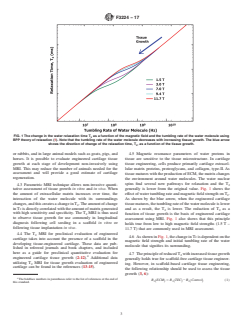
tative assessment of tissue growth in vitro and in vivo. When generally is lower from the original value. Fig. 1 shows the
the amount of extracellular matrix increases over time, the effectofwatertumblingrateandmagneticfieldstrengthonT .
interaction of the water molecule with its surroundings
As shown by the blue arrow, when the engineered cartilage
changes,andthiscreatesachangeinT .Theamountofchange
tissuematures,thetumblingrateofthewatermoleculeislower
inT isdirectlycorrelatedwiththeamountofmatrixgenerated
and as a result, the T is lower. The reduction of T as a
2 2
with high sensitivity and specificity. The T MRI is thus used
2 function of tissue growth is the basis of engineered cartilage
to observe tissue growth for use commonly in longitudinal
assessment using MRI. Fig. 1 also shows that this principle
diagnosis following cell seeding in a scaffold in vitro or
holds true from low to high magnetic field strengths (1.5 T –
following tissue implantation in vivo.
11.7 T) that are commonly used in MRI assessment.
4.4 The T MRI for preclinical evaluation of engineered
4.6 AsshowninFig.1,thechangeinT isdependentonthe
cartilage takes into account the presence of a scaffold in the
magnetic field strength and initial tumbling rate of the water
developing tissue-engineered cartilage. These data are pub-
molecule that signifies its surrounding.
lished in refereed journals and book chapters, and included
here as a guide for preclinical quantitative evaluation for
4.7 TheprincipleofreducedT withincreasedtissuegrowth
engineered cartilage tissue growth (2-12). Additional data
generally holds true for scaffold-free cartilage tissue engineer-
utilizing T MRI for tissue growth evaluation of engineered
2 ing. However, in scaffold-based cartilage tissue engineering,
cartilage can be found in the references (13-15).
the following relationship should be used to assess the tissue
growth (3, 6):
Theboldfacenumbersinparenthesesrefertothelistofreferencesattheendof
R ECM 5 R TEC 2R Control (1)
~ ! ~ ! ~ !
2 2 2
this standard.
F3224 − 17
where: performed using a dedicated small animal MRI scanner typi-
cally equipped with a bigger RF coil (~ 30-60 mm) where
R = 1/T ,
2 2
multiple such sample tubes can be arranged for simultaneous
R (ECM) = the calculated relaxation rate arising from
MRI assessment. If possible, it will be beneficial to measure
cartilage extracellular matrix,
both TEC sample and acellular control samples at the same
R (TEC) = the measured experimental relaxation rate of
the tissue-engineered cartilage graft, and time to reduce systematic errors.
R (Control) = the relaxation rate of the scaffold without
2 5.1.2 In Vivo MRI Assessment—In vivo assessment of engi-
cells.
neered cartilage can be performed using a dedicated small
animal MRI system or using a clinical MRI scanner. It is
4.7.1 The change in calculated relaxation rate, R (ECM),
expectedthatdifferentMRIhardwarewillbeusedaccordingto
using Eq 1 have been found to be positively correlated with
the need. Volume coils are more suitable for mouse or rat
tissue growth (3, 6).
models of tissue assessment whereas receive-only surface coil
5. MRI Assessment of Engineering Cartilage Tissue
may be used for rabbit or other large animal models that will
Growth
allowthebettervisualizationofsmalltestsamplesimplantedin
the animal. The sample outlines can be drawn using an MRI
5.1 Sample Preparation:
image as shown in Fig. 3.
5.1.1 In Vitro MRI Assessment—Typically, MRI tissue as-
sessment of early stage in vitro samples is performed using
5.2 MRI Measurement Process:
vertical bore high field MRI scanner and a small diameter
5.2.1 The process flowchart shown in Fig. 4 is used for
radiofrequency probe (~ 5-10 mm) that is equipped with
acquisitionandcalculationofdataforeachtimepointoftissue
gradientsinthex-,y-,andz-directionsandrelevantacquisition
assessment. Typically for in vitro assessment, the time points
software for pulse sequence generation and data acquisition.
may be every week whereas for in vivo assessment, it could be
The samples that are small (~ 3-5 mm in diameter) can be
every other week or every month. This standard envisions that
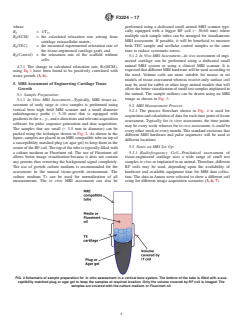
packed using the technique shown in Fig. 2. As shown in the
different MRI hardware and pulse sequences will be used at
figure,samplesareplacedinanMRI-compatibletubeontopof
different locations.
a susceptibility matched plug (or agar gel) to keep them in the
5.3 Notes on MRI Set Up:
centeroftheRFcoil.Thetopofthetubeistypicallyfilledwith
a culture medium or Fluorinert oil. The use of Fluorinert oil 5.3.1 Radiofrequency Coil—Preclinical assessment of
allows better image visualization because it does not contain tissue-engineered cartilage uses a wide range of small test
any protons thus removing the background signal completely. samples in vitroorimplantedinananimal.Therefore,different
The use of growth culture medium is recommended for the RF coils may be used, depending upon the availability of
assessment in the natural tissue-growth environment. The hardware and available equipment time for MRI data collec-
culture medium T can be used for normalization of all tion. The data inAnnex were selected to show a different coil
measurements. The in vitro MRI assessment can also be setup for different image acquisition scenarios (3, 6, 7).
FIG. 2 Schematic of sample preparation for in vitro assessment in a vertical bore system. The bottom of the tube is filled with a sus-
ceptibility matched plug or agar gel to keep the samples at required location. Only the volume covered by RF coil is imaged. The
samples are covered with the culture medium or Fluorinert oil.
F3224 − 17
FIG. 3 Schematic of sample preparation for in vivo engineered cartilage tissue grafts assessment using mouse subcutaneous model.
The bottom panel shows the T -weighted MRI image slice for locating the grafts and for drawing ROI for T calculations. The red out-
2 2
line shows the tissue engineered cartilage graft whereas the yellow outline shows the location of the acellular control graft.
FIG. 4 Flowchart for T map creation at each time point
5.3.2 Image Resolution—Typically, MRI at the preclinical are especially suitable for very high-resolution image acquisi-
stage is performed at a higher magnetic field strength that tion (~ 50 µm). Sin
...