

ASTM E2680-23
(Test Method)Standard Test Method for Appearance of Clear, Transparent Liquids (Visual Inspection Procedure)
General Information
- Abstract
SIGNIFICANCE AND USE
5.1 This method provides appearance of clear, transparent liquids. Many liquid organic products have a product specification requiring them to be clear and bright and free of visible particulate matter and of liquid phases other than the main liquid. Producers of these liquid organic products need a test method to confirm the quality of their products meets product specifications for appearance. Appearance is a manufacturing and sales specification test for ethylene and propylene glycol and polyol products and a loading specification test for methanol wall washes of marine vessels. This test method was originally designed for application to glycols and methanol wall washes of marine vessels, but may be applicable to other clear, transparent liquids. Individuals using this test method for other clear transparent liquids should assure themselves that the method is sufficient for use.
5.2 There are many factors that could affect the appearance during and after sampling of a liquid product. These factors may include transferring of the liquid into a different sample container, contamination by the sample container or contamination by ambient atmosphere. Sampling and evaluation procedures need to be followed to avoid undesirable effects and assure the appearance of the sample is typical for the liquid as manufactured.
SCOPE
1.1 This test method describes the visual assessment of the appearance of clear, transparent liquids for clarity and the presence of undesirable components (contamination) such as suspended matter, free water (or oil) and particulates when examined by transmitted light. Measurements requiring instrumentation are not included in this method. This test method was originally designed for application to glycols and methanol wall washes of marine vessels but may be applicable to other clear transparent liquids.
1.1.1 This test method can be used as a field test at storage temperatures or as a laboratory test at room temperatures.
1.1.2 This test method provides a visual appearance description of transparent liquids. It is a qualitative assessment only.
1.2 Review the current appropriate Safety Data Sheets (SDS) for detailed information concerning toxicity, first aid procedures, and safety precautions.
1.3 The values stated in SI units are to be regarded as standard. No other units of measurement are included in this standard.
1.4 This standard does not purport to address all of the safety concerns, if any, associated with its use. It is the responsibility of the user of this standard to establish appropriate safety, health, and environmental practices and determine the applicability of regulatory limitations prior to use. Consult current OSHA regulations, suppliers’ Safety Data Sheets, and local regulations for all materials used in this test method.
1.5 This international standard was developed in accordance with internationally recognized principles on standardization established in the Decision on Principles for the Development of International Standards, Guides and Recommendations issued by the World Trade Organization Technical Barriers to Trade (TBT) Committee.
- Status
- Published
- Publication Date
- 31-Oct-2023
- Technical Committee
- D16 - Aromatic, Industrial, Specialty and Related Chemicals
- Drafting Committee
- D16.04 - Instrumental Analysis
Buy Documents
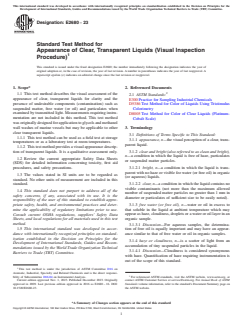
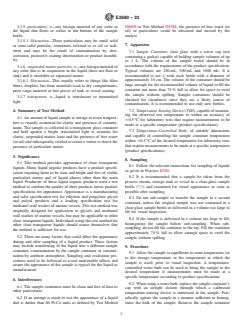


ASTM E2680-23 - Standard Test Method for Appearance of Clear, Transparent Liquids (Visual Inspection Procedure)
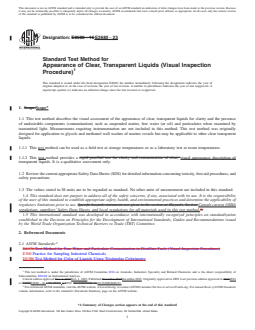
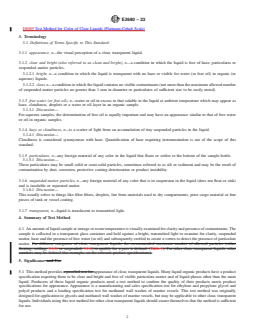
REDLINE ASTM E2680-23 - Standard Test Method for Appearance of Clear, Transparent Liquids (Visual Inspection Procedure)
Overview
ASTM E2680-23 is the internationally recognized standard test method for the visual inspection and assessment of the appearance of clear, transparent liquids. Established by ASTM International, this standard specifies a procedure to visually inspect liquids for clarity and the presence of undesirable components, including haze, suspended matter, particulates, free water, or oil, using transmitted light. Originally developed for glycols and methanol wall washes in marine vessels, ASTM E2680-23 is applicable to a broad range of clear, transparent liquid organic products where clarity and freedom from visible contamination are critical quality parameters.
Key Topics
- Visual Assessment Method: Focuses on the qualitative evaluation of liquid appearance, not requiring instrumentation. It provides a rapid "Bright" (clear and transparent) versus "Hazy" (cloudy or visually contaminated) determination.
- Detection Criteria: Inspects for cloudiness, visible suspended particles, floating or settling particulates, and free phases (water or oil) that may compromise product purity.
- Field and Laboratory Use: Suitable for both field testing at storage temperatures and laboratory settings at room temperature, enhancing its versatility for various operational environments.
- Sampling Best Practices: Emphasizes the importance of proper sampling-using clean glass containers, avoiding contamination during transfer, and minimizing exposure to ambient atmosphere to ensure accurate representation of the product’s as-manufactured appearance.
- Qualitative Reporting: Results are reported as "Bright", "Hazy", "Clear", or a descriptive account of observed contamination, according to the presence or absence of visible particulates and clarity.
Applications
ASTM E2680-23 offers significant practical value in industries where the physical appearance of clear, transparent liquids is a key specification:
- Glycol Production: Used for ethylene glycol, propylene glycol, diethylene glycol, and polyol products to ensure they meet market and regulatory clarity requirements.
- Marine Industry: Applied to methanol wall washes in marine vessel loading operations, where the absence of suspended matter or other phases is necessary for operational assurance and compliance.
- Chemical Manufacturing and Quality Control: Ensures products such as solvents and process fluids are free from unacceptable levels of particulates or phase separation prior to release or transport.
- On-Site Field Testing: Enables quick pass/fail screening of product quality at point-of-use, storage tanks, or during truck or rail loading operations.
- Wider Chemical Applications: While designed for specific products, it may be applied to other clear and transparent liquids, given proper validation for those product types.
Keywords: appearance inspection, visual clarity, particulate contamination, transparent liquids quality, clear and bright, visual assessment, glycol quality control, methanol wall wash inspection, liquid phase separation, ASTM standards for liquids
Related Standards
For further guidance on sampling and assessment of liquid products, users may refer to related ASTM standards:
- ASTM D4176: Test Method for Free Water and Particulate Contamination in Distillate Fuels (Visual Inspection Procedures)
- ASTM D5386: Test Method for Color of Liquids Using Tristimulus Colorimetry
- ASTM D8005: Test Method for Color of Clear Liquids (Platinum-Cobalt Scale)
- ASTM E300: Practice for Sampling Industrial Chemicals
By following ASTM E2680-23, quality and production professionals can ensure consistent, industry-recognized standards for the appearance of clear, transparent liquids, supporting regulatory compliance, customer satisfaction, and improved product quality control.
Relations
- Effective Date
- 01-Nov-2023
- Effective Date
- 01-Nov-2023
- Effective Date
- 01-Nov-2023
- Effective Date
- 01-Nov-2023
- Effective Date
- 01-Nov-2023
- Effective Date
- 01-Nov-2023
- Effective Date
- 01-Nov-2023
- Effective Date
- 01-Nov-2023
- Effective Date
- 01-Nov-2023
- Effective Date
- 01-Nov-2023
- Effective Date
- 01-Nov-2023
- Effective Date
- 01-Nov-2023
- Effective Date
- 01-Nov-2023
- Effective Date
- 01-Nov-2023
- Effective Date
- 01-Nov-2023
Buy Documents
ASTM E2680-23 - Standard Test Method for Appearance of Clear, Transparent Liquids (Visual Inspection Procedure)
REDLINE ASTM E2680-23 - Standard Test Method for Appearance of Clear, Transparent Liquids (Visual Inspection Procedure)
Get Certified
Connect with accredited certification bodies for this standard

DNV
DNV is an independent assurance and risk management provider.

Lloyd's Register
Lloyd's Register is a global professional services organisation specialising in engineering and technology.

FSC International
Forest Stewardship Council certification.
Sponsored listings
Frequently Asked Questions
ASTM E2680-23 is a standard published by ASTM International. Its full title is "Standard Test Method for Appearance of Clear, Transparent Liquids (Visual Inspection Procedure)". This standard covers: SIGNIFICANCE AND USE 5.1 This method provides appearance of clear, transparent liquids. Many liquid organic products have a product specification requiring them to be clear and bright and free of visible particulate matter and of liquid phases other than the main liquid. Producers of these liquid organic products need a test method to confirm the quality of their products meets product specifications for appearance. Appearance is a manufacturing and sales specification test for ethylene and propylene glycol and polyol products and a loading specification test for methanol wall washes of marine vessels. This test method was originally designed for application to glycols and methanol wall washes of marine vessels, but may be applicable to other clear, transparent liquids. Individuals using this test method for other clear transparent liquids should assure themselves that the method is sufficient for use. 5.2 There are many factors that could affect the appearance during and after sampling of a liquid product. These factors may include transferring of the liquid into a different sample container, contamination by the sample container or contamination by ambient atmosphere. Sampling and evaluation procedures need to be followed to avoid undesirable effects and assure the appearance of the sample is typical for the liquid as manufactured. SCOPE 1.1 This test method describes the visual assessment of the appearance of clear, transparent liquids for clarity and the presence of undesirable components (contamination) such as suspended matter, free water (or oil) and particulates when examined by transmitted light. Measurements requiring instrumentation are not included in this method. This test method was originally designed for application to glycols and methanol wall washes of marine vessels but may be applicable to other clear transparent liquids. 1.1.1 This test method can be used as a field test at storage temperatures or as a laboratory test at room temperatures. 1.1.2 This test method provides a visual appearance description of transparent liquids. It is a qualitative assessment only. 1.2 Review the current appropriate Safety Data Sheets (SDS) for detailed information concerning toxicity, first aid procedures, and safety precautions. 1.3 The values stated in SI units are to be regarded as standard. No other units of measurement are included in this standard. 1.4 This standard does not purport to address all of the safety concerns, if any, associated with its use. It is the responsibility of the user of this standard to establish appropriate safety, health, and environmental practices and determine the applicability of regulatory limitations prior to use. Consult current OSHA regulations, suppliers’ Safety Data Sheets, and local regulations for all materials used in this test method. 1.5 This international standard was developed in accordance with internationally recognized principles on standardization established in the Decision on Principles for the Development of International Standards, Guides and Recommendations issued by the World Trade Organization Technical Barriers to Trade (TBT) Committee.
SIGNIFICANCE AND USE 5.1 This method provides appearance of clear, transparent liquids. Many liquid organic products have a product specification requiring them to be clear and bright and free of visible particulate matter and of liquid phases other than the main liquid. Producers of these liquid organic products need a test method to confirm the quality of their products meets product specifications for appearance. Appearance is a manufacturing and sales specification test for ethylene and propylene glycol and polyol products and a loading specification test for methanol wall washes of marine vessels. This test method was originally designed for application to glycols and methanol wall washes of marine vessels, but may be applicable to other clear, transparent liquids. Individuals using this test method for other clear transparent liquids should assure themselves that the method is sufficient for use. 5.2 There are many factors that could affect the appearance during and after sampling of a liquid product. These factors may include transferring of the liquid into a different sample container, contamination by the sample container or contamination by ambient atmosphere. Sampling and evaluation procedures need to be followed to avoid undesirable effects and assure the appearance of the sample is typical for the liquid as manufactured. SCOPE 1.1 This test method describes the visual assessment of the appearance of clear, transparent liquids for clarity and the presence of undesirable components (contamination) such as suspended matter, free water (or oil) and particulates when examined by transmitted light. Measurements requiring instrumentation are not included in this method. This test method was originally designed for application to glycols and methanol wall washes of marine vessels but may be applicable to other clear transparent liquids. 1.1.1 This test method can be used as a field test at storage temperatures or as a laboratory test at room temperatures. 1.1.2 This test method provides a visual appearance description of transparent liquids. It is a qualitative assessment only. 1.2 Review the current appropriate Safety Data Sheets (SDS) for detailed information concerning toxicity, first aid procedures, and safety precautions. 1.3 The values stated in SI units are to be regarded as standard. No other units of measurement are included in this standard. 1.4 This standard does not purport to address all of the safety concerns, if any, associated with its use. It is the responsibility of the user of this standard to establish appropriate safety, health, and environmental practices and determine the applicability of regulatory limitations prior to use. Consult current OSHA regulations, suppliers’ Safety Data Sheets, and local regulations for all materials used in this test method. 1.5 This international standard was developed in accordance with internationally recognized principles on standardization established in the Decision on Principles for the Development of International Standards, Guides and Recommendations issued by the World Trade Organization Technical Barriers to Trade (TBT) Committee.
ASTM E2680-23 is classified under the following ICS (International Classification for Standards) categories: 47.020.99 - Other standards related to shipbuilding and marine structures. The ICS classification helps identify the subject area and facilitates finding related standards.
ASTM E2680-23 has the following relationships with other standards: It is inter standard links to ASTM E2680-16, ASTM D4734-20, ASTM D5309-22, ASTM D4077-23, ASTM D2827-19, ASTM D3193-19, ASTM D6367-21, ASTM D2359-19, ASTM D5871-19, ASTM D5471-23, ASTM D7951-20, ASTM D841-19, ASTM E1119-23, ASTM E2470-22, ASTM D7124-19. Understanding these relationships helps ensure you are using the most current and applicable version of the standard.
ASTM E2680-23 is available in PDF format for immediate download after purchase. The document can be added to your cart and obtained through the secure checkout process. Digital delivery ensures instant access to the complete standard document.
Standards Content (Sample)
This international standard was developed in accordance with internationally recognized principles on standardization established in the Decision on Principles for the
Development of International Standards, Guides and Recommendations issued by the World Trade Organization Technical Barriers to Trade (TBT) Committee.
Designation: E2680 − 23
Standard Test Method for
Appearance of Clear, Transparent Liquids (Visual Inspection
Procedure)
This standard is issued under the fixed designation E2680; the number immediately following the designation indicates the year of
original adoption or, in the case of revision, the year of last revision. A number in parentheses indicates the year of last reapproval. A
superscript epsilon (´) indicates an editorial change since the last revision or reapproval.
1. Scope* 2. Referenced Documents
1.1 This test method describes the visual assessment of the
2.1 ASTM Standards:
appearance of clear, transparent liquids for clarity and the
E300 Practice for Sampling Industrial Chemicals
presence of undesirable components (contamination) such as
D5386 Test Method for Color of Liquids Using Tristimulus
suspended matter, free water (or oil) and particulates when
Colorimetry
examined by transmitted light. Measurements requiring instru-
D8005 Test Method for Color of Clear Liquids (Platinum-
mentation are not included in this method. This test method
Cobalt Scale)
was originally designed for application to glycols and methanol
wall washes of marine vessels but may be applicable to other
3. Terminology
clear transparent liquids.
3.1 Definitions of Terms Specific to This Standard:
1.1.1 This test method can be used as a field test at storage
3.1.1 appearance, n—the visual perception of a clear, trans-
temperatures or as a laboratory test at room temperatures.
parent liquid.
1.1.2 This test method provides a visual appearance descrip-
3.1.2 clear and bright (also referred to as clean and bright),
tion of transparent liquids. It is a qualitative assessment only.
n—a condition in which the liquid is free of haze, particulates
1.2 Review the current appropriate Safety Data Sheets
or suspended matter particles.
(SDS) for detailed information concerning toxicity, first aid
3.1.2.1 bright, n—a condition in which the liquid is trans-
procedures, and safety precautions.
parent with no haze or visible fee water (or free oil) in organic
1.3 The values stated in SI units are to be regarded as
(or aqueous) liquids.
standard. No other units of measurement are included in this
3.1.2.2 clear, n—a condition in which the liquid contains no
standard.
visible contaminants (not more than the maximum allowed
1.4 This standard does not purport to address all of the
number of suspended matter particles no greater than 1 mm in
safety concerns, if any, associated with its use. It is the
diameter or particulates of sufficient size to be easily noted).
responsibility of the user of this standard to establish appro-
priate safety, health, and environmental practices and deter- 3.1.3 free water (or free oil), n—water or oil in excess to
that soluble in the liquid at ambient temperature which may
mine the applicability of regulatory limitations prior to use.
Consult current OSHA regulations, suppliers’ Safety Data appear as haze, cloudiness, droplets or a water or oil layer in an
Sheets, and local regulations for all materials used in this test organic sample.
method.
3.1.3.1 Discussion—For aqueous samples, the determina-
1.5 This international standard was developed in accor-
tion of free oil is equally important and may have an appear-
dance with internationally recognized principles on standard- ance similar to that of free water or oil in organic samples.
ization established in the Decision on Principles for the
3.1.4 haze or cloudiness, n—is a scatter of light from an
Development of International Standards, Guides and Recom-
accumulation of tiny suspended particles in the liquid.
mendations issued by the World Trade Organization Technical
3.1.4.1 Discussion—Cloudiness is considered synonymous
Barriers to Trade (TBT) Committee.
with haze. Quantification of haze requiring instrumentation is
out of the scope of this standard.
This test method is under the jurisdiction of ASTM Committee D16 on
Aromatic, Industrial, Specialty and Related Chemicals and is the direct responsi-
bility of Subcommittee D16.04 on Instrumental Analysis. For referenced ASTM standards, visit the ASTM website, www.astm.org, or
Current edition approved Nov. 1, 2023. Published December 2023. Originally contact ASTM Customer Service at service@astm.org. For Annual Book of ASTM
approved in 2009. Last previous edition approved in 2016 as E2680 – 16. DOI: Standards volume information, refer to the standard’s Document Summary page on
10.1520/E2680-23. the ASTM website.
*A Summary of Changes section appears at the end of this standard
Copyright © ASTM International, 100 Barr Harbor Drive, PO Box C700, West Conshohocken, PA 19428-2959. United States
E2680 − 23
3.1.5 particulates, n—any foreign material of any color in D8005 or Test Method D5386, the presence of free water (or
the liquid that floats or settles to the bottom of the sample oil) or particulates could be obscured and missed by the
bottle. analyst.
3.1.5.1 Discussion—These particulates may be small solid
7. Apparatus
or semi-solid particles, sometimes referred to as silt or sedi-
ment and may be the result of contamination by dust,
7.1 Sample Container, clear glass with a screw cap (not
corrosion, protective coating deterioration or product instabil-
containing a gasket) capable of holding sample volumes of up
ity.
to 1 L. The volume of the sample tested should be in
accordance with the requirements of the product specification.
3.1.6 suspended matter particles, n—any foreign material of
Typical volumes are 250 mL, 500 mL and 1000 mL. It is
any color that is in suspension in the liquid (does not float or
recommended to use a wide neck bottle with a diameter of
sink) and is insoluble or separated matter.
approximately 10 cm. The volume of the container should be
3.1.6.1 Discussion—This usually refers to things like filter
large enough for the recommended volume of liquid to fill the
fibers, droplets, lint from materials used to dry compartments,
container not more than 75 % full to allow for space to swirl
prior cargo material or fine pieces of tank or vessel coating.
the sample without spilling. Sample containers should be
3.1.7 transparent, n—liquid is translucent to transmitted
checked for cleanliness since they are a likely source of
light.
contamination. It is recommended to use only new bottles.
7.2 Temperature Sensing Device (TSD), capable of monitor-
4. Summary of Test Method
ing the observed test temperature to within an accuracy of
4.1 An amount of liquid sample at storage or room tempera-
60.5 ºC for laboratory tests that require measurements to be
ture is visually examined for clarity and presence of contami-
made at a specific temperature (product specifications).
nants. The sample is collected in a transparent glass container
7.3 Temperature-Controlled Bath, of suitable dimensions
and held against a bright, transmitted light to examine for
and capable of controlling the sample container temperature
clarity, suspended matter, haze and the presence of free water
within 60.5 ºC of the desired temperature for laboratory tests
(or oil) and subsequently swirled to create a vortex to detect the
that require mea
...
This document is not an ASTM standard and is intended only to provide the user of an ASTM standard an indication of what changes have been made to the previous version. Because
it may not be technically possible to adequately depict all changes accurately, ASTM recommends that users consult prior editions as appropriate. In all cases only the current version
of the standard as published by ASTM is to be considered the official document.
Designation: E2680 − 16 E2680 − 23
Standard Test Method for
Appearance of Clear, Transparent Liquids (Visual Inspection
Procedure)
This standard is issued under the fixed designation E2680; the number immediately following the designation indicates the year of
original adoption or, in the case of revision, the year of last revision. A number in parentheses indicates the year of last reapproval. A
superscript epsilon (´) indicates an editorial change since the last revision or reapproval.
1. Scope Scope*
1.1 This test method describes the visual assessment of the appearance of clear, transparent liquids for clarity and the presence
of undesirable components (contamination) such as suspended matter, free water (or oil) and particulates when examined by
transmitted light. Measurements requiring instrumentation are not included in this method. This test method was originally
designed for application to glycols and methanol wall washes of marine vessels but may be applicable to other clear transparent
liquids.
1.1.1 This test method can be used as a field test at storage temperatures or as a laboratory test at room temperatures.
1.1.2 This test method provides a rapid pass/fail test for clarity and contamination of clear, visual appearance description of
transparent liquids. It is a qualitative assessment only.
1.2 Review the current appropriate Safety Data Sheets (SDS) for detailed information concerning toxicity, first aid procedures, and
safety precautions.
1.3 The values stated in SI units are to be regarded as standard. No other units of measurement are included in this standard.
1.4 This standard does not purport to address all of the safety concerns, if any, associated with its use. It is the responsibility
of the user of this standard to establish appropriate safety, health, and environmental practices and determine the applicability of
regulatory limitations prior to use. Specific hazards statements are given in the section on Hazards, Section Consult current OSHA
regulations, suppliers’ Safety Data Sheets, and local regulations for all materials used in this test method.8.
1.5 This international standard was developed in accordance with internationally recognized principles on standardization
established in the Decision on Principles for the Development of International Standards, Guides and Recommendations issued
by the World Trade Organization Technical Barriers to Trade (TBT) Committee.
2. Referenced Documents
2.1 ASTM Standards:
D4176 Test Method for Free Water and Particulate Contamination in Distillate Fuels (Visual Inspection Procedures)
E300 Practice for Sampling Industrial Chemicals
D5386 Test Method for Color of Liquids Using Tristimulus Colorimetry
This test method is under the jurisdiction of ASTM Committee D16 on Aromatic, Industrial, Specialty and Related Chemicals and is the direct responsibility of
Subcommittee D16.04 on Instrumental Analysis.
Current edition approved Dec. 1, 2016Nov. 1, 2023. Published December 2016December 2023. Originally approved in 2009. Last previous edition approved in 20152016
ɛ1
as E2680E2680 – 16.– 09 (2015) . DOI: 10.1520/E2680-16.10.1520/E2680-23.
For referenced ASTM standards, visit the ASTM website, www.astm.org, or contact ASTM Customer Service at service@astm.org. For Annual Book of ASTM Standards
volume information, refer to the standard’s Document Summary page on the ASTM website.
*A Summary of Changes section appears at the end of this standard
Copyright © ASTM International, 100 Barr Harbor Drive, PO Box C700, West Conshohocken, PA 19428-2959. United States
E2680 − 23
D8005 Test Method for Color of Clear Liquids (Platinum-Cobalt Scale)
3. Terminology
3.1 Definitions of Terms Specific to This Standard:
3.1.1 appearance, n—the visual perception of a clear, transparent liquid.
3.1.2 clear and bright (also referred to as clean and bright), n—a condition in which the liquid is free of haze, particulates or
suspended matter particles.
3.1.2.1 bright, n—a condition in which the liquid is transparent with no haze or visible fee water (or free oil) in organic (or
aqueous) liquids.
3.1.2.2 clear, n—a condition in which the liquid contains no visible contaminants (not more than the maximum allowed number
of suspended matter particles no greater than 1 mm in diameter or particulates of sufficient size to be easily noted).
3.1.3 free water (or free oil), n—water or oil in excess to that soluble in the liquid at ambient temperature which may appear as
haze, cloudiness, droplets or a water or oil layer in an organic sample.
3.1.3.1 Discussion—
For aqueous samples, the determination of free oil is equally important and may have an appearance similar to that of free water
or oil in organic samples.
3.1.4 haze or cloudiness, n—is a scatter of light from an accumulation of tiny suspended particles in the liquid.
3.1.4.1 Discussion—
Cloudiness is considered synonymous with haze. Quantification of haze requiring instrumentation is out of the scope of this
standard.
3.1.5 particulates, n—any foreign material of any color in the liquid that floats or settles to the bottom of the sample bottle.
3.1.5.1 Discussion—
These particulates may be small solid or semi-solid particles, sometimes referred to as silt or sediment and may be the result of
contamination by dust, corrosion, protective coating deterioration or product instability.
3.1.6 suspended matter particles, n—any foreign material of any color that is in suspension in the liquid (does not float or sink)
and is insoluble or separated matter.
3.1.6.1 Discussion—
This usually refers to things like filter fibers, droplets, lint from materials used to dry compartments, prior cargo material or fine
pieces of tank or vessel coating.
3.1.7 transparent, n—liquid is translucent to transmitted light.
4. Summary of Test Method
4.1 An amount of liquid sample at storage or room temperature is visually examined for clarity and presence of contaminants. The
sample is collected in a transparent glass container and held against a bright, transmitted light to examine for clarity, suspended
matter, haze and the presence of free water (or oil) and subsequently swirled to create a vortex to detect the presence of particulate
matter. For different categories of clear, transparent liquids, the recommended maximum number of allowed particles (either
floating, settling, 3.1.5, or suspended, 3.1.6) to qualify for a pass is defined. (Table 1). For other clear, transparent liquids, other
numbers may be defined (for example, on the relevant product specifications).
5. Significance and Use
5.1 This method provides a pass/fail test for appearance of clear, transparent liquids. Many liquid organic products have a product
specification requiring them to be clear and bright and free of visible particulate matter and of liquid phases other than the main
liquid. Producers of these liquid organic products need a test method to confirm the quality of their products meets product
specifications for appearance. Appearance is a manufacturing and sales specification test for ethylene and propylene glycol and
polyol products and a loading specification test for methanol wall washes of marine vessels. This test method was originally
designed for application to glycols and methanol wall washes of marine vessels, but may be applicable to other clear, transparent
liquids. Individuals using this test method for other clear transparent liquids should assure themselves that the method is sufficient
for use.
E2680 − 23
5.2 There are many factors that could affect the appearance during and after sampling of a liquid product. These factors may
include transferring of the liquid into a different sample container, contamination by the sample container or contamination by
ambient atmosphere. Sampling and evaluation procedures need to be followed to avoid undesirable effects and assure the
appearance of the sample is typical for the liquid as manufactured.
6. Interferences
6.1 The sample containers must be clean and free of dust or other particulates.
6.2 If an attempt is made to test the appearance of a liquid that is darker than a color rating of 5 on the ASTM Color scale (Test
60 Pt-Co units as defined by Test Method D4176D8005) or 60 Pt-Co or Test Method D5386units,, the presence of free water (or
oil) or particulates could be obscured and missed by the analyst.
7. Apparatus
7.1 Sample Container, clear glass with a screw cap (not containing a gasket) capable of holding sample volumes of up to 1 L. The
volume of the sample tested should be in accordance with the requirements of the product specification. Typical volumes are 250,
500250 mL, 500 mL and 1000 mL. It is recommended to use a wide neck bottle with a diameter of approximately 10 cm. The
volume of the container should be large enough for the recommended volume of liquid to fill the container not more than 75 %
full to allow for space to swirl the sample without spilling. Sample containers should be che
...