

ASTM F2001-15(2022)
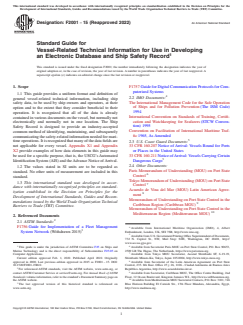
(Guide)Standard Guide for Vessel-Related Technical Information for Use in Developing an Electronic Database and Ship Safety Record
General Information
- Abstract
ABSTRACT
This guide provides a uniform format and definition of general vessel-related technical information, including ship safety data, to be used by ship owners and operators, at their option and to the extent that they consider beneficial to their operation. It is recognized that all of the data is already contained in various documents on the vessel, but normally not electronically and normally not in one location. The ship safety record is designed to provide an industry-accepted common method of identifying, maintaining, and subsequently communicating the safety-related information needed for maritime operations. The ship safety record is an electronic database of information pertaining to a specific vessel including information related to the safe operation of the vessel and the safety of its crew and the environment. The vessel particulars, vessel status, crew requirements, status of crew and persons other than passengers on board, voyage specific data, record of inspection, record of incidents and corrective actions are presented in details.
SIGNIFICANCE AND USE
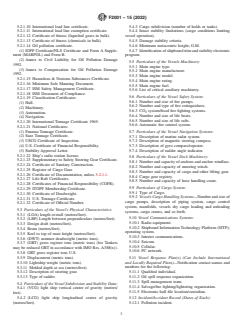
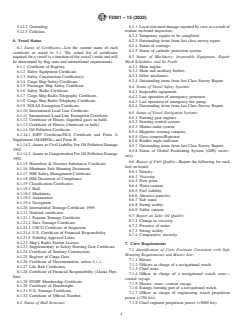
4.1 The Ship Safety Record is an electronic database of information pertaining to a specific vessel including information related to the safe operation of the vessel and the safety of it’s crew and the environment. The data is grouped and organized under the following key categories: vessel particulars, vessel status, crew requirements, crew status, voyage specific data, record of inspection, record of incidents, and corrective actions.
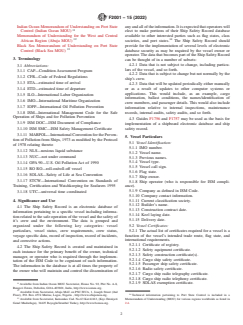
4.2 The Ship Safety Record is created and maintained in each instance for the primary benefit of the owner, technical manager, or operator who is required through the implementation of the ISM Code to be cognizant of such information. The information in the database is at all times the property of the owner who will maintain and control the dissemination of any and all of the information. It is expected that operators will elect to make portions of their Ship Safety Record database available to other interested parties such as flag states, class societies, and port states.14 The Ship Safety Record should provide for the implementation of several levels of electronic database security as may be required by the vessel owner or operator. The data that becomes part of the Ship Safety Record can be thought of in a number of subsets:
4.2.1 Data that is not subject to change, including particulars of the vessel, and so forth.
4.2.2 Data that is subject to change but not normally by the ship’s crew.
4.2.3 Data that will be updated periodically either manually or as a result of updates to other computer systems or applications. This would include, as an example, cargo information, ballast conditions, the names/identification of crew members, and passenger details. This would also include information relative to internal inspections, maintenance records, internal audits, safety audits, and so forth.
4.3 Guides F1756 and F1757 may be used as the basis for implementation of a shipboard electronic database and ship safety record.
SCOPE
1.1 This guide provides a uniform format and definition of general vessel-related technical information, including ship safety data, to be used by ship owners and operators, at their option and to the extent that they consider beneficial to their operation. It is recognized that all of the data is already contained in various documents on the vessel, but normally not electronically and normally not in one location. The Ship Safety Record is designed to provide an industry-accepted common method of identifying, maintaining, and subsequently communicating the safety-related information needed for maritime operations. It is recognized that many of the data fields are not applicable for every vessel. Appendix X1 and Appendix X2 provide examples of how data elements in this guide may be used for a specific purpose, that is, the USCG’s Automated Identification System (AIS) and the...
- Status
- Published
- Publication Date
- 31-Jan-2022
- Technical Committee
- F25 - Ships and Marine Technology
- Drafting Committee
- F25.05 - Computer Applications
Overview
ASTM F2001-15(2022), Standard Guide for Vessel-Related Technical Information for Use in Developing an Electronic Database and Ship Safety Record, establishes a uniform approach for organizing and defining vessel-related technical data, including ship safety information. Intended for voluntary use by ship owners, operators, and technical managers, the guide supports the creation and maintenance of an electronic Ship Safety Record (SSR). By consolidating disparate documents and information into a centralized electronic database, the standard enables clear identification, maintenance, and communication of data critical to maritime safety, vessel operation, crew well-being, and environmental protection.
This standard is designed to facilitate compliance with international maritime regulations, such as the ISM Code and various port state control agreements, supporting data transparency, accuracy, and secure access for both internal stakeholders and, when appropriate, external authorities.
Key Topics
- Uniform Data Structure: Provides guidance for organizing vessel technical details, safety data, certifications, and operational records in a consistent format.
- Ship Safety Record (SSR): Defines the composition and management of electronic databases containing all essential information about a vessel for safe and efficient operation.
- Data Categories: Outlines key categories of information:
- Vessel particulars and identification details
- Vessel status, certificates, and inspection records
- Crew requirements, qualifications, and training
- Crew and non-passenger status and assignments
- Voyage-specific data, including cargo and ballast information
- Records of incidents, audits, maintenance, and corrective actions
- Security and Control: Recommends multi-level database security controls, ensuring owners and operators retain authority over sensitive data dissemination.
- Integration: Allows for data to be regularly updated manually or through integration with other digital systems-improving accuracy and relevance.
- Regulatory Reference: Supports compliance with international (IMO), national (USCG), and port state requirements by referencing related regulations and Memoranda of Understanding (MOUs).
Applications
The adoption of ASTM F2001-15(2022) delivers practical value for a wide variety of maritime industry stakeholders:
- Fleet Operations: Enhances efficiency by consolidating vessel information into a single, easily accessible platform, streamlining recordkeeping and reporting.
- Ship Safety Compliance: Supports managers and operators in meeting ISM Code requirements through standardized data collection and organization.
- Audit and Inspection Readiness: Facilitates rapid access to current certification, inspection, and maintenance records for internal audits, external surveys, and port state controls.
- Crew Management: Provides detailed oversight of crew qualifications, training, work/rest hours, and medical fitness, supporting safe manning and compliance with the STCW Convention.
- Incident Response: Enables swift reporting of incidents, accidents, and corrective actions by maintaining up-to-date logs and communication records, aiding regulatory reporting and insurance claims.
- Data Sharing with Stakeholders: Allows selective, secure sharing of relevant ship safety and operational data to flag states, classification societies, port states, and authorities as needed.
Related Standards
When developing or maintaining a ship safety record or vessel electronic database, the following standards and references are relevant and may be used in conjunction with ASTM F2001-15(2022):
- ASTM F1757: Guide for Digital Communication Protocols for Computerized Systems
- International Maritime Organization (IMO):
- International Management Code for the Safe Operation of Ships and for Pollution Prevention (ISM Code)
- International Convention on Standards of Training, Certification and Watchkeeping for Seafarers (STCW)
- International Convention for the Safety of Life at Sea (SOLAS)
- US Coast Guard Regulations:
- 33 CFR 160 - Notices of Arrival for vessels bound for US ports
- International MOUs on Port State Control: Paris, Tokyo, Caribbean, Mediterranean, Black Sea, Indian Ocean, Abuja, and others
Keywords: vessel electronic database, ship safety record, maritime safety, ASTM F2001, ISM Code, port state control, crew qualifications, maritime compliance
Relations
- Refers
ASTM F1757-96(2008) - Standard Guide for Digital Communication Protocols for Computerized Systems - Effective Date
- 01-May-2008
- Effective Date
- 01-May-2008
- Effective Date
- 10-Nov-1997
- Refers
ASTM F1757-96(2002) - Standard Guide for Digital Communication Protocols for Computerized Systems - Effective Date
- 10-Nov-1996
Get Certified
Connect with accredited certification bodies for this standard

DNV
DNV is an independent assurance and risk management provider.

Lloyd's Register
Lloyd's Register is a global professional services organisation specialising in engineering and technology.

FSC International
Forest Stewardship Council certification.
Sponsored listings
Frequently Asked Questions
ASTM F2001-15(2022) is a guide published by ASTM International. Its full title is "Standard Guide for Vessel-Related Technical Information for Use in Developing an Electronic Database and Ship Safety Record". This standard covers: ABSTRACT This guide provides a uniform format and definition of general vessel-related technical information, including ship safety data, to be used by ship owners and operators, at their option and to the extent that they consider beneficial to their operation. It is recognized that all of the data is already contained in various documents on the vessel, but normally not electronically and normally not in one location. The ship safety record is designed to provide an industry-accepted common method of identifying, maintaining, and subsequently communicating the safety-related information needed for maritime operations. The ship safety record is an electronic database of information pertaining to a specific vessel including information related to the safe operation of the vessel and the safety of its crew and the environment. The vessel particulars, vessel status, crew requirements, status of crew and persons other than passengers on board, voyage specific data, record of inspection, record of incidents and corrective actions are presented in details. SIGNIFICANCE AND USE 4.1 The Ship Safety Record is an electronic database of information pertaining to a specific vessel including information related to the safe operation of the vessel and the safety of it’s crew and the environment. The data is grouped and organized under the following key categories: vessel particulars, vessel status, crew requirements, crew status, voyage specific data, record of inspection, record of incidents, and corrective actions. 4.2 The Ship Safety Record is created and maintained in each instance for the primary benefit of the owner, technical manager, or operator who is required through the implementation of the ISM Code to be cognizant of such information. The information in the database is at all times the property of the owner who will maintain and control the dissemination of any and all of the information. It is expected that operators will elect to make portions of their Ship Safety Record database available to other interested parties such as flag states, class societies, and port states.14 The Ship Safety Record should provide for the implementation of several levels of electronic database security as may be required by the vessel owner or operator. The data that becomes part of the Ship Safety Record can be thought of in a number of subsets: 4.2.1 Data that is not subject to change, including particulars of the vessel, and so forth. 4.2.2 Data that is subject to change but not normally by the ship’s crew. 4.2.3 Data that will be updated periodically either manually or as a result of updates to other computer systems or applications. This would include, as an example, cargo information, ballast conditions, the names/identification of crew members, and passenger details. This would also include information relative to internal inspections, maintenance records, internal audits, safety audits, and so forth. 4.3 Guides F1756 and F1757 may be used as the basis for implementation of a shipboard electronic database and ship safety record. SCOPE 1.1 This guide provides a uniform format and definition of general vessel-related technical information, including ship safety data, to be used by ship owners and operators, at their option and to the extent that they consider beneficial to their operation. It is recognized that all of the data is already contained in various documents on the vessel, but normally not electronically and normally not in one location. The Ship Safety Record is designed to provide an industry-accepted common method of identifying, maintaining, and subsequently communicating the safety-related information needed for maritime operations. It is recognized that many of the data fields are not applicable for every vessel. Appendix X1 and Appendix X2 provide examples of how data elements in this guide may be used for a specific purpose, that is, the USCG’s Automated Identification System (AIS) and the...
ABSTRACT This guide provides a uniform format and definition of general vessel-related technical information, including ship safety data, to be used by ship owners and operators, at their option and to the extent that they consider beneficial to their operation. It is recognized that all of the data is already contained in various documents on the vessel, but normally not electronically and normally not in one location. The ship safety record is designed to provide an industry-accepted common method of identifying, maintaining, and subsequently communicating the safety-related information needed for maritime operations. The ship safety record is an electronic database of information pertaining to a specific vessel including information related to the safe operation of the vessel and the safety of its crew and the environment. The vessel particulars, vessel status, crew requirements, status of crew and persons other than passengers on board, voyage specific data, record of inspection, record of incidents and corrective actions are presented in details. SIGNIFICANCE AND USE 4.1 The Ship Safety Record is an electronic database of information pertaining to a specific vessel including information related to the safe operation of the vessel and the safety of it’s crew and the environment. The data is grouped and organized under the following key categories: vessel particulars, vessel status, crew requirements, crew status, voyage specific data, record of inspection, record of incidents, and corrective actions. 4.2 The Ship Safety Record is created and maintained in each instance for the primary benefit of the owner, technical manager, or operator who is required through the implementation of the ISM Code to be cognizant of such information. The information in the database is at all times the property of the owner who will maintain and control the dissemination of any and all of the information. It is expected that operators will elect to make portions of their Ship Safety Record database available to other interested parties such as flag states, class societies, and port states.14 The Ship Safety Record should provide for the implementation of several levels of electronic database security as may be required by the vessel owner or operator. The data that becomes part of the Ship Safety Record can be thought of in a number of subsets: 4.2.1 Data that is not subject to change, including particulars of the vessel, and so forth. 4.2.2 Data that is subject to change but not normally by the ship’s crew. 4.2.3 Data that will be updated periodically either manually or as a result of updates to other computer systems or applications. This would include, as an example, cargo information, ballast conditions, the names/identification of crew members, and passenger details. This would also include information relative to internal inspections, maintenance records, internal audits, safety audits, and so forth. 4.3 Guides F1756 and F1757 may be used as the basis for implementation of a shipboard electronic database and ship safety record. SCOPE 1.1 This guide provides a uniform format and definition of general vessel-related technical information, including ship safety data, to be used by ship owners and operators, at their option and to the extent that they consider beneficial to their operation. It is recognized that all of the data is already contained in various documents on the vessel, but normally not electronically and normally not in one location. The Ship Safety Record is designed to provide an industry-accepted common method of identifying, maintaining, and subsequently communicating the safety-related information needed for maritime operations. It is recognized that many of the data fields are not applicable for every vessel. Appendix X1 and Appendix X2 provide examples of how data elements in this guide may be used for a specific purpose, that is, the USCG’s Automated Identification System (AIS) and the...
ASTM F2001-15(2022) is classified under the following ICS (International Classification for Standards) categories: 47.020.99 - Other standards related to shipbuilding and marine structures. The ICS classification helps identify the subject area and facilitates finding related standards.
ASTM F2001-15(2022) has the following relationships with other standards: It is inter standard links to ASTM F1757-96(2008), ASTM F1756-97a(2008), ASTM F1756-97a(2002), ASTM F1757-96(2002). Understanding these relationships helps ensure you are using the most current and applicable version of the standard.
ASTM F2001-15(2022) is available in PDF format for immediate download after purchase. The document can be added to your cart and obtained through the secure checkout process. Digital delivery ensures instant access to the complete standard document.
Standards Content (Sample)
This international standard was developed in accordance with internationally recognized principles on standardization established in the Decision on Principles for the
Development of International Standards, Guides and Recommendations issued by the World Trade Organization Technical Barriers to Trade (TBT) Committee.
Designation: F2001 − 15 (Reapproved 2022) An American National Standard
Standard Guide for
Vessel-Related Technical Information for Use in Developing
an Electronic Database and Ship Safety Record
This standard is issued under the fixed designation F2001; the number immediately following the designation indicates the year of
original adoption or, in the case of revision, the year of last revision. A number in parentheses indicates the year of last reapproval. A
superscript epsilon (´) indicates an editorial change since the last revision or reapproval.
1. Scope F1757 GuideforDigitalCommunicationProtocolsforCom-
puterized Systems
1.1 This guide provides a uniform format and definition of
2.2 IMO Documents:
general vessel-related technical information, including ship
The International Management Code for the Safe Operation
safety data, to be used by ship owners and operators, at their
of Ships and for Pollution Prevention (The ISM Code)
option and to the extent that they consider beneficial to their
operation. It is recognized that all of the data is already
International Convention on Standards of Training, Certifi-
contained in various documents on the vessel, but normally not
cation and Watchkeeping for Seafarers (STCW Conven-
electronically and normally not in one location. The Ship
tion) 1995
Safety Record is designed to provide an industry-accepted
Convention on Facilitation of International Maritime Traf-
common method of identifying, maintaining, and subsequently
fic 1965, As Amended
communicatingthesafety-relatedinformationneededformari-
timeoperations.Itisrecognizedthatmanyofthedatafieldsare
2.3 U.S. Coast Guard Documents:
not applicable for every vessel. Appendix X1 and Appendix 33 CFR 160.207 Notice of Arrival: Vessels Bound for Ports
X2 provide examples of how data elements in this guide may
or Places in the United States
be used for a specific purpose, that is, the USCG’s Automated 33 CFR 160.211 Notice ofArrival: Vessels Carrying Certain
IdentificationSystem(AIS)andtheAdvanceNoticeofArrival.
Dangerous Cargo
2.4 Other Documents:
1.2 The values stated in SI units are to be regarded as
Paris Memorandum of Understanding (MOU) on Port State
standard. No other units of measurement are included in this
Control
standard.
TokyoMemorandumofUnderstanding(MOU)onPortState
1.3 This international standard was developed in accor-
Control
dance with internationally recognized principles on standard-
Acuerdo de Vina del Mar (MOU) Latin American Agree-
ization established in the Decision on Principles for the
ment
Development of International Standards, Guides and Recom-
Memorandum of Understanding on Port State Control in the
mendations issued by the World Trade Organization Technical
Caribbean Region (Caribbean MOU)
Barriers to Trade (TBT) Committee.
Memorandum of Understanding on Port State Control in the
Mediterranean Region (Mediterranean MOU)
2. Referenced Documents
2.1 ASTM Standards:
F1756 Guide for Implementation of a Fleet Management 4
Available from International Maritime Organization (IMO), 4, Albert
System Network (Withdrawn 2015) Embankment, London, UK, SEI 7SR, http://www.imo.org.
AvailablefromU.S.GovernmentPrintingOfficeSuperintendentofDocuments,
732 N. Capitol St., NW, Mail Stop: SDE, Washington, DC 20401, http://
www.access.gpo.gov.
1 6
This guide is under the jurisdiction of ASTM Committee F25 on Ships and Available from Secretariat Paris MOU on Port State Control, P.O. Box 90653,
Marine Technology and is the direct responsibility of Subcommittee F25.05 on 2509 LR The Hague, The Netherlands, https://www.parismou.org.
Computer Applications. Available from Tokyo MOU Secretariat, Ascend Shimbashi 8F, 6-19-19,
Current edition approved Feb. 1, 2022. Published April 2022. Originally Shimbashi Minato-Ku, Tokyo, Japan 105-0004, http://www.tokyo-mou.org.
approved in 2000. Last previous edition approved in 2015 as F2001 – 15. DOI: Available from Secretariat of the Latin American Agreement on Port State
10.1520/F2001-15R22. Control, 235. 8th floor. Office 25 y 26, 1106 - Ciudad Autónoma de Buenos Aires
For referenced ASTM standards, visit the ASTM website, www.astm.org, or República Argentina, http://www.acuerdolatino.int.ar.
contact ASTM Customer Service at service@astm.org. For Annual Book of ASTM Available from Secretariat, Caribbean MOU, The Office Centre Building, 2nd
Standards volume information, refer to the standard’s Document Summary page on Floor, 12 Ocean Boulevard, Kingston Jamaica W.I., http://www.caribbeanmou.org.
the ASTM website. AvailablefromMediterraneanMOUSecretariatContacts,P.O.Box:3101,746
The last approved version of this historical standard is referenced on Blue Horizon Building El Cornish Str., 17th Floor Mandara, Alexandria, Egypt,
www.astm.org. http://www.medmou.org.
Copyright © ASTM International, 100 Barr Harbor Drive, PO Box C700, West Conshohocken, PA 19428-2959. United States
F2001 − 15 (2022)
Indian Ocean Memorandum of Understanding on Port State any and all of the information. It is expected that operators will
Control (Indian Ocean MOU) elect to make portions of their Ship Safety Record database
Memorandum of Understanding for the West and Central available to other interested parties such as flag states, class
12 14
African Region (Abuja MOU) societies, and port states. The Ship Safety Record should
Black Sea Memorandum of Understanding on Port State provide for the implementation of several levels of electronic
Control (Black Sea MOU) database security as may be required by the vessel owner or
operator. The data that becomes part of the Ship Safety Record
3. Terminology
can be thought of in a number of subsets:
4.2.1 Data that is not subject to change, including particu-
3.1 Abbreviations:
lars of the vessel, and so forth.
3.1.1 CAP—Condition Assessment Program
4.2.2 Data that is subject to change but not normally by the
3.1.2 CFR—Code of Federal Regulations
ship’s crew.
3.1.3 ETA—estimated time of arrival
4.2.3 Data that will be updated periodically either manually
3.1.4 ETD—estimated time of departure
or as a result of updates to other computer systems or
applications. This would include, as an example, cargo
3.1.5 ILO—International Labor Organization
information, ballast conditions, the names/identification of
3.1.6 IMO—International Maritime Organization
crew members, and passenger details. This would also include
3.1.7 IOPP—International Oil Pollution Prevention
information relative to internal inspections, maintenance
3.1.8 ISM—International Management Code for the Safe records, internal audits, safety audits, and so forth.
Operation of Ships and for Pollution Prevention
4.3 Guides F1756 and F1757 may be used as the basis for
3.1.9 ISM DOC—ISM Document of Compliance
implementation of a shipboard electronic database and ship
safety record.
3.1.10 ISM SMC—ISM Safety Management Certificate
3.1.11 MARPOL—InternationalConventionforthePreven-
5. Vessel Particulars
tion of Pollution from Ships, 1973 as modified by the Protocol
5.1 Vessel Identification:
of 1978 relating thereto
5.1.1 IMO number.
3.1.12 NLS—noxious liquid substance
5.1.2 Vessel name.
3.1.13 NUC—not under command
5.1.3 Previous names.
5.1.4 Vessel type.
3.1.14 OPA 90—U.S. Oil Pollution Act of 1990
5.1.5 Vessel call sign.
3.1.15 RO RO—roll-on/roll-off vessel
5.1.6 Flag state.
3.1.16 SOLAS—Safety of Life at Sea Convention
5.1.7 Ship owner.
3.1.17 STCW—International Convention on Standards of
5.1.8 Ship operator (who is responsible for ISM compli-
Training, Certification and Watchkeeping for Seafarers 1995
ance).
5.1.9 Company as defined in ISM Code.
3.1.18 UTC—universal time coordinated
5.1.10 Company contact information.
5.1.11 Current classification society.
4. Significance and Use
5.1.12 Builder’s name.
4.1 The Ship Safety Record is an electronic database of
5.1.13 Construction contract date.
information pertaining to a specific vessel including informa-
5.1.14 Keel laying date.
tion related to the safe operation of the vessel and the safety of
5.1.15 Delivery date.
it’s crew and the environment. The data is grouped and
organized under the following key categories: vessel 5.2 Vessel Certificates:
particulars, vessel status, crew requirements, crew status, 5.2.1 The actual list of certificates required for a vessel is a
voyage specific data, record of inspection, record of incidents, function of the vessel’s intended trade route, flag state, and
and corrective actions. international requirements.
5.2.1.1 Certificate of registry.
4.2 The Ship Safety Record is created and maintained in
5.2.1.2 Safety equipment certificate.
each instance for the primary benefit of the owner, technical
5.2.1.3 Safety construction certificate(s).
manager, or operator who is required through the implemen-
5.2.1.4 Cargo ship safety certificate.
tation of the ISM Code to be cognizant of such information.
5.2.1.5 Passenger ship safety certificate.
The information in the database is at all times the property of
5.2.1.6 Radio safety certificate.
the owner who will maintain and control the dissemination of
5.2.1.7 Cargo ship radio telegraphy certificate.
5.2.1.8 Cargo ship radio telephony certificate.
5.2.1.9 SOLAS exemption certificate.
Available from Indian Ocean MOU Secretariat, House No. 92, Plot No. A-8,
Rangavi Estate, Dabolim, GOA-403801, India, http://www.iomou.org.
Available from Secretariat, Abuja MoU on PSC-WCA, 1, Joseph Street (2nd
Floor), P.O. Box 4574 Marine, Lagos, Nigeria , http://www.abujamou.org. Technical information pertaining to Port State Control is included in a
Available from Secretariat, Kemankes Cad. No.63 Kat:4/412, (Kıyı Emniyeti Memorandum of Understanding (MOU) for various regions worldwide as listed in
Genel Mudurlugu), 34425 Beyoglu/Istanbul Turkey, http://www.bsmou.org. 2.4.
F2001 − 15 (2022)
5.2.1.10 International load line certificate. 5.4.3 Cargo subdivision (number of holds or tanks).
5.2.1.11 International load line exemption certificate. 5.4.4 Intact stability limitations (cargo conditions limiting
5.2.1.12 Certificate of fitness (liquefied gases in bulk). vessel operation).
5.2.1.13 Certificate of fitness (chemicals in bulk). 5.4.5 Damage stability criteria.
5.2.1.14 Oil pollution certificate. 5.4.6 Minimum metacentric height; G.M.
(1) IOPP Certificate/NLS Certificate and Form A Supple- 5.4.7 Identificationofshipboardtrimandstabilityelectronic
ment (MARPOL) and Form B. program.
(2) Annex to Civil Liability for Oil Pollution Damage
5.5 Particulars of the Vessels Machinery:
1992.
5.5.1 Main engine type.
(3) Annex to Compensation for Oil Pollution Damage
5.5.2 Main engine manufacturer.
1992.
5.5.3 Main engine model.
5.2.1.15 Hazardous & Noxious Substances Certificate.
5.5.4 Main engine rating.
5.2.1.16 Minimum Safe Manning Document.
5.5.5 Main engine fuel.
5.2.1.17 ISM Safety Management Certificate.
5.5.6 List of critical auxiliary machinery.
5.2.1.18 ISM Document of Compliance.
5.6 Particulars of the Vessel Safety System:
5.2.1.19 Classification Certificates:
5.6.1 Number and size of fire pumps.
(1) Hull.
5.6.2 Number and type of fire extinguishers.
(2) Machinery.
5.6.3 CO system/fixed fire fighting systems.
(3) Automation.
5.6.4 Number and size of life boats.
(4) Navigation.
5.6.5 Number and size of life rafts.
5.2.1.20 International Tonnage Certificate 1969.
5.6.6 Automatic fire control system.
5.2.1.21 National Certificates:
(1) Panama Tonnage Certificate. 5.7 Particulars of the Vessel Navigation Systems:
(2) Suez Tonnage Certificate.
5.7.1 Description of marine radar system.
(3) USCG Certificate of Inspection. 5.7.2 Description of magnetic steering compass.
(4) U.S. Certificate of Financial Responsibility.
5.7.3 Description of gyro compass/repeater.
(5) Stability Approval Letter. 5.7.4 Description of rudder angle indicator.
5.2.1.22 Ship’s radio station license.
5.8 Particulars of the Vessel Deck Machinery:
5.2.1.23 Supplementary to Safety Steering Gear Certificate.
5.8.1 Number and capacity of anchors and anchor windlass.
5.2.1.24 Certificate of Sanitary Construction.
5.8.2 Number and capacity of mooring winch.
5.2.1.25 Register of Cargo Gear.
5.8.3 Number and capacity of cargo and other lifting gear.
5.2.1.26 Certificate of Documentation, unless 5.2.1.1.
5.8.4 Cargo gear registry.
5.2.1.27 Life Raft Certificates.
5.8.5 Number and capacity of hose handling crane.
5.2.1.28 Certificates of Financial Responsibility (COFR).
5.9 Particulars of Cargo System:
5.2.1.29 ITOPF Membership Certificate.
5.9.1 Type of Cargo.
5.2.1.30 Certificate of Deadweight.
5.9.2 Vessels Cargo Handling Systems—Number and size of
5.2.1.31 U.S. Tonnage Certificate.
cargo pumps, description of piping system, cargo control
5.2.1.32 Certificate of Official Number.
system, manifolds, vessels dry cargo loading and unloading
5.3 Particulars of the Vessel’s Physical Characteristics:
systems, cargo cranes, and so forth.
5.3.1 (LOA) length overall (metres/feet).
5.10 Vessel Communications Systems:
5.3.2 (LBP) Length between perpendiculars (metres/feet).
5.10.1 Radio equipment.
5.3.3 Design draft (metres/feet).
5.10.2 Shipboard Information Technology Platform (SITP);
5.3.4 Beam (metres/feet).
operating system.
5.3.5 Keel to top of mast height (metres/feet).
5.10.3 Interior communications.
5.3.6 (DWT) summer deadweight (metric tons).
5.10.4 Satcom.
5.3.7 (GRT) gross register tons (metric tons) (for Tankers
5.10.5 Cellular.
may be reduced GRT in accordance with IMO Res. A388(x)).
5.10.6 PC network.
5.3.8 GRT gross register tons U.S.
5.3.9 Displacement (metric tons). 5.11 Vessel Response Plan(s) (Can Include International
5.3.10 Lightship weight (metric tons). and Locally Required Plans)—Notification contact names and
5.3.11 Molded depth at sea (metres/feet). numbers for the following:
5.3.12 Description of steering gear. 5.11.1 Qualified individual.
5.3.13 Type of rudder. 5.11.2 Oil spill response organization.
5.11.3 Spill management team.
5.4 Particulars of the Vessel Subdivision and Stability Data:
5.11.4 Salvage/fire fighting/lightering organization.
5.4.1 (VCG) light ship vertical center of gravity (metres/
5.11.5 Electronic hull file location/custodian.
feet).
5.12 Incident/Accident Record (Dates of Each):
5.4.2 (LCG) light ship longitudinal center of gravity
(metres/feet). 5.12.1 Pollution incident.
F2001 − 15 (2022)
5.12.2 Grounding. 6.2.1 Localstructuraldamagereportedbycrewasaresultof
5.12.3 Collision. routine on-board inspection.
6.2.2 Temporary repairs to be completed.
6. Vessel Status 6.2.3 Outstanding items from last class survey report.
6.2.4 Status of coatings.
6.1 Status of Certificates—List the current status of each
6.2.5 Status of cathodic protection system.
certificate as stated in 5.2. The actual list of certificates
6.3 Status of Machinery: Inoperable Equipment, Repair
required for a vessel is a function of the vessel’s trade and will
Work Schedules, and So Forth:
be determined by flag state and international requirements.
6.3.1 Main engine.
6.1.1 Certificate of Registry.
6.3.2 Main and auxiliary boilers.
6.1.2 Safety Equipment Certificate.
6.3.3 Other auxiliaries.
6.1.3 Safety Construction Certificate(s).
6.3.4 Outstanding items from last Class Survey Report.
6.1.4 Cargo Ship Safety Certificate.
6.1.5 Passenger Ship Safety Certificate.
6.4 Status of Vessel Safety Systems:
6.1.6 Safety Radio Certificate.
6.4.1 Inoperable equipment.
6.1.7 Cargo Ship Radio Telegraphy Certificate.
6.4.2 Last operation of emergency generator.
6.1.8 Cargo Ship Radio Telephony Certi
...