

ASTM F3012-22
(Specification)Standard Specification for Loose-Fill Rubber for Use as a Playground Safety Surface under and around Playground Equipment
General Information
- Abstract
ABSTRACT
This specification covers test methods and performance requirements for loose-fill rubber playground-surfacing products and is intended to complement existing ASTM International standards for determining the shock attenuation and accessibility of a playground surface. The objective of this specification is to assist playground designers and specifiers, owner/operators, and playground-surfacing suppliers in evaluating loose-fill rubber products for playground use. The test methods and performance requirements cover particle size distribution, extractable hazardous metal content, total lead content, tramp metal content, and sharp tramp metal content. It does not address the accessibility of loose-fill rubber playground surfacing, or the release of organic chemicals from loose-fill rubber intended to be used as a playground surface. Included are tables that designate a sample of loose-fill rubber in the form of nuggets; a sample of loose-fill rubber in form of buffings tested; maximum allowable soluble concentration in mg/L; and analytical correction for antimony, arsenic, barium, cadmium, chromium, lead, mercury, and selenium.
SCOPE
1.1 This specification establishes test methods and performance requirements for particle size distribution, extractable hazardous metal content, total lead content, tramp metal content, and sharp tramp metal content for loose-fill rubber that is intended to be used as a playground surface.
1.2 This specification does not contain test methods or performance requirements for the accessibility of loose-fill rubber playground surfacing. The specification also does not establish test methods or performance requirements to characterize the release of organic chemicals from loose-fill rubber intended to be used as a playground surface. Appendix X1 and Appendix X2 contain additional information on these topics.
1.3 If loose-fill rubber which meets the requirements of this standard is to be installed in the use zone of playground equipment, it must also comply with Specification F1292.
1.4 The values stated in inch-pound units are to be regarded as the standard. The values given in parentheses are mathematical conversions to SI units that are provided for information only and are not considered standard.
1.5 This standard does not purport to address all of the safety concerns, if any, associated with its use. It is the responsibility of the user of this standard to establish appropriate safety, health, and environmental practices and determine the applicability of regulatory limitations prior to use.
1.6 This international standard was developed in accordance with internationally recognized principles on standardization established in the Decision on Principles for the Development of International Standards, Guides and Recommendations issued by the World Trade Organization Technical Barriers to Trade (TBT) Committee.
- Status
- Published
- Publication Date
- 31-Jan-2022
- Technical Committee
- F08 - Sports Equipment, Playing Surfaces, and Facilities
- Drafting Committee
- F08.63 - Playground Surfacing Systems
Buy Documents
ASTM F3012-22 - Standard Specification for Loose-Fill Rubber for Use as a Playground Safety Surface under and around Playground Equipment
REDLINE ASTM F3012-22 - Standard Specification for Loose-Fill Rubber for Use as a Playground Safety Surface under and around Playground Equipment
Overview
ASTM F3012-22 outlines the standard specification for loose-fill rubber materials used as playground safety surfacing under and around playground equipment. Developed by ASTM International, this standard supports those responsible for playground safety-including designers, specifiers, owners, and surface material suppliers-in evaluating the protective properties and quality of loose-fill rubber products. ASTM F3012-22 specifies methodologies and performance requirements to ensure that recycled rubber used for playground surfaces meets stringent criteria for particle size, hazardous metal content, and metal debris, contributing to a safer play environment for children.
Key Topics
ASTM F3012-22 covers several critical aspects relevant to playground surfacing:
- Particle Size Distribution: Establishes requirements for the granular consistency of loose-fill rubber-available as either nuggets or buffings-to ensure proper drainage, resilience, and resistance to compaction.
- Extractable Hazardous Metal Content: Sets limits on the levels of hazardous metals (including antimony, arsenic, barium, cadmium, chromium, lead, mercury, and selenium) that could be present in the surfacing materials, addressing ingestion and contact risks.
- Total Lead Content: Imposes a maximum total lead content of 100 ppm to minimize potential lead exposure to children.
- Tramp Metal and Sharp Metal Content: Requires that loose-fill rubber samples are free from potentially harmful ferrous and non-ferrous metals, especially pieces that could puncture or lacerate skin.
- Sampling and Testing Protocols: Details standardized procedures for sampling large volumes of loose-fill rubber and conducting tests outlined in the specification.
- Documentation: Those claiming compliance with ASTM F3012-22 must maintain records to substantiate that all performance criteria are met.
It is important to note that ASTM F3012-22 does not provide criteria for playground surfacing accessibility (covered by other standards such as ASTM F1951) or the release of organic chemicals.
Applications
Loose-fill rubber surfacing compliant with ASTM F3012-22 is widely used in playgrounds for its shock-absorbing properties, helping to reduce injuries from falls. Key practical applications include:
- Under and Around Playground Equipment: Loose-fill rubber is specified for installation beneath swings, slides, climbing structures, and other high-use playground areas.
- Public and Private Playgrounds: The standard is applicable to municipal parks, schools, daycare centers, and residential communities.
- Recycled Rubber Utilization: Encourages the responsible reuse of tire-derived materials, contributing to sustainability efforts.
- Safety Recertification: Used by certifying agencies and inspectors to evaluate playground surfaces during initial installation and periodic safety audits.
- Material Selection Guidance: Assists designers and procurement professionals in choosing appropriate surfacing products that meet both impact attenuation and chemical safety criteria.
It is essential to ensure that any material installed according to ASTM F3012-22, within the use zone of playground equipment, also complies with ASTM F1292 for impact attenuation.
Related Standards
ASTM F3012-22 is part of a family of standards focused on playground safety and material quality. Relevant referenced standards include:
- ASTM F1292 - Specification for Impact Attenuation of Surfacing Materials Within the Use Zone of Playground Equipment.
- ASTM F963 - Consumer Safety Specification for Toy Safety, which sets testing procedures for hazardous substances.
- ASTM F1951 - Specification for Determination of Accessibility of Surface Systems Under and Around Playground Equipment.
- ASTM C136 - Test Method for Sieve Analysis of Fine and Coarse Aggregates (for particle size distribution).
- Relevant U.S. EPA Methods - For hazardous metal and lead determination (e.g., EPA Method 3050B, 3051A, 6010B, and 7470A).
- 16 CFR 1500.48 - Federal requirements for detecting sharp points in articles intended for children.
For comprehensive playground safety and accessibility, these standards should be applied collectively to deliver surfaces that are both safe and broadly accessible.
Keywords: loose-fill rubber, playground safety surface, ASTM F3012, hazardous metals, recycled rubber, particle size distribution, playground surfacing standard, tramp metal, total lead content, playground equipment safety.
Relations
- Effective Date
- 01-Aug-2023
- Effective Date
- 01-Dec-2018
- Effective Date
- 01-Oct-2017
- Effective Date
- 01-May-2017
- Effective Date
- 01-Aug-2016
- Effective Date
- 01-Nov-2013
- Effective Date
- 01-Oct-2013
- Effective Date
- 01-Dec-2011
- Effective Date
- 01-Dec-2009
- Effective Date
- 01-May-2009
- Effective Date
- 01-Dec-2008
- Effective Date
- 15-Mar-2007
- Effective Date
- 01-Mar-2006
- Effective Date
- 15-Feb-2006
- Effective Date
- 01-Feb-2005
Buy Documents
ASTM F3012-22 - Standard Specification for Loose-Fill Rubber for Use as a Playground Safety Surface under and around Playground Equipment
REDLINE ASTM F3012-22 - Standard Specification for Loose-Fill Rubber for Use as a Playground Safety Surface under and around Playground Equipment
Get Certified
Connect with accredited certification bodies for this standard

DIN CERTCO
DIN Group product certification.

Smithers Quality Assessments
US management systems and product certification.
Sponsored listings
Frequently Asked Questions
ASTM F3012-22 is a technical specification published by ASTM International. Its full title is "Standard Specification for Loose-Fill Rubber for Use as a Playground Safety Surface under and around Playground Equipment". This standard covers: ABSTRACT This specification covers test methods and performance requirements for loose-fill rubber playground-surfacing products and is intended to complement existing ASTM International standards for determining the shock attenuation and accessibility of a playground surface. The objective of this specification is to assist playground designers and specifiers, owner/operators, and playground-surfacing suppliers in evaluating loose-fill rubber products for playground use. The test methods and performance requirements cover particle size distribution, extractable hazardous metal content, total lead content, tramp metal content, and sharp tramp metal content. It does not address the accessibility of loose-fill rubber playground surfacing, or the release of organic chemicals from loose-fill rubber intended to be used as a playground surface. Included are tables that designate a sample of loose-fill rubber in the form of nuggets; a sample of loose-fill rubber in form of buffings tested; maximum allowable soluble concentration in mg/L; and analytical correction for antimony, arsenic, barium, cadmium, chromium, lead, mercury, and selenium. SCOPE 1.1 This specification establishes test methods and performance requirements for particle size distribution, extractable hazardous metal content, total lead content, tramp metal content, and sharp tramp metal content for loose-fill rubber that is intended to be used as a playground surface. 1.2 This specification does not contain test methods or performance requirements for the accessibility of loose-fill rubber playground surfacing. The specification also does not establish test methods or performance requirements to characterize the release of organic chemicals from loose-fill rubber intended to be used as a playground surface. Appendix X1 and Appendix X2 contain additional information on these topics. 1.3 If loose-fill rubber which meets the requirements of this standard is to be installed in the use zone of playground equipment, it must also comply with Specification F1292. 1.4 The values stated in inch-pound units are to be regarded as the standard. The values given in parentheses are mathematical conversions to SI units that are provided for information only and are not considered standard. 1.5 This standard does not purport to address all of the safety concerns, if any, associated with its use. It is the responsibility of the user of this standard to establish appropriate safety, health, and environmental practices and determine the applicability of regulatory limitations prior to use. 1.6 This international standard was developed in accordance with internationally recognized principles on standardization established in the Decision on Principles for the Development of International Standards, Guides and Recommendations issued by the World Trade Organization Technical Barriers to Trade (TBT) Committee.
ABSTRACT This specification covers test methods and performance requirements for loose-fill rubber playground-surfacing products and is intended to complement existing ASTM International standards for determining the shock attenuation and accessibility of a playground surface. The objective of this specification is to assist playground designers and specifiers, owner/operators, and playground-surfacing suppliers in evaluating loose-fill rubber products for playground use. The test methods and performance requirements cover particle size distribution, extractable hazardous metal content, total lead content, tramp metal content, and sharp tramp metal content. It does not address the accessibility of loose-fill rubber playground surfacing, or the release of organic chemicals from loose-fill rubber intended to be used as a playground surface. Included are tables that designate a sample of loose-fill rubber in the form of nuggets; a sample of loose-fill rubber in form of buffings tested; maximum allowable soluble concentration in mg/L; and analytical correction for antimony, arsenic, barium, cadmium, chromium, lead, mercury, and selenium. SCOPE 1.1 This specification establishes test methods and performance requirements for particle size distribution, extractable hazardous metal content, total lead content, tramp metal content, and sharp tramp metal content for loose-fill rubber that is intended to be used as a playground surface. 1.2 This specification does not contain test methods or performance requirements for the accessibility of loose-fill rubber playground surfacing. The specification also does not establish test methods or performance requirements to characterize the release of organic chemicals from loose-fill rubber intended to be used as a playground surface. Appendix X1 and Appendix X2 contain additional information on these topics. 1.3 If loose-fill rubber which meets the requirements of this standard is to be installed in the use zone of playground equipment, it must also comply with Specification F1292. 1.4 The values stated in inch-pound units are to be regarded as the standard. The values given in parentheses are mathematical conversions to SI units that are provided for information only and are not considered standard. 1.5 This standard does not purport to address all of the safety concerns, if any, associated with its use. It is the responsibility of the user of this standard to establish appropriate safety, health, and environmental practices and determine the applicability of regulatory limitations prior to use. 1.6 This international standard was developed in accordance with internationally recognized principles on standardization established in the Decision on Principles for the Development of International Standards, Guides and Recommendations issued by the World Trade Organization Technical Barriers to Trade (TBT) Committee.
ASTM F3012-22 is classified under the following ICS (International Classification for Standards) categories: 83.060 - Rubber; 97.200.40 - Playgrounds. The ICS classification helps identify the subject area and facilitates finding related standards.
ASTM F3012-22 has the following relationships with other standards: It is inter standard links to ASTM F963-23, ASTM F1292-18, ASTM F1292-17a, ASTM F1292-17, ASTM F963-16, ASTM F1292-13, ASTM E11-13, ASTM F963-11, ASTM F1292-09, ASTM E11-09e1, ASTM F963-08, ASTM F963-07e1, ASTM D1193-06, ASTM C136-06, ASTM C136-05. Understanding these relationships helps ensure you are using the most current and applicable version of the standard.
ASTM F3012-22 is available in PDF format for immediate download after purchase. The document can be added to your cart and obtained through the secure checkout process. Digital delivery ensures instant access to the complete standard document.
Standards Content (Sample)
This international standard was developed in accordance with internationally recognized principles on standardization established in the Decision on Principles for the
Development of International Standards, Guides and Recommendations issued by the World Trade Organization Technical Barriers to Trade (TBT) Committee.
Designation:F3012 −22
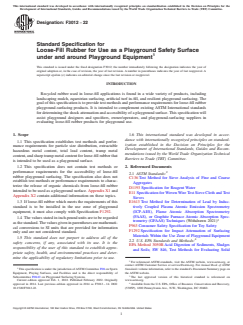
Standard Specification for
Loose-Fill Rubber for Use as a Playground Safety Surface
under and around Playground Equipment
This standard is issued under the fixed designation F3012; the number immediately following the designation indicates the year of
original adoption or, in the case of revision, the year of last revision.Anumber in parentheses indicates the year of last reapproval.A
superscript epsilon (´) indicates an editorial change since the last revision or reapproval.
INTRODUCTION
Recycled rubber used in loose-fill applications is found in a wide variety of products, including
landscaping mulch, equestrian surfacing, artificial turf in-fill, and resilient playground surfacing. The
goalofthisspecificationistoprovidetestmethodsandperformancerequirementsforloose-fillrubber
playground-surfacing products. It is intended to complement existing ASTM International standards
fordeterminingtheshockattenuationandaccessibilityofaplaygroundsurface.Thisspecificationwill
assist playground designers and specifiers, owner/operators, and playground-surfacing suppliers in
evaluating loose-fill rubber products for playground use.
1. Scope 1.6 This international standard was developed in accor-
dance with internationally recognized principles on standard-
1.1 This specification establishes test methods and perfor-
ization established in the Decision on Principles for the
mance requirements for particle size distribution, extractable
Development of International Standards, Guides and Recom-
hazardous metal content, total lead content, tramp metal
mendations issued by the World Trade Organization Technical
content,andsharptrampmetalcontentforloose-fillrubberthat
Barriers to Trade (TBT) Committee.
is intended to be used as a playground surface.
1.2 This specification does not contain test methods or 2. Referenced Documents
performance requirements for the accessibility of loose-fill 2
2.1 ASTM Standards:
rubber playground surfacing. The specification also does not
C136Test Method for Sieve Analysis of Fine and Coarse
establish test methods or performance requirements to charac-
Aggregates
terize the release of organic chemicals from loose-fill rubber
D1193Specification for Reagent Water
intended to be used as a playground surface.Appendix X1 and
E11Specification forWovenWireTest Sieve Cloth andTest
Appendix X2 contain additional information on these topics.
Sieves
1.3 If loose-fill rubber which meets the requirements of this E1613Test Method for Determination of Lead by Induc-
standard is to be installed in the use zone of playground tively Coupled Plasma Atomic Emission Spectrometry
equipment, it must also comply with Specification F1292. (ICP-AES), Flame Atomic Absorption Spectrometry
(FAAS), or Graphite Furnace Atomic Absorption Spec-
1.4 Thevaluesstatedininch-poundunitsaretoberegarded
trometry (GFAAS) Techniques (Withdrawn 2021)
asthestandard.Thevaluesgiveninparenthesesaremathemati-
F963Consumer Safety Specification for Toy Safety
cal conversions to SI units that are provided for information
F1292Specification for Impact Attenuation of Surfacing
only and are not considered standard.
Materials Within the Use Zone of Playground Equipment
1.5 This standard does not purport to address all of the
2.2 U.S. EPA Standards and Methods:
safety concerns, if any, associated with its use. It is the
EPA Method 3050BAcid Digestion of Sediments, Sludges
responsibility of the user of this standard to establish appro-
and Soils; SW 846, Test Methods for Evaluating Solid
priate safety, health, and environmental practices and deter-
mine the applicability of regulatory limitations prior to use.
For referenced ASTM standards, visit the ASTM website, www.astm.org, or
contact ASTM Customer Service at service@astm.org. For Annual Book of ASTM
This specification is under the jurisdiction ofASTM Committee F08 on Sports Standards volume information, refer to the standard’s Document Summary page on
Equipment, Playing Surfaces, and Facilities and is the direct responsibility of the ASTM website.
Subcommittee F08.63 on Playground Surfacing Systems. The last approved version of this historical standard is referenced on
Current edition approved Feb. 1, 2022. Published February 2022. Originally www.astm.org.
approved in 2014. Last previous edition approved in 2014 as F3012–14. DOI: Available from the U.S. EPA, Office of Resource Conservation and Recovery,
10.1520/F3012-22. (5305P), 1200 Pennsylvania Ave., N.W., Washington, DC 20460.
Copyright © ASTM International, 100 Barr Harbor Drive, PO Box C700, West Conshohocken, PA 19428-2959. United States
F3012−22
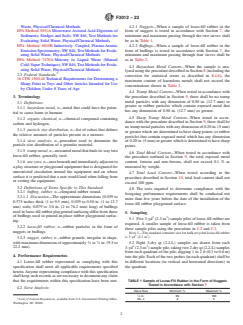
Waste, Physical/Chemical Methods 4.2.1 Nuggets—When a sample of loose-fill rubber in the
EPA Method 3051AMicrowave Assisted Acid Digestion of form of nuggets is tested in accordance with Section 7, the
Sediments, Sludges and Soils; SW 846, Test Methods for minimum and maximum passing through the two sieves shall
Evaluating Solid Waste, Physical/Chemical Methods be as in Table 1.
EPA Method 6010BInductively Coupled Plasma-Atomic 4.2.2 Buffıngs—When a sample of loose-fill rubber in the
EmissionSpectrometry;SW846,TestMethodsforEvalu- form of buffings is tested in accordance with Section 7, the
ating Solid Waste, Physical/Chemical Methods minimum and maximum passing through four sieves shall be
EPA Method 7470AMercury in Liquid Waste (Manual as in Table 2.
Cold-VaporTechnique);SW846,TestMethodsforEvalu-
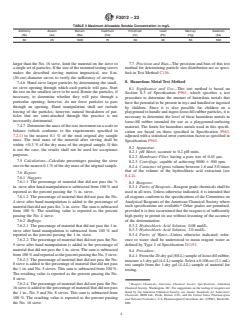
4.3 Hazardous Metal Content—When the sample is ana-
ating Solid Waste, Physical/Chemical Methods
lyzedusingtheproceduredescribedinSection8(includingthe
2.3 Federal Standards:
correction for statistical errors as described in 8.4.6), the
16 CFR 1500.48Technical Requirements for Determining a
maximum content of hazardous metals shall not exceed the
Sharp Point in Toys and Other Articles Intended for Use
concentrations shown in Table 3.
by Children Under 8 Years of Age
4.4 Tramp Metal Content—When tested in accordance with
3. Terminology the procedure described in Section 9, there shall be no tramp
metal particles with any dimension of 0.50 in. (12.7 mm) or
3.1 Definitions:
greater or rubber particles which contain exposed metal that
3.1.1 hazardous metal, n—metal that could have the poten-
has any dimension of 0.50 in. (12.7 mm) or greater.
tial to cause harm to humans
4.5 Sharp Tramp Metal Content—When tested in accor-
3.1.2 organic chemical, n—chemical compound containing
dance with the procedure described in Section 9, there shall be
carbon and hydrogen.
notrampmetalparticleswithanydimensionof0.20in.(5mm)
3.1.3 particle size distribution, n—list of values that defines
orgreaterwhicharedeterminedtohavesharppoints;orrubber
the relative amounts of particles present in a mixture.
particles that contain exposed metal which has any dimension
3.1.4 sieve analysis, n—procedure used to determine the
of0.20in.(5mm)orgreaterwhichisdeterminedtohavesharp
particle size distribution of a granular material.
points.
3.1.5 trampmetal,n—unwantedmetalthatfindsitswayinto
4.6 Total Metal Content—When tested in accordance with
loose-fill rubber, generally steel.
the procedure outlined in Section 9, the total exposed metal
3.1.6 use zone, n—areabeneathandimmediatelyadjacentto content, ferrous and non-ferrous, shall not exceed 0.1 % as
aplaystructureorplaygroundequipmentthatisdesignatedfor
measured by weight.
unrestricted circulation around the equipment and on whose
4.7 Total Lead Content—When tested according to the
surfaceitispredictedthatauserwouldlandwhenfallingfrom
procedure described in Section 10, total lead content shall not
or exiting the equipment.
exceed 100 ppm.
3.2 Definitions of Terms Specific to This Standard:
4.8 The tests required to determine compliance with the
3.2.1 buffıng, rubber, n—elongated rubber strand.
foregoing performance requirements shall be conducted not
3.2.1.1 Discussion—The approximate dimensions (0.039 to
more than five years before the date of the installation of the
0.375 inches thick (1 to 9.5 mm), 0.039 to 0.50 in. (1 to 12.7
loose-fill rubber playground surface.
mm) wide, 0.079 to 3.0 in. (2 to 76.2 mm) long) of buffings
usedinloose-fillrubberplaygroundsurfacingdifferfromthose
5. Sampling
of buffings used in poured-in-place rubber playground surfac-
3 3
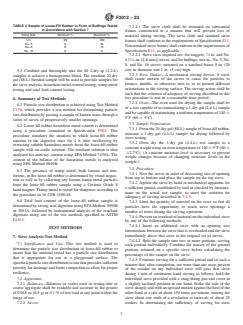
5.1 Five 3-yd (2.3-m ) sample piles of loose-fill rubber are
ing.
required. A smaller sample of loose-fill rubber is taken from
3.2.2 loose-fill rubber, n—rubber particles in the form of
these sample piles using the procedure in 5.2 and 5.3.
nuggets or buffings.
NOTE1—Thestandardcontainersizeforbulkrecycledloose-fillrubber
3 3
is3yd (2.3 m ).
3.2.3 nugget, rubber, n—rubber granule, irregular in shape,
3 7
with maximum dimension of approximately ⁄8 to ⁄8 in. (9.5 to 5.2 Eight 2-dry qt (2.2-L) samples are drawn from each
3 3
22.2 mm).
3-yd (2.3-m )samplepile,takingtwo2-dryqt(2.2-L)samples
from each quadrant of the pile, digging 1 to 2 ft (0.3 to 0.6 m)
4. Performance Requiremetns
intothepile.Eachofthetwoprobes(ineachquadrant)shallbe
4.1 Loose-fill rubber represented as complying with this in different locations (in vertical and horizontal directions) in
specification shall meet all applicable requirements specified the quadrant.
herein.Anyonerepresentingcompliancewiththisspecification
shallkeepsuchrecordsasarenecessarytodocumentanyclaim
that the requirements within this specification have been met.
TABLE 1 Sample of Loose-Fill Rubber in the Form of Nuggets
Tested in Accordance with Section 7
4.2 Sieve Analysis:
Sieve Size Minimum % Maximum %
⁄8 in. 99 100
Code of Federal Regulations, available from U.S. Government Printing Office, No. 4 0 5
Washington, DC 20402.
F3012−22
TABLE 2 Sample of Loose-Fill Rubber in Form of Buffings Tested
7.2.2.1 The sieve cloth shall be mounted on substantial
in Accordance with Section 7
frames constructed in a manner that will prevent loss of
Sieve Size Minimum % Maximum %
material during sieving. The sieve cloth and standard sieve
1 in. 99 100
frames shall conform to the requirements of Specification E11.
No. 5 0 45
Nonstandardsieveframesshallconformtotherequirementsof
No. 8 0 15
Specification E11, as applicable.
No. 16 0 5
7.2.2.2 Sieve sizes required are: for nuggets; ⁄8 in. and No.
4( ⁄16-in.(4.8-mm))sieves,andforbuffings;onein.,No.5,No.
8, and No. 16 sieves; mounted on a standard frame 8 in. (20
cm) in diameter and 2 in. (5 cm) high.
5.3 Combine and thoroughly mix the 40 2-dry qt (2.2-L)
7.2.3 Sieve Shaker—A mechanical sieving device, if used,
samples to achieve a homogenous blend. The resultant 20-dry
shall create motion of the sieves to cause the particles to
gal (88-L) blended sample will be used to provide samples for
bounce, tumble, or otherwise turn so as to present different
thesieveanalysis,hazardousmetalcontenttesting,trampmetal
orientations to the sieving surface. The sieving action shall be
testing and total lead content testing.
such that the criterion of adequacy of sieving described in this
test procedure is met in a reasonable time period.
6. Summary of Test Methods
7.2.4 Oven—The oven used for drying the sample shall be
6.1 Particle size distribution is achieved using Test Method
ofasizecapableofaccommodatinga1-drygal(4.4-L)sample
C136, which provides a test method for determining particle
andbecapableofmaintainingauniformtemperatureof140 6
size distribution by passing a sample of known mass through a
9°F (60 6 5°C).
series of sieves of progressively smaller openings.
7.3 Sample Preparation:
6.2 Loose-fill rubber hazardous metal content is determined
7.3.1 Fromthe20-drygal(88-L)sampleofloose-fillrubber,
using a procedure contained in Specification F963. This
measure a 1-dry gal (4.4-L) sample for drying followed by
procedure simulates the situation in which loose-fill rubber
sieve testing.
remains in the digestive tract for 4 h after swallowing by
7.3.2 Oven dry the 1-dry gal (4.4-L) test sample to a
extracting soluble hazardous metals from the loose-fill rubber
constantweightusinganoventemperatureof140 69°F(60 6
sample with an acidic solution. The resultant solution is then
–12.7°C). (A constant moisture level is necessary to prevent
analyzed for mercury content using EPA Method 7470A. The
weight changes because of changing moisture levels in the
content of the balance of the hazardous metals is analyzed
sample.)
using EPA Method 6010B.
7.4 Procedure:
6.3 The presence of tramp metal, both ferrous and non-
7.4.1 Nest the sieves in order of decreasing size of opening
ferrous, in the loose-fill rubber is determined by visual inspec-
from top to bottom and place the sample on the top sieve.
tion as well as by collecting any ferrous tramp metal particles
7.4.2 Agitate the sieve by hand or mechanical apparatus for
from the loose-fill rubber sample using a Ceramic Grade 8
a sufficient period, established by trial or checked by measure-
hand magnet.Tramp metal is tested for sharpness according to
ment on the actual test sample, to meet the criterion for
the procedure in 16 CFR 1500.48.
adequacy of sieving described in 7.4.5.
6.4 Total lead content of the loose-fill rubber sample is
7.4.3 Limit the quantity of material on the sieve so that all
determined by strong acid digestion using EPAMethod 3050B
particles have the opportunity to reach sieve openings a
or 3051A, followed by instrumental analysis of the resultant
number of times during the sieving operation.
digestate using one of the test methods specified in ASTM
7.4.4 Preventanoverloadofmaterialontheindividualsieve
E1613.
by one of the following methods:
7.4.4.1 Insert an additional sieve with an opening size
TEST METHODS
intermediatebetweenthesievethatisoverloadedandthesieve
immediately above that sieve in the original set of sieves.
7. Sieve Analysis Test Method
7.4.4.2 Split the sample into two or more portions, sieving
7.1 Significance and Use—This test method is used to
each portion individually. Combine the masses of the general
determine the particle size distribution of loose-fill rubber to
portions retained on a specific sieve before calculating the
insure that the material tested has a particle size distribution
percentage of the sample on the sieve.
that is appropriate for use as a playground surface. The
7.4.5 Continue sieving for a sufficient period and in such a
specifiedparticlesizedistributionisonethatprovidessufficient
manner that, after completion, not more than one mass percent
porosityfordrainageandlimitscompactiontoallowforproper
of the residue on any individual sieve will pass that sieve
resilience.
during 1 min of continuous hand sieving as follows: hold the
7.2 Apparatus: individual sieve provided with a snug-fitting pan and cover in
7.2.1 Balances—Balances or scales used in testing fine or a slightly inclined position in one hand. Strike the side of the
coarse aggregate shall be readable and accurate to the greater sievesharplyandwithanupwardmotionagainsttheheelofthe
of0.018oz(0.5g)or0.1%oftestloadatanypointwithinthe other hand at a rate of about 150 times per minute, turning the
range of use. sieve about one sixth of a revolution at intervals of about 25
7.2.2 Sieves: strokes. In determining the sufficiency of sieving for sizes
F3012−22
TABLE 3 Maximum Allowable Soluble Concentration in mg/L
Antimony Arsenic Barium Cadmium Chromium Lead Mercury Selenium
(Sb) (As) (Ba) (Cd) (Cr) (Pb) (Hg) (Se)
60 25 1000 75 60 90 60 500
larger than the No. 16 sieve, limit the material on the sieve to 7.7 Precision and Bias—The precision and bias of this test
asinglesetofparticles.Ifthesizeofthemountedtestingsieves method for determining particle size distribution are as speci-
makes the described sieving motion impractical, use 8-in. fied in Test Method C136.
(20-cm) diameter sieves to verify the sufficiency of sieving.
8. Hazardous Metal Test Method
7.4.6 Hand sieve larger particles by determining the small-
est sieve opening through which each particle will pass. Start
8.1 Significance and Use—This test method is based on
the test on the smallest sieve to be used. Rotate the particles, if
Section 8.3 of Specification F963, which specifies a test
necessary, to determine whether they will pass through a
procedure to determine the amount of hazardous metals that
particular opening; however, do not force particles to pass
havethepotentialtobepresentintoysandhandledoringested
through an opening. Hand manipulation shall not include
by children. Since it is also possible for children on a
forcing of the particles; however, natural breakdown of par-
playgroundtohandleandingestloose-fillrubberparticles,itis
ticles that are semi-attached through this practice is not
necessary to determine the level of these hazardous metals in
necessarily detrimental.
loose-fill rubber intended for use as a playground-surfacing
7.4.7 Determinethemassofthesizeincrementonascaleor
material. The limits for hazardous metals used in this specifi-
balance (which conforms to the requirements specified in
cation are based on those specified in Specification F963,
7.2.1) to the nearest 0.1 % of the total original dry sample
adjusted with a statistical error correction factor as specified in
mass. The total mass of the material after sieving shall be
Specification F963.
within 60.3 % of the dry mass of the original sample. If this
8.2 Apparatus:
is not the case, the results shall not be used for acceptance
8.2.1 pH Meter, accurate to 0.2 pH units.
purposes.
8.2.2 Membrane Filter, having a pore size of 0.45 µm.
7.5 Calculations—Calculate percentages passing the sieve
8.2.3 Centrifuge, capable of achieving 5000 6 500 rpm.
sizetothenearest0.1%ofthedrymassoftheoriginalsample.
8.2.4 Container of gross volume between 1.6 and 5.0 times
that of the volume of the hydrochloric acid extractant (see
7.6 Report:
8.4.2).
7.6.1 Nuggets:
7.6.1.1 The percentage of material that did not pass the ⁄8 8.3 Reagents:
in.sieveafterhandmanipulationissubtractedfrom100%and
8.3.1 Purity of Reagents—Reagent grade chemicals shall be
reported as the percent passing the ⁄8 in. sieve. used in all tests. Unless otherwise indicated, it is intended that
7.6.1.2 The percentage of material that did not pass the No. all reagents conform to the specifications of the Committee on
4 sieve after hand manipulation is added to the percentage of Analytical Reagents of theAmerican Chemical Society where
materialthatdidnotpassthe ⁄8in.sieve.Thesumissubtracted such specifications are available. Other grades are permitted,
from 100 %. The resulting value is reported as the percent provided it is first ascertained that the reagent is of sufficiently
high purity to permit its use without lessening of the accuracy
passing the No. 4 sieve.
7.6.2 Buffıngs: of the determination.
8.3.2 Hydrochloric Acid Solution, 0.08 mol/L.
7.6.2.1 Thepercentageofmaterialthatdidnotpassthe1in.
8.3.3 Hydrochloric Acid Solution, 2.0 mol/L.
sieve after hand manipulation is subtracted from 100 % and
8.3.4 Purity of Water—Unless otherwise indicated, refer-
reported as the percent passing the 1 in. sieve.
ence to water shall be understood to mean reagent water as
7.6.2.2 The percentage of material that did not pass the No.
defined by Type 3 of Specification D1193.
5 sieve after hand manipulation is
...
This document is not an ASTM standard and is intended only to provide the user of an ASTM standard an indication of what changes have been made to the previous version. Because
it may not be technically possible to adequately depict all changes accurately, ASTM recommends that users consult prior editions as appropriate. In all cases only the current version
of the standard as published by ASTM is to be considered the official document.
Designation: F3012 − 14 F3012 − 22
Standard Specification for
Loose-Fill Rubber for Use as a Playground Safety Surface
under and around Playground Equipment
This standard is issued under the fixed designation F3012; the number immediately following the designation indicates the year of
original adoption or, in the case of revision, the year of last revision. A number in parentheses indicates the year of last reapproval. A
superscript epsilon (´) indicates an editorial change since the last revision or reapproval.
INTRODUCTION
Recycled rubber used in loose-fill applications is found in a wide variety of products, including
landscaping mulch, equestrian surfacing, artificial turf in-fill, and resilient playground surfacing. The
goal of this specification is to provide test methods and performance requirements for loose-fill rubber
playground-surfacing products. It is intended to complement existing ASTM International standards
for determining the shock attenuation and accessibility of a playground surface. This specification will
assist playground designers and specifiers, owner/operators, and playground-surfacing suppliers in
evaluating loose-fill rubber products for playground use.
1. Scope
1.1 This specification establishes test methods and performance requirements for particle size distribution, extractable hazardous
metal content, total lead content, tramp metal content, and sharp tramp metal content for loose-fill rubber that is intended to be
used as a playground surface.
1.2 This specification does not contain test methods or performance requirements for the accessibility of loose-fill rubber
playground surfacing. The specification also does not establish test methods or performance requirements to characterize the
release of organic chemicals from loose-fill rubber intended to be used as a playground surface. Appendix X1 and Appendix X2
contain additional information on these topics.
1.3 If loose-fill rubber which meets the requirements of this standard is to be installed in the use zone of playground equipment,
it must also comply with Specification F1292.
1.4 The values stated in inch-pound units are to be regarded as the standard. The values given in parentheses are mathematical
conversions to SI units that are provided for information only and are not considered standard.
1.5 This standard does not purport to address all of the safety concerns, if any, associated with its use. It is the responsibility
of the user of this standard to establish appropriate safety safety, health, and healthenvironmental practices and determine the
applicability of regulatory limitations prior to use.
1.6 This international standard was developed in accordance with internationally recognized principles on standardization
established in the Decision on Principles for the Development of International Standards, Guides and Recommendations issued
by the World Trade Organization Technical Barriers to Trade (TBT) Committee.
This specification is under the jurisdiction of ASTM Committee F08 on Sports Equipment, Playing Surfaces, and Facilities and is the direct responsibility of
Subcommittee F08.63 on Playground Surfacing Systems.
Current edition approved May 1, 2014Feb. 1, 2022. Published May 2014February 2022. Originally approved in 2014. Last previous edition approved in 2014 as
F3012 – 14. DOI: 10.1520/F3012-14.10.1520/F3012-22.
Copyright © ASTM International, 100 Barr Harbor Drive, PO Box C700, West Conshohocken, PA 19428-2959. United States
F3012 − 22
2. Referenced Documents
2.1 ASTM Standards:
C136 Test Method for Sieve Analysis of Fine and Coarse Aggregates
D1193 Specification for Reagent Water
E11 Specification for Woven Wire Test Sieve Cloth and Test Sieves
E1613 Test Method for Determination of Lead by Inductively Coupled Plasma Atomic Emission Spectrometry (ICP-AES),
Flame Atomic Absorption Spectrometry (FAAS), or Graphite Furnace Atomic Absorption Spectrometry (GFAAS) Techniques
(Withdrawn 2021)
F963 Consumer Safety Specification for Toy Safety
F1292 Specification for Impact Attenuation of Surfacing Materials Within the Use Zone of Playground Equipment
2.2 U.S. EPA Standards and Methods:
EPA Method 3050B Acid Digestion of Sediments, Sludges and Soils; SW 846, Test Methods for Evaluating Solid Waste,
Physical/Chemical Methods
EPA Method 3051A Microwave Assisted Acid Digestion of Sediments, Sludges and Soils; SW 846, Test Methods for Evaluating
Solid Waste, Physical/Chemical Methods
EPA Method 6010B Inductively Coupled Plasma-Atomic Emission Spectrometry; SW 846, Test Methods for Evaluating Solid
Waste, Physical/Chemical Methods
EPA Method 7470A Mercury in Liquid Waste (Manual Cold-Vapor Technique); SW 846, Test Methods for Evaluating Solid
Waste, Physical/Chemical Methods
2.3 Federal Standards:
16 CFR 1500.48 Technical Requirements for Determining a Sharp Point in Toys and Other Articles Intended for Use by Children
Under 8 Years of Age
3. Terminology
3.1 Definitions:
3.1.1 hazardous metal, n—metal that could have the potential to cause harm to humans
3.1.2 organic chemical, n—chemical compound containing carbon and hydrogen.
3.1.3 particle size distribution, n—list of values that defines the relative amounts of particles present in a mixture.
3.1.4 sieve analysis, n—procedure used to determine the particle size distribution of a granular material.
3.1.5 tramp metal, n—unwanted metal that finds its way into loose-fill rubber, generally steel.
3.1.6 use zone, n—area beneath and immediately adjacent to a play structure or playground equipment that is designated for
unrestricted circulation around the equipment and on whose surface it is predicted that a user would land when falling from or
exiting the equipment.
3.2 Definitions of Terms Specific to This Standard:
3.2.1 buffıng, rubber, n—elongated rubber strand.
3.2.1.1 Discussion—
The approximate dimensions (0.039 to 0.375 inches thick (1 to 9.5 mm), 0.039 to 0.50 in. (1 to 12.7 mm) wide, 0.079 to 3.0 in.
(2 to 76.2 mm) long) of buffings used in loose-fill rubber playground surfacing differ from those of buffings used in poured-in-place
rubber playground surfacing.
3.2.2 loose-fill rubber, n—rubber particles in the form of nuggets or buffings.
For referenced ASTM standards, visit the ASTM website, www.astm.org, or contact ASTM Customer Service at service@astm.org. For Annual Book of ASTM Standards
volume information, refer to the standard’s Document Summary page on the ASTM website.
The last approved version of this historical standard is referenced on www.astm.org.
Available from the U.S. EPA, Office of Resource Conservation and Recovery, (5305P), 1200 Pennsylvania Ave., N.W., Washington, DC 20460.
Code of Federal Regulations, available from U.S. Government Printing Office, Washington, DC 20402.
F3012 − 22
3 7
3.2.3 nugget, rubber, n—rubber granule, irregular in shape, with maximum dimension of approximately ⁄8 to ⁄8 in. (9.5 to 22.2
mm).
4. Performance Requiremetns
4.1 Loose-fill rubber represented as complying with this specification shall meet all applicable requirements specified herein.
Anyone representing compliance with this specification shall keep such records as are necessary to document any claim that the
requirements within this specification have been met.
4.2 Sieve Analysis:
4.2.1 Nuggets—When a sample of loose-fill rubber in the form of nuggets is tested in accordance with Section 7, the minimum
and maximum passing through the two sieves shall be as in Table 1.
4.2.2 Buffıngs—When a sample of loose-fill rubber in the form of buffings is tested in accordance with Section 7, the minimum
and maximum passing through four sieves shall be as in Table 2.
4.3 Hazardous Metal Content—When the sample is analyzed using the procedure described in Section 8 (including the correction
for statistical errors as described in 8.4.6), the maximum content of hazardous metals shall not exceed the concentrations shown
in Table 3.
4.4 Tramp Metal Content—When tested in accordance with the procedure described in Section 9, there shall be no tramp metal
particles with any dimension of 0.50 in. (12.7 mm) or greater or rubber particles which contain exposed metal that has any
dimension of 0.50 in. (12.7 mm) or greater.
4.5 Sharp Tramp Metal Content—When tested in accordance with the procedure described in Section 9, there shall be no tramp
metal particles with any dimension of 0.20 in. (5 mm) or greater which are determined to have sharp points; or rubber particles
that contain exposed metal which has any dimension of 0.20 in. (5 mm) or greater which is determined to have sharp points.
4.6 Total Metal Content—When tested in accordance with the procedure outlined in Section 9, the total exposed metal content,
ferrous and non-ferrous, shall not exceed 0.1 % as measured by weight.
4.7 Total Lead Content—When tested according to the procedure described in Section 10, total lead content shall not exceed 100
ppm.
4.8 The tests required to determine compliance with the foregoing performance requirements shall be conducted not more than
threefive years before the date of the installation of the loose-fill rubber playground surface.
5. Sampling
3 3
5.1 Five 3-yd (2.3-m ) sample piles of loose-fill rubber are required. A smaller sample of loose-fill rubber is taken from these
sample piles using the procedure in 5.2 and 5.3.
3 3
NOTE 1—The standard container size for bulk recycled loose-fill rubber is 3 yd (2.3 m ).
3 3
5.2 Eight 2-dry qt (2.2-L) samples are drawn from each 3-yd (2.3-m ) sample pile, taking two 2-dry qt (2.2-L) samples from each
quadrant of the pile, digging 1 to 2 ft (0.3 to 0.6 m) into the pile. Each of the two probes (in each quadrant) shall be in different
locations (in vertical and horizontal directions) in the quadrant.
TABLE 1 Sample of Loose-Fill Rubber in the Form of Nuggets
Tested in Accordance with Section 7
Sieve Size Minimum % Maximum %
⁄8 in. 99 100
No. 4 0 5
F3012 − 22
TABLE 2 Sample of Loose-Fill Rubber in Form of Buffings Tested
in Accordance with Section 7
Sieve Size Minimum % Maximum %
1 in. 99 100
No. 5 0 45
No. 8 0 15
No. 16 0 5
5.3 Combine and thoroughly mix the 40 2-dry qt (2.2-L) samples to achieve a homogenous blend. The resultant 20-dry gal (88-L)
blended sample will be used to provide samples for the sieve analysis, hazardous metal content testing, tramp metal testing and
total lead content testing.
6. Summary of Test Methods
6.1 Particle size distribution is achieved using Test Method C136, which provides a test method for determining particle size
distribution by passing a sample of known mass through a series of sieves of progressively smaller openings.
6.2 Loose-fill rubber hazardous metal content is determined using a procedure contained in Specification F963. This procedure
simulates the situation in which loose-fill rubber remains in the digestive tract for 4 h after swallowing by extracting soluble
hazardous metals from the loose-fill rubber sample with an acidic solution. The resultant solution is then analyzed for mercury
content using EPA Method 7470A. The content of the balance of the hazardous metals is analyzed using EPA Method 6010B.
6.3 The presence of tramp metal metal, both ferrous and non-ferrous, in the loose-fill rubber is determined by visual inspection
as well as by collecting any ferrous tramp metal particles from the loose-fill rubber sample using a Ceramic Grade 8 hand magnet.
Tramp metal is tested for sharpness according to the procedure in 16 CFR 1500.48.
6.4 Total lead content of the loose-fill rubber sample is determined by strong acid digestion using EPA Method 3050B or 3051A,
followed by instrumental analysis of the resultant digestate using one of the test methods specified in ASTM E1613.
TEST METHODS
7. Sieve Analysis Test Method
7.1 Significance and Use—This test method is used to determine the particle size distribution of loose-fill rubber to insure that the
material tested has a particle size distribution that is appropriate for use as a playground surface. The specified particle size
distribution is one that provides sufficient porosity for drainage and limits compaction to allow for proper resilience.
7.2 Apparatus:
7.2.1 Balances—Balances or scales used in testing fine or coarse aggregate shall be readable and accurate to the greater of 0.018
oz (0.5 g) or 0.1 % of test load at any point within the range of use.
7.2.2 Sieves:
7.2.2.1 The sieve cloth shall be mounted on substantial frames constructed in a manner that will prevent loss of material during
sieving. The sieve cloth and standard sieve frames shall conform to the requirements of Specification E11. Nonstandard sieve
frames shall conform to the requirements of Specification E11, as applicable.
7 3
7.2.2.2 Sieve sizes required are: for nuggets; ⁄8 in. and No. 4 ( ⁄16-in. (4.8-mm)) sieves, and for buffings; one in., No. 5, No. 8,
and No. 16 sieves; mounted on a standard frame 8 in. (20 cm) in diameter and 2 in. (5 cm) high.
7.2.3 Sieve Shaker—A mechanical sieving device, if used, shall create motion of the sieves to cause the particles to bounce,
tumble, or otherwise turn so as to present different orientations to the sieving surface. The sieving action shall be such that the
criterion of adequacy of sieving described in this test procedure is met in a reasonable time period.
F3012 − 22
TABLE 3 Maximum Allowable Soluble Concentration in mg/L
Antimony Arsenic Barium Cadmium Chromium Lead Mercury Selenium
(Sb) (As) (Ba) (Cd) (Cr) (Pb) (Hg) (Se)
60 25 1000 75 60 90 60 500
7.2.4 Oven—The oven used for drying the sample shall be of a size capable of accommodating a 1-dry gal (4.4-L) sample and
be capable of maintaining a uniform temperature of 140 6 9°F (60 6 5°C).
7.3 Sample Preparation:
7.3.1 From the 20-dry gal (88-L) sample of loose-fill rubber, measure a 1-dry gal (4.4-L) sample for drying followed by sieve
testing.
7.3.2 Oven dry the 1-dry gal (4.4-L) test sample to a constant weight using an oven temperature of 140 6 9°F (60 6 –12.7°C).
(A constant moisture level is necessary to prevent weight changes because of changing moisture levels in the sample.)
7.4 Procedure:
7.4.1 Nest the sieves in order of decreasing size of opening from top to bottom and place the sample on the top sieve.
7.4.2 Agitate the sieve by hand or mechanical apparatus for a sufficient period, established by trial or checked by measurement
on the actual test sample, to meet the criterion for adequacy of sieving described in 7.4.5.
7.4.3 Limit the quantity of material on the sieve so that all particles have the opportunity to reach sieve openings a number of times
during the sieving operation.
7.4.4 Prevent an overload of material on the individual sieve by one of the following methods:
7.4.4.1 Insert an additional sieve with an opening size intermediate between the sieve that is overloaded and the sieve immediately
above that sieve in the original set of sieves.
7.4.4.2 Split the sample into two or more portions, sieving each portion individually. Combine the masses of the general portions
retained on a specific sieve before calculating the percentage of the sample on the sieve.
7.4.5 Continue sieving for a sufficient period and in such a manner that, after completion, not more than one mass percent of the
residue on any individual sieve will pass that sieve during 1 min of continuous hand sieving as follows: hold the individual sieve
provided with a snug-fitting pan and cover in a slightly inclined position in one hand. Strike the side of the sieve sharply and with
an upward motion against the heel of the other hand at a rate of about 150 times per minute, turning the sieve about one sixth of
a revolution at intervals of about 25 strokes. In determining the sufficiency of sieving for sizes larger than the No. 16 sieve, limit
the material on the sieve to a single set of particles. If the size of the mounted testing sieves makes the described sieving motion
impractical, use 8-in. (20-cm) diameter sieves to verify the sufficiency of sieving.
7.4.6 Hand sieve larger particles by determining the smallest sieve opening through which each particle will pass. Start the test
on the smallest sieve to be used. Rotate the particles, if necessary, to determine whether they will pass through a particular opening;
however, do not force particles to pass through an opening. Hand manipulation shall not include forcing of the particles; however,
natural breakdown of particles that are semi-attached through this practice is not necessarily detrimental.
7.4.7 Determine the mass of the size increment on a scale or balance (which conforms to the requirements specified in 7.2.1) to
the nearest 0.1 % of the total original dry sample mass. The total mass of the material after sieving shall be within 60.3 % of the
dry mass of the original sample. If this is not the case, the results shall not be used for acceptance purposes.
7.5 Calculations—Calculate percentages passing the sieve size to the nearest 0.1 % of the dry mass of the original sample.
7.6 Report:
F3012 − 22
7.6.1 Nuggets:
7.6.1.1 The percentage of material that did not pass the ⁄8 in. sieve after hand manipulation is subtracted from 100 % and reported
as the percent passing the ⁄8 in. sieve.
7.6.1.2 The percentage of material that did not pass the No. 4 sieve after hand manipulation is added to the percentage of material
that did not pass the ⁄8 in. sieve. The sum is subtracted from 100 %. The resulting value is reported as the percent passing the No.
4 sieve.
7.6.2 Buffıngs:
7.6.2.1 The percentage of material that did not pass the 1 in. sieve after hand manipulation is subtracted from 100 % and reported
as the percent passing the 1 in. sieve.
7.6.2.2 The percentage of material that did not pass the No. 5 sieve after hand manipulation is added to the percentage of material
that did not pass the 1 in. sieve. The sum is subtracted from 100 % and reported as the percent passing the No. 5 sieve.
7.6.2.3 The percentage of material that did not pass the No. 8 sieve is added to the percentage of material that did not pass the
1 in. and No. 5 sieves. This sum is subtracted from 100 %. The resulting value is reported as the percent passing the No. 8 sieve.
7.6.2.4 The percentage of material that did not pass the No. 16 sieve is added to the percentage of material that did not pass the
1 in., No. 5 and No. 8 sieves. This sum is subtracted from 100 %. The resulting value is reported as the percent passing the No.
16 sieve.
7.7 Precision and Bias—The precision and bias of this test method for determining particle size distribution are as specified in Test
Method C136.
8. Hazardous Metal Test Method
8.1 Significance and Use—This test method is based on Section 8.3 of Specification F963, which specifies a test procedure to
determine the amount of hazardous metals that have the potential to be present in toys and handled or ingested by children. Since
it is also possible for children on a playground to handle and ingest loose-fill rubber particles, it is necessary to determine the level
of these hazardous metals in loose-fill rubber intended for use as a playground-surfacing material. The limits for hazardous metals
used in this specification are based on those specified in Specification F963, adjusted with a statistical error correction factor as
specified in Specification F963.
8.2 Apparatus:
8.2.1 pH Meter, accurate to 0.2 pH units.
8.2.2 Membrane Filter, having a pore size of 0.45 μm.
8.2.3 Centrifuge, capable of achieving 5000 6 500
...