

ASTM F109-21
(Terminology)Standard Terminology Relating to Surface Imperfections on Ceramics
General Information
- Abstract
SCOPE
1.1 This terminology describes and illustrates imperfections observed on whitewares and related products. For additional definitions of terms relating to whitewares and related products, refer to Terminology C242. To observe these defects, examination shall be performed visually, with or without the aid of a dye penetrant, as described in Test Method C949. Agreement by the manufacturer and the purchaser regarding specific techniques of observation is strongly recommended.
1.2 This terminology does not cover every defect or imperfection possible for whitewares or related products. The standard is not intended to be an all inclusive document for ceramic imperfections. New defect types may be created as ceramic processes, materials, and technology evolve.
1.3 Some of the imperfection photos utilize magnification for clarity in documentation. Unless otherwise noted, typical observation conditions for detection of tile imperfections/defects shall consist of current ANSI A137.1 viewing criteria for the specific defect type
1.4 This international standard was developed in accordance with internationally recognized principles on standardization established in the Decision on Principles for the Development of International Standards, Guides and Recommendations issued by the World Trade Organization Technical Barriers to Trade (TBT) Committee.
- Status
- Published
- Publication Date
- 31-Jan-2021
- Technical Committee
- C21 - Ceramic Whitewares and Related Products
- Drafting Committee
- C21.01 - Editorial and Terminology
Overview
ASTM F109-21: Standard Terminology Relating to Surface Imperfections on Ceramics provides a comprehensive vocabulary for describing and identifying common imperfections that may occur on ceramic whitewares and related products. Developed by ASTM International, this terminology standard is intended to facilitate effective communication between manufacturers, purchasers, inspectors, and other stakeholders in the ceramics industry. The standard supports quality control, product specification, and defect evaluation processes by clarifying the types of visual flaws found on ceramic surfaces, their typical causes, and terminology for documentation.
Key Topics
ASTM F109-21 standardizes the definitions and visual descriptions of a wide range of surface imperfections relevant to ceramics, including:
- Blemish: Discolored or strained areas due to composition or forming processes.
- Blister: Surface bubbles or gaseous inclusions that may break to create pits.
- Burrs: Fragments or foreign particles adhering to the ceramic surface.
- Chips: Broken or fractured material at the edges or corners, including "closed chips" where the piece has not fully separated.
- Cracks: Fractures of various origins, including those from cooling (dunting, thermal shock), liquid contamination, drying, or impact to greenware.
- Crazing: Fine crack networks in glaze or coatings due to tensile stress.
- Delamination: Horizontal cracks or separated layers within the ceramic body.
- Divots, Pinholes, Pits, Pocks, Pores: Various depressions and cavities ranging from shallow marks to deeper voids in the glaze or body.
- Surface Irregularities: Flow lines, ridges, lumps, grinding marks, and waviness affecting the flatness or finish.
- Contaminants and Markings: Inclusions, specks, metal marks, rim formations, and discolorations from processing or handling.
- Digital Print Defects: Specific issues seen in inkjet-printed ceramics, including misprints, banding, overspray, pixilation, and synchronization faults.
These definitions support consistent visual examination of ceramic products, whether evaluated unaided or with tools such as dye penetrant testing.
Applications
ASTM F109-21 is used widely across the ceramics industry for:
- Quality Control: Manufacturers and quality inspectors apply these standard terms to identify, categorize, and report imperfections, improving product consistency and customer satisfaction.
- Procurement: Purchasers and suppliers use the terminology to agree on inspection methods and acceptability criteria for surface quality.
- Production Process Optimization: Understanding defect types helps identify root causes and corrective actions during ceramic processing, glazing, and firing.
- Product Specification: Designers and engineers refer to this standard when drafting technical specifications or tolerances for glazed and unglazed ceramics.
- Inspection and Testing: The standard supports visual assessments, and references additional test methods such as ASTM C949 (Dye Penetrant Testing) and ASTM C485 (Warpage Measurement).
Related Standards
ASTM F109-21 complements and references several important related standards and guidelines, including:
- ASTM C242: Terminology of Ceramic Whitewares and Related Products, for broader ceramic terms.
- ASTM C485: Test Method for Measuring Warpage of Ceramic Tile, essential for evaluating camber and waviness.
- ASTM C949: Test Method for Porosity in Vitreous Whitewares by Dye Penetration, useful for detecting porous areas.
- ASTM E165/E165M: Practice for Liquid Penetrant Testing for General Industry.
- ANSI A137.1: American National Standards Specifications for Ceramic Tile, setting industry-accepted visual inspection criteria.
Practical Value
By standardizing terminology for ceramic surface imperfections, ASTM F109-21 improves communication, inspection accuracy, and defect reporting throughout the supply chain. The standard is particularly valuable for manufacturers, inspectors, quality control professionals, and buyers needing to:
- Ensure uniform quality assessments for ceramic whitewares and tiles
- Develop clear acceptance or rejection criteria for ceramic products
- Support technical documentation and training initiatives within ceramic production and inspection environments
For the most up-to-date terminology and detailed illustrations, stakeholders are encouraged to refer to the current published version of ASTM F109-21 available through ASTM International.
Relations
- Effective Date
- 01-Feb-2024
- Effective Date
- 01-Feb-2020
- Effective Date
- 01-Oct-2019
- Effective Date
- 01-Aug-2019
- Effective Date
- 01-Feb-2018
- Effective Date
- 01-Dec-2016
- Effective Date
- 01-Mar-2015
- Effective Date
- 01-Feb-2014
- Effective Date
- 01-May-2012
- Effective Date
- 01-Apr-2012
- Effective Date
- 01-Jan-2009
- Effective Date
- 01-Nov-2007
- Refers
ASTM C949-80(2007) - Standard Test Method for Porosity in Vitreous Whitewares by Dye Penetration - Effective Date
- 01-May-2007
- Effective Date
- 01-Oct-2003
- Effective Date
- 01-Oct-2003
Frequently Asked Questions
ASTM F109-21 is a standard published by ASTM International. Its full title is "Standard Terminology Relating to Surface Imperfections on Ceramics". This standard covers: SCOPE 1.1 This terminology describes and illustrates imperfections observed on whitewares and related products. For additional definitions of terms relating to whitewares and related products, refer to Terminology C242. To observe these defects, examination shall be performed visually, with or without the aid of a dye penetrant, as described in Test Method C949. Agreement by the manufacturer and the purchaser regarding specific techniques of observation is strongly recommended. 1.2 This terminology does not cover every defect or imperfection possible for whitewares or related products. The standard is not intended to be an all inclusive document for ceramic imperfections. New defect types may be created as ceramic processes, materials, and technology evolve. 1.3 Some of the imperfection photos utilize magnification for clarity in documentation. Unless otherwise noted, typical observation conditions for detection of tile imperfections/defects shall consist of current ANSI A137.1 viewing criteria for the specific defect type 1.4 This international standard was developed in accordance with internationally recognized principles on standardization established in the Decision on Principles for the Development of International Standards, Guides and Recommendations issued by the World Trade Organization Technical Barriers to Trade (TBT) Committee.
SCOPE 1.1 This terminology describes and illustrates imperfections observed on whitewares and related products. For additional definitions of terms relating to whitewares and related products, refer to Terminology C242. To observe these defects, examination shall be performed visually, with or without the aid of a dye penetrant, as described in Test Method C949. Agreement by the manufacturer and the purchaser regarding specific techniques of observation is strongly recommended. 1.2 This terminology does not cover every defect or imperfection possible for whitewares or related products. The standard is not intended to be an all inclusive document for ceramic imperfections. New defect types may be created as ceramic processes, materials, and technology evolve. 1.3 Some of the imperfection photos utilize magnification for clarity in documentation. Unless otherwise noted, typical observation conditions for detection of tile imperfections/defects shall consist of current ANSI A137.1 viewing criteria for the specific defect type 1.4 This international standard was developed in accordance with internationally recognized principles on standardization established in the Decision on Principles for the Development of International Standards, Guides and Recommendations issued by the World Trade Organization Technical Barriers to Trade (TBT) Committee.
ASTM F109-21 is classified under the following ICS (International Classification for Standards) categories: 01.040.81 - Glass and ceramics industries (Vocabularies); 81.060.20 - Ceramic products. The ICS classification helps identify the subject area and facilitates finding related standards.
ASTM F109-21 has the following relationships with other standards: It is inter standard links to ASTM C485-24, ASTM C242-20, ASTM C242-19a, ASTM C242-19, ASTM C242-18, ASTM C485-16, ASTM C242-15, ASTM C242-14, ASTM C242-12, ASTM C949-80(2012), ASTM C485-09, ASTM C242-01(2007), ASTM C949-80(2007), ASTM C485-83(2003), ASTM C485-83(2003)e1. Understanding these relationships helps ensure you are using the most current and applicable version of the standard.
ASTM F109-21 is available in PDF format for immediate download after purchase. The document can be added to your cart and obtained through the secure checkout process. Digital delivery ensures instant access to the complete standard document.
Standards Content (Sample)
This international standard was developed in accordance with internationally recognized principles on standardization established in the Decision on Principles for the
Development of International Standards, Guides and Recommendations issued by the World Trade Organization Technical Barriers to Trade (TBT) Committee.
Designation: F109 − 21
Standard Terminology Relating to
Surface Imperfections on Ceramics
ThisstandardisissuedunderthefixeddesignationF109;thenumberimmediatelyfollowingthedesignationindicatestheyearoforiginal
adoption or, in the case of revision, the year of last revision.Anumber in parentheses indicates the year of last reapproval.Asuperscript
epsilon (´) indicates an editorial change since the last revision or reapproval.
1. Scope E165/E165M Practice for Liquid Penetrant Testing for Gen-
eral Industry
1.1 This terminology describes and illustrates imperfections
2.2 ANSI Standard:
observed on whitewares and related products. For additional
ANSI A137.1 American National Standards Specifications
definitions of terms relating to whitewares and related
For Ceramic Tile
products, refer to Terminology C242. To observe these defects,
examination shall be performed visually, with or without the
3. Terminology
aid of a dye penetrant, as described in Test Method C949.
Agreement by the manufacturer and the purchaser regarding
3.1 Definitions:
specific techniques of observation is strongly recommended.
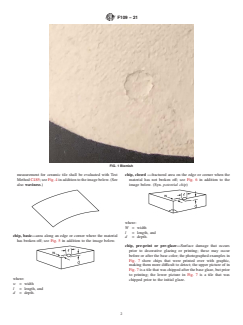
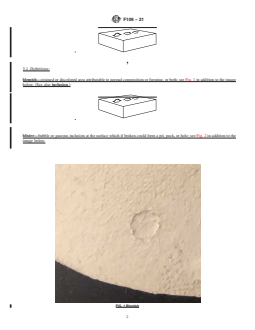
blemish—strained or discolored area attributable to normal
composition or forming, or both; see Fig. 1 in addition to the
1.2 This terminology does not cover every defect or imper-
image below. (See also inclusion.)
fection possible for whitewares or related products. The
standard is not intended to be an all inclusive document for
ceramic imperfections. New defect types may be created as
ceramic processes, materials, and technology evolve.
1.3 Some of the imperfection photos utilize magnification
for clarity in documentation. Unless otherwise noted, typical
observation conditions for detection of tile imperfections/
defects shall consist of current ANSI A137.1 viewing criteria
blister—bubble or gaseous inclusion at the surface which if
for the specific defect type
broken could form a pit, pock, or hole; see Fig. 2 in addition
1.4 This international standard was developed in accor-
to the image below.
dance with internationally recognized principles on standard-
ization established in the Decision on Principles for the
Development of International Standards, Guides and Recom-
mendations issued by the World Trade Organization Technical
Barriers to Trade (TBT) Committee.
2. Referenced Documents
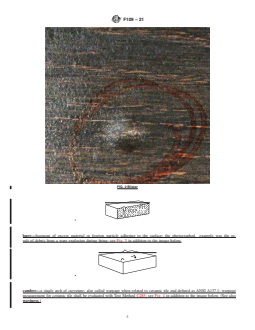
burr—fragment of excess material or foreign particle adhering
to the surface; the photographed example was the re-
2.1 ASTM Standards:
sult of debris from a ware explosion during firing; see Fig. 3
C242 Terminology of Ceramic Whitewares and Related
in addition to the image below.
Products
C485 Test Method for Measuring Warpage of Ceramic Tile
C949 Test Method for Porosity in Vitreous Whitewares by
Dye Penetration
This terminology is under the jurisdiction of ASTM Committee C21 on
Ceramic Whitewares and Related Products and is the direct responsibility of
C21.01Editorial and Terminology on Nomenclature.
camber—a single arch of curvature; also called warpage when
Current edition approved Feb. 1, 2021. Published March 2021. Originally
approved in 1969. Last previous edition approved 2018 as F109 – 12 (2018). DOI:
related to ceramic tile and defined asANSIA137.1; warpage
10.1520/F0109-21.
For referenced ASTM standards, visit the ASTM website, www.astm.org, or
contact ASTM Customer Service at service@astm.org. For Annual Book of ASTM
Standards volume information, refer to the standard’s Document Summary page on Available from American National Standards Institute (ANSI), 25 W. 43rd St.,
the ASTM website. 4th Floor, New York, NY 10036, http://www.ansi.org.
Copyright © ASTM International, 100 Barr Harbor Drive, PO Box C700, West Conshohocken, PA 19428-2959. United States
F109 − 21
FIG. 1 Blemish
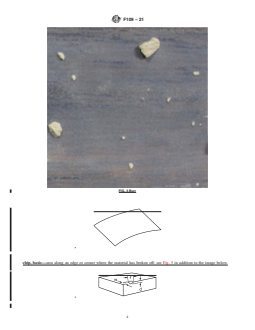
measurement for ceramic tile shall be evaluated with Test chip, closed —fractured area on the edge or corner when the
MethodC485;seeFig.4inadditiontotheimagebelow.(See material has not broken off; see Fig. 6 in addition to the
also waviness.)
image below. (Syn. potential chip)
where:
W = width
l = length, and
chip, basic—area along an edge or corner where the material
d = depth.
has broken off; see Fig. 5 in addition to the image below.
chip, pre-print or pre-glaze—Surface damage that occurs
prior to decorative glazing or printing; these may occur
before or after the base color; the photographed examples in
Fig. 7 show chips that were printed over with graphic,
making them more difficult to detect; the upper picture of in
Fig. 7 is a tile that was chipped after the base glaze, but prior
to printing; the lower picture in Fig. 7 is a tile that was
where:
chipped prior to the initial glaze.
w = width
l = length, and
d = depth.
F109 − 21
FIG. 2 Blister
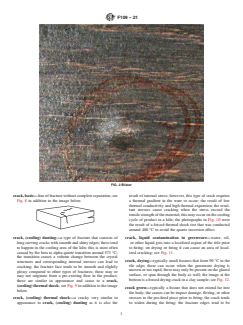
crack, basic—lineoffracturewithoutcompleteseparation;see result of internal stress; however, this type of crack requires
Fig. 8 in addition to the image below.
a thermal gradient in the ware to occur; the result of low
thermal conductivity and high thermal expansion; the resul-
tant stresses cause cracking when the stress exceed the
tensilestrengthofthematerial;thismayoccuronthecooling
cycle of product in a kiln; the photographs in Fig. 10 were
the result of a forced thermal shock test that was conducted
around 400 °C to avoid the quartz inversion effect.
crack, liquid contamination in greenware—water, oil,
crack, (cooling) dunting—a type of fracture that consists of
long curving cracks with smooth and shiny edges; these tend or other liquid gets into a localized region of the title prior
to happen in the cooling area of the kiln; this is most often to firing; on drying or firing it can cause an area of local-
caused by the beta to alpha quartz transition around 573 °C; ized cracking; see Fig. 11.
the transition causes a volume change between the crystal
crack, drying—typically small fissures that form 90 °C to the
structures and corresponding internal stresses can lead to
tile edge; these can occur when the greenware drying is
cracking; the fracture face tends to be smooth and slightly
uneven or too rapid; these may only be present on the glazed
glossy compared to other types of fractures; these may or
surface, or span through the body as well; the image at the
may not originate from a pre-existing flaw in the product;
bottom is a forced drying crack in a clay sample; see Fig. 12.
these are similar in appearance and cause to a crack,
(cooling) thermal shock; see Fig. 9 in addition to the image
crack green—typically a fissure that does not extend far into
below.
the body; the causes can be impact damage, flexing, or other
crack, (cooling) thermal shock—a cracky very similar in stresses to the pre-fired piece prior to firing; the crack tends
appearance to crack, (cooling) dunting as it is also the to widen during the firing; the fracture edges tend to be
F109 − 21
FIG. 3 Burr
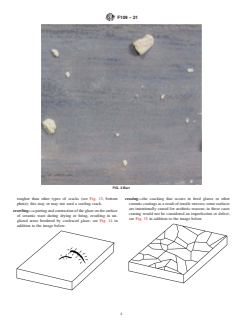
rougher than other types of cracks (see Fig. 13, bottom crazing—the cracking that occurs in fired glazes or other
photo); this may or may not seed a cooling crack. ceramiccoatingsasaresultoftensilestresses;somesurfaces
are intentionally crazed for aesthetic reasons; in these cases
crawling—apartingandcontractionoftheglazeonthesurface
crazing would not be considered an imperfection or defect;
of ceramic ware during drying or firing, resulting in un-
see Fig. 15 in addition to the image below.
glazed areas bordered by coalesced glaze; see Fig. 14 in
addition to the image below.
F109 − 21
FIG. 4 Camber
delaminaon—cracks that tend to run horizontal to the tile
thickness; they may or may not break the surfaces; when
broken, the areas tend to shale off in large flakes; this defect
occurs during the body forming process (pressing or extru-
sion); see Fig. 16.
divot—a shallow depression; this can be the result of a pinhole
or pit that was subjected to polishing; the result is a roughly
circular halo effect; the phenomena can occur flat or as a
flow line—one or more streaks distinguished by a difference in
very shallow depression; this defect is often more visible
light reflectance from the surrounding area, charateristic of
under glare conditions; see Fig. 17.
injection-molded parts. (See also weld mark.)
fin—fine feather-edge protrusion from the surface; on tile this
can occur when the edges miss cleaning after pressing; on
glazed products, the fin can shear off and expose the layer
underneath the glaze; see Fig. 18 in addition to the following
image. (Syn. flash)
F109 − 21
FIG. 5 Chip, Basic
grinding mark—a pattern of fine striations or scoring, usually inclusion—embedded foreign material or a stain other than
directional, resulting from machining, as distinct from sur- from normal composition or forming, or both; see Fig. 21.
face marks; see Fig. 19.
(See also blemish).
kink—atypeofwavinessoccurringinteriortotheedges,notto
be confused with the more abrupt departures as ridges or
surface marks. (See also waviness.)
hole—a deep depression or void, the bottom of which is not
visible by normal (20/20) vision under 200 fc illumination;
see Fig. 20 in addition to the image below.
lump—a raised area on the surface having the appearance of
being solid; see Fig. 22.
F109 − 21
FIG. 5 Chip, Basic (continued)
metal marks—lines on the surface of a ceramic body or glaze peeling—compressivestressesinafiredglazeorotherceramic
caused by drawing a hard metal, such as a knife, across the coating of sufficient magnitude to exceed the strength of
surface; see Fig. 23 in addition to the image below.
adhesion between the glaze and the body.
F109 − 21
FIG. 6 Chip, Closed
pinholes—imperfections in the surface of a ceramic glaze pit—a shallow depression or crater in which all surfaces are
resembling pin pricks; these tend to be shallow and the
visible by normal (20/20) vision under 200 fc of illumina-
bottom may be visible; visibility is sometimes enhanced
tion; the images in Fig. 25 are magnified for publication; the
under glare like conditions; see Fig. 24 in addition to the
top photo is a cross section of a pit, the bottom photo is a top
image below.
view.
F109 − 21
FIG. 7 Chip, Pre{print or Pre-glaze
F109 − 21
FIG. 8 Crack, Basic
F109 − 21
FIG. 9 Crack, (Cooling) Dunting
F109 − 21
FIG. 9 Crack, (Cooling) Dunting (continued)
F109 − 21
FIG. 10 Crack, (Cooling) Thermal Shock
F109 − 21
FIG. 11 Crack, Liquid Contaminaon in Greenware
pock—a partially closed surface cavity; see Fig. 26 in addition porous area—an area that will retain dye when tested in
to the image below.
accordance with Practice E165/E165M and, if broken
through at the porous area, will show evidence of dye
penetration into the body; see Fig. 28 in addition to the
image below.
where:
w = width.
pore—an internal cavity which may be exposed by cutting,
grinding,orpolishingtobecomeapit,pock,orhole;seeFig.
ridge—long, narrow protrusion on any surface.
27 in addition to the image below.
F109 − 21
FIG. 11 Crack, Liquid Contaminaon in Greenware (continued)
rim—a protrusion, usually of base material, bordering either wedging apparatus (C-502). The measurement is only rel-
partially or completelly a hole, pit, or pock; see Fig. 29 in
evant to the straight sides of tiles.
addition to the image below.
speck—adiscreteparticleofunreactedorunwantedmaterialin
a ceramic body or glaze; see Fig. 30 in addition to the image
below.
surface marks—relatively long, narrow, shallow grooves or
cuts in the surface, such as scratches, score marks, and
machiningmarks;seeFig.31inadditiontotheimagebelow.
(See also grinding mark.)
straightness of sides—the deviation from straightness of the
...
This document is not an ASTM standard and is intended only to provide the user of an ASTM standard an indication of what changes have been made to the previous version. Because
it may not be technically possible to adequately depict all changes accurately, ASTM recommends that users consult prior editions as appropriate. In all cases only the current version
of the standard as published by ASTM is to be considered the official document.
Designation: F109 − 12 (Reapproved 2018) F109 − 21
Standard Terminology Relating to
Surface Imperfections on Ceramics
This standard is issued under the fixed designation F109; the number immediately following the designation indicates the year of original
adoption or, in the case of revision, the year of last revision. A number in parentheses indicates the year of last reapproval. A superscript
epsilon (´) indicates an editorial change since the last revision or reapproval.
1. Scope
1.1 This terminology describes and illustrates imperfections observed on whitewares and related products. For additional
definitions of terms relating to whitewares and related products, refer to Terminology C242. To observe these defects, examination
shall be performed visually, with or without the aid of a dye penetrant, as described in Test Method C949. Agreement by the
manufacturer and the purchaser regarding specific techniques of observation is strongly recommended.
1.2 This terminology does not cover every defect or imperfection possible for whitewares or related products. The standard is not
intended to be an all inclusive document for ceramic imperfections. New defect types may be created as ceramic processes,
materials, and technology evolve.
1.3 Some of the imperfection photos utilize magnification for clarity in documentation. Unless otherwise noted, typical
observation conditions for detection of tile imperfections/defects shall consist of current ANSI A137.1 viewing criteria for the
specific defect type
1.4 This international standard was developed in accordance with internationally recognized principles on standardization
established in the Decision on Principles for the Development of International Standards, Guides and Recommendations issued
by the World Trade Organization Technical Barriers to Trade (TBT) Committee.
2. Referenced Documents
2.1 ASTM Standards:
C242 Terminology of Ceramic Whitewares and Related Products
C485 Test Method for Measuring Warpage of Ceramic Tile
C949 Test Method for Porosity in Vitreous Whitewares by Dye Penetration
E165E165/E165M Practice for Liquid Penetrant Testing for General Industry
2.2 ANSI Standard:
ANSI A137.1 American National Standards Specifications For Ceramic Tile
3. Terminology
blemish—strained or discolored area attributable to normal composition or forming, or both. (See also inclusion.
This terminology is under the jurisdiction of ASTM Committee C21 on Ceramic Whitewares and Related Products and is the direct responsibility of C21.01Editorial
and Terminology on Nomenclature.
Current edition approved Feb. 1, 2018Feb. 1, 2021. Published February 2018March 2021. Originally approved in 1969. Last previous edition approved 20122018 as
F109 – 12.F109 – 12 (2018). DOI: 10.1520/F0109-12R18.10.1520/F0109-21.
For referenced ASTM standards, visit the ASTM website, www.astm.org, or contact ASTM Customer Service at service@astm.org. For Annual Book of ASTM Standards
volume information, refer to the standard’s Document Summary page on the ASTM website.
Available from American National Standards Institute (ANSI), 25 W. 43rd St., 4th Floor, New York, NY 10036, http://www.ansi.org.
Copyright © ASTM International, 100 Barr Harbor Drive, PO Box C700, West Conshohocken, PA 19428-2959. United States
F109 − 21
)
3.1 Definitions:
blemish—strained or discolored area attributable to normal composition or forming, or both; see Fig. 1 in addition to the image
below. (See also inclusion.)
blister—bubble or gaseous inclusion at the surface which if broken could form a pit, pock, or hole; see Fig. 2 in addition to the
image below.
FIG. 1 Blemish
F109 − 21
FIG. 2 Blister
burr—fragment of excess material or foreign particle adhering to the surface; the photographed example was the re-
sult of debris from a ware explosion during firing; see Fig. 3 in addition to the image below.
camber—a single arch of curvature; also called warpage when related to ceramic tile and defined as ANSI A137.1; warpage
measurement for ceramic tile shall be evaluated with Test Method C485; see Fig. 4 in addition to the image below. (See also
waviness.)
F109 − 21
FIG. 3 Burr
chip, basic—area along an edge or corner where the material has broken off; see Fig. 5 in addition to the image below.
F109 − 21
FIG. 4 Camber
where:
w = width
l = length, and
d = depth.
chip, closed —fractured area on the edge or corner when the material has not broken off; see Fig. 6 in addition to the image
below. (Syn. potential chip)
where:
W = width
l = length, and
d = depth.
F109 − 21
FIG. 5 Chip, Basic
chip, pre-print or pre-glaze—Surface damage that occurs prior to decorative glazing or printing; these may occur before or
after the base color; the photographed examples in Fig. 7 show chips that were printed over with graphic, making them more
difficult to detect; the upper picture of in Fig. 7 is a tile that was chipped after the base glaze, but prior to printing; the lower
picture in Fig. 7 is a tile that was chipped prior to the initial glaze.
F109 − 21
FIG. 5 Chip, Basic (continued)
crack, basic—line of fracture without complete separation; see Fig. 8 in addition to the image below.
crack, (cooling) dunting—a type of fracture that consists of long curving cracks with smooth and shiny edges; these tend to
happen in the cooling area of the kiln; this is most often caused by the beta to alpha quartz transition around 573 °C; the
transition causes a volume change between the crystal structures and corresponding internal stresses can lead to cracking; the
fracture face tends to be smooth and slightly glossy compared to other types of fractures; these may or may not originate from
a pre-existing flaw in the product; these are similar in appearance and cause to a crack, (cooling) thermal shock; see Fig. 9
in addition to the image below.
crack, (cooling) thermal shock—a cracky very similar in appearance to crack, (cooling) dunting as it is also the result of
internal stress; however, this type of crack requires a thermal gradient in the ware to occur; the result of low thermal conductivity
and high thermal expansion; the resultant stresses cause cracking when the stress exceed the tensile strength of the material; this
F109 − 21
FIG. 6 Chip, Closed
may occur on the cooling cycle of product in a kiln; the photographs in Fig. 10 were the result of a forced thermal shock test
that was conducted around 400 °C to avoid the quartz inversion effect.
crack, liquid contamination in greenware—water, oil, or other liquid gets into a localized region of the title prior to firing;
on drying or firing it can cause an area of localized cracking; see Fig. 11.
crack, drying—typically small fissures that form 90 °C to the tile edge; these can occur when the greenware drying is uneven
or too rapid; these may only be present on the glazed surface, or span through the body as well; the image at the bottom is a
forced drying crack in a clay sample; see Fig. 12.
crack green—typically a fissure that does not extend far into the body; the causes can be impact damage, flexing, or other
stresses to the pre-fired piece prior to firing; the crack tends to widen during the firing; the fracture edges tend to be rougher
than other types of cracks (see Fig. 13, bottom photo); this may or may not seed a cooling crack.
crawling—a parting and contraction of the glaze on the surface of ceramic ware during drying or firing, resulting in unglazed
areas bordered by coalesced glaze; see Fig. 14 in addition to the image below.
F109 − 21
FIG. 7 Chip, Pre{print or Pre-glaze
F109 − 21
FIG. 8 Crack, Basic
F109 − 21
FIG. 9 Crack, (Cooling) Dunting
F109 − 21
FIG. 9 Crack, (Cooling) Dunting (continued)
F109 − 21
FIG. 10 Crack, (Cooling) Thermal Shock
F109 − 21
FIG. 11 Crack, Liquid Contaminaon in Greenware
crazing—the cracking that occurs in fired glazes or other ceramic coatings as a result of tensile stresses; some surfaces are
intentionally crazed for aesthetic reasons; in these cases crazing would not be considered an imperfection or defect; see Fig. 15
in addition to the image below.
F109 − 21
FIG. 11 Crack, Liquid Contaminaon in Greenware (continued)
delaminaon—cracks that tend to run horizontal to the tile thickness; they may or may not break the surfaces; when broken, the
areas tend to shale off in large flakes; this defect occurs during the body forming process (pressing or extrusion); see Fig. 16.
divot—a shallow depression; this can be the result of a pinhole or pit that was subjected to polishing; the result is a roughly
circular halo effect; the phenomena can occur flat or as a very shallow depression; this defect is often more visible under glare
conditions; see Fig. 17.
fin—fine feather-edge protrusion from the surface; on tile this can occur when the edges miss cleaning after pressing; on glazed
products, the fin can shear off and expose the layer underneath the glaze; see Fig. 18 in addition to the following image. (Syn.
flash)
F109 − 21
FIG. 12 Crack, Drying
F109 − 21
FIG. 12 Crack, Drying (continued)
flow line—one or more streaks distinguished by a difference in light reflectance from the surrounding area, charateristic of
injection-molded parts. (See also weld mark.)
F109 − 21
FIG. 13 Crack, Green
F109 − 21
FIG. 13 Crack, Green (continued)
FIG. 14 Crawling
grinding mark—a pattern of fine striations or scoring, usually directional, resulting from machining, as distinct from surface
marks; see Fig. 19.
F109 − 21
FIG. 15 Crazing
FIG. 16 Delaminaon
F109 − 21
FIG. 16 Delaminaon (continued)
hole—a deep depression or void, the bottom of which is not visible by normal (20/20) vision under 200 fc illumination; see Fig.
20 in addition to the image below.
inclusion—embedded foreign material or a stain other than from normal composition or forming, or both; see Fig. 21. (See also
blemish).
F109 − 21
FIG. 17 Divot
F109 − 21
FIG. 18 Fin
kink—a type of waviness occurring interior to the edges, not to be confused with the more abrupt departures as ridges or surface
marks. (See also waviness.)
lump—a raised area on the surface having the appearance of being solid; see Fig. 22.
F109 − 21
FIG. 18 Fin (continued)
metal marks—lines on the surface of a ceramic body or glaze caused by drawing a hard metal, such as a knife, across the
surface; see Fig. 23 in addition to the image below.
F109 − 21
FIG. 19 Grinding Mark
peeling—compressive stresses in a fired glaze or other ceramic coating of sufficient magnitude to exceed the strength of
adhesion between the glaze and the body.
F109 − 21
This photography is a magnified hole that was formed during the burn of a contaminant.
FIG. 20 Hole
FIG. 21 Inclusion
pinholes—imperfections in the surface of a ceramic glaze resembling pin pricks; these tend to be shallow and the bottom may
be visible; visibility is sometimes enhanced under glare like conditions; see Fig. 24 in addition to the image below.
F109 − 21
FIG. 21 Inclusion (continued)
F109 − 21
FIG. 22 Lump
F109 − 21
FIG. 23 Metal Marks
pit—a shallow depression or crater in which all surfaces are visible by normal (20/20) vision under 200 fc of illumination; the
images in Fig. 25 are magnified for publication; the top photo is a cross section of a pit, the bottom photo is a top view.
F109 − 21
The bottom image is magnified for clarity in this publication.
FIG. 24 Pinholes
pock—a partially closed surface cavity; see Fig. 26 in addition to the image below.
F109 − 21
The top photo is a cross section of a pit, the bottom picture is a top view.
FIG. 25 Pit
F109 − 21
FIG. 26 Pock
where:
w = width.
pore—an internal cavity which may be exposed by cutting, grinding, or polishing to become a pit, pock, or hole; see Fig. 27
in addition to the image below.
This photograph is a cross section of a pore in a porcelain body.
FIG. 27 Pore
F109 − 21
porous area—an area that will retain dye when tested in accordance with Practice E165/E165M and, if broken through at the
porous area, will show evidence of dye penetration into the body; see Fig. 28 in addition to the image below.
FIG. 28 Porous Area
F109 − 21
ridge—long, narrow protrusion on any surface.
F109 − 21
rim—a protrusion, usually of base material, bordering either partially or completelly a hole, pit, or pock; see Fig. 29 in addition
to the image below.
speck—a discrete particle of unreacted or unwanted material in a ceramic body or glaze; see Fig. 30 in addition to the image
below.
FIG. 29 Rim
F109 − 21
FIG. 30 Speck
straightness of sides—the deviation from straightness of the center of the side in the plane of the tile, as measured by a wedgi
...