

ASTM D2881-19
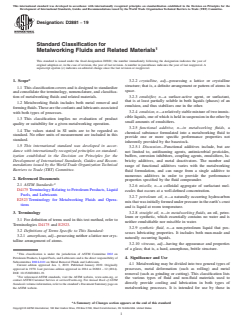
(Classification)Standard Classification for Metalworking Fluids and Related Materials
General Information
- Abstract
SIGNIFICANCE AND USE
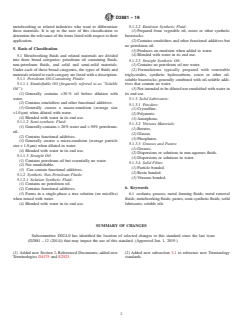
4.1 Metalworking may be divided into two general types of processes, metal deformation (such as rolling) and metal removal (such as grinding or cutting). This classification lists the various types of fluid and non-fluid materials used to directly provide cooling and lubrication in both types of metalworking processes. It is intended for use by those in metalworking or related industries who want to differentiate these materials. It is up to the user of this classification to determine the relevance of the items listed with respect to their application.
SCOPE
1.1 This classification covers and is designed to standardize and consolidate the terminology, nomenclature, and classification of metalworking fluids and related materials.
1.2 Metalworking fluids includes both metal removal and forming fluids. These are the coolants and lubricants associated with both types of processes.
1.3 This classification implies no evaluation of product quality or suitability for a given metalworking operation.
1.4 The values stated in SI units are to be regarded as standard. No other units of measurement are included in this standard.
1.5 This international standard was developed in accordance with internationally recognized principles on standardization established in the Decision on Principles for the Development of International Standards, Guides and Recommendations issued by the World Trade Organization Technical Barriers to Trade (TBT) Committee.
- Status
- Published
- Publication Date
- 31-Dec-2018
- Technical Committee
- D02 - Petroleum Products, Liquid Fuels, and Lubricants
- Drafting Committee
- D02.L0.01 - Metal Removal Fluids and Lubricants




Overview
ASTM D2881-19: Standard Classification for Metalworking Fluids and Related Materials provides a comprehensive framework for the terminology, classification, and nomenclature of metalworking fluids and their related materials. This standard, developed by ASTM International, is essential for professionals in metalworking and related industries to standardize communication and differentiate between various types of fluids and materials used in metal deformation and metal removal processes.
The classification encapsulated in ASTM D2881-19 covers coolants and lubricants used in machining, forming, grinding, and cutting operations. The standard itself does not evaluate product quality or specify the suitability of specific fluids for particular applications. All values and references in this standard are presented in SI units.
Key Topics
Classification Categories:
Metalworking fluids and materials are divided into three primary categories:- Petroleum oil-containing fluids
- Non-petroleum (synthetic) fluids
- Solid and semi-solid lubricants
Types of Fluids and Materials:
- Petroleum Oil-Containing Fluids:
- Emulsifiable (Soluble) Oils: Oil blended with water, creating a macro-emulsion
- Semi-synthetic Fluids: Mixture of petroleum oil and water, forming a micro-emulsion
- Straight Oils: Undiluted petroleum or synthetic oils, not emulsifiable with water
- Synthetic (Non-Petroleum) Fluids:
- Solution Synthetic Fluids: True solutions containing functional additives, blended with water
- Emulsion Synthetic Fluids: Based on vegetable oils or esters, no petroleum content
- Straight Synthetic Oils: Non-petroleum, non-water-based lubricants
- Solid Lubricants:
- Powders (crystalline, polymeric, amorphous), vitreous materials (e.g., borates, glasses), greases and pastes, and various solid films
- Petroleum Oil-Containing Fluids:
Standardized Terminology:
Provides definitions for industry-specific terms such as emulsion, functional additive, micelle, and more, referencing ASTM D4175 and E2523 for consistency.Significance and Use:
The classification helps manufacturers, suppliers, and end-users properly identify, specify, and apply metalworking fluids and materials according to process needs.
Applications
ASTM D2881-19 is widely utilized in:
- Metalworking Operations:
- Metal deformation processes (e.g., rolling)
- Metal removal processes (e.g., cutting, grinding)
- Selection and Specification:
Assists procurement and technical teams in choosing suitable fluids and related materials for particular machining operations, considering cooling, lubrication, and process compatibility. - Product Development:
Provides a unified vocabulary and classification structure for manufacturers and formulators developing new fluid products or alternative lubricants. - Regulatory and Quality Compliance:
Helps ensure products meet industry communication standards and simplifies compliance with international trade regulations per WTO guidelines.
Related Standards
- ASTM D4175: Terminology Relating to Petroleum Products, Liquid Fuels, and Lubricants
- ASTM E2523: Terminology for Metalworking Fluids and Operations
Key terms:
Metalworking fluids, metal removal fluids, metal forming fluids, coolants, lubricants, solid lubricants, greases, soluble oils, semi-synthetic fluids.
For those involved in machining, forming, and metalworking, referring to ASTM D2881-19 ensures clear communication about material types, aiding in the specification, procurement, and application of the right fluids and materials for optimal performance and process efficiency. For more detailed definitions or application guidance, consult the latest official version via ASTM International.
Relations
- Effective Date
- 01-Jan-2019
- Refers
ASTM D4175-23a - Standard Terminology Relating to Petroleum Products, Liquid Fuels, and Lubricants - Effective Date
- 15-Dec-2023
- Effective Date
- 01-Nov-2023
- Refers
ASTM D4175-23e1 - Standard Terminology Relating to Petroleum Products, Liquid Fuels, and Lubricants - Effective Date
- 01-Jul-2023
- Effective Date
- 01-Oct-2018
- Effective Date
- 01-Apr-2013
- Effective Date
- 01-Jan-2011
- Effective Date
- 15-Apr-2007
- Effective Date
- 01-Dec-2006
- Effective Date
- 01-Jan-2019
- Effective Date
- 01-Jan-2019
- Effective Date
- 01-Jan-2019
- Effective Date
- 01-Jan-2019
- Effective Date
- 01-Jan-2019
- Effective Date
- 01-Jan-2019
Get Certified
Connect with accredited certification bodies for this standard

Element Materials Technology
Materials testing and product certification.

ABS Group Brazil
ABS Group certification services in Brazil.

ABS Quality Evaluations Inc.
American Bureau of Shipping quality certification.
Sponsored listings
Frequently Asked Questions
ASTM D2881-19 is a standard published by ASTM International. Its full title is "Standard Classification for Metalworking Fluids and Related Materials". This standard covers: SIGNIFICANCE AND USE 4.1 Metalworking may be divided into two general types of processes, metal deformation (such as rolling) and metal removal (such as grinding or cutting). This classification lists the various types of fluid and non-fluid materials used to directly provide cooling and lubrication in both types of metalworking processes. It is intended for use by those in metalworking or related industries who want to differentiate these materials. It is up to the user of this classification to determine the relevance of the items listed with respect to their application. SCOPE 1.1 This classification covers and is designed to standardize and consolidate the terminology, nomenclature, and classification of metalworking fluids and related materials. 1.2 Metalworking fluids includes both metal removal and forming fluids. These are the coolants and lubricants associated with both types of processes. 1.3 This classification implies no evaluation of product quality or suitability for a given metalworking operation. 1.4 The values stated in SI units are to be regarded as standard. No other units of measurement are included in this standard. 1.5 This international standard was developed in accordance with internationally recognized principles on standardization established in the Decision on Principles for the Development of International Standards, Guides and Recommendations issued by the World Trade Organization Technical Barriers to Trade (TBT) Committee.
SIGNIFICANCE AND USE 4.1 Metalworking may be divided into two general types of processes, metal deformation (such as rolling) and metal removal (such as grinding or cutting). This classification lists the various types of fluid and non-fluid materials used to directly provide cooling and lubrication in both types of metalworking processes. It is intended for use by those in metalworking or related industries who want to differentiate these materials. It is up to the user of this classification to determine the relevance of the items listed with respect to their application. SCOPE 1.1 This classification covers and is designed to standardize and consolidate the terminology, nomenclature, and classification of metalworking fluids and related materials. 1.2 Metalworking fluids includes both metal removal and forming fluids. These are the coolants and lubricants associated with both types of processes. 1.3 This classification implies no evaluation of product quality or suitability for a given metalworking operation. 1.4 The values stated in SI units are to be regarded as standard. No other units of measurement are included in this standard. 1.5 This international standard was developed in accordance with internationally recognized principles on standardization established in the Decision on Principles for the Development of International Standards, Guides and Recommendations issued by the World Trade Organization Technical Barriers to Trade (TBT) Committee.
ASTM D2881-19 is classified under the following ICS (International Classification for Standards) categories: 75.100 - Lubricants, industrial oils and related products. The ICS classification helps identify the subject area and facilitates finding related standards.
ASTM D2881-19 has the following relationships with other standards: It is inter standard links to ASTM D2881-12(2014), ASTM D4175-23a, ASTM E2523-23, ASTM D4175-23e1, ASTM E2523-13(2018), ASTM E2523-13, ASTM E2523-11, ASTM E2523-07, ASTM E2523-06, ASTM E2144-21, ASTM E2889-12(2017), ASTM E2564-18, ASTM E2657-21, ASTM E2693-19, ASTM D8288-19. Understanding these relationships helps ensure you are using the most current and applicable version of the standard.
ASTM D2881-19 is available in PDF format for immediate download after purchase. The document can be added to your cart and obtained through the secure checkout process. Digital delivery ensures instant access to the complete standard document.
Standards Content (Sample)
This international standard was developed in accordance with internationally recognized principles on standardization established in the Decision on Principles for the
Development of International Standards, Guides and Recommendations issued by the World Trade Organization Technical Barriers to Trade (TBT) Committee.
Designation: D2881 −19
Standard Classification for
Metalworking Fluids and Related Materials
This standard is issued under the fixed designation D2881; the number immediately following the designation indicates the year of
original adoption or, in the case of revision, the year of last revision. A number in parentheses indicates the year of last reapproval. A
superscript epsilon (´) indicates an editorial change since the last revision or reapproval.
1. Scope* 3.2.2 crystalline, adj—possessing a lattice or crystalline
structure; that is, a definite arrangement or pattern of atoms in
1.1 This classification covers and is designed to standardize
space.
and consolidate the terminology, nomenclature, and classifica-
3.2.3 emulsifier, n—a surface-active agent, or surfactant,
tion of metalworking fluids and related materials.
that is at least partially soluble in both liquids (phases) of an
1.2 Metalworking fluids includes both metal removal and
emulsion, and thus stabilizes one in the other.
forming fluids.These are the coolants and lubricants associated
3.2.4 emulsion, n—a relatively stable mixture of two immis-
with both types of processes.
cible liquids, one of which is held in suspension in the other by
1.3 This classification implies no evaluation of product
small amounts of emulsifiers.
quality or suitability for a given metalworking operation.
3.2.5 functional additive, n—in metalworking fluids,a
1.4 The values stated in SI units are to be regarded as
chemical substance formulated into a metalworking fluid to
standard. No other units of measurement are included in this
provide one or more specific performance properties not
standard.
inherently provided by the basestock.
1.5 This international standard was developed in accor-
3.2.5.1 Discussion—Functional additives include, but are
dance with internationally recognized principles on standard-
not limited to, antifoaming agents, antimicrobial pesticides,
ization established in the Decision on Principles for the
buffers, corrosion inhibitors, coupling agents, emulsifiers, lu-
Development of International Standards, Guides and Recom-
bricity additives, and metal deactivators. The number and
mendations issued by the World Trade Organization Technical
range of functional additives varies with the metalworking
Barriers to Trade (TBT) Committee.
fluid formulation, and can range from a single additive to
numerous additives in order to provide the performance
2. Referenced Documents
properties specified by the fluid compounder.
2.1 ASTM Standards:
3.2.6 micelle, n—a colloidal aggregate of surfactant mol-
D4175 Terminology Relating to Petroleum Products, Liquid
ecules that occurs at a well-defined concentration.
Fuels, and Lubricants
3.2.7 petroleum oil, n—a naturally occurring hydrocarbon
E2523 Terminology for Metalworking Fluids and Opera-
mix that was initially formed under pressure in the earth’s crust
tions
and is liquid at room temperature.
3.2.8 straight oil, n—in metalworking fluids, an oil, petro-
3. Terminology
leum or synthetic, which essentially contains no water and is
3.1 For definition of terms used in this test method, refer to
neither emulsifiable nor miscible in water.
Terminologies D4175 and E2523.
3.2.9 synthetic fluid, n—a non-petroleum liquid that pos-
3.2 Definitions of Terms Specific to This Standard:
sesses lubricating properties. It includes both man-made and
3.2.1 amorphous, adj—possessing neither a lattice nor crys-
naturally occurring liquids.
talline arrangement of atoms.
3.2.10 vitreous, adj—having the appearance and properties
of a glass; that is, a hard, amorphous, brittle structure.
This classification is under the jurisdiction of ASTM Committee D02 on
4. Significance and Use
Petroleum Products, Liquid Fuels, and Lubricants and is the direct responsibility of
Subcommittee D02.L0.01 on Metal Removal Fluids and Lubricants.
4.1 Metalworking may be divided into two general types of
Current edition approved Jan. 1, 2019. Published January 2019. Originally
processes, metal deformation (such as rolling) and metal
approved in 1970. Last previous edition approved in 2014 as D2881 – 12 (2014).
DOI: 10.1520/D2881-19.
removal (such as grinding or cutting). This classification lists
For referenced ASTM standards, visit the ASTM website, www.astm.org, or
the various types of fluid and non-fluid materials used to
contact ASTM Customer Service at service@astm.org. For Annual Book of ASTM
directly provide cooling and lubrication in both types of
Standards volume information, refer to the standard’s Document Summary page on
the ASTM website. metalworking processes. It is intended for use b
...
This document is not an ASTM standard and is intended only to provide the user of an ASTM standard an indication of what changes have been made to the previous version. Because
it may not be technically possible to adequately depict all changes accurately, ASTM recommends that users consult prior editions as appropriate. In all cases only the current version
of the standard as published by ASTM is to be considered the official document.
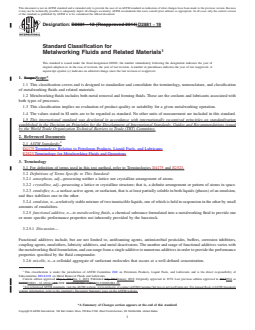
Designation: D2881 − 12 (Reapproved 2014) D2881 − 19
Standard Classification for
Metalworking Fluids and Related Materials
This standard is issued under the fixed designation D2881; the number immediately following the designation indicates the year of
original adoption or, in the case of revision, the year of last revision. A number in parentheses indicates the year of last reapproval. A
superscript epsilon (´) indicates an editorial change since the last revision or reapproval.
1. Scope Scope*
1.1 This classification covers and is designed to standardize and consolidate the terminology, nomenclature, and classification
of metalworking fluids and related materials.
1.2 Metalworking fluids includes both metal removal and forming fluids. These are the coolants and lubricants associated with
both types of processes.
1.3 This classification implies no evaluation of product quality or suitability for a given metalworking operation.
1.4 The values stated in SI units are to be regarded as standard. No other units of measurement are included in this standard.
1.5 This international standard was developed in accordance with internationally recognized principles on standardization
established in the Decision on Principles for the Development of International Standards, Guides and Recommendations issued
by the World Trade Organization Technical Barriers to Trade (TBT) Committee.
2. Referenced Documents
2.1 ASTM Standards:
D4175 Terminology Relating to Petroleum Products, Liquid Fuels, and Lubricants
E2523 Terminology for Metalworking Fluids and Operations
3. Terminology
3.1 For definition of terms used in this test method, refer to Terminologies D4175 and E2523.
3.2 Definitions of Terms Specific to This Standard:
3.2.1 amorphous, adj—possessing neither a lattice nor crystalline arrangement of atoms.
3.2.2 crystalline, adj—possessing a lattice or crystalline structure; that is, a definite arrangement or pattern of atoms in space.
3.2.3 emulsifier, n—a surface-active agent, or surfactant, that is at least partially soluble in both liquids (phases) of an emulsion,
and thus stabilizes one in the other.
3.2.4 emulsion, n—a relatively stable mixture of two immiscible liquids, one of which is held in suspension in the other by small
amounts of emulsifiers.
3.2.5 functional additive, n—in metalworking fluids, a chemical substance formulated into a metalworking fluid to provide one
or more specific performance properties not inherently provided by the basestock.
3.2.5.1 Discussion—
Functional additives include, but are not limited to, antifoaming agents, antimicrobial pesticides, buffers, corrosion inhibitors,
coupling agents, emulsifiers, lubricity additives, and metal deactivators. The number and range of functional additives varies with
the metalworking fluid formulation, and can range from a single additive to numerous additives in order to provide the performance
properties specified by the fluid compounder.
3.2.6 micelle, n—a colloidal aggregate of surfactant molecules that occurs at a well-defined concentration.
This classification is under the jurisdiction of ASTM Committee D02 on Petroleum Products, Liquid Fuels, and Lubricants and is the direct responsibility of
Subcommittee D02.L0.01 on Metal Removal Fluids and Lubricants.
Current edition approved May 1, 2014Jan. 1, 2019. Published July 2014January 2019. Originally approved in 1970. Last previous edition approved in 20122014 as
D2881D2881 – 12 (2014).–12. DOI: 10.1520/D2881-12R14.10.1520/D2881-19.
For referenced ASTM standards, visit the ASTM website, www.astm.org, or contact ASTM Customer Service at service@astm.org. For Annual Book of ASTM Standards
volume information, refer to the standard’s Document Summary page on the ASTM website.
*A Summary of Changes section appears at the end of this standard
Copyright © ASTM International, 100 Barr Harbor Drive, PO Box C700, West Conshohocken, PA 19428-2959. United States
D2881 − 19
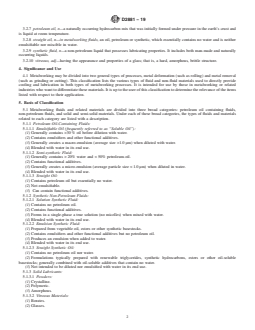
3.2.7 petroleum oil, n—a naturally occurring hydrocarbon mix that was initially formed under pressure in the earth’s crust and
is liquid at room temperature.
3.2.8 straight oil, n—in metalworking fluids, an oil, petroleum or synthetic, which essentially contains no water and is neither
emulsifiable nor miscible in water.
3.2.9 synthetic fluid, n—a non-petroleum liquid that possesses lubricating properties. It includes both man-made and naturally
occurring liquids.
3.2.10 vitreous, adj—having the appearance and properties of a glass; that is, a hard, amorphous, brittle structure.
4. Significance and Use
4.
...