

ASTM D8288-19
(Test Method)Standard Test Method for Comparison of Metalworking Fluids Using a Tapping Torque Test Machine
General Information
- Abstract
SIGNIFICANCE AND USE
5.1 This test method can be used to predict the comparative lubricating properties of a metalworking fluid (MWF).
5.1.1 Fluids that produce lower torques or higher efficiencies are predicted to have better machining characteristics.
5.2 The method is applicable to all tap types, machining speeds, alloys and coatings that can be fabricated into a test piece.
5.3 Comparison between different operating conditions or various types of fluids can be made.
5.4 The reportable quantity is the efficiency or mean average torque of a reference fluid divided by the mean average torque of the fluid of interest.
SCOPE
1.1 This test method describes a laboratory technique to evaluate the relative performance of metal removal fluids using an instrumented tapping machine that measures and records torque.
1.1.1 The method is applicable to all tap types, machining speeds, and alloys that can be fabricated into a test piece. Comparison can be made between different operating conditions or various types of fluids including straight and emulsifiable oils, semi-synthetics and synthetic fluids (see Classification D2881).
1.2 The values stated in SI units are to be regarded as standard.
1.2.1 Exception—The units for the threads of the tap, M6, are in metric thread units.
1.3 This standard does not purport to address all of the safety concerns, if any, associated with its use. It is the responsibility of the user of this standard to establish appropriate safety, health, and environmental practices and determine the applicability of regulatory limitations prior to use.
1.4 This international standard was developed in accordance with internationally recognized principles on standardization established in the Decision on Principles for the Development of International Standards, Guides and Recommendations issued by the World Trade Organization Technical Barriers to Trade (TBT) Committee.
- Status
- Published
- Publication Date
- 30-Nov-2019
- Technical Committee
- D02 - Petroleum Products, Liquid Fuels, and Lubricants
- Drafting Committee
- D02.L0.01 - Metal Removal Fluids and Lubricants
Overview
ASTM D8288-19 defines the standard test method for comparing metalworking fluids (MWF) using a tapping torque test machine. This laboratory-based method evaluates the relative performance of metal removal fluids by measuring the torque required to tap threads in metal test pieces. The test assesses lubricating efficiency, allowing predictions about the fluid's suitability in machining operations. The method is applicable to a wide range of tap types, machining speeds, alloys, and coatings that can be fabricated into a test piece, providing critical comparative data for both straight and emulsifiable oils, semi-synthetic, and synthetic fluids.
Key Topics
- Comparative Lubricity Assessment: The standard enables the comparison of the lubricating properties of various metalworking fluids. Fluids yielding lower torque or higher efficiency during the tapping process are predicted to offer better machining performance.
- Applicability to Various Conditions: Coverage includes all tap types, machining speeds, and metal alloys or coatings that can fit into a test setup, ensuring broad relevance to industry needs.
- Repeatable and Reliable Methodology: The test method incorporates procedures for setting up the tapping machine, preparing test samples, and analyzing data to ensure consistent and precise measurements.
- Efficiency Calculation: Results are quantified as the ratio of mean average torque of a reference fluid to that of the test fluid, offering a clear metric for comparing fluid performance.
- Precision and Validity: The standard includes guidelines for ensuring repeatability, addressing sources of variation, and referencing proper statistical procedures for test method development.
Applications
- Metalworking Fluid Selection: This method helps manufacturers and end-users select the most suitable metalworking fluids by providing quantitative data on lubricity and efficiency under varying machining conditions.
- Quality Control: Metalworking fluid producers utilize the test to maintain formulation consistency and to compare new and existing products.
- Process Optimization: Production facilities can use test results to optimize cutting operations by choosing fluids that minimize torque and improve tool life.
- Comparative Analysis: The standard allows benchmarking of new fluid formulations and supports research and development for lubricants intended for demanding machining applications.
Related Standards
- ASTM D2881: Classification for Metalworking Fluids and Related Materials
- ASTM D4175: Terminology Relating to Petroleum Products, Liquid Fuels, and Lubricants
- ASTM D6300: Practice for Determination of Precision and Bias Data for Use in Test Methods for Petroleum Products and Lubricants
- ASTM D7778: Guide for Conducting an Interlaboratory Study to Determine the Precision of a Test Method
- ASTM E1488: Guide for Statistical Procedures to Use in Developing and Applying Test Methods
Practical Value
Implementing ASTM D8288-19 provides a standardized, repeatable procedure for comparing metalworking fluids, supporting informed decisions that can lead to increased machining efficiency, reduced tool wear, and improved production quality. By using torque measurement as a direct indicator of fluid performance, users gain actionable insight into the tribological properties of fluids under real-world operating conditions. This helps drive innovation in fluid formulation and ensures processes remain cost-effective and competitive.
Keywords: metalworking fluids, tapping torque, lubricity, machining efficiency, comparative analysis, ASTM D8288-19, metal removal fluids, manufacturing standards, lubricant performance, torque testing
Relations
- Effective Date
- 01-Mar-2024
- Refers
ASTM D4175-23a - Standard Terminology Relating to Petroleum Products, Liquid Fuels, and Lubricants - Effective Date
- 15-Dec-2023
- Effective Date
- 01-Dec-2023
- Effective Date
- 01-Nov-2023
- Refers
ASTM D4175-23e1 - Standard Terminology Relating to Petroleum Products, Liquid Fuels, and Lubricants - Effective Date
- 01-Jul-2023
- Effective Date
- 01-Dec-2019
- Effective Date
- 01-Jan-2019
- Effective Date
- 01-Apr-2016
- Effective Date
- 01-Jun-2015
- Effective Date
- 01-Jun-2014
- Effective Date
- 01-Jun-2014
- Effective Date
- 01-May-2014
- Effective Date
- 01-May-2014
- Effective Date
- 01-Dec-2013
- Effective Date
- 15-Jul-2013
Get Certified
Connect with accredited certification bodies for this standard

Element Materials Technology
Materials testing and product certification.

ABS Group Brazil
ABS Group certification services in Brazil.

ABS Quality Evaluations Inc.
American Bureau of Shipping quality certification.
Sponsored listings
Frequently Asked Questions
ASTM D8288-19 is a standard published by ASTM International. Its full title is "Standard Test Method for Comparison of Metalworking Fluids Using a Tapping Torque Test Machine". This standard covers: SIGNIFICANCE AND USE 5.1 This test method can be used to predict the comparative lubricating properties of a metalworking fluid (MWF). 5.1.1 Fluids that produce lower torques or higher efficiencies are predicted to have better machining characteristics. 5.2 The method is applicable to all tap types, machining speeds, alloys and coatings that can be fabricated into a test piece. 5.3 Comparison between different operating conditions or various types of fluids can be made. 5.4 The reportable quantity is the efficiency or mean average torque of a reference fluid divided by the mean average torque of the fluid of interest. SCOPE 1.1 This test method describes a laboratory technique to evaluate the relative performance of metal removal fluids using an instrumented tapping machine that measures and records torque. 1.1.1 The method is applicable to all tap types, machining speeds, and alloys that can be fabricated into a test piece. Comparison can be made between different operating conditions or various types of fluids including straight and emulsifiable oils, semi-synthetics and synthetic fluids (see Classification D2881). 1.2 The values stated in SI units are to be regarded as standard. 1.2.1 Exception—The units for the threads of the tap, M6, are in metric thread units. 1.3 This standard does not purport to address all of the safety concerns, if any, associated with its use. It is the responsibility of the user of this standard to establish appropriate safety, health, and environmental practices and determine the applicability of regulatory limitations prior to use. 1.4 This international standard was developed in accordance with internationally recognized principles on standardization established in the Decision on Principles for the Development of International Standards, Guides and Recommendations issued by the World Trade Organization Technical Barriers to Trade (TBT) Committee.
SIGNIFICANCE AND USE 5.1 This test method can be used to predict the comparative lubricating properties of a metalworking fluid (MWF). 5.1.1 Fluids that produce lower torques or higher efficiencies are predicted to have better machining characteristics. 5.2 The method is applicable to all tap types, machining speeds, alloys and coatings that can be fabricated into a test piece. 5.3 Comparison between different operating conditions or various types of fluids can be made. 5.4 The reportable quantity is the efficiency or mean average torque of a reference fluid divided by the mean average torque of the fluid of interest. SCOPE 1.1 This test method describes a laboratory technique to evaluate the relative performance of metal removal fluids using an instrumented tapping machine that measures and records torque. 1.1.1 The method is applicable to all tap types, machining speeds, and alloys that can be fabricated into a test piece. Comparison can be made between different operating conditions or various types of fluids including straight and emulsifiable oils, semi-synthetics and synthetic fluids (see Classification D2881). 1.2 The values stated in SI units are to be regarded as standard. 1.2.1 Exception—The units for the threads of the tap, M6, are in metric thread units. 1.3 This standard does not purport to address all of the safety concerns, if any, associated with its use. It is the responsibility of the user of this standard to establish appropriate safety, health, and environmental practices and determine the applicability of regulatory limitations prior to use. 1.4 This international standard was developed in accordance with internationally recognized principles on standardization established in the Decision on Principles for the Development of International Standards, Guides and Recommendations issued by the World Trade Organization Technical Barriers to Trade (TBT) Committee.
ASTM D8288-19 is classified under the following ICS (International Classification for Standards) categories: 75.100 - Lubricants, industrial oils and related products. The ICS classification helps identify the subject area and facilitates finding related standards.
ASTM D8288-19 has the following relationships with other standards: It is inter standard links to ASTM D6300-24, ASTM D4175-23a, ASTM D6300-23a, ASTM E1488-23, ASTM D4175-23e1, ASTM D6300-19a, ASTM D2881-19, ASTM D6300-16, ASTM D6300-15, ASTM D6300-14ae1, ASTM D6300-14a, ASTM D2881-12(2014), ASTM D6300-14, ASTM D6300-13a, ASTM D6300-13. Understanding these relationships helps ensure you are using the most current and applicable version of the standard.
ASTM D8288-19 is available in PDF format for immediate download after purchase. The document can be added to your cart and obtained through the secure checkout process. Digital delivery ensures instant access to the complete standard document.
Standards Content (Sample)
This international standard was developed in accordance with internationally recognized principles on standardization established in the Decision on Principles for the
Development of International Standards, Guides and Recommendations issued by the World Trade Organization Technical Barriers to Trade (TBT) Committee.
Designation: D8288 − 19
Standard Test Method for
Comparison of Metalworking Fluids Using a Tapping Torque
Test Machine
This standard is issued under the fixed designation D8288; the number immediately following the designation indicates the year of
original adoption or, in the case of revision, the year of last revision.Anumber in parentheses indicates the year of last reapproval.A
superscript epsilon (´) indicates an editorial change since the last revision or reapproval.
1. Scope D5619Test Method for Comparing Metal Removal Fluids
Using the Tapping Torque Test Machine (Withdrawn
1.1 This test method describes a laboratory technique to
2016)
evaluatetherelativeperformanceofmetalremovalfluidsusing
D6300Practice for Determination of Precision and Bias
an instrumented tapping machine that measures and records
Data for Use in Test Methods for Petroleum Products and
torque.
Lubricants
1.1.1 The method is applicable to all tap types, machining
D7778Guide for Conducting an Interlaboratory Study to
speeds, and alloys that can be fabricated into a test piece.
Determine the Precision of a Test Method
Comparison can be made between different operating condi-
E1488GuideforStatisticalProcedurestoUseinDeveloping
tions or various types of fluids including straight and emulsi-
and Applying Test Methods
fiable oils, semi-synthetics and synthetic fluids (see Classifica-
tion D2881).
3. Terminology
1.2 The values stated in SI units are to be regarded as
3.1 Fordefinitionsoftermsusedinthistestmethod,referto
standard.
Terminology D4175.
1.2.1 Exception—The units for the threads of the tap, M6,
3.2 Definitions of Terms Specific to This Standard:
are in metric thread units.
3.2.1 built up edge, n—an accumulation of the material
1.3 This standard does not purport to address all of the
beingtappedwhichseizesorbondstothecuttingsurfaceofthe
safety concerns, if any, associated with its use. It is the
tap.
responsibility of the user of this standard to establish appro-
3.2.2 cutting tap, n—in metal removal, a machine tool
priate safety, health, and environmental practices and deter-
which forms a thread by cutting and removing test piece
mine the applicability of regulatory limitations prior to use.
material.
1.4 This international standard was developed in accor-
3.2.2.1 Discussion—Cutting taps form threads by removing
dance with internationally recognized principles on standard-
material as chips; less force is typically required and they are
ization established in the Decision on Principles for the
more effective than forming taps for hard materials.
Development of International Standards, Guides and Recom-
mendations issued by the World Trade Organization Technical
3.2.3 datum mark (D), n—anetchedindicationonthecorner
Barriers to Trade (TBT) Committee. of a machined test piece indicating that the adjoining sides are
square or perpendicular.
2. Referenced Documents
3.2.4 forming tap, n—in metal removal, a machine tool that
2.1 ASTM Standards:
forms a thread by displacing or deforming the test piece
D2881Classification for Metalworking Fluids and Related
material.
Materials
3.2.4.1 Discussion—A form tap is most effective in ductile
D4175Terminology Relating to Petroleum Products, Liquid
materials where metal can flow; no chips are removed.
Fuels, and Lubricants
3.2.5 tool feed rate, n—the distance traveled by the tool at a
uniform rate divided by the number of spindle revolutions
during which this travel occurs.
This test method is under the jurisdiction of ASTM Committee D02 on
Petroleum Products, Liquid Fuels, and Lubricants and is the direct responsibility of
3.2.5.1 Discussion—In this method the tool feed rate is the
Subcommittee D02.L0.01 on Metal Removal Fluids and Lubricants.
distance (mm) per second a cutting or forming tap (8.9) passes
Current edition approved Dec. 1, 2019. Published January 2020. DOI: 10.1520/
through a hole in a test piece (8.10).
D8288-19.
For referenced ASTM standards, visit the ASTM website, www.astm.org, or
contact ASTM Customer Service at service@astm.org. For Annual Book of ASTM
Standards volume information, refer to the standard’s Document Summary page on The last approved version of this historical standard is referenced on
the ASTM website. www.astm.org.
Copyright © ASTM International, 100 Barr Harbor Drive, PO Box C700, West Conshohocken, PA 19428-2959. United States
D8288 − 19
4. Summary of Test Method 7.1.3 The machine’s software shall be capable of:
7.1.3.1 Recording torque and vertical positioning data dur-
4.1 The torque required to tap threads is measured for a
ing tapping events.
numberofholesinatestpiecelubricatedwithametalremoval
7.1.3.2 Capturingandtransmitting7.1.3.1datatotheanaly-
fluid. These values are compared with the comparable torques
sis program.
using another fluid such as a reference fluid. The relative
tapping efficiency is then calculated. 7.2 Computer—Attached computer with installed control
and analysis software
5. Significance and Use
7.2.1 Thecomputer’ssoftwareshallbecapableofrecording
5.1 This test method can be used to predict the comparative the tapping machine operating conditions and analyzing and
lubricating properties of a metalworking fluid (MWF). displaying data for multiple test runs.
5.1.1 Fluids that produce lower torques or higher efficien-
8. Reagents and Materials
cies are predicted to have better machining characteristics.
8.1 Air-line, pressurized, filtered.
5.2 The method is applicable to all tap types, machining
8.1.1 Thedownwardtravelofthetapfromresttoitscontact
speeds, alloys and coatings that can be fabricated into a test
with the test piece is initiated by compressed air to ensure
piece.
repeatability.
5.3 Comparison between different operating conditions or
8.2 Alignment Tool—Tap plug gauge.
various types of fluids can be made.
8.2.1 Alignment tool shall be mounted in the tap chuck to
5.4 The reportable quantity is the efficiency or mean aver-
verify alignment of the tap with the test hole.
age torque of a reference fluid divided by the mean average
8.3 Fluid, Reference—MWFwithknowntappingtorquetest
torque of the fluid of interest.
performance properties.
6. Interferences and Primary Sources of Test Method
8.3.1 Reference fluid should be similar in type to the fluids
Variation
being tested (for example, straight or emulsifiable oil, semi-
synthetic or synthetic fluid (per Classification D2881).
6.1 The tapping torque is a function of multiple factors,
8.3.2 Tappingtorquetestrepeatabilityandprecisionshallbe
including, but not limited to:
known for the reference fluid used under the test conditions to
6.1.1 MWF Chemistry, formulation and concentration for
be used to evaluate test fluid (8.4) performance.
water miscible fluids
6.1.2 Metal alloy being tested and test piece variation.
NOTE 1—Preferably, the reference fluid will not contain active extreme
6.1.3 Tap rotational speed as well as tap to tap variation. pressureagentssuchassulfur,chlorine,orphosphorusasthesecouldreact
with the tap and potentially bias the results for the test fluid(s). The
6.1.4 Ambient temperature.
reference fluid should have a known composition that can be properly
6.2 The precision statistics provided in Section 16 apply
defined and replicated.
only to the instrument used and the test conditions included in
8.4 Test Fluid—MWF to be tested per this method.
the repeatability study.
8.4.1 The volume of test fluid should be sufficient for all
6.2.1 Usersofthismethodshoulddeterminetheprecisionof
operations.
the method when using instruments, MWF, test piece alloys,
8.5 Magnifier, 3× to 5× (handheld or bench mounted).
tool feed rates, tapping torque instruments or combinations
thereof other than those included in the repeatability study.
8.6 Pipettes, Disposable Plastic Dropper Type:
6.2.2 For information on determining the precision of test-
8.6.1 Aclean or previously unused pipette shall be used for
ingperformedunderspecificconditions,refertoGuidesD7778
reference fluid (8.3) and each test fluid (8.4).
and E1488.
8.7 Solvent, easily evaporated, non-filming and non-
chlorinated.
7. Apparatus
8.7.1 Select a solvent in which test fluid (8.4) is soluble.
7.1 Tapping Torque Machine—Capableofprovidingalower
NOTE 2—Mineral spirits has been found to be suitable for water-
limit not to exceed 300r⁄min and an upper limit of at least
immiscible fluids such as straight oils; distilled or reverse osmosis water
2400r⁄minwithamaximumtorqueofatleast7Nmanddigital
has been found to be suitable for water-miscible fluids such as emulsifi-
output of tap vertical position precise to at least 0.04mm and
able oils, semi-synthetics and synthetics.
torque precise to at least 0.01Nm.
8.8 Tape:
7.1.1 The machine’s tap position shall be stationary.
8.8.1 The tape shall be resistant to the reference and test
7.1.2 The machine’s test piece holder shall be a movable
fluids. Polyamide tape has been found to be suitable.
X-Ytableorfixturethatprovidesthemeansforpositioningthe
8.9 Taps, Cutting or Forming:
test holes beneath the tap.
7.1.2.1 Test piece holder fixture shall be capable of holding 8.9.1 The tap size used for determining the precision of this
methodisM6x1.TherepeatabilitystatisticsreportedinSection
test piece (8.10) firmly in place for the duration of all tapping
operations performed on the test piece 16 may not apply for testing performed using other sized taps.
NOTE 3—Uncoated taps have been found to be effective in evaluating
This test method was conducted using apparatus and materials available from metal working fluids since there is no coating to provide an ameliorative
Microtap USA, Inc, 1854 Star Batt Drive, Rochester Hills, MI 48309. effect on lubrication.
D8288 − 19
NOTE 4—Depending on the test piece (8.10) alloy, either a cutting tap
9.7 Set the test parameters of the tapping machine (7.1)
or forming tap may be used. The use of cut or form taps is application
including speed, torque limit, tapping depth and other param-
specific.Themethodofformtappingispreferredasitrequiresmoreforce
eters according to the manufacturer’s directions.
and provides greater torque definition than cut tapping to create a thread.
Cut tapping is typically used for hard or difficult to deform alloys such as
NOTE 7—The same test bar should be used for all comparative tests; if
stainless steels, titanium or nickel-based alloys.
this is not possible then one of more fluids should be run on each test bar
used to verify equivalence. Minimum depth of tap should be 6mm.
8.10 Test Piece—Metal alloy or composite blocks of a
suitable size to fit and be fixtured on the table.
10. Tap Inspection and Preparation
NOTE 5—Most commonly 1018 steel or 6061-T6 aluminum are used to
10.1 Clean taps using an appropriate solvent (8.7) and blow
fabricate test pieces; they may have blind or through holes.
dry using clean compressed air (8.1).
8.10.1 Test piece shall be pre-drilled and reamed with
10.2 Check the taps carefully under magnification if neces-
suitable holes for the tap used. 5.55mm holes are recom-
sary (8.5).
mended for M6 forming taps or 5.00mm holes for M6 cutting
10.2.1 Ifanybuiltupedgeornicksaredetected,discardthe
taps. The distance between pre-drilled holes should be suffi-
tap.
cient to prevent interactions between the holes.
10.2.2 If contamination is evident, re-clean as described
NOTE 6—For an M6 test piece for 1018 steel, 6061-T6 aluminum and
above.
other non-ferrous alloys up to four rows of holes spaced no closer than
10mm (0.4in.) from the center of one hole to the center of the next; for
NOTE 8—The same tap is used for all fluids being tested provided it is
harder or work hardened materials such as stainless steel up to three rows
not worn or damaged during the evaluation session. Use a bristle or brass
of properly sized holes spaced no closer than 12mm (0.5in.) from the
wire brush to assist removal of chips from the tap.
center of one hole to the center of the next.
8.10.2 Each hole shall be drilled, reamed with a chamfer at 11. New Tap or New Test Condition Validation
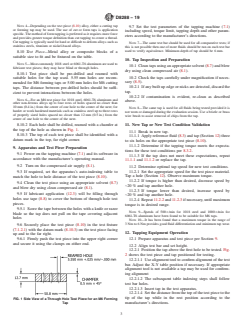
the top of the hole as shown in Fig. 1.
11.1 Break in new tap.
8.10.3 The top of each test piece shall be identified with a
11.1.1 Applyreferencefluid(8.3)andtap(Section12)three
datum mark in the top, far right corner.
to six holes on the appropriate test piece (8.10).
11.1.2 Determine if the tapping torque meets the expecta-
9. Apparatus and Test Piece Preparation
tions for these test conditions per 8.3.2.
9.1 Power on the tapping machine (7.1) and its software in
11.1.3 If the tap does not meet these expectations, repeat
accordance with the manufacturer’s operating manual.
11.1.1 and 11.1.2 or replace the tap.
9.2 Turn on the compressed air supply (8.1).
11.2 Determine optimal tap speed for new test conditions.
11.2.1 Set the appropriate speed for the test piece material.
9.3 If required, set the apparatus’s auto-indexing table to
Tap a hole (Section 12). Observe maximum torque.
match the hole to hole distance of the test piece (8.10).
11.2.2 If torque is higher than desired, decrease speed by
9.4 Clean the test piece using an appropriate solvent (8.7)
~20% and tap another hole.
and blow dry using clean compressed air (8.1).
11.2.3 If torque lower than desired, increase speed by
9.5 If lubricant application (12.3) will be filling through
~20% and tap another hole.
holes use tape (8.8) to cover the bottom of through hole test
11.2.4 Repeat11.2.2and11.2.3ifnecessary,untilmaximum
pieces.
torque is in desired range.
9.5.1 Score the tape between the holes with a knife or razor
NOTE 9—Speeds of 500r⁄min for 1018 steel and 1000r⁄min for
blade so the tap does not pull on the tape covering adjacent
6061-T6 aluminum have been found to be suitable for M6 taps.
holes
NOTE 10—It has been found that a maximum torque in the range of
3Nm to 6Nm provides good fluid differentiation and minimum tap wear.
9.6 Securely place the test piece (8.10) in the test fixture
(7.1.2.1) with the datum mark (8.10.3) on the test piece facing
12. Tapping Equipment Operation
up and to the far right.
9.6.1 Firmly push the test piece into the upper right corner 12.1 Prepare appa
...