

ASTM C1782/C1782M-23a
(Specification)Standard Specification for Segmental Concrete Paving Slabs
General Information
- Abstract
ABSTRACT
This specification covers segmental concrete paving slabs manufactured for construction of pedestrian and roof applications for commercial and municipal projects where close dimensional tolerances for thickness, and/or length and width are not required. These slabs can be manufactured with a dry-cast, wet-cast, or hydraulically pressed process. Concrete units covered by this specification shall be made with lightweight or normal weight aggregates or both.
SCOPE
1.1 This specification covers the requirements for segmental concrete paving slabs manufactured for construction of pedestrian and roof applications for commercial and municipal projects. These slabs can be manufactured with a dry-cast, wet-cast, or hydraulically pressed process.
Note 1: Pedestal-set applications and those applications subject to vehicular traffic may require alternate materials properties or structural support or both.
1.2 Concrete units covered by this specification shall be made with lightweight or normal weight aggregates or both.
Note 2: If particular features are desired, such as weight classification, higher modulus of rupture, surface textures, finish, color, or other special features, such properties should be specified by the purchaser. Local sellers, however, should be consulted as to availability of units having the desired features.
1.3 The values stated in either inch-pound units or SI units are to be regarded separately as standard. The values stated in each system may not be exact equivalents; therefore, each system shall be used independently of the other. Combining values from the two systems may result in non-conformance with the standard.
1.4 This international standard was developed in accordance with internationally recognized principles on standardization established in the Decision on Principles for the Development of International Standards, Guides and Recommendations issued by the World Trade Organization Technical Barriers to Trade (TBT) Committee.
- Status
- Published
- Publication Date
- 30-Nov-2023
- Technical Committee
- C15 - Masonry – Manufactured Masonry Units, Mortars and Grouts
- Drafting Committee
- C15.03 - Concrete Masonry Units and Related Units
Buy Documents

ASTM C1782/C1782M-23a - Standard Specification for Segmental Concrete Paving Slabs
REDLINE ASTM C1782/C1782M-23a - Standard Specification for Segmental Concrete Paving Slabs
Overview
ASTM C1782/C1782M-23a: Standard Specification for Segmental Concrete Paving Slabs establishes the requirements for segmental concrete paving slabs primarily used in pedestrian and roof applications within commercial and municipal projects. This international standard, developed by ASTM International, addresses the characteristics, manufacturing methods, materials, and testing requirements for concrete paving slabs where strict tolerances for thickness, length, or width are not necessary. The standard supports the implementation of best practices in urban landscaping, public spaces, and green roof construction by providing consistent guidelines for manufacturers and project stakeholders.
Key Topics
- Scope of Application: Applies to segmental concrete paving slabs for pedestrian and roof use, excluding vehicular traffic or pedestal-set applications which may require different specifications.
- Manufacturing Methods: Recognizes multiple production techniques, including dry-cast, wet-cast, and hydraulically pressed processes, to offer flexibility in manufacturing.
- Material Requirements: Allows use of both lightweight and normal weight aggregates, conforming to referenced ASTM material standards for aggregates, cementitious materials, pigments, pozzolans, and additives.
- Dimensional Tolerances: Defines permissible variations in length, width, thickness, and warpage, ensuring slabs meet essential quality and performance criteria at delivery.
- Physical Performance: Specifies minimum values for thickness, modulus of rupture (flexural strength), and maximum dimensions, contributing to the slabs' durability and integrity.
- Sampling and Testing: Details procedures for sampling, dimensional verification, and physical testing, including freeze-thaw resistance, to validate compliance with the standard’s requirements.
- Compliance and Quality Assurance: Offers guidance on inspection, rejection criteria, and retesting, supporting quality assurance throughout the supply chain.
Applications
Segmental concrete paving slabs specified under ASTM C1782/C1782M-23a are widely utilized in:
- Pedestrian Pathways: Providing durable and attractive paving for sidewalks, plazas, and parks.
- Rooftop Surfaces: Serving as walkable surfacing solutions for green roofs and rooftop amenities in commercial and municipal buildings.
- Public Spaces: Enhancing urban infrastructure in squares, courtyards, terraces, and outdoor recreational areas.
- Municipal Landscaping Projects: Facilitating sustainable design by offering permeable or decorative paving options for public works.
- Customization: Allowing project-specific requirements such as color, texture, finish, or increased structural performance, as agreed between purchaser and supplier.
These applications benefit from the standard’s flexibility and comprehensive testing protocols, ensuring suitability across a range of project scales and environments.
Related Standards
Several ASTM standards provide foundational support and are referenced within ASTM C1782/C1782M-23a, including:
- C33/C33M: Specification for Concrete Aggregates
- C150/C150M: Specification for Portland Cement
- C595/C595M: Specification for Blended Hydraulic Cements
- C979/C979M: Specification for Pigments for Integrally Colored Concrete
- C1645: Test Method for Freeze-Thaw and De-icing Salt Durability
- C140/C140M: Test Methods for Sampling and Testing Concrete Masonry Units
- C331/C331M: Specification for Lightweight Aggregates
- C1157/C1157M: Performance Specification for Hydraulic Cement
- C618: Specification for Coal Ash and Raw or Calcined Natural Pozzolan
- C989/C989M: Specification for Slag Cement
- C1240: Specification for Silica Fume
Integrating these referenced standards ensures segmental concrete paving slabs meet comprehensive quality, durability, and performance expectations essential for sustainable, long-term construction outcomes.
Optimize your municipal, commercial, and landscape projects with confidence by adhering to the ASTM C1782/C1782M-23a specification for segmental concrete paving slabs. This standard supports robust project execution through consistent material quality and clear performance benchmarks, meeting the evolving demands of modern infrastructure and architectural design.
Relations
- Effective Date
- 01-Dec-2023
- Effective Date
- 01-Feb-2024
- Effective Date
- 15-Dec-2023
- Effective Date
- 01-Dec-2023
- Effective Date
- 01-Jun-2023
- Effective Date
- 01-Jul-2022
- Effective Date
- 01-Dec-2021
Buy Documents
ASTM C1782/C1782M-23a - Standard Specification for Segmental Concrete Paving Slabs
REDLINE ASTM C1782/C1782M-23a - Standard Specification for Segmental Concrete Paving Slabs
Get Certified
Connect with accredited certification bodies for this standard

Zavod za gradbeništvo Slovenije (ZAG) - Inšpekcija
ZAG inspection body for construction products, structures, and materials.
Sponsored listings
Frequently Asked Questions
ASTM C1782/C1782M-23a is a technical specification published by ASTM International. Its full title is "Standard Specification for Segmental Concrete Paving Slabs". This standard covers: ABSTRACT This specification covers segmental concrete paving slabs manufactured for construction of pedestrian and roof applications for commercial and municipal projects where close dimensional tolerances for thickness, and/or length and width are not required. These slabs can be manufactured with a dry-cast, wet-cast, or hydraulically pressed process. Concrete units covered by this specification shall be made with lightweight or normal weight aggregates or both. SCOPE 1.1 This specification covers the requirements for segmental concrete paving slabs manufactured for construction of pedestrian and roof applications for commercial and municipal projects. These slabs can be manufactured with a dry-cast, wet-cast, or hydraulically pressed process. Note 1: Pedestal-set applications and those applications subject to vehicular traffic may require alternate materials properties or structural support or both. 1.2 Concrete units covered by this specification shall be made with lightweight or normal weight aggregates or both. Note 2: If particular features are desired, such as weight classification, higher modulus of rupture, surface textures, finish, color, or other special features, such properties should be specified by the purchaser. Local sellers, however, should be consulted as to availability of units having the desired features. 1.3 The values stated in either inch-pound units or SI units are to be regarded separately as standard. The values stated in each system may not be exact equivalents; therefore, each system shall be used independently of the other. Combining values from the two systems may result in non-conformance with the standard. 1.4 This international standard was developed in accordance with internationally recognized principles on standardization established in the Decision on Principles for the Development of International Standards, Guides and Recommendations issued by the World Trade Organization Technical Barriers to Trade (TBT) Committee.
ABSTRACT This specification covers segmental concrete paving slabs manufactured for construction of pedestrian and roof applications for commercial and municipal projects where close dimensional tolerances for thickness, and/or length and width are not required. These slabs can be manufactured with a dry-cast, wet-cast, or hydraulically pressed process. Concrete units covered by this specification shall be made with lightweight or normal weight aggregates or both. SCOPE 1.1 This specification covers the requirements for segmental concrete paving slabs manufactured for construction of pedestrian and roof applications for commercial and municipal projects. These slabs can be manufactured with a dry-cast, wet-cast, or hydraulically pressed process. Note 1: Pedestal-set applications and those applications subject to vehicular traffic may require alternate materials properties or structural support or both. 1.2 Concrete units covered by this specification shall be made with lightweight or normal weight aggregates or both. Note 2: If particular features are desired, such as weight classification, higher modulus of rupture, surface textures, finish, color, or other special features, such properties should be specified by the purchaser. Local sellers, however, should be consulted as to availability of units having the desired features. 1.3 The values stated in either inch-pound units or SI units are to be regarded separately as standard. The values stated in each system may not be exact equivalents; therefore, each system shall be used independently of the other. Combining values from the two systems may result in non-conformance with the standard. 1.4 This international standard was developed in accordance with internationally recognized principles on standardization established in the Decision on Principles for the Development of International Standards, Guides and Recommendations issued by the World Trade Organization Technical Barriers to Trade (TBT) Committee.
ASTM C1782/C1782M-23a is classified under the following ICS (International Classification for Standards) categories: 93.080.20 - Road construction materials. The ICS classification helps identify the subject area and facilitates finding related standards.
ASTM C1782/C1782M-23a has the following relationships with other standards: It is inter standard links to ASTM C1782/C1782M-23, ASTM C989/C989M-24, ASTM C1232-23, ASTM C140/C140M-23a, ASTM C140/C140M-23, ASTM C989/C989M-22, ASTM C1232-21a. Understanding these relationships helps ensure you are using the most current and applicable version of the standard.
ASTM C1782/C1782M-23a is available in PDF format for immediate download after purchase. The document can be added to your cart and obtained through the secure checkout process. Digital delivery ensures instant access to the complete standard document.
Standards Content (Sample)
This international standard was developed in accordance with internationally recognized principles on standardization established in the Decision on Principles for the
Development of International Standards, Guides and Recommendations issued by the World Trade Organization Technical Barriers to Trade (TBT) Committee.
Designation: C1782/C1782M − 23a
Standard Specification for
Segmental Concrete Paving Slabs
This standard is issued under the fixed designation C1782/C1782M; the number immediately following the designation indicates the
year of original adoption or, in the case of revision, the year of last revision. A number in parentheses indicates the year of last
reapproval. A superscript epsilon (´) indicates an editorial change since the last revision or reapproval.
1. Scope* C331/C331M Specification for Lightweight Aggregates for
Concrete Masonry Units
1.1 This specification covers the requirements for segmental
C595/C595M Specification for Blended Hydraulic Cements
concrete paving slabs manufactured for construction of pedes-
C618 Specification for Coal Ash and Raw or Calcined
trian and roof applications for commercial and municipal
Natural Pozzolan for Use in Concrete
projects. These slabs can be manufactured with a dry-cast,
C979/C979M Specification for Pigments for Integrally Col-
wet-cast, or hydraulically pressed process.
ored Concrete
NOTE 1—Pedestal-set applications and those applications subject to
C989/C989M Specification for Slag Cement for Use in
vehicular traffic may require alternate materials properties or structural
Concrete and Mortars
support or both.
C1157/C1157M Performance Specification for Hydraulic
1.2 Concrete units covered by this specification shall be
Cement
made with lightweight or normal weight aggregates or both.
C1232 Terminology for Masonry
C1240 Specification for Silica Fume Used in Cementitious
NOTE 2—If particular features are desired, such as weight classification,
higher modulus of rupture, surface textures, finish, color, or other special Mixtures
features, such properties should be specified by the purchaser. Local
C1645 Test Method for Freeze-thaw and De-icing Salt
sellers, however, should be consulted as to availability of units having the
Durability of Solid Concrete Interlocking Paving Units
desired features.
D1056 Specification for Flexible Cellular Materials—
1.3 The values stated in either inch-pound units or SI units
Sponge or Expanded Rubber
are to be regarded separately as standard. The values stated in
3. Terminology
each system may not be exact equivalents; therefore, each
system shall be used independently of the other. Combining
3.1 Terminology defined in C1232 shall apply for this
values from the two systems may result in non-conformance
specification.
with the standard.
3.2 Definitions of Terms Specific to This Standard:
1.4 This international standard was developed in accor-
3.2.1 warpage, n—the maximum vertical deviation from a
dance with internationally recognized principles on standard-
straightedge placed across the full length, width or diagonal
ization established in the Decision on Principles for the
dimension of the paving slab surface.
Development of International Standards, Guides and Recom-
mendations issued by the World Trade Organization Technical
4. Materials
Barriers to Trade (TBT) Committee.
4.1 Cementitious Materials—Cementitious materials shall
conform to the following applicable specifications:
2. Referenced Documents
4.1.1 Portland Cements—Specification C150/C150M.
2.1 ASTM Standards:
4.1.2 Modified Portland Cement—Portland cement con-
C33/C33M Specification for Concrete Aggregates
forming to Specification C150/C150M, modified as follows:
C140/C140M Test Methods for Sampling and Testing Con-
(1) Limestone—If calcium carbonate is added to the
crete Masonry Units and Related Units
cement, the CaCO content shall not be less than 85 %.
C150/C150M Specification for Portland Cement
(2) Limitation on Insoluble Residue—1.5 %.
C207 Specification for Hydrated Lime for Masonry Pur-
(3) Limitation on Air Content of Mortar—Volume percent,
poses
22 % max.
(4) Limitation on Loss on Ignition—7 %.
4.1.3 Hydraulic Cements—Specification C1157/C1157M.
This test method is under the jurisdiction of ASTM Committee C15 on
Manufactured Masonry Units and is the direct responsibility of Subcommittee
4.1.4 Blended Hydraulic Cements—Specification C595/
C15.03 on Concrete Masonry Units and Related Units.
C595M.
Current edition approved Dec. 1, 2023. Published December 2023. Originally
4.1.5 Pozzolans—Specification C618.
approved in 2016. Last previous edition approved in 2023 as C1782/C1782M – 23.
DOI: 10.1520/C1782_C1782M-23A. 4.1.6 Slag Cement—Specification C989/C989M.
*A Summary of Changes section appears at the end of this standard
Copyright © ASTM International, 100 Barr Harbor Drive, PO Box C700, West Conshohocken, PA 19428-2959. United States
C1782/C1782M − 23a
4.1.7 Silica Fume—Specification C1240. tory test is used, test in accordance with 7.4. Specimens
sampled from units that will not be exposed to deicing salts in
4.2 Aggregates—Aggregates shall conform to the following
service shall be tested in tap water. Specimens sampled from
specifications, except for the grading requirements:
units that will be exposed to deicing materials in service shall
4.2.1 Normal Weight Aggregates—Specification C33/
be tested in 3 % saline solution. The average mass loss of all
C33M.
the specimens tested shall not be greater than: (a) 225 g/m
4.2.2 Lightweight Aggregates—Specification C331/C331M.
when subject to 28 freeze-thaw cycles, or (b) 500 g/m when
NOTE 3—The grading requirements of Specifications C33/C33M and
subject to 49 freeze-thaw cycles.
C331/C331M may not be suitable for segmental concrete paving slab
production. Because of this, producers are allowed to modify grading to
5.4 Dimensional Tolerances—At the time of delivery to the
meet their needs and the requirements of this specification.
job site, the length, width and thickness dimensions, and
4.3 Pigments for Integrally Colored Concrete— concave or convex warpage measured across the full length,
width and diagonal dimensions, as determined in accordance
Specification C979/C979M.
with 7.3, shall not differ from the amounts for the specified
4.4 Other Constituents—Air-entraining agents, integral wa-
dimensions by more than the tolerances in Table 1. Length,
ter repellents, and other constituents shall be previously estab-
width and thickness dimensions are based on specified dimen-
lished as suitable for use in segmental concrete paving slabs
sions for the particular shape identified.
and shall conform to applicable ASTM standards or shall be
shown by test or experience not to be detrimental to the
NOTE 4—Some applications including units placed on a sand-bitumen
durability of the segmental concrete paving slabs or any
setting bed or on pedestals for roof applications may require tighter
dimensional tolerances for thickness and warpage than those shown in
material customarily used in segmental pavement construction.
Table 1. These tolerances should be specified separately.
5. Physical Requirements
2 6. Visual Inspectio
...
This document is not an ASTM standard and is intended only to provide the user of an ASTM standard an indication of what changes have been made to the previous version. Because
it may not be technically possible to adequately depict all changes accurately, ASTM recommends that users consult prior editions as appropriate. In all cases only the current version
of the standard as published by ASTM is to be considered the official document.
Designation: C1782/C1782M − 23 C1782/C1782M − 23a
Standard Specification for
Segmental Concrete Paving Slabs
This standard is issued under the fixed designation C1782/C1782M; the number immediately following the designation indicates the
year of original adoption or, in the case of revision, the year of last revision. A number in parentheses indicates the year of last
reapproval. A superscript epsilon (´) indicates an editorial change since the last revision or reapproval.
1. Scope*
1.1 This specification covers the requirements for segmental concrete paving slabs manufactured for construction of pedestrian
and roof applications for commercial and municipal projects. These slabs can be manufactured with a dry-cast, wet-cast, or
hydraulically pressed process.
NOTE 1—Pedestal-set applications and those applications subject to vehicular traffic may require alternate materials properties or structural support or
both.
1.2 Concrete units covered by this specification shall be made with lightweight or normal weight aggregates or both.
NOTE 2—If particular features are desired, such as weight classification, higher modulus of rupture, surface textures, finish, color, or other special features,
such properties should be specified by the purchaser. Local sellers, however, should be consulted as to availability of units having the desired features.
1.3 The values stated in either inch-pound units or SI units are to be regarded separately as standard. The values stated in each
system may not be exact equivalents; therefore, each system shall be used independently of the other. Combining values from the
two systems may result in non-conformance with the standard.
1.4 This international standard was developed in accordance with internationally recognized principles on standardization
established in the Decision on Principles for the Development of International Standards, Guides and Recommendations issued
by the World Trade Organization Technical Barriers to Trade (TBT) Committee.
2. Referenced Documents
2.1 ASTM Standards:
C33/C33M Specification for Concrete Aggregates
C140/C140M Test Methods for Sampling and Testing Concrete Masonry Units and Related Units
C150/C150M Specification for Portland Cement
C207 Specification for Hydrated Lime for Masonry Purposes
C331/C331M Specification for Lightweight Aggregates for Concrete Masonry Units
C595/C595M Specification for Blended Hydraulic Cements
C618 Specification for Coal Ash and Raw or Calcined Natural Pozzolan for Use in Concrete
C979/C979M Specification for Pigments for Integrally Colored Concrete
C989/C989M Specification for Slag Cement for Use in Concrete and Mortars
C1157/C1157M Performance Specification for Hydraulic Cement
This test method is under the jurisdiction of ASTM Committee C15 on Manufactured Masonry Units and is the direct responsibility of Subcommittee C15.03 on Concrete
Masonry Units and Related Units.
Current edition approved June 15, 2023Dec. 1, 2023. Published June 2023December 2023. Originally approved in 2016. Last previous edition approved in 20212023 as
C1782/C1782M – 21.C1782/C1782M – 23. DOI: 10.1520/C1782_C1782M-23.10.1520/C1782_C1782M-23A.
*A Summary of Changes section appears at the end of this standard
Copyright © ASTM International, 100 Barr Harbor Drive, PO Box C700, West Conshohocken, PA 19428-2959. United States
C1782/C1782M − 23a
C1232 Terminology for Masonry
C1240 Specification for Silica Fume Used in Cementitious Mixtures
C1645 Test Method for Freeze-thaw and De-icing Salt Durability of Solid Concrete Interlocking Paving Units
D1056 Specification for Flexible Cellular Materials—Sponge or Expanded Rubber
3. Terminology
3.1 Terminology defined in C1232 shall apply for this specification.
3.2 Definitions of Terms Specific to This Standard:
3.2.1 warpage, n—the maximum vertical deviation from a straightedge placed across the full length, width or diagonal dimension
of the paving slab surface.
4. Materials
4.1 Cementitious Materials—Materials Cementitious materials shall conform to the following applicable specifications:
4.1.1 Portland Cements—Specification C150/C150M.
4.1.2 Modified Portland Cement—Portland cement conforming to Specification C150/C150M, modified as follows:
(1) Limestone—If calcium carbonate is added to the cement, the CaCO content shall not be less than 85 %.
(2) Limitation on Insoluble Residue—1.5 %.
(3) Limitation on Air Content of Mortar—Volume percent, 22 % max.
(4) Limitation on Loss on Ignition—7 %.
4.1.3 Hydraulic Cements—Specification C1157/C1157M.
4.1.4 Blended Hydraulic Cements—Specification C595/C595M.
4.1.5 Pozzolans—Specification C618.
4.1.6 Slag Cement—Specification C989/C989M.
4.1.7 Silica Fume—Specification C1240.
4.2 Aggregates—Aggregates shall conform to the following specifications, except for the grading requirements:
4.2.1 Normal Weight Aggregates—Specification C33/C33M.
4.2.2 Lightweight Aggregates—Specification C331/C331M.
NOTE 3—The grading requirements of Specifications C33/C33M and C331/C331M may not be suitable for segmental concrete paving slab production.
Because of this, producers are allowed to modify grading to meet their needs and the requirements of this specification.
4.3 Pigments for Integrally Colored Concrete—Specification C979/C979M.
4.4 Other Constituents—Air-entraining agents, integral water repellents, and other constituents shall be previously established as
suitable for use in segmental concrete paving slabs and shall conform to applicable ASTM standards or shall be shown by test or
experience not to be detrimental to the durability of the segmental concrete paving slabs or any material customarily used in
segmental pavement construction.
5. Physical Requirements
2 2
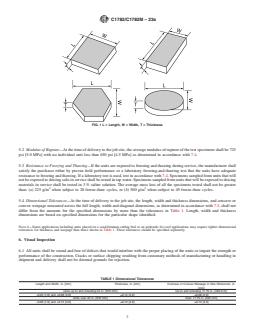
5.1 Units shall have a finished face area greater than 101 in. [0.065 m ] and their length (L) divided by thickness (T) shall be
greater than 4. The minimum thickness shall be 1.2 in. [30 mm]. The maximum length and width dimensions shall be 48 in. [1220
mm]. See Fig. 1.
C1782/C1782M − 23a
FIG. 1 L = Length, W = Width, T = Thickness
5.2 Modulus of Rupture—At the time of delivery to the job site, the average modulus of rupture of the test specimens shall be 725
psi [5.0 MPa] with no individual unit less than 650 psi [4.5 MPa] as determined in accordance with 7.4.
5.3 Resistance to Freezing and Thawing—If the units are exposed to freezing and thawing during service, the manufacturer shall
satisfy the purchaser either by proven field performance or a laboratory freezing-and-thawing test that the units have adequate
resistance to freezing and thawing. If a laboratory test is used, test in accordance with 7.4. Specimens sampled from units that will
not be exposed to deicing salts in service shall be tested in tap water. Specimens sampled from units that will be exposed to d
...