

ASTM C1781/C1781M-21
(Test Method)Standard Test Method for Surface Infiltration Rate of Permeable Unit Pavement Systems
General Information
- Abstract
SIGNIFICANCE AND USE
5.1 This test method can be used for acceptance of surface infiltration of new permeable unit pavement systems.
5.2 Tests performed at the same location across a span of years may be used to detect a reduction of infiltration rate of the permeable surface, thereby identifying the need for any remedial maintenance intended to increase the infiltration rates to predefined levels.
5.3 The infiltration rate obtained by this method is valid only for the localized area of the pavement where the test is conducted. To determine the surface infiltration rate of the entire permeable pavement, multiple locations must be tested and the results averaged.
5.4 The minimum acceptable infiltration rate is typically established by the design engineer of record or the municipality and can be a function of the design precipitation event.
5.5 This test method can also be used to demonstrate the infiltration rate of a particular permeable unit pavement system if the drainage joints are filled with the aggregate that is specified for use in that system.
SCOPE
1.1 This test method covers the determination of the field surface infiltration rate of in place permeable unit pavement systems surfaced with solid interlocking concrete paving units, concrete grid paving units, or clay paving brick.
Note 1: For in-place pervious concrete, Test Method C1701/C1701M should be used. Test Method C1701/C1701M is functionally identical to this standard, but does not include the added provisions for positioning and securing the test ring to a discontinuous surface, which are detailed in this standard. Both tests methods give comparable results
1.2 The values stated in either SI units or inch-pound units are to be regarded separately as standard. The values stated in each system may not be exact equivalents; therefore, each system shall be used independently of the other. Combining values from the two systems may result in non-conformance with the standard.
1.3 The text of this test method references notes that provide explanatory material. These notes shall not be considered as requirements of the test method.
1.4 This standard does not purport to address all of the safety concerns, if any, associated with its use. It is the responsibility of the user of this standard to establish appropriate safety, health, and environmental practices and determine the applicability of regulatory limitations prior to use.
1.5 This international standard was developed in accordance with internationally recognized principles on standardization established in the Decision on Principles for the Development of International Standards, Guides and Recommendations issued by the World Trade Organization Technical Barriers to Trade (TBT) Committee.
- Status
- Published
- Publication Date
- 30-Nov-2021
- Technical Committee
- C15 - Masonry – Manufactured Masonry Units, Mortars and Grouts
- Drafting Committee
- C15.04 - Research for Masonry Units and Assemblies
Buy Documents
ASTM C1781/C1781M-21 - Standard Test Method for Surface Infiltration Rate of Permeable Unit Pavement Systems
REDLINE ASTM C1781/C1781M-21 - Standard Test Method for Surface Infiltration Rate of Permeable Unit Pavement Systems
Overview
ASTM C1781/C1781M-21: Standard Test Method for Surface Infiltration Rate of Permeable Unit Pavement Systems provides a standardized field method to determine the surface infiltration rate of in-place permeable unit pavement systems. These pavements typically incorporate solid interlocking concrete units, concrete grid units, or clay paving bricks that allow water to pass through joints or specially designed voids. Reliable measurement of infiltration rates is critical for stormwater management, pavement acceptance, ongoing maintenance, and regulatory compliance. This test method supports sustainable infrastructure and site development practices by quantifying how effectively a permeable pavement manages water runoff over time.
Key Topics
- Scope of Application: The method is designed for use on existing, in-place permeable unit pavement systems. Covered pavements include those constructed with interlocking concrete units, concrete grid units, and clay paving bricks. The test is not intended for pervious concrete surfaces (see ASTM C1701/C1701M).
- Localized Measurement and Averaging: The infiltration rate measured at each test site applies only to that specific area. To determine the average infiltration rate for an entire permeable pavement installation, multiple locations must be tested and averaged, reflecting any spatial variability.
- Testing Process:
- Use of an infiltration ring that is temporarily sealed to the pavement surface.
- Pre-wetting the test area and controlled delivery of a known quantity of water.
- Recording the time for water infiltration and calculating the infiltration rate.
- Use in Maintenance and Acceptance: The method can determine the initial acceptance of new pavements and help identify maintenance needs over time by monitoring reductions in infiltration rates, which may indicate surface clogging or degradation.
- Minimum Acceptable Rates: Target infiltration rates are typically set by design engineers or local municipal requirements and are based on anticipated stormwater events.
Applications
- Stormwater Management: This test method enables municipalities, engineers, and facility owners to evaluate the performance of permeable pavements in managing rainfall and reducing surface runoff. Integrating permeable pavements is a key approach for sustainable urban drainage systems (SUDS) and low-impact development (LID).
- Infrastructure Maintenance: Routine testing over time allows early detection of clogging or diminished performance, supporting preventative maintenance and ensuring long-term permeability.
- Acceptance Testing and Quality Control: Verifying that new permeable unit pavement installations achieve design-specified infiltration rates helps ensure that site drainage goals are met from the outset.
- Regulatory Compliance: Many jurisdictions require permeable pavement systems to meet minimum infiltration thresholds for stormwater permits or development approvals.
- Product and System Evaluation: The method can be used to assess the performance characteristics of specific permeable pavement designs, materials, and joint aggregates.
Related Standards
- ASTM C1701/C1701M: Standard Test Method for Infiltration Rate of In Place Pervious Concrete. While similar in procedure, this standard is for pervious concrete and does not address requirements for discontinuous surfaces as C1781/C1781M does.
- ASTM C936/C936M: Specification for Solid Concrete Interlocking Paving Units.
- ASTM C1319: Specification for Concrete Grid Paving Units.
- ASTM C902 & ASTM C1272: Specifications for clay and heavy vehicular paving bricks.
- ASTM C1232: Terminology for Masonry, including definitions relevant to permeable pavements.
By employing ASTM C1781/C1781M-21, stakeholders can ensure consistent, repeatable, and verifiable assessment of surface infiltration rates. This strengthens the resilience and effectiveness of permeable pavement installations in stormwater control and urban infrastructure. For best outcomes, align testing frequency, location, and reporting with regional guidelines and project-specific design requirements.
Relations
- Effective Date
- 15-Dec-2023
- Effective Date
- 01-Dec-2023
- Effective Date
- 01-Dec-2023
- Effective Date
- 01-Oct-2023
- Effective Date
- 01-Sep-2018
- Effective Date
- 01-Jan-2018
- Effective Date
- 01-Jun-2017
- Refers
ASTM C1701/C1701M-17 - Standard Test Method for Infiltration Rate of In Place Pervious Concrete - Effective Date
- 01-Mar-2017
- Effective Date
- 01-Dec-2016
- Effective Date
- 01-Dec-2016
- Effective Date
- 01-Jun-2016
- Effective Date
- 01-Jun-2016
- Effective Date
- 15-Jan-2016
- Effective Date
- 01-Dec-2015
- Effective Date
- 01-Sep-2015
Buy Documents
ASTM C1781/C1781M-21 - Standard Test Method for Surface Infiltration Rate of Permeable Unit Pavement Systems
REDLINE ASTM C1781/C1781M-21 - Standard Test Method for Surface Infiltration Rate of Permeable Unit Pavement Systems
Get Certified
Connect with accredited certification bodies for this standard

Zavod za gradbeništvo Slovenije (ZAG) - Inšpekcija
ZAG inspection body for construction products, structures, and materials.
Sponsored listings
Frequently Asked Questions
ASTM C1781/C1781M-21 is a standard published by ASTM International. Its full title is "Standard Test Method for Surface Infiltration Rate of Permeable Unit Pavement Systems". This standard covers: SIGNIFICANCE AND USE 5.1 This test method can be used for acceptance of surface infiltration of new permeable unit pavement systems. 5.2 Tests performed at the same location across a span of years may be used to detect a reduction of infiltration rate of the permeable surface, thereby identifying the need for any remedial maintenance intended to increase the infiltration rates to predefined levels. 5.3 The infiltration rate obtained by this method is valid only for the localized area of the pavement where the test is conducted. To determine the surface infiltration rate of the entire permeable pavement, multiple locations must be tested and the results averaged. 5.4 The minimum acceptable infiltration rate is typically established by the design engineer of record or the municipality and can be a function of the design precipitation event. 5.5 This test method can also be used to demonstrate the infiltration rate of a particular permeable unit pavement system if the drainage joints are filled with the aggregate that is specified for use in that system. SCOPE 1.1 This test method covers the determination of the field surface infiltration rate of in place permeable unit pavement systems surfaced with solid interlocking concrete paving units, concrete grid paving units, or clay paving brick. Note 1: For in-place pervious concrete, Test Method C1701/C1701M should be used. Test Method C1701/C1701M is functionally identical to this standard, but does not include the added provisions for positioning and securing the test ring to a discontinuous surface, which are detailed in this standard. Both tests methods give comparable results 1.2 The values stated in either SI units or inch-pound units are to be regarded separately as standard. The values stated in each system may not be exact equivalents; therefore, each system shall be used independently of the other. Combining values from the two systems may result in non-conformance with the standard. 1.3 The text of this test method references notes that provide explanatory material. These notes shall not be considered as requirements of the test method. 1.4 This standard does not purport to address all of the safety concerns, if any, associated with its use. It is the responsibility of the user of this standard to establish appropriate safety, health, and environmental practices and determine the applicability of regulatory limitations prior to use. 1.5 This international standard was developed in accordance with internationally recognized principles on standardization established in the Decision on Principles for the Development of International Standards, Guides and Recommendations issued by the World Trade Organization Technical Barriers to Trade (TBT) Committee.
SIGNIFICANCE AND USE 5.1 This test method can be used for acceptance of surface infiltration of new permeable unit pavement systems. 5.2 Tests performed at the same location across a span of years may be used to detect a reduction of infiltration rate of the permeable surface, thereby identifying the need for any remedial maintenance intended to increase the infiltration rates to predefined levels. 5.3 The infiltration rate obtained by this method is valid only for the localized area of the pavement where the test is conducted. To determine the surface infiltration rate of the entire permeable pavement, multiple locations must be tested and the results averaged. 5.4 The minimum acceptable infiltration rate is typically established by the design engineer of record or the municipality and can be a function of the design precipitation event. 5.5 This test method can also be used to demonstrate the infiltration rate of a particular permeable unit pavement system if the drainage joints are filled with the aggregate that is specified for use in that system. SCOPE 1.1 This test method covers the determination of the field surface infiltration rate of in place permeable unit pavement systems surfaced with solid interlocking concrete paving units, concrete grid paving units, or clay paving brick. Note 1: For in-place pervious concrete, Test Method C1701/C1701M should be used. Test Method C1701/C1701M is functionally identical to this standard, but does not include the added provisions for positioning and securing the test ring to a discontinuous surface, which are detailed in this standard. Both tests methods give comparable results 1.2 The values stated in either SI units or inch-pound units are to be regarded separately as standard. The values stated in each system may not be exact equivalents; therefore, each system shall be used independently of the other. Combining values from the two systems may result in non-conformance with the standard. 1.3 The text of this test method references notes that provide explanatory material. These notes shall not be considered as requirements of the test method. 1.4 This standard does not purport to address all of the safety concerns, if any, associated with its use. It is the responsibility of the user of this standard to establish appropriate safety, health, and environmental practices and determine the applicability of regulatory limitations prior to use. 1.5 This international standard was developed in accordance with internationally recognized principles on standardization established in the Decision on Principles for the Development of International Standards, Guides and Recommendations issued by the World Trade Organization Technical Barriers to Trade (TBT) Committee.
ASTM C1781/C1781M-21 is classified under the following ICS (International Classification for Standards) categories: 93.080.20 - Road construction materials. The ICS classification helps identify the subject area and facilitates finding related standards.
ASTM C1781/C1781M-21 has the following relationships with other standards: It is inter standard links to ASTM C1232-23, ASTM C936/C936M-23a, ASTM C1319-23a, ASTM C1701/C1701M-17a(2023), ASTM C936/C936M-18, ASTM C920-18, ASTM C1232-17, ASTM C1701/C1701M-17, ASTM C1272-16b, ASTM C1319-16, ASTM C936/C936M-16, ASTM C1272-16a, ASTM C1272-16, ASTM C1272-15, ASTM C1232-15a. Understanding these relationships helps ensure you are using the most current and applicable version of the standard.
ASTM C1781/C1781M-21 is available in PDF format for immediate download after purchase. The document can be added to your cart and obtained through the secure checkout process. Digital delivery ensures instant access to the complete standard document.
Standards Content (Sample)
This international standard was developed in accordance with internationally recognized principles on standardization established in the Decision on Principles for the
Development of International Standards, Guides and Recommendations issued by the World Trade Organization Technical Barriers to Trade (TBT) Committee.
Designation: C1781/C1781M −21
Standard Test Method for
Surface Infiltration Rate of Permeable Unit Pavement
Systems
This standard is issued under the fixed designation C1781/C1781M; the number immediately following the designation indicates the
year of original adoption or, in the case of revision, the year of last revision. A number in parentheses indicates the year of last
reapproval. A superscript epsilon (´) indicates an editorial change since the last revision or reapproval.
1. Scope* 2. Referenced Documents
1.1 This test method covers the determination of the field 2.1 ASTM Standards:
surface infiltration rate of in place permeable unit pavement C902 Specification for Pedestrian and Light Traffic Paving
systems surfaced with solid interlocking concrete paving units, Brick
concrete grid paving units, or clay paving brick. C920 Specification for Elastomeric Joint Sealants
C936/C936M Specification for Solid Concrete Interlocking
NOTE 1—For in-place pervious concrete, Test Method C1701/C1701M
Paving Units
should be used. Test Method C1701/C1701M is functionally identical to
C1232 Terminology for Masonry
this standard, but does not include the added provisions for positioning
and securing the test ring to a discontinuous surface, which are detailed in
C1272 Specification for Heavy Vehicular Paving Brick
this standard. Both tests methods give comparable results
C1319 Specification for Concrete Grid Paving Units
1.2 The values stated in either SI units or inch-pound units C1701/C1701M TestMethodforInfiltrationRateofInPlace
are to be regarded separately as standard. The values stated in Pervious Concrete
each system may not be exact equivalents; therefore, each 2.2 Other Standards:
system shall be used independently of the other. Combining Federal Specification A-A-3110 (TT-P-1536A) Plumbing
values from the two systems may result in non-conformance Fixture Setting Compound
with the standard.
3. Terminology
1.3 Thetextofthistestmethodreferencesnotesthatprovide
3.1 The terms used in this test method are defined in
explanatory material. These notes shall not be considered as
Terminology C1232.
requirements of the test method.
3.2 Definitions:
1.4 This standard does not purport to address all of the
3.2.1 permeable unit pavement system, n—pavement with
safety concerns, if any, associated with its use. It is the
wearing surface made from clay or concrete units that allows
responsibility of the user of this standard to establish appro-
infiltration of water through open-graded aggregate in the
priate safety, health, and environmental practices and deter-
joints, cores, or other openings, to a bed, base, and subbase, or
mine the applicability of regulatory limitations prior to use.
combinations thereof.
1.5 This international standard was developed in accor-
3.2.1.1 Discussion—Permeable pavement systems are uti-
dance with internationally recognized principles on standard-
lized to reduce stormwater runoff. Permeable pavements have
ization established in the Decision on Principles for the
wearing surfaces with high initial water infiltration through
Development of International Standards, Guides and Recom-
open spaces filled with aggregates to drain water into open-
mendations issued by the World Trade Organization Technical
graded bedding and base materials. The open spaces in the
Barriers to Trade (TBT) Committee.
For referenced ASTM standards, visit the ASTM website, www.astm.org, or
This test method is under the jurisdiction of ASTM Committee C15 on contact ASTM Customer Service at service@astm.org. For Annual Book of ASTM
Manufactured Masonry Units and is the direct responsibility of Subcommittee Standards volume information, refer to the standard’s Document Summary page on
C15.04 on Research. the ASTM website.
Current edition approved Dec. 1, 2021. Published December 2021. Originally Available from Standardization Documents Order Desk, DODSSP, Bldg. 4,
ɛ1
approvedin2013.Lastpreviouseditionapprovedin2018asC1781/C1781M – 18 . Section D, 700 Robbins Ave., Philadelphia, PA 19111-5098, http://
DOI: 10.1520/C1781_C1781M–21. dodssp.daps.dla.mil.
*A Summary of Changes section appears at the end of this standard
Copyright © ASTM International, 100 Barr Harbor Drive, PO Box C700, West Conshohocken, PA 19428-2959. United States
C1781/C1781M − 21
wearing surface are designed to enable sufficient infiltration
rates to handle runoff from designated storm types (for
example, 1 year, 24-hour event). With unit pavers the open
spaces can be achieved with exposed coring, a specially-
shaped perimeter configuration, or wider joints, or combina-
tions thereof. Permeable pavement systems can also be made
with standard units and a laying pattern that permits sufficient
water entry.
4. Summary of Test Method
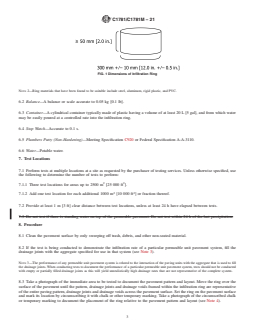
FIG. 1 Dimensions of Infiltration Ring
4.1 An infiltration ring is temporarily sealed to the surface
of a permeable unit pavement system. These pavements
NOTE 2—Ring materials that have been found to be suitable include
typically consist of solid concrete paving units conforming to
steel, aluminum, rigid plastic, and PVC.
Specification C936/C936M, concrete grid paving units con-
6.2 Balance—Abalanceorscaleaccurateto0.05kg[0.1lb].
forming to Specification C1319, or clay paving brick conform-
ing to Specification C902 or C1272. These pavements allow
6.3 Container—A cylindrical container typically made of
drainage through joints between the units or through voids
plastichavingavolumeofatleast20L[5gal],andfromwhich
formed by the intersection of two or more units or intentionally
water may be easily poured at a controlled rate into the
manufactured into the units. The results of this test method for
infiltration ring.
unit pavement systems can be compared to that using Test
6.4 Stop Watch—Accurate to 0.1 s.
Method C1701/C1701M for pervious concrete. After pre-
6.5 Plumbers Putty (Non-Hardening)—Meeting Specifica-
wetting the test location, a given mass of water is introduced
tion C920 or Federal Specification A-A-3110.
into the ring and the time for the water to infiltrate the
pavement is recorded. The infiltration rate is calculated in
6.6 Water—Potable water.
accordance with 9.1.
7. Test Locations
5. Significance and Use
7.1 Perform tests at multiple locations at a site as requested
5.1 This test method can be used for acceptance of surface
by the purchaser of testing services. Unless otherwise
infiltration of new permeable unit pavement systems.
specified, use the following to determine the number of tests to
perform:
5.2 Tests performed at the same location across a span of
7.1.1 Three test locations for areas up to 2500 m [25 000
years may be used to detect a reduction of infiltration rate of
ft ].
the permeable surface, thereby identifying the need for any
7.1.2 Add one test location for each additional 1000 m [10
remedial maintenance intended to increase the infiltration rates
000 ft ] or fraction thereof.
to predefined levels.
7.2 Provide at least1m[3ft] clear distance between test
5.3 The infiltration rate obtained by this method is valid
locations, unless at least 24 h have elapsed between tests.
only for the localized area of the pavement where the test is
conducted. To determine the surface infiltration rate of the
8. Procedure
entire permeable pavement, multiple locations must be tested
8.1 Clean the pavement surface by only sweeping off trash,
and the results averaged.
debris, and other non-seated material.
5.4 The minimum acceptable infiltration rate is typically
8.2 If the test is being conducted to demonstrate the infil-
establishedbythedesignengineerofrecordorthemunicipality
tration rate of a particular permeable unit pavement system, fill
and can be a function of the design precipitation event.
the drainage joints with the aggregate specified for use in that
5.5 This test method can also be used to demonstrate the
system (see Note 3).
infiltration rate of a particular permeable unit pavement system
NOTE 3—The performance of any permeable unit pavement system is
if the drainage joints are filled with the aggregate that is
relatedtotheinteractionofthepavingunitswiththeaggregatethatisused
specified for use in that system.
to fill the drainage joints. When conducting tests to document the
performance of a particular permeable unit pavement system, tests should
6. Apparatus
not be conducted with empty or partially filled drainage joints as this will
yield unrealistically high drainage rates that are not representative of the
6.1 Infiltration Ring—A cylindrical ring, open at both ends
complete system.
(See Fig. 1). The ring shall be watertight, sufficiently rigid to
retainitsformwhenfilledwithwater,andshallhaveadiameter 8.3 Take a photograph of the immediate area to be tested to
of 300 6 10 mm [12.0 6 0.5 in.] with a minimum height of 50 document the pavement pattern and layout. Move the ring over
mm [2.0 in.]. The bottom edge of the ring shall be even. The the surface of the pavement until the pattern, drainage joints
inner surface of the ring shall be marked or scored with two and drainage voids framed within the infiltration ring are
linesatadistanceof10and15mm[0.40and0.60in.]fromthe representative of the entire paving pattern, drainage joints and
bottom of the ring. Measure and record the inner diameter of drainage voids across the pavement surface. Set the ring on the
the ring to the nearest 1 mm [0.05 in.]. pavement surface and mark its location by circumscribing it
C1781/C1781M − 21
with chalk or other temporary marking. Take a photograph of of 3.60 6 0.05 kg [8.0 6 0.1 lb] of water. Record the weight
the circumscribed chalk or temporary marking to document the of water to the nearest 0.05 kg [0.1 lb]. Pour the water onto the
placement of the ring relative to the pavement pattern and ring at a rate sufficient to maintain a head between the two
layout (see Note 4). marked lines and until the measured amount of water has been
used. Take care to pour the water such that it falls directly on
NOTE 4—The procedure in 8.3 for selecting and documenting the
the surface of a paving unit and not onto the joints. This
placement of the infiltration ring on a representative area of the pavement
minimizes displacement of jointing aggregate and any accu-
is sufficient in most cases for determining the infiltration rate of the
pavement.The drainage area within the infiltration ring is typically within mulated sediment in the joints during the test (see Note 7).
620 % of the average drainage area of the pavement as a whole. This
Begin timing as soon as the water impacts the permeable
accuracy is adequate for most situations. If a more accurate quantification
pavement surface. Stop timing when free water is no longer
of the infiltration rate is needed, the procedure detailed in Appendix X1
present on the surface. Record the testing duration (t)tothe
can be used to normalize the drainage area within the infiltration ring to
nearest 0.1 second.
the average drainage area of the pavement as a whole.
NOTE 7—If a sloped pavement is being measured, maintain head
8.4 For solid interlocking concrete paving units and clay
between the two marked lines at the lowest point of the slope.
brickpaving,removeaggregatetoadepthofnogreaterthan10
mm [0.5 in.] in any joint or drainage void that will be directly 8.8 If a test is repeated at the same location, the repeat test
below the test ring and fill these areas with plumbers putty so does not require pre-wetting if conducted within 5 min after
that a positive seal can be made to the test ring once it is placed completion of the first test. If two tests are conducted at a
onthesurface.Takecarenottoextendtheplumbersputtymore location on a given day, the infiltration rate at that location on
than 10 mm [0.5 in.] inside the perimeter of the chalk line or that day shall be calculated as the average of the two tests. No
other temporary marking. For concrete grid paving units, more than two tests shall be conducted at the same location on
center as much of the ring as possible on the webs. For ring the same day.
locations over openings, remove any vegetation, if present,
8.9 When completed with testing, remove plumbers putty
directly below the test ring to a depth of no greater than 10 mm
from the joints and surface, reinstate the removed aggregate
[0.5 in] and apply plumbers putty to the surface of the soil, or
jointing materials, and sweep test area clean.
to the aggregate, if present, so that a positive seal can be made
to the test ring once it is placed on the surface. Take care not
9. Calculation
to extend the plumbers putty more than 10 mm [0.5 in.] inside
9.1 Calculatetheinfiltrationrate(I)usingconsistentunitsas
the perimeter of the chalk line or other temporary marking.
follows:
8.5 Infiltration Ring Installation—Apply plumbers putty
I 5KM⁄~D * t! (1)
around the bottom edge of the ring and place the ring onto the
surfacebeingtested.Presstheputtyintothesurfaceandaround
where:
the bottom edge of the ring to create a watertight seal making
I = Infiltration rate, mm/h [in./h],
sure that the putty does not extend more than 10 mm [0.5 in.]
M = Mass of infiltrated water, kg [lb],
inside the perimeter of the ring. Place additional putty as
D = Inside diameter of infiltration ring, mm [in.],
needed to ensure a watertight seal.
t = time required for measured amount of water to infiltrate
the surface, s, and
NOTE 5—In a hot environment or when the surface temperature is over
K = 4 583 666 000 in SI units or 126 870 in [inch-pound]
38°C [100°F] plumbers putty may not adhere to the surface of the
units.
pavement easily. Therefore it is advisable to perform this test during a
3 3
cooler temperature. NOTE 8—The factor K has units of (mm s)/(kgh) [(in. s)/(lbh)] and is
needed to convert the recorded data (W, D, and t) to the infiltration rate I
8.6 Prewetting—Pour water into the ring at a rate sufficient
in mm/h [in./h
...
This document is not an ASTM standard and is intended only to provide the user of an ASTM standard an indication of what changes have been made to the previous version. Because
it may not be technically possible to adequately depict all changes accurately, ASTM recommends that users consult prior editions as appropriate. In all cases only the current version
of the standard as published by ASTM is to be considered the official document.
´1
Designation: C1781/C1781M − 18 C1781/C1781M − 21
Standard Test Method for
Surface Infiltration Rate of Permeable Unit Pavement
Systems
This standard is issued under the fixed designation C1781/C1781M; the number immediately following the designation indicates the
year of original adoption or, in the case of revision, the year of last revision. A number in parentheses indicates the year of last
reapproval. A superscript epsilon (´) indicates an editorial change since the last revision or reapproval.
ε NOTE—Summary of Changes section was editorially corrected in April 2020.
1. Scope*
1.1 This test method covers the determination of the field surface infiltration rate of in place permeable unit pavement systems
surfaced with solid interlocking concrete paving units, concrete grid paving units, or clay paving brick.
NOTE 1—For in-place pervious concrete, Test Method C1701/C1701M should be used. Test Method C1701/C1701M is functionally identical to this
standard, but does not include the added provisions for positioning and securing the test ring to a discontinuous surface, which are detailed in this standard.
Both tests methods give comparable results
1.2 The values stated in either SI units or inch-pound units are to be regarded separately as standard. The values stated in each
system may not be exact equivalents; therefore, each system shall be used independently of the other. Combining values from the
two systems may result in non-conformance with the standard.
1.3 The text of this test method references notes that provide explanatory material. These notes shall not be considered as
requirements of the test method.
1.4 This standard does not purport to address all of the safety concerns, if any, associated with its use. It is the responsibility
of the user of this standard to establish appropriate safety, health, and environmental practices and determine the applicability of
regulatory limitations prior to use.
1.5 This international standard was developed in accordance with internationally recognized principles on standardization
established in the Decision on Principles for the Development of International Standards, Guides and Recommendations issued
by the World Trade Organization Technical Barriers to Trade (TBT) Committee.
2. Referenced Documents
2.1 ASTM Standards:
C902 Specification for Pedestrian and Light Traffic Paving Brick
C920 Specification for Elastomeric Joint Sealants
C936/C936M Specification for Solid Concrete Interlocking Paving Units
C1232 Terminology for Masonry
C1272 Specification for Heavy Vehicular Paving Brick
C1319 Specification for Concrete Grid Paving Units
This test method is under the jurisdiction of ASTM Committee C15 on Manufactured Masonry Units and is the direct responsibility of Subcommittee C15.04 on Research.
Current edition approved Dec. 15, 2018Dec. 1, 2021. Published December 2018December 2021. Originally approved in 2013. Last previous edition approved in 20152018
ɛ1
as C1781/C1781M – 15.C1781/C1781M – 18 . DOI: 10.1520/C1781_C1781M–18E01.10.1520/C1781_C1781M–21.
For referenced ASTM standards, visit the ASTM website, www.astm.org, or contact ASTM Customer Service at service@astm.org. For Annual Book of ASTM Standards
volume information, refer to the standard’s Document Summary page on the ASTM website.
*A Summary of Changes section appears at the end of this standard
Copyright © ASTM International, 100 Barr Harbor Drive, PO Box C700, West Conshohocken, PA 19428-2959. United States
C1781/C1781M − 21
C1701/C1701M Test Method for Infiltration Rate of In Place Pervious Concrete
2.2 Other Standards:
Federal Specification A-A-3110 (TT-P-1536A) Plumbing Fixture Setting Compound
3. Terminology
3.1 The terms used in this test method are defined in Terminology C1232.
3.2 Definitions:
3.2.1 permeable unit pavement system, n—pavement with wearing surface made from clay or concrete units that allows infiltration
of water through open-graded aggregate in the joints, cores, or other openings, to a bed, base, and subbase, or combinations thereof.
3.2.1.1 Discussion—
Permeable pavement systems are utilized to reduce stormwater runoff. Permeable pavements have wearing surfaces with high
initial water infiltration through open spaces filled with aggregates to drain water into open-graded bedding and base materials. The
open spaces in the wearing surface are designed to enable sufficient infiltration rates to handle runoff from designated storm types
(for example, 1 year, 24-hour event). With unit pavers the open spaces can be achieved with exposed coring, a specially-shaped
perimeter configuration, or wider joints, or combinations thereof. Permeable pavement systems can also be made with standard
units and a laying pattern that permits sufficient water entry.
4. Summary of Test Method
4.1 An infiltration ring is temporarily sealed to the surface of a permeable unit pavement system. These pavements typically
consist of solid concrete paving units conforming to Specification C936/C936M, concrete grid paving units conforming to
Specification C1319, or clay paving brick conforming to Specification C902 or C1272. These pavements allow drainage through
joints between the units or through voids formed by the intersection of two or more units or intentionally manufactured into the
units. The results of this test method for unit pavement systems can be compared to that using Test Method C1701/C1701M for
pervious concrete. After pre-wetting the test location, a given mass of water is introduced into the ring and the time for the water
to infiltrate the pavement is recorded. The infiltration rate is calculated in accordance with 9.1.
5. Significance and Use
5.1 This test method can be used for acceptance of surface infiltration of new permeable unit pavement systems.
5.2 Tests performed at the same location across a span of years may be used to detect a reduction of infiltration rate of the
permeable surface, thereby identifying the need for any remedial maintenance intended to increase the infiltration rates to
predefined levels.
5.3 The infiltration rate obtained by this method is valid only for the localized area of the pavement where the test is conducted.
To determine the surface infiltration rate of the entire permeable pavement, multiple locations must be tested and the results
averaged.
5.4 The minimum acceptable infiltration rate is typically established by the design engineer of record or the municipality and can
be a function of the design precipitation event.
5.5 This test method can also be used to demonstrate the infiltration rate of a particular permeable unit pavement system if the
drainage joints are filled with the aggregate that is specified for use in that system.
6. Apparatus
6.1 Infiltration Ring—A cylindrical ring, open at both ends (See Fig. 1). The ring shall be watertight, sufficiently rigid to retain
its form when filled with water, and shall have a diameter of 300 6 10 mm [12.0 6 0.5 in.] with a minimum height of 50 mm
[2.0 in.]. The bottom edge of the ring shall be even. The inner surface of the ring shall be marked or scored with two lines at a
distance of 10 and 15 mm [0.40 and 0.60 in.] from the bottom of the ring. Measure and record the inner diameter of the ring to
the nearest 1 mm [0.05 in.].
Available from Standardization Documents Order Desk, DODSSP, Bldg. 4, Section D, 700 Robbins Ave., Philadelphia, PA 19111-5098, http://dodssp.daps.dla.mil.
C1781/C1781M − 21
FIG. 1 Dimensions of Infiltration Ring
NOTE 2—Ring materials that have been found to be suitable include steel, aluminum, rigid plastic, and PVC.
6.2 Balance—A balance or scale accurate to 0.05 kg [0.1 lb].
6.3 Container—A cylindrical container typically made of plastic having a volume of at least 20 L [5 gal], and from which water
may be easily poured at a controlled rate into the infiltration ring.
6.4 Stop Watch—Accurate to 0.1 s.
6.5 Plumbers Putty (Non-Hardening)—Meeting Specification C920 or Federal Specification A-A-3110.
6.6 Water—Potable water.
7. Test Locations
7.1 Perform tests at multiple locations at a site as requested by the purchaser of testing services. Unless otherwise specified, use
the following to determine the number of tests to perform:
2 2
7.1.1 Three test locations for areas up to 2500 m [25 000 ft ].
2 2
7.1.2 Add one test location for each additional 1000 m [10 000 ft ] or fraction thereof.
7.2 Provide at least 1 m [3 ft] clear distance between test locations, unless at least 24 h have elapsed between tests.
7.3 Do not test if there is standing water on top of the permeable pavement. Do not test within 24 h of the last precipitation.
8. Procedure
8.1 Clean the pavement surface by only sweeping off trash, debris, and other non-seated material.
8.2 If the test is being conducted to demonstrate the infiltration rate of a particular permeable unit pavement system, fill the
drainage joints with the aggregate specified for use in that system (see Note 3).
NOTE 3—The performance of any permeable unit pavement system is related to the interaction of the paving units with the aggregate that is used to fill
the drainage joints. When conducting tests to document the performance of a particular permeable unit pavement system, tests should not be conducted
with empty or partially filled drainage joints as this will yield unrealistically high drainage rates that are not representative of the complete system.
8.3 Take a photograph of the immediate area to be tested to document the pavement pattern and layout. Move the ring over the
surface of the pavement until the pattern, drainage joints and drainage voids framed within the infiltration ring are representative
of the entire paving pattern, drainage joints and drainage voids across the pavement surface. Set the ring on the pavement surface
and mark its location by circumscribing it with chalk or other temporary marking. Take a photograph of the circumscribed chalk
or temporary marking to document the placement of the ring relative to the pavement pattern and layout (see Note 4).
C1781/C1781M − 21
NOTE 4—The procedure in 8.3 for selecting and documenting the placement of the infiltration ring on a representative area of the pavement is sufficient
in most cases for determining the infiltration rate of the pavement. The drainage area within the infiltration ring is typically within 620 % of the average
drainage area of the pavement as a whole. This accuracy is adequate for most situations. If a more accurate quantification of the infiltration rate is needed,
the procedure detailed in Appendix X1 can be used to normalize the drainage area within the infiltration ring to the average drainage area of the pavement
as a whole.
8.4 For solid interlocking concrete paving units and clay brick paving, remove aggregate to a depth of no greater than 10 mm [0.5
in.] in any joint or drainage void that will be directly below the test ring and fill these areas with plumbers putty so that a positive
seal can be made to the test ring once it is placed on the surface. Take care not to extend the plumbers putty more than 10 mm
[0.5 in.] inside the perimeter of the chalk line or other temporary marking. For concrete grid paving units, center as much of the
ring as possible on the webs. For ring locations over openings, remove any vegetation, if present, directly below the test ring to
a depth of no greater than 10 mm [0.5 in] and apply plumbers putty to the surface of the soil, or to the aggregate, if present, so
that a positive seal can be made to the test ring once it is placed on the surface. Take care not to extend the plumbers putty more
than 10 mm [0.5 in.] inside the perimeter of the chalk line or other temporary marking.
8.5 Infiltration Ring Installation—Apply plumbers putty around the bottom edge of the ring and place the ring onto the surface
being tested. Press the putty into the surface and around the bottom edge of the ring to create a watertight seal making sure that
the putty does not extend more than 10 mm [0.5 in.] inside the perimeter of the ring. Place additional putty as needed to ensure
a watertight seal.
NOTE 5—In a hot environment or when the surface temperature is over 38°C [100°F] plumbers putty may not adhere to the surface of the pavement easily.
Therefore it is advisable to perform this test during a cooler temperature.
8.6 Prewetting—Pour water into the ring at a rate sufficient to maintain a head between the two marked lines. Take care to pour
the water such that it falls directly on the surface of a paving unit and not onto the joints. This minimizes displacement of jointing
aggregate and any accumulated sediment in the joints during the test (see Note 6). Use a total of 3.60 6 0.05 kg [8.0 6 0.1 lb]
of water. Begin timing as soon as the water impacts the permeable pavement surface. Stop timing when free water is no longer
present on the surface. Record the amount of elapsed time to the nearest 0.1 second.
NOTE 6—It is recommended that the pour height be limited to a maximum of 150 mm [6.0 in.] above the surface of the paving units to minimize
disruption.
8.7 Test—The test shall be started within 2 min after the completion of the prewetting. If the elapsed time in the prewetting stage
is less than 30 s, then use a total of 18.00 6 0.25 kg [40.00 6 0.5 lb] of water. If the elapsed time in the prewetting stage is greater
than or equal to 30 s, then use a total of 3.60 6 0.05 kg [8.0 6 0.1 lb] of water. Record the weight of water to the nearest 0.05
kg [0.1 lb]. Pour the water onto the ring at a rate sufficient to maintain a head between the two marked lines and until the measured
amount of water has been used. Take care to pour the water such that it falls directly on the surface of a paving unit and not onto
the joints. This minimizes displacement of jointing aggregate and any accumulated sediment in the joints during the test (see Note
7). Begin timing as soon as the water impacts the permeable pavement surface. Stop timing when free water is no longer present
on the surface. Record the testing duration (t) to the nearest 0.1 second.
NOTE 7—If a sloped pavement is being measured, maintain head between the two marked lines at the lowest point of the slope.
8.8 If a test is repeated at the same location, the repeat test does not require pre-wetting if conducted wit
...