


ASTM C1701/C1701M-17a(2023)
(Test Method)Standard Test Method for Infiltration Rate of In Place Pervious Concrete
Standard Test Method for Infiltration Rate of In Place Pervious Concrete
SIGNIFICANCE AND USE
5.1 Tests performed at the same location across a span of years may be used to detect a reduction of infiltration rate of the pervious concrete, thereby identifying the need for remediation.
5.2 The infiltration rate obtained by this method is valid only for the localized area of the pavement where the test is conducted. To determine the infiltration rate of the entire pervious pavement multiple locations must be tested and the results averaged.
5.3 The field infiltration rate is typically established by the design engineer of record and is a function of the design precipitation event.
5.4 This test method does not measure the influence on in-place infiltration rate due to sealing of voids near the bottom of the pervious concrete slab. Visual inspection of concrete cores is the best approach for determining sealing of voids near the bottom of the pervious concrete slab.
SCOPE
1.1 This test method covers the determination of the field water infiltration rate of in place pervious concrete.
Note 1: For permeable unit pavement systems, Test Method C1781/C1781M should be used. Test Method C1781/C1781M is functionally identical to this test method but includes added provisions for positioning and securing the test ring to a discontinuous surface. Both tests methods give comparable results
1.2 The values stated in either SI units or inch-pound units are to be regarded separately as standard. The values stated in each system may not be exact equivalents; therefore, each system shall be used independently of the other. Combining values from the two systems may result in non-conformance with the standard.
1.3 The text of this standard references notes that provide explanatory material. These notes shall not be considered as requirements of the standard.
1.4 This standard does not purport to address all of the safety concerns, if any, associated with its use. It is the responsibility of the user of this standard to establish appropriate safety, health, and environmental practices and determine the applicability of regulatory limitations prior to use.
1.5 This international standard was developed in accordance with internationally recognized principles on standardization established in the Decision on Principles for the Development of International Standards, Guides and Recommendations issued by the World Trade Organization Technical Barriers to Trade (TBT) Committee.
General Information
- Status
- Published
- Publication Date
- 30-Sep-2023
- Technical Committee
- C09 - Concrete and Concrete Aggregates
- Drafting Committee
- C09.49 - Pervious Concrete
Relations
- Replaces
ASTM C1701/C1701M-17a - Standard Test Method for Infiltration Rate of In Place Pervious Concrete - Effective Date
- 01-Oct-2023
- Effective Date
- 01-Oct-2023
Overview
ASTM C1701/C1701M-17a(2023) is the internationally recognized standard test method for determining the field infiltration rate of in-place pervious concrete. Managed by ASTM Committee C09 on Concrete and Concrete Aggregates, this standard enables accurate assessment of how efficiently water permeates pervious concrete surfaces. The test method is essential for verifying the hydrological performance of permeable pavements designed for stormwater management, sustainable construction, and urban infrastructure.
This test method is specifically intended for pervious concrete pavements. For permeable unit pavement systems, ASTM C1781/C1781M should be used. The standard provides procedures for site selection, test setup, test execution, and reporting, ensuring reliable and consistent evaluation of infiltration rates.
Key Topics
- Localized Testing: The test measures infiltration rate only at the specific location where it is conducted. To represent the entire pavement, multiple tests at different locations should be performed and results averaged.
- Performance Monitoring: Repeated measurements at the same site over time can help detect reductions in infiltration rate, signaling the need for remediation or maintenance.
- Test Procedure: The method involves sealing an infiltration ring to the concrete surface, adding a measured amount of water, and recording the time taken for infiltration.
- Sampling Requirements: A minimum number of test locations is prescribed based on the area of the pavement to ensure adequate representation.
- Precision and Reporting: The standard specifies required reporting details such as test location, date, age and thickness of concrete, rainfall history, infiltration rate, and additional parameters for full data transparency.
- Limitations: The method does not account for the impact of sealed voids near the bottom of the concrete slab, for which visual inspection of cores is recommended.
Applications
ASTM C1701/C1701M-17a(2023) provides practical value in several key areas:
- Stormwater Management: Used by engineers and municipalities to validate pervious concrete pavements’ capacity to absorb rainwater, reducing runoff and mitigating urban flooding.
- Sustainable Building: Supports certification requirements in green construction by verifying the effectiveness of permeable surfaces.
- Pavement Maintenance: Facility managers employ this method to monitor loss of permeability over time, informing cleaning or rehabilitation actions.
- Infrastructure Compliance: Ensures new and existing pervious concrete installations comply with regional, national, or project-specific infiltration standards.
- Design Validation: Assists design engineers in confirming that as-built pervious concrete meets the intended infiltration rate based on local precipitation events.
Related Standards
- ASTM C1781/C1781M - Standard Test Method for Surface Infiltration Rate of Permeable Unit Pavement Systems. This standard is functionally similar but adapted for unit pavers and discontinuous surfaces.
- ASTM C125 - Terminology Relating to Concrete and Concrete Aggregates. Provides definitions for terms used in this standard.
- ASTM C920 - Specification for Elastomeric Joint Sealants. Cited for sealant selection.
- Federal Specification A-A-3110 (TT-P-1536A) - Plumbing Fixture Setting Compound. Used as an acceptable sealant in the testing process.
ASTM C1701/C1701M-17a(2023) is an essential tool in the assessment and long-term performance monitoring of pervious concrete for stormwater infiltration, supporting infrastructure durability and environmental best practices.


Get Certified
Connect with accredited certification bodies for this standard

ICC Evaluation Service
Building products evaluation and certification.

QAI Laboratories
Building and construction product testing and certification.

Aboma Certification B.V.
Specialized in construction, metal, and transport sectors.
Sponsored listings
Frequently Asked Questions
ASTM C1701/C1701M-17a(2023) is a standard published by ASTM International. Its full title is "Standard Test Method for Infiltration Rate of In Place Pervious Concrete". This standard covers: SIGNIFICANCE AND USE 5.1 Tests performed at the same location across a span of years may be used to detect a reduction of infiltration rate of the pervious concrete, thereby identifying the need for remediation. 5.2 The infiltration rate obtained by this method is valid only for the localized area of the pavement where the test is conducted. To determine the infiltration rate of the entire pervious pavement multiple locations must be tested and the results averaged. 5.3 The field infiltration rate is typically established by the design engineer of record and is a function of the design precipitation event. 5.4 This test method does not measure the influence on in-place infiltration rate due to sealing of voids near the bottom of the pervious concrete slab. Visual inspection of concrete cores is the best approach for determining sealing of voids near the bottom of the pervious concrete slab. SCOPE 1.1 This test method covers the determination of the field water infiltration rate of in place pervious concrete. Note 1: For permeable unit pavement systems, Test Method C1781/C1781M should be used. Test Method C1781/C1781M is functionally identical to this test method but includes added provisions for positioning and securing the test ring to a discontinuous surface. Both tests methods give comparable results 1.2 The values stated in either SI units or inch-pound units are to be regarded separately as standard. The values stated in each system may not be exact equivalents; therefore, each system shall be used independently of the other. Combining values from the two systems may result in non-conformance with the standard. 1.3 The text of this standard references notes that provide explanatory material. These notes shall not be considered as requirements of the standard. 1.4 This standard does not purport to address all of the safety concerns, if any, associated with its use. It is the responsibility of the user of this standard to establish appropriate safety, health, and environmental practices and determine the applicability of regulatory limitations prior to use. 1.5 This international standard was developed in accordance with internationally recognized principles on standardization established in the Decision on Principles for the Development of International Standards, Guides and Recommendations issued by the World Trade Organization Technical Barriers to Trade (TBT) Committee.
SIGNIFICANCE AND USE 5.1 Tests performed at the same location across a span of years may be used to detect a reduction of infiltration rate of the pervious concrete, thereby identifying the need for remediation. 5.2 The infiltration rate obtained by this method is valid only for the localized area of the pavement where the test is conducted. To determine the infiltration rate of the entire pervious pavement multiple locations must be tested and the results averaged. 5.3 The field infiltration rate is typically established by the design engineer of record and is a function of the design precipitation event. 5.4 This test method does not measure the influence on in-place infiltration rate due to sealing of voids near the bottom of the pervious concrete slab. Visual inspection of concrete cores is the best approach for determining sealing of voids near the bottom of the pervious concrete slab. SCOPE 1.1 This test method covers the determination of the field water infiltration rate of in place pervious concrete. Note 1: For permeable unit pavement systems, Test Method C1781/C1781M should be used. Test Method C1781/C1781M is functionally identical to this test method but includes added provisions for positioning and securing the test ring to a discontinuous surface. Both tests methods give comparable results 1.2 The values stated in either SI units or inch-pound units are to be regarded separately as standard. The values stated in each system may not be exact equivalents; therefore, each system shall be used independently of the other. Combining values from the two systems may result in non-conformance with the standard. 1.3 The text of this standard references notes that provide explanatory material. These notes shall not be considered as requirements of the standard. 1.4 This standard does not purport to address all of the safety concerns, if any, associated with its use. It is the responsibility of the user of this standard to establish appropriate safety, health, and environmental practices and determine the applicability of regulatory limitations prior to use. 1.5 This international standard was developed in accordance with internationally recognized principles on standardization established in the Decision on Principles for the Development of International Standards, Guides and Recommendations issued by the World Trade Organization Technical Barriers to Trade (TBT) Committee.
ASTM C1701/C1701M-17a(2023) is classified under the following ICS (International Classification for Standards) categories: 91.100.30 - Concrete and concrete products. The ICS classification helps identify the subject area and facilitates finding related standards.
ASTM C1701/C1701M-17a(2023) has the following relationships with other standards: It is inter standard links to ASTM C1701/C1701M-17a, ASTM C1781/C1781M-21. Understanding these relationships helps ensure you are using the most current and applicable version of the standard.
ASTM C1701/C1701M-17a(2023) is available in PDF format for immediate download after purchase. The document can be added to your cart and obtained through the secure checkout process. Digital delivery ensures instant access to the complete standard document.
Standards Content (Sample)
This international standard was developed in accordance with internationally recognized principles on standardization established in the Decision on Principles for the
Development of International Standards, Guides and Recommendations issued by the World Trade Organization Technical Barriers to Trade (TBT) Committee.
Designation: C1701/C1701M − 17a (Reapproved 2023)
Standard Test Method for
Infiltration Rate of In Place Pervious Concrete
This standard is issued under the fixed designation C1701/C1701M; the number immediately following the designation indicates the
year of original adoption or, in the case of revision, the year of last revision. A number in parentheses indicates the year of last
reapproval. A superscript epsilon (´) indicates an editorial change since the last revision or reapproval.
1. Scope* C1781/C1781M Test Method for Surface Infiltration Rate of
Permeable Unit Pavement Systems
1.1 This test method covers the determination of the field
2.2 Other Standards:
water infiltration rate of in place pervious concrete.
Federal Specification A-A-3110 (TT-P-1536A) Plumbing
NOTE 1—For permeable unit pavement systems, Test Method C1781/
Fixture Setting Compound
C1781M should be used. Test Method C1781/C1781M is functionally
identical to this test method but includes added provisions for positioning
3. Terminology
and securing the test ring to a discontinuous surface. Both tests methods
give comparable results
3.1 Definitions:
1.2 The values stated in either SI units or inch-pound units
3.1.1 The terms used in this test method are defined in
are to be regarded separately as standard. The values stated in
Terminology C125.
each system may not be exact equivalents; therefore, each
4. Summary of Test Method
system shall be used independently of the other. Combining
values from the two systems may result in non-conformance
4.1 An infiltration ring is temporarily sealed to the surface
with the standard.
of a pervious pavement. After prewetting the test location, a
given mass of water is introduced into the ring and the time for
1.3 The text of this standard references notes that provide
the water to infiltrate the pavement is recorded. The infiltration
explanatory material. These notes shall not be considered as
rate is calculated in accordance with 9.1.
requirements of the standard.
1.4 This standard does not purport to address all of the
5. Significance and Use
safety concerns, if any, associated with its use. It is the
5.1 Tests performed at the same location across a span of
responsibility of the user of this standard to establish appro-
years may be used to detect a reduction of infiltration rate of
priate safety, health, and environmental practices and deter-
the pervious concrete, thereby identifying the need for reme-
mine the applicability of regulatory limitations prior to use.
diation.
1.5 This international standard was developed in accor-
dance with internationally recognized principles on standard- 5.2 The infiltration rate obtained by this method is valid
ization established in the Decision on Principles for the
only for the localized area of the pavement where the test is
Development of International Standards, Guides and Recom- conducted. To determine the infiltration rate of the entire
mendations issued by the World Trade Organization Technical
pervious pavement multiple locations must be tested and the
Barriers to Trade (TBT) Committee. results averaged.
5.3 The field infiltration rate is typically established by the
2. Referenced Documents
design engineer of record and is a function of the design
2.1 ASTM Standards:
precipitation event.
C125 Terminology Relating to Concrete and Concrete Ag-
5.4 This test method does not measure the influence on
gregates
in-place infiltration rate due to sealing of voids near the bottom
C920 Specification for Elastomeric Joint Sealants
of the pervious concrete slab. Visual inspection of concrete
cores is the best approach for determining sealing of voids near
the bottom of the pervious concrete slab.
This test method is under the jurisdiction of ASTM Committee C09 on
Concrete and Concrete Aggregates and is the direct responsibility of Subcommittee
C09.49 on Pervious Concrete.
6. Apparatus
Current edition approved Oct. 1, 2023. Published October 2023. Originally
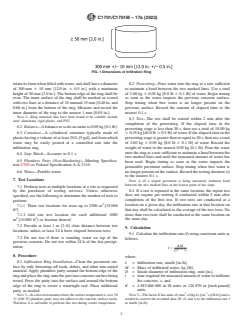
6.1 Infiltration Ring—A cylindrical ring, open at both ends
approved in 2009. Last previous edition approved in 2017 as C1701/C1701M– 17a.
DOI: 10.1520/C1701_C1701M-17AR23.
(See Fig. 1). The ring shall be watertight, sufficiently rigid to
For referenced ASTM standards, visit the ASTM website, www.astm.org, or
contact ASTM Customer Service at service@astm.org. For Annual Book of ASTM
Standards volume information, refer to the standard’s Document Summary page on Available from DLA Document Services, Building 4/D, 700 Robbins Ave.,
the ASTM website. Philadelphia, PA 19111-5094, http://quicksearch.dla.mil.
*A Summary of Changes section appears at the end of this standard
Copyright © ASTM International, 100 Barr Harbor Drive, PO Box C700, West Conshohocken, PA 19428-2959. United States
C1701/C1701M − 17a (2023)
FIG. 1 Dimensions of Infiltration Ring
retain its form when filled with water, and shall have a diameter 8.2 Prewetting—Pour water into the ring at a rate sufficient
of 300 mm 6 10 mm [12.0 in. 6 0.5 in.] with a minimum to maintain a head between the two marked lines. Use a total
height of 50 mm [2.0 in.]. The bottom edge of the ring shall be of 3.60 kg 6 0.05 kg [8.0 lb 6 0.1 lb] of water. Begin timing
even. The inner surface of the ring shall be marked or scored as soon as the water impacts the pervious concrete surface.
with two lines at a distance of 10 mmand 15 mm [0.40 in. and Stop timing when free water is no longer present on the
0.60 in.] from the bottom of the ring. Measure and record the pervious surface. Record the amount of elapsed time to the
inner diameter of the ring to the nearest 1 mm [0.05 in.]. nearest 0.1 s.
NOTE 2—Ring materials that have been found to be suitable include
8.3 Test—The test shall be started within 2 min after the
steel, aluminum, rigid plastic, and PVC.
completion of the prewetting. If the elapsed time in the
6.2 Balance—A balance or scale accurate to 0.05 kg [0.1 lb].
prewetting stage is less than 30 s, then use a total of 18.00 kg
6.3 Container—A cylindrical container typically made of 6 0.25 kg [40.0 lb 6 0.5 lb] of water. If the elapsed time in the
plastic having a
...
Questions, Comments and Discussion
Ask us and Technical Secretary will try to provide an answer. You can facilitate discussion about the standard in here.
Loading comments...